The Philosophy Chair and Rector at Ghent U stood accused by an astonishing 70% of the Philosophy staff of violating the Ghent U Code of Ethics for having appointed Cofnas. They reviewed his public statements in favor, for example, of the disappearance of Black faculty at…
Since becoming rector in October 2025, De Sutter has presided over the transformation of Ghent University's Department of Philosophy and Moral Sciences into a European hub for the race science movement.
Nathan Cofnas – A philosopher who wrote that "the number of Black professors would approach zero". Hired in March 2026. Defended by De Sutter when 45 philosophers called for his resignation, accusing him of promoting "racist pseudoscience".
Bouke de Vries – The professor who hired Cofnas. Formally reprimanded for teaching replacement theory. Accused of legitimizing eugenics.
Craig Willy – De Vries's PhD student. Regular contributor to Aporia magazine—a publication of the Human Diversity Foundation, a far-right organization whose members argue certain ethnic groups are genetically superior.
Arday was fragile, like Swartz and Graeber. Graeber was a fantasist and Arday was little else. He and Swarz were killed by their enablers, but Arday had conned them, and they were desperate to be conned. Petra De Sutter is a man.
Sunday, November 24, 2024
For what it’s worth, nobody I know has ever jerked off on the thigh of one of their interns while on the clock in their office, so that’s one way Clinton is not like us. https://t.co/rSCVLGAV4U
He couldn't think of the obvious, and had to imagine something implausible.
It took me back. The politics of earnest, seemingly sexless, men. Also of course, some women.
It's the self-blind politics that makes support for transwomen obligatory because they call themselves women; but Philosemitism is suspect, and Rachel Dolezel earns mockery.
I find this reduction of sexual orientation to genitalia – what’s more, genitalia from birth – puzzling. Is anyone innately attracted to penises or vaginas?
Like Moyn's pathetic politics. And he's doing it again. Brazil just indicted Bolsonaro, but somehow the US is supposed to be above such things. The model is the faculty lounge.
2020
repeats. The distinction between collaborative reason in the academy, and adversarial reason in the world at large.
2017
The fetish for happiness, for demand for resolution of all conflicts, external and internal, the denial of the possibility of tragedy, the liberal institutionalization of narcissism, while denying the possibility that it could exist. Cafe revolutionaries, liberal Zionists, transsexuals, the popular triumph of wishful thinking. The absolute triumph of course is fascism.
The overlap between critics of liberal transgenderism and defenders of Zionism, and critics of Zionism and defenders of male fantasy. Zionist fantasies have become reality through the state of Israel, and Palestinian reality has become tied to fantasy.
I really feel almost alone
Lewinsky tells her story
“And so we moved to the bathroom and were more intimate. There was some attention paid on me and then I was reciprocating, where up until that point he had always stopped before completion on his part,” Lewinsky said, delicately trying to explain their encounter.
“I sort of stood up and said I wanted to move past that stage and so he finally said OK.
That’s when the dress was soiled, but Lewinsky didn’t notice at the time. “So that finished and then I hugged him after. And he hugged me,” she said. “And off I went.”
The 30 year old man on the right is officially a woman, named Giulia Valentino.
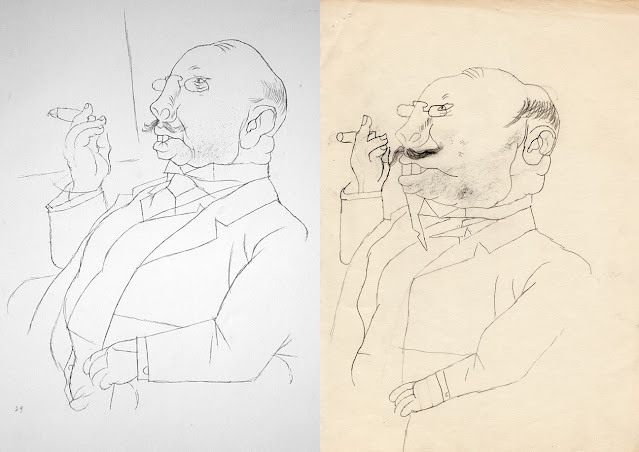
This idiot did more damage to the GOP than the Democrats have recently. America will become a failed state before it's ruled by fascists. The images, repeats: one and two
Wednesday, April 24, 2024
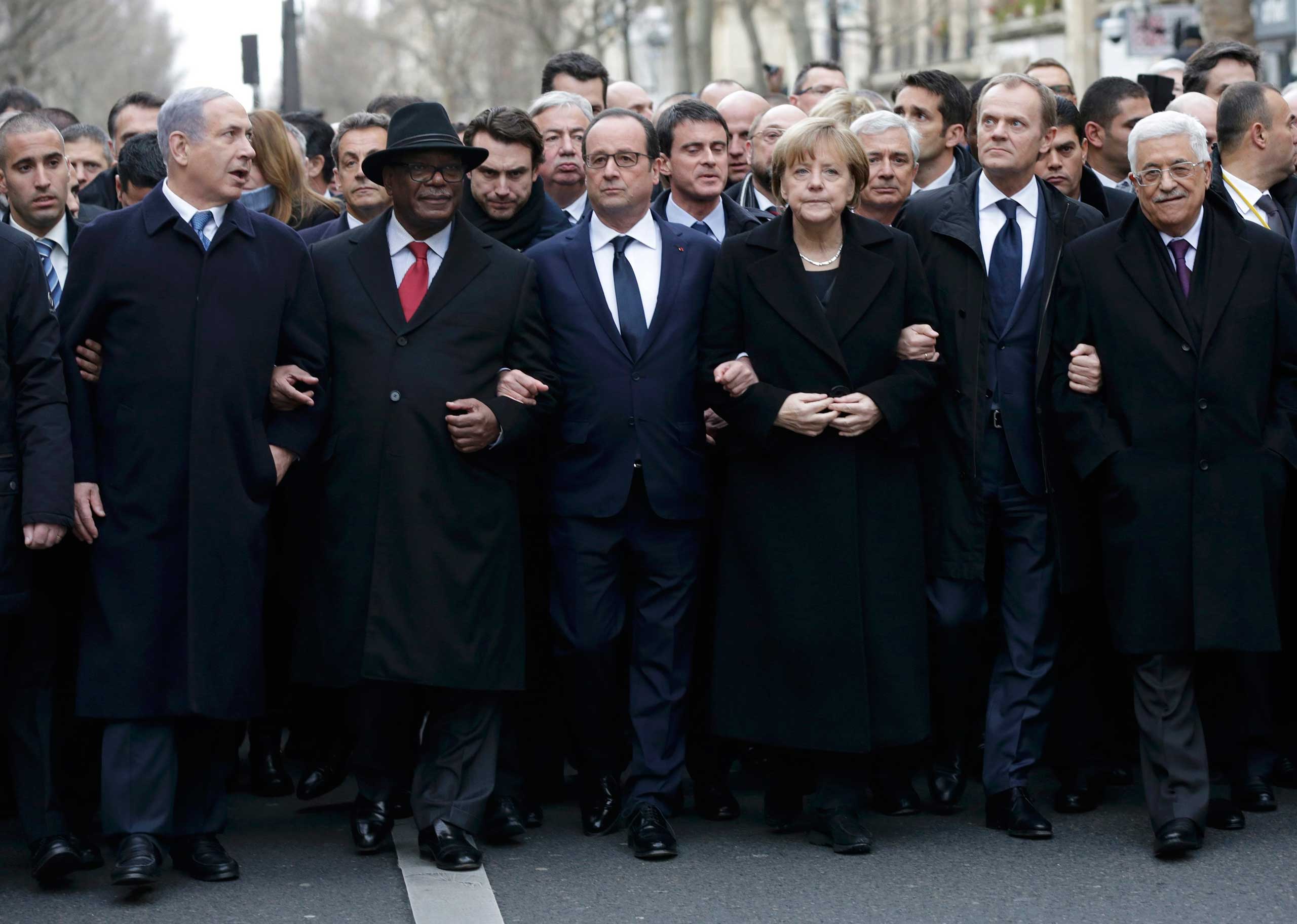
The man talking above is a liar, a hack, abetting a crime. The kid below thinks he's saying what he sincerely believes, riffing with no idea beyond enthusiasm of what his words might actually mean, a spoiled moralizing brat, one of a group that now includes "African Americans".
"The cloying theatricality of American protests" etc.
'It's like pop culture, concentrated teen angst,' she said of the rally. 'The rhetoric is too heavy handed. That's the problem with American activists. They need to simplify.' Someone on the stage railed against police brutality, and she rolled her eyes."
Nicholas Christakis in 2024—
"Universities remain strikingly incurious about where all the anti-semitism (as distinct from opposition to Israeli policy) has come from? How and why have students come to think and act this way? Might the pedagogy of faculty and policies of administrators have anything to do with it?"
—and 2015: "...other people have rights too." Responding to protests about Halloween costumes, but not this one:
2015 NYT, "Walmart Withdraws Hooked ‘Sheik Fagin’ Nose From Halloween Store"
The link (Christakis ) from 2015 includes a link to this.
"To be perfectly clear, student journalists do have the right to take photos and protesters do not have a right to push away journalists. Students engaged in public protest, the very purpose of which is visibility, cannot credibly argue that they have any reasonable expectation of privacy."
During Jummah (Friday prayer) this afternoon, Columbia University students formed a human shield with blankets to provide privacy to those students participating in prayer after a video showing students praying on the lawn began circulating on social media
The Foundation for Individual Rights in Education changed their name in 2022. The Foundation for Individual Rights and Expression hasn't commented on the behavior of the students at Columbia.
The protestors are or have friends who are Palestinian, Arab, or Muslim. Any sense of principle beyond loyalty is minimal. "The fact that Bella Hadid exists is more important than anything Edward Said ever wrote."
"This was the most astonishing thing about teaching freshmen at Cornell this fall: students who had never read anything longer than a reading comprehension excerpt for the SAT."
meeting academics from virtually anywhere in the world these days: “how’s the teaching going?” [series of frustrated sighs] “none of them know how to write an essay anymore”
"Forensic Architecture". I said I was going to write more, but I'm not sure I have the patience.
Weizman: I don’t think it’s controversial to say that freedom of expression needs to be measured in relation to hate speech, and the safety and dignity of survivors.
It's not controversial unless you defend freedom of speech. Giving the state the right to measure speech led to the censorship that he opposes. But of course he follows the German idea of freedom, which is also the academic model for permissible speech.
Kant: A lesser degree of civic freedom, however, creates room to let that free spirit expand to the limits of its capacity.
And this becomes scholastic perversity of Forensic Architecture's "investigative aesthetics", which is the model of journalism as art, and the parallel fantasy that art is "truth".
But the most offensive thing about he piece in Granta is the pathological blindness to things at the core of German- and European-Israel relations. Herzl was right."The anti-Semites will become our most dependable friends, the anti-Semitic countries our allies", once we leave. Weizman and EDB are too close to their German and Zionist roots, too loyal to both, to see the obvious.
Monday, November 13, 2023
Some of the hostages held by Hamas have German citizenship, so when I asked a politician from Germany’s governing coalition what the government’s position was on those people, I was shocked when his response, in private, was: Das sind doch keine reinen Deutschen, which translates to: well, those aren’t pure Germans. He didn’t choose from a host of perfectly acceptable terms to refer to Germans with dual citizenship, he didn’t even use adjectives such as richtige or echte to refer to them not being full or proper Germans – instead, he used the old Nazi term to differentiate between Aryans and non-Aryans.
"Germany is a good place to be Jewish. Unless, like me, you’re a Jew who criticises Israel"
Germany is not a good place to be Jewish. The piece is hard to read.
Whenever I told people I was of German descent, they would argue with me -- then upon discovering that I was Jewish, would say "Oh, so you're not German, you're Jewish" (strangely, I never heard anyone say to someone, upon discovering that they were Christian, "Oh, so you're not German, you're Christian").
Self-hatred runs deep. Feldman, Lipton, Stanley, Lipstadt, Corey Robin; the last two can at least look for evidence in the mirror. With the possible exception of Feldman, every one of them defends the existence of the Jewish state in conquered Palestine.
Feldman's latest book, Judenfetisch, isn't available in English.
Feldman in The Forward in 2015, returning to the scene of the crime.
Friday, August 25, 2023
Working all day makes it easier just to troll than think, but mindless repetition being what it is, sometimes ideas pop into your head.
"Woke" is the knee-jerk response of guilty liberals—if post-war Germans can be defined as liberal—goaded by justified anger of marginalized groups—make your own list—who craft technical fixes to avoid the burden of coming to terms with a given problem. From reconstruction to Brown v Board, the conquests of Liberia and Palestine, to the sterilization of teenagers.
The anti-woke left are all Zionists and aligned with reactionaries: anti-idpol with white identity.[includes Jäger on Charles Maier. see below] It's not even interesting watching Leusder and Jäger anymore; too often one click away from certified race science and fascism. I could write a long list of readers of Razib Khan and Richard Hanania. The last link is to Buppie Bourgeoisie in the NY Times, who does movie reviews with Ganz, the "leftist".
Adam Tooze follows Khan. And Khan follows Emil Kirkegaard; the link is his memorial for Richard Lynn.
Leiter used to be a fan of Lemoine, now a partner in Hanania's absurd little substack "The Center for the Study of Partisanship and Ideology", but that changed at some point.
He still links Freddie deBoer, a man on "the actual left". deBoer interviewed by Razib Khan as a member of the "hereditarian left"
Two repeats, now as a pair.
In the end there's not much thought in any of the above. The thinking was over mostly years ago. It's just plug and play.
Wednesday, July 12, 2023
Mark Graber
Harvard tried to keep out Jews and other unsuitable children of immigrants from Eastern and southern Europe by using intelligence tests. The persons who devised those tests assured the American elite that standardized examinations distinguished the natural intelligence of sturdy Anglo-Saxons from Jews and others whose inflated grades reflected obsessive studying. Alas, Jews and other immigrants figured out how to game the test. An admissions system based entirely on text scores and school grades would increase further the percentage of Jews and immigrant children at Harvard.
Diversity was the better solution to Harvard’s Jewish problem. Maybe Jews and other immigrant children were smart (“cunning“ and "shrewd” were other words found apt by many), but all they did was work and grade-grub. Protestant men were well-rounded leaders. You could go hiking in the woods or party with Protestants on weekends. Universities that were finishing schools for the elite wanted students who could appreciate the full richness of American society. The Protestant elite was convinced that all Jews did was study. How some managed to have children was a mystery to them. Evaluating the full person guaranteed classes made up predominantly of Protestants who would be political, economic, and social leaders and minimized the number of Jews who would do little more than become doctors, lawyers, engineers, and teachers....
When the Supreme Court of the United States first ruled on the constitutionality of race-conscious university admissions policies, four justices took the historical disadvantage route rather than Harvard’s road to diversity. The issue in Regents of the University of California v. Bakke (1978) was whether the medical school at the University of California, Davis could set aside sixteen seats for students of color. Justices William Brennan, Byron White, Thurgood Marshall, and Harry Blackmun found this policy constitutionally unproblematic. Brennan’s opinion observed that “whites as a class” were “not saddled with such disabilities or subjected to such a history of purposeful unequal treatment or relegated to such a position of political powerlessness as to command extraordinary protection from the majoritarian political process.” Relying on what in the United States is called “intermediate scrutiny,” a form of judicial review that resembles what the rest of the world describes as “proportionality,” Brennan asserted that the medical school “could conclude that the serious and persistent underrepresentation of minorities in medicine . . . is the result of handicaps under which minority applicants labor as a consequence of a background of deliberate, purposeful discrimination against minorities in education and in society generally, as well as in the medical profession.” White, Marshall, and Blackmun played variations on these themes in their opinions. None cared much for diversity.
Justice Lewis Powell, who provided the crucial fifth vote on a court of nine justices, proved a better Harvard man. His opinion rejected both of Brennan’s central arguments. Powell insisted that the Court apply the highest level of scrutiny, strict scrutiny, to all race classifications. In his view, because “the white majority is composed of various minority groups most of which can lay claim to a history of prior discrimination, . . . no principled basis” existed “for deciding which groups would merit heightened judicial scrutiny.”
Diversity came to the rescue. Powell concluded that “a diverse student body” was a compelling interest given that “the nation’s future depends upon leaders trained through wide exposure to the ideas and mores of students as diverse as this Nation of many peoples.”
Good one
Justice Clarence Thomas noted that the University of Michigan Law School would enroll more students of color by being less selective and that the institution’s interest in being ranked in the top ten could not possibly be a compelling interest.
Every administrator dreams of working at a top tier school, for the same reason professors lord it over secondary school teachers, and the highest ranking are happy when they don't have to teach at all.
Leiter's arguments against "diversity blather" are founded in vulgar positivism: there's no reason for women to have a role in writing abortion policy.
repeat: There's noepistemological need to have blacks, or women, or homosexuals, or Palestinians, tell their own stories, or judge others' stories.
Tuesday, July 11, 2023
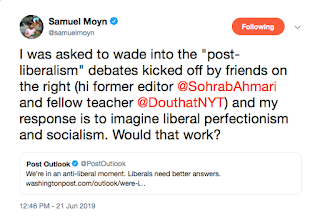
I posted Moyn's piece without starting with the obvious. It's so late in the game for him to be doing this. It's kind of amazing. He has a long history playing cute with reactionaries, but he has no time even for Beinart. It really marks the boundaries of liberal academia, as a thing in the world.
More amusing discoveries. Daniel Steinmetz-Jenkins in Dissent, in 2021, comparing Beinart from 2006 to Moyn in the present. Beinart's changed, but not in any way any of them can accept. Dissent, provincial American "progressivism". Steinmetz-Jenkins previously. ---
Moyn, "perhaps Arendt... wasn’t Zionist enough"
For this reason, the great use of reading Arendt alongside Cold War liberals in the age of decolonization is to consider the geographical morality they shared. They offered Cold War libertarianism for the transatlantic “West,” an emancipatory statism (with violence if necessary) in their Zionist politics, and a caustic skepticism about the fate of freedom in either form elsewhere, based on an implicitly hierarchical set of assumptions about the world’s peoples. If this is right, their establishment of that special category for Jews in the Middle East is compelling and remarkable, for its very existence—as the sole place in their thought where earlier forms of liberalism with their activism and statism were allowed to survive— represents a fundamental challenge to their call for limits in developed countries and anxieties about meaningless violence in developing ones. To the extent that Zionism allowed a last remnant of the earlier philosophy of liberal emancipation they all liquidated, perhaps Arendt, like the Cold War liberals, wasn’t Zionist enough.
YK: We cleared one village after another and expelled – expelled them, they fled to the Sea of Galilee and from there to the Galilee.
E: But how? How?
YK: You mean by shooting?
E: How do you mean?
YK: We shot, we threw a grenade here and there. Just listen – there's one thing you have to understand: at first, once they heard shots they took off with the intention of returning later.
E: But, wait a sec, that was before May 15, that was before the Arab armies came.
Operation Broom, Operation Broom then. How does it happen? Do you receive any information? Is it an organized campaign?
YK: Yeah, sure.
E: Tell me.
YK: It was. Who was it? Yigal Allon himself planned it. We moved from one place to the next.
E: What places? Can you tell me?
YK: We passed, we passed by Tiberias and moved from one village to the other, from one to the next.
E: So you had orders to expel and clean up the villages?
YK: And then go home.
E: But you did see how they ran away?
YK: We saw them, what do you think? I fired at them with that – with the Browning – on the boats.
E: They fled on boats?
YK: Yes.
E: On the Sea of Galilee?
YK: Yes. On the other side they had more [villages], except [Kibbutz] Ein Gev [which was the only Jewish settlement on the east bank].
E: And who were the people who fled?
YK: Village people, they were fishermen, among other things. Then it was Lod.
E: Wait a minute. We'll get to that.
YK: Ramle. We entered the houses only in one place, in Balad al-Sheikh, near Yagur. There it was really, murderous and all that. And he said, you go there with axes.
E: Who did?
YK: Only one man could – Yigal Allon. And I assume there was no misunderstanding between him and Ben Gurion, no. "So go there with axes, let them get lost, leave no trace. As much as you can, don't use any bullets, so that they won't hear it at the [British] police [station in Yagur] and, so that they won't send them reinforcements.
E: So what did you do?
YK: We smashed the door and throw a grenade…
E: In Balad al-Sheikh?
YK: And indeed it never rose again, it's gone.
Arendt, "Zionism Reconsidered"
Not less dangerous and quite in accord with this general trend was the sole new piece of historical philosophy which the Zionists contributed out of their own new experiences; "A nation is a group of people ... held together by a common enemy" (Herzl)-an absurd doctrine containing only this bit of truth: that many Zionists had, indeed, been convinced they were Jews by the enemies of the Jewish people. Thereupon these Zionists concluded that without antisemitism the Jewish people would not have survived in the countries of the Diaspora; and hence they were opposed to any attempt to liquidate antisemitism on a large scale. On the contrary, they declared that our foes, the antisemites, "will be our most reliable friends, the antisemitic countries our allies" (Herzl). The result could only be, of course, an utter confusion in which nobody could distinguish between friend and foe, in which the foe became the friend and the friend the hidden, and therefore all the more dangerous, enemy.
"We were the first fascists" Marcus Garvey.
We are living in a time of exploding nationalisms. The blacks in America are the first to abjure the idea of assimilation, to realize the inherent lie in the concept of melting pot. Through black nationalism has developed a new black pride and hence the ticket to liberation
Today’s young American Jew is a good bit slower. He desperately wants assimilation: Jewishness embarrasses him. He finds the idea of Jewish nationalism, Israel not withstanding, laughable. The leftist Jewish student is today’s Uncle Tom. He scrapes along, demonstrating for a John Hatchett, ashamed of his identity, and obsessed with it. He cannot accept the fact that he is seen as a Jew, that his destiny is that of the Jews, and that his only effectiveness is as a Jew. But he wants to be an “American,” a leftist American, talking liberation and aspiring WASP. He is a ludicrous figure.
Monday, July 10, 2023
Caitlín Doherty, "poetry editor" at a journal so over-the-top that its editors used mocking criticism for its blurbs—
Swimming in the blood of her own body, in labor and in pain, the woman is a half-human who achieves her half-human fate in pregnancy and childbearing. The canal through which the infant is extruded is the man’s place of sex; he enters, not wanting blood to drown him or contaminate him or pollute him; the blood makes her dirty and threatens his pristine penis; this makes her an abomination.
Susie Bright was right, she's a great pornographer. She's wrong to call her a lousy writer; that's a good paragraph. But how do you deal with so much self-loathing; anger directed first at herself and then out at the world? Dworkin did it by making her hate into a kind of art that laws she promoted would ban, or should if they're followed. Far from the first artist to make an art from self-destruction.
Doherty is no better than the women she's responding to, all of them focused on style to avoid what they can't face, following Dworkin's model rather than trying to understand it. But Doherty can't accept that it's the style that makes it personal; and even the impersonal is a style if it's filled with details. It's those details that make it the communication between one single, specific, individual, person and another or others, and that's what the other writers are responding too. It's the details that make it the writing of "Andrea Dworkin". But Doherty—the poetry editor!—has no interest in the specifics of another life; she can't even read "Fascinating Fascism" for what it is.
Doherty has to pretend. Programs and positivism: so earnest.
It cannot be overstated how deeply boring all this is. How unthrilling, how inessential, to how few urgent questions this seems to contain the seeds of any possible answers. As Dworkin said of porn (after her friend said it of heroin): ‘The worst thing about it all is the endless repetition.’ We’ve been here before, of course, in the past few years’ debate over Afropessimism. Similar risks adhere to a negative feminism: if the aim is to move from a biological conception of gender, as of race, to one that is socially constructed but no less real for it in its consequences, might it not behoove us to arrive at a category definition that does not condemn all those who fall within it to limitless amounts of pain? Feminism has no absolute right to existence. It must describe something about the world accurately for it to make sense as a political-philosophical position. And that description must contain within it verifiable truths about the current situation of women, or else it will be – only – a style.
"Afropessimism", academia like big pharma, evergreening the blues, "double-consciousness", "down by law", the history of black experience, and the experience of the working class, of any race, for the age of buppies; like Zionism and "little Israel".
And then this: "...if the aim is to move from a biological conception of gender" Brilliant.
"And that description must contain within it verifiable truths about the current situation of women, or else it will be – only – a style."
All of this describes the current situation of women. But it's up to the next generation to read the details and understand the inner lives of the dead.
I've said it before: I was was shocked when I learned, late, that Brecht never recognized his own decadence. It was always the doubleness, contradiction, the violence that made the hairs on my arms stand up, that gave me shivers. I always saw everything for context. Everything's always been double. Or if it wasn't needed to be. If it wasn't double it bored me. But the obliviousness of people now, those who should know better if only because they've read the history, and even teach it! amazes me.
"and the experience of the working class, of any race". Cracker pessimism
I could run down my list of lowlights; it's long. One will do.
Ted Barlow "(of glorious memory)" [HF]
The Islamic world has ample reasons for legitimate criticism. Anti-Semitism, sexism, lack of democracy, lack of opportunity, nurturing of terrorism… these are sad realities, not the hallucinations of right-wingers. Anger and criticism are appropriate, but our approach has to start with the assumption that Muslims are not going away. Short of deliberate genocide, there’s no way forward in the long run except for “hearts and minds.”
They've changed over the years, but since they don't want to remember ever being wrong about anything, it doesn't register.
in NLR, "Decapitalizing Culture", (filed under society)
There are countless debates among sociologists and economists concerning the terms ‘human capital’ and ‘cultural capital’. The general view is that the former implies a rational instrumental attitude to the attainment of skills, whereas the latter suggests an investment in what Bourdieusians call illusio: the denial that the game of culture is in fact a game. Iván Szelényi once characterized the distinction slightly differently, writing that human capital denoted skills that are rewarded because of their contribution to productivity, while cultural capital was fundamentally a claim to rent. It seems to me, however, that we ought to be raising a different set of questions. In particular, it is important to ask: under what historical conditions does culture take the form of an ‘asset’ or ‘quasi-asset’?
John-Baptiste Oduor, editor at Hamasmag, in NLR, "Role Play", (filed under culture)
repeat. It's absurd how much is lost when the goal of disinterest devolves into a fiction of objectivity.
Stanley Hoffman reviews Distinction
But if “using rare words and tropes in place of common words and phrases” is a strategy of “deliberate transgression” of the norms of clear prose characteristic of the dominant classes and is opposed to “the hyper-correction strategies of pretentious outsiders,” then Bourdieu is a master strategist. Words such as lexis, allodoxia, chiastic, askesis, espace hodologique, hysteresis, and of course habitus (and, indeed, hysteresis of habitus) are scattered throughout the text. That a work of social science should—”unlike the sometimes illuminating intuitions of the essay”—require an effort on the part of the reader is fair enough. Here, however, reality disappears into the hypertrophied rhetoric of the Ecole Normale.
Simply as a critic, never mind the pretension to politics, Oduor doesn't know enough. A first person essay about why he likes the work, what it means to him as a writer, would be the only honest choice, but he'd never make it.
"There's no point in having sharp images if you've got fuzzy ideas. Leacock's lack of subjectivity leads him ultimately to a lack of objectivity. He doesn't even know he's a metteur-en-scene, that pure reportage doesn't exist."
“Documentaries are thought to have the same relation to social change as penicillin to syphilis.”
Jeff Wall: [Referring to Delacroix] Violence is only a theme in this kind of art; the art itself isn’t violent. That makes it very different from, even opposed to, the art of the avant-garde, which expresses aggression against the idea of art itself. This aggression is no longer viable. I don’t think its necessary or possible to go beyond the idea of bourgeois art -that is of autonomous art- towards a fusion of art and its context. Or if its possible it isn’t very desirable. We have learned how the aggression against autonomous art was consistent with aspects of totalitarianism, from the Stalinist period for example, and how state violence could benefit from that kind of aesthetic. The concept of art as autonomous, and therefore less amenable to that kind of instrumentalization, is a central concern of the modern, and I’m most sympathetic to that.
A-MB/RM: Modernity and avant-garde, to you, are two separate things?
JW: We can’t confuse them anymore.
"A Democratic, a Bourgeois Tradition of Art: a Conversation with Jeff Wall"
Jeff Wall: Selected Essays and Interviews
Chevrier, cited by Odour, is in the same volume. I have a lot of respect for Wall, and I've watched him work a room. See previously on Hammons. Fine art is conservative, or it's reactionary. And Fried is a fucking idiot. Always a moralist, I should have guessed that when when he adapted to change he'd become a fan of Greuze.
Thursday, June 29, 2023
as expected, the court has inverted the 14th. an amendment written explicitly to directly ameliorate the conditions of race hierarchy becomes in conservative hands an amendment that says it’s illegal to try to directly ameliorate the conditions of race hierarchy https://t.co/CeklyHtyBr
In disavowing race as a factor in achieving educational diversity, the court all but ensured that the student population at the campuses of elite institutions will become whiter and more Asian and less Black and Latino.
[I]n 1867 Congress passed a law providing relief for “freedmen or destitute colored people in the District of Columbia,” to be distributed under the auspices of the Freedmen’s Bureau. Of particular importance in the late 1860s was the Bureau’s operation of schools for blacks, to the point that black children in the South were often better educated than their white counterparts.
The great critical race scholar Derrick Bell, for example, argued that African Americans can advance on issues of race only when whites also benefit. One way to secure this “interest convergence,” he observed, is to ally with lower-class whites "who, except for the disadvantages imposed on blacks because of color, are in the same economic and political boat."
NYT today:
College admissions experts anticipate there will be increased pressure on elite schools to end preferential treatment for children of alumni, who are more frequently white and affluent, as a result of the Supreme Court’s decision.
And in his concurring opinion, Justice Neil M. Gorsuch criticized Harvard for resisting proposals to eliminate legacy admissions, saying the university’s “preferences for the children of donors alumni, and faculty are no help to applicants who cannot boast of their parents’ good fortune or trip to the alumni tent all their lives,” he wrote.
Saturday, June 10, 2023
Modernism and its delusions
Somewhere, sometime, the 1950s:
Commonsense notions of development associate it with capitalist socialist modernization. Such notions assume that cumulative economic growth enables poor countries to become more like rich ones.
To facilitate such growth, policymakers, international institutions, and many academics urge poor countries and their populations to adopt modern ways of thought and action, dispensing with familial or communal loyalties and embracing the benefits of capitalist socialism markets and impersonal bureaucracies.
Those who adopt this perspective insist that such modernization will be beneficial for developing societies in the long run, even though there will always be those who lose out and seek to resist the process. However, since the benefits of economic growth and cultural change outweigh the losses, it is legitimate to forcefully suppress such opposition.
Milanovic, on HBO
What “Succession” serves us is the end of the illusion of ethical capitalism. The issues are the same as they appeared in the beginnings of the commercial society, and were discussed by Bernard Mandeville and Adam Smith. The question was the following: can the unchecked use of what are conventionally considered vices, namely passions for power and wealth, be reconciled with the existence of an ethical society? Can a society that places the acquisition of wealth on the pedestal, considers it the most desirable social attribute, and regards the rich as worthy of emulation, be ethical?
The obvious reply.
The illusion of ethical power is with us more than ever. "Democratic control of the economy" means only that the powerful have a mandate to serve the interests of the majority as they see fit.
There's nothing democratic about that.
Leusder rt's Daniela Gabor
historians of ideas will look back at the 2020-22 COVID period as a rather incredible blip in the hegemony of austerity/monetary dominance.
Defending of the primacy of ideas, or mocking it? Jäger, or Indiana?
Leusder
Academia strikes me as a strange baroque bal masqué: there's a strong incentive for preference falsification, ingratiation and sycophancy, and yet, at the same time, for singling certain people out for public vitriol in order to make a reputation and compete for jobs and grants.
He rt's Harry Crane, a professor of statistics
I used to think peer review served an important purpose.
I was wrong.
Peer review serves no meaningful purpose, and could be abolished without anyone (except academic's whose livelihoods depend on it) noticing.
The best reply, as always, is Hüppauf
The university belongs, like the church and the military, to the social institutions that are situated at a considerable distance from democracy and adhere to premodern power structures.
Kate Mackenzie
.@MonaAli_NY_US: Centre of gravity of world manufacturing (80%) is in developing countries, yet world finance is concentrated in the transatlantic. "That's the geopolitical tension... one that can be defused or de-escalated."
NLR, "The AMLO Project"
Just a few months into his presidency, AMLO declared the death of Mexican neoliberalism. It was a bold statement, more of an aspiration than a fait accompli. The first signs of its realization were rhetorical. Previously, political discourse focused on the division between a vaguely defined ‘civil society’ and the state. Public officials increasingly conceded the necessity of increasing ‘citizen control’ over ‘governance’. Class antagonism had all but disappeared from mainstream commentary. Yet under AMLO it reemerged in Laclauian guise: as a confrontation between ‘the people’ and ‘the elite’ (fifis and machuchones as he mockingly calls them), the latter defined by their wealth, meritocratic self-delusion and disdain for working-class culture.
This verbal shift was matched by a stark process of party realignment. In the 2018 election, working-class votes were scattered across different parties, including the neoliberal bloc, while AMLO had an edge with middle-class professionals. At that time, 48% of voters with a college degree supported MORENA’s congressional candidates. In the 2021 mid-terms, by contrast, that figure fell to 33%. The inverse occurred at the bottom end of the educational attainment bracket: 42% of people with only elementary school education voted for MORENA in 2018, while 55% did so in 2021. Recent polling shows that those most supportive of AMLO are ordinary workers, the informal sector and peasants, while his most vociferous opponents are businesspeople and college-educated professionals. The ‘Brahmin Left’ phenomenon, which increasingly characterizes voting patterns in Europe and the US, has evidently been reversed in Mexico.
The owner of the lunch counter where I spend too much time, whose wife, son, and youngest daughter just came back from a trip through Spain, Italy, Greece, and Egypt, says AMLO is popular because he gives money to the poor. But the poor aren't greedy and don't ask for a lot. It's everyone else who never has enough, especially the rich. He works seven days a week and he's a cheapskate, though less than he used to be. His son has to pull posts of his travels from Facebook because people in his village get jealous. He works behind the counter and pays his own way on his trips; he went with friends to Russia for the World Cup with stops in Germany and the Netherlands. His father has more property than he used to and some cattle. He's buying a horse. A few years ago he and his wife stopped going home because the cartels had moved in and they worried about being kidnapped. But the cartel now is sticking to business and leaving people alone. He knows AMLO is limited in what he can do. He likes AMLO for doing what he can. He's petty bourgeois through and through, a striver; he complains about crime and parking, but he's still connected to the community that made him. He's still tied to the world of work being a world of jobs as opposed to careers, the world of people and not ideas.
Milanovic is kind of dim, but he's a cosmopolitan in his way, not trapped in the Anglosphere, or even the Eurosphere. His imagination was formed in the culture of the non-aligned movement.
And now I'm going to watch Tár, to see if my assumptions were off in any way at all.
There is no "path" from the aesthetic experience to politics; they're inseparable. Your preferences are shown in the record of your actions, not what you claim for them.
---
I'm a few minutes beyond the credits and it's absolute kitsch. She's blurbed as being an EGOT winner, along with Mel Brooks, Audrey Hepburn, Marvin Hamlisch, Whoopi Goldberg, and Andrew Lloyd Motherfucking Webber. It's not a film about art; it's a film about Aaahhrt. And it's just going to get worse. Brooks at least would get the joke. Jäger and everyone else, from the New Yorker and the NLR is fucking blind.
But no. I was wrong. He's following Ruben Östlund, Force Majeure, The Square, and Triangle of Sadness. It's still shallow and reactionary—lazy, obvious, at least to... what, the old? the actually sophisticated? And Brody, Jägeret al. are still fucking blind.
Jäger
This is perhaps why the moralistic commentary on Tár runs into an explanatory impasse; for it is not Lydia’s personal culpability but these impersonal forces that are the real subject of the film.
The most obvious among them is the stratified sphere of classical music – in which the lower ranks can only improve their career prospects by cultivating informal relationships with those higher up the ladder.
He makes it so easy. From Lydia Tár to Avital Ronell, because in fact it's the other way around.
"The university belongs, like the church and the military, to the social institutions that are situated at a considerable distance from democracy and adhere to premodern power structures."
Mocking Gopnik's script, and Lydia’s personal culpability, from the start.
He runs down the list of EGOT winners, cross-cut with shots of Blanchett at work, ending on "...Andrew Lloyd Webber, and of course... Mel Brooks." The audience laughs and Blanchett looks up from the page, as if hearing the laughter. It's not just the cheapness. That one leaves a bad taste.
This is the core issue: the film was made as parody, and being received as serious it's become kitsch. Or maybe Field can't make up his mind what kind of cheap moralist he wants to be. Either way I don't care.
Jäger: "Throughout, Field meticulously evokes the authentic world of the Bildungsbürgertum".
This could all hinge on my snobbery against others'; never mind the Spaceballs vid. But I've never forgotten the description of Adolph Green's last night, written by his son, and this:
We argued the relative merits of classical composers (any suggestion that Tchaikovsky had a maudlin streak or that von Suppé might not have been the last word in profundity infuriated him).
I don't like Tchaikovsky, but through Strayhorn, there'd be no Ellington without him. My father hated Kerouac but loved Pynchon. He was right about both, but couldn't accept the relation. That more than anything is the beginning of my argument with modernism as ideology as opposed to modernity as fact. Mel Brooks will outlast Andrew Lloyd Webber. Adolph Green knew he loved crap and minor art, and he didn't care. He worked with the maudlin and the sentimental and made something out of it. That's more than Field is capable of, or Östlund for that matter. And Sir Steve McQueen is a good filmmaker, but his politics is not the politics some think it is.
---
My father hated musicals but he could quote lines from A Funny Thing Happened on the Way to the Forum. My parents loved Zero Mostel andJack Gilford. Gilford was an old friend of David Graeber's parents. My mother's last words were lyrics from Oklahoma.
Tuesday, April 11, 2023
A moratorium on immigration of native-born college graduates from outside a hundred mile radius of the city; visas for visits of up to two weeks. Open borders for high school graduates and dropouts, and anyone from any other country, huddled masses yearning to breathe free, etc. English not required.
City government will expropriate the real estate of Columbia and NYU, and their endowments, and give the schools to CUNY.
From Leiter of course, and I'll repeat the obvious, updating again:
Golda Mabovitz changed her name in 1956.
Joseph Raz was Joseph Zaltsman. David Ben-Gurion was David Grün; Ariel Sharon was the son of Shmuel Scheinerman; Amiri Baraka was LeRoi Jones; Uri Avnery was Helmut Ostermann; Louis Farrakhan was Louis Eugene Wolcott; Malcolm X was Malcolm Little; Netanyahu was Mileikowsky; Muhammad Ali was Cassius Clay; Martin David (Meir) Kahane passed, as "Michael King"; Mark Regev was Mark Freiberg.
The finance minister of the Black Panther party was a Jew. And in NY so were the bomb makers (Bronx Science). Stories told to me by two women, both Jewish, who've never met, but knew the people involved: the finance minister, and the bomb makers.
The Panthers asked my father to stash guns in our basement. He said no. But telling the story, his reasons changed depending on his mood. Yes, it was silly.
Wednesday, April 05, 2023
Nationalism is a means. Anyone serious understands its limits.
Edited by Stefan Vogt, Derek Penslar, and Arieh Saposnik
The first work to systematically investigate the potential for a dialogue between postcolonial studies and the history of Zionism.
There is an “unacknowledged kinship” between studies of Zionism and post-colonial studies, a kinship that deserves to be both discovered and acknowledged. Unacknowledged Kinships strives to facilitate a conversation between the historiography of Zionism and postcolonial studies by identifying and exploring possible linkages and affiliations between their subjects as well as the limits of such connections. The contributors to this volume discuss central theoretical concepts developed within the field of postcolonial studies, and they use these concepts to analyze crucial aspects of the history of Zionism while contextualizing Zionist thought, politics, and culture within colonial and postcolonial histories. This book also argues that postcolonial studies could gain from looking at the history of Zionism as an example of not only colonial domination but also the seemingly contradictory processes of national liberation and self-empowerment.
Unacknowledged Kinships is the first work to systematically investigate the potential for a dialogue between postcolonial studies and Zionist historiography. It is also unique in suggesting that postcolonial concepts can be applied to the history of European Zionism just as comprehensively as to the history of Zionism in Palestine and Israel or Arab countries. Most importantly, the book is an overture for a dialogue between postcolonial studies and the historiography of Zionism.
What should I do, quote Herzl's mash note to Rhodes, or cite Rabin and South Africa?
David Ben-Gurion was David Grün; Ariel Sharon was the son of Shmuel Scheinerman; Amiri Baraka was LeRoi Jones;...
Yair Mileikowsky is whiter than anyone in my father's family.
Tuesday, March 07, 2023
Lisa Jennings Young, Twitter's former head of content design, was one of the people who specialised in introducing features designed to protect users from hate. Twitter was a hotbed for trolling long before Mr Musk took over, but she says her team had made good headway at limiting this. Internal Twitter research, seen by the BBC, appears to back this up.
"It was not at all perfect. But we were trying, and we were making things better all the time," she says. It is the first time she's publicly spoken of her experience since she left after Mr Musk's takeover.
Ms Jennings Young's team worked on several new features including safety mode, which can automatically block abusive accounts. They also designed labels applied to misleading tweets, and something called the "harmful reply nudge". The "nudge" alerts users before they send a tweet in which AI technology has detected trigger words or harmful language.
Twitter's own research, seen by the BBC, appears to show the "nudge" and other safety tools being effective.
"Content design"
"...because tech platforms are perhaps the most important speech regulators in the world."
Two simple and obvious points:
Social media companies make their money by creating mobs; liberals want to censor the mob and leave the instigator untouched.
In France, and Twitter, you can mock Muslims and and Turks but not Jews or trannies.
A prominent advocate for women’s rights in France is being taken to criminal court over accusations of “misgendering” two transgender public figures. Dora Moutot, a best-selling author and social media influencer, is facing a legal complaint alleging insults on the basis of gender identity, and public incitement to hatred or violence towards a group of people on the basis of their gender identity.
Wednesday, March 01, 2023
Leiter links to Beinart, "...this hard-hitting opinion piece in the NYT"
On the surface, the battle between Mr. Netanyahu and his critics does indeed look familiar. In recent years, from Brazil to Hungary to India to the United States, anti-government protesters have accused authoritarian-minded populists of threatening liberal democracy. But look closer at Israel’s political drama and you notice something striking: The people most threatened by Mr. Netanyahu’s authoritarianism aren’t part of the movement against it.
The demonstrations include very few Palestinians. In fact, Palestinian politicians have criticized them for having, in the words of former Knesset member Sami Abu Shehadeh, “nothing to do with the main problem in the region — justice and equality for all the people living here.”
The reason is that the movement against Mr. Netanyahu is not like the pro-democracy opposition movements in Turkey, India or Brazil — or the movement against Trumpism in the United States. It’s not a movement for equal rights. It’s a movement to preserve the political system that existed before Mr. Netanyahu’s right-wing coalition took power, which was not, for Palestinians, a genuine liberal democracy in the first place. It’s a movement to save liberal democracy for Jews.
This is mostly true, but also a non-sequitur: even in an apartheid state, the loss of judicial independence can make the place worse, and especially when the courts are the only branch of government which sometimes defend the rights of the victims of apartheid-like policies. All Israeli Jews and Arabs will be worse off if judicial independence is destroyed; the situation of the Palestinians in the occupied territories will be mostly unchanged (although I can't see how they would not eventually be worse off if the judiciary is fully subordinated to the right-wing coalition).
"This is mostly true, but also a non-sequitur..." There's not much to say.
Serendipity, via Jäger.
"Convergence on inflation and divergence on price control among post Keynesian pioneers: insights from Galbraith and Lerner"
Epistemologically their relationship to the market mechanism was fundamentally different, in particular because of an institutionalist anchoring for Galbraith and a neoclassical one for Lerner. This divergence was reinforced by Galbraith’s practical expertise—not only within the OPA but also the United States Strategic Bombing Survey and then the State Department—as well as his field know ledge—notably through his activity at Fortune magazine, whereas Lerner’s activities remained largely confined to academia. Normatively Lerner had an almost dogmatic fascination for the market price mechanism, in the name of the principle of consumer sovereignty which lay at the core of neoclassical welfare economics.