Showing posts with label Iran. Show all posts

Friday, June 20, 2025

Today, one of the most tragic pieces of art is a novel called Uncle Tom’s Cabin by Harriet Beecher Stow. The novel narrates the story of slavery in the United States; this work is still alive, after two hundred years, since first written.
The Americans introduce certain principles as “American principles” and claim that these apply to the entire world. The principles they introduce are human freedom, freedom of thought, human rights and the like. Are these “American” principles? Are these the qualities of the American society today? Was it not your government that massacred the natives of America and destroyed the Indians? Was it not the same government and its influential agents who enslaved millions of Africans - abducting young girls and boys from their homes- treating them atrociously for years?

Today, one of the most tragic pieces of art is a novel called Uncle Tom’s Cabin by Harriet Beecher Stow. The novel narrates the story of slavery in the United States; this work is still alive, after two hundred years, since first written. These are the realities of the United States; this is the government of the United States; this is what distinguishes and characterizes the American establishment and showcases it to the world; not freedom, nor equality of humans! What equality? You do not consider white and black equal yet. To this day, a person having Native blood is considered “inferior “when it comes to recruiting individuals for various occupations. And you talk about equality of human beings and freedom of thought?

Statements at a meeting with government officials; March 18, 2002

His favorite novelist is Victor Hugo.

etc...

It is interesting to realize that America overthrew his government even though Mosaddeq had shown no animosity toward them. 

---

“The Bicentennial Man,” by Isaac Asimov (1920--1992) has recently been published in Farsi. I came across it. In this book, a robot suddenly develops intellect, conscience and comprehension capability!  

He'll be remembered as a tragic figure, or more. Few Israelis now alive will.

Tuesday, January 07, 2025

I’ve spent the past few weeks in Iran. 

It’s been some time since I’ve been back home, with my previous visits being in the summer of 2023 and winter of 2022/2023. 

The ten points below are a summary of my observations about the current state of affairs.

I do not pretend to represent every Iranian – other people may have radically different experiences. 

Nonetheless, these points provide a useful frame of reference that go beyond superficial news headlines.
 
# 1 – Social Tensions

In previous years, particularly after the Zan, Zendegi, Azadi movement, there was a trend of sharply rising social tension between groups of people, particularly the “religious” and “secular” (the names here are oversimplifications and there’s more than two groups, but this is enough to convey my point).

One group saw the other as direct representatives of the government, or at least, privileged and unfairly benefiting from government, regardless of whether they were connected with them or not. On the other hand, many of the religious, even those against the government, feared reprisals against them in the future.

I was surprised to see these tensions had cooled quite a bit (this was the opposite of what I witnessed in the diaspora). In fact, I didn’t believe this was the case until I had talked with a great deal of people from different sides and spent some time myself observing different situations.

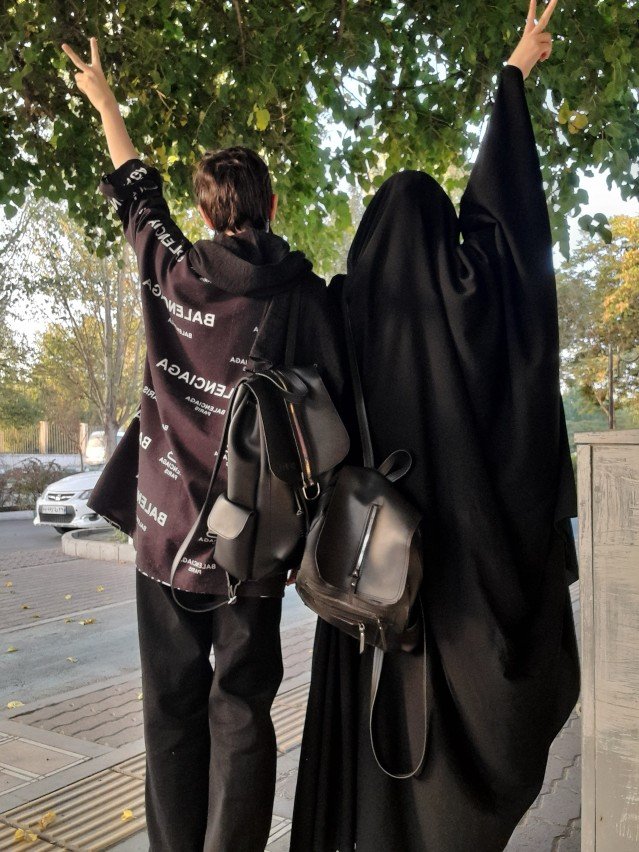
It is far less unusual today to see two friends walking together – one wearing a chador and one without a hejab entirely, than it was in previous years. This extends to social circles, public spaces (things like gym classes), and beyond. These different groups, with different lifestyle choices, are more tolerant of each other and mingle far more, even beyond family groups.

I don’t want to pretend this didn’t happen in the past or that there aren’t still very real tensions. We’re talking about large scale trends, not individual people. But there is a real, noticeable shift compared to the past – particularly among the young.

I find this to be a source of hope. No matter what happens politically, it’s not healthy for different groups among the people to want to increasingly tear each other into pieces.  Though the real test will be if this will persist if some new spark lights the country into a crisis again.

# 2 – Hejab

As has been the case for the past two years, in almost any street in the country, ~30% of woman, old or young, go outside with their hair bare and without any kind of head covering.

There are some variations seen – the rate of no hejab is highest in Tehran and large cities, higher in the north of the country than the south, and fluctuates based on neighborhoods. In trendy cafes or shopping centers it is sometimes closer to 90%.

This was not always the case. Despite all the changes in dress trends over the past few decades, when Vida Movahed intentionally didn’t wear any scarf in an act of civil disobedience 7 years ago, it was unusual and stood out. Today you can see someone dressed exactly like her basically anywhere in Tehran and wouldn’t blink an eye.

Zooming out even more shows how much change there has been. When I was young, it was considered edgy for woman to wear hejab in a way that would reveal the front of their hair when looking at them directly from the front but would not be visible when looking from the side. Today, it’s not usual to see people wearing crop tops with a cardigan or loose jacket revealing their midriff when looking from the front.

The government has retreated on the issue, particularly under Pezeshkian. Women who break hejab laws still face serious potential consequences – consequences that are sometimes enforced & there are still sometimes Hejab Enforcers in public spaces. But it’s not the same as the draconian “Tarhe Noor” & more often than not people completely ignore the enforcers without consequence.

While the government is unlikely to formally revoke hejab laws anytime soon, it is also unlikely the situation on the streets reverses to what it was like just three or four years ago.

None of this is to say this represents all women. There are plenty of women, including young ones, who still wear all sorts of different head coverings, including chadors. I do not mean to imply that the amount of skin women show (or don’t) is a sign of progress. 

Furthermore, focusing just on hejab risks losing track of the vast amount of other societal changes happening beneath the surface.

# 3 – Societal Change

Without a doubt the most important story in Iran today is not regional politics, the nuclear conflict, or even the economy – rather it is the breathtaking speed of change happening in societal values and norms.

That’s not to say Iranian society has been stagnant in the past (it’s been one of the most dynamic in the world for generations), but this change has been rapidly accelerating in the past few years.

These are not things that are apparent from news articles or tidbits on X. Dozens of foreign reporters or tourists may be physically present in the country and still miss it. You can only fully appreciate them behind closed doors, in family settings (particularly traditional ones), among people that you’ve known for decades.

Attitudes towards everything from gender roles, spirituality, the relationship with Iran’s past, what we want from the future, who we are, LGBT issues (I’m not promoting anything, but there’s no arguing these are, for good or bad, becoming more prominent and attitudes are shifting), and much more are changing.

What is considered a ‘normal’ lifestyle and where social taboos lie are changing. I’m not just talking about the young – this is much more universal, across all age groups. I would say the change has been more prominent among women but is not exclusive to them.

These changes are independent of any political circumstances. For over a century, different Iranian governments have tried to impose top-down reforms on society based on their ideological frameworks. When those reforms clash with the values and norms of the masses, they’ve failed.

What is happening today can’t be explained by simplistic explanations like a reaction to cultural policies of the Islamic Republic. Nor can they be entirely explained by things like social media or globalization. They are a continuation of a multigenerational struggle to make sense of Iranian culture, values, and norms in the context of modernity and all it entails.

I don’t want to oversimplify things and claim the result of this will be the triumph of liberalism, or that Iranians will turn into clones of the West. It’s more complicated than that. There’s also been massive changes in the way religion is practiced or in how conservatives justify their view of society. What is consistent has been the change.

All future development in the country, from macrolevel changes like the relationship of Iran with the outside world to people’s individual choices in their lives will be affected by these changes. Much has been discussed about the relationship between the people and their rulers, but not enough about changes among the people themselves.

#4 – Inflation and Blackouts

Ever since Pezeshkian took office, there has been a roughly 40% decline in the value of the toman against this dollar – with the price being about 58,000 toman a dollar when he was inaugurated and reaching a record low of 82,000 toman a dollar last week (it has since slightly appreciated, but it’s unclear if that trend will last).

Most of that decline has happened after the election of Donald Trump as the US president. I believe it is largely due to the market pricing in a resumption of Trump’s maximum pressure policy to squeeze out addition concessions from Iran … though monetary policy by the central bank is also has an impact.

This decline has a major impact on inflation. It also means that the price of many key goods which are subsidized by the government are unsustainable. The most prominent among these is gasoline. The price of gasoline in Iran is significantly cheaper than Iran’s neighbors, meaning that there’s a huge amount of smuggling abroad with massive profits. There will almost certainly be an increase in the cost of gasoline in the next Iranian year – which carries the risk of social instability and will bring more inflation.

The minimum wage that was set in the government’s budget bill for 1404 is already out of synch with the reality of society.

However, no matter how painful this is, particularly for workers on fixed incomes, this level of currency devaluation and inflation is not unusual & has unfortunately been the norm for the past two decades. What is unusual have been nationwide blackouts during the winter.

I’ll write another post on blackouts later, but in short, natural gas supply (the source of most Iran’s electricity production) has not been able to keep up with demand. Peak demand is during winter months, when much of the north of the country plunges to freezing temperatures & needs gas for heating. Since there’s no short-term fix for supply, there’s been blackouts to make up for the shortage.

Blackouts usually last 2 hours, during peak demand hours, and happen around twice a week. Not every area gets them – some neighborhoods haven’t lost power at all. Typically (but not always) the power companies post a list of where will have blackouts and when from beforehand (and in some cases thieves look at those and take advantage of those times to steal wires).

These have led to a lot of problems. Note that a loss of power means that pumps also won’t work, so it usually means a loss of water too. People get stuck in elevators. Washing machines turn off mid cycle. Kids who had school canceled because high air pollution have to switch to mobile hotspots if they are attending remotely.

The problems are worse for businesses. I went to a local pastry shop and saw the owner cursing everything and everyone because a large batch of sweets went bad when the oven turned off mid cycle.

Industrial production is crushed because not only does production go down, but raw materials from suppliers is also decreased, so there is a compounding effect as one goes up the supply chain. There were also major blackouts for industry during the summer (those didn’t impact residential areas), so many factories were hoping to use these months to catch up with lost production. Altogether, this adds up to a massive loss to the economy.

#5 – Taxation

Since the government has experienced a massive loss of income from oil sales and other traditional sources due to sanctions, it is increasingly resorting to taxes for revenue. Existing taxes are constantly increased, things that get taxed are growing, and there is a steady march of new regulations to report transactions to the government to help enforce taxes more effectively.

This has led to tension with bazaris and producers. For example, earlier this year there were strikes by traditional gold sellers over tax related items. Taxation rates are still relatively low compared to global norms. However, many merchants retort that the quality of services received by the government is not the same as high tax countries either (such as the electricity issue mentioned) & the public sector is extremely bloated and inefficient.

# 6 – Bazaar Protests

I saw some social media posts about a protest in the Tehran Bazaar. In my opinion the significance of these was greatly exaggerated. There was not any sort of strike that was detectable across the country. Most the bazaris I talked to believed a conspiracy theory that this was all an inside job by elements in the government to put pressure to impeach Mohamad Reza Farzin, the head of the Central Bank (a carryover from the Raisi administration).

Protests in Iran are not unusual. There are frequent labor protests or strikes by groups like nurses and teachers, with varying degrees of success. And there are also nationwide protests like those that happened two years ago. Many of these are quite significant. But it’s difficult to separate out signal from noise from watching social media posts that imply every single one is a sign of the fall of the government.

In contrast, one act of protest that I did see almost everyone I know applaud was from Mohammad Khakpour, a former Iranian football player, who praised the former Shah as a patriot on TV during an event marking the opening of Azadi Stadium after a period of repairs. I thought that act was far more significant than the video from the bazaar.

#7 - Nostalgia for the Past

As long as I remember, there has been a feeling of nostalgia towards the past, particularly the two decades before the revolution in Iranian society. This nostalgia has grown more intense in the past few years.

Basically every trendy café in the country plays music from Iran’s pre-revolutionary pop singers. There are stickers of them in every bookstore you can buy. You don’t have to go very far to find portraits of the Shah sold openly on the streets. I had a funny experience where I was trying to buy a specific book by the current foreign minister and couldn’t find it despite looking in dozens of bookstores but was able to find a Persian copy of the Shah’s book “Answer to History” all over the place.

This nostalgia is not universal, but also not limited to just one group. I talked to a former political prisoner under the Shah who praised his long term thinking and kept repeating a quote of his about saving Iran’s oil wealth for future generations.

In the past, these signs of affection for the past may have been hidden, but right now it’s very much in the open and everywhere. Khakpour was not the first person to praise the Shah on state TV.

This feeling of nostalgia does not mean that everyone expressing it believes the Shah was completely faultless or agrees with all his policies. This isn’t the case. 

But popular views of him and his rule have shifted – most people would not say he was some evil puppet of the West, but rather someone that had good intentions and accomplished many good things (and perhaps some bad ones).

In contrast, I was not able to find a single person who seriously supported his son as the next ruler of the country. I have no doubt such people exist (they’re all over social media), but they’re certainly not in my social circles. Nonetheless the numbers are not really comparable to the vast group that have nostalgia for the past or are discontent with the current state of affairs.

# 8 – Pezeshkian

Masoud Pezeshkian has now been president for 5 months. This has been one of the most tumultuous periods in Iran’s recent history in terms of regional politics. However, most perceptions of him have to do with his performance at home, not on battlefields abroad.

There’s still a lot of uncertainty about him, but his popularity has certainly gone down significantly due to the recent rise in inflation and winter power cuts. Most people I talked to viewed him as weak, without plans, and not pushing hard enough. A very popular comment was that he didn’t have the aura of the president and still seemed to be adjusting to the role.

His most concrete accomplishment has been allowing many of the professors and students expelled from universities in the past 2 years to return. There also has been a marked decrease in hijab law enforcement since he came in power. He’s objected to implementing a new enforcement law that was passed by Majles.

He did manage to get WhatsApp and Google Play removed from the list of censored apps. This is a good start, but if he wants to get things to the point where people don’t need to constantly buy VPNs, as he promised when campaigning, then apps like Instagram, Telegram, and YouTube also need to be removed. He’s implied there’s more to come on this front, but progress has been slow.

The reaction to WhatsApp getting removed was generally positive. There were some conservatives who complained this would harm Iranian made messaging apps like Eitaa. I also encountered a few far right people who very seriously believed this was all part of a larger conspiracy by Pezeshkian to start riots against the Islamic Republic – something I doubt.

# 9 – Foreign Policy

I did encounter some people who nervously joked about an Israeli attack on Iran’s nuclear facilities, but by and large most the collective conscious had moved on from the back-and-forth attacks in October. Recent events in Syria were a much more popular subject of discussion.

Almost every discussion on politics I had eventually ended up on whether Iran was or wasn’t liable to a sudden collapse similar to Syria (I side with the second group). Opinions on the new Syrian government varied.

Most religious people I encountered were quite suspicious of them due to previous affiliations with anti-Shia sectarian jihadist groups. A lot of nonreligious people also disliked them because they don’t like Islamists, and the downfall of Assad reminded them of the downfall of the Shah.

On the other hand, there were some hardcore opponents of the government that welcomed these events because they were a setback to the Islamic Republic’s regional policies. I also encountered some people who were happy because the plight of Syrian refugees was over and they could return home and because the fall of a dictator.

There was also a widespread theory that there was some sort of deal between major world powers on removing Assad from power, which included guarantees not to harm the shrines in Damascus or massacre Syrian Shias, as well as security concessions to Iran. I don’t think it’s impossible, but Iranians also have the same conspiracy about basically every world event, so it’s difficult to discern.

# 10 – Trump

The elephant in the room for the coming months is Donald Trump returning as the US president and his relations with Iran. It’s impossible to fully know what’s happening behind closed doors, but there’s been multiple signs that the incoming US administration wants to engage in negotiations with Iran over the nuclear program and other areas of dispute.

What is unclear is what the Iranian government’s response to this is. There appears to be a growing divide between rhetoric from the Supreme Leader and statements coming out of the foreign ministry about negotiations (the same divide is seen over relations with the new government in Syria).

The administration appears quite willing, even eager, to engage in negotiations. This is not surprising given that Pezeshkian pretty openly campaigned on negotiating with Trump and even stated that there may have be concessions given.

This appears to contradict recent statements by the Supreme Leader. Furthermore, right wing groups are talking about the need to tighten belts and get ready for a difficult year with significant economic pressure. I even talked to a few people who said that they expected that “the enemy would instigate unrest” in the coming year and that they were fully ready to encounter this.

On the other hand, Pezeshkian does appear to have gotten the ok from the Supreme Leader to reintroduce discussions about implementing FATF reforms into the Expediency Discernment Council. Perhaps he does have a mandate to pursue a moderate realignment in foreign policy. What happens in the upcoming months will be telling.

Bonus Observation – Animals

I could swear that the number of street cats in Tehran has significantly increased, almost to an Istanbul level. They also seem much more plump and well fed than before. My theory is that this relates to evolving social attitudes towards animals and pets & the result of people feeding stray animals rather than viewing them as pests.

Tuesday, December 03, 2024

more comedy
BEIRUT/GENEVA/DUBAI, Dec 2 (Reuters) - The U.S. and the United Arab Emirates have discussed with each other the possibility of lifting sanctions on Syrian President Bashar al-Assad if he peels himself away from Iran and cuts off weapons routes to Lebanon's Hezbollah, five people familiar with the matter said. The conversations intensified in recent months, the sources said, driven by the possible expiry on Dec. 20 of sweeping U.S. sanctions on Syria and by Israel's campaign against Tehran's regional network, including Hezbollah in Lebanon, Hamas in Gaza and Iranian assets in Syria.

--- 

"...we are not always consistent" etc.

Wednesday, November 13, 2024

The Beautiful Game

Twitter may not last.

Monday, April 15, 2024

Never mind the tits.

Saturday, April 13, 2024

Thursday, July 06, 2023

'See you later, Max.'

Ryan Ruby: oh, but it makes perfect sense: the criticism of a work of art is implicitly a criticism of a way of life. this is what gives criticism its stakes. people's resentment towards critics is both an acknowledgment of its importance and the highest compliment that can be paid to them.

Corey Robin: Kind of reminds me of what George Steiner said about the KGB: that no one took literature more seriously than they did.

Ruby: Perhaps it's self-flattery, but I've always been sympathetic to this observation--and have from time to time wondered if the most perfect form of censorship is paradoxically that people should be free to say whatever they like because language itself does not matter.

Robin: Don't tell anyone I said this, but I kind of agree.

Ruby: your secret is safe with me (and the internet)

Robin: That and similar arguments of his produced this epic conversation on British television between him, Mary McCarthy, and Joseph Brodsky. One of those things you stumble across on YouTube late at night, when you can't sleep. 
 
Ruby: never seen this! luckily, I expect to be facing a night when I can't sleep in the very near future. (also: al alvarez: there's a name you don't hear too often any more.)

repeats

Kant, What is Enlightenment

Thus we observe here as elsewhere in human affairs, in which almost everything is paradoxical, a surprising and unexpected course of events: a large degree of civic freedom appears to be of advantage to the intellectual freedom of the people, yet at the same time it establishes insurmountable barriers. A lesser degree of civic freedom, however, creates room to let that free spirit expand to the limits of its capacity. 

de Maistre

Everything that constrains a man, strengthens him.
"This guy was out here, one of the head honchos, and he was upset -- what was it? -- oh, yeah -- because Billy Al Bengston was racing motorcycles at the time. This critic just dismissed that out of hand as a superficial, suicidal self-indulgence. And I said you can't do that. We got going and ended up arguing about folk art. He was one of those Marxist critics who like to think they're real involved with the people, making great gestures and so forth, but they're hardly in the world at all. Anyway, he was talking about pot-making and weaving and everything, and my feeling was that that was all historical art but not folk art. As far as I'm concerned, a folk art is when you take a utilitarian object, something you use everyday, and you give it overlays of your own personality, what it is you feel and so forth. You enhance it with your life. And a folk art in the current period of time would more appropriately be in the area of something like a motorcycle. I mean, a motorcycle can be a lot more than just a machine that runs along; it can be a whole description of a personality and an aesthetic.

"Anyway, so I looked in the paper, and I found this ad of a guy who was selling a hot rod and a motorcycle. And I took the critic out to this place. It was really fortunate, because it was exactly what I wanted. We arrived at this place in the Valley, in the middle of nowhere, and here's this kid: he's selling a hot rod and he's got another he's working on. He's selling a '32 coupe, and he's got a '29 roadster in the garage. The '32 he was getting rid of was an absolute cherry. But what was more interesting, and which I was able to show this critic, was that here was this '29, absolutely dismantled, I mean, completely apart, and the kid was making decisions about the frame, whether or not he was going to cad plate certain bolts or whether he was going to buff grind them, or whether he was going to leave them raw as they were. He was insulating and soundproofing doors, all kinds of things that no one would ever know or see unless they were truly a sophisticate in the area. But, I mean, real aesthetic decisions, truly aesthetic decisions. Here was a fifteen-year-old kid who wouldn't know art from schmart, but you couldn't talk about a more real aesthetic activity than what he was doing, how he was carefully weighing: what was the attitude of this whole thing? What exactly? How should it look? What was the relationship in terms of its machinery, its social bearing, everything? I mean, all these things were being weighed in terms of the aesthetics of how the thing should look. It was a perfect example.
"The critic simply denied it. Simply denied it: not important, unreal, untrue, doesn't happen, doesn't exist. See, he comes from a world in New York where the automobile . . . I mean, automobiles are 'What? Automobile? Nothing.' Right? I mean, no awareness, no sensitivity, no involvement. So he simply denied it: 'It doesn't exist.' Like that: 'Not an issue.' Which we argued about a little on the way back over the Sepulveda pass.

"I said, 'How can you deny it? You may not be interested, but how can you deny it? I mean, there it is, full blown, right in front of you, and it's obviously a folk art!'

"Anyway, he, 'No, no.'

"So I finally just stopped the car and made him get out. I just flat left him there by the road, man, and just drove off. Said, 'See you later, Max.'"

The Sharjah Biennial is less art than style sold on money and lies. Without either there'd be only a smaller regional audience, and who knows what you'd find under the surface.  Film festivals in Iran are more serious, because more local, and because films, like books, aren't luxury commodities, so conspicuous consumption is effect not cause.

repeats  


David Drake is a flabby white suburbanite out of the Simpsons, now in Brooklyn, who writes about hip hop. The black teenagers who invented it didn't need a critics's permission, and neither did their friends.  The relation of artists to critics is adversarial, but critics are a byproduct not a cause. And it's not news that culture is richest where repression leaves room or is giving way. 

repeats: Steiner, Panofsky and Benjamin;  Steiner and Robin, and Farrell and Scialabba. Steiner is obviously conflicted, or he separates art from its audience: the people who make it represent freedom; their audience, including critics, are seduced, "and thus the cry in the poem may come to sound louder, more urgent, more real than the cry in the street outside. The death in the novel may move us more potently than the death in the next room."  Steiner could have been referring to himself; he had a fraternal bond with fragile bookworms, reactionary romantics of the library.

An artist has no necessary obligation to "what is best", only to the truth of experience, including the experience of lying, cheating and killing. And when the interview was first shown Alvarez had just published The Biggest Game in Town. I had no idea a British literary critic is responsible for the rise of Poker. Serendipity/The Ghost of Panofsky: Robert Irwin—above, explaining art to an art critic—made a living as a gambler before he made one as an artist.

Art wasn't invented by pretentious college students, white fans of the blues, critics, philosophers, moralists, priests, or librarians with fantasies of what art is supposed to be.
The most fascinating point of all applies more broadly than to Godard; it reaches out to anyone who believes that film is more important than the world. Maybe film is not the great new language of engagement with the world that Bazin hoped it would be. Perhaps it is, instead, a vehicle more suited to dreaming, sensationalism and not wanting to grow up.
repeats. Ryan Ruby and Matthew Sitman defend snobbery.

And remember that Robin is famous for lumping Edmund Burke with the Republican du jour. He's changed the reference in the subhead from Palin to Trump. What next, The Reactionary Mind: An Autobiography?

Robin, back in the day:

I think people have lots of different interests, and I think an elitist project like conservatism actually offers non-elites certain opportunities for power (though power that is always allied/hitched to subjection), which is one of the reasons non-elites support it.

And now he's come out of the closet, and my response hasn't changed. 


Sunday, May 14, 2023

repeats, from 2008 and 12: NYT, Religion and Class in Turkey

ISTANBUL : When two women in Islamic head scarves were spotted in an Italian restaurant in this city’s new shopping mall this month, Gulbin Simitcioglu did a double take.

Covered women, long seen as backward peasants from the countryside, “have started to be everywhere,” said Ms. Simitcioglu, a sales clerk in an Italian clothing store, and it is making women like her more than a little uncomfortable. “We are Turkey’s image. They are ruining it.”

As Turkey lurches toward a repeal of a ban on head scarves at universities, the country’s secular upper middle class is feeling increasingly threatened.

Religious Turks, once the underclass of society here, have become educated and middle class, and are moving into urban spaces that were once the exclusive domain of the elite.  

and 2022: From polarization to pluralism 

April 20, Politico.eu

The man seeking to dislodge Recep Tayyip Erdoğan as Turkey’s leader has shaken up next month’s presidential elections by declaring his identity as an Alevi — a member of the country’s main religious minority, which has often suffered discrimination.

The statement by Kemal Kılıçdaroğlu, the joint presidential candidate backed by six opposition parties, came in a Twitter video viewed almost 20 million times in less than 24 hours. The tweet itself was viewed some 70 million times.

While most Turks have long known that Kılıçdaroğlu hails from the Alevi minority, his decision to stress his identity is being widely viewed as a plea for pluralism and tolerance, and an attempt to strike a contrast with Erdoğan, who has based much of his political career on his mainstream Sunni identity.

As always: Fuck Dani Rodrik.

Sunday, April 30, 2023

4/28 FT  US seizure of oil vessel triggered Iran tanker capture

Authorities in US redirected ship of Iranian oil bound for China in recent days, prompting retaliation from Tehran

US authorities ordered a tanker of Iranian crude oil to redirect towards the US in recent days, in a move officials believe was the trigger for Iran’s decision to capture a US-bound tanker on Thursday.

Three people briefed on the situation said the US had intervened to summon a ship loaded with Iranian crude, originally destined for China, as Washington looks to step up enforcement of sanctions on Tehran. Iran’s navy unsuccessfully tried to pursue the tanker after it began its latest journey.

The people said the US Department of Justice seized the tanker, the Suez Rajan, under a court order with co-operation from at least one company involved with the vessel. The Suez Rajan has been the subject of scrutiny since it was accused last year of taking on board a cargo of Iranian oil, then intended for China, from another ship near Singapore. The DoJ declined to comment.

The previously unreported US action towards the Suez Rajan shines a new light on Iran’s decision to capture the Advantage Sweet, a US-bound tanker of Kuwaiti crude that was chartered by Chevron.

A US official said Thursday’s “seizure appears to be in retaliation for a prior US seizure of Iranian oil, which Iran recently attempted to get back but failed”.

Iran has a history of seizing tankers in retaliation for western countries targeting its crude oil shipments. In 2019, Iran seized two British-flagged tankers shortly after the UK impounded an Iranian vessel that had stopped at Gibraltar en route to Syria. Last year, Iran also took two Greek-flagged vessels in the Strait of Hormuz after Greece had allowed the US to drain the cargo of an Iranian tanker in Greek waters.

From Tom Stevenson of the LRB "There's no global empire, but..." 

Wednesday, April 26, 2023

 commenter Abu Ali replies to Séamus Malekafzali 

Being an Iraqi dude, Iran and its internal politics has always been interesting to me. With how unpopular the government in Iran has become recently and with diaspora trying to properly organize into a semi-united front, it's hard to not draw parallels to how the Iraqi opposition slowly coalesced before the American invasion in 2003. The most striking difference to me is how "unrepresentative" the current diaspora opposition is of local attitudes. I've been to Iran multiple times and I've seen a diverse population that is sometimes not very fond of the government, but is still proud of their Iranian identity with both its Islamic and non-Islamic components. Mosques and Hussianiyas were filled with people and there's a genuine sense of pride over the fact that Iran is the face of Shia Islam.

The Iraqi opposition with all its disastrous mistakes still tried to reflect the diversity of Iraqi society, everyone from communists to shia islamists to CIA guys to separatist Kurds to secular Shias and even disgruntled London Sunnis found a place at the diaspora table in the end. I don't see anything representative of Iran in the diaspora opposition, they're only representative of the diaspora itself. You can't tell me that there isn't a single exiled Shia cleric that they can invite to a conference to at least make it look more legitmate. I found it very telling that when Reza Pahlavi visited Israel, he only went to the Western Wall when Al Aqsa is literally two minutes away. He pandered to a few neocon donors while he claims to represent the people of Iran, who are definitely more Muslim and more interested in Al Aqsa. I won't even be too harsh on him, the loudest voices in the diaspora opposition all seem to base their entire worldview on one reddit post titled "Female Iranian students playing and laughing, Tehran, 1974". They're so ridiculously disconnected from the lives of the local Iranian people. It's really a shame because Iran deserves better than the IR, but the so-called opposition in America is disgraceful. The regime doesn't even need to work hard when vilifying these people, when they're disgracing themselves in Israel and doing wacky performance art outside of embassies. All I can is God help the people in choosing their own path.

Thursday, February 23, 2023

"How Iran’s religious classes are turning increasingly secular" 

Mohsen, who spoke to Amwaj.media on the condition that his surname be withheld, has led Shiite mourning rituals in the city for two decades. In his assessment, “Around 90% of Shiite ceremonies in Mashhad have turned secular.” In a stark example of the shifting sentiments, he elaborated, “At the ceremonies, we usually invite a cleric to speak about the ordeals and martyrdoms of the [Shiite] Imams, but any cleric who speaks politically and in favor of the Islamic Republic will be kicked out. And this is happening in most of the Shiite ceremonies in the city.”

Mohsen insisted that he and other religious Iranians “are fed up with our religion [being] damaged by the establishment, and we do not want our Shiite ceremonies to be seen as a propaganda tool and representative of the establishment.”

Clashes over the politicization of mourning ceremonies date back to the monarchy. Prior to 1979, supporters of Khomeini held Shiite rituals in which they mostly addressed political issues. In contrast, several groups close to quietist grand ayatollahs who avoided criticizing the Shah’s regime kept their rituals strictly apolitical.

The disagreements reached a peak in July 1978, when Khomeini called for a boycott of religious ceremonies to mark the birthday of the “Hidden Imam.” Against his wishes, groups like the Hojjatieh Society went ahead and commemorated the occasion.

The current Islamist ruling class is aware of the danger that such rituals can pose to their grip on power. For instance, in 2017, Nasser Rafiei—a hardline cleric and supporter of the establishment—emphasized the need for religious ceremonies to be political. In his view, it was “the enemy,” in reference to the west, that wants to keep politics away from Shiite religious ceremonies.

More recently, Ayatollah Rahim Tavakol, a member of the Assembly of Experts—a top council tasked with electing the next supreme leader—last year stated that apolitical ceremonies had negative impacts. These impacts, in the view of Tavakol, include “[supporting] the oppressor, remaining silent in the face of oppression, and being on the false path.”  He further claimed, “Young people go to these ceremonies and are deceived, and after some time, they become indifferent towards the daily issues of society and politics,” whereas non-secular rituals “strengthen the revolutionary spirit of the people." 

Thursday, December 29, 2022

Amwaj: Inside story: Amid protests, talk of reform crosses political divide in Iran 

Groups of politicians from across the political spectrum within the Islamic Republic are debating reforms to Iran’s governance system amid the ongoing anti-establishment protests. Yet there are differences in perceptions of possible changes based on partisan stances. Broadly, Reformists are hoping for structural changes, while conservatives are looking at more limited adjustments.

Regardless of their political affiliation, however, all those mulling reforms are stuck between a rock and a hard place. On the one hand, it is not clear whether they can overcome supporters of the status quo. Nor is it known whether any proposed reforms will satisfy a public that is hungry for fundamental change.

Monday, October 31, 2022

10/21 Azadeh Moaveni in the LRB. The last 6 of  22 graphs  

A month and a half into the protests, the Islamic Republic’s most senior figures are in disarray. Setting the official tone on 3 October, the supreme leader, Ali Khamenei, mentioned Mahsa Amini’s death as though it were a sad but distant event. ‘In the accident that happened, a young woman passed away,’ he told a gathering of army cadets, ‘which also pained us.’ But the riots, he insisted, were the design of Iran’s enemies, the United States and Israel. A few days later, President Raisi, visiting a women’s university, recited a poem that likened the protesters to flies. Students heckled him and told him to ‘get lost.’ The head of the judiciary declared himself ready for dialogue with any groups or individuals who had ‘questions, criticism, uncertainties or protests’, but three days later ordered judges to hand down stiff sentences to those arrested.

Looming over all these responses is the possibility that the supreme leader might not have much longer to live. Khamenei is 83 and rumoured to be unwell. Ali Larijani, a former speaker of parliament and a member of a prominent clerical family, gave a lengthy magazine interview recently in which he said that dress codes were out of touch with Iranian society and it wasn’t the state’s place, either religiously or politically, to regulate social behaviour. He wasn’t only contradicting Khamenei’s depiction of the protests but offering up an alternative mode of governance. It was a bit of a campaign speech, although it was so long and theologically ponderous, laced with references to the fall of Andalusia and tolerant ayatollahs, that it was easy to miss the implication that the supreme leader was becoming a bit Salafist in his outlook, too wrapped up in a reactionary Islam of laws and security.

To an extent, the Islamic Republic has boxed itself in. It has purged the reformists who once served as a useful distraction at such moments, allowing the highest authorities to claim the system was pushing back against over rapid change. In exchange for being admitted into politics, the reformists refrained from making the most telling criticisms: that Iran’s democratic theocracy was unworkable, that a system could not simultaneously be accountable to God and the people. Now that there are no reformists in politics any more, the Islamic Republic has no useful opposition and is finally on its own, aware of being in a moment of acute existential crisis, but unable to take any steps to save itself. As a former mayor of Tehran recently pointed out on state television, the government can’t have it both ways: it can’t claim millions of young women as loyal citizens when they turn out for the funeral of a Revolutionary Guard commander, as they did for Qasem Soleimani in 2020, but disown them as deviants and law-breakers when they show up on the streets now. 

Television is the only outlet to the outside world now that the internet is down. There isn’t a Persian-language news sphere so much as a grand theatre for the geopolitical contest between the Islamic Republic and its opponents in the region and the West. As well as the state broadcaster there are channels loyal to the absentee royal family, and one run by the terrorist cult Mujaheddin e Khalq, whose presenters speak in the stentorian tones of the 1970s and transmit messages from their long-dead leader. Iran International, set up in London with Saudi money, broadcasts a steady stream of breathless ‘no-context revolution’ videos and occasional disinformation, and explores scenarios for a post-Islamic Republic future. One of the presenters from the channel recently addressed the subcommittee on human rights at the European Parliament. The investment in this media infrastructure by opponents of the Islamic Republic has proven especially useful at moments of crisis, giving platforms to terrorist groups and advancing the narrative that Iran is riven by sectarian divisions and on the brink of fragmentation. The result is that the lines between spirited reporting, disinformation and propaganda are often blurred.

These media outlets had a remarkable effect on my relatives when they were holed up at home during the pandemic. They came out on the other side not simply derisive of the Islamic Republic, as they’d been before, but programmed with demonstrably false lines of information and an impassioned new and formulaic way of speaking about key enemies (usually diaspora journalists or organisations). Propaganda works. Last week, the commander of the Revolutionary Guards paused before starting a military drill in north-west Iran to speak to the Saudis directly: ‘Watch your behaviour and control these media; otherwise you will pay the price.’ Iran’s own conduct has helped produce the security problem it now faces: by putting a generation of journalists out of work through censorship and intimidation, it has created a talented and eager pool of labour for its opponents’ networks.

I asked one young activist what he thought of these channels and the dissidents who appear on them, some of whom claim to be leading events on the ground, even as the protesters celebrate their leaderlessness. ‘Of course they urge people to come out,’ he said, ‘promising the day after collapse will be better, a utopia, although we know the day after is when everything is broken, and when the problems start. They know how to seduce people with trickery and showmanship. But there’s also no doubt that the country is being destroyed, and that reform is dead.’ 

The choices are no change, transformation, and collapse. It's obvious things have changed, and if transformation is reform, it's obvious also reform isn't dead. 

"...it was easy to miss the implication that the supreme leader was becoming a bit Salafist in his outlook". US and Israel's Salafist ally Saudi Arabia just sentenced a US citizen to 16 years, for tweeting.  

Thursday, October 20, 2022

The Independent

He has spent the last 25 years of his life in devotion to Islam and the values of the Islamic Republic of Iran. He is a member of a “hayat”, one of the network of neighbourhood religious committees that organises regular mourning ceremonies to commemorate Imam Hossein, the grandson of the prophet Muhammad and a key figure in Iran’s majority Shia faith.

But over the last five weeks he has had a crisis of conscience watching Iran unravel in the wake of the death of 22-year-old Mahsa Amini after her arrest by the morality protest and the subsequent waves of protest.

“Oppression is oppression, whether America does it, Israel does it, or the Islamic Republic does it,” Vahid Khoramian, an Iranian engineer and social media personality, said during a recent public discussion on Twitter, as thousands tuned in. “And what I have learned in the ‘hayat’ over the last 25 years is to stand against oppression, not with the oppressor.”

A significant bulk of Iran’s religious conservatives and hardliners are standing by the regime. But the death of Amini and the government’s handling of it and its aftermath has prompted significant dissent within the conservative camp. Few if any senior officials have endorsed the protests, like some did during Iran’s 2009 uprising. But some have publicly questioned enforcement of the mandatory hijab law that prompted Amini’s arrest and the ire of Iranian women.

Beyond the political elite, there has been even more dissent and disgust. “The conservative guys are saying that these people, with their actions, they’ve humiliated us as well,” says Khoramian, who said he had spoken with dozens of “hayat” members since the uprising.  “They say, ‘how do we defend this?’”

Saturday, October 01, 2022

repeat from 2008 (but here is better: in the second link she reviews Azar Nafisi)

Elaine Sciolino, who was better on Iran than any other American journalist. 

On that visit, he laments, he “couldn’t find a single good restaurant in Tehran.” He was invited to parties, which he heard were as “wild and hip” as anything in the West, but worried that he had “pressed his luck” and stayed away. Anyway, he adds, “I couldn’t stay up that late.” Readers who enjoyed George Clooney’s performance in “Syriana” (the character was modeled on Mr. Baer) might be disappointed that in real life Mr. Baer was too timid and tired to go to a party in a private Iranian home. He might have met some real Iranians there. And did he really have so few sources on the ground in Tehran that he could not find a good restaurant? (There are many.)

It made me wonder if she'd ever written about Emily in Paris. She has. She even mentions her escape to Tehran. 

Darren Star is doing to Paris what he did to NY: telling American provincials what they want to hear. But they'd already taken over NY by 1998. By the early 2000s I was meeting Eastern Europeans in who came here like Hongkongers who moved to Beijing and New Yorkers who moved to LA: giving up and cashing in. 

Sex in the City was a big hit with career girls in China for the same reason it was a hit in Cleveland: glass half empty or half full. It's all relative.

"You're not a real New Yorker. You're from Queens", says an NYU student with high school French, to a woman who speaks 6 languages and is married to a Frenchman. 

The girl from Queens—half-Iranian—works for Michael Kors. She said I reminded her of her father: he only wants to talk politics.

Thursday, September 29, 2022

Turkey: from polarisation to pluralism 

On September 5th Kemal Kılıçdaroğlu, the leader of Turkey’s main opposition party, the social-democratic Republican People’s Party (CHP), announced his willingness to run as a presidential candidate in next year’s election—should the centrist electoral alliance of which the CHP is part agree.

Besides the social democrats, that opposition ‘Nation Alliance’ includes nationalists, conservatives, Islamists and liberals. The six parties to it have pledged to overhaul the current constitution, which gives unchecked powers to the president, restoring power to the parliament and securing the autonomy of the judiciary.

The polls show that Recep Tayyip Erdoğan, president since 2014, has lost ground and that the candidate of a unified, centrist opposition stands a realistic chance of winning. Erdoğan’s economic policies have impoverished the broad masses: consumer inflation exceeds 80 per cent and the number of poor increased by 3.2 million during the last two years, reaching ten million. While in 2012 per capita income exceeded $12,000, it has since fallen by a third.
repeats of repeats of repeats: 
The Islamic revolution in Iran and the rise of the AKP  created the middle class that made these changes possible. Apart from rhetoric, there's nothing radical about the protests in Iran. That's their strength.

The flipped image is interesting (the Balenciaga hoodie). It looks better this way, but that's another subject. The whole thing's staged, probably by a professional. No crowds, they're signaling at a mostly empty street. The symmetry, the $700 hoodie and leather bags. The short hair and the chador flowing down the back of the head is a nice detail. (source) 

Tuesday, September 27, 2022

various
Dawn, "Leading Iran cleric calls on authorities to ‘listen to people’"
“The leaders must listen to the demands of the people, resolve their problems and show sensitivity to their rights,” said Grand Ayatollah Hossein Nouri Hamedani in a statement posted on his website Sunday.

The powerful 97-year-old cleric has long been aligned with the country’s ultra-conservative establishment and strongly backed supreme leader Ayatollah Ali Khamenei on several occasions — notably during the 2009 protests against the reelection of former president Mahmoud Ahmadinejad.

“Any insult to the sanctities and any attack on the rights of the people and public property are condemned,” Hamedani added.

At least 41 people have been killed since the protests began on September 16, mostly protesters but including security forces, according to an official toll.

Thread 

Crowds significant & countrywide, but even if we’re still unclear on exact numbers, little doubt myriad both within Iran & diaspora in deep sympathy w/ humane & democratic impulse of movement but reluctant 2 join becoz have no illusions about extreme violence #Iran state capable.

Movement is repudiation of #Iran’s state as patriarch inter pares & assumed right 2 control women’s bodies on basis of Islamic jurisprudence & regulate social order; repudiation of gender politics & social cleavages Islamists capitalised upon 2 entrench their regime in 1st place.

We can think of this revolution in qualitative terms, an eruption to the surface of profound transformation of norms, values & ideals of huge swathe of #Iran society. Missed entirely if all one does is look at crowd sizes or fact regime hasn’t fallen & been replaced by new elite.

While I’m doubtful this regime is going anywhere in short to medium term, its days are numbered like never before. What the outcome will be, I have little idea, but the status quo has proven itself not only untenable, but intolerable for millions of #Iran’ians and we must listen.

"Masih" Alinejad.  
"How are more people not talking about the fact that she changed her name to 'messiah?"
Compare the New Yorker, 2013
"How The Trump Administration Is Exploiting Iran’s Burgeoning Feminist Movement"

The protests have served a different purpose in the United States. As headlines across the world have heralded #TheGirlsofRevolutionStreet as Iran’s #MeToo movement, the Trump Administration has deployed the cause as part of its campaign to isolate the Islamic Republic and promote regime change in Tehran. From the moment that the U.S. pulled out of the Iran nuclear deal, Mike Pompeo, the Secretary of State, has put Iranian women at the center of the Administration’s new strategy. In a major policy speech at the Heritage Foundation, a conservative think tank in Washington, Pompeo said that Iranian women’s protests were evidence of a growing divide between Iranians and their government. “The brutal men of the regime seem to be particularly terrified by Iranian women who are demanding their rights,” he said. “As human beings with inherent dignity and inalienable rights, the women of Iran deserve the same freedoms that the men of Iran possess.”

Pompeo has since become the most outspoken Secretary of State in U.S. history on the subject of Iranian women’s struggle for equality. On his Twitter account, Pompeo released an eerie graphic of a miniature Movahed, in front of a glowing Iranian flag, that noted the number of women jailed for protesting the hijab. Another tweet featured a line graph showing a surge in protests superimposed over the image of a woman with her fist in the air. “Hmm… Can this be explained?” he asked. The graph gave no source for the data, and the y-axis was unlabelled. When reporters pressed Heather Nauert, a State Department spokesperson, to share the origin of the information, she referred vaguely to “U.S. government sources.” 

Sunday, September 25, 2022

Alinejad supports sanctions and yesterday was protesting outside the UN backed by people waving the flag of the monarchy. And marchers in Iran are calling for a return to what the revolution promised. 


obvious repeats: The US, Israel and the Gulf monarchies don't want a democratic Iran; they want a weak Iran. Which is why As'ad AbuKhalil spent days downplaying the protests.
Not only were the contents of the sermon and the method of its delivery wholly in tune with Britain’s historical efforts to buttress the Ottoman Caliphate and then its stillborn attempts to recreate one in Mecca, but it also resonated strongly with the White House’s plans for Saudi Arabia’s Ibn Saud to become ‘the great gookety gook of the Muslim world’ and a counterweight to Gamal Abdel Nasser.

There are more Jews in Iran than in any other country in the ME outside Israel, and I'd rather be a Jew in Iran than a Palestinian in Gaza. Iran is more democratic than any of Israel's regional allies, and I'd rather have a chastened regime than its overthrow. That's how politics works.

Friday, September 23, 2022

The protests are astonishing in their scope and also the bravery of protestors. Many are women who have removed their scarves to protest the mandatory veiling law

Many veiled women have also joined in, disgusted by the use of Islam and religion as a weapon to punish other women:

One of the most common chants has been:

Zan, Zendegy, Azadi
Woman, Life, Freedom

Pointing to the central place of women in the cause and the demonstrations themselves:

In another iconic slogan, protestors chant: "Down with the oppressor, whether it is a Shah or a Rahbar"

Here they condemn both the pre-1979 Pahlavi royal dictatorship as well as the post-1979 Islamic Republic, refusing the binary of Iranian politics

As in many past waves of protests in Iran, university students are at the center of the uprising

Major protests are breaking out in campuses across the country, despite the presence of repressive forces and potentially severe consequences for students

Across the country, Basiji and anti-riot forces have attacked and arrested protestors, beating people indiscriminately in the streets.

In many places, protestors have responded in turn, attacking and overpowering agents of repression:

After beginning in cities of Iranian Kurdistan, the region Mahsa Amini was from, the protests have spread to Tehran and even smaller regional cities like Rasht:

A heartening sign is the solidarity from many segments of Iranian society, religious and non-religious

Wednesday, September 21, 2022

Because as always, Americans don't know shit. And as luck would have it, this does double-duty today 

An email "Editor's Note" from the Guardian.
Mahsa Amini, a 22-year-old Iranian woman, was travelling with her family from Iran’s western province of Kurdistan to the capital, Tehran, to visit relatives when she fell foul of Iran’s notorious morality police. Stopped for failing to meet the required standards for wearing the mandatory hijab, her arrest allegedly turned violent with reports of her being beaten in police custody. Days later, she died in a Tehran hospital.

Her death has sparked a wave of fury on the streets of Iran and across social media that the authorities are now struggling to contain. Three people have been killed in street protests, with the Iranian regime continuing to hold the official line that Amini died of pre-existing medical conditions instead of at the hands of the police who detained her.

Her death is the consequence of an increasingly repressive crackdown on women’s rights across the country, after Iran’s hardline president Ebrahim Raisi launched a new hijab decree mandating stricter enforcement of Iran’s laws on women’s dress in public spaces.

For the past month, the Rights and Freedom team has been reporting on the fallout from Raisi’s crackdown, on the spate of arrests, detentions and public humiliation of women who dared to defy the required dress code. The government has also announced it was planning to use facial recognition technology to identify women flouting dress laws on public transport....

2004, under Khatami. 

2008, under Ahmadinejad.  

repeats (because it's been a while)