Showing posts with label The Ghost of Panofsky. Show all posts

Thursday, July 06, 2023

'See you later, Max.'

Ryan Ruby: oh, but it makes perfect sense: the criticism of a work of art is implicitly a criticism of a way of life. this is what gives criticism its stakes. people's resentment towards critics is both an acknowledgment of its importance and the highest compliment that can be paid to them.

Corey Robin: Kind of reminds me of what George Steiner said about the KGB: that no one took literature more seriously than they did.

Ruby: Perhaps it's self-flattery, but I've always been sympathetic to this observation--and have from time to time wondered if the most perfect form of censorship is paradoxically that people should be free to say whatever they like because language itself does not matter.

Robin: Don't tell anyone I said this, but I kind of agree.

Ruby: your secret is safe with me (and the internet)

Robin: That and similar arguments of his produced this epic conversation on British television between him, Mary McCarthy, and Joseph Brodsky. One of those things you stumble across on YouTube late at night, when you can't sleep. 
 
Ruby: never seen this! luckily, I expect to be facing a night when I can't sleep in the very near future. (also: al alvarez: there's a name you don't hear too often any more.)

repeats

Kant, What is Enlightenment

Thus we observe here as elsewhere in human affairs, in which almost everything is paradoxical, a surprising and unexpected course of events: a large degree of civic freedom appears to be of advantage to the intellectual freedom of the people, yet at the same time it establishes insurmountable barriers. A lesser degree of civic freedom, however, creates room to let that free spirit expand to the limits of its capacity. 

de Maistre

Everything that constrains a man, strengthens him.
"This guy was out here, one of the head honchos, and he was upset -- what was it? -- oh, yeah -- because Billy Al Bengston was racing motorcycles at the time. This critic just dismissed that out of hand as a superficial, suicidal self-indulgence. And I said you can't do that. We got going and ended up arguing about folk art. He was one of those Marxist critics who like to think they're real involved with the people, making great gestures and so forth, but they're hardly in the world at all. Anyway, he was talking about pot-making and weaving and everything, and my feeling was that that was all historical art but not folk art. As far as I'm concerned, a folk art is when you take a utilitarian object, something you use everyday, and you give it overlays of your own personality, what it is you feel and so forth. You enhance it with your life. And a folk art in the current period of time would more appropriately be in the area of something like a motorcycle. I mean, a motorcycle can be a lot more than just a machine that runs along; it can be a whole description of a personality and an aesthetic.

"Anyway, so I looked in the paper, and I found this ad of a guy who was selling a hot rod and a motorcycle. And I took the critic out to this place. It was really fortunate, because it was exactly what I wanted. We arrived at this place in the Valley, in the middle of nowhere, and here's this kid: he's selling a hot rod and he's got another he's working on. He's selling a '32 coupe, and he's got a '29 roadster in the garage. The '32 he was getting rid of was an absolute cherry. But what was more interesting, and which I was able to show this critic, was that here was this '29, absolutely dismantled, I mean, completely apart, and the kid was making decisions about the frame, whether or not he was going to cad plate certain bolts or whether he was going to buff grind them, or whether he was going to leave them raw as they were. He was insulating and soundproofing doors, all kinds of things that no one would ever know or see unless they were truly a sophisticate in the area. But, I mean, real aesthetic decisions, truly aesthetic decisions. Here was a fifteen-year-old kid who wouldn't know art from schmart, but you couldn't talk about a more real aesthetic activity than what he was doing, how he was carefully weighing: what was the attitude of this whole thing? What exactly? How should it look? What was the relationship in terms of its machinery, its social bearing, everything? I mean, all these things were being weighed in terms of the aesthetics of how the thing should look. It was a perfect example.
"The critic simply denied it. Simply denied it: not important, unreal, untrue, doesn't happen, doesn't exist. See, he comes from a world in New York where the automobile . . . I mean, automobiles are 'What? Automobile? Nothing.' Right? I mean, no awareness, no sensitivity, no involvement. So he simply denied it: 'It doesn't exist.' Like that: 'Not an issue.' Which we argued about a little on the way back over the Sepulveda pass.

"I said, 'How can you deny it? You may not be interested, but how can you deny it? I mean, there it is, full blown, right in front of you, and it's obviously a folk art!'

"Anyway, he, 'No, no.'

"So I finally just stopped the car and made him get out. I just flat left him there by the road, man, and just drove off. Said, 'See you later, Max.'"

The Sharjah Biennial is less art than style sold on money and lies. Without either there'd be only a smaller regional audience, and who knows what you'd find under the surface.  Film festivals in Iran are more serious, because more local, and because films, like books, aren't luxury commodities, so conspicuous consumption is effect not cause.

repeats  


David Drake is a flabby white suburbanite out of the Simpsons, now in Brooklyn, who writes about hip hop. The black teenagers who invented it didn't need a critics's permission, and neither did their friends.  The relation of artists to critics is adversarial, but critics are a byproduct not a cause. And it's not news that culture is richest where repression leaves room or is giving way. 

repeats: Steiner, Panofsky and Benjamin;  Steiner and Robin, and Farrell and Scialabba. Steiner is obviously conflicted, or he separates art from its audience: the people who make it represent freedom; their audience, including critics, are seduced, "and thus the cry in the poem may come to sound louder, more urgent, more real than the cry in the street outside. The death in the novel may move us more potently than the death in the next room."  Steiner could have been referring to himself; he had a fraternal bond with fragile bookworms, reactionary romantics of the library.

An artist has no necessary obligation to "what is best", only to the truth of experience, including the experience of lying, cheating and killing. And when the interview was first shown Alvarez had just published The Biggest Game in Town. I had no idea a British literary critic is responsible for the rise of Poker. Serendipity/The Ghost of Panofsky: Robert Irwin—above, explaining art to an art critic—made a living as a gambler before he made one as an artist.

Art wasn't invented by pretentious college students, white fans of the blues, critics, philosophers, moralists, priests, or librarians with fantasies of what art is supposed to be.
The most fascinating point of all applies more broadly than to Godard; it reaches out to anyone who believes that film is more important than the world. Maybe film is not the great new language of engagement with the world that Bazin hoped it would be. Perhaps it is, instead, a vehicle more suited to dreaming, sensationalism and not wanting to grow up.
repeats. Ryan Ruby and Matthew Sitman defend snobbery.

And remember that Robin is famous for lumping Edmund Burke with the Republican du jour. He's changed the reference in the subhead from Palin to Trump. What next, The Reactionary Mind: An Autobiography?

Robin, back in the day:

I think people have lots of different interests, and I think an elitist project like conservatism actually offers non-elites certain opportunities for power (though power that is always allied/hitched to subjection), which is one of the reasons non-elites support it.

And now he's come out of the closet, and my response hasn't changed. 


Saturday, April 08, 2023

Looking through the kerfuffle over Dylan Riley's piece on SVP for Sidecar, and I got sidetracked

Ajay Singh Chaudhary

Ok, I absolutely should be writing but damn that Dylan Riley blog is getting really ungenerous readings. There's plenty of bits I don't love and I think he's setting people off with using terms that have become sacred but the central arg is correct: climate politics is zero sum.

It's a short thread, 4 tweets, and the last two are on the main page, and just below he retweets Isi Litke

still spots open for my in-person  @BklynInstitute  course on utopia, which begins next monday night!! (fourier, morris, bloch, adorno, marcuse, le guin, robinson, jemisin, jameson, jennie livingston, &c.) 
Imagining Utopia: Politics, Planning, and the (Im)Possible (In-Person)
With a pic of Bosch's Garden of Earthly Delights

Dystopias abound in the contemporary landscape—in literature, on screen, in our diagnoses of the present. From the zombie apocalypse to planetary catastrophe to nightmarish visions of gender disciplining, dystopia is today a particularly salient category, a popular outlet for imaginations of (im)possible political futures. But the utopian genre, older by over a century, appears to have been all but eclipsed by its unsettling counterpart, even relegated to a pejorative: the utopian as politically naïve, escapist, nostalgic, irrational, dogmatic, and, ultimately, unrealizable. While the latter designation perhaps misapprehends the actual value and aspirations of the genre, what are we to make of this apparent retreat from utopian thinking—in both our cultural and political imaginaries? For whom, and in what form, does utopia remain—or stand a chance of becoming—a fruitful category for contemporary politics? 

In this course, we will engage the project of utopia in its various forms and functions—as regulative principle, diagnostic tool, speculative exploration, and concrete political intervention. Beginning with Marx’s admittedly ambivalent relationship with the utopian socialists of his era, we will work our way through writings by Thomas More, William Morris, Oscar Wilde, before expanding our conversation to include twentieth and twenty-first century thinkers for whom the utopian impulse was vital for a Marxist politics—including Ernst Bloch, Walter Benjamin, Herbert Marcuse, Fredric Jameson, and Mark Fisher. How did these writers and thinkers situate their visions of utopia in relation to emancipatory movements past and present? Along the way, we’ll explore literary and other cultural expressions of utopia, with a focus on utopian literature’s close affinity with feminist and queer theory in works by, among others, Shulamith Firestone, Ursula Le Guin, and Jennie Livingston. How does the figure of utopia allow us to envision a world that might be otherwise—at a time when crisis and catastrophe dominate our imaginations of the future?

Course Schedule
Monday, 6:30-9:30pm ET
April 10 — May 01, 2023
4 weeks
$315.00 

Isi Litke teaches at the intersection of politics and aesthetics, with particular interests in 20th century avant-garde movements, critical theory, visual studies, and the politics of memory. She is currently working on several writing and curatorial projects related to the sculptor Jacques Jarrige and the architect and filmmaker László Rajk Jr. She holds an MA in Political Theory from Princeton University and an MSc from the Oxford Internet Institute.

So I go to google and it leads me to Valerie Goodman Gallery

Collector's limited edition book Jacques Jarrige with Candleholder
(1/50), 2022 
Printed book and aluminum candle holder
2 x 11 x 10 in
$300 

ABOUT THE WORK
The special collector edition of our book Jacques Jarrige includes a specially designed candle holder in steel. The candle holder is packaged in a folio in 4 parts to be easily assembled. Edition of 50

This mid-career survey of the works of Jacques Jarrige marks the 12th anniversary of my fruitful collaboration with him.
At the heart of Jacques’ practice is the moment of encounter: between the artist and himself, his material, his audience—between the audience and a work or process. In this spirit, I invited seven contributors with different backgrounds and sensibilities to write about their own encounters with Jacques and his work. Their texts form the backbone of the present volume, which unfolds in five sections.

In Section I, curator and art historian Glenn Adamson describes the French decorative arts world from which Jarrige emerged and draws the reader’s attention to art movements, particularly surrealism and Art Brut, whose aesthetic and intellectual sensibilities are reflected in Jacques’ work. Isi Litke then reflects on a series of exchanges with Jacques that took place over the course of 2021, concerning his early encounters with art and the process of finding his voice and vocabulary as a young artist....

Valerie Goodman Gallery is a high end design store on the upper east side. Jacques Jarrige makes lamps and coffee tables. The only thing on the page with a listed price is a a pair of side tables for $18,000, expensive for furniture but dirt cheap for art. Art galleries spend more than that on frames for one show. 

I found a podcast with Chaudaury and Litke. I made it through 4 minutes. Gentrification makes a desert and calls it peace.

Riley 

In short, the SVB collapse is a beautiful, almost paradigmatic, demonstration of the fundamental structural problem of contemporary capitalism: a hyper-competitive system, clogged with excess capacity and savings, with no obvious outlets to soak them up. It must be emphasized that the current vogue for ‘industrial policy’ – quite pronounced in both the Biden and Macron governments inter alia – will do nothing to address this underlying issue. The immediate practical problem with a new round of investment in which the state seeks to incentivize capital is clear enough. The investors will want their quarterly returns. Why would they tie up capital in vastly ambitious projects, to promote the green transition or increase investment in health and education, which will have long time horizons and uncertain returns? More importantly, even if such a strategy were workable, would it be desirable?

...The problem is that neither the Biden administration, nor the neo-Kautskyites, have a credible answer to the structural logic of capital. Imagine, for the sake of argument, that Bidenomics in its most ambitious form were successful. What exactly would this mean? Above all it would lead to the onshoring of industrial capacity in both chip manufacturing and green tech. But that process would unfold in a global context in which all the other capitalist powers were vigorously attempting to do more or less the same thing. The consequence of this simultaneous industrialization drive would be a massive exacerbation of the problems of overcapacity on a world scale, putting sharp pressure on the returns of the same private capital that was ‘crowded-in’ by ‘market-making’ industrialization policies.

How might the US government react to this conjuncture? The response would likely be increased state support, which might take the form of monetary juicing leading to asset bubbles (what Robert Brenner has described as ‘bubblenomics’) or direct profitability guarantees. But this would only exacerbate the phenomenon of political capitalism. That is, directly political mechanisms would become increasingly necessary to generate returns.

What would be an adequate response to this dilemma from the standpoint of a humanized society? The main point is that no socialist should advocate an ‘industrial policy’ of any sort, nor have any truck with self-defeating New Deals, green or otherwise. What the planet and humanity need is massive investment in low-return, low-productivity activities: care, education and environmental restoration. Capital is incapable of doing this. It seeks ‘value’ which these sectors struggle to produce. The underlying reason is obvious: neither health, nor culture, nor the umwelt function very well as commodities. Thus, as Oskar Lange had already intuited in the 1930s, gradualism cannot work. The commanding heights of the economy – in this period, finance – must be seized at once. Any other strategy will lead either to the cul-de-sac described above or to massive capital flight. Under current conditions, half-measures are self-contradictory absurdities. Blather about New Deals and sepia-toned ‘Rooseveltologia’ should be exposed for what it is: a backward-facing obstacle to the establishment of socialism. 

Blather all you want about New Deals, sepia-toned ‘Rooseveltologia’ and socialism; the fact remains that to get anything done in a zero sum game you need dictatorship, one-party rule, etc. Dictatorship is not utopia.
And on Monday I'm back in the wood shop working on frames for art galleries on the upper east side.

Tuesday, December 27, 2022

I guess I'm just having fun piling on. Fun and frustration.
---

Riegl, Late Roman Art Industry 

The greatest adhesion to the pure sense perception of the (seemingly objective) material individuality of objects and, therefore, the possible greatest assimilation of the material appearance of the work of art to the plane, yet not the optical plane, imagined by our eye at a distance from the objects, but the tactile plane suggested by the sense of touch, because on this level of development, to be certain about (touchable) impenetrability also means having the convinction of the material individuality. From the optical point of view, this is the plane which the eye perceives when it comes so close to the surface of an object, that all the silhouettes and, in particular all shadows which otherwise could disclose an alteration in depth, disappear.2 The perception of objects, which characterizes this first level of the ancient Kunstwollen, is thus tactile, and in as much as it has to be optical to a certain degree, it is nahsichtig; ancient Egyptian art expresses it in almost its purest form.3 Foreshortenings and shadows (disclosing deep space) avoid this as painstakingly as the expression of mental states (disclosing the subjective psychic life). The main accent, however, is placed on the silhouettes which are kept as symmetrical as possible, because symmetry reveals to the exterior an uninterrupted tactile connection within the plane in the most convincing manner. Symmetry inherently belongs to the dimensions of the plane, it is limited, if not destroyed, by depth; for that reason in the visual arts of all of antiquity symmetry became the essential instrument of bestowing completeness on material entities on plane surfaces.
---

2) One can test this, for example, with ancient Egyptian statues by looking first from a distance where they make a flat and absolutely lifeless impression and then gradually from greater proximity, where the planes become increasingly lively, until eventually the fine modelling can be felt entirely, when one lets the tip of the fingers glide over them.

3) As can be understood from its development over a thousand years, ancient Egyptian art also developed at various points beyond this indicated degree; on the other side the Greeks, even during an advanced period were still partly constrained by it.

"...until eventually the fine modelling can be felt entirely, when one lets the tip of the fingers glide over them."

He knows because he's done it. I've done it. Riegl's not writing from an abstracted rationalized empiricism. He's fucking great.
That's the simple way to put it. The more complex way is to say he belongs fully to an academic milieu while still describing the the richness and immediacy of his own experience. 
The primacy of perception 

Christopher Wood, Introduction to Panofsky,  Perspective as Symbolic Form

This antagonism between the historicist scruple and the structuralist  imagination is revealed most graphically in Panofsky’s awkward chronological coordinations of art history and intellectual history. Synchrony is never better than approximate. Modern projective geometry as worked  out by Desargues corresponds to the directionless space of Descartes,  but it also corresponds to Alberti’s costruzione legittima and to Kantian  epistemology. The conceptions of space of Democritus, Plato and Aristotle all correspond to Greco-Roman landscape painting. The Aristotelian revival of the twelfth and thirteenth centuries correSponds to High  Gothic sculpture. These are great blind spots in Panofsky, spectacular  moments of irresponsible synthesis, forgiven because they serve as mere  rhetorical punctuation of lengthy and substantive arguments. But what  do they reveal about those arguments? The two kinds of events, philosophical and artistic, run in parallel because they derive from a common Weltanschauung. Because their relationships to that Weltanscbauung are  different — one is logical, the other symbolic — the time scales may  diverge. But once they are out of synchrony, we lose our grip on the  Weltanschauung. We are reduced to coordinating entirely unrelated sequences of events without any sense of Why they should be coordinated. The Weltanschauung is stripped of its historical reality, exposed as the  hypothetical least common denominator between art and philosophy. 15
---
15. One is not necessarily more confident when the synchrony is exact: see for instance Panofsky’s comments on Cubism and Einstein s relativity in Early Netherlandish Painting (Cambridge: Harvard University Press, 1953), p. 5, n. 1.

Panofsky, Early Netherlandish Painting, p. 5, n. 1.

In spite of all the changes in accident to which space was subjected from ca. 1400 to the end of the nineteenth century, it remained unaltered in substance. Even Mannerism and Raroque, even Matisse, Gauguin and Cezanne do not defy the assumption that space, whatever happens within it, is three-dimensional (cf. Cezanne's famous injunction to "treat nature by the cylinder, the sphere, the cone, everything in proper perspective so that every side of an object or a plane is directed towards a central point"), continuous and, therefore, static. It was only with Picasso, and his more or less avowed followers, that an attempt was made to open up the fourth dimension of time so that the objects cease to be determinable by three co-ordinates alone and can present themselves in any number of aspects and in all states of either "becoming" or disintegrating. In the present discussion the use of the term "modern" is naturally limited to a pre-Picassian or non-Picassian interpretation of space.

Stephen G. Brush, Physics Today, 2001

The French mathematician Henri Poincaré provided inspiration for both Einstein and Picasso. Einstein read Poincaré’s Science and Hypothesis (French edition 1902, German translation 1904) and discussed it with his friends in Bern. He might also have read Poincaré’s 1898 article on the measurement of time, in which the synchronization of clocks was discussed—a topic of professional interest to Einstein as a patent examiner. Picasso learned about Science and Hypothesis indirectly through Maurice Princet, an insurance actuary who explained the new geometry to Picasso and his friends in Paris. At that time there was considerable popular fascination with the idea of a fourth spatial dimension, thought by some to be the home of spirits, conceived by others as an “astral plane” where one can see all sides of an object at once. The British novelist H. G. Wells caused a sensation with his book The Time Machine (1895, French translation in a popular magazine 1898-99), where the fourth dimension was time, not space.

 I'm ignoring the stupid title of the book and the art/science, beauty/truth crap.

Spending the day reading Wood above and his introduction to The Vienna School Reader. These people depress me. I just don't pay enough attention or I would have known sooner. 

p 47.  Interesting, but unsurprising, history and lazy thought.

Both Panofsky and Sedlmayr, for instance, aimed at a totalizing comprehension of historical phenomena. Both rejected the choice implied by the conventional dichotomies of connoisseurship and history, form and content. Both took the risk of extending Riegl’s project and trying to make the individual work of art do more historiographical work than it was capable of. Both trusted in the fundamental, deep-structural affinity between works of art and the world at large, what Charles Rosen calls the “unified stylistic field-theory.” One could argue that the links that Panofsky posited between work and world under the quasi-philosophical rubric “symbolic forms” were as irrational and unprovable as any of Sedlmayr’s. Peter Betthausen gave the example of the juxtaposition of Neoplatonic ideas and Michelangelo’s drawings in the article “The Neoplatonic Movement and Michelangelo” (1939). Many aspects of the Many aspects of the “Viennese” Panofsky survived the emigration to America and his turn to plain English and common sense. Indeed none of Panofsky’s eidetic intuitions was more creative, and more difficult to prove, than the extended analogy between the Gothic cathedral and the Scholastic encyclopedia in Gothic Architecture and Scholasticism (1951). This is not such a different kind of book from the treatise on the cathedral written the year before by his methodological “evil twin” Sedlmayr.

Only a decade later the comparison between the two methods was explicitly drawn by George Kubler when—in order to dismiss them both as wishful thinking, basically—he described iconology and Strukturanalyse (“configurational analysis”) as two modes of inquiry into “adherent meaning," with Strukturanalyse slightly preferable for being more  “perplexed” about discontinuities in the cultures under study.  

In the end, it is impossible to normalize Sedlmayr. The totalitarian vision is intrinsic to his art history. Joseph Koerner showed this in a reading of Sedlmayr's essay “Bruegel’s Macchia.” Sedlmayr, in his formal analysis of the atomized blobs of subhumanity on Bruegel’s picture surfaces, recapitulated the pitiless vertical  pitch of Bruegel's own society and the inhumanity of his original  aristocratic patrons and admirers. In this sense Sedlmayr was truly  re-creating the work of the historical artist, just as he had promised to do in “Toward a Rigorous Study of Art “ (pp. 147-48). His Bruegel essay is a chilling, anachronistic reanimation of a lost ideological world. Interpretative violence, which we prize in Riegl, Warburg, or Piicht, here converges with ideological violence.

But it is important to realize that the objection is not to Sedlmayr’s historical interpretation of Bruegel as such, but to the role that he forces Bruegel to play within his own grandiose, bitter critique of modernity. Sedlmayr's historical reading of Bruegel’s  paintings is powerful and not so easy to overturn. And that  reading is the direct product of the insight into the meaning of the color patch in the encyclopedic paintings. Empirical research  on its own could never have arrived at the link between the color  patch and the worldview. Empiricism is supposed to provide a  methodological guarantee against subjective, “interested” interpretations and pernicious ideological mystifications. Many today doubt that empiricism can actually do this. But even if it could,  it is not clear that it would be worth sacrificing the historical  insights yielded by the anti-empiricist, allegorical method. One  might well decide to take one’s chances with allegory. 

Even more disquieting than this comparison of art historical methodologies is the comparison between the attitudes of Sedlmayr, on the one hand, and of the liberal émigré art historians, on the other, toward modern art. What is striking is Sedlmayr’s extreme sensitivity, to the point of inflammation, to modernity and to modern art. Whereas Panofsky and Gombrich, as has often  been noted, made no serious effort to understand the art of their  time or the function of art in modern life, Sedlmayr hated modern art and wrote quite a lot about it. Not only that, but in his excoriating commentary on modern painting, sculpture, and  architecture he managed to hit almost all the right targets. Sedlmayr derided the eighteenth-century French architects Ledoux, Boullée and Lequeu for detaching their utopian buildings from  their natural base on the earth.  He chose a Duchamp readymade, the Porte-Bouteilles (1914), as the first illustration in his book Die Revolution der modernen Kunst. He saw how Walt Disney’s cartoons transformed the oneiric, crossbred fantasies of Grandville—sickly, unlawful, and terrifying to Baudelaire—into  “an idiom of innocence, a fairy idiom of pure fun.” The antiheroes of Art in Crisis: The Lost Center are Bosch, Bruegel, Goya, Ledoux, Friedrich, Cézanne. Sedlmayr's vilification of modern art  was even more perspicacious than the National Socialists’ Degenerate Art exhibition eleven years earlier.

Sedlmayr lamented the tumult of postwar European society  but refused to acknowledge how it had all come about. insolently  he compared the images of the European cities reduced to rubble  by total war to the “dc-compositions” of surrealism, as if all  nations somehow shared the responsibility for the war, as they  surely did share the blame for surrealism. For modernism was,  of course, a European disease: a cosmopolitan and urban condition. Sedlmayr did not even look to German culture as a source of aesthetic salvation, except possibly in architecture. In fact  for Sedlmayr the trouble had begun in the age of the ascendant  nation-state. The solution was to be found, if anywhere, in the  feudal, Christian Middle Ages.

It is hard for us today to understand the impact Sedlmayr’s  book had in 1948.” At the time, he was the only German art historian of premodern art writing about the function and meaning of modern art and was recognized as such even by his enemies.  There was no German equivalent to Meyer Schapiro. Sedlmayr’s  theses were publicly debated at the Second Conference of German Art Historians in 1949. In 1950 he was one of two featured speakers, alongside the Bauhaus artist and teacher Johannes Itten,  on the first evening of the Darmstadter Gespra'ch, a major conference of artists, art historians, philosophers, theologians, sociologists, and scientists. The topic of the conference was “The Image  of Man in Our Time.” Sedlmayr’s lecture was interrupted by whistling, stamping, heckling, including the cry “Heil Hitler!,” but also applause. Sedlmayr’s surprising ally at the conference turned out  to be none other than Adorno, who had returned from the United  States only the year before. It has been suggested that Sedlmayr was perhaps one of the few participants who had any clear idea of who Adorno was. In his lecture Sedlmayr cited Adorno on Schoenberg. Later, in 1955 and 1976, he would again quote Adorno in his writings. At the Darmstéidter Gesprach, Adorno sided with Sedlmayr against Franz Roh and others who spoke of the reconciliatory function of art: “As much as I object to the cultural pessimism Sedlmayr brings to bear, he does on this point quite correctly  define something otherwise neglected by a too unbroken and  naive belief in progress. Speaking dialectically, I would say that  the harmony of an artwork consists in its bringing the riven, itself unreconciled, to unmisplaced expression, and that it withstand the  riven.” Adorno conceded in 1958-1959 that some of his writing on modern music ran “parallel to the work of Sedlmayr.” Werner  Hofmann has pointed out that Sedlmayr's entire polemic was a  partly understandable response to the ubiquitous postwar apologetics for autonomous art, which wanted to insulate art and exempt it from any “interrogation" whatsoever. [footnote to Kuspit attacking Fried] Many artists were sympathetic. Georg Grosz, for example, saluted Sedlmayr in a letter in 1955. Even Gerhard Richter has commented ruefully on the  “loss of the center" in modern art, with deliberately perverse reference to Sedlmayr but without irony. It has to be admitted that with his instinct for distortion, degradation, catastrophe, chaos,  deadpan evacuations of meaning, and Nietzschean mismatches  between subject and object, and his fascination with the ruin, the  fragment, and the spectacle, Sedlmayr never lost sight of “art." 

The contrast with. Panofsky is sharp. After reading Sedlmayr,  one starts to wish that Panofsky’s neat analogies between modernist painting and the early twentieth-century “worldview” had been somehow more anguished. Panofsky the cultural historian simply absorbed Picasso into the “unified stylistic field" by comparing cubism to Einstein’s theory of relativity. In 1933 Panofsky (with his co-author Fritz Saxl) expressed the naive confidence  that artistic and cultural crisis could be “overcome" by the “recourse" to classicism, as it always had been; here too he invoked Picasso. It is as if Panofsky and Sedlmayr were recognizing the  same crisis, but that one of them considered Picasso part of the solution and the other considered him part of the problem. Gombrich for his part has affected blasé or supercilious indifference to the art of his own time. His standard model of “making vs . matching" — conformity to schemata vs. direct imitation of nature  - leaves little room for a transfiguring artistic vision. Panofsky  and Gombrich’s discreet response to modern art’s promulgation  of the abject, the entropic, and the anarchic was to ignore it. Sedlmayr, by contrast, did not repress his panic but rather let it spill out into tasteless, gothic demagoguery. 

Panofsky and Saxl, “Classical Mythology in Medieval Art,” Metropolitan Museum Studies 4 (1932-1933),  JSTOR 

Thus  the classical past, while it was more and more  thought of and investigated as a concrete historical phenomenon, simultaneously developed into an enchanting Utopia that was surrounded with a halo of sweet and melancholy resignation, as in some of the paintings by Nicolas Poussin and Claude Lorraine. The idea of antiquity developed into a dream of bliss and happiness; the classical past became a visionary harbor of refuge from every distress. A paradise lamented without having been possessed and longed for without being attainable, it  promised an ideal fulfillment to all unappeased desires. From this we can understand why, from the crisis of the Counter Reformation in the sixteenth century, when the classicism of the Carracci led the way out of Mannerism into the baroque style, down to the crisis of  our own days, which, among other phenomena, has given rise to the classicism of Picasso, almost every artistic and cultural crisis has been  overcome by that recourse to antiquity which we know as Classicism.
An old friend and colleague of Panofsky, now as far as I can tell a cynic—he's given up—told me Panofsky was too generous. I don't question him on that. Panofsky always wanted to accentuate the positive. His refusal to accept  The Flaying of Marsyas as Titian's surprised me, but it makes sense. He even quotes Henry James in defense of his decision to exclude it. [I need to add the context in the manuscript] Picasso's turn to classicism in fits Panofsky's model perfectly, but it was shallow.  I doubt he took Picasso's work in 1932 that seriously, but the  article was published one month before Panofsky was dismissed from his position in Hamburg. 

The rest is old news for me but not for anyone who drops by, so why not?

Panofsky, 1934

Today there is no denying that narrative films are not only “art”—not often good art, to be sure, but this applies to other media as well—but also, besides architecture, cartooning and “commercial design,” the only visual art entirely alive.

The belief that Panofsky "made no serious effort to understand the art of [his] time or the function of art in modern life" is absurd. Wood should know better. But he has a limited notion of "art"

The canonical account is that Panofsky was approached by Iris Barry in 1934, who was in the process of gathering support for a new Film Department at the Museum of Modern Art of which she would later become the founding curator....

In terms of the history of film theory, Panofsky’s film essay manifests many of the hallmarks of the first generation of theoretical writings on the cinema, which are, by and large, the product of the silent cinema era.  

Panofsky, 1938 

If the anthropocratic civilization of the Renaissance is headed, as it seems to be, for a Middle Ages in reverse—a satanocracy as opposed to the mediaeval theocracy—not only the humanities but also the natural sciences, as we know them, will disappear, and nothing will be left but what serves the dictates of the subhuman. 

Panofsky, 195? 

“They are not subversives, they are mass murderers! We are the subversives” 

Wood is a Zionist and an an admitted critic of humanism as defined by Panofsky, who was a universalist opposed to Zionism and nationalism as such. And I'm tired of defenses of Benjamin. There's of a lot of information in the passage above.

"Even Gerhard Richter" That's good for a laugh. He used to be a nihilist but he sold out. 

Looking through earlier reference to Grosz, I found this too. A good fit. Arguing with philosophers, and with Wood:

Instead of treating art as a unique creation that requires reason and refined taste to appreciate, Elizabeth Grosz argues that art-especially architecture, music, and painting-is born from the disruptive forces of sexual selection. She approaches art as a form of erotic expression connecting sensory richness with primal desire, and in doing so, finds that the meaning of art comes from the intensities and sensations it inspires, not just its intention and aesthetic.

Find and Replace

Instead of treating scholarship as a unique creation that requires reason and refined taste to appreciate, Elizabeth Grosz argues that intellectual activity-especially theory, philosophy, and the humanities as such-is born from the disruptive forces of sexual selection. She approaches the humanities as a form of erotic expression connecting sensory richness with primal desire, and in doing so, finds that the meaning of works comes from the intensities and sensations they inspire, not just their intention.

At some point in the 50s [George] Grosz have a lecture in NY earnestly defending figurative art and criticizing abstraction. The audience started to laugh, and he ended up reading his speech as a travesty. The audience loved it. He was humiliated. His estate has never allowed it to be published.

And since The Vienna School Reader is published by Zone,  I'll add the tag for Design as Crime
--

I'm going to be returning to this to add some of the footnotes I stripped from Wood's text. This is all just public notetaking.

It's obvious reading Sedlmayr that like all "philosophically" minded thinkers on "fine art" he's disgusted by the rise of fictions against eternal truths: the hieratic vs the demotic.


Art vs Theater. Thomas Crow vs Jean-Christophe Agnew. Worlds Apart. Going back to the beginnings of my manuscript in the late 80s

Panofsky isn't a snob. Adorno and Sedlmayr are equally opposed to democracy. Negative dialectics is a preference for ironic self-destruction. It gets boring. Grosz is a tragic figure.

Wood: "[Sedlmayr's] Bruegel essay is a chilling, anachronistic reanimation of a lost ideological world." 
The language of an angry schoolmaster staring out at the chaos of the playground.  
The mask—this “most profound deception” that disguises a  form and changes its meaning—is, as it were, the essence of this  process of estrangement concretized as a device, a process that  can take hold of any object or event whatsoever. Even without  the aid of the device of disguise, everyday things can be made to  appear no less fantastic and bizarre, suspicious and unfathomable than the masked actors representing “Carnival.” Such an active attitude consists in shedding all knowledge of the usual and self-evident sense of the course of everyday life, acting as if one knew  nothing of the meaning and function of persons and things —an  artificial and abstract attitude. Then the everyday world discloses  its hitherto concealed fantastic qualities.13 The first and classic  product of this estranged vision turned onto the everyday is Children’s Games. If one disregards what children’s games are, and what they mean for us and for children, then what children do  when engaged in these games is as absurd, uncanny, and suspicious as the behavior of a band of lunatics or other beings incomprehensible to us. There are monsters with ten legs and three  heads. The blindfolded boy looking for a pot with a staff is reminiscent of an executioner, the stilt walker of a cripple, the contortions produced by the games of epileptic seizures, the strange toys  of magical apparatuses -— the whole scene is one of “indescribable  mania.”
This is so easy. George Bernard Shaw: 
… Search [in Shakespeare] for statesmanship, or even citizenship, or any sense of the commonwealth, material or spiritual, and you will not find the making of a decent vestryman or curate in the whole horde. As to faith, hope, courage, conviction, or any of the true heroic qualities, you find nothing but death made sensational, despair made stage-sublime, sex made romantic, and barrenness covered up by sentimentality and the mechanical lilt of blank verse.

"Brighouse’s philosophy, like Cohen’s, like all the liberalism of ideas, is deeply anti-social, laced with the melancholy superiority of a schoolmaster of a school for wayward youth."  

"In the end, it is impossible to normalize Sedlmayr." By that logic it should be impossible to normalize Plato or the ethnic cleansing of Palestine.

THE LANDSCAPE GARDEN  
The landscape garden had its origin in England about 1720 as a conscious protest against the architectural gardens of France. The French product's use of geometric forms in its layout was now rejected as something unnatural. From 1760 onwards the 'English Garden' swept the Continent with a rapidity and completeness which, in a matter of this kind, was wholly without precedent. Under the hands of artists of note its early and uncertain attempts to take shape gave place to creations of unparalleled grandeur. Everywhere the French parks were transformed, often at enormous expense, into English ones. Towards the end ofthe epoch- say, around 183o-whole stretches of territory began to be trans- formed into nature parks. Enthusiasm for the new art infected the widest circles. Even at the end of the epoch Prince Armin von Plickler-Muskau, who had twice attempted to transform his great Silesian properties into a single landscape and had ruined himself in doing so, could still speak of a prevailing 'Parkomania '.

Since the time of the Renaissance the rivalry of the arts for precedence had been a constant theme of discussion among artistic theorists. Now for the first time the gardener's art claimed the primacy. The artistic theory of the day bases this claim on a variety of grounds. Firstly, the art of the gardener is of all the most comprehensive since it comprises, and in a spatial sense actually contains, both sculpture and architecture, even as architecture contains sculpture, painting and decoration. It therefore brings into being the most comprehensive o f all imaginable works of art-a work of art that may well be termed 'super-comprehensive'. Yet there is a deeper sense in which the term comprehensive may be applied to this form of art, for it is indeed a rival to architecture, which it surpasses above all in the sheer size of its productions; moreover, it brings into being free creations in space of superlative magnificence. It composes with such organic masses as groups of bushes and trees, with hills and great expanses of lawn and with ponds and streams, it entwines among these tree masses the decorative element provided by flowering plants. Out of the constituent elements of nature it builds nature pictures which the painter can only hold fast within a two-dimensional framework; further-and here it is comparable to music-it creates entire successions of such pictures, an advantage to which other arts than music cannot aspire. In the different scenes that it calls into being it can ring the changes on all our feelings, can present us with grandeur, with charm, with the genial, the melancholy and the wild. Finally-and this is the weightiest ground of all-this art is most intimately connected with nature herself, and is, like nature, elusive and changing. 'None of the imitative arts is as interwoven with nature as is that of the gardener, none approximates to her more closely.' Such theoretical justification of the landscape gardener's primacy among the arts would mean but little did not the actual facts of the case clearly show landscape gardening to have aroused an enthusiasm far exceeding that felt for any other art at the time. 'Everywhere we find expressions of a veritable passion for these novel works of art, a passion comparable to the building passion of the Baroque.

All this proves that the landscape garden was something much more than a new kind of garden. It implied a revolt against the hegemony of architecture. It implied a wholly new relationship between man and nature and a new conception of art in general.

One condition was essential if the landscape garden was to come into being. The active relation of man to nature had necessarily to become a passive one!  

It's hard not to laugh. 

Wood: "At the time, he was the only German art historian of premodern art writing about the function and meaning of modern art and was recognized as such even by his enemies."

How is it the model of academia that scholars of the past are seen to have authority over the culture of the present? Isn't that what he was arguing against: a programmatic art? Panofsky didn't write about film as a man granting permission. He wrote as a hobbyist, and a lifelong member of the audience.

But that's the problem all reactionaries have: the need to burn the village to save it. It would really help if people like Wood would see themselves as aspects of their times. Riegl's sympathetic understanding of the human experience of touch belongs with Panofsky and Auerbach 

"It differs from the factual one in that it is apprehended, not by simple identification, but by "empathy". To understand it, I need a certain sensitivity, but this sensitivity is still part of my practical experience that is, of my everyday familiarity with objects and events. "

"He liked to quote Erich Auerbach’s assertion that in reading literature we need an ‘empirical confidence in our spontaneous faculty for understanding others on the basis of our own experience’."

And both were Jewish humanists who forswore Zionism, not as radicals but as liberals. That's never mentioned anywhere, because their principled liberalism is forgotten. Compared to that the debate over iconography or interpretation of form is a friendly game. I don't pick sides.

Kids these days don't know shit.  The parallel in Sedlmayr is Gombrich and The Preference for the Primitive; along with Wood, varieties of decadence in denial.  

Now I'm going to get drunk and read the Roger Kimball introduction.

In 1937, the Nazis mounted a show of modernist art and called it “Degenerate Art.” They were wrong about the art, but does that mean we are henceforth forbidden from describing any art as “degenerate”? Consider the photographs in Robert Mapplethorpe’s notorious “X Portfolio”: would “degenerate” be out of place in describing them?... 

Sedlmayr writes as an Augustinian Catholic. For him, the underlying motive for the pursuit of autonomy is pride. The “lost center” of his original title is God. Autonomy, for finite, mortal creatures, is a dangerous illusion. “Autonomous man,” he writes, “does not and cannot exist—any more than can autonomous art, architecture, painting and so on. It is of the essence of man that he should be both natural and supernatural. . . . Man is fully human only in so far as he is a repository of the divine spirit.”

Seeing ourselves as a part of nature, even a English gardener, isn't enough. Self-hatred is key. Mapplethorpe said it himself: “There's this clock in Hell that chimes every hour, You will never get out . . . you will never get out . . . you will never get out."

Why is this so easy? Shouldn't I be able to make a living at this shit by now? 

Tuesday, December 20, 2022

At some point I began to assume humanprovince was a woman but recently he's referred to a wife. No guarantees but I'll switch. It's not the point anyway. This was a good one 

I have always really appreciated that France gets heavy hitters to do their x for dummies books. 

"Bourdieu argued that racism was the core structure of the colonial polity, and that colonial regimes transformed even nonracist Frenchmen into racists. The colonial system "creates the ‘contemptible’ person at the same time as it creates his  contemptuous attitude” (1958, 1962)"

I day later Steinmetz is rt'd by Jäger, the earnest European intellectual anti-colonialist, with exceptions.

Jäger then rips John Ganz a new asshole for his criticism of Jäger's article about Putnam.                           

"Simply doing a copypasta from an undergrad reading list is not a refutation of an argument."

The article itself is stupid, and Jäger is blind. He's in another league in sophistication and academic decadence, above Ganz, but they're both self-important soi-disant leftist intellectuals, debating the leftist response to Trumpism while (1) having nothing to say about Zionism ["Because it is something colonial" (Herzl to Cecil Rhodes) ], and (2) petty bourgeois reformers are the ones doing all the work and winning. Maybe the intellectuals should just shut up. 

Fetterman and Warnock don't pretend to be leftists and are pathetic on Israel, but most Palestinians are petty bourgeois realists, and I follow their lead.
---

I opened my copy of Goffman's Presentation of Self... again, to a random page and read a few paragraphs.  The same response every time: Don't we know this already, living around other human beings? The first time I read him I thought of Godard. 
"There's no point in having sharp images if you've got fuzzy ideas. Leacock's lack of subjectivity leads him ultimately to a lack of objectivity. He doesn't even know he's a metteur-en-scene, that pure reportage doesn't exist."
It could've been Wiseman, who consistently underplays the politics that Godard overplayed, for a while. It could have been Panofsky, or Auerbach. 

And years later I read Jay Rosen on journalism. This country is so backwards. 

I had a conversation with a historian of science specializing in 19th c. Germany, and Goffman came up. "Isn't what every old Rabbi is supposed to know?" He agreed, or at least didn't argue.

By pure coincidence, today. Wolf Liebeschuetz, East and West in Late Antiquity. 
From the author's introduction, also an elegy. 
I have been interested in history as long as I can remember, inspired by my mother. She was a doctor and research physiologist,1 but she had to leave her research institute at the Hamburg University Hospital at Eppendorf on get- ting married, and was stopped from exercising her venia legendi at Hamburg University by the National Socialist government. She therefore had plenty of time to devote to her three children, and particularly to myself, the eldest. She told fairy tales, and drew pictures to illustrate them. One of her favourites was Heinrich Hoffmann’s König Nussknacker und der arme Reinhold (Nutcracker king and poor Reinhold). She had an extraordinary visual memory, which enabled her to reproduce that book, text and illustration, from memory for her eldest granddaughter nearly thirty years later. Mother regularly told us stories from the Bible: the creation, Joseph and his brothers, Moses and the exodus from Egypt, Saul and David and Jonathan, selected incidents from the Books of Kings, and the heroic story of the Maccabees. In an account of our life under the Nazis that mother wrote she records that she had learnt from her parents that a fighting spirit is the only antidote against the low self-esteem experienced by outsiders, such as the Jews, and that this is what she was nursing in her chil- dren. She also related the stories of the Trojan War as well as much more recent history, notably of the “victorious war” of 1870−71 and “the lost war” of 1914−18, in accordance with our patriotic perspective of those days. I seem to remem- ber that Hindenburg, then president of Germany and in some ways the man who let Hitler in, figured quite prominently. Mother also read from a series of books by Elisabeth Averdiek about a Hamburg family in the first half of the nineteenth century. I particularly remember an account of the great fire that destroyed much of the old city in 1842. I also heard quite a lot about Napoleon and his campaigns from the memoirs of Louis de Ségur, Napoleon’s aide-de- camp. Later, mother read us a lot of plays, mainly historical ones: Goethe’s Götz von Berlichingen (as well as the autobiography of that knight with an iron hand); Schiller’s Wilhelm Tell, his Wallenstein plays, and Jungfrau von Orleans; and then Shakespeare, first in German translation and later in English, starting with Julius Caesar and Coriolanus and going on to Henry IV Part I and Macbeth. So history played a prominent role in my early life.

I have not yet mentioned my father, Hans Liebeschütz, who was a historian. He had received the classical education then provided by German gymnasia at the Gelehrtenschule des Johanneums in Hamburg. When he left school he wanted to become a rabbi and had spent 1913 as a student in Berlin at the Lehranstalt der Wissenschaft des Judentums, a seminar for training Liberal rabbis. He was at the same time registered as a student at Berlin University, where he heard, among others, Ulrich von Wilamowitz and Eduard Meyer. The impression lasted for the rest of his life. When he resumed his studies after war service in France he specialised in Medieval History. But he kept a particular interest in the language and literature, and especially the history, of the Greeks and Romans. Homer and Plato (especially The Republic) were his favorite Greek authors. Of Roman authors, he preferred Lucretius to Virgil. In the late 1920s and up to 1933 he taught a combination of German, Latin, History, and Religion (Kulturkunde) at the Lichtwarkschule, an experimental progressive school run by the city authorities. At the same time he obtained the venia legendi to teach Medieval Latin and Medieval Literature at Hamburg University. Of course he lost both jobs when Hitler came to power. After a short interval he began to teach at the Lehranstalt der Wissenschaft des Judentums in Berlin, where he had attended courses before the war. So in term time he was away from home during the week. But he had many books, which I was free to look at and read. It might be worth mentioning that thirty or so years later my children did not read my books. Fathers are not what they used to be! Their power (potestas) may be much the same, but their influence (auctoritas) has been much reduced. My father’s books included Carl Oppel’s Das alte Wunderland der Pyramiden (4th ed., 1881) (Wonderland of the Pyramids), a book that he had read as a boy, and that I found fascinating as soon as I was able to read it. Another book I read quite early was James Breasted’s Geschichte Egyptens (History of Egypt), a German translation of a book originally written in English, and published in 1936. The library also included Georg Dehio’s Geschichte der Deutschen Kunst (History of German Art). I was fascinated by the architectural illustrations. The volumes are at Nottingham now, and they still show evidence of serious childish misuse As long as I can remember I have been interested in looking at historical buildings, and was sorry even then that Hamburg had so few of them, and that apart from the destruction caused by the great fire of 1842, the citizens of Hamburg had been quite ruthless with their architectural heritage. Since then, of course, the war has destroyed almost all that was left, except for two beautifully restored Gothic churches.

Tuesday, December 13, 2022

Discovering the obvious/reinventing the fucking wheel, again and again and...

"my left-wing defence of Putnam’s ‘Bowling Alone’, or how capital’s controlled demolition of the public sphere in the 1980s and 1990s made society both more lonely and less fascist."

"In the six years since Donald Trump’s election, a waspish debate on whether he should be classified as a fascist has overtaken American and European academia. The January 6 riots proved shocking and unsurprising to these observers."

Academics quibbling about the meaning of fascism, without understanding the roots of fascism—Stanley and Robin are moralizing idiots. Meanwhile, Jan 6th was an attempted coup.

Weimar: elite alienation, intellectual distance, aestheticized politics, and passivity.

It's unlocked so I read the thing. Jesus.

Last year, the Survey Center on American Life published a study tracking friendship patterns in the United States. The report was anything but heartening. Registering a “friendship recession,” the report noted how Americans were increasingly lonely and isolated: 12 percent of them now say they do not have close friendships, compared to 3 percent in 1990, and almost 50 percent said they lost contact with friends during the COVID-19 pandemic. The psychosomatic fallout was dire: heart disease, sleep disruptions, increased risk of Alzheimer’s. The friendship recession has had potentially lethal effects.

The center’s study offered a miniaturized model of a much broader process that has overtaken countries beyond the United States in the last thirty years. As the quintessential voluntary association, friendship circles stand in for other institutions in our collective life — unions, parties, clubs. In his memoirs, French philosopher Jean-Claude Michéa said that one of the most disconcerting moments of his childhood was the day he discovered that there were people in the village who were not members of the Communist Party. “That seemed unimaginable,” he recalled, as if those people “lived outside of society.” Not coincidentally, in May 1968, French students sometimes compared the relationship of workers to the Communist Party with that of Christians to the church. The Christians yearned for God, and the workers for revolution. Instead, “the Christians got the church, and the working class got the party.”

Branko again. No Fucking Shit, again.

Now, almost half-a-century later, as I was writing about the war, I realized how Marxism in that case really fulfilled the essential functions of a religion. 

 Ad infinitum, ad nauseam  

"Perhaps more than an ambiguity, it was an irony of history. The real legacy of May ’68, as we see in France today, is individualism, the rejection of civic sense and ideology, the rehabilitation of the idea that personal and financial success is a worthy pursuit — in short, a revival of capitalism. To borrow an expression of Lenin’s, we were useful idiots. Indeed, the uprising was more a counterrevolution than a revolution....

It was the strike, not the student revolt, that truly paralyzed the country for three long weeks. The paradox is that these two movements never encountered each other. The students marching toward the factories to “meet the workers” found the doors closed. The unions didn’t want them: the workers found the students disorganized and irresponsible." 

"What has happened politically, economically, culturally and socially since the sea change of the late ’60s isn’t contradictory or incongruous. It’s all of a piece. For hippies and bohemians as for businesspeople and investors, extreme individualism has been triumphant. Selfishness won." 

Eric Rohmer

"I wasn’t hostile to May ’68, but whereas the people who participated in it saw it as a beginning, I saw it rather as an end. May ’68 was the first stone thrown into the pond of Marxism. The ideological collapse of Marxism began in ’68. Because I believe that May ’68, paradoxically, cured many people, including perhaps me, of communism and anticommunism. I think that the kind of Marxist fever that took place after May ’68 carried within it its condemnation and its end, it was a last flare-up."

--- 

12/11

And again, remembering the obvious, because I've used it so many times: Branko the jackass. I'd forgotten he even makes the reference!
Is the life where we “bowl alone”, dine alone, exercise alone, go to concerts alone, live alone our ultimate objective? It seems to be the case....

Being alone is both our preference and a response to a world of competitiveness, commodification and higher incomes. The new world that we can glean will not be dystopian. It will be a Utopia, with a twist.
And maybe this is why Leusder just shut down his Soundcloud account. Klub kid wants to grow up.
---

12/6  more later, yes.

Jäger, Nov 8 

I’m in this spicy new issue with a left-wing defence of Robert Putnam’s Bowling Alone — assessing the argument twenty years later, and how the book still speaks to our era of class dealignment and resurgent ‘fascism’.

Because Putnam's obvious points in earnest language weren't spicy the first time; only their rediscovery by intellectual edgelords years makes them hot. 
---

12/5 more later maybe.

2016

Americans and Europeans share many things: a commitment to fundamental democratic principles, a strategic alliance that has shaped the world order for more than half a century, and despite serious economic challenges in recent years, some of the highest living standards in the world. Still, there are notable differences across the Atlantic. As our polling has found over the years, Americans and Europeans often have different perspectives on individualism, the role of government, free expression, religion and morality.


 2017 

There's an apparent paradox in modern life: Society as a whole is getting smarter, yet we aren't any closer to figuring out how to all get along. "How is it possible that we have just as many, if not more, conflicts as before?" asks social psychologist Igor Grossmann at the University of Waterloo in Canada.

The answer is that raw intelligence doesn't reduce conflict, he asserts. Wisdom does. Such wisdom—in effect, the ability to take the perspectives of others into account and aim for compromise—comes much more naturally to those who grow up poor or working class, according to a new study by Grossman and colleagues.

"This work represents the cutting edge in wisdom research," says Eranda Jayawickreme, a social psychologist at Wake Forest University in Winston-Salem, North Carolina.

 2018

Drawing on recent research on the psychology of social class, I argue that the material conditions in which people grow up and live have a lasting impact on their personal and social identities and that this influences both the way they think and feel about their social environment and key aspects of their social behaviour. Relative to middle-class counterparts, lower/working-class individuals are less likely to define themselves in terms of their socioeconomic status and are more likely to have interdependent self-concepts; they are also more inclined to explain social events in situational terms, as a result of having a lower sense of personal control. Working-class people score higher on measures of empathy and are more likely to help others in distress. The widely held view that working-class individuals are more prejudiced towards immigrants and ethnic minorities is shown to be a function of economic threat, in that highly educated people also express prejudice towards these groups when the latter are described as highly educated and therefore pose an economic threat. The fact that middle-class norms of independence prevail in universities and prestigious workplaces makes working-class people less likely to apply for positions in such institutions, less likely to be selected and less likely to stay if selected. In other words, social class differences in identity, cognition, feelings, and behaviour make it less likely that working-class individuals can benefit from educational and occupational opportunities to improve their material circumstances. This means that redistributive policies are needed to break the cycle of deprivation that limits opportunities and threatens social cohesion.

2022

Psychologists have increasingly come to recognise the role that social and cultural factors play in shaping how we think and behave. While some human experiences may be universal, research has shown that the society we come from can have a profound influence on everything from our perception of music to the way we interpret emotions. 

There has been less of a focus on how social class is reflected in our psychology. And yet, a growing number of studies finds that much like our culture, our class background also influences our thoughts and behaviour. What’s more, research suggests that in a society where middle class norms and ways of thinking are prioritised, these differences can end up further disadvantaging individuals from lower-class backgrounds.

Class: A form of culture?

In some ways, class is a form of culture: people from different class backgrounds grow up in environments with particular norms and values, and this shapes their behaviour and sense of identity. For instance, note Michael W. Kraus and colleagues in their 2019 book chapter Social class as culture, for working class individuals the ‘self’ tends to be tied more to others, and there is an emphasis on strong social bonds. In contrast, middle class individuals tend to define themselves as separate from others and more focused on their own uniqueness. Young children are taught these identities from early on, the researchers write: middle class parents are more likely than working class parents to encourage their kids to speak up at school, for instance, or choose their own hobbies.

Alex Rosenberg now has a tag.

Consciousness tells us that we employ a theory of mind, both to decide on our own actions and to predict and explain the behavior of others. According to this theory there have to be particular belief/desire pairings somewhere in our brains working together to bring about movements of the body, including speech and writing. Which beliefs and desires in particular? Roughly speaking it’s the contents of beliefs and desires—what they are about—that pair them up to drive our actions. The desires represent the ends, the beliefs record the available means to attain them. It is thus that we give meaning to our actions, and make sense of what others do....

Several sources of evidence suggest that we have an innate mind-reading ability more powerful than other primates. It’s an ability to track other people’s actions that is triggered soon after birth.  Child psychologists have established its operation in pre-linguistic toddlers, while primatologists have shown its absence in other primates even when they exceed infants in other forms of reasoning. Social psychologists have established deficiencies in its deployment among children on the Autism spectrum. fMRI and transcranial magnetic stimulation studies have localized a brain region that delivers this mind-reading ability. Evolutionary anthropology, game theory and experimental economics have established the indispensability of powerful mind reading for the cooperation and collaboration that resulted in Hominin genus’s rapid ascent of the African savanna’s food chain.

Humanity has converted this innate mind reading ability into a theory of mind with a powerful but nearly invisible role in our understanding of human action. We’ve built our cultural, legal and political institutions on this theory that people’s actions are caused by choices made rational in the light of their beliefs and their desires.

The theory of mind we all carry around with us almost since birth creates our craving for stories with plots, narratives about human achievements, with intriguing beginnings, tension filled middles, satisfying denouements. The taste for narrative driven by the theory of mind fosters our demands for history and for historical fiction—for stories–true or artfully created.

But here’s the problem: the theory of mind we call carry around with us and use every day has no basis in what neuroscience—Nobel Prize winning neuroscience–tell us about how the brain works. Neuroscience has revealed that the theory is quite as much of a dead end as Ptolemaic astronomy. It’s been around for such a longtime only because it was the predictive device natural selection came up with, in spite of being fundamentally mistaken about how things were really arranged.

I remember when Yasmina Reza's play Art was performed in the US, and discussion of the disconnect between French and American audiences, forms of male friendship, and the meaning of copain. 
Capitalism has never been that popular in France, and "Americans aren't social!"
I never argued with Rosenberg's determinism, only that he exempts himself. But if autism is the future, then the future is the the future of managers and the hive.
---

Jäger will always end up confirming that his preferences are not what he claims.

Wednesday, February 16, 2022

Following American self-styled leftists going back and fourth between attacking the anti-democratic state, and defending it against "anarchist libertarians" who oppose vaccine mandates. School vaccines have never been mandatory in Canada and the UK and France changed the law in 2018.  Two from "Carl Beijer", as symptomatic of a suburban high-school romance with an imagined past. Arguing with himself on Marx, Lenin and state censorship it just reminds you how far removed Americans are from the rest of the world.

Another way to put it is to say that truth is private, and politics is public, and liberals with their "politics of truth", square the circle in defense of their own self-image and self-interest. Their lies begin as lies to themselves.

Beijer's idealistic authoritarianism is fundamentally liberal, and stupid. 


The Ghost of Panofsky: "Whichever book you open, you will find precisely the passage you need."
Timing is everything.

Leiter, a few days ago on "Standpoint Epistemology", and now, on  Truth, freedom of speech and academic freedom, linking to CHE and to himself. The arguments are absurd. Academia is an institution, and no institution is an arbiter of truth in the way these idiots fantasize. They're defending a fucking church, which is why Leiter is against  freedom of speech for the rest of us.

I've made that point a thousand times but I don't think I've ever used the word "Hayek" when the name doesn't appear in a quote. The market tells you nothing about what it means to be a woman or a slave, and the academy is no better. Women's, Ethnic, Jewish, Black, and "Subaltern" Studies, are the result of change not the cause of it, which is why I'm following the globalized subaltern academic bourgeois celebrating communism, nationalism, internationalism, fascism—without acknowledging it—modern poetry, and Ermenegildo Zegna. 

James C. Scott, anarchist control freak. I'm not surprised he worked for the CIA. "Academics... don’t take ideas seriously. For academics, ideas are games."

Sunday, December 26, 2021


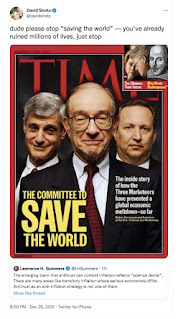
Don't Look Up isn't very good; mostly it's bad, and it's worth thinking about why. But it includes the most gloriously over the top attack on autism as an ideal that I've ever seen. 

Sirota is ballyhooing, and complaining about "elite" critics, attacking corporate media and bragging about success, in corporate media. Blind enthusiasm and self-congratulation are a problem both for the film its makers. The differences between their film and the films they mock aren't as big as they pretend.

Related, since Larry Summers and antitrust, efficiency and supply-chains are in the news again...

"The emerging claim that antitrust can combat inflation reflects 'science denial'”.  

I searched the archives, but I have a short memory. I didn't have to go very far at all. It's got pretty much everything, including economics and science fiction.

This one's good too, economic pseudoscience, left-liberal utilitarianism and the moralists' understanding of art. 

Also: Saint-Simon

My first reference to the inverse relation of efficiency to stability was an annoyed comment to Dani Rodrik in 2008. It seemed obvious then.

Dani Rodrik, Angus Deaton, Krugman, and Quiggin.

Saturday, May 08, 2021

Marx says somewhere that Hegel says somewhere that...

At Christmastime, Baldwin published a deluxe boxed coffee table book of photographs with his high school friend Richard Avedon, now a successful fashion photographer. The collaboration was Avedon’s idea, and Avedon spent a long time trying to get Baldwin to finish his accompanying essay. The Avedon photographs are an inchoate assortment that includes Allen Ginsberg, George Wallace, the Everly Brothers, members of SNCC, Martin Luther King, Jr.’s, son, and Marilyn Monroe, along with pictures of people at the beach and inmates in a mental hospital outside Baton Rouge (who had not been told they were being photographed). Many of the subjects look as reptilian and papier-mâché as “possible, an effect Avedon had a gift for. Baldwin’s essay is a cri de coeur on the banality of American life. It begins with despairing reflections on the artificiality of actors in television commercials and descends into musings like: “When a civilization treats its poets with the disdain with which we treat ours, it cannot be far from disaster; it cannot be far from the slaughter of the innocents.” 

There is a way in which this boutique item, which does not present itself as a book about race, brings the precariousness of Baldwin’s position into focus. When he said things like “the history of this country was built on my back” or, in a widely publicized debate with William F. Buckley at the Cambridge Union, “I picked cotton, I carried it to the market, I built the railroads under someone else’s whip,” he was using an established conceit of group autobiography (as Malcolm X did in his autobiography, published in 1965.) The understanding is that if these things did not happen to the author, they happened to somebody like the author. The “I” stands for the group.

White people don’t write group autobiographies, however. It was not that people did not believe that when Baldwin lived in the United States, he had encountered racism and discrimination. It was that professionally, he had suffered no more, and arguably less, from efforts to censor him than, for instance, Norman Mailer or Henry Miller had. From the very beginning, he had been supported and promoted by powerful writers and editors, Black and white. He had written bestsellers: the only book that sold more copies than Another Country in 1963 was William Golding’s Lord of the Flies. He wrote for Partisan Review and The New Yorker. He had been on the cover of Time. He hung around with celebrities; he was rich; he had an entourage. And on top of all that, he had been living in Paris for eight years, and when the Montgomery bus boycott turned out to be a success, he turned up on the scene and started telling everyone what it was like to be Black in America.

The New York Review of Books was ready for Nothing Personal. The headline was “Everybody Knows My Name,” and the reviewer was Robert Brustein, who was soon to become dean of the Yale School of Drama. It was a time, Brustein began, of “show-biz moralists.” 

Now comes Richard Avedon, high-fashion photographer for Harper’s Bazaar, to join these other outrage exploiters, giving the suburban clubwoman a titillating peek into the obscene and ugly faces of the mad, the dispossessed, and the great and neargreat [sic]—with James Baldwin interrupting from time to time, like a punchy and pugnacious drunk awakening from a boozy doze during a stag movie, to introduce his garrulous, irrelevant, and by now predictable comments on how to live, how to love, and how to build Jerusalem.

“[L]ending himself to such an enterprise,” Brustein concluded, “Baldwin reveals that he is now part and parcel of the very things he is criticizing." Baldwin was one of a handful of Black writers who had a white audience in 1963, and he lost it.

Another white intellectual who found it necessary to call Baldwin out was Irving Howe. But this time, Baldwin ducked, and Howe’s shot struck a different target. [p. 600]  

Mocking buppies, in 1964, and 2021.

"White people don’t write group autobiographies", but Jews do. "Another white intellectual... Irving Howe" (I stripped the footnotes but kept two below)

The size of the Jewish population in New York made it natural for second-generation Jews to assimilate and for discriminatory barriers to fall. Although some continued to try, it made no sense for schools, employers, and even private associations to exclude a quarter or more of the local population. A notion later grew up that a sense of being socially and culturally marginalized is what drew Jewish intellectuals to the coterie life of radical politics and gave them a critical eye on mainstream culture.* None of them ever claimed this. Most of them felt, with the same reservations that any American intellectual might have had, that they were part of mainstream culture.** What they rejected was the Yiddishkeit, the Jewish-centered provincialism, of their parents. And, of course, the overwhelming majority of second-generation American Jews had nothing to do with radical politics or cultural criticism.”[p. 161]

*See Alexander Bloom, Prodigal Sons: The New York Intellectuals and Their World (New York: Oxford University Press, 1986), 11–27; Terry A. Cooney, The Rise of the New York Intellectuals: Partisan Review and Its Circle, 1934–1945 (Madison: University of Wisconsin Press, 1986), 43–44; Hugh Wilford, The New York Intellectuals: From Vanguard to Institution (Manchester: Manchester University Press, 1995), 2–8; Joseph Dorman, Arguing the World: The New York Intellectuals in Their Own Words (New York: Free Press, 2000), 9–11. Cf. Russell Jacoby, The Last Intellectuals: American Culture in the Age of Academe (New York: Basic Books, 1987), 72–111. See also Norman Podhoretz, Making It (New York: Random House, 1967), 116–25.

See “Under Forty: A Symposium on American Literature and the Younger Generation of American Jews,” 3–36; Irving Howe, World of Our Fathers: The Journey of the East European Jews to America and the Life They Found and Made (New York: Harcourt Brace Jovanovich, 1986), 598–602. 

Taking people at their word. Making It. The only reference to Portnoy's Complaint is in a discussion of censorship. The central themes of postwar Jewish culture are assimilation and insecurity. And of course all comedy is "cultural criticism". 

I have no interest in Avedon, or in the book, recently republished with new introduction by Hilton Als. Criticism of radical chic is fine as long as it's better than Tom Wolfe, but Baldwin never pretended he wasn't bourgeois. He didn't indulge narcissistic fantasies... or maybe he did, as we all do, but not as a moralist or pedant. The last link's to Menand. Maybe he should debate Als. 

The Ghost of Panofsky. I thought of this today in a different context, but of course it fits. From 1969:

We are living in a time of exploding nationalisms. The blacks in America are the first to abjure the idea of assimilation, to realize the inherent lie in the concept of melting pot. Through black nationalism has developed a new black pride and hence the ticket to liberation. 
Today’s young American Jew is a good bit slower. He desperately wants assimilation: Jewishness embarrasses him. He finds the idea of Jewish nationalism, Israel notwithstanding, laughable. The leftist Jewish student is today‘s Uncle Tom. He scrapes along, demonstrating for a John Hatchett. ashamed of his identity. and obsessed with it. He cannot accept the fact that he is seen as a Jew, that his destiny is that of the Jews, and that his only effectiveness is as a Jew. But he wants to be an “American,” a leftist American, talking liberation and aspiring WASP. He is a ludicrous figure. 
---
jumping forward, Baldwin and Mailer