Showing posts with label Moyn. Show all posts

Sunday, November 24, 2024

He couldn't think of the obvious, and had to imagine something implausible.
It took me back. The politics of earnest, seemingly sexless, men. Also of course, some women.

It's the self-blind politics that makes support for transwomen obligatory because they call themselves women; but Philosemitism is suspect, and Rachel Dolezel earns mockery.
Arthur Danto on urinals. 

 Oxbridge "philosophers".
I find this reduction of sexual orientation to genitalia – what’s more, genitalia from birth – puzzling. Is anyone innately attracted to penises or vaginas? 
Like Moyn's pathetic politics. And he's doing it again. Brazil just indicted Bolsonaro, but somehow the US is supposed to be above such things. The model is the faculty lounge.

2020
repeats.  The distinction between collaborative reason in the academy, and adversarial reason in the world at large.

2017
The fetish for happiness, for demand for resolution of all conflicts, external and internal, the denial of the possibility of tragedy, the liberal institutionalization of narcissism, while denying the possibility that it could exist. Cafe revolutionaries, liberal Zionists, transsexuals, the popular triumph of wishful thinking. The absolute triumph of course is fascism.
The overlap between critics of liberal transgenderism and defenders of Zionism, and critics of Zionism and defenders of male fantasy. Zionist fantasies have become reality through the state of Israel, and Palestinian reality has become tied to fantasy. 

I really feel almost alone

Lewinsky tells her story
“And so we moved to the bathroom and were more intimate. There was some attention paid on me and then I was reciprocating, where up until that point he had always stopped before completion on his part,” Lewinsky said, delicately trying to explain their encounter.
“I sort of stood up and said I wanted to move past that stage and so he finally said OK.
That’s when the dress was soiled, but Lewinsky didn’t notice at the time. “So that finished and then I hugged him after. And he hugged me,” she said. “And off I went.”

The 30 year old man on the right is officially a woman, named Giulia Valentino.  

Tuesday, July 11, 2023

I posted Moyn's piece without starting with the obvious. It's so late in the game for him to be doing this. It's kind of amazing. He has a long history playing cute with reactionaries, but he has no time even for Beinart. It really marks the boundaries of liberal academia, as a thing in the world.
More amusing discoveries. Daniel Steinmetz-Jenkins in Dissent, in 2021, comparing Beinart from 2006 to Moyn in the present. Beinart's changed, but not in any way any of them can accept. Dissent, provincial American "progressivism".  Steinmetz-Jenkins previously.
---

Moyn, "perhaps Arendt... wasn’t Zionist enough"

For this reason, the great use of reading Arendt alongside Cold War liberals in the age of decolonization is to consider the geographical morality they shared. They offered Cold War libertarianism for the transatlantic “West,” an emancipatory statism (with violence if necessary) in their Zionist politics, and a caustic skepticism about the fate of freedom in either form elsewhere, based on an implicitly hierarchical set of assumptions about the world’s peoples. If this is right, their establishment of that special category for Jews in the Middle East is compelling and remarkable, for its very existence—as the sole place in their thought where earlier forms of liberalism with their activism and statism were allowed to survive— represents a fundamental challenge to their call for limits in developed countries and anxieties about meaningless violence in developing ones. To the extent that Zionism allowed a last remnant of the earlier philosophy of liberal emancipation they all liquidated, perhaps Arendt, like the Cold War liberals, wasn’t Zionist enough.

Yerachmiel Kahanovich

E: What is Operation Broom and what was its objective? 

YK: We cleared all the villages…

E: What do you mean?

YK: We cleared one village after another and expelled – expelled them, they fled to the Sea of Galilee and from there to the Galilee. 

E: But how? How? 

YK: You mean by shooting?

E: How do you mean?

YK: We shot, we threw a grenade here and there. Just listen – there's one thing you have to understand: at first, once they heard shots they took off with the intention of returning later. 

E: But, wait a sec, that was before May 15, that was before the Arab armies came. 

Operation Broom, Operation Broom then. How does it happen? Do you receive any information? Is it an organized campaign?

YK: Yeah, sure.

E: Tell me.

YK: It was. Who was it? Yigal Allon himself planned it. We moved from one place to the next. 

E: What places? Can you tell me?

YK: We passed, we passed by Tiberias and moved from one village to the other, from one to the next. 

E: So you had orders to expel and clean up the villages?

YK: And then go home. 

E: But you did see how they ran away?

YK: We saw them, what do you think? I fired at them with that – with the Browning – on the boats. 

E: They fled on boats?

YK: Yes. 

E: On the Sea of Galilee?

YK: Yes. On the other side they had more [villages], except [Kibbutz] Ein Gev [which was the only Jewish settlement on the east bank]. 

E: And who were the people who fled?

YK: Village people, they were fishermen, among other things. Then it was Lod. 

E: Wait a minute. We'll get to that. 

YK: Ramle. We entered the houses only in one place, in Balad al-Sheikh, near Yagur. There it was really, murderous and all that. And he said, you go there with axes. 

E: Who did?

YK: Only one man could – Yigal Allon. And I assume there was no misunderstanding between him and Ben Gurion, no. "So go there with axes, let them get lost, leave no trace. As much as you can, don't use any bullets, so that they won't hear it at the [British] police [station in Yagur] and, so that they won't send them reinforcements. 

E: So what did you do?

YK: We smashed the door and throw a grenade…

E: In Balad al-Sheikh?

YK: And indeed it never rose again, it's gone. 


Arendt, "Zionism Reconsidered"
Not less dangerous and quite in accord with this general trend was the sole new piece of historical philosophy which the Zionists contributed out of their own new experiences; "A nation is a group of people ... held together by a common enemy" (Herzl)-an absurd doctrine containing only this bit of truth: that many Zionists had, indeed, been convinced they were Jews by the enemies of the Jewish people. Thereupon these Zionists concluded that without antisemitism the Jewish people would not have survived in the countries of the Diaspora; and hence they were opposed to any attempt to liquidate antisemitism on a large scale. On the contrary, they declared that our foes, the antisemites, "will be our most reliable friends, the antisemitic countries our allies" (Herzl). The result could only be, of course, an utter confusion in which nobody could distinguish between friend and foe, in which the foe became the friend and the friend the hidden, and therefore all the more dangerous, enemy.

"We were the first fascists" Marcus Garvey.
We are living in a time of exploding nationalisms. The blacks in America are the first to abjure the idea of assimilation, to realize the inherent lie in the concept of melting pot. Through black nationalism has developed a new black pride and hence the ticket to liberation

Today’s young American Jew is a good bit slower. He desperately wants assimilation: Jewishness embarrasses him. He finds the idea of Jewish nationalism, Israel not­ withstanding, laughable. The leftist Jewish student is today’s Uncle Tom. He scrapes along, demons­trating for a John Hatchett, asham­ed of his identity, and obsessed with it. He cannot accept the fact that he is seen as a Jew, that his destiny is that of the Jews, and that his only effectiveness is as a Jew. But he wants to be an “American,” a left­ist American, talking liberation and aspiring WASP. He is a ludicrous figure. 

Sunday, March 19, 2023

from Leiter. The funniest thing I've read all week. Mentioned before, but I'm adding the text.

Half the people living under Israeli law are living under occupation. Their existence is ignored in the proposal, but Palestinians in Israel are asked to imagine themselves behind a "veil of ignorance".

Rawls' fantasy is of a world before the Fall.
repeat. abandoning Jewish cosmopolitanism for Anglo-Protestant pedantry.
King was a Protestant, but his use of irony was not.
Shallow understanding from people of good will is more frustrating than absolute misunderstanding from people of ill will. Lukewarm acceptance is much more bewildering than outright rejection.

Alon Harel, Alon Klement: "Separating Substance from Procedure: How to Address the Israeli Constitutional Crisis" 

Many proposals to resolve the current Israeli constitutional crisis have been recently advanced. These include the President’s proposal, Friedman & Elbashan’s proposal, Stern’s Proposal, Barak Medina proposal, and many others’. These proposals, however, appear unlikely to bring about a compromise, not because their content cannot be accepted by the parties involved, but because they do not address their substantive concerns.

Both sides aim to reach a compromise that reflects and advances their ideological goals or constituent interests. In making decisions concerning decision-making mechanisms and the role of the Court, neither side considers whether these mechanisms are good or desirable from a long-term perspective, but only whether they will enable it to further its short-term goals It is therefore imperative to separate short-term interests related to urgent substantive issues from procedural decisions that shape decision-making mechanisms in order to find a solution.

We propose a framework that, if adopted, can provide a basis for a viable compromise. The framework we propose is based on a strict separation between the urgent substantive issues, such as the conscription of ultra-orthodox, the regulation of public transportation on Saturdays, Kosher laws, etc on the one hand, and determining the mechanisms for decision-making concerning constitutional questions on the other. While with respect to the substantive issues, the interests of the parties are distinct and are based on conflicting ideologies, with respect to the institutional mechanisms of decision-making, there may be greater overlap than seems at first sight. Hence, separating the negotiations about the substantive issues from those about the procedural issues is necessary if a compromise is to be realized.

One way to establish institutional mechanisms for decision-making is to do so behind what is often called in the literature “the veil of ignorance.” The term was coined by the political philosopher John Rawls in his important book A Theory of Justice. In his view, foundational decisions must be settled in a way that is not influenced by sectarian interests. The normative foundations of a state should ideally reflect the rules that we would have endorsed had we been ignorant with respect to our identity, our social class, our religion, or sexual orientation. These are all central components of our identity, but they cannot provide a basis for constitutional decisions.

Thus if I am a Catholic, I may be voting for a party that promotes Catholicism, but if I vote behind a veil of ignorance, I would not know whether, at the end of the day, I would be a Catholic, a Jew, or an atheist. Hence I may vote for a rule that would guarantee freedom of religion. Similarly, if a heterosexual who dislikes gay couples would vote behind the veil of ignorance, he may vote for gay marriage as he does not know whether, at the end of the day, he would turn out to be gay or not.

While Rawls applied this principle not only with respect to decisions concerning procedure and decision-making rules but also with respect to substantive decisions, we wish to apply this mechanism only to procedural decision-making mechanisms. The real world however, does not provide a veil of ignorance. In the real world, we vote while knowing our socio-economic

status, our religious beliefs, our sexual orientation, etc. How can we guarantee that our decisions concerning the decision-making mechanisms and the status of the Supreme Court do not take into consideration our short-term interests? We believe that while we cannot fully realize this idea, it is possible to make some progress in this direction.

Our proposal is that the different sectors in society, including ultra-orthodox, seculars, traditionalists and Palestinians will specify what their basic, most important interests are. One may presume that the ultra-orthodox will raise the issue of conscription, Kosher food, and additional issues that seems essential to them. The modern orthodox and the seculars would raise other issues. The parties to the negotiations will have to consider accepting such demands with the understanding that once they do so these issues will be removed from the agenda and therefore the decision-making process and the status of the Court may be determined in a way that would only take long term considerations into account.

After an agreement regarding the urgent substantive issues is reached (which we admit is not an easy task), these issues would be entrenched and not be subject to judicial review. Only then would the parties negotiate long-term procedural mechanisms for decision-making. Since the urgent substantive issues would not be affected by the procedural mechanisms, it would be easier to reach an agreement with respect to the procedure. Such negotiations would be easier when urgent substantive concerns are removed from the agenda. For example, it would be easier for the Ultra-Orthodox to agree to judicial review when they know that courts cannot interfere in the decision to exempt them from conscription. Removing the substantive questions from the agenda will facilitate an agreement with respect to the procedure.

The separation between substance and procedure can be done in different ways. It is possible to reach an agreement with respect to the substantive issues and then make determinations with respect to the procedural questions. Alternatively, different committees could simultaneously engage in negotiations concerning procedural and substantive issues.

To conclude, the constitutional crisis results from the fact that the parties to the conflict shape their proposals concerning the decision-making process in a way that is conducive to their short-term substantive interests. The solution should separate the two. Our proposal facilitates such a separation and therefore seems to us promising.

Friday, February 17, 2023

He really is dim. It's not like the US didn't threaten to "bring an end to it". 
"It's like arguing with Zionists."

A Stanford endocrinologist advocating for the castration of 10 year olds. 


Cooper's spent the last few days focusing on the fantasies of a subset of a subset, while downplaying the disaster in Ohio. Contempt for the trash is the corollary of the intellectual liberal imperative—Moyn and Balkin—for civility among the elite. The intellectuals play footsie with fascists while the middling pundits piss on their followers.
[I misread the @USDOT tweet. That was stupid. It happens] 

Sirota's new rag has been good. Jeet Heer is a putz, but he's smart enough to keep his priorities straight.
"Buttigieg’s Paralysis After the East Palestine Disaster Is a Gift to the Hard Right" 

The Big Short hasn't aged well; moralizing stockbrokers doesn't work in the long run. Someone needs to make a feature length mashup of The Big Short and Margin Call. That would be an interesting project.

Friday, December 23, 2022

Just trying to cover all the bases. 

"By the time anything becomes known as an idea, it’s been around for awhile."
I'm going to keep hammering on this. It's embarrassing how little these idiots know about the world. Bungacast and Jäger: like autistic 12 year olds.


The debate over fascism is a debate over the meaning of words as opposed to the meaning of acts. Debating fascism vs Bonapartism as natural kinds in a crisis is an act of evasion. 

When a man tells me he's a fascist it's not worth arguing, and when an Israeli says "not all fascists are Nazis" I agree. We were drinking with a man who says "I used to be a Nazi" and probably still is. And neither of them annoy me as much as the Americans who call themselves "socialists", or even worse "communists." That became our running joke. Will the cast of Aufbunga Bunga, Jäger, and Tooze, ever be subject to an analysis as to whether they're actually "leftists"?  They aren't. So what do they represent? What natural kinds do they manifest? 

Jäger on Badiou's Saint Paul. "People don't realize it but this is one of the best critiques of identity politics ever written"
And he rt's a reply. "Probably the best, especially since he successfully shows how the most consequent realisation of identity politics is Nazism."

Saint Paul is the model for Christian fascists. Badiou still calls himself a Maoist. Is he? Alex Hochuli styles himself "Modernist". Modernism and democracy have never mixed well. Badiou at least tries, in a painfully earnest way, to respond to Israel. No one else above will even go that far. Jewish identity politics n'existe pas. So much for value free science. 

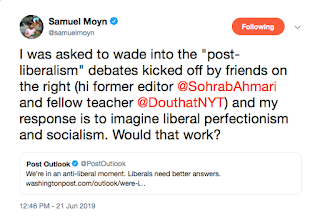
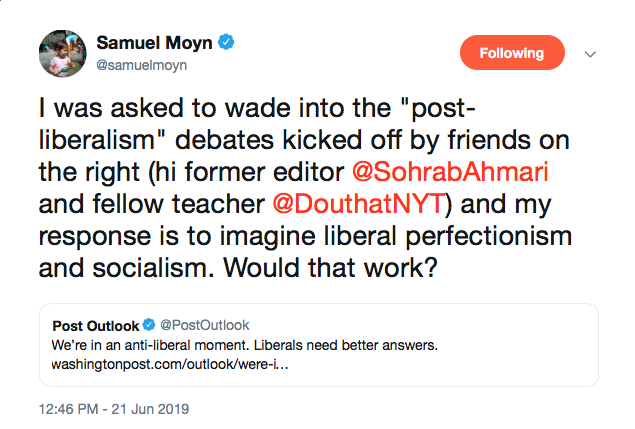
Inaction is a form of action. Since Hochuli and Curtis Yarvin are both writing for Sohrab Ahmari, this, on Rawls and Shklar, and Moyn, is a good fit. 
Remove yourself from the world in order to think about it, and then you worry about the result.  The refusal to participate in the political world is a political act, and an anti-politicalact. The letter and its subject are formed out of denial.
Ahmari. Decadence recognizes itself. 
Tributes are pouring in for Mike Davis, the chronicler of urban apocalypse who died Monday at age 76. Most of these eulogies have focused on the political passions—fellow feeling for the dispossessed, hot-burning rage for their class enemies—that animated Davis’s remarkable life and career. This is fair enough. But attention should also be paid to his form and craft, the mastery of literary nonfiction that gave rise to a body of work that will long endure.

...I devoured City of Quartz, and then I read everything else Davis had written up to that point, and I was left wanting more. Still, it’s City of Quartz that remains my favorite, and that I returned to last summer as I was setting out on my own latest book project—not for any specific piece of research, mind you, but just to get in a writing sort of mood. That’s how important Davis’s craft is to me, and I know I’m not alone in this regard.

repeats from November: T.J. Clark on Davis 

I made a comment on Jäger's piece on Baudrillard that included this
The fascism of reactionary Catholics will fail only because the deeply self-loathing will always be a small minority. It’s a rare thing when ressentiment drives the population of an entire country. It's happening now in Israel. 
There are contradiction in those statements that I'd like to edit out but Bonapartism is not based on ressentiment;it's the foundation of fascism. These idiots think of fascism as something that only exists as a function of the mass: the aggregate. They can't think in specifics because it reminds them that's what they are: individuals, particularities. I've referred dozens of time to fascism as self-hatred but ressentiment is the word these assholes recognize. Technocrats can think in terms of public health, but doctors treat patients. Back to Jerome Groopman.

Peter Mair's Ruling the Void, gets good press. 
The key element within this transformation, whether seen in terms of the location of the parties within the polity, or in terms of the functions parties are expected to perform, is the ascendancy of the party in public offce. Parties have reduced their presence in the wider society and become part of the state. They have become agencies that govern – in the widest sense of the term – rather than represent. They bring order rather than give voice. It is in this sense that we can also speak of the disengagement or withdrawal of the elites. For despite the rhetoric, it seems that they too are heading for the exits, although with this obvious dierence: while the exiting citizens are often headed towards a more privatized or individualized world, the exiting political elites are retreating into an official world – a world of public offices.
The safe havens that are being sought in the wake of the passing of the mass party may be different; the withdrawal is mutual, however, and this is the conclusion that needs to be most clearly underlined. It is not that the citizens are disengaging and leaving hapless politicians behind, or that politicians are retreating and leaving voiceless citizens in the lurch. Both sides are withdrawing, and hence rather than thinking in terms of a linear sequence in which one of the movements leads to the other, and hence in which only one side is assumed to be responsible for the ensuing gap – the crude populist interpretation – it makes much more sense to think of a process of mutual reinforcement. The elites are inclined to withdraw to the institutions as a defence against the uncertainties of the electoral market. Just as state subventions to political parties have compensated for the inability of parties to raise sucient resources from their own members and supporters, so the security of an institutional or procedural role can compensate elites for their vulnerability in dealing with an increasingly disengaged and random electorate. At the same time, citizens withdraw from parties and a conventional politics that no longer seem to be part of their own world: traditional politics is seen less and less as something that belongs to the citizens or to the society, more and more as something done by politicians. There is a world of the citizens – or a host of particular worlds of the citizens – and a world of the politicians and parties, and the interaction between them steadily diminishes. Citizens change from participants into spectators, while the elites win more and more space in which to pursue their own particular interests. The result is the beginning of a new form of democracy, one in which the citizens stay at home while the parties get on with governing.
It's the end of the chapter 3 "The Withdrawal of the Elites". No mention of the withdrawal of a subset of the elite into the ivory tower.
They have become agencies that govern – in the widest sense of the term – rather than represent. They bring order rather than give voice.
To give voice would require a social tie to those you rule, a personal as opposed to impersonal relation. The existence of managers is a given, but they come in different forms. 
This link is as good as any. It covers all the bases.

Wednesday, October 26, 2022

Koppelman, "How Charles Koch Successfully Peddled the Snake Oil of Climate Change Denial"  

Koch, one of the world’s richest men, is often depicted as merely a greedy plutocrat hoping only to line his own pockets. This is wrong. Koch is—or, at least, he once was—an idealist. We live in a world that was shaped by his ideals—ideals that have real attractions, but which have taken on a malign form.

A lot has been written about him. But until now, his political philosophy has never been carefully examined. When we do that, we learn both the power and the limitations of the libertarianism that so many have found attractive. We also discover that Koch has not even been faithful to his own unworthy aspirations.

Any account of Koch’s philosophy must begin with the story he tells about himself.

No.  Any account of his philosophy begins with the history of his actions.

I emailed Koppelman: "Social darwinism is idealist. Let the weak suffer and die off."

He replied, agreeing, in a sentence I'd love to quote in public. I replied saying maybe he should have been more direct: the KKK is idealist. Fascism is idealist. I haven't heard back.
I'm remembering Moyn's "liberal perfectionism." 

Koppelman has a tag.

Jason Mazzone, at Balkin

Stop what you're doing and read the extraordinary amici curiae brief Akhil Amar, Vik Amar and Steve Calabresi have just filed in Moore v. Harper. That's the case involving a claim by North Carolina legislators that under the Constitution only the legislature of a state has the power to regulate federal elections--without any interference from state courts or any constraints from state constitutions. The brief from Akhil, Vik and Steve is an intellectual battering ram that demolishes the independent state legislature theory. It is also the punchiest brief filed in a very long time. In its substance and by its candor, the brief sets a new standard for friend of the court. The brief is available at this link.

Judicial Review!!!  

The adoption of new republican state constitutions across the American continent was a transcendent achievement in the late 1770s, acclaimed by Americans everywhere. These new state constitutions were the beating heart of the American Revolution. In a now-famous letter to his wife Abigail on May 17, 1776, John Adams explained, with pride and awe, the monumental import of the Confederation Congress’s decisive vote to encourage each state to adopt is own new constitution: A “whole [state] Government of our own Choice, managed by Persons who We love, revere, and can confide in, has charms for which Men will fight.”

So of course state constitutions were understood as supreme over state legislatures at the Founding! And of course state courts could—and did—enforce these state higher laws against state legislatures. Prominent state judicial review under state constitutions predated the Philadelphia Convention, The Federalist No. 78, and Marbury v. Madison. Indeed, state constitutions formed the basic template for the federal Constitution.

my highlighting. Judicial review has a tag

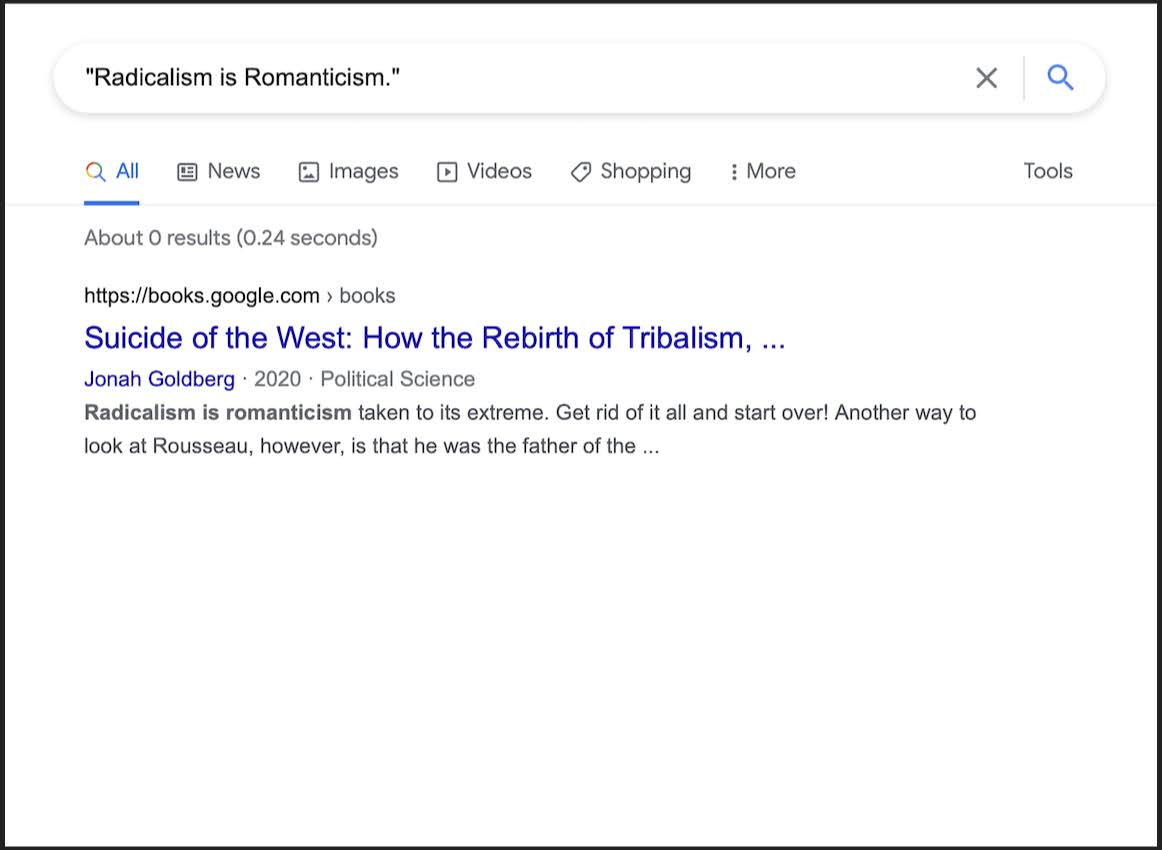
"Fascism is utopian." Googling it—in english—you get almost nothing, and absent "the struggle against fascism is...", even less. But you get a pirate site download of a book on Jameson, citing him.  Googling "Enlightenment anti-humanism", is still the same. I'm reminded every day, language and psychology are funny things.

Jameson, The Political Unconscious, p.289.
On the contrary, it is increasingly clear in today's world (if it had ever been in doubt) that a Left which cannot grasp the immense Utopian appeal of nationalism (any more than it can grasp that of religion or of fascism) can scarcely hope to "reappropriate" such collective energies and must effectively doom itself to political impotence.

We have a winner.

---
… But now we have another problem.
What is that?
What if we find out what makes each of us internally consistent? What if I find your true name, that thing which describes exactly what you are?
Then I will always be honest, or predictable at least. And you will be able to interpret everything I say and never be wrong. And of course I’ll know your name as well.
No dishonesty, no subterfuge, no Freud, no art… Then we can all be logical positivists.
But it doesn’t matter. That dream’s irrelevant.
I want unification.
It’s an illusion.
I want the illusion.
Do you want the illusion or do you want the illusion to be real? 
What’s the difference?
One means that you have an appreciation of the arts. The other means that you’re a fascist.

Sunday, August 14, 2022

Found on twitter. Shklar to Rawls. So stupid. 

The one issue that does puzzle me is the basic assumption on which you build you[r] edifice: the implicit values of an actual political society. The task you then set yourself is to draw out these intimations and make them explicit. The burden of historical proof then becomes very heavy. You cannot evade the demand for demonstrably accurate historical evidence to show that these are indeed the latent values. How latent? How widely shared? How deeply held and by whom at what times? In peace and In war, in secure and insecure times? Remember that most of your fellow citizens just now think that the Declaration of Independence is too radical for them. And while this is a good time for the First Amendment, It is not always so. One can say that only religion is safe, because no one cares about it that much any longer, and that in a way what is left is all Protestant anyhow. Finally your account of the conflicting beliefs that can overlap may be be out of date. It is not religion and even ideology that now separates us us, but race, language gut-loathing and ethnic incommunicability. Does your model fit that reality, or only one in which tolerance of creedal diversity was in question? My point is simple. If you base you[r] case on history, then contemporary history, which is what the best social science is, must provide you with a far less speculative ground to start from. Those latent values have to be accounted for every bit as much as more overt ones.


The Papers of John Rawls, Box 41, Folder 14. "Shklar, Dita, memorial remarks [1992]". Harvard archives.
Remove yourself from the world in order to think about it, and then you worry about the result.  The refusal to participate in the political world is a political act, and an anti-political act. The letter and its subject are formed out of denial.

Someone once described art history from its beginnings as Jews explaining Catholic theology to Protestants. It's an old quote and I don't remember the source. But now with Shklar, and Moyn, and the rest, the humor and irony are gone. Jewish scholarship, and Jewish liberalism, has become Protestant pedantry.

"contemporary history, which is what the best social science is,..." The history of the past is not a science, so neither is the study of the present. But the spread of the "research model" into everything means now that everything can be—and needs to be—academic. This is how we've ended up with "Auto(erotic)ethnography"—the link's from 2012; it's not the new one. It explains why we have PhDs in creative writing, and J School, and reporters holding back important information to use later in books, betraying their obligation as hacks and ambulance chasers to play at being historians—out of pretension or for money—and why people need the state to validate and justify their fantasies.  Passivity and the need to be guided, the end of agency. The need to the elite to grant permission and the need of the masses to be granted it. Corruption is weakness; weakness breeds corruption. 

This was a good one. 

---

Moyn, again living down to expectations.

More of the same from Andrew Koppelman
Forced pregnancy is totalitarian. It involves the kind of bodily control that America imposed on slaves before the Civil War. Criminal restrictions don’t do much to lower the abortion rate, but endanger all pregnant women by limiting doctors’ ability to treat them.... 

But I just said all that without so much as mentioning my opponents’ motives or treating religious support for a law as a kind of contaminant that makes otherwise legitimate laws invalid.
Forced pregnancy is totalitarian but I'm not calling you a totalitarian. That would be rude.

If you can't articulate your normative commitments in the language of the community it should play no role it law. 

As I reminded him in an email exchange: politics is a schoolyard before it's a seminar. The schoolyard leads; the seminar follows: Women's Studies programs are the result of feminism not the cause. etc.
Intellectual history is academia as self-justifying narcissism. All repeats.

Adding this, from Moyn at the link above—"expectations"—because people don't click, and  Koppelman's piece really is more of the same.

Koppelman now has a tag. It goes back to 2010.
Ahmari can exist only as parody. You could imagine Moyn referring to his "friend" Dinesh D'Souza.

Tuesday, July 26, 2022


I wanted to see what showed up, but that's it. LOL as the kids say. With Liberal Fascism I called Goldberg the poor man's Foucault. 

Adam Kirsch
Interwar German thought exercised an enormous influence in the late-twentieth-century US, from Martin Heidegger’s existentialism to the critical theory of the Frankfurt School to the Marxist mysticism of Walter Benjamin. But the apocalyptic radicalism that made these thinkers so fascinating—the product of a period that felt like, and in a sense really was, the end of the world—is absent in Cassirer.

Goldberg and Kirsch are both tribalists, but won't admit it.

The blacks in America are the first to abjure the idea of assimilation, to realize the inherent lie in the concept of melting pot. Through black nationalism has developed a new black pride and hence the ticket to liberation. 
Today’s young American Jew is a good bit slower. He desperately wants assimilation: Jewishness embarrasses him.

Goldberg and Kirsch are more embarrassed.

The anti-Jewish prejudice in America in various areas of life, such as the universities, had quickly become evident to the émigrés. Conservative East Coast society above all clung to a clear distinction between Jew and non-Jew.  As early as 1936 a disillusioned Panofsky wrote to Fritz Saxl in London that he was reckoning on “a reunion of our whole circle of friends in Honduras or Liberia, probably in 1940. By then things will have gone so far here too that Jews and Liberals will no longer be welcome.”

No mention of Palestine, because the meaning of such a choice is obvious.

Panofsky contra Benjamin's indulgence, "love of the arcane," and "pretense".  

Judith Shklar, After Utopia, Chapter IV-The End of Radicalism 

What answers can be offered to these counsels of social despair? Romanticism refuses to analyze the social world with any degree of thoroughness, and Christian fatalism subjects modern history to an excess of simplification in order to satisfy its sense of outrage. But to have noted all these shortcomings is not a reply. In fact, no reply is forthcoming. The spirit of rational optimism which alone could furnish a reply does not flourish at present. 
"The spirit of rational optimism", and "liberal perfectionism" is pure romance. 
The liberalism of Cassirer and Panofsky, of humanism, is lost, forgotten, irrelevant.


Leusder retweeted this yesterday
There are many things the left has abandoned at its peril. One of them is certainly the abandonment of confident high modernism: large projects, space exploration, scientific and technological progress for it's own sake, the creation of a rational order etc.

quoting Jäger: 

Zero Lies detected

quoting Sarah Zedig: 

"skyscraper" is such a cool word. pure modernist idealism. they just don't make em like that anymore. if they invented the skyscraper today they'd call it some shit like "vertical housing" or "enhanced elevation office space." culture in decline 

Leusder 

Addendum: this is not Fordist nostalgia, but a non-aesthetic plaidoyer for 'scientific optimism' about the creation of a rational order that can harness distributed resources within political and ecological means. It's not motivated by the technological sublime. 
"a non-aesthetic"advocacy. Because aesthetics is something you can indulge or not.
So says Max Weber.

The fact that there are works of art is given for aesthetics. It seeks to find out under what conditions this fact exists, but it does not raise the question whether or not the realm of art is perhaps a realm of diabolical grandeur, a realm of this world, and therefore, in its core, hostile to God and, in its innermost and aristocratic spirit, hostile to the brotherhood of man. Hence, aesthetics does not ask whether there should be works of art.

Contra Weber, your aesthetic is the manifestation of your ethic. Your ethic is recorded in the history of your actions. Academia is an aesthetic and an ethic; a cafe revolutionary is a creature of the cafe, not the revolution, etc. etc. 

Leusder is an economist and club kid. [And now he's shut it down.] That takes me back to 2008 and Henry Farrell: Leusder's "minimaldamage" to Farrell's "My Bloody Valentine"

The tweet includes a quote from James C. Scott, a variety of the same decadence: anarchism as a hobby for tenured technocrats.

And to the recent past, and the LSE again—Xenofeminism, "Storm the Heavens and Conquer Death"—it's always just a hop from rational optimism to violence and utopian kitsch. 

Sarah Zedig: @hmsnofun,"trans communist goat, she/her. 33. does video essays, writes @godfeelsCanon"
“godfeels”-an ongoing experimental homestuck fanfiction that starts with a depressed young man becoming a woman to mixed approval from her friends, and culminates in a macrocosmic war between every body and every mind.
The London School of Economics; Storm the Heavens and Conquer Death; a macrocosmic war between every body and every mind; minimal damage; My Bloody Valentine. 
Expressionism in the atomic age is the product of technocracy and the bomb, the emotion escaping the denial of emotion; it's the melodrama behind positivism, from Vienna to Weimar to New York, the relation of Strangelove to von Neumann.

I forgot about this one. It goes back to 2007 this time.  

The institutionalization of narcissism 

Sunday, April 10, 2022

“For Fukuyama it is this double demonstration, of the magnetism of representative institutions and of competitive markets, that has sealed the victory of liberal capitalism.”

One of the images above is an image of stability. The other illustrates the quote. Markets are only as liberal as the people who control them. The end of history is the end of time.

It would be simpler if Fukuyama tried to make the case that what's ended for now is the fantasy of the politics of utopia. But that would require him to face those who would argue that this is a return of history as the word is understood by historians as opposed to millenarians, to secularism and materialism as practiced, and the fading of the authority of philosophy as such. But his definition of liberalism is founded on ideas, to which acts are made to fit. Idealists are first idealists about themselves. And Anderson can't call bullshit on fantasies without calling bullshit on his own.
  
It still amazes me how so much self-defined "intellectual" debate reduces to theology, the relations of ideas coded as words woven into a web that's then labeled, without a wink or a smile, "True Map of the World".  It annoyed me when Arendt referred to "authority","power", "force",  "strength", as if they were elements in the periodic table. And Shklar refers to "radical" in the same way.

Tooze says Anderson's essay was a revelation. I don't fucking understand these people. His review works best as philology, but that's now it was intended. A Zone of Engagement includes a piece on Marshall Berman, another romantic liberal individualist. This shit is tiresome.

Tooze
One of humanity’s recurring hopes has been that through history we might escape war. Since World War II Western Europe in particular has been invested in the idea of consigning war to the past. That is a hope that is based not just on a humanitarian impulse, but also on the sense that the basic questions of international politics were resolved and that for the settlement of whatever remained, the modern instruments of war – most notably nuclear weapons – were likely counterproductive. The era of military history was thus consigned to an earlier developmental phase.

He quotes Hochuli and Hoare’s The End of the End of History 

In Hegel’s view, the specific historic gain of the French Revolution was to reveal the universal character of human freedom, that is, the claim that freedom is in fact part of being human. Freedom was thus not merely an abstract philosophical proposition, but a political proposition that could be realized in concrete institutions. This was Hegel’s original meaning of the End of History – that whatever followed the French Revolution had to be based on the universal claims of human freedom. This in turn meant that no social or political order could ever be fully stable. The significance of this insight is that freedom cannot be limited or appended to one specific regime or order, as it is precisely the expansiveness and restlessness of human freedom that exceeds any one specific set of political and social institutions.

I've said it for 40 years: modern philosophy is the product of theologians struggling to come to terms with the absence of god, and therefore of purpose. And Nietzsche's anti-Christianity is predicated on the existence of what it struggles to oppose: Nietzsche's is a slave mentality in rebellion against itself. It's all so boring. 

I wrote somewhere recently that post-humanism describes the situation in Europe for the past 2000 years. Hegel's "insight" is important only in marking the fading of Christian teleology.

The end of history was the end of the age of Europeans fighting with each other; history returned when they began fighting each other again. It only makes sense that Hochuli and Hoare (and Cunliffe) would be useless on Israel. Liberals throw up their hands and walk away when conflicts make them uncomfortable. They lose the ability to analyze. There's more, but it's not worth it. He's a fan of Timothy Brennan. And I've mocked Lee Fang enough that he almost deserves his own tag.

Gordon Brown is calling for a new Nuremberg-style trial for Putin. Liberalism does make nihilism attractive.

Thursday, March 31, 2022

I should write an essay titled "Against Philosophy" and submit it to the NLR. These people are such idiots.

Tuesday, March 15, 2022

I always forget my own history. Almost everything below I've said before. The references are different.
---

Again on aestheticized politics, and again on Bersani,  on Liberalism and Moyn. 

Ryan Cooper calls Mike Davis' new piece in the NLR "disappointingly glib". Cooper is one kind of moralist; Davis is another. Davis is in love with decay, meaning in love with death. I read a bit of him years ago and it annoyed me, meaning of course that the writing annoying me. Everything worth reading is worth reading as a primary text: reading for form is reading for subtext. Marxist millenarianism, (and again). Cooper has no sense of any of this of course. Just as he has no sense of the actual situation in Chile.

Jäger fittingly (see link in the last parentheses) links to Tablet, and a piece which wraps this all into a package, with a nice ribbon and a pretty bow. It's as openly perverse as Vermeule and Ahmari. 

I used to drink with a Croatian Nazi and an Israeli fascist, both ex-military. They were friends. Barbarism and the academic defense of barbarism are very different things, and the Croat had the best short war story I've ever heard—"Cover me! I'm goin' for a beer."—a great description of urban warfare in your own country. Unlike Borges and the leftists of the library, I don't worship killers, but I've known a few, and even liked them.

Taubes had visited Schmitt, with whom he maintained a long epistolary relationship, the year before the latter’s death in 1985. In that meeting, he and Schmitt had read together Paul’s letter to the Romans, debating whether the text founded—as Schmitt believed it did—enmity between Christians and Jews. Taubes argued against Schmitt’s interpretation of Paul, which seemed to give scriptural justification for the murderous antisemitism Schmitt had endorsed as the leading legal thinker of the Third Reich. He gave his own reading of the text, and “when I had finished explaining everything to him,” Taubes said, Schmitt insisted that Taubes must, before he died, reveal it to the world.

Obeying the wish of the eminent, dying Nazi, Taubes, now dying himself, would speak about Paul, “as a Jew, not as a professor, a title to which I don’t attribute much importance.” This was not to be a scholarly exercise, but an existential confrontation with the question of Messiah—and of his enemies. The latter, Taubes argued, are those who seek to “hold back” the end of the present world, who believe that it can get along for itself without a “living God” who appears unpredictably into history and into our lives. He calls these people, with contempt, “liberals.” Paul, he argued, was “more Jewish than all the liberal or reformed rabbis” who prayed only half-heartedly for Messiah.

All philosophy is perverse. The perfect is the enemy of the world. 

MLA Forum Debates: MLA Annual Convention, 2005
"Should a homosexual be a good citizen?" Leo Bersani asked in Homos in 1995, expressing a gay skepticism that has dogged every upsurge of gay politics. Bersani's doubt results from his diagnosis of "the rage for respectability ... in gay life today." He locates that rage in postmodern dissolutions of gay identity, in clamors for gay marriage and gay parenting, in queer antisepticizings of gay sex. "Useful thought," Homos suggests, might result from "questioning the compatibility of homosexuality with civic service." And from questioning more: Bersani makes a claim about social being itself. He hypothesizes "that homo-ness ... necessitates a massive redefining of relationality," that it instances "a potentially revolutionary inaptitude perhaps inherent in gay desire for sociality as it is known." If there is anything "politically indispensable" in homosexuality, it is its "politically unacceptable" opposition to community. Thus Homos paradoxically formulates what might be called "the antisocial thesis" in contemporary queer theory.

Bersani's formulation and others like it have inspired a decade of explorations of queer unbelonging. Meanwhile, pace scholarship, gay rage for normalizing sociability—to judge by the gay-marriage boom alone has intensified.Given such divergent developments, I suggested to my colleague on the MLA's Division Executive Committee for Gay Studies in Language and Literature that stocktaking of the antisocial thesis might be in order.

I'm a lazy scholar, but this shit marks the transition of the radical/reactionary anti-politics of the demimonde into respectability. Homosexual self-hatred is defended by philosophers for whom disgust of the body is a given, but is now along with the self-hatred of "gender dysphoria", hidden behind the facade of the "liberal" academy: people so ideologically opposed to history that they've rationalized themselves into optimistic fascism. 

Thug life is barbarism. It needs no written philosophy. It needs no defense. It's not opposed to art. As I've said more than once, maybe not here, if art were about morality, killers wouldn't know how to dance.

Arendt on public and private life, and the and privacy of pain. She doesn't go far enough/wide enough. she shies away, at least in public.

Wednesday, March 02, 2022

Moyn is ripping me off  :-) 

Or not. If he is, it's not the first time someone has.

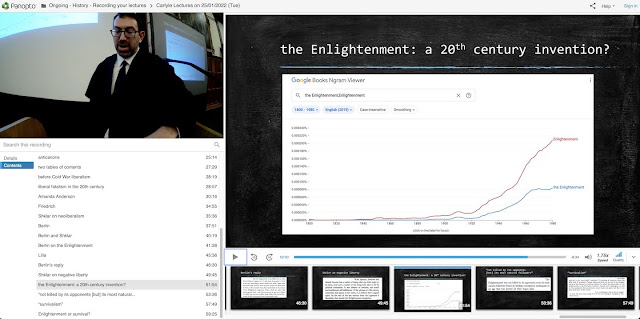
But he misses the point. I'd like to see some enlightenment. I'd like to see some progress, but there hasn't been much. The humanists were not optimists. Kant was not an optimist. Republicanism predates liberalism, and will outlast it. Utopia means "no place" etc, etc.

I should send him a note and politely rip him a new asshole. Now he has a tag.

I'm adding other tags—that are appropriate. I'm going to come back to this, and Judith Shklar. [I did. See below]
Utopianism is illiberal, in every understanding of the word that makes liberalism worth defending.  Political realists are more likely to be functional liberals than idealists are.
The rest was written earlier as another post. But it belongs here.


I've never thought of people as very smart. That's why I've always focused on finding the small gestures of intelligence in what's called art. People are predictable not rational. 

Chotiner interviews Mearsheimer. As others have said they talk a little around each other; they don't speak the same language. 

Chotiner: "What if Ukraine, the people of Ukraine, want to live in a pro-American liberal democracy?"

That's irrelevant. But Mearsheimer can be a bit of an idiot. Americans at best were lying to themselves.

There’s a big difference between how the United States behaved during the unipolar moment and how it’s behaved in the course of its history. I agree with you when you talk about American foreign policy in the course of its broader history, but the unipolar moment was a very special time. I believe that during the unipolar moment, we were deeply committed to spreading democracy.

And some people are debating as if it's all a Gettier problem. If Mearsheimer's predictions were right, but his justifications were wrong, the next step is ask why he was right.

Seva Gunitsky

The unasked question: what is the actual existential threat to Russia? How does Ukraine joining NATO and/or EU actually threaten the *existence* of Russia? 

Perception is reality. If you're negotiating with a man who's fearful, the fear is a fact. Whether it's justified or not is part of the analysis of that fact. Gunitsky reminds me of the anthropologist who was exited about some recent important historical event, because "it gives us more things to theorize about." I've forgotten the source but the sentiment is common enough. In philosophy as in theology the history of ideas takes precedence.

The history of events merely provides a series of pegs to hang the history of ideas on, and it is the latter that is of real interest.

Arendt

You will remember that Plato said that only his body still inhabited the City and, in the Phaedo, also explained how right ordinary people are when they say that a philosopher's life is like dying. Death, being the separation of body and soul, is welcome to him; he is somehow in love with death, because the body, with all its demands, constantly interrupts the soul's pursuits. 

Philosophy by definition is either conservative or reactionary.

JM: "I don’t know anybody who talks about this whole problem in terms of imperialism. This is great-power politics." He has an old-fashioned maybe pedantic definition of imperialism. That may turn some people off.

IC: I went back and I reread your article about the Israel lobby in the London Review of Books, from 2006. You were talking about the Palestinian issue, and you said something that I very much agree with, which is: “There is a moral dimension here as well. Thanks to the lobby of the United States it has become the de facto enabler of Israeli occupation in the occupied territories, making it complicit in the crimes perpetrated against the Palestinians.” I was cheered to read that because I know you think of yourself as a tough, crusty old guy who doesn’t talk about morality, but it seemed to me you were suggesting that there was a moral dimension here. I’m curious what you think, if any, of the moral dimension to what’s going on in Ukraine right now.

JM: I think there is a strategic and a moral dimension involved with almost every issue in international politics. I think that sometimes those moral and strategic dimensions line up with each other. In other words, if you’re fighting against Nazi Germany from 1941 to 1945, you know the rest of the story. There are other occasions where those arrows point in opposite directions, where doing what is strategically right is morally wrong. I think if you join an alliance with the Soviet Union to fight against Nazi Germany, it is a strategically wise policy, but it is a morally wrong policy. But you do it because you have no choice for strategic reasons. In other words, what I’m saying to you, Isaac, is that when push comes to shove, strategic considerations overwhelm moral considerations. In an ideal world, it would be wonderful if the Ukrainians were free to choose their own political system and to choose their own foreign policy.

But in the real world, that is not feasible. The Ukrainians have a vested interest in paying serious attention to what the Russians want from them. They run a grave risk if they alienate the Russians in a fundamental way. If Russia thinks that Ukraine presents an existential threat to Russia because it is aligning with the United States and its West European allies, this is going to cause an enormous amount of damage to Ukraine. That of course is exactly what’s happening now. So my argument is: the strategically wise strategy for Ukraine is to break off its close relations with the West, especially with the United States, and try to accommodate the Russians. If there had been no decision to move nato eastward to include Ukraine, Crimea and the Donbass would be part of Ukraine today, and there would be no war in Ukraine.

I've said before it drives me nuts that so many people, specifically Americans, who defend illiberal states as a matter of policy—vis-a-vis US hegemony—end up defending them as as matter of belief. In my twitter days I always used the alliance with "Uncle Joe" as the definition of realism.

And Mearsheimer has a very Kantian definition of morality: "the lesser evil" is not a moral choice. So much for military piety, and trolley problems. And this fits with the need for people like Max Blumenthal to identify with the people they defend. It's two versions of the same need for simplicity, though one is affective and one affectless. 

It's obvious as Mearsheimer says that China is the biggest threat to US interests, but I'd tell smaller countries in Asia the same thing I would have told the smaller countries in eastern Europe in 1995: join together and create your own center of gravity. The US doesn't defend democracy. It protects its own interests.

Shklar, After Utopia, Chapter IV-The End of Radicalism 

What answers can be offered to these counsels of social despair? Romanticism refuses to analyze the social world with any degree of thoroughness, and Christian fatalism subjects modern history to an excess of simplification in order to satisfy its sense of outrage. But to have noted all these shortcomings is not a reply. In fact, no reply is forthcoming. The spirit of rational optimism which alone could furnish a reply does not flourish at present. The Enlightenment was not killed by its opponents; even its most natural followers found its leading conceptions inadequate in an age that has proved all their hopes false. There are, of course, traces of survival. Sartre, very characteristically, notes that the conformism of Americans is really due to their uni­versal rationalism and optimism. But even in America this spirit is no longer encountered among social philosophers. There are few serious people who really believe today that the advantages of democratic government are so self-evident that once it is established it must appeal to all. Probably President Wilson's Fourteen Points were the last great document to testify to that faith. By now it is only too well known that democracy is not inevitable, that it may be destroyed from within, and that even the most successful constitutional de­mocracies are not the models of social perfection that the En­lightenment had dreamed about. This disenchantment—per­haps it is realism—even among the most consistent advocates of democratic government is the real measure of the decline of social optimism.

"The spirit of rational optimism... does not flourish at this moment" "Sartre, very characteristically, notes that the conformism of Americans is really due to their uni­versal rationalism and optimism." Hilarious.

Her reference to Woodrow Wilson reminds me of Mearsheimer. Hope, and delusion, the white man's burden—Liberia and Israel are not caveats—springs eternal: "I believe that during the unipolar moment, we were deeply committed to spreading democracy."

Wednesday, December 23, 2020

"No society that still has traces of the old tripartite division of humanity into those who pray, those who fight, and those who labor can be liberal." Shklar "The Liberalism of Fear"

Liberalism is defined by the tripartite division of those who fight, and those who labor, and those who think.

"Of all the cases made against liberalism, the most bizarre is that liberals are really indifferent, if not openly hostile, to personal freedom."

What a fucking idiot.

Saturday, September 02, 2017

Leiter
The strategic reasons the ACLU embraced "free speech" for Nazis in the 1930s

Interesting bit of forgotten history courtesy of my colleague Laura Weinrib. Given the pathologies of American political culture, however, I'm not confident a different approach would end happily.
Weinrib: "The ACLU's free speech stance should be about social justice, not 'timeless' principles"

Weinrib, HUP 2016: The Taming of Free Speech: America’s Civil Liberties Compromise

Using google books I searched the text for references to the National Emergency Civil Liberties Committee and found nothing. I found a review by Samuel Moyn in the WSJ. He'd linked to it on twitter, and almost a year later I replied.

"Seems no mention of the NECLC. If so it begs the question of 'principle' and destroys the book's argument."

"The book ends before WW II; NECLC from after"

"But that makes my point. NECLC stood for principle during the cold war. It had a big effect on ACLU. Seen as a dark period in ACLU history"

My final reply has one like: Samuel Moyn.

Tuesday, May 24, 2016

"It is the common fate of the indolent to see their rights become a prey to the active. The condition upon which God hath given liberty to man is eternal vigilance; which condition if he break, servitude is at once the consequence of his crime and the punishment of his guilt."
John Philpot Curran

"The behaviors attributed to me go fundamentally against what I believe, teach and write about.” Thomas Pogge

The academy is built on a collaborative model of intellectual life. Even the "discovery" of our self-interest is seen as the product of the practice of its opposite. Pogge is whining narcissist, in a culture of whining narcissists.
There is no aspect of scientific knowledge that mandates institutionalized instrumental reason in all aspects of life. There is no telos to the world beyond entropy, and even that puts too much of a glow on physical events. The 18th century was the age of enchantment with science, an enchantment morphing over time into various forms of a philosophy along a line also described in the arts, which themselves describe (again) not the world but our perceptions of it. Equality in the language of philosophy originates in the discovery or construction, by members of an elite, of the idea of equality, rather than in the recognition of the practice of it by the people, and has ended in the study of people by that same elite not as equal but alike: the study of each of us only in terms of the aggregate. And in this the logic of individualism becomes its opposite, except that the elite observers have quietly removed themselves from the game. The greatest heroes of technocracy are those who can predict the behavior of the middling and in this they have become middling themselves. But it’s these heroes who are left to make the decisions for the rest of us. [also here]

Repeats: A lecture on feminism and the rule of law from Jian Ghomeshi's lawyer. I have more respect for her than the plaintiffs in these cases. I have pity for them, and pity isn't respect.  Marie Henein isn't a scientist or a pseudoscientist; she's an advocate playing her part in a game that she takes very seriously.

Adversarialism is predicted on the existence and equal authority of the other. We are all each others' others; the only question left is how to extend that understanding to our relations with outsiders, for whom the category of the other was imagined by scholastic philosophers who had no interest in adversarialism.

The philosophy of science—philosophy as science—is the philosophy of metaphysical plumbing and race car engines, the philosophy of intellectual mechanics. With goals assumed, utility defined, the politics is authoritarian. Democracy sees goals as open. It requires tougher people: adults. It's not for rubes or Hollies Golightly.  It's much more interesting. And it's sexier.

Lawyers, not judges, not philosophers are at the center of our legal system.

It's Rashomon, you idiots

Friday, May 20, 2016

Updating. Documenting drift.
When Thomas Pogge travels around the world, he finds eager young fans waiting for him in every lecture hall. The 62-year-old German-born professor, a protégé of the philosopher John Rawls, is bespectacled and slight of stature. But he’s a giant in the field of global ethics, and one of only a small handful of philosophers who have managed to translate prominence within the academy to an influential place in debates about policy.
Leiter
“It breaks my heart to have to say it,” said Christia Mercer, a former colleague from the Columbia philosophy department, “but it’s clear that Thomas uses his reputation as a supporter of justice to prey unjustly on those who trust and admire him, who then — once victimized — are too intimidated by his reputation and power to tell their stories.”

This is also my reaction.
Ludlow, McGinn "It's no secret". Rationalists rationalize.

Leiter links to IHE, on the threat to the liberal arts.
For Talbot Brewer, professor and chair of philosophy at the University of Virginia, the liberal arts need saving in part from the “black mirrors” so many of us are glued to each day. Cellular phones, computers and, especially for children, television, facilitate a kind of “reverse-Weberian,” late capitalistic assault...

Calling attention a “vital resource,” Brewer described it as “the medium of passion, of friendship, of love. 
Not “reverse-Weberian", simply Weberian. And again, for Leiter the whole point of philosophy is that it is not art or fiction, but close to science.  He reads for text without subtext. As I repeat again and again, Leiter, like his friend Posner, is a technocratic anti-humanist.

Maria Farrell (start here or here) discovers "Post-Democracy"
I’ve been reading and re-reading Colin Crouch’s Post-Democracy on and off for about eighteen months, and just spotted a nice precis of it on OpenDemocracy in a piece by Kit de Waal about celebrity activism:

“The term ‘post-democracy’ was coined by Colin Crouch to refer to the fusion of corporate power with government, generating an elite politics based on a political-financial cycle in which money buys power and power rewards money. Post-democracy is a plausible imitation of democracy. It has a popular, consultative appearance, while the real politics of power and money consists of a continuing round of inter-personal transactions among elites.”

What makes Post-Democracy hard for me to digest more than a dozen pages at a time is not, I think, its relentless rightness, which I personally find more or less inarguable, but how little there appears we can do about it. My experience of reading it is basically ‘yes, this is better researched and thought through than I’d ever manage, and I agree; we’re basically fucked.’

I get that I’m experiencing nothing more than the cognitive dissonance of a social democrat who knows capitalism is awful and probably tending towards disaster – but more the chronic debilitating disease kind of disaster of, say, a slow-boiled lobster, than the explosive, revolutionary and strangely psycho-sexual climax of sudden foment and change – but who has neither the temperament nor the constitution for either ripping it up or walking away. (Hello Rosa Luxembourg. Like my hero Virginia Woolf, you would despise me, too.) But simply knowing this doesn’t help.

About a decade ago I was at a weekend conference in New York on what was then called ‘the new philanthropy’. The impeccably well-educated and well-spoken man who’d been Angelina Jolie’s fixer in the world of Davos and the UN system was there to say how great it was that celebrities were now getting down into development issues and doing things that governments didn’t have the will for. At the Q&A, I made myself a bit awkward by asking how democratic it was that those people could re-order policy priorities on a whim, and wouldn’t it be better if they just voted and paid their taxes like the little people....
A smart commenter replies quoting a post by her I'd decided not to read.
Oh I remember you. 
“The question isn’t whether the Easter Rising accelerated Ireland’s independence or made it happen at all; it’s whether it was worth the death of one bow-legged tenement child. Of course it wasn’t."
If you don’t have faith in the people to create democracy why do you mourn its passing?
From the older post
In 1916, my great-grand father, Eoin MacNeill, was the head of a dissident army, the Irish Volunteers. At its height, before many left and volunteered to fight in World War I, the Irish Volunteers numbered about eighty thousand men.
The befuddled sister of a Weberian "liberal" and wife of a career military officer, she prays daily for the health of the Pope, and mourns our fallen state.

The Farrells are from the gentry. They are not "the little people", but for Maria celebrities are vulgar. Her brother's clan, the technocrats, are the new aristocrats, but like her he's never understood the switch. And both in different ways pretend to be defending democracy. I'm with Norman Mailer

Weber's technocratic elite, the masters of "value-free science" could never exist separately from the capitalist elite. They're siblings. Again, see Leiter's friendship with Posner, and Henry Farrell's interest -liberal academia's interest- in libertarianism, which outside of the academy is no more or less than a cult. Technocracy is not democracy. The link's a google site search. Search the web; it's still mostly me. And still obvious.
---
But we can take hope from our own history. Amid unrelenting upheaval and popular anger, the Renaissance left a legacy that we still celebrate as one of humanity’s brightest. It also left wisdom, in both its triumphs and disasters, to help us steer through similar storms. Looking through a Renaissance lens, what to do now becomes startlingly clear. We need to welcome genius. To understand that disruptive change and technological revolutions can spread both immense good and harm. To celebrate diversity and overcome prejudice. To raise public and private patronage. To embrace change, and strengthen public safety nets in ways that embolden us all. To build new crossroads and welcome migrants. To tear up the (mental) maps that unhelpfully divide people. To stoke virtues – especially honesty, audacity and dignity. To champion collective endeavours as well as individual freedoms.

The Renaissance offers lessons on how to magnify the flourishing under way. It also offers warnings about what happens when we fail, in a time of great change, to renew our social bargain with one another.

This is our age of discovery. We can succumb to its pressures, close our borders and our minds to new people, ideas and technologies, and thereby surrender the possibilities inherent in humanity’s present circumstances. Or we can seize this moment, navigate the crises of our own time and co-create a blossoming that the world will still talk about in 2500.

Flounder or flourish? The choice is ours. 
Ian Goldin and Chris Kutarna’s Age of Discovery: Navigating the Risks and Rewards of Our New Renaissance is published by Bloomsbury/St Martin’s Press 
Ian Goldin is director of the Oxford Martin School and professor of globalisation and development at Oxford University (@ian_goldin). Chris Kutarna is a two-time Governor General’s medallist, Commonwealth scholar and fellow at the Oxford Martin School (@ChrisKutarna).
According to his Oxford student profile Kutarna was the lead China research on this tome:
Globalization is about Americans outsourcing product development and services to other countries. Globality is the next step.
Globalization has never been about American outsourcing. Globality is packaging and book sales.

"This is our age of discovery." The Industrial Revolution which hasn't ended is being rebranded in the language of Madison Avenue and B. school to refer to the Renaissance as opposed to the Enlightenment. That's the only relevant data point, except for the fact that Kutarna seems to have published a novel in Mandarin.
---

More of the same at The Boston Review

What Is Education For?
Opening the Debate, Danielle Allen: Preparation for democratic citizenship demands humanities education, not just STEM.
Samuel Moyn:  Rights vs. Duties, Reclaiming Civic Balance
The second piece isn't part of the symposium.  It should be.

repeats, repeats, repeats.
Rules can't be contradictory; obligations will conflict. The formalism of truth vs the formalism of process. Liberalism, technocracy and science (and pseudoscience), vs republicanism, democracy, and law (and art).  More of the same.