Showing posts with label Jack Balkin. Show all posts

Saturday, March 04, 2023

Jack Balkin's decline and Henry Farrell's... I don't know. It's all sad.

Henry Farrell and Marion Fourcade, "The Moral Economy of High-Tech Modernism"

Algorithms—especially machine learning algorithms—have become major social institutions. To paraphrase anthropologist Mary Douglas, algorithms “do the classifying.”1 They assemble and they sort—people, events, things. They distribute material opportunities and social prestige. But do they, like all artifacts, have a particular politics?2 Technologists defend themselves against the very notion, but a lively literature in philosophy, computer science, and law belies this naive view. Arcane technical debates rage around the translation of concepts such as fairness and democracy into code. For some, it is a matter of legal exposure. For others, it is about designing regulatory rules and verifying compliance. For a third group, it is about crafting hopeful political futures.3

The questions from the social sciences are often different: How do algorithms concretely govern? How do they compare to other modes of governance, like bureaucracy or the market? How does their mediation shape moral intuitions, cultural representations, and political action? In other words, the social sciences worry not only about specific algorithmic outcomes, but also about the broad, society-wide consequences of the deployment of algorithmic regimes—systems of decision-making that rely heavily on computational processes running on large databases. These consequences are not easy to study or apprehend. This is not just because, like bureaucracies, algorithms are simultaneously rule-bound and secretive. Nor is it because, like markets, they are simultaneously empowering and manipulative. It is because they are a bit of both. Algorithms extend both the logic of hierarchy and the logic of competition. They are machines for making categories and applying them, much like traditional bureaucracy. And 

Understanding this helps highlight both similarities and differences between the historical regime that political scientist James Scott calls “high modernism” and what we dub high-tech modernism.4  We show that bureaucracy, the typical high modernist institution, and machine learning algorithms, the quintessential high­ tech modernist one, share common roots as technologies of hierarchical classification and intervention. But whereas bureaucracy reinforces human sameness and tends toward large, monopolistic (and often state­-based) organizations, algo­rithms encourage human competition, in a process spearheaded by large, near­ monopolistic (and often market-based) organizations. High-tech modernism and high modernism are born from the same impulse to exert control, but are articulated in fundamentally different ways, with quite different consequences for the construction of the social and economic order. The contradictions between these two moral economies, and their supporting institutions, generate many of the key struggles of our times.
Both bureaucracy and computation enable an important form of social pow­ er: the power to classify.5 Bureaucracy deploys filing cabinets and memorandums to organize the world and make it “legible,” in Scott’s terminology. Legibility is, in the first instance, a matter of classification. Scott explains how “high modernist” bureaucracies crafted categories and standardized processes, turning rich but ambiguous social relationships into thin but tractable informa­tion. The bureaucratic capacity to categorize, organize, and exploit this informa­ tion revolutionized the state’s ability to get things done. It also led the state to reorder society in ways that reflected its categorizations and acted them out. So­cial, political, and even physical geographies were simplified to make them legible to public officials. Surnames were imposed to tax individuals; the streets of Paris were redesigned to facilitate control.

Yet high modernism was not just about the state. Markets, too, were standardized, as concrete goods like grain, lumber, and meat were converted into abstract qualities to be traded at scale.6 The power to categorize made and shaped markets, allowing grain buyers, for example, to create categories that advantaged them at the expense of the farmers they bought from. Businesses created their own bu­reaucracies to order the world, deciding who could participate in markets and how goods ought to be categorized.

We use the term high­-tech modernism to refer to the body of classifying tech­nologies based on quantitative techniques and digitized information that partly displaces, and partly is layered over, the analog processes used by high modernist or­ganizations. Computational algorithms–especially machine learning algorithms– perform similar functions to the bureaucratic technologies that Scott describes. Both supervised machine learning (which classifies data using a labeled training set) and unsupervised machine learning (which organizes data into self­-discovered clusters) make it easier to categorize unstructured data at scale. But unlike their paper­-pushing predecessors in bureaucratic institutions, the humans of high­-tech modernism disappear behind an algorithmic curtain. The workings of algorithms are much less visible, even though they penetrate deeper into the social fabric than the workings of bureaucracies. The development of smart environments and the Internet of Things has made the collection and processing of information about people too comprehensive, minutely geared, inescapable, and fast-growing for considered consent and resistance.

In a basic sense, machine learning does not strip away nearly as much infor­mation as traditional high modernism. It potentially fits people into categories (“classifiers”) that are narrower–even bespoke. The movie streaming platform Netflix will slot you into one of its two thousand–plus “microcommunities” and match you to a subset of its thousands of subgenres. Your movie choices alter your position in this scheme and might in principle even alter the classificatory grid itself, creating a new category of viewer reflecting your idiosyncratic viewing practices.

Many of the crude, broad categories of nineteenth­-century bureaucracies have been replaced by new, multidimensional classifications, powered by machine learning, that are often hard for human minds to grasp.7 People can find them­ selves grouped around particular behaviors or experiences, sometimes ephemer­ al, such as followers of a particular YouTuber, subprime borrowers, or fans of ac­ tion movies with strong female characters. Unlike clunky high modernist catego­ries, high­-tech modernist ones can be emergent and technically dynamic, adapting to new behaviors and information as they come in. They incorporate tacit information in ways that are sometimes spookily right, and sometimes disturbing and misguided: music-producing algorithms that imitate a particular artist’s style, language models that mimic social context, or empathic AI that supposedly grasps one’s state of mind.8 Generative AI technologies can take a prompt and generate an original picture, video, poem, or essay that seems to casual observers as though it were produced by a human being. 
Taken together, these changes foster a new politics. Traditional high modern­ism did not just rely on standard issue bureaucrats. It empowered a wide variety of experts to make decisions in the area of their particular specialist knowledge and authority. Now, many of these experts are embattled, as their authority is nibbled away by algorithms whose advocates claim are more accurate, more reliable, and less partial than their human predecessors....

At the end of the day, the relationship between high modernism and high-tech modernism is a struggle between two elites: a new elite of coders, who claim to mediate the wisdom of crowds, and an older elite who based their claims to legitimacy on specialized professional, scientific, or bureaucratic knowledge.32 Both elites draw on rhetorical resources to justify their positions; neither is disinterested.they are self-adjusting allocative machines, much like canonical markets.
---

1 Mary Douglas, How Institutions Think (Syracuse, N.Y.: Syracuse University Press, 1986), 91.

2 Langdon Winner, “Do Artifacts Have Politics?” Dædalus 109 (1) (Winter 1980): 121–136.

3 Virginia Eubanks, “The Mythography of the ‘New’ Frontier,” MIT Communications Forum, 1999.

4 James Scott, Seeing Like a State: How Certain Schemes to Improve the Human Condition Have Failed, (New Haven, Conn.: Yale University Press, 1998).

5 Robyn Caplan and danah boyd, “Isomorphism through Algorithms: Institutional Dependencies in the Case of Facebook,” Big Data & Society 5 (1) (2018): 1–12.

6 William Cronon, Nature’s Metropolis: Chicago and the Great West (New York: W. W. Norton, 1991).

7 Marion Fourcade and Kieran Healy, “Seeing Like a Market,” Socio-Economic Review 15 (1) (2017): 9–29.

32 William Davies, “Elite Power Under Advanced Neoliberalism,” Theory, Culture and Society 34 (5–6) (2017): 227–250; and Jenna Burrell and Marion Fourcade, “The Society of Algorithms,” Annual Review of Sociology 47 (2021): 213–237.

Farrell has a tag;  Healy does too, but his link here is specific. Same with Farrell and boyd,   

Norman Geras: What is your favourite song?  Henry Farrell: My Bloody Valentine, 'Soon'.

Atomization: modernist technocracy—bureaucracy not as necessary as but as utopia—dumbs down both managers and managed. Connoisseurs are replaced by experts—Healy is the author of "Fuck Nuance"—it passed review. 

Everything is overlap: scroll down for James C. Scott; connoisseurship, like anarchism, is a hobby for rich tenured technocrats. 

What Farrell's still too stupid to see—still too much the academic tempted by libertarianism—is that government bureaucracy is authoritarianism out of the academy, of priests and shepherds, and the bureaucracy of the market is the bureaucracy of wolves. Academic libertarianism like academic radicalism in every form, is an oxymoron: a strict hierarchic elite engaged in collaborative, soi-disant disinterested reason, calling for... something else.

In a basic sense, machine learning does not strip away nearly as much infor­mation as traditional high modernism. It potentially fits people into categories (“classifiers”) that are narrower–even bespoke.
Bespoke bread and circuses. Narcissism is bad for democracy, yes? But that was never the goal.
Further down this parenthetical 

(The irony is that while high-tech modernist firms are happy to turn the market screw on everyone else, they strive to establish monopoly for themselves).22  

The footnote is to Peter Thiel in the WSJ "Competition is for Losers". 

Farrell should know that people who want to rule the world, wave the rules. 
I had my first drink in a bar—not my first drink—at 15, in the back room of a bar owned my a man who ran guns for the IRA.

The irony is there, but Farrell doesn't get it.

Friday, March 03, 2023

The Knight First Amendment Institute, again.  It's an absolute disaster for free speech doctrine.

Views on First, Episode Four

Social media platforms make more decisions about free speech every minute than the Supreme Court has made in more than 200 years. So the values and systems adopted by these corporate speech overlords matter a lot.  Guests Nicole Wong—former Google VP and Twitter exec—and Alex Stamos—director of the Stanford Internet Observatory and former Facebook chief security officer—tell the story of how Big Tech stumbled its way through developing systems of speech regulation, from the early laissez-faire days to the controversies of today. Turns out that speech regulation is hard.

Host Evelyn Douek, a "self-described content-moderation nerd"

For those of you who have been with us so far, you'll know that we've been thinking and talking a lot about how the First Amendment should adjust to the new challenges of the platform era.

Because adjusting the platforms to fit the First Amendment is unthinkable. 

And that shouldn't be a surprise. We're a First Amendment Institute and so we spend a lot of time thinking about the First Amendment and legal doctrine. But most of our free speech debates happen outside the courts. They're about norms and rules that are not legal or constitutional issues, but social ones. And increasingly, they're corporate ones. Because alongside the story that we've been telling about how tech platforms have collided with the First Amendment, there's another story about how tech platforms have collided with different understandings of free speech. And that's an important story because tech platforms are perhaps the most important speech regulators in the world. 

It's cued up; the speaker's Daphne Keller, previously here, and previously "Associate General Counsel for Google", now "Director of Program on Platform Regulation, Cyber Policy Center" at Stanford.

Keller
But the the so-called "must carry" provisions are a little different in the two laws and they're both long convoluted hard to read poorly drafted laws. I don't think the lawmakers thought I don't know thought about a future of anybody actually complying. I think it was just really fun for them to to draft these laws. So the Texas one, the key provision says that platforms can't discriminate on the basis of viewpoint when they remove or demote or demonetize or otherwise moderate content by their users. And I think what these legislators were thinking was you can't discriminate against you know Tucker Carlson you know stop censoring conservative voices. But really what it means to not discriminate on the basis of viewpoint, while this is somewhat debated on the details, but if you are leaving up anti teen anorexia videos then you have to also leave up the pro teen anorexia videos. If you're leaving up the anti-suicide videos you ['can't' makes sense in context] take down the pro-suicide videos. If you're leaving up the claims that the Holocaust is real you also leave up the claims that the Holocaust is not real, so there's just this very grim array of consequences from that rule requiring viewpoint neutrality.

The"very grim array of consequences" is the definition of free speech. So these go here.

Amnesty International, September 29,  2022

Beginning in August 2017, the Myanmar security forces undertook a brutal campaign of ethnic cleansing against Rohingya Muslims. This report is based on an in-depth investigation into Meta (formerly Facebook)’s role in the serious human rights violations perpetrated against the Rohingya. Meta’s algorithms proactively amplified and promoted content which incited violence, hatred, and discrimination against the Rohingya – pouring fuel on the fire of long-standing discrimination and substantially increasing the risk of an outbreak of mass violence. The report concludes that Meta substantially contributed to adverse human rights impacts suffered by the Rohingya and has a responsibility to provide survivors with an effective remedy.

Defend free speech but not incitement promoted by a global monopoly. It's so fucking obvious. For FB incitement is the model. It's the definition of engagement, and engagement is money. Balkin at this point just depresses me.

Two from Deborah Lipstadt, Recognize the name?

Donald Trump’s "Inadvertent Anti-Semitism"

Is Donald Trump a committed anti-Semite? I don’t think so. This is a man who is exceptionally proud of his daughter, a traditional Jew who is giving her children a solid Jewish education. His son-in-law, upon whose advice he increasingly leans, is an Orthodox Jew. This is not the profile of an anti-Semite. I also think that the comparisons between Trump and Hitler are way over the top.

"Jimmy Carter's Jewish Problem"

It is hard to criticize an icon. Jimmy Carter's humanitarian work has saved countless lives. Yet his life has also been shaped by the Bible, where the Hebrew prophets taught us to speak truth to power. So I write.

Lipstadt: "Anti-Zionism is anti-Semitism." Karl Popper was an anti-Zionist. Was he an anti-Semite? 


The Hill: "Legal experts say Fox News on shaky legal ground in Dominion lawsuit" 
A slew of internal communications and depositions taken by Dominion as part of its discovery process has left many legal experts warning that Fox could be on shaky legal footing.  

Dominion argues the vignettes contained in its court filings demonstrate how top hosts and executives at Fox knew the claims being pushed by Trump’s associates about Dominion were false but aired them anyway.  

“One just doesn’t see cases like this in defamation,” said Catherine Ross, a constitutional law professor at George Washington University who specializes in First Amendment issues.  

“Fox does not appear to have any plausible defense, particularly in light of what Dominion uncovered in discovery of real-time knowledge of falsity,” she said. 

I hope the lawyers bring down Fox and Facebook, because the law professors ain't doin' shit. Get the joke? 

Friday, February 17, 2023

He really is dim. It's not like the US didn't threaten to "bring an end to it". 
"It's like arguing with Zionists."

A Stanford endocrinologist advocating for the castration of 10 year olds. 


Cooper's spent the last few days focusing on the fantasies of a subset of a subset, while downplaying the disaster in Ohio. Contempt for the trash is the corollary of the intellectual liberal imperative—Moyn and Balkin—for civility among the elite. The intellectuals play footsie with fascists while the middling pundits piss on their followers.
[I misread the @USDOT tweet. That was stupid. It happens] 

Sirota's new rag has been good. Jeet Heer is a putz, but he's smart enough to keep his priorities straight.
"Buttigieg’s Paralysis After the East Palestine Disaster Is a Gift to the Hard Right" 

The Big Short hasn't aged well; moralizing stockbrokers doesn't work in the long run. Someone needs to make a feature length mashup of The Big Short and Margin Call. That would be an interesting project.

Tuesday, January 31, 2023

A sitting US Senator asking us to sign a petition to get the owner of a media platform to stop trying to control the news. I emailed Jack Balkin days ago but he didn't reply.
And this is almost impossible to describe, but from what I can see it's not going over well with the common people.

Nicholas Thompson is the CEO of The Atlantic, a position he has held since February 2021. He was formerly the editor-in-chief of WIRED. He’s also a former contributor to CBS News, a frequent public speaker–who gives talks and moderates events around the world–and an occasional musician with three albums of instrumental acoustic guitar music. He was previously the editor of NewYorker.com, a co-founder of the multi-media publishing company the Atavist, and the author of The Hawk and the Dove: Paul Nitze, George Kennan, and the History of the Cold War

Nita A. Farahany is a leading scholar on the ethical, legal, and social implications of emerging technologies. She is the Robinson O. Everett Distinguished Professor of Law & Philosophy at Duke Law School, the Founding Director of Duke Science & Society, the Faculty Chair of the Duke MA in Bioethics & Science Policy, and principal investigator of SLAP Lab. 

Farahany is a frequent commentator for national media and radio shows and a regular keynote speaker. She presents her work to diverse academic, legal, corporate, and public audiences including at TED, the World Economic Forum, Aspen Ideas Festival, Judicial Conferences for US Court of Appeals, scientific venue including the American Association for the Advancement of Science, the Society for Neuroscience, the National Academies of Science, Engineering and Medicine, the American Society for Political and Legal Philosophy, and by testifying before Congress. 

Monday, December 12, 2022

Solum at Balkinization. I added the links. I have to laugh

A third wave of progressive originalism is now well underway.  Justice Jackson is already the de facto leader of a group of scholars, lawyers, and judges who understand the dangers that judicial supremacy and living constitutionalism pose to democracy and equality—given the reality that conservative justices will dominate the Supreme Court for at least a decade or two.  Justice Jackson’s originalism is a direct and forceful response to the conservative justices’ increasing reliance on a selective mix of history, tradition, and precedent to undermine the original meaning of the Constitution’s text, while claiming to be “originalists.”

Ironically, the fiercest critics of progressive originalism are not conservatives.  Instead, it is progressives themselves who have gone on the warpath.  Prominent examples include “Originalism is Bunk,” by Ruth Marcus of The Washington Post, “Worse than Nothing,” a slender monograph by Erwin Chemerinsky, and “Resisting Originalism, Even When ‘Done Well,’” a post on the Yale Journal of Regulation’s Notice and Comment Blog by Lisa Heinzerling.  What these critics and their many supporters share is an opposition to Justice Jackson’s embrace of originalism’s progressive potential, both as a counter to conservative living constitutionalism and as the key to unlocking the emancipatory power of the Fourteenth Amendment.

Solum, in 2003.

[T]he distinction between high politics and low politics .... [is a] conjuring trick. If the universe consists of decisions that are either high politics or low politics, then it's all politics. But it isn't all politics. The crucial distinction is not between political decisions that favor your ideology and those that favor your party. It isn't even between political decisions that are based on general principles you believe in and those which adopt principles you abhor to get to the results that you like. The crucial distinction is between decisions that are based on the law--on things like texts, history, and precedent--and decisions that are based on politics.

Solum, 2022

Douglass’s devastating criticism of Dred Scott was simple: it is the public meaning of the constitutional text and not the racist intentions of some of its authors that must be treated as the binding source of constitutional law. 

What's the public meaning of the 14th Amendment?

All persons born or naturalized in the United States and subject to the jurisdiction thereof, are citizens of the United States and of the State wherein they reside. No State shall make or enforce any law which shall abridge the privileges or immunities of citizens of the United States; nor shall any State deprive any person of life, liberty, or property, without due process of law; nor deny to any person within its jurisdiction the equal protection of the laws.

"[I]n 1867 Congress passed a law providing relief for “freedmen or destitute colored people in the District of Columbia,” to be distributed under the auspices of the Freedmen’s Bureau. Of particular importance in the late 1860s was the Bureau’s operation of schools for blacks, to the point that black children in the South were often better educated than their white counterparts."

[See the link for Justice Jackson, below.]

repeats 

I think this is when I emailed Balkin telling him he was always far too polite, and he replied defending honey over vinegar.  11 years later we got "Why are Americans Originalist?" and Kill'em with Kindness, all too coy by half.

And of course the new originalists are now defending Judicial review!

Originalism is a rhetorical device. That liberals now embrace it while conservatives oppose it is just more proof. Supreme court justices are political appointees, and Jackson is another lightweight, mediocre mind. Solum's not much better.

Old reference, with a new link this time. 
"The Persons Case and the living tree theory of constitutional interpretation."

On 18 October 1929, the Judicial Committee of the Privy Council ruled that women were legally eligible for appointment to the Senate of Canada. The judgment was written by Lord Sankey, the reform-minded Lord Chancellor appointed by Labour Prime Minister Ramsay MacDonald. Lord Sankey departed from a long line of cases and proclaimed an organic and progressive theory of constitutional interpretation. The British North America Act, 1867 (2) had, according to Lord Sankey, planted in Canada "a living tree capable of growth and expansion within its natural limits." This allowed him to rule that "the exclusion of women from all public offices is a relic of days more barbarous than ours."

The Privy Council's decision, popularly known in Canada as the "Person's Case", was a bold legal step that reverberates to this day as a proclamation of equality and universal personhood, and as a guiding principle of constitutional interpretation.
Koppelman is still struggling to find ways to back away from previous commitments

And one more rom Balkin. A symposium on Tanya K. Hernández, Racial Innocence: Unmasking Latino Anti-Black Bias and the Struggle for Equality. 

The only "racial innocence" is the innocence of white narcissists, and wannabes, and every author at Balkinization who claims rights to land in the Middle East. Many Latinos are racist. They'll tell you that themselves.
  

Back and forth, again and again.

Thursday, October 20, 2022

The Making of Neoliberal Globalization: Norm Substitution and the Politics of Clandestine Institutional Change  [paywalled above, but free here]

Since the 1980s, neoliberal policies have been diffused around the world by international institutions established to support a very different world order. This article examines the repurposing of the International Monetary Fund (IMF) to become the world’s leading promoter of free markets. Social scientists commonly point to two modes of global-level institutional change: formal and fundamental transformations, like renegotiated treaties, or informal and incremental changes of a modest nature. The case of the IMF fits neither of these molds: it underwent a major transformation but without change in its formal foundations. Relying on archival material and interviews, the authors show that fundamental-yet-informal change was effected through a process of norm substitution—the alteration of everyday assumptions about the appropriateness of a set of activities. This transformation was led by the United States and rested on three pillars: mobilization of resources and allies, normalization of new practices, and symbolic work to stabilize the new modus operandi. This account denaturalizes neoliberal globalization and illuminates the clandestine politics behind its rise.
"Social scientists commonly point to two modes".  Social scientists may, but historians don't.

Modes and "modalities"

Language games lack purity: they refuse clear-cut boundaries, they borrow and steal from other sources, they overlap with other language games, and their governing rules are always in a state of flux and disputation. Lived language games are unruly and unkempt, untamed and untidy, much as life itself is. We do not doubt that Professor Bobbitt, like his mentor Wittgenstein, would fully agree.Yet in his moments as normative grammarian, Bobbitt still longs to preserve a certain purity within the language game of constitutional argument. We think this attempt is doomed to failure. Living language games are the products of history: they are motley and variegated, often chaotic, and always jerry-rigged. Their heterogeneity continually reasserts itself, especially when, as with constitutional legal argument, they are both a means and an object of intense political dispute. Such language games are both a terrain of cultural struggle and a potential prize in that struggle; they always frustrate the attempts of grammarians, normative and descriptive alike, to police their asserted boundaries and preserve their imagined purity. 

 "The Making of..." Kentikelenis lays it out in a thread.

I told him they should make it a book, and they are.  But it's not social science or a history of "ideas"; it's a history of actions and events, of politics and power games. Ideas are secondary; they're the superstructure.

Friday, July 08, 2022

Done fucking with this
---
repeats of repeats: The distinction between collaborative reason in the academy its proud imitators and adversarial reason in the world at large.

Continuing from the previous post, and building on it in light of news.

I've quoted this scene for years, and used it as part of a montage without sound, but I've never posted the scene straight. As I said 20 years ago, "When it is so easy to share, people will do it. And whether or not that sharing should be bound in some sense by other forms of obligation is largely irrelevant."  "Downloading is theft, but if the opportunity is ubiquitous then theft will be too, and you will need to change your model."  Capitalists realized that takedown notices are bad for business and they adapted, so I'm blocked from making money off the video. It's not that "data wants to be free"; it's realism. I didn't expect to be bringing in Aaron Swartz, but there you go. Economic reason is adversarial within the model of markets, but not all social relations are economic. Adversarialism is formal. It's a game, and games have rules. But libertarians don't believe in games. They believe in "truth".
"For the aesthetic in general as an expression of the supreme ultimate value of a system can influence the result of ethical action only secondarily, just as “wealth” is not the main goal but the side effect of individual commercial activity. And “wealth” itself is an irrational concept. It is an almost mystical process, the setting of ethical values: Arising from the irrational, transforming the irrational to the rational, yet nonetheless it is the irrational that radiates from within the resulting form."
Hermann Broch

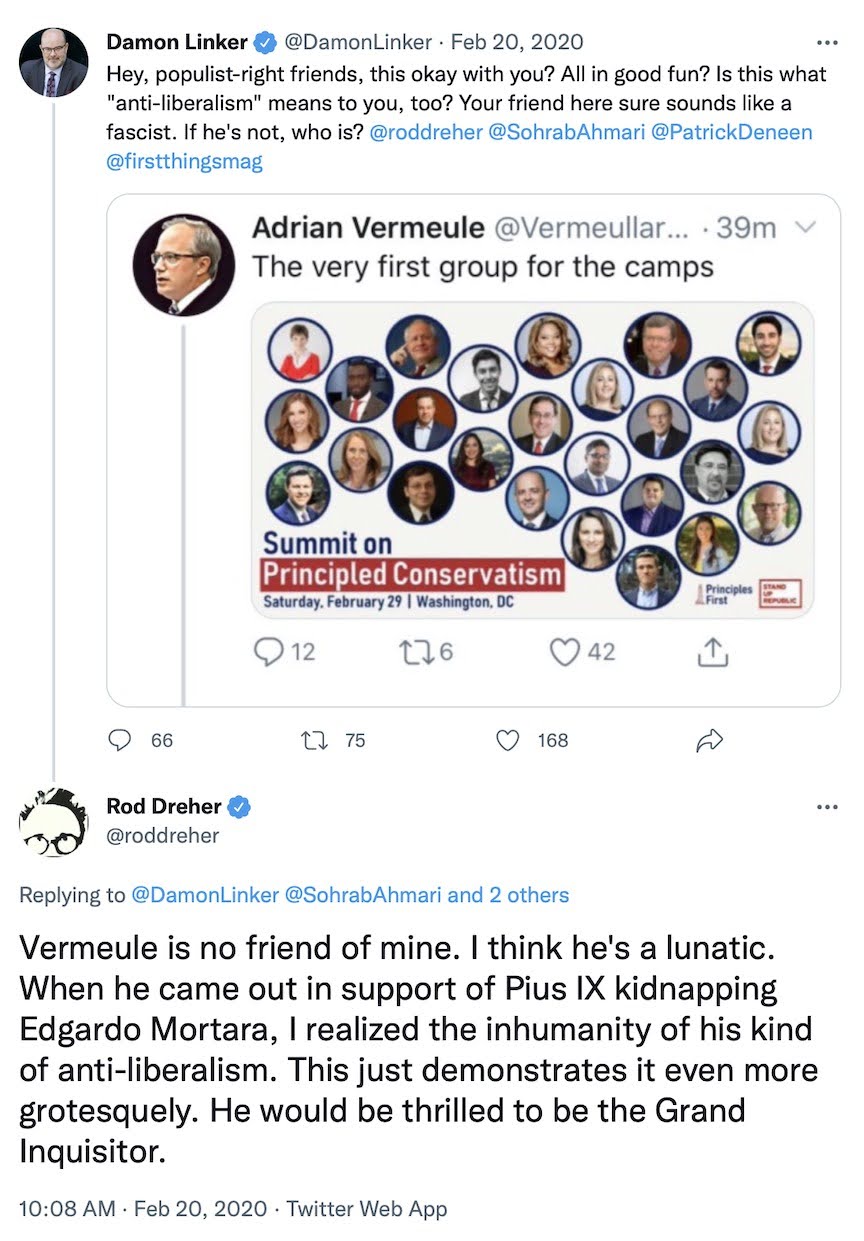
Jack Balkin debates fascists. 

The republican tradition certainly hopes that citizens and officials alike will possess civic virtue and be devoted to the common good. At the same time, it does not assume that government officials will in fact have civic virtue and be adequately devoted to the public good. Republican theory focuses instead on the fact that republics are difficult to maintain and easily corrupted; that government officials—and especially executive officials—are likely to engage in self-aggrandizement, self-dealing and a desire to maintain power; that representative government can easily slide into oligarchy; and that public officials will undermine the public good in the process. Anyone who has lived through recent American history can understand the contemporary relevance of these ideas.

Vermeule, by contrast, is comparatively complacent about these questions. Along with Eric Posner, he coined the phrase "tyrannophobia" to describe an excessive concern with government overreaching, self-aggrandizement and illegitimate attempts by rulers to entrench themselves in power.

But what Vermeule regards as a pathology of thought is actually a central idea in the republican tradition—and the liberal tradition as well. It is precisely because of a deep concern that public officials will become corrupt, misbehave, or try to entrench themselves in power that the republican tradition has focused on questions of separation of powers, checks and balances, rule of law limitations, and rights.

Balkin's contribution as part of a symposium that includes more than one: Vermeule and an earnest defender. There's a time for choosing honey over vinegar, and those are Balkin's words, but this ain't it.  

repeats: Leiter's model of academic discourse, paraphrased  

Universities would deserve criticism for rejecting a presentation by the authors of the Nuremberg Laws, but would be right in rejecting a speech by a rabble-rousing journalist who promotes them.

John Quiggin, 2008: "Sunstein argues that the echo chamber effect tends to reinforce existing views and produce a poisonous partisan divide. It seems to me that exactly the opposite is true. "

repeats

I always thought Sunstein's point was obvious, especially for any culture founded on individualist liberalism. It's that culture that's given us Facebook and surveillance capitalism and personalized marketing, the virtual store where the displays are changed and items moved to the front to fit your last purchases. Newsfeeds work the same way, reinforcing biases, from narrowcasting to microcasting to the narcissism where the world is reduced to a mirror.

Twitter changed its algorithm years ago, forcing you to choose between replying to a tweet and quoting it, limiting the exposure of either your followers or those of the person you're replying to. Up to that point a reply appeared on both timelines.

Ryan Cooper 

Have you ever argued with a conservative? They won't learn anything no matter what I say or where I say it. Whatever I say is wrong by definition.

The same is "true"—the same facts hold—for liberals, and for most people. They hold for Cooper. 

The web was made by techs and in the Anglosphere self-selected for technocratic culture—I haven't used that link in a while. It's was made for talking to your friends, not for argument. I was told that 20 years ago. It's the model of civility, contempt and passive aggression basic to academia under the pretense that academia, educated liberals, the elite, the licensed vanguard are just that.  It was always bullshit.  Balkin, practicing "high politics" treats Vermeule as a friend. He's from the same tradition as Panofsky, but he's weaker. He called Vermeule and Posner "fine young scholars", when they defended legalized torture. I had more patience in 2004.

Balkin has a tag. Vermeule has one.  I emailed Balkin as I do sometimes, to ask him why he's done it again, ceding ground to opponents of democracy.  

I've gotten drunk with honest reactionaries. They're better company than hypocrites. I cede them nothing. But I have more contempt for liberals like Cooper who are blind to what they are. 

If everything is political, then high politics and low politics both have their place.  There's a time for debate and a time to stand on principle and walk away. If you don't understand both you don't understand either.

The Mortara Case "Why Some Catholics Defend the Kidnapping of a Jewish Boy"


Dreher, 16 days earlier:
The invention of the "Judeo-Christian" tradition, etc.

 repeating the link above.

Most arguments against mass surveillance don't respond fully substantively to claims that you shouldn't worry if you "have nothing to hide".  Defense of personal freedom isn't enough.  What's needed is an argument in defense of the need for citizens in a democratic state to be able to be all kinds of wrong, all kinds of confused, creepy, conflicted, desirous, weepy or hate-filled, so that they may be able to learn to understand and outgrow their childishness. The choice is between a community of adults with a minority of the inveterately childish and criminal or a community of children ruled by moralists and crime lords.

Freedom of speech is the right to argue for freedom of property. Those who defend freedom of property are among the first to oppose freedom of speech. I support Vermeule's right to be a fascist, but an earnest engagement with his ideas is to take fascism seriously as an intellectual position. Allowing the argument to exist does not mean treating it with respect. It means destroying it, again, and again.

"It is the common fate of the indolent to see their rights become a prey to the active. The condition upon which God hath given liberty to man is eternal vigilance; which condition if he break, servitude is at once the consequence of his crime and the punishment of his guilt."

I like Balkin, but he's a law professor, not a lawyer. He's passive. He's not a legal philosopher—they all suck—but he doesn't understand the importance of vulgarity. 

I forgot I'd used this with Vermeule already. All I do is repeat myself.

…in a hospital tent at the clearing station I came across a man with a French flag wrapped around his waist; the medics discovered it when they cut his shirt away. He was a hard-looking, blondish chap with a mouthful of gold teeth and a face adorned by a cross-shaped knife scar—the croix de vache with which procurers sometimes mark business rivals. An interesting collection of obscene tattooing showed on the parts of him that the flag did not cover. Outwardly he was not a sentimental type.
"Where are you from?" I asked him.
"Belleville," he said. Belleville is a part of Paris not distinguished for its elegance.
"What did you do in civilian life?" I inquired.
That made him grin. "I lived on my income," he said.
"Why did you choose the Corps Franc?"
"Because I understood," he said. 

And again: thugs against fascists

"He was always a loser, a jest/he barely got 50% on his high-school test/with a bribe the rich kid's a fool no more/got 100 diplomas hanging on his door/You crows nesting in our house/why are you ruining all our fun?

We won't do as you tell us/Spare us your face/Cook up your case/That's what the Interior does/I'm arrested and charged as a terrorist/Just for holding a flare and singing Ahly"

All philosophy is perverse.

Wednesday, May 18, 2022

Lev Golinkin, The Nation: Meet the Head of Biden’s New “Disinformation Governing Board”

Late last month, the Joe Biden administration publicly confirmed that a “Disinformation Governing Board” working group had been created within the Department of Homeland Security. The news prompted a flood of concern about the impact of such an Orwellian organ on America.

But there’s no need to engage in hypotheticals to understand the dangers. One has to only consider the past of Nina Jankowicz, the head of the new disinformation board.

Jankowicz’s experience as a disinformation warrior includes her work with StopFake, a US government-funded “anti-disinformation” organization founded in March 2014 and lauded as a model of how to combat Kremlin lies. Four years later, StopFake began aggressively whitewashing two Ukrainian neo-Nazi groups with a long track record of violence, including war crimes.

Today, StopFake is an official Facebook fact-checking partner, which gives it the power to censor news, while Jankowicz is America’s disinformation czar. 

Remember that Leiter and others defend academic freedom, and are against free speech for the rest of us.

These platforms are now responsible for shaping and allowing participation in our new digital and democratic culture, yet they have little direct accountability to their users. Future intervention, if any, must take into account how and why these platforms regulate online speech in order to strike a balance between preserving the democratizing forces of the internet and protecting the generative power of our New Governors.

They may or may not associate corporations with rightful "epistemic authority", but they damn sure associate themselves with it.

Facebook reversed its reversal of its Azov policy after the shooting in Buffalo.
---
Now Golinkin tells me the policy's unchanged.  But Jancowicz is gone.
 

Emerson T. Brooking (@etbrooking) is at the Atlantic Council, with Oleksiy Honcharuk.
On October 13, photographs started circulating across social media showing a man resembling Ukrainian Prime Minister Oleksiy Honcharuk on stage at the “Veterans Strong” concert event in Kyiv. This was, however, no ordinary concert — it was organized by a far-right figure accused of murder, and headlined by a neo-Nazi band. 

Thursday, September 02, 2021

Not bad

Washington, D.C. and Menlo Park, CA-- Today Facebook and the United States Supreme Court announced a joint venture, the creation of a Supreme Court Oversight Board that will perform tasks that the Supreme Court is no longer able to perform: hearing cases on the merits after full oral argument and briefing, and rendering reasoned opinions explaining its conclusions to the public. 

To this end, the new Supreme Court Oversight Board (SCOBUS) will contract with a group of former judges to do what Supreme Court Justices used to do. The U.S. Supreme Court will continue to tweet out its decisions at or around midnight, and leave it to the new Oversight Board to explain their legal meaning to others and take all responsibility for decisions that people don't like.

"We're extremely grateful to Facebook for suggesting this possibility to us," Justice Samuel Alito explained. "With 60 to 80 cases a year and only four clerks per Justice, we can't possibly carefully consider every case brought before us, much less justify our conclusions. Frankly, we're swamped. Many of us are busy writing best-selling books and doing book tours, which consumes a lot of our time."

"We think that this is a win-win for the Supreme Court," added Mark Zuckerberg, Facebook's founder. "We know what it's like to be a secretive, all-powerful body, accountable to nobody, that holds the fate of countless people in its hands."

I wonder who wrote it. It wasn't Balkin. Or maybe it was. 

And another: Private Enforcement Mechanisms and You

Draft and enact a statute – maybe in CT but no, especially in DC -- that prohibits the expression of anti-choice views and anti-choice advocacy and delegates enforcement of that law to “any person.”  Statutory damages for violation of the statutory would be – let’s go big -- $100,000.  Anyone could then sue Americans United for Life and individuals (politicians) advocating for the overthrow of Roe.   

Or here’s another one. Prohibit entry to the bar to a group of people (you pick) and also prohibit anyone from aiding or abetting a member of that group who is trying to become a member of the Bar.  (See, e.g., Law Schools, Professors, the LSAT people, me – I’m a clinical professor). The law could even be applied retrospectively to members of this group who are members of the Bar.  Delegate enforcement of the law to another specific group of people).  Statutory damages for violation of the law again 100,000.  A form of reparations.

Let’s see how quickly things would change. I suspect the Court would rush to prevent such laws from taking effect. It would decide we need to have a mechanism for enforcement of federal constitutional rights in federal court and states can’t void this mechanism by playing these sorts of games.  Either our interpretation of the 11th amendment must change or the Ex Parte Young doctrine – already a ‘fiction’ after all – must be broadened.  Would they limit these mechanisms to the fancy First Amendment, cuz it’s the most important – it was first, foundation of democracy, etc., etc.  You be the Judge.

new tag for Judicial Review.  a bit late.

Saturday, February 27, 2021

Nevada Governor Proposes Giving Tech Firms Power to Govern [He's a Democrat]

And Paul Romer, again. 
And Kate Klonick, again.

These platforms are now responsible for shaping and allowing participation in our new digital and democratic culture, yet they have little direct accountability to their users. Future intervention, if any, must take into account how and why these platforms regulate online speech in order to strike a balance between preserving the democratizing forces of the internet and protecting the generative power of our New Governors.

Balkin's not a wartime consigliere.  

Wednesday, February 24, 2021

"Information fiduciaries" again
Wolff is a professor of economics at UMass. The post is here. I was blocked from sharing it, but not the Guardian article itself. From Doug Henwood on twitter. 

The Greyzone, Blumenthal, and Reuters 

 What's the definition of a "platform"?

In that same update about group recommendations, the product manager also explained how leaders decided against making changes to a feature called In Feed Recommendations (IFR) due to potential political worries. Designed to insert posts into people’s feeds from accounts they don’t follow, IFR was intended to foster new connections or interests. For example, if a person followed the Facebook page for a football team like the Kansas City Chiefs, IFR might add a post from the NFL to their feed, even if that person didn’t follow the NFL.

One thing IFR was not supposed to do was recommend political content. But earlier that spring, Facebook users began complaining that they were seeing posts from conservative personalities including Ben Shapiro in their News Feeds even though they had never engaged with that type of content.

When the issue was flagged internally, Facebook’s content policy team warned that removing such suggestions for political content could reduce those pages’ engagement and traffic, and possibly inspire complaints from publishers. A News Feed product manager and a policy team member reiterated this argument in an August post to Facebook’s internal message board.

“A noticeable drop in distribution for these producers (via traffic insights for recommendations) is likely to result in high-profile escalations that could include accusations of shadow-banning and/or FB bias against certain political entities during the US 2020 election cycle,” they explained. Shadow-banning, or the limiting of a page’s circulation without informing its owners, is a common accusation leveled by right-wing personalities against social media platforms.

Throughout 2020, the “fear of antagonizing powerful political actors,” as the former core data scientist put it in their memo, became a key public policy team rationalization for forgoing action on potentially violative content or rolling out product changes ahead of the US presidential election. They also said they had seen “a dozen proposals to measure the objective quality of content on News Feed diluted or killed because … they have a disproportionate impact across the US political spectrum, typically harming conservative content more.”

The data scientist, who spent more than five years at the company before leaving late last year, noted that while strides had been made since 2016, the state of political content on News Feed was “still generally agreed to be bad.” According to Facebook data, they added, 1 of every 100 views on content about US politics was for some type of hoax, while the majority of views for political materials were on partisan posts. Yet the company continued to give known spreaders of false and misleading information a pass if they were deemed “‘sensitive’ or likely to retaliate,” the data scientist said.

“In the US it appears that interventions have been almost exclusively on behalf of conservative publishers,” they wrote, attributing this to political pressure or a reluctance to upset sensitive publishers and high-profile users.

As BuzzFeed News reported last summer, members of Facebook’s policy team — including Kaplan — intervened on behalf of right-wing figures and publications such as Charlie Kirk, Breitbart, and Prager University, in some cases pushing for the removal of misinformation strikes against their pages or accounts. Strikes, which are applied at the recommendation of Facebook’s third-party fact-checkers, can result in a range of penalties, from a decrease in how far their posts are distributed to the removal of the page or account.

Kaplan’s other interventions are well documented. In 2018, the Wall Street Journal revealed that he helped kill a project to connect Americans who have political differences. The paper said Kaplan had objected “when briefed on internal Facebook research that found right-leaning users tended to be more polarized, or less exposed to different points of view, than those on the left.” Last year, the New York Times reported that policy executives declined to expand a feature called “correct the record” — which notified users when they interacted with content that was later labeled false by Facebook’s fact-checking partners — out of fear that it would “disproportionately show notifications to people who shared false news from right-wing websites.”

Wednesday, February 17, 2021

The Research Director of the Knight First Amendment Center at Colombia 

In the NYT,  @jameeljaffer  and I argue that the new Facebook Oversight Board should push FB for a full investigation of how the platform may have contributed to the Jan. 6 Capitol riots before they take up the Trump suspension question.
"Facebook’s ‘Supreme Court’ Faces Its First Major Test" 

Jaffer is the The Executive Director.  The New Yorker piece, by Kate Klonick, in context. 
Stoller is good.
“Fundamentally American”? No. Facebook represents a fundamentally un-American view of free speech. We have never had public policy to centralize control of communications and media like this before.

To be fair, both those were written before today's news. A lot of people are going to be ashamed of their earlier positions, including Balkin. This is going to hit. Palestine will take a little longer. 

But this really is becoming fun. 

Friday, January 29, 2021

"Shut the front door!"

Patterson again, Law and Truth

For Dworkin, understanding law is akin to understanding language. As we have noticed, Dworkin sees interpretation as a pervasive feature of many aspects of human existence. He believes it to be of central importance to jurisprudence. Dworkin explains that because “law is an interpretive concept, any jurisprudence worth having must be built on some view of what interpretation is.”98 As we shall see, Dworkin makes far too much of the work of interpretation.

Before turning to the role of interpretation in law, we need to look closely at Dworkin’s general claim that understanding in law (or any other social practice) is a matter of interpretation. Perhaps it is best to begin by reminding ourselves of the putative work of interpretation. To do this, recall the following statement by Dworkin: “We interpret the sounds or marks another person makes in order to decide what he has said.”99 What role does Dworkin assign to interpretation in his account of one person understanding the written or spoken words of another? In the sentence just quoted, it is fair to say that interpretation mediates between the sounds or signs emanating from the mouth or pen of another and the act of meaning apprehension on the part of the listener or reader. Interpretation, as Dworkin says, is something we do. And why do we do it? What results from it? We do it “in order to decide what [another person] has said.”100
Presumably, if we interpret another correctly, we have grasped the meaning of his words. If not, then we have interpreted him incorrectly. Whether correct or not, the act of interpretation is interposed between the utterance and our grasp of its meaning. Interpretation is an act of mediation: Done correctly, it results in the apprehension of meaning. Done poorly, comprehension eludes us.

Dworkin’s claims to the contrary notwithstanding, understanding an utterance is not a matter of deriving its meaning through an act or operation of mind.101 The criterion for understanding an utterance is not engagement of a process; rather, it is acting appropriately in response to the utterance.102 For example, one evinces understanding of the request “Please pass the salt” by passing the salt or by explaining why it is impossible to do so. Understanding is made manifest in the act of passing the salt, and the act is a criterion for having understood the utterance.103 Understanding is acting properly in response to the request. If the request is vague or otherwise opaque, interpretation of the request may be necessary, otherwise not.

This last point suggests a certain logical problem endemic to accounts such as Dworkin’s, which assign a primordial role to interpretation in normative activities. As mentioned, interpretation is best thought of as an activity we engage in when our understanding of an utterance is somehow in question (e.g., a request to pass the salt when the salt is directly in front of the person making the request). Interpretation is an activity of clarification: we take the utterance in question and appraise competing construals or interpretations of it in an effort to clarify its meaning.104

If all understanding were interpretation, then each interpretation would itself stand in need of interpretation, and so on, infinitely regressing to infinity.105 This logical problem, one long ago recognized,106 suggests that there is something deeply wrong with assigning to interpretation a mediating role between utterances and the understanding of them. The only way out of this vicious regress is to recognize that the normativity of rule-guided behavior (e. g., law) lies not in the act of the individual (e.g., interpretation) but in a practice. Of course, Dworkin argues that law is a practice, and in this he is surely correct. He has simply misstated the role of interpretation in that practice.

[99-100, cite Dworkin, Law's Empire, the rest cite P.M.S. Hacker,  "Language, Rules and Pseudo-Rules" notes below in the original]

101. See Hacker, supra note 13, at 168 (arguing in the spirit of Wittgenstein that understanding is best explained as an ability).
102. Id. at 167—68 (“Understanding sentences of a language is a skill that is manifest in using sentences correctly in appropriate circumstances, in reacting appropriately to their use, and in explaining (if asked) what they mean.” (emphasis added)).
103. See Ludwig Wittgenstein, On Certainty § 29 (G. E. M. Ansombe 8: G. H. von Wright
eds., Denis Paul 8: G. E. M. Anscombe trans, 1972) (“Practice in the use of the rule also shews what is a mistake in its employment.”)."
104. See Hacker, supra note 13, at 168 (arguing that interpretation is explanation and that explanation is usually required only when a statement contains “[o]bscurities, ambiguities, or complexities”).
105. A recent discussion of this problem in the context of rule-following is Charles Taylor, “To Follow a Rule,” in Rule: and Convention: 167 (Mette Hjort cd., 1992).
106. Wittgenstein mentions the problem in the following discussion: “This was our paradox: no course of action could be determined by a rule, because every course of action can be made out to accord with the rule. The answer was: if everything can be made out to accord with the rule, then it can also be made out to conflict with it. And so there would be neither accord nor conflict here. It can be seen that there is a misunderstanding here from the mere fact that in the course of our argument we give one interpretation after another; as if each contented us at least for a moment, until we thought of yet another standing behind it. What this shews is that there is a way of grasping a rule which is not an interpretation, but which is exhibited in what we call ‘obeying a rule’ and ‘going against it’ in actual cases. Hence there is an inclination to say: every action ac- cording to the rule is an interpretation. But we ought to restrict the term ‘interpretation’ to the substitution of one expression of the rule for another.” Wittgenstein, supra note 1[Philosophical Investigations, Anscombe], at § 201. 

 Hacker, "Language, Rules and Pseudo-Rules"  

Philosophers, unlike linguists, are not typically tempted to assimilate mastery of a language to a mental state. They recognize that it is an ability. But they insist that this ability can only correctly be characterized by reference to a theory of meaning for the language. They point out correctly that an ability is characterized by specification of what it is an ability to do. The investigation and determination of a person’s abilities involve studying the exercises of his abilities in practice. But philosophers are immediately thrown off the track by the idea that to understand a sentence is to assign to it its truth-conditions, and by the correct observation that there is no limit to the number of sentences that a speaker of a language can understand (although this platitude is usually cast in the form of the incorrect claim that one can understand an infinite number of sentences).From this it seems to follow that since one cannot list all the sentences of a language and pair them with their truth-conditions, one must construct a recursive theory consisting of axioms, rules and principles which can ‘generate’ the truth-conditions of any arbitrary sentence of the language. Such a theory will, it is held, be a ‘model’ of what it is to understand a language. There are many reasons for doubting the coherence of this picture. Here I shall point out only one salient disturbing feature. Assigning truth-conditions to a sentence is not an act which human beings engage in; it is not a piece of human behaviour  that manifests the ability that we call ‘understanding a language’. Asking and answering questions, issuing requests, pleas or orders and complying with them, passing judgment, making statements, describing things are exercises of one’s linguistic abilities. These and a myriad other acts (including buying and selling, signing cheques, making contracts and wills, following instructions, obeying regulations, building and using complex machines) manifest one’s understanding of a language. But these are not, nor do they involve, acts of assigning truth-conditions to sentences.Understanding sentences of a language is a skill that is manifest in using sentences correctly in appropriate circumstances, in reacting appropriately to their use, and in explaining (if asked) what they mean.

To understand an utterance is not to perform any act of derivation whereby the meaning of the utterance, conceived as its truth-condition, is derived from the meanings of its constituents and its structure in accord with the rules and principles of a theory of meaning. The criteria for whether someone has understood an utterance are not criteria for the performance of a derivation of a theorem from axioms and rules. To understand the question ‘Is the door shut?‘, the request ‘Shut the door, please’ or the assertion ‘The door is shut’ is not to engage in any computational process, although it is of course true that if one does not know what ‘door’ means, one will probably not understand these utterances. A person manifests his understanding of the question ‘Is the door shut?’ by answering ‘Yes, it is’ or ‘No, it isn’t’ or ‘I can’t see from here’ etc.; but not by absurdly saying ‘It is a theorem of English that “The door is shut” is true if and only if the door is shut’.

Similarly it is a grievous error to think that in understanding an utterance one always or even usually engages in interpretation. To interpret an utterance is to explain it, typically to paraphrase it in the same language or to translate it into a different language. But when I ask ‘What is the time?’ I understand what I have said without interpreting my own words, and if my addressee speaks English he too will understand my words without interpreting them. Obscurities, ambiguities or complexities may call out for an interpretation, but it would be wholly incoherent to think that all understanding is interpreting. For then the interpretation given, i.e. the paraphrase, would itself stand in need of an interpretation in order to be understood; and a vicious regress would be generated. This misconception has manifold roots. One is the bizarre idea that what we hear or utter are mere sounds which have to be correlated with or mapped on to meanings in order to be understood. But we no more hear or utter mere sounds than we see or paint mere patches of colour. We hear and utter meaningful words and sentences, just as we see multicoloured objects such as chairs and tables, trees and flowers. The idea that all understanding is interpreting is a transposition onto a linguistic plane of the empiricist dogma of the ‘bare given’ (sense data, sensibilia, ideas or impressions) that constitutes the raw data of experience. A second source of misunderstanding is the correct insight that if someone understands an utterance he can explain what it means. Indeed, how a person explains as sentence uttered on an occasion is one criterion for whether he understands it. But it does not follow that to understand is to explain or interpret. For another criterion of understanding is what one does in response to an utterance. One manifests one’s understanding of the request ‘Shut the door, please’ by shutting the door, not (typically) by saying ‘I take it that you wish me to close the portal’.

T.S. Eliot, "Hamlet and his Problems"

Qua work of art, the work of art cannot be interpreted; there is nothing to interpret; we can only criticize it according to standards, in comparison to other works of art; and for “interpretation” the chief task is the presentation of relevant historical facts which the reader is not assumed to know. Mr. Robertson points out, very pertinently, how critics have failed in their “interpretation” of Hamlet by ignoring what ought to be very obvious: that Hamlet is a stratification, that it represents the efforts of a series of men, each making what he could out of the work of his predecessors. The Hamlet of Shakespeare will appear to us very differently if, instead of treating the whole action of the play as due to Shakespeare’s design, we perceive his Hamlet to be superposed upon much cruder material which persists even in the final form. 
Hacker, "To understand the question ‘Is the door shut?‘, the request ‘Shut the door, please’ or the assertion ‘The door is shut’ is not to engage in any computational process"
"Shut the front door, Robot" Question Begging 101, with Prof. Descartes, aka The Wizard.  “That which cannot be said must not be said. That which cannot be said, one must be silent thereof.” Getting Is from Ought. "Pay no attention to the man behind the curtain!" Replacing Chomskian absurdity with more of the same.  Jesus fuck. [video added 2/05, because why not?]


Patterson again, "Against a Theory of Meaning" 
A language is not something about which one can have a theory. Nor is a language itself a theory. Quantum mechanics and historical materialism are theories. Each is formulated in a language in terms of laws and explanatory principles. Thus, to construct a theory, one must already have mastered a language. A fortiori, it is implausible to speak -as Chomsky does 1-of children learning their native language by constructing theories of grammar. 2

1. See Noam Chomsky, A Review of B.F. Skinner's Verbal Behaviour, 35 LANGUAGE 26,57 (1959) ("The child who learns a language has in some sense constructed the grammar for himself on the basis of his observation of sentences and non-sentences (i.e. corrections by the verbal community).").
2. The most complete and thoroughgoing rout of the philosophical excesses of linguistics is GORDON B. BAKER & PETER M. HACKER, LANGUAGE, SENSE AND NONSENSE (1984).
Patterson: You can't make series of observations and inferences without language. Bullshit.
Reminds me of the first time I read Searle, beyond his exchanges with Dennett. All the same shit. At some point it all comes down to an assumption: a virgin birth, a can opener, a self.

See previous, Glenn Gould and Wittgenstein.
Patterson and Hacker from 2010. I forget these things.

Saturday, October 17, 2020

The answer is no

The idiot Tushnet 

Yesterday I was contacted by a reporter with PolitiFact, with a question based on this statement by Joe Biden: “The only court packing is going on right now. It’s going on with the Republicans packing the Court now. It’s not constitutional what they're doing.” The question to me was in connection with a “fact check,” and asked, “Is what's happening right now -- the Republican push to install Amy Coney Barrett as the ninth Supreme Court justice -- in any way unconstitutional?” 

I now realize that I should have answered that the question was badly posed as a “fact check” one because treating a claim about the Constitution as implicating a fact – rather than an opinion, or a prediction, or an assessment of whether there are reasonable arguments one way, the other way, or both ways – is just a mistake. But I didn’t, and the result, I think, was a decrease in civic knowledge (if anyone pays attention to PolitiFact).

Here’s my initial response: “As usual with this sort of thing, the answer’s complicated because ‘unconstitutional’ can and does mean many things. (1) If ‘unconstitutional’ means that a court would find what the Republicans are doing to be inconsistent with the Constitution, the answer is no, no court would make such a holding. (2) If ‘unconstitutional’ means that what they are doing is inconsistent with what some people reasonably view as fundamental principles underlying the constitutional order, then yes, what they are doing is unconstitutional. The political uses of the word ‘unconstitutional’ are different from the purely legal uses, but both (or all) kinds of uses are well within the bounds of the way we -- ordinary people, politicians, and lawyers -- talk about the Constitution. I know that this isn’t the way you do things, but I personally wouldn’t award any Pinocchios to the statement.”

I responded to a follow-up question about my second point by identifying as a relevant “fundamental principle” that “the political system should operate over time to ensure that overall all of our institutions are roughly in line with what the American people want.”

PolitiFact’s editors awarded a “False” to the Biden statement. The reason, supported by statements they got from Sai Prakash, Ilya Shapiro, and Robert Levy, appears to be that the word “unconstitutional” can be applied only to practices that are addressed by some express terms in the Constitution, supplemented with the proposition that everything not so addressed is to be determined by politics, understood to include sheer political power but not to include fundamental principles underlying the constitutional order. That reason and proposition are coherent and defensible (though wrong, in my view), but so are alternatives, and the labels “true” and “false” just aren’t apposite. (The formulation of the question to me – “in any way” – ought to have caused the PolitiFact editors to reflect a bit more upon their choice.)

So bored of this shit (a link to the old Balkin, not the new one).

I've said it a dozen times. In the past the ACLU took no position on the Second Amendment. It was the only principled response to questions that could only be resolved politically. 

If the labels "true" and "false", "constitutional" and "unconstitutional", aren't apposite, neither are the labels "sheer political power",  and "fundamental principles".

(The formulation of the question to me – “in any way” – ought to have caused the PolitiFact editors to reflect a bit more upon their choice.)

Shorter Tushnet: "It's their fault I can't explain things simply."

No trial lawyer would make Tushnet's mistake. A smarter politician wouldn't have made Biden's.

Academics don't take politics seriously. They're theologians defending their own ratiocinations as truths. Most law professors forget, if they ever knew, what it means to be a lawyer. They identify with judges. 

The university belongs, like the church and the military, to the social institutions that are situated at a considerable distance from democracy and adhere to premodern power structures. 

Complain all you want about the Senate and the electoral college; the lack of a federal secondary education system is a bigger problem. It's a country of 50 states, and Americans as a collective are the most powerful, uneducated, inarticulate, narcissistic people on the planet.

the political system should operate over time to ensure that overall all of our institutions are roughly in line with what the American people want.

I want to say Tushnet would do more good teaching high school or at a community college, or night school but he'd fuck that up too.