Showing posts with label Aristocrats. Show all posts

Tuesday, February 04, 2025


We are the hollow men
We are the stuffed men 
Leaning together
Headpiece filled with straw. Alas!
Our dried voices, when 
We whisper together 
Are quiet and meaningless
As wind in dry grass 
Or rats’ feet over broken glass
In our dry cellar
Someone grabbed some text from Yarvin's interview, so I did the obvious. I told Sam Moyn today that and he his peers are more responsible than anyone for the failure of the republic. Musk is a symptom. If I want to be the determinist I sometimes claim to be—If *I* want to be the determinist *I* sometimes claim to be—I shouldn't credit anyone as a cause, but I really hate liberals so fucking much. And I hate the pretensions of Oxbridge philosophy, the academic "left", and cosplay communists.  

Yarvin doesn't know what aristocracy is  any more than liberals do. I'm not going to repeat myself for the thousandth time.

In other countries most of the intellectual left admit if only tacitly, that they defend the ideals of the high bourgeois. Americans have no sense of irony. The country has been destroyed by sincerity.

Saturday, November 25, 2023

Foucault and the obvious, again and again, and again.

From an academic who found this interesting.  

There has been a lot of debate about Michel Foucault’s political orientation. He himself seemed quite content that readers found it hard to place him on a conventional left-right spectrum. But where did he stand, in the end?

I have been thinking a lot about this question. Foucault always subscribed to a number of social projects. And in his texts he was talking to readers in an ongoing transformative process. Over the past year I edited his 1971–1972 lectures at the Collège de France, together with Bernard Harcourt, and it became clear to me that his thinking revolved around the idea of change, of transformation, of individuals and collectives. In the stale climate of the 1960s we thought the transformation could occur only through literature and art. And in the early 1970s, when things were opening up, Foucault thought that social change was possible merely by changing a small number of very important relations of power — for example, the prison system. But already in 1976 he realized that this project of social change was a failure, and that people are much more easily mobilized by religious motives or nationalistic ones. The great movements weren’t social. He didn’t give up on his project of social change. But it had gotten more complicated.

The aristocratic critique of bourgeois democracy and moralism. click on the tags 

“What’s on the menu?” asks Kissinger, and I can barely restrain myself from shrieking, “What’s on the menu, Henry? Would that be Operation Menu?”

Liberals are idiots. Optimists are first optimists about themselves. The demimonde is always full of monarchists, etc. etc. But Ewald seems sort of grotesque.

The coverage of the Palestinian experience in the American press has never been this open. 

I got a laugh saying the fact that Bella Hadid exists is more important than anything Edward Said ever wrote. It's called naturalism. 

Thursday, May 25, 2023

in re:the last two posts

Her only piece of writing advice, if it can be called that, is: “If it’s not a risk then it’s nothing.”

What's the relation between those who want risk and those who want to be left the fuck alone?  Or those who've acclimated to risk and those who haven't? I'm not sure Annie Ernaux has thought that far ahead. She's an alienated individualist, in the sense of dedicating her life to the recording of her own experience, but she uses others as material only in the production of words. She instrumentalizes people from her past, expressing her superiority as an author controls characters, at the same time defending people as a whole, as a community, against those who would instrumentalize them in life in the service of wealth. Her life is dedicated to noblesse oblige. It's the moral superiority of a whore. "Better a victim than a victimizer" as my mother used to say. And my mother had a deep respect for whores. Leftism, Iris Murdoch and The Story of O. 

"No idea's original, there's nothing new under the sun"

Saturday, May 20, 2023

It is precisely in this conclusion, however, that the analytical shortcomings of Welfare for Markets come into view. Can this metaphysic of money do the explanatory work that Jäger and Zamora ask it to do, given that social life has been principally mediated by money and markets in the Global North for several centuries now? After all, as the authors remind us with the book’s first epigraph, Karl Marx already offered a trenchant critique of the “cash nexus” by the 1840s—nearly a century before the height of the solidaristic politics whose downfall the book justifiably laments. If the monetary mediation of life is really so singularly corrosive, one might wonder how the New Deal emerged at all in a country where life insurance has been a mass industry since the Civil War. It is necessary to push deeper since, as Alyssa Battistoni observed in her political reading of Virginia Woolf’s A Room of One’s Own (1929), money is first and foremost a means to life itself. When Woolf marveled at the transubstantiation of the physical money in her hands after a small bequest left her a fixed allowance for life, her elation was entirely unrelated to the possibilities of individualized consumption. “It is remarkable,” Woolf observed, “what a change of temper a fixed income will bring about. No force in the world can take from me my five hundred pounds. Food, house and clothing are mine forever.” 

Battistoni, (Harvard/Barnard/Jacobin/Utopia), is in the middle.

I'm bored.

The great majority of nobles either did not know how, or did not wish, to get rich. The great majority of younger sons had no desire to "derogate." They sought the remedy elsewhere, in a growing exclusiveness. Some held that the nobility should form a body like the clergy and be constituted as a closed caste.

New gen European intellectual historians: "You can't give people free money. It's turn them into vulgar materialists!" The new gen American historians. "Well..."  The corollary to the Americanization of the world.

Back to the review.

Jäger and Zamora, both Belgian, are historians of modern political thought... 

Zamora’s puckishly framed The Last Man Takes LSD: Foucault and the End of the Revolution (2021), co-written with Mitchell Dean, ruffled feathers by exploring what it took to be Michael Foucault’s alleged late career dalliance with the libertarian undercurrents of neoliberal and Californian thinking.

Again too perfect. Back to Baudelaire.

This habitude of military metaphors denotes minds not military, but made for discipline, that is, for conformity, minds born domesticated, Belgian minds, which can think only in society. 

Foucault was a libertine. The demimonde is always full of monarchists. The "ruffled feathers" belong to moralists. Genet opposed prison reform because prison made him what he was. It's almost bizarre that I even have to say this shit.

In his mid 30s my brother quit his job, left his apartment and moved into a homeless shelter to work on his chess game. The man on the right is the Representative of the Dutch Ministry of Finance and self-described paleo-libertarian. My brother works as a proofreader. He won the game, winning the tournament and two weeks in Russia.

All of the writers above live lives dedicated to work, competition, argument, posing, and climbing. People who aren't interested in any of those things shouldn't be forced to suffer all the consequences. Oxbridge philosophs and Oxbridge bankers are cut from the same cloth: they like to win and rule. 

Give people free money and legalize bloodsport. Bring back politics and stop teaching its theory. Teach history from second grade and leave philosophy as an elective in college. France is different. The relation to the Netherlandish and the Anglosphere is an interesting topic.
---
Torracinta (Boston Review) again
One might expect to encounter this perspective in the words of transfer recipients themselves. Yet in perhaps the biggest shortcoming of the intellectual historical orientation of Welfare for Markets, such voices are entirely absent. Firmly ensconced in the world of planners, economists, utopians, technocrats, philosophers, and the occasional activist, the book notably overlooks the views of the poor, who are portrayed in precisely the same abstract fashion that Jäger and Zamora explicitly decry when it comes to economic theory.
more on Jäger and Zamora
Torracinta, here second row left

Friday, May 12, 2023

An amazing photograph; so much there if you choose to make the effort. Self-identifying as a thinker or anything else is meaningless.


serendipity. The secret to comedy. But nobody gets my jokes.


Sunday, May 07, 2023

updated a few times by now

John Ganz got into a twitter feud with a wise-ass, who turned out to be an asshole, but it started when the asshole made a point that was obvious to Panofsky 90 years ago, though the asshole overstated his case. It wasn't obvious to Ganz so I paid my 5 dollars and subscribed again, just so I could use the quotes I have for years. I riffed a bit on Richter and the art world, told stories and name-dropped. After that I cancelled my account. I don't think Ganz knows it was me. He liked the comment. Or maybe deleting it might have been difficult. Or maybe he'll still do it. If Shadi Hamid can like and delete, why not Ganz? 

Film art is the only art the development of which men now living have witnessed from the very beginnings; and this development is all the more interesting as it took place under conditions contrary to precedent. It was not an artistic urge that gave rise to the discovery and gradual perfection of a new technique; it was a technical invention that gave rise to the discovery and gradual perfection of a new art.

From this we understand two fundamental facts. First, that the primordial basis of the enjoyment of moving pictures was not an objective interest in a specific subject matter, much less an aesthetic interest in the formal presentation of subject matter, but the sheer delight in the fact that things seemed to move, no matter what things they were. Second, that films—first exhibited in “kinetoscopes,” namely, cinematographic peep shows, but projectable to a screen since as early as 1894—are, originally, a product of genuine folk art (whereas, as a rule, folk art derives from what is known as “higher art”). At the very beginning of things we find the simple recording of movements: galloping horses, railroad trains, fire engines, sporting events, street scenes. And when it had come to the making of narrative films these were produced by photographers who were anything but “producers” or “directors,” performed by people who were anything but actors, and enjoyed by people who would have been much offended had anyone called them “art lovers.”

The casts of these archaic films were usually collected in a “café” where unemployed supers or ordinary citizens possessed of a suitable exterior were wont to assemble at a given hour. An enterprising photographer would walk in, hire four or five convenient characters, and make the picture while carefully instructing them what to do: “Now, you pretend to hit this lady over the head”; and (to the lady): “And you pretend to fall down in a heap.” Productions like these were shown, together with those purely factual recordings of “movement for movement’s sake,” in a few small and dingy cinemas mostly frequented by the “lower classes” and a sprinkling of youngsters in quest of adventure (about 1905, I happen to remember, there was only one obscure and faintly disreputable Kino in the whole city of Berlin, bearing, for some unfathomable reason, the English name of “The Meeting Room”). Small wonder that the “better classes,” when they slowly began to venture into these early picture theaters, did so, not by way of seeking normal and possibly serious entertainment, but with that characteristic sensation of self-conscious condescension with which we may plunge, in gay company, into the folkloristic depths of Coney Island or a European kermis; even a few years ago it was the regulation attitude of the socially or intellectually prominent that one could confess to enjoying such austerely educational films as The Sex Life of the Starfish or films with “beautiful scenery,” but never to a serious liking for narratives.

Today there is no denying that narrative films are not only “art”— not often good art, to be sure, but this applies to other media as well—but also, besides architecture, cartooning, and “commercial design,” the only visual art entirely alive. The “movies” have reestablished that dynamic contact between art production and art consumption which, for reasons too complex to be considered here, is sorely attenuated, if not entirely interrupted, in many other fields of artistic endeavor. Whether we like it or not, it is the movies that mold, more than any other single force, the opinions, the taste, the language, the dress, the behavior, and even the physical appearance of a public comprising more than 60 percent of the population of the earth. If all the serious lyrical poets, composers, painters, and sculptors were forced by law to stop their activities, a rather small fraction of the general public would become aware of the fact and a still smaller fraction would seriously regret it. If the same thing were to happen with the movies the social consequences would be catastrophic.

I also added something because the asshole made a comment about Ganz' connection with Zwirner. Ganz is now writing for Artforum and has a piece on Richter. 

Fine art is a luxury commodity. Galleries are luxury boutiques, not bookstores. And of course you're connected to Zwirner. When you were an "artist" in Bushwick did you have any friends who were born there? Any social connection at all to the working class other than as idea? In 1993 Zwirner told me with a shrug to me that there was no difference between art and fashion anymore. Art is now style, and HBO has more art than Chelsea. Panofsky was right. Fine art and couture are vestiges of the old regime. Art for the rich. The connection to philosophy is tied to that and the lie that philosophy is superior to fiction, as theology concerns "truth" and fiction is lies.

All of the above is obvious in 2023, except to pretentious American liberals who call themselves leftists: Ganz and the Brooklyn Institute. I have friends born in Bushwick and I've known Zwirner for 30 years. Ganz the earnest gentrifier doesn't talk socially to art dealers, art collectors, or the working class. The only union members he knows are grad students, or maybe WGA, probably not even even IATSE.  He stays in his bubble, and that's never good. Now I'm wondering if the Richter show I mentioned is the one where I told Roberta Smith that she had her head up her ass writing about late Picasso. Saltz was there too. About Richter he asked me "Do you really think this is art for the ages?" I said, of course not, but I was sympathetic. I should have asked him if he thought Donald Judd was art for the ages, but that would have started a whole new fight, with his wife.

Everything above is a repeat, except some of the name-dropping.
---

...and this development is all the more interesting as it took place under conditions contrary to precedent.  It was not an artistic urge that gave rise to the discovery and gradual perfection of a new technique; it was a technical invention that gave rise to the discovery and gradual perfection of a new art.

But Panofsky is wrong.  If we want to be optimistic, the relation of art and and technology is reciprocal. Pessimism—or materialism—says art follows technology: secularization and the printing press, painting on walls or wood panels that can be bought and sold, theater and the novel, the rise of the middle classes, democracy. We're back to free will and determinism, which goes back to Richter and HBO and the Nolan brothers, Westworld, Devs, Tenet, The Dark Knight. But as a teacher of mine said about Gursky, "he used to be a nihilist, but he sold out". Another old story. The same is true for Richter. 

But that's why the asshole was wrong. It's not that the "fine" art is meaningless, only which forms give us the most compelling description of the present.

I can't make a living at any of this—art or criticism—only because I'm always best at pissing people off. Talking to a woman at Christie's a few years ago I said only billionaires could be honest talking about what they liked and why, but that I was raised to behave as if I were a billionaire. She looked back at me and smiled sweetly. "Then you're free." I guess I am. The rich and the poor can be honest. Everyone else lies to themselves first, and then everyone else.

Ganz helped to gentrify a working class neighborhood, admitting he formed no social connections to people who lived there; he writes about romanticism, the sublime, and hope, as manifest in multi-million dollar baubles on display in a luxury boutique, and with earnest moral fervor about the killing of a homeless man on the subway, all without the slightest sense of self-awareness.

Richter's work at best is a notch above kitsch, describing a desperate need for cheap sentiment to be more than it is. Modernism is full of that, and I have a sympathy for it. He's fighting his own numbness. Ganz by comparison is earnest, shallow, callow, self-absorbed, self-serving, and on down the list. From my grandfather's job as a hired killer to my father's essay on Hammett, I have him cold. It doesn't matter.

I remember walking around the Kunstakademie Düsseldorf, sitting in on crits, and one student's video, or it might have been a film, which was nothing but him on a beach yelling at the sea, shouting his name at the top of his lungs at the surf, demanding to be recognized: an over-the-top, absurd, derivative but full-throated performance, an expression of humility.

If a character in a novel lights a cigarette, the cigarette is part of a work of art. In a play the cigarette is a prop. In the older definition of art objects the craft supplied a formal logic internal to the piece. The iconography supplied a formal logic external to it. For relics as opposed to artworks the logic was external only: absent its place in a narrative a thighbone is a thighbone, a cigarette is just a cigarette, a madeleine... etc.

Duchamp has a tag. click it.

Sereny again

Into That Darkness 

Shortly before breaking off for lunch – when, I had been told, I would have to give him as much time as he wanted for his meal and rest – I told him that having listened to him for two and a half hours I thought I had better explain what I really wanted. He could then think about it and let me know after lunch whether he wanted to go on. I said that I knew inside out all the things he had said that morning; all of them had been said before by any number of people. And I didn’t wish to argue the right or wrong of any of this; I felt it was pointless. What I had come for was something quite different: I wanted him really to talk to me; to tell me about himself as a child, a boy, a youth, a man; to tell me about his father, his mother, his friends, his wife and his children; tell me not what he did or did not do but what he loved and what he hated and what he felt about the things in his life which had eventually brought him to where he was sitting now. If he didn’t want to do this, but preferred to go on in the vein of that morning’s recital, then I would listen to him, I said, to the end of that afternoon, go back to England, write a little something about the interview, and that would be the end of it. But if, after thinking about it, he decided to help me delve deeper into the past (his past, because things had happened to and inside him which had happened to hardly anyone else, ever) then perhaps we could find some truth together; some new truth which would contribute to the understanding of things that had never yet been understood. If this could be done I would be prepared to stay in Düsseldorf as long as he liked; days or even weeks. I told him, too, that he had to know from the start that I abhorred everything the Nazis had stood for and done, but that I would promise him to write down exactly what he said, whatever it would be, and that I would try – my own feelings notwithstanding – to understand without prejudice.

When I’d finished he didn’t say anything, only nodded. And when a moment later the guard came to take him back to his cell, he left the room with nothing but a small formal bow. I was not at all sure I’d see him again....

Stangl looked indefinably different when he was brought back to the little room on the second floor at 2 p.m. He had taken off his tie and unbuttoned the top button of his shirt, but he still looked spruce – that wasn’t it. He was as well shaved as he had been in the morning – had probably shaved again – yet he no longer looked quite clean-shaven, nor was his skin as taut and young-looking as before....

I’ve thought about what you said,” he told me at once, his voice slightly unsteady. “I hadn’t understood before – I hadn’t understood what you wanted. I think I understand now … I want to do it. I want to try to do it.…”

There were tears in his eyes before we even began to speak of his childhood. “I thought you just wanted – you know – an ‘interview’,” he said, emphasizing that loaded term. I had some English cigarettes and he took one – he was, I soon saw, a chain-smoker. “My childhood,” he began, shaking his head several times, “I’ll tell you.

"Did he perhaps think of you as his friend?" 
"No I don't think he would have dared to think of that. He was very respectful. He a provincial Austrian. I was a Hungarian aristocrat." 

Saturday, May 06, 2023

This is just hilarious.

---
Sereny makes me laugh. She has a good hard understanding of the world. 
Q: This phrase the banality of evil, is that what you're talking about?
A: Ah.. I suppose so. I really dislike that um... sentence. You know, evil is a huge word. Actually there was nothing evil about Stangl.

Arendt's use of "banality" isn't the problem; it's the here use of the word "evil" Arendt could never stop being a philosopher. That was always her weakness. Sereny doesn't need to pretend. 

Earlier, laughing, putting her hand to her chest:"Remembering Stangl and to think of him as being fundamental is always funny." An empty suit, but the suit was a uniform. Deep down he's shallow. Her aristocratic contempt.

Watching Sereny I thought of Stengneth, and my own contempt grew even stronger. Sereny seconds Arendt in a way that Stangneth could never counter. Post-war German Zionism continues pre-war German anti-Semitism, a transition without a break.

Sereny was a journalist and Harris was a lawyer. Empiricism over rationalism

Sereny's description of Speer and Hitler would probably offend a lot of people if they paid attention. 


"The conservatism of Nick Cave" NFS means no fucking shit.

I don't care about his rationalizations. The demimonde is always full of monarchists. 

Cave is a complex public figure and one of the finest living songwriters and performers 

He's always been a poser and a fake, a progenitor of Anna and Dasha, playing at nihilism. Tom Waits at least was a drunk. 

Duchamp was a monarchist. Warhol went to Mass every week. Gilbert and George are monarchists. Patti Smith has had friends in the Vatican for decades. Rupert Everett is an ex rentboy and a patron of the British Monarchist Society. Stephen Frears is a "Queenist", and John Waters votes Republican. Louise Brooks was an honest whore. 

"It is painful to note that we find similar errors in two opposed schools: the bourgeois school and the socialist school. 'Moralize! Moralize!' cry both with missionary fervor."

Above: Punk Rock and moral conservatism, 2021

Punk Rock and the rich, 2012

Wednesday, December 14, 2022

 Cory Robin on Keynes

“The inhabitant of London,” Keynes wrote, “could order by telephone, sipping his morning tea in bed, the various products of the whole earth, in such quantity as he might see fit, and reasonably expect their early delivery upon his doorstep.” The man in London followed the world’s goings-on, whether near or far, and traveled everywhere he could. He was a lot like Keynes, Zachary Carter shows in The Price of Peace, his delightful and penetrating biography of the economist and his afterlives. Keynes toured the Continent, hoping that the “world of art, beauty, and cross-cultural understanding” that he and his wife, Lydia, a Russian ballerina, had created in London could be reproduced elsewhere—if only the right economic arrangements were made.

But, Keynes wondered, what if that man and that world were disappearing? In the twentieth century, it seemed that the most common act of Homo economicus was not intercourse but “abstinence,” a word that reverberates across Keynes’s writings. Most of the time the man in London hid at home, holding on to his money. This was not an entirely new development. As Keynes points out in his essay on Thomas Malthus, capital’s withdrawal from the economy was a problem in the early nineteenth century as well. But it had ceased to be a temporary malady of individuals only. Entire cities, states, and societies now associated the word “economy” with “the negative act of withholding expenditure.” Instead of creating wealth, acts of economy yielded waste—unused materials, unemployed labor, empty factories. No longer the child of eros, economics had become a shepherd of death. Keynes set out to discover why....

The reason money is not a neutral instrument of exchange, then, is not simply that it is a hedge against uncertainty or a salve for anxiety or that we live in an economy of booms and busts. It’s that money becomes more real than the concrete goods we are giving up or in quest of. Forgetting that money is “a means to the enjoyments and realities of life,” not an end, we abandon the reality of the present for the fiction of the future. The person who thinks in money

does not love his cat, but his cat’s kittens; nor, in truth, the kittens, but only the kittens’ kittens, and so on forward for ever to the end of cat-dom. For him jam is not jam unless it is a case of jam tomorrow and never jam today. Thus by pushing his jam always forward into the future, he strives to secure for his act of boiling it an immortality.

The danger of money is not that it is abstract, but that it abstracts us. It removes us from the here and now and throws us to that “spurious and delusive immortality” that lies beyond.

So fucking obvious.

1-Aristocrats and high bourgeois: James, Russell, Santayana. 

"Real life is, to most men, a long second-best, a perpetual compromise between the ideal and the possible; but the world of pure reason knows no compromise, no practical limitations, no barrier to the creative activity embodying in splendid edifices the passionate aspiration after the perfect from which all great work springs. Remote from human passions, remote even from the pitiful facts of nature, the generations have gradually created an ordered cosmos, where pure thought can dwell as in its natural home, and where one, at least, of our nobler impulses can escape from the dreary exile of the actual world." 

"Mathematics seems to have a value for Mr. Russell akin to that of religion. It affords a sanctuary to which to flee from the world, a heaven suffused with a serene radiance and full of a peculiar sweetness and consolation."

2-Arendt, twice. For  “spurious and delusive immortality”, see the eternal.

The philosopher's experience of the eternal, which to Plato was arrhēton ("unspeakable"), and to Aristotle aneu logon ("without word"), and which later was conceptualized in the paradoxical nunc stans ("the standing now"), can occur only outside the realm of human affairs and outside the plurality of men, as we know from the Cave parable in Plato's Republic, where the philosopher, having liberated himself from the fetters that bound him to his fellow men, leaves the cave in perfect "singularity," as it were, neither accompanied nor followed by others. Politically speaking, if to die is the same as "to cease to be among men," experience of the eternal is a kind of death, and the only thing that separates it from real death is that it is not final because no living creature can endure it for any length of time. And this is precisely what separates the vita contemplativa from the vita activa in medieval thought. Yet it is decisive that the experience of the eternal, in contradistinction to that of the immortal, has no correspondence with and cannot be transformed into any activity whatsoever, since even the activity of thought, which goes on within one's self by means of words, is obviously not only inadequate to render it but would interrupt and ruin the experience itself.

You will remember that Plato said that only his body still inhabited the City and, in the Phaedo, also explained how right ordinary people are when they say that a philosopher's life is like dying. Death, being the separation of body and soul, is welcome to him; he is somehow in love with death, because the body, with all its demands, constantly interrupts the soul's pursuits.

3-Stephen Turner 

What changed? In a word, professionalization. The description on the back of Jencks’ and Riesman’s book describes its message as follows 

academic professionalism is an advance over amateur gentility, but they warn of its dangers and limitations: the elitism and arrogance implicit in meritocracy, the myopia that derives from a strictly academic view of human experience and understanding, the complacency that comes from making technical competence an end rather than a means. 

Philosophers went from modestly saying, accurately, that they “taught philosophy” to saying they were “philosophers” or even “professional philosophers” to distinguish them from other things that go by the name of philosophy. In sociology, the name of the American Sociological Society was changed to the acronymically less anatomical American Sociological Association to reflect the new status of “profession.” Political sciences became “scientific,” with the behavioralist revolution, whose leaders are now mercifully forgotten. The term “scholar” was consistent with knowing and expounding, and with the value of learning as an end in itself: the term “profession” implied not merely “professing” but possessing a specific set of skills and body of knowledge that was in some sense exclusive—unlike the mere learning of the amateur.

When I lived with him the second time, Graeber used to talk about the destabilizing power of money, because it was invisible. But by the time I moved to Chicago, I'd already read Worlds Apart, so it made perfect sense.

I wonder if any Robin and Carter have any understanding that the root of Keynes is not in social democracy but noblesse oblige.  I doubt it. I more than doubt it.

And I remembered Jason Stanley "In short, a university should seek to promote work that will give that university prestige in the future and not in the present."

"Who believes in this? –aside from a few big children in university chairs or editorial offices." Max Weber

A recent exchange with Carter. I forget everything.

Bankers in The City and Oxbridge philosophers. Inseparable. I've said it all before.

Saturday, November 26, 2022

Scorsese on Godard, 
When you’re watching an actor in a fiction, to what degree are you watching a character and to what degree are you watching a human being in action? What exactly is a story on film—is a shot or a sequence of shots equivalent to paragraphs in a novel, is it instants of ongoing reality recorded by the camera, or is it both at once? Only someone who loved the cinema as much as Godard and who knew it as well as he did could have asked these questions and approached them with such a mixture of rigor and freedom. 

All art is documentary: the record of an event. And all documentary is fiction.

This made me laugh. 

My favorite of Godard’s films is Contempt. It’s a genuinely tragic experience, a film about real betrayal: the betrayal of a wife by her husband, the betrayal of cinema (personified by Fritz Lang as himself—his spirit also haunts Jacques Rivette’s Paris Belongs to Us) by Jack Palance’s producer, the betrayal of Homer, of myth, of antiquity. The final moment, when the camera pans away from the film being made to the calm ocean in the distance over calls for silence, never fails to move me deeply. It’s an elegy for cinema, for love, for honor, for western civilization itself.

The top bit was quoted elsewhere by someone who wouldn't pay attention to the second.  Art is conservative or its reactionary. Bourgeois vulgarianism and aristocratic sadness. Get the joke now?

Thursday, September 08, 2022

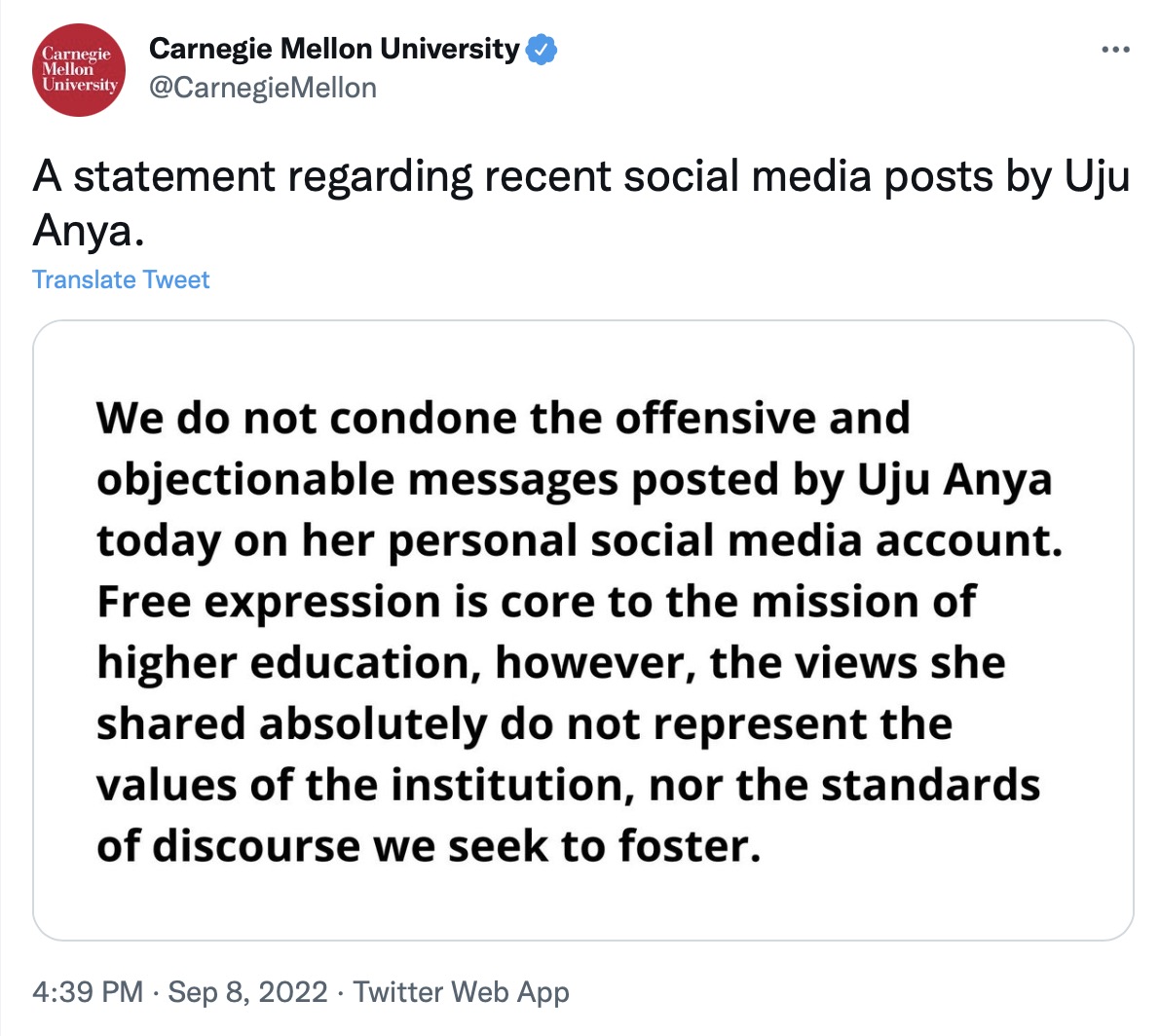
Old and new, continuing from older posts on art and politics, Uju Anya and Chomsky,  aristocrats and nouveau riche, comedians, the Queen...
and The Queen. [the scene's not deleted]

Frears: I don’t think the film has anything to do with conventional questions about monarchy.
Slate: You don’t think The Queen has anything to do with monarchy?
Frears: No.
Slate: OK. Let’s say this then—much of the film explores the contrasts between old styles of reticence and the new emotionalism of therapeutic cultures—
Frears: Yes. It’s about tradition and change.
Charlie Rose: Are you a monarchist?
Frears: I'm a Queenist.

Monday, July 25, 2022

Blyth. It's good from the beginning but I wanted to start here


At about 18:30 you get to here: "Very hard to defend a low-lying beach. Eventually people will come for you."

"I've always been allied to the followers of the materialist long view,..." Tooze has a tag, and so does Milanovic. Now Blyth. And Streeck. 

History isn't kind to optimists. Economists are optimists; economic historians look over a history of failure. But intellectual historians continue a history of narcissism.  
"I say this now to remind myself how words can squirt sideways, mute and mad; you think they are tools, or toys, or tame, and all at once they burn all your clothes off and you’re standing there singed and ridiculous in the glare of the lightning."
Anne Carson
No poet is read after they're gone as the author of projects. Or they're read that way by a minority with a preference for philosophy and intellectual history over poetry.

"For twelve centuries social rank in China has been determined more by qualification for office than by wealth."  Max Weber
Mass hysteria, wave after breaking wave
Blueblooded Cantonese upon these shores

Left the gene pool Lux-opaque and smoking
With dimestore mutants. One turned up today.

Plum in bloom, pagoda, blue birds, plume of willow—
Almost the replica of a prewar pattern—

The same boat bearing the gnat-sized lovers away,
The old bridge now bent double where her father signals

Feebly, as from flypaper, minding less and less.
Two smaller retainers with lanterns light him home.

Is that a scroll he carries? He must by now be immensely
Wise, and have given up earthly attachments, and all that.

Soon, of these May mornings, rising in mist, he will ask
Only to blend—like ink in flesh, blue anchor

Needled upon drunkenness while its destroyer
Full steam departs, the stigma throbbing, intricate—

Onlv to blend into a crazing texture.
You are far away. The leaves tell what they tell.

But this lone, chipped vessel, if it fills,
Fills for you with something warm and clear.
Around its inner horizon the old odd designs
Crowd as before, and seem to concentrate on vou.

They represent, I fancy, a version of heaven
In its day more trouble to mend than to replace:

Steep roofs aslant, minutely tiled;
Tilted honeycombs, thunderhead blue.
James Merrill, Willowware Cup

There will always be a stratum of managers. The question is how people become a part of that group, and what kind of people they are. Technocrats are bureaucrats after Saint-Simon and Bentham, Taylorism, Fordism, Weber's value-free science and "big children in university chairs", who think words are tools, or toys, or tame.

I've been repeating myself for longer than I've had this page. I think for a few years it was just filing away the record of other people's stupidity. I don't want to be a file clerk of shit. That was my mistake.

Thursday, May 05, 2022

He believed that democratic politics tended to fail because official liberty of thought—free speech and so forth—did not produce real freedom, as naïve liberals hoped, but a new form of conformism and clannishness. Tocqueville judged that Americans, who were theoretically free to speak as they wished, showed less independence of mind and freedom of discussion than the people of any other country he knew of: The quiet self-certainty of fellow citizens stifled dissent with a reach and power that a censor’s office could only envy. In a democracy, he judged, “tyranny … leaves the body alone and goes straight for the soul.” A dissenter feared that he would be shunned as “an impure being” and abandoned even by his friends. Democracies drifted or lurched into effusions of radical energy or the doldrums of modest, anxious ambition and anxious, middling views.

In times without great principles or goals, people might turn inward, looking after their own material interests, and enter a kind of solitary confinement: “a multitude of men, alike and equal, constantly circling around in pursuit of the petty and banal pleasures with which they glut their souls. Each one of them, withdrawn into himself, is almost unaware of the fate of the rest. As for the rest of his fellow citizens, they are near enough, but he does not notice them. He touches them but feels nothing.” In this condition, democrats would happily accept “a network of petty, complicated rules” administered by “schoolmasters.” Tocqueville called this enervated condition democratic despotism, the soft, passive twin of majority tyranny. Democracy might come with an executioner’s blade or with soothing tones, and either way it could obliterate people like Alexis de Tocqueville.

The subhead: "American government succeeded, Tocqueville thought, because it didn’t empower the people too much." Burying the lede. Purdy didn't write the title, but he's more conflicted than he wants to admit. 

Kant, de Maistre, Libertaet, and academia; 

Tocqueville, Lawrence (Hawthorne and Spielberg) and Weber, and academia again.

Sunday, May 01, 2022

continuing. because I kept searching. I'm in a rut, for now.


Ilene Grabel, When Things Don't Fall Apart: Global Financial Governance and Developmental Finance in an Age of Productive Incoherence, MIT Press, Open Access

Foreword by Dani Rodrik
It happens only rarely and is all the more pleasurable because of it. You pick up a manuscript that fundamentally changes the way you look at certain things. This is one such book. Ilene Grabel has produced a daring and delightful reinterpretation of developments in global finance since the Asian financial crisis of 1997–1998.

The book addresses, and resolves, a long-standing puzzle: Why has our present model of financial globalization been so resilient, despite an abysmal track record that includes the most severe global financial crisis since the Great Depression, recurrent sovereign debt crises (in Latin America, East Asia, Russia, and Turkey), and many other disappointments (such as capi- tal flowing “uphill” from poorer to richer nations)? How is it that we have not jettisoned this model for something that is more sensible and works better?

Professor Grabel’s insight is that those of us who were looking for signs of change have had the wrong idea about how real reform often happens. We have been mistaken in searching for evidence of wholesale, programmatic reconsideration of the rules of global finance. Systems of governance rarely change through established blueprints, a master plan, or radical reforms. And besides, such a reform path would suffer from the same kind of hubris that the neoliberal playbook produced.

Instead, she suggests, it is the cracks in the consensus, the local heresies, and the small departures and innovations that matter and lead us in an altogether novel direction. Inconsistency, ambiguity, and incoherence are useful and productive—they are a feature, not a bug.

Rodrik in 2008

It is remarkable to see something in theory work so well in practice. Ricardo Hausmann and I wrote a paper several years ago called "Economic Development as Self-Discovery," where the idea was that entrepreneurship in a developing country consists of discovering the underlying cost structure--what can and cannot be produced profitably. Initial investors in a new line of economic activity face a great amount of uncertainty, since foreign technology always needs some local adaptation. Plus, their cost discovery soon becomes public knowledge--everyone can observe whether their projects are successful or not--so the social value they generate exceeds their private costs. If they succeed, much of the gains are socialized through entry and emulation, whereas if they fail, they bear the full costs.

Some of the what I have been seeing in Ethiopia is a picture perfect illustration of this process at work. Most notable in this respect is the flower industry, which was started by some courageous entrepreneurs who had observed the success of the industry in nearby Kenya and wondered if it could be made to work in Ethiopia as well. Even though much of the technology is standard, local soil conditions make a lot of difference to the economics of growing flowers, and a whole range of other services--from daily cargo flights to high-quality cardboard packaging--has to be in place before the operation can succeed. To its credit, the Ethiopian government understood the need to subsidize these pioneer firms, through cheap land and tax holidays, and the industry took off. Exports have reached $100 million from zero in just a few years. There are now around 90 flower farms in the country, with latecomers the beneficiary of the tinkering that early investors have undertaken.

"Comparative advantage a literature almost as absurd as trolley problems." 

"The open access edition of this book was made possible by generous funding from Arcadia – a charitable fund of Lisbet Rausing and Peter Baldwin."

Rausing. Tetra Pak. When things fall apart: 

Neither sister appears to relish the attention-gathering side of their philanthropy. Sigrid has been willing to slow-grow a public profile, in part to encourage philanthropy in others. She has said she finds interviews "vulgar" but has been tempted to do so to encourage more giving among the wealthy in the UK. "People give a lot of money to art projects here. I think it would be a very good thing if similar kinds of sums can go into refuges for women and refugee causes."... 

Sigrid, for her own part, has spoken of a time in her youth when she was "paranoid" and "ashamed" of her wealth. This was especially the case before the family arrived in the UK from "very progressive" Sweden. "Not a good place to be a capitalist. I spent so many of my teenage years skulking in doorways, hiding away." 

The source of the quotes 

Although she will not put a figure on her own personal wealth, Rausing is surprisingly candid about the fraught relationship she has with money. "I grew up being acutely uncomfortable. In the 1960s and 70s, Sweden was very progressive, not a good place to be a capitalist. I spent so many of my teenage years skulking in doorways, hiding away."

In her early 20s, she says, she lived a simple life. There were no shopping sprees or luxury holidays. Even now, she owns only one car, a Volvo.

"I was very paranoid about anyone finding me out," she says. So has she ever sought therapy to deal with her guilt about being so rich? "Yes, I wanted to be who I was and didn't want to hide anything any more. I know people who are emotionally crippled by money they inherited. It does not help anyone."

She has said she finds interviews "vulgar".  The high bourgeois heirs to the aristocracy.
Read, or scroll down for Henri Lefebvre. 
The great majority of nobles either did not know how, or did not wish, to get rich. The great majority of younger sons had no desire to "derogate." They sought the remedy elsewhere, in a growing exclusiveness. Some held that the nobility should form a body like the clergy and be constituted as a closed caste.
S.E. Working Title: Avant-Garde is Kitsch. 
“...did not know how, or did not wish, to get rich”. Self-interest, beyond a point, was vulgar.

The whole fucking point of Grey Gardens: the distinction between having money and working for it. Better to die in poverty than get a job. Why the idle rich love the idle poor, the lumpenproletariat and demimonde.   

"I grew up being acutely uncomfortable."  Scandinavian conformism. 
And from the year before, with a reference to Janteloven.

I recognized the name of the ex-wife of Joseph Koerner.

Tuesday, April 05, 2022

If it hasn't been done someone should write a history of bureaucracy looking beneath the mechanics. Weber the historian is more interesting than Weber the prognosticator. 

For twelve centuries social rank in China has been determined more by qualification for office than by wealth. This qualification, in turn, has been determined by education, and especially by examinations. China has made literary education the yardstick of social prestige in the most exclusive fashion, far more exclusively than did Europe during the period of the humanists, or as Germany has done. Even during the period of the Warring States, the stratum of aspirants for office who were educated in literature—and originally this only meant that they had a scriptural knowledge—extended through all the individual states. Literati have been the bearers of progress toward a rational administration and of all 'intelligence.'

As with Brahmanism in India, in China the literati have been the (decisive exponents of the unity of culture. Territories (as well as enclaves) not administered by officials educated in literature, according to the model of the orthodox state idea, were considered heterodox and barbarian, in the same way as were the tribal territories that were within the territory of Hinduism but not regulated by the Brahmans, as well as landscapes not organized as polis by the Greeks. The increasingly bureaucratic structure of Chinese polities and of their carriers has given to the whole literary tradition of China its characteristic stamp. For more than two thousand years the literati have definitely been the ruling stratum in China and they still are. Their dominance has been interrupted; often it has been hotly contested; but always it has been renewed and expanded. According to the Annals, the Emperor addressed the literati, and them alone, as 'My lords'  for the first time in 1496.

It has been of immeasurable importance for the way in which Chinese culture has developed that this leading stratum of intellectuals has never had the character of the clerics of Christianity or of Islam, or of Jewish rabbis, or Indian Brahmans, or Ancient Egyptian priests, or Egyptian or Indian scribes. It is significant that the stratum of literati in China, although developed from ritual training, grew out of an education for genteel laymen. The 'literati' of the feudal period, then officially called puo che, that is, 'living libraries,' were first of all proficient in ritualism. They did not, however, stem from the sibs of a priestly nobility, as did the Rishi sibs of the Rig-Veda, or from a guild of sorcerers, as did in all likelihood the Brahmans of the Atharva-Veda.

In China, the literati go back, at least in the main, to the descendants, probably the younger sons, of feudal families who had acquired a literary education, especially the knowledge of writing, and whose social position rested upon this knowledge of writing and of literature. A plebeian could also acquire a knowledge of writing, although, considering the Chinese system of writing, it was difficult. But if the plebeian succeeded, he shared the prestige of any other scholar. Even in the feudal period, the stratum of literati was not hereditary or exclusive—another contrast with the Brahmans.

"It has been of immeasurable importance for the way in which Chinese culture has developed that this leading stratum of intellectuals has never had the character of the clerics of Christianity or of Islam, or of Jewish rabbis, or Indian Brahmans,..."

The bureaucracy of poets and literary critics is closer to the rule of lawyers than the rule of philosophers, who by definition are descended from theologians. Again...

The passage above is the result of the fact that I knew if I wanted to make a generalization about the modern idea of bureaucracy relating to China I should check Weber. I'm an amateur and a sloppy scholar, but I knew what to search for, and I've used Weber's words make my point.

Now I guess I should look up Foucault on bureaucracy under monarchy and liberalism. I'm not assuming he said anything directly, and I'm not sure I care. I'm interested in thick descriptions of thick culture.  My first scribbling on this are in the margins of my copy of Eisenstein's Film Form that I bought in 1984. Eisenstein was desperate to build a conventionalism in post-revolutionary Russia to match the conventionalism the revolution had destroyed.  He wanted to add meat to the bones of ideology. I was repeating myself in 2003. The writing is sloppy but it makes the point. Bureaucracy can be a thick mode of performance.  The justice system is a bureaucracy. etc. etc. Weber's misery is based on an his delusions.
---
Weber and China previously. (I'd forgotten)

Friday, October 29, 2021

Updated, for fun this time.

Reed wrote songs about junkies on the corner.
"You know. I'm glad that we met man
It was really nice talking

And I really wish there was a little more time to speak"
Every time I hear that voice I think of a man I knew 35 years ago. I hear Jimmy Santulli, alias James Jubert. I'm pretty sure he's been dead for a long time. 
"Weird Alex" Pareene is weird in his own little world.
 

About the time Reed did the ad campaign for Honda, in 86 or so, he was asked to do something for a public service campaign for HIV prevention. He refused, saying he'd never been safe, and he was still alive.

I had dinner with Legs McNeil and a few others at some point in the mid 90s. It may have been after the premier of the film mentioned below. Or it could have been for Billy Name. Billy was there. McNeil went off on political punk. He hated it. He's a moralist.  Moralists are conservative by definition. Genet opposed prison reform because it made him who he was. I've said it before, in the same general context.  John Waters and Mike Kelley agreed, they both still loved the Catholic Church. John's a conservative. I've said that before too. And then there are the Quines 


It's still hard writing for an American audience.


The discussion of Dune and Star Wars among pseudo-leftist pundits is a corollary to Trumpist rage: varieties of childishness. And these overlap with the fanboys and fangirls of the cinematic fanboy Todd Haynes. The film critic on a website for "democratic socialists", named for anti-democratic moralists, violent political puritans, celebrates self-identified heirs of de Sade and Huysmans.

Haynes now has a tag. Haynes, Mad Men, and the nostalgia of Americans for their own childhood, or fantasies of others' youth. "They are not intellectuals, but occasionally dream that they will be. That is their secret ambition." 

Liberals and liberalism, and the whig history of the demimonde.

The Velvet Underground, like most of the self-identified avant-garde were pretentious. Pretension is defensive posturing, signaling insecurity. Lou Reed always got high on his own supply, and he was an asshole. But sometimes fuckups get something something right, describing complexity honestly, That's the basis of a large percentage of what's called "modern art". 

Picasso in 1906 is flying blind. In 1916 he's full of shit, a poseur, but still struggling. The need for easy answers, the indulgence in and struggle against kitsch, lying —to yourself and others—vs honesty,  becomes the conflict between art and pose, rebellion and its marketing.
All the albums I put out after this are going to be things I want to put out. No more bullshit, no more dyed hair, faggot junkie trip. I mimic me better than anyone else so if everybody else is making money ripping me off, I figure maybe I better get in on it. Why not? I created Lou Reed. I have nothing even faintly in common with that guy, but I can play him well, really well. 
All of this is in the context of conservatism, and an honesty that undermines intention. People who say "conservatism is the new punk rock" are right. Punk rock was always self-destructive.

I've repeated this quote from Candy Darling enough. “I’ve been up all night alone, wondering about my identity. Trying to look for an explanation for living this strange, stylized sexuality."

I'll add another, about the lover Reed dumped, from Please Kill Me: The Uncensored Oral History Of Punk.

p. 155

Eileen Polk: Everybody hung out at Max's, and then the New York Dolls played their famous show in drag at the 82 Club. I started hanging out there. The 82 Club was a famous drag-queen bar on Fourth Street, around the corner from CBGB's, which wasn't happening yet. I started going to the 82 Club real early on and made friends with all the drag queens. That's where I met Rachel, Lou Reed's girlfriend. Rachel was a drag queen who was very feminine and really nice. The drag queens liked me, but Rachel was especially nice. One night when she was really drunk she told me that she could never be a guy because she had such a small dick. Then she showed it to me, and it was really small. I said, "That's okay, Rachel. That's okay." And she said, "Well, it better be, because I make a better woman than I do a man."

Then she met Lou Reed, and he was the man of her dreams. Apparently it was love at first sight. Rachel told me, "I've met Lou Reed! I've made it! This is it! I knew this was gonna happen! Something good was gonna happen to me, and this is it and I'm in love!" She was just ecstatic.

Lou would just sit in the corner and Rachel would keep everyone away from him. She announced to everyone, "I don't want anyone near him. I don't want anyone to talk to him. He's mine." And everyone respected that at the 82 Club. All the other drag queens stayed away from him, and all the women did too. Rachel said, "He's mine," but she didn't threaten anybody. I felt like everybody wanted something good to happen for her. And when it did, everyone was happy.

p. 206 

Mary Harron: We all went off to the Locale and none of us had any money and we couldn't order food. I remember Lou Reed ordered a cheeseburger because I was so hungry. Lou was with Rachel, who was the first transvestite I'd ever met. Very beautiful, but frightening. But I mean definitely a guy: Rachel had stubble.

Legs and John were chatting with Lou so I sat next to Rachel, and I asked her what her name was—him, what his name was—and he said, "Rachel."

I thought, Right. That kind of shut me up for a bit. I think I actually sort of tried to make conversation with him, but Rachel wasn't talkative. I think that was the sum total of our conversation.

A review of Halston, on Netflix 

This is not a new lane for Murphy, and once again it seems revolutionary — how rare to make an entire five-episode series dedicated to amplifying such a sour, cynical note — until one realizes there is nowhere for this story to go. Certainly the notion that the modern history of gay life is one as colored by repression and self-loathing as much as by the power of expression is a rich vein throughout Murphy’s work. Just last year, he produced a feature film remake of “The Boys in the Band,” the 1968 play that is the ultimate theatrical howl of isolation and pain. Previously, Ben Platt in “The Politician” and Darren Criss in “The Assassination of Gianni Versace: American Crime Story” played queer men driven by ambition that looks a lot like misdirected rage.

I went to school with the director. He was a screenwriter for I shot Andy Warhol, directed by Mary Harron, quoted above. And both films have the same producer, Christine Vachon, who went to school with Haynes, and has worked him from the beginning of his career. One of my closest friends at the time was a consultant on the Warhol film; we went to the premiere. At some point after that I remember Callie saying, dryly, that it was still safe to assume every homosexual was self-hating until proven otherwise—for Boys in the Band see The Queer Art of Failure and How to be Gay, both from the second decade of this century. Vachon also worked with Cindy Sherman on her only, failed, film; Sherman's work documenting not homosexual but female self-hatred. The absurdity is the lie they tell themselves—if indeed they do—that they're liberal. Maybe it's more that earnest liberals claim them as their own. Liberalism has turned self-hatred, for some, into self-affirmation.

And this brings us back to science fiction,  the geek art of failure unacknowledged, building worlds rather than observing this one. 

Krugman in 2021

The blogger John Rogers once noted that there are two novels that can shape the lives of bookish 14-year-olds: “Atlas Shrugged” and “The Lord of the Rings.” One of these novels, he asserted, is a childish fantasy that can leave you emotionally stunted; the other involves orcs.

Well, I was a bookish 14-year-old, but my touchstones were two different novels: Isaac Asimov’s “Foundation” and Frank Herbert’s “Dune.”

Many social scientists, it turns out, are science fiction readers. For example, quite a few experts on international relations who I know are fanatics about the TV version of “The Expanse.” I think it’s because good science fiction involves building imaginary worlds that are different from the world we know, but in interesting ways that relate to the attempt to understand why society is the way it is.

 Angus Deaton, Dani Rodrik and John Quiggin, and Krugman in 1996

At the deepest level, opposition to comparative advantage -- like opposition to the theory of evolution -- reflects the aversion of many intellectuals to an essentially mathematical way of understanding the world. Both comparative advantage and natural selection are ideas grounded, at base, in mathematical models -- simple models that can be stated without actually writing down any equations, but mathematical models all the same. The hostility that both evolutionary theorists and economists encounter from humanists arises from the fact that both fields lie on the front line of the war between C.P. Snow's two cultures: territory that humanists feel is rightfully theirs, but which has been invaded by aliens armed with equations and computers.

Any systems engineer knows that efficiency in a system is in inverse proportion to stability.

Krugman indulged a fantasy; his preferences were founded in aesthetics before they were founded in ethics: he rationalized a desire, wanted to believe an absurdity, defended it as science and mocked anyone who opposed him as irrational. 

The only thing interesting is that he didn't learn from his mistakes.

How is the philosophy behind Asimov's Foundation less authoritarian than The Fountainhead? Krugman conflates art and illustration, and art and science, "truth and lies".  His link on The Expanse is to Drezner, indulging the horse-race model of political science and IR, the academic origin of the model of journalistic "objectivity" and passivity. Both Krugman and Drezner imagine statements without subtext, themselves without subtext. Their intellects are brittle, though Krugman is "intelligent". The only thing interesting about Dune is how it describes the desires and fantasies of its makers and its audience, and civilization on earth in 2021.

Tagged The Pictures Generation, the aestheticized politics of 80s art, made in the shadow of something worshipped and feared—hated—indulging reaction as radical. That's the mix that turns conservatism into fascism.  Needless to say I have more sympathy for Candy Darling and Rachel Humphreys, who's buried in Potter's Field, than Lou Reed. I have sympathy for them as people.

I want the illusion.
Do you want the illusion or do you want the illusion to be real? 
What’s the difference?
One means that you have an appreciation of the arts. The other means that you’re a fascist.
Art makes the world more interesting than it is. "We tell ourselves stories in order to live."
Living your life as art, and imposing your art on others is more than authoritarianism. Authoritarianism only demands that you behave a certain way. It doesn't demand that you believe. Coerced belief is the definition of fascism. I think Foucault was trying to construct a new conservatism. Neoliberalism ain't it.
[I've used this one before.]


I've made so many riffs on monarchists and monarchism, on liberalism, on the left, and right.
Jean-Marie Straub's film, below, was on Jonathan Rosenbaum's top 10 for 2020. In the link above [reaction as radical] he refers to Sirk and Fassbinder as "more defeatist than progressive". The man in Straub's film is reciting Georges Bernanos. It's hard to get more defeatist than Bernanos. The film is dedicated to Godard.

Sunday, October 03, 2021

Ryan Cooper
I made a (somewhat slapdash) video about Lord of the Rings and why America has no tradition of dutiful conservatism

Of course the same applies to liberalism. "The Impossibility of a Paretian Liberal" only came out in 1970, and A Theory of Justice was published in 1971

In the work of Rawls, Dworkin,  Arneson, and Cohen, a central example that clinches the case against equality of welfare as the ethically correct kind of egalitarianism is the required treatment of a person with voluntarily cultivated expensive tastes. Under welfare egalitarianism, such a person must receive a larger-than-normal bundle of scarce resources, which appears to render him a kind of exploiter of others with more frugal tastes. In the model I have presented, a person who has a high rate of time discount (r) or who views education as very costly (low value of s) has expensive tastes, for he will choose a low level of education (ceteris paribus) will consequently have low expected future income, and will have a low expected welfare. 

To take a the classic example, consider the person who derives satisfaction from a drink only If it is a pre-phylloxera claret. Such a person requires more money to derive the same satisfaction that a beer lover derives from her brew. Here is how Dworkin, Arneson, and I would differ in the treatment of a person. Dworkin would not compensate the one who could derive satisfaction only front pre-phylloxera claret if she identifies with those tastes. Arneson would not compensate her if it had been prudent for her to learn to like beer: presumably, if she knew that she would not have the income to purchase the ancient claret, and if she had the opportunity to develop frugal tastes, then it would have been prudent for her to do so. I propose that the decision whether to compensate her depends on how the median person of her type behaved. Let us say that her type is "child of impoverished aristocrats." If the "median preferences" of persons of that type are for pre-phylloxera claret, then she is entitled to compensation to increase her level of welfare to what the person of frugal tastes, who exercised a median degree of responsibility in other circumstances can experience with his resources.  

If you click through the links they get you back to Rawls, Roemer et al. 

And Cooper contracts something he wrote less than a month ago. 

At bottom, the argument that socialists need to behave virtuously for political reasons is liberal and individualist – the same fallacy seen from Matt Bors' famous Mr. Gotcha. The whole point of leftist politics is to solve problems through collective coordination, not by convincing individuals to behave differently. 
And as always
SE: "Arguments for the nobility of greed are a recent development."
Chris Bertram: "If, by 'recent' you mean 1705, you may be right."

To match this, Leiter has a new paper calling for a return to Hart. Varieties of pseudoscience and anti-politics.

I'll add the Aristocrats tag. I don't have one for virtue ethics. And The Discovery of Experience. It's still Tolkien but at least Cooper is trying. But the video is pretty bad. 
---

A day later he tries again: "I spent like 60 hours making this video, pls watch"

Because it fits. Because an ex-editor of Commonweal[!]  asks: Does motherhood make us less free?

And that's why the fascist Sophie Lewis calls for abolition. End the family, in the name of freedom, 
self-interest, and self-hatred. 

And we're back to the previous post: "It might be worth defining fascism as the rebellion of individualism against itself, since fascists are incapable of functioning within a community. "