Showing posts with label The Posners. Show all posts

Sunday, August 27, 2023

From 2004, an update

Posner and Verlmeule's op-ed was pulled so quickly that Balkin had to link to a cache file that died within a year. Now the piece has been republished. There's no telling if it's been cut but I'm betting it hasn't. That's how far we've come.
I found out it'd been republished because I had to search for it again after ridiculing a member of the extended PRC apparat who was defending the honor of China against a Foggy Bottom intellectual. The link in his header and the pinned tweet is to an interview with Vermeule.
"A lesson of virtue" in The Beijing Review. Vermeule must follow him because he blocked me, again.

Whining about the Cold War is like asking McDonalds or KFC to stop competing with each other; the difference is the armies and the nukes. The only option is to reject US and Chinese foreign policy goals as such, and look to the small states forced to negotiate a path between them.

I think the reason all these academic intellectuals follow edgelords and fascists, is that their minds are too dead to think for themselves.


Conservative men should read T.S. Eliot. His poems describe the true misery of the conservative male, and reading him will help them escape it.

This list has gone to three

"My students were all obsessed with sex. Not the idea of sex, or the meaning of sex, but sex!"

"I find this reduction of sexual orientation to genitalia – what’s more, genitalia from birth – puzzling."

Eliot may well have become more liberal when he was older but it wasn't because of the poetry; it was the sex.

Philip Roth. "Céline is my Proust!" 

Saturday, October 22, 2022

where are your priors?

October 18, Open Democracy, "Suella Braverman quietly tries to give herself fresh anti-protest powers"

Suella Braverman is quietly handing herself new powers to clamp down on the government’s political opponents, civil right advocates have warned.

The home secretary pushed through a last-minute amendment to a widely criticised anti-protest bill on Tuesday that would allow her to apply for injunctions against anyone she deems ‘likely’ to carry out protests that could cause ‘serious disruption’ to ‘key national infrastructure’, prevent access to ‘essential’ goods or services, or have a ‘serious adverse effect on public safety’. The proposal would also give police the power to arrest anyone they suspect to be breaching such an injunction.

Leading human rights groups say that the Public Order Bill, which passed a final vote in the Commons yesterday, would align the UK’s anti-protest laws with those in Russia and Belarus.

The bill includes new powers, such as protest banning orders, that the government was forced to exclude from its Police, Crime, Sentencing and Courts Act (PCSC) after they were voted down in the House of Lords earlier this year. Peers could reject the measures once more when the bill progresses to the Lords in the coming weeks.

2015, future former home secretary Suella Fernande [now Braverman] in The Telegraph

"Britain is so obsessed with human rights it has forgotten about human duties" 

The plight of millions of people belies the noble aspirations of the Universal Declaration of Human Rights, adopted by the UN General Assembly those many decades ago.

One reason for this is because the Universal Declaration was never a treaty in the formal sense. It was not ratified by nations, never became international law, and had no real provision for enforcement.

Another reason is that the rights are described in imprecise, aspirational terms which allow governments to interpret them in any way they see fit. The US, for example, did not undertake to outlaw racial segregation until many years later. And there are hundreds of international human rights – rights to work and education, to freedom of expression and religious worship, to non-discrimination, to privacy, to pretty much anything you might think important in a perfect world. The sheer volume and array of rights imply an all-embracing protection. This is impossible, because there will always be trade-offs in which some rights are sacrificed to uphold others.

Professor Eric Posner makes this point forcefully in his book, Twilight of Human Rights Law. In Brazil, there have been several cases of the use of torture by the police in the name of crime prevention. They justify this by putting a general right to live free from crime and intimidation above their rights of those who are tortured. To wipe out torture, the government would need to create robust, well-paid policing and judicial services to guarantee the same results. The government might argue that this money is better spent on new schools and medical clinics, protecting wider rights to freedom of education and health. These sort of value judgments, inherent in the practical application of human rights (whether we agree with them or not), undermine their "universality".

But across most of the West, something else has happened which devalues human rights. A fatal misassumption plagues our whole approach to civil liberties: the predominance of the individual over the communal. The importance of the individual is seen as the defining axiom upon which we should base our policy and gauge its success. Emerging by reference to individual instincts and desires, rights and entitlements are paramount in our society, prevailing over considerations of how our choices affect others, over reference to past experience, or over the consequences for those born later on.

2004, Balkin, "Vermeule and [Eric] Posner Defend the Torture Memo"

2014, Eric Posner, The Twilight of Human Rights Law, OUP, 

[P]roblems with so-called positive or social rights are well known. Less well known is that the same problem exists for the “negative rights” in the ICCPR, such as the right not to be tortured. One might think that a state could comply with the prohibition on torture at no cost by refraining from torture. But it turns out that local police officials frequently engage in torture even though they are not authorized to do so. To stop torture, then, the government must not only enact laws, but must also invest resources in investigating allegations of torture, punishing torturers, and purging and retraining law enforcement. Thus, the key question for a state is how much of its resources it must devote to countering torture at the expense of building health clinics and public schools. The treaties provide no guidance as to how resources should be allocated. If there is no way to distinguish positive and negative rights, and we are skeptical about whether judges can enforce positive rights, then we ought to be skeptical about whether they can enforce negative rights as well. The real question is not the nature of the rights but the extent to which we can trust judges or other enforcing agents to distribute resources between competing rights.

There is yet another problem. Although not all treaty terms are vague, the actual legal effect of even specific norms is often ambiguous because they conflict with terms in other treaties as well as with broader norms of public international law. Consider sections 3 and 4 of Article 9 of the ICCPR:

3. Anyone arrested or detained on a criminal charge shall be brought promptly before a judge or other officer authorized by law to exercise judicial power and shall be entitled to trial within a reasonable time or to release. . . .

4. Anyone who is deprived of his liberty by arrest or detention shall be entitled to take proceedings before a court, in order that that court may decide without delay on the lawfulness of his detention and order his release if the detention is not lawful.

Whatever else these rights require, they do clearly prohibit a state from detaining people without charging them. Thus, many commentators accused the United States of violating the human rights of Al Qaeda and Taliban suspects by detaining them without charging them and taking them before a judge for a trial. However, the United States argued in response that the ICCPR does not apply to wartime conditions: the Geneva Conventions and other laws of war, which do not require the involvement of courts for detention, are lex specialis, and thus override human rights law.

The principle of lex specialis is well established in international (and domestic) law. Different sources of law conflict, and a principle is needed to resolve such conflicts. Many human rights advocates believe that the human rights treaties provide a moral minimum that other bodies of law can never supersede, much like the rights in the U.S. Bill of Rights. However, the human rights treaties themselves do not say this, nor does any other authoritative source of international law. There is no clear resolution of the dispute between the United States and its critics. [p.89]

1979, Richard Posner, "Utilitarianism, Economics, and Legal Theory",  

Among the severest critics of the use of economic theory to explain and sometimes to justify the principles of torts, contracts, restitution and other fields of Anglo-American 'judge-made law' are those who attack the economic underpinnings of the theory as a version of utilitarianism. Their procedure is first to equate economics with utilitarianism and then to attack utilitarianism. Whether they follow this procedure because they are more comfortable with the terminology of philosophy than with that of the social sciences or because they want to exploit the current tide of hostility to utilitarianism is of no moment. The important question is whether utilitarianism and economics are really the same thing. I believe they are not and, further, that the economic norm I shall call "wealth maximization" provides a firmer basis for a normative theory of law than does utilitarianism.

1948, John Houston (and B. Traven) 

---

Braverman

But across most of the West, something else has happened which devalues human rights. A fatal misassumption plagues our whole approach to civil liberties: the predominance of the individual over the communal.

1987, Thatcher, the same point from the opposite direction.

I think we have gone through a period when too many children and people have been given to understand ‘I have a problem, it is the Government’s job to cope with it!’ or ‘I have a problem, I will go and get a grant to cope with it!’ ‘I am homeless, the Government must house me!’ and so they are casting their problems on society and who is society? There is no such thing! There are individual men and women and there are families and no government can do anything except through people and people look to themselves first.

Friday, July 08, 2022

Done fucking with this
---
repeats of repeats: The distinction between collaborative reason in the academy its proud imitators and adversarial reason in the world at large.

Continuing from the previous post, and building on it in light of news.

I've quoted this scene for years, and used it as part of a montage without sound, but I've never posted the scene straight. As I said 20 years ago, "When it is so easy to share, people will do it. And whether or not that sharing should be bound in some sense by other forms of obligation is largely irrelevant."  "Downloading is theft, but if the opportunity is ubiquitous then theft will be too, and you will need to change your model."  Capitalists realized that takedown notices are bad for business and they adapted, so I'm blocked from making money off the video. It's not that "data wants to be free"; it's realism. I didn't expect to be bringing in Aaron Swartz, but there you go. Economic reason is adversarial within the model of markets, but not all social relations are economic. Adversarialism is formal. It's a game, and games have rules. But libertarians don't believe in games. They believe in "truth".
"For the aesthetic in general as an expression of the supreme ultimate value of a system can influence the result of ethical action only secondarily, just as “wealth” is not the main goal but the side effect of individual commercial activity. And “wealth” itself is an irrational concept. It is an almost mystical process, the setting of ethical values: Arising from the irrational, transforming the irrational to the rational, yet nonetheless it is the irrational that radiates from within the resulting form."
Hermann Broch

Jack Balkin debates fascists. 

The republican tradition certainly hopes that citizens and officials alike will possess civic virtue and be devoted to the common good. At the same time, it does not assume that government officials will in fact have civic virtue and be adequately devoted to the public good. Republican theory focuses instead on the fact that republics are difficult to maintain and easily corrupted; that government officials—and especially executive officials—are likely to engage in self-aggrandizement, self-dealing and a desire to maintain power; that representative government can easily slide into oligarchy; and that public officials will undermine the public good in the process. Anyone who has lived through recent American history can understand the contemporary relevance of these ideas.

Vermeule, by contrast, is comparatively complacent about these questions. Along with Eric Posner, he coined the phrase "tyrannophobia" to describe an excessive concern with government overreaching, self-aggrandizement and illegitimate attempts by rulers to entrench themselves in power.

But what Vermeule regards as a pathology of thought is actually a central idea in the republican tradition—and the liberal tradition as well. It is precisely because of a deep concern that public officials will become corrupt, misbehave, or try to entrench themselves in power that the republican tradition has focused on questions of separation of powers, checks and balances, rule of law limitations, and rights.

Balkin's contribution as part of a symposium that includes more than one: Vermeule and an earnest defender. There's a time for choosing honey over vinegar, and those are Balkin's words, but this ain't it.  

repeats: Leiter's model of academic discourse, paraphrased  

Universities would deserve criticism for rejecting a presentation by the authors of the Nuremberg Laws, but would be right in rejecting a speech by a rabble-rousing journalist who promotes them.

John Quiggin, 2008: "Sunstein argues that the echo chamber effect tends to reinforce existing views and produce a poisonous partisan divide. It seems to me that exactly the opposite is true. "

repeats

I always thought Sunstein's point was obvious, especially for any culture founded on individualist liberalism. It's that culture that's given us Facebook and surveillance capitalism and personalized marketing, the virtual store where the displays are changed and items moved to the front to fit your last purchases. Newsfeeds work the same way, reinforcing biases, from narrowcasting to microcasting to the narcissism where the world is reduced to a mirror.

Twitter changed its algorithm years ago, forcing you to choose between replying to a tweet and quoting it, limiting the exposure of either your followers or those of the person you're replying to. Up to that point a reply appeared on both timelines.

Ryan Cooper 

Have you ever argued with a conservative? They won't learn anything no matter what I say or where I say it. Whatever I say is wrong by definition.

The same is "true"—the same facts hold—for liberals, and for most people. They hold for Cooper. 

The web was made by techs and in the Anglosphere self-selected for technocratic culture—I haven't used that link in a while. It's was made for talking to your friends, not for argument. I was told that 20 years ago. It's the model of civility, contempt and passive aggression basic to academia under the pretense that academia, educated liberals, the elite, the licensed vanguard are just that.  It was always bullshit.  Balkin, practicing "high politics" treats Vermeule as a friend. He's from the same tradition as Panofsky, but he's weaker. He called Vermeule and Posner "fine young scholars", when they defended legalized torture. I had more patience in 2004.

Balkin has a tag. Vermeule has one.  I emailed Balkin as I do sometimes, to ask him why he's done it again, ceding ground to opponents of democracy.  

I've gotten drunk with honest reactionaries. They're better company than hypocrites. I cede them nothing. But I have more contempt for liberals like Cooper who are blind to what they are. 

If everything is political, then high politics and low politics both have their place.  There's a time for debate and a time to stand on principle and walk away. If you don't understand both you don't understand either.

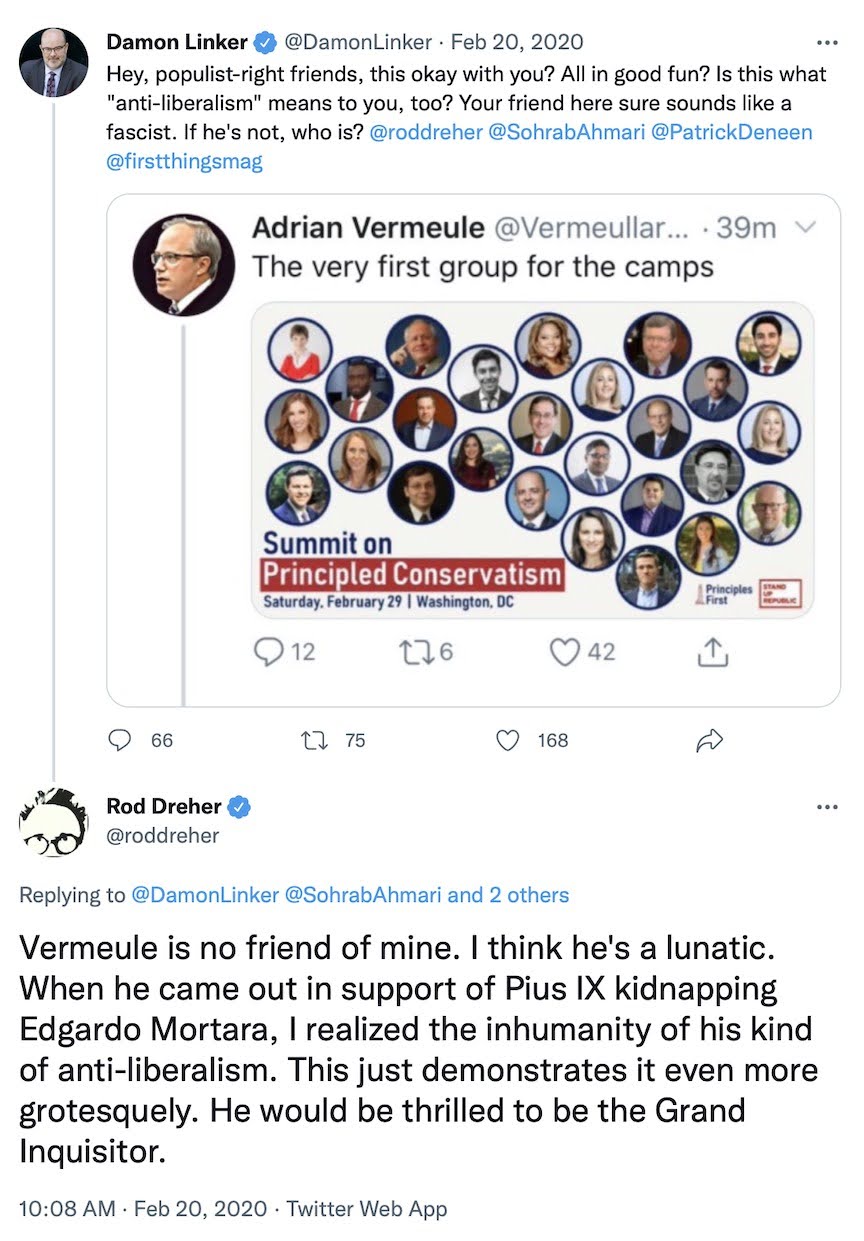
The Mortara Case "Why Some Catholics Defend the Kidnapping of a Jewish Boy"


Dreher, 16 days earlier:
The invention of the "Judeo-Christian" tradition, etc.

 repeating the link above.

Most arguments against mass surveillance don't respond fully substantively to claims that you shouldn't worry if you "have nothing to hide".  Defense of personal freedom isn't enough.  What's needed is an argument in defense of the need for citizens in a democratic state to be able to be all kinds of wrong, all kinds of confused, creepy, conflicted, desirous, weepy or hate-filled, so that they may be able to learn to understand and outgrow their childishness. The choice is between a community of adults with a minority of the inveterately childish and criminal or a community of children ruled by moralists and crime lords.

Freedom of speech is the right to argue for freedom of property. Those who defend freedom of property are among the first to oppose freedom of speech. I support Vermeule's right to be a fascist, but an earnest engagement with his ideas is to take fascism seriously as an intellectual position. Allowing the argument to exist does not mean treating it with respect. It means destroying it, again, and again.

"It is the common fate of the indolent to see their rights become a prey to the active. The condition upon which God hath given liberty to man is eternal vigilance; which condition if he break, servitude is at once the consequence of his crime and the punishment of his guilt."

I like Balkin, but he's a law professor, not a lawyer. He's passive. He's not a legal philosopher—they all suck—but he doesn't understand the importance of vulgarity. 

I forgot I'd used this with Vermeule already. All I do is repeat myself.

…in a hospital tent at the clearing station I came across a man with a French flag wrapped around his waist; the medics discovered it when they cut his shirt away. He was a hard-looking, blondish chap with a mouthful of gold teeth and a face adorned by a cross-shaped knife scar—the croix de vache with which procurers sometimes mark business rivals. An interesting collection of obscene tattooing showed on the parts of him that the flag did not cover. Outwardly he was not a sentimental type.
"Where are you from?" I asked him.
"Belleville," he said. Belleville is a part of Paris not distinguished for its elegance.
"What did you do in civilian life?" I inquired.
That made him grin. "I lived on my income," he said.
"Why did you choose the Corps Franc?"
"Because I understood," he said. 

And again: thugs against fascists

"He was always a loser, a jest/he barely got 50% on his high-school test/with a bribe the rich kid's a fool no more/got 100 diplomas hanging on his door/You crows nesting in our house/why are you ruining all our fun?

We won't do as you tell us/Spare us your face/Cook up your case/That's what the Interior does/I'm arrested and charged as a terrorist/Just for holding a flare and singing Ahly"

All philosophy is perverse.

Tuesday, January 04, 2022

Amy Wax again, and Leiter 

Under the AAUP definition of academic freedom, "extramural" speech by faculty is protected speech that cannot be sanctioned by a university employer.  Yet even the First Amendment right of public sector employees to free speech can be outweighed by the employer's interest in running its workplace efficiently and without excessive disruption (the "Pickering test").  One can imagine a court being sympathetic to a private university's invocation of similar reasoning.
"the employer's interest in running its workplace efficiently and without excessive disruption"
Workplace efficiency: the definition of the neoliberal academy.  By that logic U. Penn could have fired Du Bois for being uppity, MIT could've fired Chomsky, and teach-ins would have been career suicide.

I'm a stronger defender of academic freedom than Brian Leiter. I guess I've always assumed that.

Leiter: "Soon the only students who can safely take her classes at Penn will be Jews and WASPs."

New language from him. But student safety isn't the issue. The issue is the risk of lawsuits.
---

And again in July, and Leiter begins to see a problem: "Penn Dean calls for "major sanctions" (which could include termination) against tenured law professor"

The Dean's letter is here...  The AFA has now sent a letter to the Penn President in response.   A few observations of my own: 

...The AFA letter,  however, neglects the fact that some of the allegations concern not extramural speech, but speech and actions in the classroom; and some concern extramural speech on matters that impact the functioning of the school.  In the former category is the fact that Professor Wax invited an infamous (and unabashed) racist, Jared Taylor, to speak in her class and have lunch with her students.  It is dubious that the decision to host Mr. Taylor in her classroom can be defended on academic freedom grounds, as a professionally sound choice given academic standards in law teaching.  It also has the potential to implicate violation of anti-discrimination norms, to which the law school is bound (although one would need more details to say for sure).  In the latter category is Professor Wax's public disparagement of the academic competence of her Black students, which I have addressed before.   Disciplinary action for both of these incidents would not violate principles of academic freedom (indeed, Wax has already been disciplined for the latter incident).

Monday, April 06, 2020

Vermeule is back.
Last time he was defending the kidnapping of Jewish children, and now it's atheists, sending conservatives to the camps, and this.

He has a tag now; so do the Posners. I trolled Vermeule and his old writing partner on twitter awhile ago asking if they were still friends.

I'd forgotten Vermeule at Crooked Timber. They never end up looking good.

repeat from 2011, a comment at Concurring Opinions
Balkin is acting as an advocate, as lawyers do. He’s engaged in an argument with Posner, Vermeule and their ilk. But his logic or his faith force him to fudge his history to defend his vision of democracy, which allows Vermeule to counter as a hardened realist and blablabla [blablabla]. I find myself more and more envious of Canada and the living tree doctrine, which renders all this irrelevant. 
Our relation to the Constitution is like our relation to Don Giovanni. And every time Peter Sellars has a new production set in Trump Tower or Las Vegas, we set about arguing whether he made the thing fresh or somehow screwed it up. The only difference between the two debates is I suppose the matters of life and death, or justice and tyranny: the baggage of politics. I love baggage; thinking about baggage takes up a good part of my life. But treating politics as baggage, as vulgar, has its advantages. I see no need to waft about in discussions of faith and redemption; fascism is fascism, why pussyfoot around it? Posner and Vermeule defend what lovers of democracy abhor, what else is there to say? They claim to find support for this in the Constitution but Christian kings found support for the Crusades in the Bible. They claim to defend reason. My response is simple. I’ve said it before and I’ll repeat it: “That authoritarianism has become normative may be a scientific fact, but that does not make authoritarianism itself a scientific truth.”
Balkin is arguing from the past and about the future, but somehow the present is lacking.
Liebling
…in a hospital tent at the clearing station I came across a man with a French flag wrapped around his waist; the medics discovered it when they cut his shirt away. He was a hard-looking, blondish chap with a mouthful of gold teeth and a face adorned by a cross-shaped knife scar—the croix de vache with which procurers sometimes mark business rivals. An interesting collection of obscene tattooing showed on the parts of him that the flag did not cover. Outwardly he was not a sentimental type.
"Where are you from?" I asked him.
"Belleville," he said. Belleville is a part of Paris not distinguished for its elegance.
"What did you do in civilian life?" I inquired.
That made him grin. "I lived on my income," he said.
"Why did you choose the Corps Franc?"
"Because I understood," he said.

Saturday, August 03, 2019

From 2004, on Posner, writing at Leiter's page. Still not bad

Friday, May 20, 2016

Updating. Documenting drift.
When Thomas Pogge travels around the world, he finds eager young fans waiting for him in every lecture hall. The 62-year-old German-born professor, a protégé of the philosopher John Rawls, is bespectacled and slight of stature. But he’s a giant in the field of global ethics, and one of only a small handful of philosophers who have managed to translate prominence within the academy to an influential place in debates about policy.
Leiter
“It breaks my heart to have to say it,” said Christia Mercer, a former colleague from the Columbia philosophy department, “but it’s clear that Thomas uses his reputation as a supporter of justice to prey unjustly on those who trust and admire him, who then — once victimized — are too intimidated by his reputation and power to tell their stories.”

This is also my reaction.
Ludlow, McGinn "It's no secret". Rationalists rationalize.

Leiter links to IHE, on the threat to the liberal arts.
For Talbot Brewer, professor and chair of philosophy at the University of Virginia, the liberal arts need saving in part from the “black mirrors” so many of us are glued to each day. Cellular phones, computers and, especially for children, television, facilitate a kind of “reverse-Weberian,” late capitalistic assault...

Calling attention a “vital resource,” Brewer described it as “the medium of passion, of friendship, of love. 
Not “reverse-Weberian", simply Weberian. And again, for Leiter the whole point of philosophy is that it is not art or fiction, but close to science.  He reads for text without subtext. As I repeat again and again, Leiter, like his friend Posner, is a technocratic anti-humanist.

Maria Farrell (start here or here) discovers "Post-Democracy"
I’ve been reading and re-reading Colin Crouch’s Post-Democracy on and off for about eighteen months, and just spotted a nice precis of it on OpenDemocracy in a piece by Kit de Waal about celebrity activism:

“The term ‘post-democracy’ was coined by Colin Crouch to refer to the fusion of corporate power with government, generating an elite politics based on a political-financial cycle in which money buys power and power rewards money. Post-democracy is a plausible imitation of democracy. It has a popular, consultative appearance, while the real politics of power and money consists of a continuing round of inter-personal transactions among elites.”

What makes Post-Democracy hard for me to digest more than a dozen pages at a time is not, I think, its relentless rightness, which I personally find more or less inarguable, but how little there appears we can do about it. My experience of reading it is basically ‘yes, this is better researched and thought through than I’d ever manage, and I agree; we’re basically fucked.’

I get that I’m experiencing nothing more than the cognitive dissonance of a social democrat who knows capitalism is awful and probably tending towards disaster – but more the chronic debilitating disease kind of disaster of, say, a slow-boiled lobster, than the explosive, revolutionary and strangely psycho-sexual climax of sudden foment and change – but who has neither the temperament nor the constitution for either ripping it up or walking away. (Hello Rosa Luxembourg. Like my hero Virginia Woolf, you would despise me, too.) But simply knowing this doesn’t help.

About a decade ago I was at a weekend conference in New York on what was then called ‘the new philanthropy’. The impeccably well-educated and well-spoken man who’d been Angelina Jolie’s fixer in the world of Davos and the UN system was there to say how great it was that celebrities were now getting down into development issues and doing things that governments didn’t have the will for. At the Q&A, I made myself a bit awkward by asking how democratic it was that those people could re-order policy priorities on a whim, and wouldn’t it be better if they just voted and paid their taxes like the little people....
A smart commenter replies quoting a post by her I'd decided not to read.
Oh I remember you. 
“The question isn’t whether the Easter Rising accelerated Ireland’s independence or made it happen at all; it’s whether it was worth the death of one bow-legged tenement child. Of course it wasn’t."
If you don’t have faith in the people to create democracy why do you mourn its passing?
From the older post
In 1916, my great-grand father, Eoin MacNeill, was the head of a dissident army, the Irish Volunteers. At its height, before many left and volunteered to fight in World War I, the Irish Volunteers numbered about eighty thousand men.
The befuddled sister of a Weberian "liberal" and wife of a career military officer, she prays daily for the health of the Pope, and mourns our fallen state.

The Farrells are from the gentry. They are not "the little people", but for Maria celebrities are vulgar. Her brother's clan, the technocrats, are the new aristocrats, but like her he's never understood the switch. And both in different ways pretend to be defending democracy. I'm with Norman Mailer

Weber's technocratic elite, the masters of "value-free science" could never exist separately from the capitalist elite. They're siblings. Again, see Leiter's friendship with Posner, and Henry Farrell's interest -liberal academia's interest- in libertarianism, which outside of the academy is no more or less than a cult. Technocracy is not democracy. The link's a google site search. Search the web; it's still mostly me. And still obvious.
---
But we can take hope from our own history. Amid unrelenting upheaval and popular anger, the Renaissance left a legacy that we still celebrate as one of humanity’s brightest. It also left wisdom, in both its triumphs and disasters, to help us steer through similar storms. Looking through a Renaissance lens, what to do now becomes startlingly clear. We need to welcome genius. To understand that disruptive change and technological revolutions can spread both immense good and harm. To celebrate diversity and overcome prejudice. To raise public and private patronage. To embrace change, and strengthen public safety nets in ways that embolden us all. To build new crossroads and welcome migrants. To tear up the (mental) maps that unhelpfully divide people. To stoke virtues – especially honesty, audacity and dignity. To champion collective endeavours as well as individual freedoms.

The Renaissance offers lessons on how to magnify the flourishing under way. It also offers warnings about what happens when we fail, in a time of great change, to renew our social bargain with one another.

This is our age of discovery. We can succumb to its pressures, close our borders and our minds to new people, ideas and technologies, and thereby surrender the possibilities inherent in humanity’s present circumstances. Or we can seize this moment, navigate the crises of our own time and co-create a blossoming that the world will still talk about in 2500.

Flounder or flourish? The choice is ours. 
Ian Goldin and Chris Kutarna’s Age of Discovery: Navigating the Risks and Rewards of Our New Renaissance is published by Bloomsbury/St Martin’s Press 
Ian Goldin is director of the Oxford Martin School and professor of globalisation and development at Oxford University (@ian_goldin). Chris Kutarna is a two-time Governor General’s medallist, Commonwealth scholar and fellow at the Oxford Martin School (@ChrisKutarna).
According to his Oxford student profile Kutarna was the lead China research on this tome:
Globalization is about Americans outsourcing product development and services to other countries. Globality is the next step.
Globalization has never been about American outsourcing. Globality is packaging and book sales.

"This is our age of discovery." The Industrial Revolution which hasn't ended is being rebranded in the language of Madison Avenue and B. school to refer to the Renaissance as opposed to the Enlightenment. That's the only relevant data point, except for the fact that Kutarna seems to have published a novel in Mandarin.
---

More of the same at The Boston Review

What Is Education For?
Opening the Debate, Danielle Allen: Preparation for democratic citizenship demands humanities education, not just STEM.
Samuel Moyn:  Rights vs. Duties, Reclaiming Civic Balance
The second piece isn't part of the symposium.  It should be.

repeats, repeats, repeats.
Rules can't be contradictory; obligations will conflict. The formalism of truth vs the formalism of process. Liberalism, technocracy and science (and pseudoscience), vs republicanism, democracy, and law (and art).  More of the same.

Wednesday, December 16, 2015

Eric Posner today:  ISIS Gives Us No Choice but to Consider Limits on Speech
and 2012: The World Doesn’t Love the First Amendment.
2004
Jack Balkin: Vermeule and Posner Defend the Torture Memo
In effect, Vermeule and Posner argue that government officials need not follow existing law if it conflicts with the academic theories of a "dynamic" new generation of legal scholars. They argue that critics of the torture memo "have a distinct methodological valence, one with intellectually partisan overtones." But it seems to me that the OLC's memo better fits this description.

Much as I respect Vermeule and Posner's other work, I must confess that I'm deeply worried about the abdication of moral responsibility in this op-ed, as well as its cavalier assumption that the purpose of the OLC is to push a particular ideological agenda heedless of any larger responsibilities to the Nation as a whole. The notion that government officials can simply discard relevant precedent if it gets in the way of ideology is inconsistent with the basic obligations of government lawyers. Is this truly, as Vermeule and Posner tell us, characteristic of the next generation of constitutional scholarship? I shudder at the thought.
Posner, Vermeule, etc.
fascist shit.

Sunday, October 18, 2015

It's still no secret that contemporary philosophy is under the spell of the Other

updated: Peter Ludlow, Colin McGinn, Richard Posner and the People's Republic of China.
---

I haven't added anything to the Colin McGinn tag in awhile.
I have a rather modest unassuming leg--nothing flashy, but quite agreeable. Not like your spectacular look-at-me legs! We should have a foot race one day--I expect to be left in the dust. Also, what about wearing shorts or a skirt one day so I can actually see them--so far I've only strictly seen their shape. Not that I'm obsessed or anything. Your mind should model itself on your legs--powerful, muscular, beautiful, agile. Oh reader!
"She did not respond."

A specific variety of asshole. Rationalists rationalize.

Found by accident, from years ago:
The rule of "reason" leads to the rule of truthiness. That's why we choose the rule of law. Richard Posner:
the duty of judges is "always [to] try to do the best they can do for the present and the future, unchecked by any felt duty to secure consistency in principle with what other officials have done in the past"
The point of using precedent or intention or any other interpretive device is to test one's arguments against others. Posner's argument is that of the man who tests his ideas only against himself: of the chess player who plays alone, spinning the board between moves, or the man who thinks he's good in bed because he always comes when he masturbates.
That's a good way to weaken your game.
It's more than that. According to Posner's logic the exclusionary rule and the doctrine of the "fruit of the poisonous tree" just gets in the way of utilitarian justice, as per the mind of the beholding judge.

Daniel A. Bell, The China Model: Political Meritocracy and the Limits of Democracy, Princeton Univ. Press.

Blurb
Westerners tend to divide the political world into "good" democracies and "bad" authoritarian regimes. But the Chinese political model does not fit neatly in either category. Over the past three decades, China has evolved a political system that can best be described as "political meritocracy." The China Model seeks to understand the ideals and the reality of this unique political system. How do the ideals of political meritocracy set the standard for evaluating political progress (and regress) in China? How can China avoid the disadvantages of political meritocracy? And how can political meritocracy best be combined with democracy? Daniel Bell answers these questions and more.
The PRC is only a meritocracy following Posner's logic, and Leiter's, and Jason Brennan's (Princeton again). It bequeaths us mandarin bureaucrats who think like Posner, and apparatchiks who behave like Ludlow and McGinn, and the general corruption of the academy.
The University of Chicago has suspended negotiations to renew its agreement to host a Confucius Institute after objecting to an unflattering article that appeared in the Chinese press. The decision follows a petition, signed by more than 100 faculty members this spring, calling for the closure of the institute. The petition raised concerns that in hosting the Chinese government-funded center for research and language teaching, Chicago was ceding control over faculty hiring, course content, and programming to Confucius Institute headquarters in Beijing, which is also known as Hanban.
See also, Sahlins. I said in a note to him that the Confucius Institute made perfect sense in the context of an academy based on Posner's principles.

see also, Apple University.

Sunday, January 11, 2015

"Some of my best friends are Jews"

Atrios in 2005. Start here.
Connerly's France
Just to add on a bit to what Juan Cole wrote to reiterate a couple of things. France's approach to multiculturalism and race is essentially that of Ward Connerly you simply make it officially not exist. A couple years back Connerly pushed for a ballot measure in California which would've made it illegal for the state government, in most cases, to make any racial classifications by race. While I'm not entirely unsympathetic to the notion that such classification systems are problematic for various reasons, the alternative is simply having no information at all about race.
The defenders of Charlie qua Charlie by and large are proud moderns. They defend free speech, and satire, and "Liberty and Laughter" as the headline for Simon Schama's piece in the FT puts it, without noting the obvious, that Europeans don't have what we would call freedom of speech. The US is an exception, as Eric Posner, (see above), Leiter and others like to remind us. But even then we're stuck responding to absurd arguments. I've gone over this enough.
And I've repeated this paragraph too, but it's appropriate.
It says something about the decline of this country that a specialist in Middle East Studies writing about Kuwait gives a better defense of free speech than a professor of American constitutional law does writing about The U.S. 
Under hate speech laws only the powerful judge who has freedom and who doesn't.

"Under French law, the magazine could run cartoons mocking Islam, but it could not run cartoons mocking the Holocaust."
Charlie Hebdo: A Testimony From Paris
Charlie Hebdo were immensely popular among the French: not as stars of the media, nor as towering intellectuals, but as good pals living next door, the kind of friends you were always happy to come across at the café downstairs for a good laugh, for an unbridled exchange of jokes on the latest events in French and world politics: the bigger the better, good or bad taste did not matter.
"François Nicoullaud's diplomatic career (1964 to 2005) brought him to New York, Chile, Berlin, Bombay, and finally to Budapest and Tehran as French ambassador."

I never would have guessed.

France is officially color-blind: since the revolution under the principle of jus soli, the right of soil; there's no recognition of a French ethnicity. Germany began to weaken jus sanguinis, the right of blood, only in 2000.  Racism in France is ubiquitous but it's shaded by power: the arrogance of proud rationalists in the face of superstition and "backwardness". I grew up in a black neighborhood and knew the constant small humiliations my friends felt. But add to those the friendly smiles that say, here it's not about race, while doubling down on the moral superiority that everywhere comes too easily with education. I asked a friend, a daughter of immigrants to France, and she said Charlie Hebdo attacked everyone, but promoted racism and anti-semitism "under the cover of humor".

The same twisted logic applies to European defenses of free speech. To defend free speech for everyone, including fascists, allows you to counsel prudence: the right to speak allows the option not to. But those who've argued for tact -against publishing the Muhammad cartoons- are accused now of illiberalism and appeasement by people who take their own liberalism for granted, and who stand for its opposite: the rationalized perquisites of power. The logic of Jyllands-Posten and Charlie Hebdo is not only that the powerful are powerful and the weak are weak, but that the powerful should feel free to add insult to injury. That they never understood this is a mark of their "inability",  as Arendt said of Eichmann, "ever to look at anything from the other fellow's point of view.”

I've gone over this dozens of times: the illiberalism of technocrats. The liberalism of process is not the liberalism of reason. Tossing out evidence from a warrantless search, as "fruit of the poisonous tree", is based on a presumption of human self-interest inseparable from a pessimist's understanding of human behavior. That's the understanding seen in the history of legal doctrine. In the context of liberal philosophy, focused on high moral principle, and in modern economics, self-interest has been transformed from a given into a good: from is to ought. And it's technocratic liberals, philosophical idealists and optimists, proud children of the Enlightenment (and optimists always see themselves in a good light) who are defending not only the right of Charlie Hebdo to publish, but what it publishes. Technocratic liberals are unable to separate one from the other, to separate justice from intent. Proof of this is in the existence of speech regulations that they will not acknowledge as they march.
SE: Arguments for the nobility of greed are a recent development.
Bertram: If, by “recent” you mean 1705, you may be right.
There's a reason Liberalism won out over Republicanism.
Liberalism is amenable to fans of science since it can claim reasonably or not to be without priors. Republicanism is a virtue ethic and priors are explicit: burdens precede freedoms, making hypocrisy more difficult to hide, from yourself at least. 
Liberal objectivity: "If her interests have the same value as his, then my interests must have the same value as yours." The opposite of virtue.
That last is one version of the collapsing of individuals into tokens, of equality into identity, human beings into drones.  The more common example is much simpler.

If I say "Eh, I'm a Jew." it means one thing, or a range of things, one of which could be humor and irony. If someone else says "Eh, you're a Jew" the range of meanings change. The logic of Charlie Hebdo is the logic of the white man who thinks he can call a black man a nigger because "blacks call each other nigger all the time". That France is the home of Enlightenment universalism is the reason they could get away with it as long as they have.

On top of all this there's the absurdity and narcissism of marchers defending western freedoms in a country now trying to be that largest arms dealer to Saudi Arabia. Banning the Burka in France while helping to ensure it's imposition elsewhere is par for the course in the history of European empire.

On Storify:These 'staunch defenders' of the free press are attending today's solidarity rally in Paris
The last:

Friday, October 03, 2014

Watching academic philosophy tear itself apart.
A repeat from 2011.
---

I added a new comment on Leiter's thread, [see below] posting the passage quoted here. Read Seaford for Romano and the reviewer for Jason Stanley.
It may not appear. I can never tell.
---

I'll post the passage again. From a review of Money and the Early Greek Mind at NDPR
Overall, Seaford’s book is interesting, insightful, and combines expertise in ancient sources with careful reasoning. It certainly offers an invaluable discussion of the origins and cultural contexts of early Greek philosophy. But Seaford’s concern with the historical explanations of Greek philosophy suggests that his book may not appeal to scholars interested exclusively in the philosophical content and argumentation of Presocratic texts. The author often explicitly minimizes intellectual explanations of a philosopher’s views in favor of socio-political, religious, and psychological factors (219; 253–4; 273). In fact, he insists that comprehending the relevant cultural factors is necessary for understanding Presocratic metaphysics. We must, he maintains, avoid treating ancient philosophy as if it were created in a “historical vacuum” (10), even if this threatens most Presocratic scholars’ “control of their subject and the autonomy of ’doing philosophy’“
Stanley writing about his father [new link here]
I recently spent two years writing a book review. So I’m not quite the one for the task of summarizing, however briefly, the legacy of life and work that my father has left behind. The task is made more difficult by the differences in our lives. He was raised in Berlin, under the shadow of Hitler, and first experienced this country as a refugee. The path he took, first to the academy, and then within the academy, was largely determined by these experiences. I was raised in a secure setting, surrounded by other children of academics, and my work is not related to the experiences of my past. Finally, my father was not a typical academic, content (as I am) to master a small area, and rule over his academic fiefdom with an iron fist. Specialization was not for him. Indeed, he wrote a whole book about its dangers.

That book, The Technological Conscience: Survival and Dignity in an Age of Expertise, [Stanley doesn't supply a link] tries to do many things. But fundamentally its topic is human dignity, a topic that is perhaps the theme of my father’s life and work. As a person, my father was steeped in myths that usually accompanied a more religious cast of mind. He lived his own life as a calling, and was not one to let others live as they thought they wished. He could not understand how anyone could live without a deeper purpose or meaning. Like many a religious soul, he was suspicious of mechanistic explanations whose purpose he suspected was to remove the mythic purpose of our journey. It is presumably for this reason that The Technological Conscience is occasionally found on the syllabi of courses taught in Christian colleges, which concern the conflict between religion and science.

But it would be a fundamental misunderstanding of my father’s life to construe him as religious. Religions run certain risks my father was never prepared to take. They run the risk of rejecting the truths of the past, of the moral lessons of the Holocaust, and they run the risk of rejecting the truths of the future, that we are, unless all of us make it our callings to intervene, doomed. Religion conflicts with the humanistic impulse to face directly the hard truths that emerge through the study of human interaction. Once we have recognized these truths, we will see our future, and may function as agents in altering its course. Dignity is achieved in recognizing our agency in this task. The purpose of myths, morals, and meaning is to motivate us towards this purpose.

At the end of The Technological Conscience, my father moves to the topic of education. Education was the battleground that my father believed the war over the soul in the mechanistic, consumerist age would be fought. Without intervention, education was bound to become the domain of technocrats, seeking to instill in us tools for survival, but not the means by which to flourish. (There is an unfortunate tendency, in the book, to view this grim future as one in which we are all forced to learn some math; we are darkly warned that “We may expect that mathematics, statistics, and computer related symbol skills will spread as a nationwide focus of curriculum revision and elaboration”.) The topic of education was one that occupied my father through the rest of his career. In particular, he wrote about the role of the university in providing the means by which to achieve dignity. The way we academics function as agents in history is by bestowing the gift of autonomy upon our students.

Again, religious themes emerge in this work. My father’s reading of the Adam myth, in his paper “The Educator’s Conscience: From Paradise to Disneyland”, was that autonomy was God’s gift to Adam and Eve. Through eating from the Tree of Knowledge, Adam and Eve acquired self-reflection, and thereby became autonomous moral agents, capable of forging their own paths through the world. The function of the university is to play God, by awakening critical self-reflection. At our best, according to my father’s work, we academics grant our students the gift of autonomy along with knowledge of the mistakes of the past, in the perhaps vain hope of securing the future.
It wouldn't be fair to say Stanley's father is echoing Panofsky; they share a tradition.

Jason Stanley [2006]: In Defense of Baroque Specialization

Marcus Stanley, and my response
"The sociology of modern knowledge production empowers the scholar over the humanist, and the collective / communal enterprise of scholarship over the inspiration of the individual thinker."

You have that precisely backwards. The humanist is embedded in culture by calling, the mathematician only by default, while embedded by choice in a private world of universals.
Reading Davidson again and Quine, what becomes clear is the Puritan moralism behind the logic; that it would be preferable to have Mozart without the performances of Wilhelm Kempff or Alfred Brendel. Or perhaps there's no difference because the "content" is the same. The dream of a language reduced to the essential. A desire to collapse of the space between image and object. The impossible desire precedes reason. Values precede logic and then return to impose it.
There could be no more poignant contrast to this confidence in the spells of art [in the perceptual "objectivity" of hieroglyphs] than a passage from Plato's older contemporary Euripides that also deals with tomb sculpture. When Alcestis is going to die, her grieving husband Admetus speaks of the work he will commission for his solace:

And represented by the skillfull hands
Of craftsmen, on the bed thy body shall
Be laid; whereon I shall fall in embrace
And clasp my hands around it, call thy name,
And fancy in my arms my darling wife
To hold, holding her not; perhaps, I grant,
Illusory delight, yet my soul's burden
Thus shall I lighten...


What Admetus seeks is not a spell, not even assurance, only a dream for those who are awake; in other words, precisely that state of mind to which Plato, the stern seeker after truth, objected.
Plato, we know, looked back with nostalgia at the immobile schemata of Egyptian art.

Gombrich, Art and Illusion, p.126
Marcus Stanley: "The sociology of modern knowledge production empowers the scholar over the humanist, and the collective / communal enterprise of scholarship over the inspiration of the individual thinker."

The question is whether we want the communal enterprise of Athens and Euripides or of Plato and technocratic pharaohs.

"When fascism comes to America..."
Leiter quotes Sinclair Lewis, and links to Rick Perry. I reply, sending him a link to Richard Posner. Leiter thinks that content separates his ideas from those of his friend, but form unites them. The formal relation of elitism and authoritarianism is more important than the difference between the "content" of legal realism and law and economics. The focus on content is a waste of time. Content or "meaning" is private; all that is public, all that we share, is form.

Rosen contra Brendel It's in the paper [pdf] and here.

Monday, September 08, 2014

repeats of repeats of repeats, from March 14. Trudeau still makes me laugh. The only political figure I've ever met -including those wanted by the police at the time- that I've ever truly liked.
---

repeat from 2003. I'd forgotten the Posner quote.


From a related post from the same time.
What is 'The Law?' Is it the concept or only the concept in action? Is it a set of rules, or is it the process of arguing about those rules - in a room, in summer, without air conditioning, and with a bad hangover? 
Is it the relation between the two?
The above, in relation to Corey Robin, here, and to what he describes as "a sharp take on the left".
My comment was to repost relevant bits of this. It's not simply the number of people, academics, opposed to freedom of speech, but that they're opposed to it without understanding how their arguments originate in their idealist sense of their own authority. Trudeau by comparison was principled but pragmatic. And society survived.

Again. Shouting down Michael Oren is one thing; claiming that its justified as an example of free speech is another. Along with discussions of "triggers", the first is asking the state's permission to disrupt the state's activity, the second is asking the state or some authority to protect you from knowledge, even knowledge only of someone's beliefs. In both cases the relation of the individual to the state is of child to authority. And technocrats are always willing parents.

The ACLU defense of the Nazis in the Skokie case was not about the right to march but the right to march in a town full of Holocaust survivors.

repeats: the lousy politics of willed innocence

Trudeau was always hoping people would grow up.


the comedy continues here

Tuesday, June 10, 2014

A repeat, from June, 2003. A little rough.
If we assume that economic relations are the primary means and end of social activity it makes sense to regulate such activity. And when we regulate the private sphere, when we say that private social organizations must be nondiscriminatory if they have some impact on the public, the effect is to weaken, in the name of economic liberty and forced civility, the ideal of the private sphere itself. What begins with a critique of economic relations as based on the inequality of specific non economically defined subgroups becomes a defense of the economic relations as a determinant of social function.

I'll do this quickly, since what I am going to say is something I've been writing about for 20 years, and I'm not in the mood to go into it much. One of the mistakes in the academic left critique of culture is to confuse the result of an activity with its justification. Southern slave holders did not maintain their economy in order to keep slaves, they maintained a culture and a social order by means of slavery. The rich and powerful do not exist in order to keep the poor at the bottom of the heap, poverty is merely the result. The rich mostly think about money and golf. Men are not sexist because the spend all day finding ways to maintain sexual and political superiority over women, though that is the result of their actions. In all these cases the interest is in social, and in some but not all cases financial, continuity. The reaction as such of the powerful, in the form of conscious attempts to maintain the status quo, comes only as a result of pressure from below.

So what should become the defining logic of that pressure? What form does its argument take? For the victims of a social order, or more specifically the intellectuals who flock to their cause, it's logical to see what they want as what the powerful take for granted; it's logical to see economics as the prime mover. Marx saw that, but saw also that economics per se was the means to an end, even for the powerful. Marx had the advantage of being a 19th century humanist, and he understood that economics and culture were, or had been, two different things, but that capitalism was in the process of making them one and the same. He hoped that in the long run, after a revolutionary transformation, economic considerations would fade in importance. That hasn't happened, and liberals and economic conservatives are continuing the process of consolidation of all social activity under the rule of 'competition' and the public market.

As the market expands and inner life, both private and collective, becomes assimilated to it, regional and folk traditions, from Sam Heldman's fiddle music to the small town provincialism that created and supported it, are being ground to dust. Any attempt to create a justification for existence that is not bound by the market is redefined as mere metaphysical indulgence useful only as entertainment and of no philosophical importance. And those who fight against this reduction of life to mechanical processes as often as not fall into the trap, and end up defending 'spirituality' or some other such absurd or shallow construct as an alternative, as if religion were ever more than a metonym for society itself, for rules of collective activity, of language and community. Gods in fact serve only one purpose, that of rhetorical devices used to hold communities together. To use myths to defend against the logic of the market is to use magic to defend yourself from bullets. The only defense against instrumental reason is the argument for of and about democracy itself. The defense of democracy, as a defense of indecision and therefore of curiosity, is a defense of the ability to choose one's fate. My defense of the rule of law is a defense of process as opposed to outcomes. To say that the market should precede all, as Posner apparently does, is to limit both curiosity and freedom in the name of greed.

My defense of the rule of law as a self sustaining rhetoric, as an epistemology of doubt, has all the hallmarks of those things which the religious defend, without the requirement of metaphysics. It's logical and rational and yet is not, in fact can never be, programmatic. After all, it's a defense of argument not victory. It's simple: any practicing lawyer who enjoys his job will understand its basis. And it's the description of an order built not on greed but on its opposite. If you move the notion of economic freedom from the central position to the periphery, as many societies have found ways to do, it's amazing how easy it is to resolve many of the conflicts that arise. But modern liberalism, no less than modern conservatism, puts economic man at the center of the universe, and yet claims to speak for something else, without explaining what it is. The least I can do is ask once again for someone who believes in this something to tell us what it is.

This post will go the way of all the others, which is fine. They all began with an article on anti-narrative and modernist esthetics. "Modernism Parody and the Denial of Narrative," retitled "Parody and Privacy" and mangled by the editor, was published in ARTS in 1987. A longer piece, "Modern Esthetics and Social Ideology" has never seen the light of day. Be that as it may, I'm not humble. These last few posts on law and ideology, together with a few others I've put up over the past year, notwithstanding grammatical errors and mistakes in terminology, are among the best things that any of you have ever read on the subjects. 

Thursday, March 27, 2014

pedants and children

repeat from 2003. I'd forgotten the Posner quote.


From a related post from the same time.
What is 'The Law?' Is it the concept or only the concept in action? Is it a set of rules, or is it the process of arguing about those rules - in a room, in summer, without air conditioning, and with a bad hangover? 
Is it the relation between the two?
The above, in relation to Corey Robin, here, and to what he describes as "a sharp take on the left".
My comment was to repost relevant bits of this. It's not simply the number of people, academics, opposed to freedom of speech, but that they're opposed to it without understanding how their arguments originate in their idealist sense of their own authority. Trudeau by comparison was principled but pragmatic. And society survived.

Again. Shouting down Michael Oren is one thing; claiming that its justified as an example of free speech is another. Along with discussions of "triggers", the first is asking the state's permission to disrupt the state's activity, the second is asking the state or some authority to protect you from knowledge, even knowledge only of someone's beliefs. In both cases the relation of the individual to the state is of child to authority. And technocrats are always willing parents.

The ACLU defense of the Nazis in the Skokie case was not about the right to march but the right to march in a town full of Holocaust survivors.

repeats: the lousy politics of willed innocence

Trudeau was always hoping people would grow up.


the comedy continues here

Thursday, February 21, 2013

Politics, in large part, is a response to diversity. It reflects a seemingly incon­trovertible condition—any imaginable human population is heterogeneous across multiple, overlapping dimensions, including material interests, moral and ethical commitments, and cultural attachments.
"Politics, in large part, is a response to diversity." No. Politics begins with negotiated intimacy, parents and children, and expands out.  System builders start with regulation and end up systematizing familial relations.

Shalizi
This is a book with some important, even profound, ideas about politics, institutions, the virtues of democracy and what it takes to realize them, but it is written so so very, very diffusely that it will will have next to no impact, which is a shame. Let me try to lay out the main path of argument, which is rather lost amid the authors’ digressions and verbiage. 
We live in big, complex societies, which means we are thoroughly interdependent on each other, and that we will naturally have different ideas about how our life in common should go, and will have divergent interests. This means that politics we shall always have with us.
Again, earnest condescension is his métier.

Boettke: "Institutional Problems Demand Institutional Solutions"
Knight and Johnson have produced one of the most profound books in recent memory dealing with the questions of political structure and the processes that are necessary to reconcile our differences and to learn to live better together.
"Peter Boettke is a University Professor of Economics and Philosophy at George Mason University, the BB&T Professor for the Study of Capitalism, and the Director of the F.A. Hayek Program for Advanced Study in Philosophy, Politics, and Economics at the Mercatus Center at GMU."

Vermeule
If democracy is to be justified, it will have to be in consequentialist (or, if we prefer, “pragmatist”) terms; and as it seems prima facie implausible to think that all political and social institutions could or should be democratic in a first-order sense, only a second-order version of the consequentialist case for democracy can succeed.
A review [PDF] of Vermeule's Judging Under Uncertainty
As with statutes, so too with the Constitution. The courts, Vermeule argues, should enforce clear and specific constitutional texts, but should disclaim any role beyond that. Where constitutional texts are ambiguous or open ended, courts should let legislatures interpret them. Under this rule, Vermeule blandly notes, courts would cease enforcing the Bill of Rights and the Fourteenth Amendment. In particular, freedom of speech, due process, and equal protection would all be remitted to legislative enforcement.
Vermeule in 2004, with Eric Posner, defending the OLC torture memo; more here and here, etc. A fascist from a good family.

James Johnson co-author of The Priority of Democracy, on his own site:  "Political Science In The News: They Say Political Science is Arcane and Silly. And They Say That As Though It Is A Bad Thing!"
What are we to make of this essay at The Atlantic? It is easy enough just to be snarky. We could point out that Mr. Ferenstein actually learned something important from his foray into grad school: he was not cut out for the profession. He simply did not like - or was no good at - political science (although it turns out in the comments thread that he had gone off to study political philosophy, which is a whole other thing).  Good! Hopefully his talents are better used elsewhere, although this essay is hardly evidence of that. And we might also point out that he seems to have no idea what he is talking about. Example: "The problem is that modern-day "political science" is rarely related to public policy or diplomacy at all. The scientific study of politics is the hyper-analytic mathematical, psychological, and anthropological study of civic behavior" Let's assume that this final sentence makes sense (it doesn't). Let's issue the same complaint about, say, evolutionary biology, which is not really related to direct practical human purposes either.
The perverse esthetics of systems and system-builders: a vampish defense of political science as the equivalent of biology, as if human beings (those other than the author and his copains) are proteins or cogs. That's not a simple defense of the article in the Atlantic. The question is whether political science and political philosophy are themselves anti-political and anti-humanist.
Cohen: I wrote a book called "If you're an Egalitarian How Come You're so Rich?" And the final chapter discusses fourteen reasons people give for not giving away their money when they're rich but they profess belief in equality, twelve of which are, well, rubbish. I think there are two reasonable answers that a person who doesn't give too much of it away can give and one of them has to do with the burden of depressing yourself below the level of your peer group with whom you're shared a certain way of life; and in particular, depriving your children of things that the children around them favor. And also, and slightly separately, the transition from being wealthy to being not wealthy at all can be extremely burdensome and the person who has tasted wealth will suffer more typically from lack of it than someone who's had quote unquote the good fortune never to be wealthy and therefore has built up the character and the orientation that can cope well with it.
It's so much harder to be powerless if you once had power. Pity the rich ex-Marxist.

The foundation of democracy is not in the ability of any given system to regulate conflicts among citizens, but the willingness and the ability of citizens' to face and then negotiate their own contradictory desires. Negotiation with others extends out from negotiation within a divided self.

The focus on technics and ideal organization weakens social bonds by weakening the ability to understand them. The focus exclusively on the world  beyond the self does not eliminate the self; it elides it, flattening it. Selflessness requires self-awareness. Self-awareness requires an awareness of internal division.   Saying you don't understand why people go to church, watch sports, have a "hometown", is not the same as choosing not to think or behave as they do.  It's self-satisfied, incurious, and it means you're blind to your own reflexes and foibles: blind to your own complexity.

"A focus on the mean puts downward pressure on the mean."  The performative reinforcement of mediocrity.