Showing posts with label Comedians. Show all posts
Showing posts with label Comedians. Show all posts
Friday, March 20, 2026


Tuesday, February 17, 2026
Tuesday, September 16, 2025
“Hey guys, I have bad news for you all … it was me at UVU yesterday.” Thus Tyler Robinson messaged his friends on Discord, seemingly apologizing for murdering Charlie Kirk. “I’m sorry for all of this.”I obtained this and other Discord chats I’ve decided to publish (the legacy news media, as usual, refuses), along with new information I’ve learned about Robinson from the people who knew him best.
Klippenstein, Walker
Sunday, April 06, 2025


Friday, January 24, 2025
Trump
By the authority vested in me as President by the Constitution and the laws of the United States of America, including the Immigration and Nationality Act (8 U.S.C. 1101 et seq.) (INA), it is hereby ordered as follows:
Section 1. Purpose. This order sets in motion a process by which Ansar Allah, also known as the Houthis, shall be considered for designation as a Foreign Terrorist Organization, consistent with section 219 of the...
Houthis
Donald Trump has redesignated Yemen's Ansarallah as a Foreign Terrorist Organization.
— روني الدنماركي (@Aldanmarki) January 24, 2025
Here's Yemen's response 🇾🇪 pic.twitter.com/GABDbBWRbE
Wednesday, December 25, 2024
writing rewriting
Conclave and La Nona Ora

It's a standard trope of the modern novel that the central figure is more an observer than an actor: someone moved by forces beyond his control. In a novel, or written language, the first protagonist is the writer. In film because of the immediacy of connection to the image of the person on the screen, the performer leads. Fiennes is impressive because he shows all the confusion, but he's more impressive than the character he plays. A stronger director, cinematographer, editor, would pull the interest back to the observing eye. As it is Cardinal Tedesco is the greatest figure on the screen. Another option would have been to give him much more time, to give the devil his due.

It's a standard trope of the modern novel that the central figure is more an observer than an actor: someone moved by forces beyond his control. In a novel, or written language, the first protagonist is the writer. In film because of the immediacy of connection to the image of the person on the screen, the performer leads. Fiennes is impressive because he shows all the confusion, but he's more impressive than the character he plays. A stronger director, cinematographer, editor, would pull the interest back to the observing eye. As it is Cardinal Tedesco is the greatest figure on the screen. Another option would have been to give him much more time, to give the devil his due.
In Barry Lyndon the central figure was a lousy actor, a blank playing a blank. I want to see it again.
Sunday, December 15, 2024
Ali Bati, the ad that became a meme.
The original drawing was about progress as it gradually became more skillful from left to right.art vs illustration, intent vs reception, reading images, and time, left to right, in the West. I always liked the meme. I saw it today used to describe the Biden administration and decided to look for the source. That's when I learned that the one move was to flip the drawing. A simple transformation, and brilliant.
Jokes are popular art. Duchamp was a joker. There are a few cases where Bati could sue, but he seems to take in it stride.


Wednesday, November 13, 2024
The Beautiful Game
The Kyrgyzstan Football Federation released this clip for their upcoming World Cup Qualifier against Team Melli pic.twitter.com/pnU6Za86BZ
— Alireza Talakoubnejad (@websterkaroon) November 14, 2024
Monday, October 28, 2024
Updated at the top.
There was always to risk that the Democrats would up the ante. And they did.
This idiot did more damage to the GOP than the Democrats have recently. America will become a failed state before it's ruled by fascists. The images, repeats: one and two


New Yorkers: Donald Trump may have Madison Square, but we have Carnegie Hall.
— Hillary Clinton (@HillaryClinton) October 29, 2024
Join me this Wednesday night to get real about this election, our way forward as a country, and so much more. https://t.co/U2OLpCvQwj pic.twitter.com/Bm2y3LCcHh


Thursday, March 07, 2024
Coetzee likes to trespass on his own fictional territory. In Elizabeth Costello (2003) he was quickly on the scene to pause the action and deliver a little lesson in the nature of fictiveness: ‘The presentation scene itself we skip. It is not a good idea to interrupt the narrative too often, since storytelling works by lulling the reader or listener into a dreamlike state in which the time and space of the real world fade away, superseded by the time and space of the fiction.’ And so on.
The origin of all this "meta-fictional" crap isn't fiction—Shakespeare is "meta-fiction" by default.
"The line is the thought. This is the point of iambic pentameter."
And then
The 'seriousness' of realist art is based on the absence of any reminder of the fact that it is really is a question of art.
Tristram Shandy as literature in the Age of Reason.
Various ways to repeat myself. I wish more people got the joke
Saturday, February 10, 2024
general
Democratic candidates 2024, with the backup singers. The GOP is done. Coming to terms with genocide will be take decades.


---
1. Can't overstate the tragic irony that untill Oct.6, 2SS was lip service. Since Oct.7, it is a policy directive.
— Nimrod Novik (@NimrodNovik) January 29, 2024
Nimrod Novik
@NimrodNovik
Special Ambassador (ret ).
Past Senior Adviser to PM Peres (RIP).
Fellow, Israel Policy Forum.
BOD, Commanders for Israel's Security (CIS).
Senior Fellow, ECF
Friday, December 29, 2023
Here again the convergences in the translations are striking. But the minor variants talk to us too. Proust’s narrator speaks of ‘l’idée que je me suis faite du sadisme’. Nelson’s phrase ‘my conception of sadism’ is close to Scott Moncrieff and Carter’s ‘my idea of sadism’, while the original Scott Moncrieff version expands the phrase into a sort of commentary: ‘my idea of that cruel side of human passion called “sadism”’. Kilmartin and Davis respond more openly to the mention of the idea’s making – ‘the notion I was to form’ (Kilmartin), ‘the idea which I formed’ (Davis) – and Grieve does so at greater length: ‘a certain notion of the meaning of sadism was to form ... in my mind.’ The little train of words Proust’s narrator offers to describe Mlle Vinteuil’s ‘air’ as she closes the shutters (‘las, gauche, affairé, honnête et triste’) creates a quietly interesting puzzle. All the translators but one start with ‘weary, awkward’ (Kilmartin goes for ‘languid, awkward’) and they all end with ‘sad’. ‘Affairé’ and ‘honnête’ turn out to be more elusive or questionable. The suggestions here are ‘fussy, prim’ (Nelson), ‘fussy, honest’ (Davis), ‘busy, trustworthy’ (Grieve), ‘bustling, sincere’ (Kilmartin and Carter), ‘preoccupied, sincere’ (Scott Moncrieff). Small differences, but our view of the narrator’s view of Mlle Vinteuil shifts quite a bit as it moves among them. And in this context, the choice between staying with Proust’s grammar and speeding it up is intriguing. Four translations out of six convert Proust’s ‘might perhaps still not have lost faith’ (‘n’eût peut-être pas encore perdu sa foi’) into ‘might still have continued to believe’; Grieve elaborates a little: ‘preserved some scrap of faith’. We are looking perhaps at the difference between relaying meaning and tracking movements of thought.
An hour or two drifting from Levinas on the Talmud, to the Talmud, and then to someone's memories of Quine. It still amazes me how many people search for the meaning in the world itself, as if meanings were subatomic particles. It's the definition of theology, and that's one thing I have no interest in at all.
I've said it all before. My writing's changed. I don't try as hard.
And drifting again, I end back here.
If you're going to spend your life studying Proust or Michelangelo, in the end you're using them to study yourself: your own perceptions of things. It's better to admit you're using them as material. The scholarship of false humility is creepy: the creepiness of biography, and journalism.
---
Philosophers vs historians again, on Arendt.
Geuss vs Pocock, The Machiavellian Moment,
In terms borrowed from or suggested by the language of Hannah Arendt, this book has told part of the story of the revival in the early modern West of the ancient ideal of homo politicus (the zoon politikon of Aristotle), who affirms his being and his virtue by the medium of political action, whose closest kinsman is homo rhetor and whose antithesis is the homo credens of Christian faith. Following this debate into the beginnings of modern historicist sociology, we have been led to study the complex eighteenth-century controversy between homo politicus and homo mercator, whom we saw to be an offshoot and not a progenitor—at least as regards the history of social perception—of homo creditor. The latter figure was defined and to a large degree discredited by his failure to meet the standards set by homo politicus, and eighteenth-century attempts to construct a bourgeois ideology contended none too successfully with the primacy already enjoyed by a civic ideology; even in America a liberal work ethic has historically suffered from the guilt imposed on it by its inability to define for itself a virtue that saves it from corruption; the descent from Daniel Boone to Willy Loman is seen as steady and uninterrupted. But one figure from the Arendtian gallery is missing, curiously enough, from the history even of the American work ethic: the homo faber of the European idealist and socialist traditions, who served to bridge the gap between the myths of the bourgeoisie and the proletariat. It is not yet as clear as it might be how the emergence of this figure is related to the European debate between virtue and commerce; but because industrial labor in America conquered a wilderness rather than transforming an ancient agrarian landscape, homo faber in this continent is seen as conquering space rather than transforming history, and the American work force has been even less willing than the European to see itself as a true proletariat. The ethos of historicist socialism has consequently been an importation of transplanted intellectuals (even the martyr Joe Hill left word that he "had lived as an artist and would die as an artist"), and has remained in many ways subject to the messianic populisms of the westward movement.
Fun and frustration, mostly frustration.
In America there are comparatively few who are rich enough to live without profession. Every profession requires an apprenticeship, which limits the time of instruction to the early years of life. At fifteen they enter upon their calling, and thus their education ends at the age when ours begins.
Davidson is also known for rejection of the idea of a conceptual scheme, thought of as something peculiar to one language or one way of looking at the world, arguing that where the possibility of translation stops so does the coherence of the idea that there is something to translate.

Beginning in the 1950s and blossoming since 1961, a major scholarly controversy has sucked The Federalist into its gravitational field: What was its role in the great shift from republicanism to liberalism in American political thought? These complex bodies of ideas and practices have almost no direct links to today’s Republican party or modern American liberalism; moreover, these terms have become so vague that many historians have abandoned both words as useless.
Saturday, November 25, 2023
Foucault and the obvious, again and again, and again.
From an academic who found this interesting.
There has been a lot of debate about Michel Foucault’s political orientation. He himself seemed quite content that readers found it hard to place him on a conventional left-right spectrum. But where did he stand, in the end?
I have been thinking a lot about this question. Foucault always subscribed to a number of social projects. And in his texts he was talking to readers in an ongoing transformative process. Over the past year I edited his 1971–1972 lectures at the Collège de France, together with Bernard Harcourt, and it became clear to me that his thinking revolved around the idea of change, of transformation, of individuals and collectives. In the stale climate of the 1960s we thought the transformation could occur only through literature and art. And in the early 1970s, when things were opening up, Foucault thought that social change was possible merely by changing a small number of very important relations of power — for example, the prison system. But already in 1976 he realized that this project of social change was a failure, and that people are much more easily mobilized by religious motives or nationalistic ones. The great movements weren’t social. He didn’t give up on his project of social change. But it had gotten more complicated.
The aristocratic critique of bourgeois democracy and moralism. click on the tags
“What’s on the menu?” asks Kissinger, and I can barely restrain myself from shrieking, “What’s on the menu, Henry? Would that be Operation Menu?”
Liberals are idiots. Optimists are first optimists about themselves. The demimonde is always full of monarchists, etc. etc. But Ewald seems sort of grotesque.
The coverage of the Palestinian experience in the American press has never been this open.
I got a laugh saying the fact that Bella Hadid exists is more important than anything Edward Said ever wrote. It's called naturalism.
Monday, October 23, 2023
Youssef is a comedian, speaking from experience as comedians do.
I'll ignore the claim that Hamas is dedicated to Israel's destruction.
Also, blasts from the past
Mountaintop on edge of Golan Heights illustrates complexities."2017, Times of Israel, "Ex-defense minister says IS ‘apologized’ to Israel for November clashMoshe Ya’alon’s office refuses to elaborate after alluding to contact with terror group"
and my old standby
As always, amazing and absurd to think that Israel just did the local branch of Al-Qaeda a favor by carrying out an airstrike.— Gregg Carlstrom (@glcarlstrom) January 18, 2015
@glcarlstrom why? Hezbollah+Iran are a much bigger threat to Israel than Al-Qaida have ever been.— Anshel Pfeffer (@AnshelPfeffer) January 18, 2015
Monday, October 02, 2023


NFTs are the perverse inverse: the meaningless but one-of-a-kind as a market substitute for things rich with meaning and/because infinitely reproducible. Paul Pfeiffer began with something similar—working off it, not inventing it; the art world imperative derailed him. Banksy is better.
But "memes" are the equivalent of children's games, or slang. We know the origins of some but know them mostly as things passed around, less as things made than things chosen for survival, which is why the name of course. MoMA should do the show, but they won't. Paris would be good.


Monday, September 04, 2023
updated
---
This one's for the archives. Thee text stays even if he deletes it.something's that increasingly emerge is "normie fascism" people that relatively well-adjusted, have middle class jobs and careers, families, etc. are not avant garde bohemian posers or declassed skinhead/militia types, but have thinly veiled extreme right sympathies
— John Ganz (@lionel_trolling) September 2, 2023
Why not add more
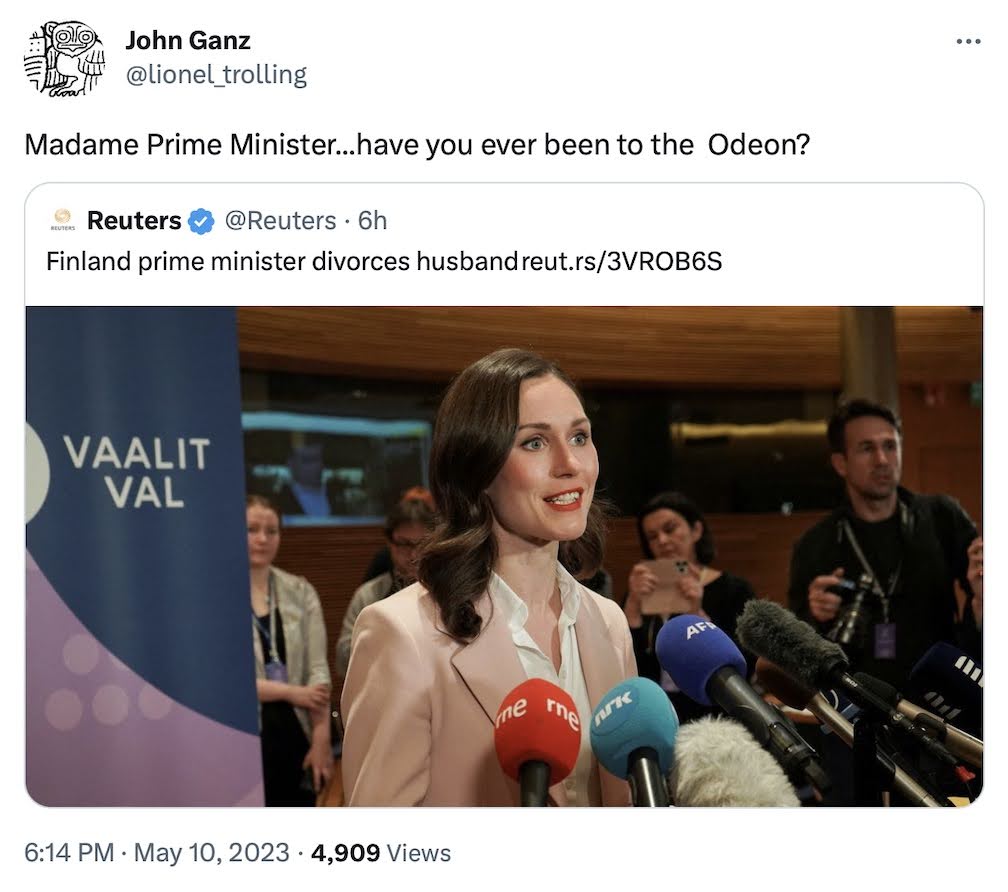
Euronews: "Finland's former PM Sanna Marin leaves parliament for Blair foundation"
Thursday, August 17, 2023

Monday, August 14, 2023
George Grosz: An Autobiography
Our artistic persuasion at that time was Dada." Ifthat expressed anything at all, itwas our long fermenting restlessness, discontent and sarcasm. Any national defeat, any change to a new era gives birth to that sort of movement. At a different time in history we might just as well have been flagellants.
Dada, as much as I know, came from Zurich. During the war, a few poets, painters and composers founded the Cabaret Voltaire. It was directed by Hugo Ball with the help of Richard Hülsenbeck, Hans Arp, Emmy Hennings and a few other international artists. Their program was not exactly political but rather modernist- futurist. The name Dada was conceived by Ball and Hülsenbeck by opening a French dictionary blindfolded and pointing to a word. The word happened to be dada, meaning hobbyhorse.
Hülsenbeck brought Dada to Berlin, where it immediately became politicized. The atmosphere in Berlin was different. The esthetic side was maintained, but got increasingly dislodged by a sort of anarchistic nihilism whose main protagonist was the writer Franz Jung. Jung was a Rimbaud-like audacious adventurer, not to be deterred by anything. He joined us and because he was so powerful, he immediately became the guiding influence of the whole Dada movement. He drank heavily; he also wrote books in a style that was hard to read. He became very famous for a few weeks when he captured a steamship in the Baltic with the help of a sailor named Knuffgen, had it steered to Leningrad, and presented it to the Russians, at a time when the victory of the Communists seemed imminent and there was no real government in Germany.
Jung had no real occupation; he was always surrounded by a few loyally attached vassals. When drunk, he would shoot his revolver at us like a cowboy in a Western; he made a living writing about the stock exchange; at one time, he published his own journal on the subject of economics. He was one of the most brilliant people I have ever met and one of the most unhappy.
We Dadaists had ‘meetings’’ (we used the English word) in which, for a small admission fee, we did nothing but tell people the truth, i.e. insulted them. We spoke without inhibition using plenty of four-letter words. We would say, ‘‘You old heap of shit over there—yes, I mean you, you stupid ass,” or ‘Don’t you laugh, you moron!’’ When anybody answered, which of course they did, we would shout the way they did in the army: ‘‘Shut up, or I'll give you an ass full’ and so on, and so on.
Word spread fast, and soon our meetings and our Sunday morning matinees were sold out to people who were amused and/ or angry. Eventually, we had to have police in the hall because of the constant fighting. Later on it got so wild that we had to get a permit from the local police station. We derided everything, respected nothing, spat upon everything: that was Dada. It was not mysticism, not communism, not anarchy. All those movements had some sort of program. We however were complete nihilists; our symbol was nonexistence, a vacuum, a hole.
Intermittently we produced ‘‘art.’’...
Monday, August 07, 2023
Ten years ago, Israel had prominent, liberal, defenders in American media + academia. It no longer does. https://t.co/lP1MBUxMbi
— Peter Beinart (@PeterBeinart) August 7, 2023
You ten years ago "I'm not asking Israel to be Utopian. I'm not asking it to allow Palestinians... to return to their homes. I'm not even asking it to allow full, equal citizenship,... I'm actually pretty willing to compromise my liberalism."https://t.co/h0jUnO43tc
— Aloise (@AloiseFahyling) August 7, 2023
The Atlantic cut the best passages. Was that or Goldberg? Are you trying to rewrite your past?
— Aloise (@AloiseFahyling) August 7, 2023
I should add the "utopia and intentional communities" tag to every post about Israel. I've added it to most of them I think, after I started it
The new link is to archive.org. I've updated it on a few earlier posts.
I'm not asking Israel to be Utopian. I'm not asking it to allow Palestinians who were forced out (or fled) in 1948 to return to their homes. I'm not even asking it to allow full, equal citizenship to Arab Israelis, since that would require Israel no longer being a Jewish state. I'm actually pretty willing to compromise my liberalism for Israel's security and for its status as a Jewish state. What I am asking is that Israel not do things that foreclose the possibility of a Palestinian state in the West Bank, because if it is does that it will become--and I'm quoting Ehud Olmert and Ehud Barak here--an "apartheid state."
The most he ever wanted was a Bantustan
Saturday, August 05, 2023
I don't know if it was Altman who told it but I remember a story about a Hollywood director from the classic years who said if you need the script to tell the story you're in trouble. Even after the talkies film is visual. That's the origin of this scene. Television changed things. I'd have no problem making a film from an AI script. Godard would have had a problem but he'd try. You can get rid of actors too, but not cinematographers or editors.
Branko, back his old stupidity, asks if the novel was born and died with the end of bourgeois society.
So I get to defend bourgeois capitalism against oligopoly:
It might be good if large scale productions are reduced entirely to garbage. A24 and other independents aren't part of the AMPTP.
- Great. Let's start.
- Larry was in the middle of something.
No, I wasn't. I was just killing time
waiting for Griffin.
No, finish.
What were you saying?
I was saying I've yet to meet a writer
who could change water into wine...
...and we have a tendency
to treat them like that.
Not at this studio.
A million and a half of these scripts.
It's nuts.
And I think avoidable.
Let me ask you. When was the last time
you bought a ticket to see a movie?
- You actually paid your own money?
- Last night.
Pasadena. The Bicycle Thief.
- You saw The Bicycle Thief?
- I love that. It's a great film.
It's an art movie. It doesn't count.
We're talking about movie movies.
Jesus, people.
I'm just saying there's time
and money to be saved...
...if we came up with these stories
on our own.
- Where are these stories coming from?
- Anywhere. It doesn't matter.
The newspaper.
Pick any story.
'Immigrants protest budget cuts
in literacy program. '
Human spirit overcoming human adversity.
Sounds like Horatio Alger in the barrio.
Put Jimmy Smits in it and you've got
a sexy Stand and Deliver.
- Next. Come on.
- Larry was in the middle of something.
No, I wasn't. I was just killing time
waiting for Griffin.
No, finish.
What were you saying?
I was saying I've yet to meet a writer
who could change water into wine...
...and we have a tendency
to treat them like that.
Not at this studio.
A million and a half of these scripts.
It's nuts.
And I think avoidable.
Let me ask you. When was the last time
you bought a ticket to see a movie?
- You actually paid your own money?
- Last night.
Pasadena. The Bicycle Thief.
- You saw The Bicycle Thief?
- I love that. It's a great film.
It's an art movie. It doesn't count.
We're talking about movie movies.
Jesus, people.
I'm just saying there's time
and money to be saved...
...if we came up with these stories
on our own.
- Where are these stories coming from?
- Anywhere. It doesn't matter.
The newspaper.
Pick any story.
'Immigrants protest budget cuts
in literacy program. '
Human spirit overcoming human adversity.
Sounds like Horatio Alger in the barrio.
Put Jimmy Smits in it and you've got
a sexy Stand and Deliver.
- Next. Come on.
- This isn't my field.
It doesn't matter. Give it a shot. You can't lose here.
How about 'Mud slide kills 60
in slums of Chile'?
That's good. Triumph over tragedy.
Sounds like a John Boorman picture.
Slap a happy ending on it,
the script will write itself.
- Bonnie. Give me the paper.
- I don't know, Larry.
Give it a shot.
'Further bond losses
push Dow down 7.15.'
- I see Connery as Bond.
- That's funny.
It's a good thing Oliver Stone wasn't
listening to you. Where would we be?
We would have been spared
sitting through Wall Street.
- What did Wall Street do worldwide?
- 70, 75, maybe 80.
$80 million,
a couple Oscars.
I think Larry's point is well taken.
Let's move on.
Can you give us an update
on the Taylor Hackford project?
Griffin?
Yeah.
I was thinking what
an interesting concept it is
to eliminate the writer
from the artistic process.
If we can get rid of the actors and
directors, maybe we've got something.
Hello, Walter.
Make yourself at home.
It doesn't matter. Give it a shot. You can't lose here.
How about 'Mud slide kills 60
in slums of Chile'?
That's good. Triumph over tragedy.
Sounds like a John Boorman picture.
Slap a happy ending on it,
the script will write itself.
- Bonnie. Give me the paper.
- I don't know, Larry.
Give it a shot.
'Further bond losses
push Dow down 7.15.'
- I see Connery as Bond.
- That's funny.
It's a good thing Oliver Stone wasn't
listening to you. Where would we be?
We would have been spared
sitting through Wall Street.
- What did Wall Street do worldwide?
- 70, 75, maybe 80.
$80 million,
a couple Oscars.
I think Larry's point is well taken.
Let's move on.
Can you give us an update
on the Taylor Hackford project?
Griffin?
Yeah.
I was thinking what
an interesting concept it is
to eliminate the writer
from the artistic process.
If we can get rid of the actors and
directors, maybe we've got something.
Hello, Walter.
Make yourself at home.
Altman, in 2001
Q: You said once that there had never been a truly great film because film relies so heavily on literature and theatre. Have you seen one since?
RA: No. I think they’re getting worse! I had been quoted as saying a really good film had not been made yet, and I think the possibilities of film have not really been explored yet. Maybe there is somebody lying in a crib somewhere that will end up doing it. We still connect it too much to theatre and literature and not enough to just the image. Music has become background for it rather than something that is indigenous to the material. we give awards for the best film and awards for the best soundtrack and one doesn’t necessarily have anything to do with the other. It’s a strange, bastardised type of artform and it draws on all this. It draws on theatre, the visual, performance art, literature. You can’t say, ‘This is the best film.’ This is a different film. As varied as people are.
I think the reference is to an earlier interview with Dick Cavett I discussed here
And it all connects to something I've repeated a lot recently.
That link starts a chain that begins in 2004.
The most fascinating point of all applies more broadly than to Godard; it reaches out to anyone who believes that film is more important than the world. Maybe film is not the great new language of engagement with the world that Bazin hoped it would be. Perhaps it is, instead, a vehicle more suited to dreaming, sensationalism and not wanting to grow up.
And this connects again to something I haven't repeated: a short chain, two hops, to Hans Hotter, and "beloved but flawed art". I could add "Im Abendrot" again, but that would be too much.
Why not: Scroll down for Strauss and Riefenstahl
Subscribe to:
Posts (Atom)