Showing posts with label Borges. Show all posts

Monday, December 05, 2022

A new Smithson tag, mostly now for notes. All the below will have to be fit into the manuscript continuing or expanding on this.

I always understood the weakness in Smithson's work, that his preoccupations were transitional, but I loved them for describing the situation we were in: the negative idealism, the association of narrative with banality, searching for an absolute of some sort.

Humanism at its most mature is a focus on man as she is—I'll be cute and mix it up—not as she want to be; even the use of prescriptive rhetoric only overlays a descriptive core. So the greatest art of humanism achieves a balance not out of ideology or pedantry but respect for the things being balanced, including sobriety and drunkenness. In art, communicative form, drunkenness is the description of the experience, not the thing itself, but it's hard to give due credit without experience. 

"Perception does not know the concept of infinity"

The Baroque was the last flowering of absolutism, manifest in hierarchy able to describe itself as flexible without losing its authority. At the same time its scholasticism can produce an art that rather than describing a mechanism or a function begins to follow it.  

Reading Smithson he's the mirror of Fried: a decadent moralist, a reactionary post-humanist (seeing humanism only as pedantry), elitist, anti-democratic, etc. 

—Jorge Luis Borges begins his From Allegories to Novels by saying, "For all of us, the allegory is an aesthetic error."

—Duchamp shares Shakespeare's disgust when it comes to the elevation of expressive naturalism over the rules of the game.  

Like Borges, he only understands the novel from the world of allegories, and like him they're all he's good for. His comment about Duchamp and Shakespeare is absurd. He reduces the rules of the game to a mechanism which his own work serves only to illustrate. He's closer to Frampton than he admits. But he would've gotten a kick of David Thomson on Godard.

Craig Owens, "The Allegorical Impulse: Toward a Theory of Postmodernism", October, Vol 12. (Spring, 1980) JSTOR  

A week or so ago I updated a post mentioning October.

I've always hated Borges, but not Smithson.

Vesely, (again)  p 207

The problem of infinity was not new. It was discussed in antiquity, during the Middle Ages, and throughout the Renaissance, but always with reference to the transcendental nature of divine reality. From the human point of view, infinity could be only potentially present in a world that was by definition finite. This situation had changed by the end of the sixteenth and the beginning of the seventeenth century, when, for the first time, infinity was thought of and experienced as a plausible actuality. The new appreciation of infinity has much to do with developments in mathematics and with the appropriative nature of introverted representation. The contrast between the introverted experience and the indeterminate beyond, which could not be grasped but could no longer be ignored, was probably the main source of the anxiety often expressed in seventeenth-century writing. The contemplation of infinity. Kepler writes "parries with it I don't know what secret hidden horror: indeed one finds oneself wandering in this immensity to which are denied limits and center and therefore all determinate places. His tone comes close to that of the famous fragment by Pascal: "the eternal silence of these infinite spaces terrifies me."

This fear of the infinite is not shared by Guarini, but it finds its place in his commitment to move beyond the uncertainties and ambiguities of the finite, sensible world and in his elaborate effort to come to terms with the problem of infinity. Guarini's commitment was based on a deep faith in the continuity between the finite human world and the infinity of the divine mind. This faith was combined with an awareness, common in the Aristotelian tradition. that there is not a direct proportion between finite and infinite things or realities. However, if the traditional proportions are raised the level of universal proportions, the ratios can be generated toward infinity. This possibility is a key to Guarini's universal mathematics and metaphysics (prima philosophical, which rests on the assumption that geometrical proportion is both generic and universal in relation to all other proportions.

The important step that Guarini takes is to contemplate approaching the problem of infinity through the continuous progression of ratios in asymptotic approximation. As he himself acknowledges, "the boundary of progression is the end of a series to which no progression can approach, even if it is contained in infinity[,]... but it approaches it in perpetuity" (E.A 213) The progression of ratios to infinity closely corresponds to the principle of diminishing proportions in Renaissance perspective. But there is an important difference: the shift from the human to the divine point of view and from perspective to projection. This shift is readily apparent in the discussion of proportions in the Euclides adauctus, which leads to a consideration of the problem of continuity and culminates in the interpretation of the continuous geometrical proportion of surfaces and their projective relationships. Surface plays a unique role in Guarini's thinking because it is continuous and infinite, and generates geometrical proportions by its very nature--that is, by being a surface. This may explain why Guarini uses the planimetric figure of the hexagon as a primary element in the construction of the Sindone dome. The pyramidal stacking of the hexagons follows the rule of gnomonic difference, which is a proportional difference between individual figures. The sequence may be developed into an infinite series of terms belonging to the same continuous analogy. The key to this idea of the construction of the dome is a relatively little known drawing preserved in the Archivio di Stato in Turin. showing the stereographic pyramidal projection of its triangular elements. (figure 4.16)

The Trinitarian meaning of the triangle is preserved in its transformation into a hexagon. as well as in the twelve rays of the sun achieved by the hexagon's rotation. But the hexagon in the dome is open to more than one interpretation. We can see its meaning as a fulfillment of the primary theme of the chapel, the Passion culminating as a resurrection on the first day of the new creation (the day of sun)in other words, as a new expression of the cosmogonic role and meaning of light in the six days of creation (hexaemeron). Supporting this interpretation is another rather interesting, important fact: the dome is composed of six hexagons (six steps in the journey toward the sun; figures 4.17 and 4.18). [14.18 see below s.e.]

Guarini's geometrical language becomes comprehensible only in the context of his oeuvre as a whole, which also helps us to enter into the culture of the Baroque in which his architecture was received and understood. Broadly speaking, the Baroque culture of the seventeenth century was still dominated by symbolic thinking, which included mathematical speculation and representation (figure 4.19). More specifically, symbolic representation was sustained by dialectical thinking. It is probably no accident that Guarini titled Expensio V of his Euclides "De proportione dialectica." The section treats the dialectical relationship between quantitative entities (magnitudes) and their qualitative meaning. However, the title refers more specifically to the dialectics of geometrical operations in their relation to theological or philosophical discourse. What is new in Guarini's dialectics is its hidden and often enigmatic nature, which must be discerned behind apparently pure geometrical constructions and arguments. This aspect of Guarini's thinking is brought out by his references to Proclus and Nicholas of Cusa, the authors he followed most closely.

Smithson, The Collected Writings,

Jack Flam's introduction

p. XV

In a way, Smithson saw and treated the world as an enormous text, reminiscent of the library in Borges's "Library of Babel," which is synonymous with the universe itself, "composed of an indefinite and perhaps an infinite number of hexagonal galleries"-which seem to prefigure the crystalline structures that Smithson himself favored. Borges's library, moreover, is defined as "a sphere whose exact center is any one of its hexagons and whose circurriference is inaccessible," recalling Smithson's favorite quote from Pascal, that "Nature is an infinite sphere whose center is everywhere and whose circumference is nowhere." Significantly, in a 1968 citation of Pascal's statement, Smithson added "or language becomes an infinite museum whose center is everywhere and whose limits are nowhere."

p.52  Towards The Development of an Air Terminal Site (1967)

p 59

Tony Smith writes about "a dark pavement" that is "punctuated by stacks, towers, fumes and colored lights." (Artforum, December 1966.) The key word is "punctuated." In a sense, the "dark pavement" could be considered a "vast sentence," and the things perceived along it,"punctuation marks.""... tower ..." =the exclamation mark(!)."... stacks . . ."= the dash(-).". . .fumes ..."= the question mark(?)."... colored lights .. ." = the colon (:).Of course, I form these equations on the basis of sense-data and not rational-data. Punctuation refers to interruptions in "printed matter." It is used to emphasize and clarify the meaning of specific segments of usage. Sentences like "skylines" are made of separate "things" that constitute a whole syntax. Tony Smith also refers to his art as "interruptions" in a "space-grid."

p. 66 Letter to the Editor, Artforum (1967)

Sirs:

France has given us the anti-novel, now Michael Fried has given us the anti-theater. A production could be developed on a monstrous scale with the Seven Deadly Isms, verbose diatribes, scandalous refutations, a vindication of Stanley Cavell, shrill but brilliant disputes on "shapehood" vs. "objecthood," dark curses, infamous claims, etc. The stage should subdivide into millions of stages.

The following is a "prologue" from an unwritten TV "spectacular" called The Tribulations of Michael Fried.

. . . there will be no end to this exquisite, horrible misery, when you look forward you shall see a long forever, a boundless duration before you, which will swallow up your thoughts.

Jonathan Edwards

Michael Fried has in his article "Art and Objecthood" (Artforum, June 1967) declared a "war" on what he quixotically calls "theatricality." In a manner worthy of the most fanatical puritan, he provides the art world with a long-overdue spectacle-a kind of ready-made parody of the war between Renaissance classicism (modernity) versus Manneristic anti-classicism (theater) . Fried, without knowing it, has brought into being a schism complete with all the "mimic fury" (Thomas Carew) of a fictive inquisition. He becomes, I want to say, in effect the first truly manneristic critic of "modernity." Fried has set the critical stage for manneristic modernism, although he is trying hard not to fall from the "grip" of grace. This grace he maintains by avoiding appearance, or by keeping art at "arm's length." Fried discusses this "grip" in Anthony Caro and Kenneth No/and—Some Notes on Not Composing (The Lugano Review, 1965/III-IV). What Fried fears most is the consciousness ofwhat he is doing—namely being himself theatrical. He dreads "distance" because that would force him to become aware of the role he is playing. His sense of intimacy would be annihilated by the "God" Jonathan Edwards feared so much. Fried, the orthodox modernist, the keeper of the gospel of Clement Greenberg has been "struck by Tony Smith," the agent of endlessness. Fried has declared his sacred duty to modernism and will now make combat with what Jorge Luis Borges calls "the numerous Hydra (the swamp monster which amounts to a prefiguration or emblem of geometric progressions) ... ", in other words "Judd's Specific Objects, and Morris's gestalts or unitary forms, Smith's cube ... " This atemporal world threatens Fried's present state of temporal grace - his "presentness." The terrors of infinity are taking over the mind of Michael Fried. Corrupt appearances of endlessness worse than any known Evil. A radical skepticism, known only to the dreadful "literalists" is making inroads into intimate "shapehood." Non-durational labyrinths of time are infecting his brain with eternity. Fried, the Marxist saint, shall not be tempted into this awful sensibility, instead he will cling for dear life to the "surfaces" of Jules Olitski's Bunga. Better one million Bungas than one "specific object." Yet, little known "specific demons" are at this moment, I want to say, "breaking the fingers" of Fried's grip on Bunga. This "harrowing" of hellish objecthood is causing modernity much vexation and turmoil-not to say "gnashing of teeth."

At any rate, eternity brings about the dissolution of belief in temporal histories, empires, revolutions, and counter-revolutions—all becomes ephemeral and in a sense unreal, even the universe loses its reality. Nature gives way to the incalculable cycles of nonduration. Eternal time is the result of skepticism, not belief. Every refutation is a mirror of the thing it refutes-ad infinitum. Every war is a battle with reflections.What Michael Fried attacks is what he is. He is a naturalist who attacks natural time. Could it be there is a double Michael Fried-the atemporal Fried and the temporal Fried? Consider a subdivided progression of "Frieds" on millions of stages.

p 138 A Cinematic Atopia (1971)

Going to the cinema results in an immobilization of the body. Not much gets in the way of one's perception. All one can do is look and listen. One forgets where one is sitting. The luminous screen spreads a murky light throughout the darkness. Making a film is one thing, viewing a film another. Impassive, mute, still the viewer sits. The outside world fades as the eyes probe the screen. Does it matter what film one is watching? Perhaps. One thing all films have in common is the power to take perception elsewhere. As I write this, I'm trying to remember a film I liked, or even one I didn't like. My memory becomes a wilderness of elsewheres. How, in such a condition, can I write about film' I don't know. I could know. But I would rather not know. Instead, I will allow the elsewheres to reconstruct themselves as a tangled mass. Somewhere at the bottom of my n1.emory are the sunken remains o fall the films I have ever seen, good and bad they swarm together forming cinematic mirages, stagnant pools of images that cancel each other out. A notion of the abstractness of films crosses my mind, only to be swallowed up in a morass of Hollywood garbage. A pure film of lights and darks slips into a dim landscape of countless westerns. Some sagebrush here, a little cactus there, trails and hoofbeats going nowhere. The thought of a film with a "story" makes me listless. How many stories have I seen on the screen? All those "characters" carrying out dumb tasks. Actors doing exciting things. It's enough to put one into a permanent coma.

Let us assume I have a few favorites. Ikiru? also called Living, To Live, Doomed. No, that won't do. Japanese films are too exhausting. Taken as a lump, they re- mind me of a recording by Captain Beef Heart[sic] called Japan in a Dishpan. There's always Satyajit Ray for a heavy dose of tedium, if you're into tedium. Actually, I tend to prefer lurid sensationalism. For that I must turn to some English director, Alfred Hitchcock will do. You know, the shot in Psycho where Janet Leigh's eye emerges from the bathtub drain after she's been stabbed. Then there's always the Expanded Cinema, as developed by Gene Youngblood, complete with an introduction by "Bucky" Fuller. Rats for Breakfast could be a hypothetical film directed by the great utopian himself. It's not hard to con- sider cinema expanding into a deafening pale abstraction controlled by computers. At the fringes of this expanse one might discover the deteriorated images of Hollis Frampton's Maxwell's Denton? After the "structural film" there is the sprawl of entropy. The monad of cinematic limits spills out into a state of stupefaction. We are faced with inventories of limbo.

p. 349  Ivan the Terrible to Roger Corman or Paradoxes of Conduct in Mannerism as reflected in he Cinema (1967)

p. 350 

Manneristic art is often called pseudo, sick, perverse, false, phony and decadent by the naturalists or truth tellers, yet it seems to me that what the Mannerist esthetic does disclose or recover is a sense of primal evil. Both Eisenstein and Poe seem to have been acutely aware of such a malevolent condition. Parker Tyler in his Classics ofForeign Films has this to say, "Eisenstein knew perfectly well that 'Mephistofeles' and 'wild beast,' the labels he had given Ivan, also applied to himself, to the history of his career as man and film artist." Such an awareness not only locates him within the Mannerist esthetic, but also makes him an artist of the first order.

The Mannerist is not innocent of corruption. He casts a cold eye, and what he sees he treats with humor and terror. A great example of pictorial humor and terror is The Allegory ofEurope or the Beheading ofJohn the Baptist by an unknown Mannerist master (collection of the Prado).The very word "allegory" is enough to strike terror into the hearts of the expressive artist; there is perhaps no device as exhausted as allegory. But strangely enough Allan Kaprow has shown interest in that worn-out device. Jorge Luis Borges begins his From Allegories to Novels by saying, "For all of us, the allegory is an aesthetic error."

p. 352 

Duchamp shares Shakespeare's disgust when it comes to the elevation of expressive naturalism over the rules of the game. 

Sam Wagstaff, "Talking with Tony Smith", Artforum (1966)

I’m not aware of how light and shadow falls on my pieces. I’m just aware of basic form. I’m interested in the thing, not in the effects—pyramids are only geometry, not an effect.

—————————

My speculations with plane and solid geometry and crystal forms led me to making models for sculpture, but what I did always made use of the 90-degree angle, like De Stijl. I only began to use more advanced relationships of solids after working with Wright and then related the thirty and sixty-degree angles to the ninety-degree angles.

—————————

We think in two dimensions—horizontally and vertically. Any angle off that is very hard to remember. For that reason I make models—drawings would be impossible.

—————————

I’m very interested in Topology, the mathematics of surfaces, Euclidian geometry, line and plane relationships. “Rubber sheet geometry,” where facts are more primary than distances and angles, is more elemental but more sophisticated than plane geometry.

————————— 

When I was teaching at Cooper Union in the first year or two of the fifties, someone told me how I could get on to the unfinished New Jersey Turnpike. I took three students and drove from somewhere in the Meadows to New Brunswick. It was a dark night and there were no lights or shoulder markers, lines, railings, or anything at all except the dark pavement moving through the landscape of the flats, rimmed by hills in the distance, but punctuated by stacks, towers, fumes, and colored lights. This drive was a revealing experience. The road and much of the landscape was artificial, and yet it couldn’t be called a work of art. On the other hand, it did something for me that art had never done. At first I didn’t know what it was, but its effect was to liberate me from many of the views I had had about art. It seemed that there had been a reality there which had not had any expression in art. 

 The experience on the road was something mapped out but not socially recognized. I thought to myself, it ought to be clear that’s the end of art. Most painting looks pretty pictorial after that. There is no way you can frame it, you just have to experience it. Later I discovered some abandoned airstrips in Europe—abandoned works, Surrealist landscapes, something that had nothing to do with any function, created worlds without tradition. Artificial landscape without cultural precedent began to dawn on me. There is a drill ground in Nuremberg, large enough to accommodate two million men. The entire field is enclosed with high embankments and towers. The concrete approach is three sixteen-inch steps, one above the other, stretching for a mile or so.

--- 

Gregory of St Vincent, 1647 
Guarini, Cappella della Sacra Sindone, completed in 1694 
Tony Smith Model for Smoke, 1967
Tony Smith, Smug, 1973
Robert Smithson, Alogon #2, 1966
Mirror Stratum, 1966
Spiral Jetty, 1970 
Gyrostasis, 1968
Plunge, 1966 


Sunday, June 12, 2022

The politics of cosplay

The genius of D&D wasn’t just the way it let players wield halberds, turn into wolves or cast fireball spells, though players (especially young ones) can use it to do only those things if they want. It turned out to serve as a perfect bridge from statistics-oriented, win-or-lose simulations of complex combat (like many video games, or fantasy football) to character creation and story-oriented play (like acting, or novel writing). You set out to find the caves and slay the Balrog, and ten sessions later you’ve fallen in love with Samwise, but Pippin’s fallen in love with you. (D&D’s revival piggybacked on the film-based Tolkien revival too, though the Tolkien estate may not have loved it: the first D&D sets had characters called hobbits, but the makers changed the name to ‘halflings’ after a trademark challenge.) The first role-playing games (RPGs) and the first popular video games appeared at nearly the same time: symptoms, if you like, of an emerging nerd culture, pastimes and ways of life made by, for and about people who preferred graph paper, basements and imagined monsters to what we have been instructed to call the real world.
A lot of those people turned out to be trans.

The writing of cosplay is speculative fiction, like John Rawls and Isaac Asimov. The writing of "literary fiction", detective fiction and romance novels, is formal and descriptive. Jane Austen described the experience of 19th century women of a specific nationality, class, and race.  Romance novels serve a function as a fantasy that readers build on. The "art" the "thick description" is after-the-fact, in the minds of the readers. Fantasy is thin by definition. 

I googled the author on a hunch before I finished the paragraph above. I won the bet.

The politics of D&D is reactionary. I've said it enough, as I've linked to the stories of women threatened with assault by bitter fantasists,  and the long record of liberal optimism and authoritarian technocracy. Wanting to be something you're not is as human as sadness. Playing along is a courtesy. Demanding that others accept your lies as their own is something else entirely. But rationalists rationalize.
---
The pathetic man above isn't a threat to anyone; not every fantasist is a fascist. But the first link above links to this, and to a few pathetic fantasists who are.
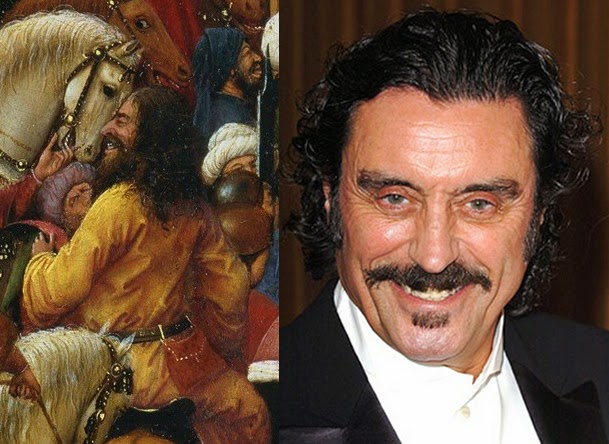
Now tell me why this smiling little man reminds me of Borges.
---
Musk is right of course. For anyone who sees himself, or herself or itself as happily non-binary, pronouns are irrelevant. But that's not what this is about.

Jeet Heer mocks Musk for his comment —"There are divorced guys and there are divorced guys. But as I said before, Elon Musk is the most divorced guy ever"— and then Stewart Brand, oblivious to the fact that Brand and Musk's hypertrophied individualism and futurism are part and parcel of the fantasies of all the various trans-humanists.
Unlike Forrest Gump, who jogged through the same period blissfully ignorant and unseduced by any particular line, Brand fervently believed in almost everything—at least for a little while. Born into an ownership-class family in Rockford, Ill., he was the youngest of four children. His father was a partner at an advertising agency, but the family money traced to the Midwestern timber boom. Stewart attended prep schools, boarding at Exeter Academy in New Hampshire, where despite his intellectual disposition, he was an unexceptional student, especially compared with a standout older brother. It was here, Markoff writes, that Brand developed a “coping mechanism” that became an “operating manual” for him throughout his life: “Brand figured out that the best way to compete was not to follow the crowd but to instead chart his own iconoclastic path.” For an underachieving elitist, better to be incomparably strange than second-rate.

The author is Malcom Harris, another fantasist.

"For an underachieving elitist, better to be incomparably strange than second-rate." Not always underachieving. Narcissism takes many forms. Harris got his start at OWS, with Justine Tunney. Follow the bouncing ball from The Grateful Dead to techno fascism. Aaron Swartz and Scott Aaronson (and here) and David Graeber, and Stewart Brand, have a lot in common. My parents knew Brand in the 60s. They knew what he was. 

Monday, December 06, 2021

updated, AGAIN, because... 

Rawls’s highly abstract and intricate philosophical system was not a flight from the real world’s effects on him, Forrester argues, but rather a direct response to the harrowing experiences, personal and political, that had shaped much of the first three decades of his life.
It was both. And we're back to Calvino. It doesn't matter if it's Chomsky and linguistics-as-physics, or de Man, Robbe-Grillet and Feyerabend, or Quine, who combines them, or Rawls. It's all Post-war intellectual formalism. 
In related news, Matt Bruenig is autistic. So fucking perfect.

Philosophy is literature. The history of literature is scholarship.
---

Twice this week I've come across people writing on art and "the arts", critics with a wide following, who are so unsophisticated it makes me howl. If art were made for aesthetes, dandies would be the ideal. They fantasize art without effort, without "the mud and the flies", alongside their twins, self-identified as artless: the junkie bohemians. Working artists are surrounded with these types. They talk and drink with them and fuck them. They make work about them: they're raw material. But artists aren't lazy; they're obsessed with work.
Philosophers try to make art safe or try to ban it. And now we have a generation of earnest college graduates, and above, who either celebrate corporate entertainment as great art or disdain it as inferior. They love "Art". They love to talk about it. And they're endlessly optimistic.

A comment that labeled me a "nihilist":

12 years ago on the subway, I watched a man playing the accordion. My first thought was that he knew how to handle a knife. His playing was hard, cold and precise, but it was turned in an instant from jagged to fluid, from points to curves, swooping and stabbing. The music described the violent moral universe that made him. He was trailed by a stoop-shouldered woman with a cup. The expression on her face was heartbreaking.

He was the sort of man who could side with fascists or republicans, but he wasn't either. He was the sort of man Borges worshipped, but who held Borges in contempt. 
---

Amia Srinivasan's conflicts are more than skin deep: "The corollary of bro is babe". 

Srinivasan mentions "a black queer porn director with a film degree from the San Francisco Art Institute". That brings us back to Laura Kipnis and George Kuchar.


more on this. It's a fucking disaster.

Tuesday, November 23, 2021

Given the bleak trajectory of American politics, I worry about progressives retreating into private life to preserve their sanity, a retreat that will only hasten democracy’s decay.
Because politics is a choice, not a necessity, at its worst a fantasy, a speculative fiction.

"Isaac Asimov’s Foundation series is perhaps the definitive expression of mid-century American liberalism."

"The nerdy classic is quite possibly the definitive statement of 20th Century American liberal thought."

Sci-fi was very much a young man's game, and its tropes -- rockets, extraterrestrials, etc. -- were interpreted by thinking adults as inherently juvenile indulgences. Sci-fi publications marketed themselves almost exclusively to adolescent boys, and the leading practitioners were only slightly more mature than their audience.

Zachary D. Carter, the author of a biography of Keynes, follows Krugman as a TV critic.

Asimov is Ayn Rand for people who think they've outgrown Ayn Rand, or Rand for PhDs.

repeats repeats repeats

"Science Fiction was created by men trying to get away from the alien environment populated by their wives."

The rise of a self-conscious geek culture, the proud celebration of the preadolescent imagination in adulthood, came in earnest ten years after the publication of One-Dimensional Man and the release of Dr. Strangelove, the title character an amalgam of Werner von Braun and the ur-geek von Neumann.  “If you say why not bomb them tomorrow, I say, why not today? If you say today at 5 o’clock, I say why not one o’clock?”

On that note, Henry seems to have dumped Tyler Cowen for Noah Smith.

But Henry is using the same Calvino quote he used 12 years ago, so I'll repeat the comments I made there at the time, repeating arguments I made 30 years before that. 

And they're still "struggling to come to terms with the obvious".

Comments on "literary fiction" at Language Log; deleted ones—I always save a copy—here.

If the video dies. Imagining the Future: Science Fiction and Social Science, with Farrell, Ada Palmer, Smith, Jo Walton. Moderator, Krugman. Introduction, Karen Sander. At the CUNY Gradate Center, on Zoom. 11/10/21

Friday, May 28, 2021

The poverty of positivism/the poverty of originalism

"There is no better way of finding out what a writer meant than to attempt to state his meaning in different words, preferably in another language."

Gombrich, "Aby Warburg: His Aims and Methods"

We may accept the doctrine that associates having a language with having a conceptual scheme. The relation may be supposed to be this: if conceptual schemes differ, so do languages. But speakers of different languages may share a conceptual scheme provided there is a way of translating one language into the other. Studying the criteria of translation is therefore a way of focussing on criteria of identity for conceptual schemes. If conceptual schemes aren't associated with languages in this way, the original problem is needlessly doubled, for then we would have to imagine the mind, with its ordinary categories, operating with a language with its organizing structure. Under the circumstances we would certainly want to ask who is to be master. 

Donald Davidson, "On the Very Idea of a Conceptual Scheme" 

“When I use a word,” Humpty Dumpty said, in rather a scornful tone, “it means just what I Choose it to mean—neither more nor less.”
“The question is,” said Alice, “whether you can make words mean so many different things." .
“The question is,” said Humpty Dumpty, “which is to be master—‘that’s all.”

I never paid much attention to Davidson—the argument itself was enough for me to laugh—but the Lewis Carroll connection above was clear. 

Carroll and Borges and Aaronson, Nabokov, Nino Scalia, and Scott Soames. Aesthetics is the manifestation of ethics. Hooray for induction.

I'd written "every writer knows language is the master", but that separates writers from philosophers and artists from illustrators: those who recognize that language is the master, and those who refuse to admit it. Writers are craftspeople.

"But art is not essentially content. Art is essentially form. Art is object, not subject." Ursula K. Le Guin
---
I know I repeat myself, but anyone finding one page would miss the full argument.
---

New Scientist, Alice's adventures in algebra. 
The 19th century was a turbulent time for mathematics, with many new and controversial concepts, like imaginary numbers, becoming widely accepted in the mathematical community. Putting Alice’s Adventures in Wonderland in this context, it becomes clear that Dodgson, a stubbornly conservative mathematician, used some of the missing scenes to satirise these radical new ideas.

Even Dodgson’s keenest admirers would admit he was a cautious mathematician who produced little original work. He was, however, a conscientious tutor, and, above everything, he valued the ancient Greek textbook Euclid’s Elements as the epitome of mathematical thinking. Broadly speaking, it covered the geometry of circles, quadrilaterals, parallel lines and some basic trigonometry. But what’s really striking about Elements is its rigorous reasoning: it starts with a few incontrovertible truths, or axioms, and builds up complex arguments through simple, logical steps. Each proposition is stated, proved and finally signed off with QED.

For centuries, this approach had been seen as the pinnacle of mathematical and logical reasoning. Yet to Dodgson’s dismay, contemporary mathematicians weren’t always as rigorous as Euclid. He dismissed their writing as “semi-colloquial” and even “semi-logical”. Worse still for Dodgson, this new mathematics departed from the physical reality that had grounded Euclid’s works.

By now, scholars had started routinely using seemingly nonsensical concepts such as imaginary numbers – the square root of a negative number – which don’t represent physical quantities in the same way that whole numbers or fractions do. No Victorian embraced these new concepts wholeheartedly, and all struggled to find a philosophical framework that would accommodate them. But they gave mathematicians a freedom to explore new ideas, and some were prepared to go along with these strange concepts as long as they were manipulated using a consistent framework of operations. To Dodgson, though, the new mathematics was absurd, and while he accepted it might be interesting to an advanced mathematician, he believed it would be impossible to teach to an undergraduate.

Outgunned in the specialist press, Dodgson took his mathematics to his fiction. Using a technique familiar from Euclid’s proofs, reductio ad absurdum, he picked apart the “semi-logic” of the new abstract mathematics, mocking its weakness by taking these premises to their logical conclusions, with mad results. The outcome is Alice’s Adventures in Wonderland.

Wednesday, November 06, 2019

Thinking. Solving problems elsewhere.

‘Innocent’ formalism, the play of the imagination, the timeless present of children, anarchic and pre-humanist.

The formalism of the untrained, in the world of experts. Le Douanier Rousseau

The formalism of elision, of speaking and hiding, originating in childhood experience but continuing in schooled, articulate, adulthood. James, Elliot, Borges

The formalism of autistic savants.

The art of the periods in-between, the aristocratic as opposed to bourgeois culture of time, of absolutism trying to come to terms with contingency in the forms of the baroque, the contradictory ideal theater.  Leibniz, Bernini, Borromini (sorry kids, the argument predates Deleuze)

The intellectual as counsel to the king, or theologian, becoming the intellectual as academic.

The intellectual as jester, the anarchist at court, and the anti-utilitarianism of aristocratic leisure, becoming the anti-academic intellectual as cosmopolitan observer, artist, critic, flaneur.

Some of the tensions are or seem to be specific to Christian Europe and the Socratic contempt for democracy. The evangelical idealism that separated truth from rhetoric –and linked object making and no other art with philosophy– sets Europe apart.

Interesting to see the last two thousand years in the west as largely "post-democratic",  rebelling against the model of Athens and the Roman republic.  Opposition to democracy precedes its re-invention. And liberal philosophers oppose democracy, since they have to be the authors of the state. The word most come before the act. But that's not how it happens.

And repeats: the two cultures of the two cultures. The UK divides pedants and ironists/ philosophers and novelists; French philosophers are both.  The UK legal system is adversarial; the French is inquisitorial: the ironic philosopher is the French intellectual model.
Anglosphere philosophers are pedants; Anglosphere lawyers are ironists.

Athens: a culture with a great official material and literary tradition.

The best way to come to terms with Athens is to refuse to see it as western.

"You can't understand the complexity of Athenian art, dynamic/naturalistic and hieratic, until you see it, and the best of it. Its closest parallels in Asia don't match it. Nothing in Europe matches in since."


Sunday, February 10, 2019

continuing
---

Film is narrative by definition, even more so than literature. Until recently you couldn’t push rewind; you still can't in the theater. To dream of a non-narrative film is to dream of turning time into the timeless, a human being into an immortal one, into an idea. Ideas feel no pain; they don’t ‘die’.  An idealist working in narrative is always returning to the scene of a crime. That’s why the narrative art of idealists is either formal, hieratic, distancing, or reduces to melodrama, the narrative form of kitsch, either way to forms of pre or post or anti humanism.

Hollis Frampton was a friend of Andre and Stella, and following all the rules of Greenbergian Modernism applied to film, using the  “characteristic methods of a discipline to criticize the discipline itself, not in order to subvert it but in order to entrench it more firmly in its area of competence”.  Remember my mother’s insistence–and she was only half a decade years older than any of them–that’s Eliot’s poetry was “about language”.  

Frampton was the son of a coal miner. He was born in Ohio. He says he barely spoke when he was young and described himself as having been “borderline autistic”.  At 15 he wrote himself an application to Phillips Academy Andover, and was accepted in full scholarship.  That’s where he met Andre and Stella. Later he decided he wanted to be a poet and started a correspondence and then friendship with Ezra Pound, but he decided he wasn’t a good poet, and switched to photography and film.

J. Hoberman  calls Frampton’s film-cycle Hapax Legomena  “crypto-autobiographical”. At the same time he quotes Frampton referring to himself as a “a spectator of mathematics like others are spectators of soccer or pornography”[i], again the same dichotomy of incorporeal formalism and base physicality.

Zorn’s Lemma begins with a black screen and a woman’s voiceover, an unprofessional reading of the 24 couplets  (without I or U, following custom derived from Latin,)  of  The Bay State Primer, from 1800. 

 In Adam's Fall/ We sinned all.
 Thy Life to Mend/ God’s Book Attend.
 The Catdoth play/ And after slay.
 A Dogwill bite/ A Thief at night.
 An Eagle'sflight/ Is Out of sight.
 The Idle Fool/  Is Whipt at School. …

The second section begins with the a montage, each shot lasting one second, -24 frames- of close-up images of the 24 letters of the Roman alphabet  (without J or V- reversing/mirroring the above ) in order,  each formed by typing into a sheet of tin foil.  At the last letter the alphabet begins again, this time formed by footage of signs and lettering on Manhattan streets, again each for one second­ –24 frames. The first shot is a hand holding up a large plastic letter A. Shots continue to loop through the alphabet, the photographs for each letter changing with every repeat. Some of the shots are stable, some  hand held, shaky, with camera motion. Gradually over repeated loops the words are replaced with wordless images. The first four substitutions are a bonfire at night (X),  reversed footage of waves breaking on a beach (Z)  a tracking shot of cattails in the wind (Y)  steam from a street vent (Q), for the four classical elements:  fire, water, earth and air.  Some of the substituted shots are repeated on each loop, some, peeling and eating a tangerine, changing a tire, continue on each loop where they’d had left off. The second section ends when all the words have been replaced  images, which coincides as well with the endings of the continuing shots.

The final section begins with an empty shot of a winter landscape with a tree line in the distance. A man and a woman walking with a dog pass the camera from behind and begin to  move out into the distance. Six female voices in succession recite individual words, timed by a metronome at one second each, from a section of  “On Light, or the Ingression of Forms”, by  Robert Grosseteste, a 13thcentury English prelate and scholastic philosopher. Frampton used his own translation[ii] By the end of the reading, the figures have moved out of sight.

The first bodily form I judge to be Light. For Light, of itself, diffuses itself in  every direction, so that a sphere of Light as great as you please is born instantly from a point of Light.
But Form cannot abandon Matter because Form is not separable and Matter cannot be emptied of Form. 
Form is Light itself or the doer of its work and the bringer of dimensions into Matter. But Light is of a more noble and more excellent essence than all bodily things. 
Since Light, which is the first Form created in first Matter, could not 
abandon Matter, in the beginning of Time it drew out Matter along with itself 
into a mass as great as the fabric of the world.
When the first sphere has been completed in this way, it spreads out its daylight from every part of itself to the center of the whole. This daylight, in its passage, does not divide the body through which it passes, but assembles and  disperses it. And this assembling which disperses proceeded in order, until 
the nine celestial spheres were perfected. 
Matter for the four Elements was assembled within the ninth sphere, which is the sphere of the moon. The ninth sphere, engendering daylight from 
itself, and assembling the Mass within itself, has brought forth Fire. 
Fire engendering Light has brought forth Air. 
Air engendering from itself a bodily spirit has brought forth Water and Earth….

P. Adams Sitney 

In Zorn’s Lemma Frampton followed the tactics of his two elected literary masters Jorge Luis Borges and Ezra Pound. From Borges he learned the art of labyrinthine construction and the dialectic of presenting and obliterating the self. Following Pound, Frampton has incorporated in the end of his film a crucial indirect allusion; it is to the paradox of Arnulf Rainer’s reduction.* In Grosseteste's essay, materiality is the final dissolution, or the point of weakest articulation, of pure light. But in the graphic cinema that vector is reversed. In the quest for sheer materiality - for an image that would be, and not simply represent - the artist seeks endless refinement of light itself. As the choral text moves from Neo-Platonic source-light to the grosser impurities of objective reality, Frampton slowly opens the shutter, washing out his snowscape into the untinted whiteness of the screen.[iii]

* Arnulf Rainer. 1960 film by the Austrian filmmaker Peter Kubelka, made up of cuts between black and white leader with changes so small, down to one or two frames, that the viewer is unable to register them. It’s a film about film, made to be read about, and ‘understood’ but not experienced. 


Zorn’s Lemma manifests the same paradox we’ve seen before, depending of whom we’re talking about, of autism and the closet: the expressive and insistent denial of expression, of the self. Wanda Bershen, writing in Artforum in 1971, fittingly considering the date, sees this anti-Humanism as liberating. 

Having established itself as belonging to the generic category of "film," Zorns Lemma proceeds to totally ignore normal movie conventions. Not only does the structure lie bare, unclothed by any vestige of "content," but that structure is self-constructed. The film maker has provided a set of conditions and allowed them simply to take their course as if programmed by a calculating machine. A 24-letter alphabet at 24 f.p.s. provides the entire structural frame of the movie. The implication here, of course is that the artist is less "responsible" than usual for his work. Rather than an inventor or "maker" he is a kind of "engineer," a director of forces which already exist in his world.

The 24-letter alphabet is man-made, while the 24-f.p.s. film speed is a requirement of film machinery. Philosophically this suggests a considerably less egocentric concept of the artist than has prevailed even in the earlier decades of our own century. And if the artist is not permitted full control of his creation, neither is the audience. Room is left for real interaction, for real discourse, in "real time" between the spectator and the thing observed. A work like Zorn's Lemma is incomplete without the viewer's participation. If the film is indeed a model for the general category of film-viewing, that fact has broad implications. What does it mean for an event to be "complete"? Does not each interaction of each viewer with each event (or object) produce a unique situation? Is not experience (and therefore knowledge) of every sort finally subjective, and personal, and beyond a certain point, incommunicable?[iv]

Rather than an inventor or "maker" he is a kind of "engineer," a director of forces which already exist in his world. Remember Daston and Galison. This is also a twist on Bourdieu’s mocking of the “singularity of experience” in art, since it “elaborates no laws”[v], and therefore is merely a function of banal entertainment. And now we have an argument that rules and laws promote a singularity of experience because there is no author. Bourdieu’s bureaucratic dehumanization has become a celebration of atomization. 

Allen S. Weiss, writing in October in 1985 is both more aware of the conflicts and more committed to radical esotericism, so even more committed to erudite denial. I’ll begin where he does. 

Copulation and mirrors are abominable. For 
one of those gnostics, the visible universe was 
an illusion or (more Precisely) a sophism. 
Mirrors and fatherhood are abominable 
because they multiply and disseminate that 
universe. 
—Jorge Luis Borges 

I do not believe there is such a thing as a 
perfect appearance. Even an epiphany is not 
in the theological sense a perfect appearance. 
Appearance itself is imperfect, 
— Hollis Frampton 

To the abominations of copulation and mirrors one might add cinema. In a world where error, as Nietzsche teaches us, is the very precondition of thought, truth and beauty are always proximate to sophism and illusion, Cinema disposes of yet another set of codes which are available for ideological misappropriation. This disposition by means of seriality, exemplification, listing, and cataloguing operates within the limits of two antithetical functions. Either such listing is a subversive activity, destroying all taxonomic schemes, or lists serve as formal Imperatives, constituting structures and systems. In the former case, a hermeneutic schema entails a de-centering and de-totalizing logic of events, operating according to the aleatory conditions of' existence. In the latter, a hermeneutics entails a centering and totalizing logic of structures and formal systems, constituting a determinate axiomatics.

Hollis Frampton's film Zorn’s Lemmais structured according to a twofold axiomatic system. The first axiom is indicated by the film's title, which refers to mathematical set theory: "Zorn's lemma. The maximal principle: If T is partially ordered and each linearly ordered subset has an upper bound in T, then T contains at least one maximal element." The second axiom derives from the mystical philosophy expounded by Robert Grosseteste in On Light, or the Ingression of Forms, which offers a combination of neo-Platonic and Aristotelian philosophy to express a theology, ontology, and cosmology of light. A section of this text is read in the third part of the film. 

These two axioms are already figured within the text recited in the first part of the film, the eighteenth-century Massachusetts elementary school lesson book called The Bay State Primer. The production of the sets and subsets in the  second part of the film is determined by a system of substitutions and progressions ordered by the (abridged) twenty-four-letter alphabet of the English language used in the primer. The mathematical axiom is operative in the alphabetical order of the text; the theological axiom is operative in the biblical content of the text. Thus the twofold axiomatic system is articulated according to a double coding: structural and ontological. [vi]

Here he adds a footnote

Thus Annette Michelson is correct to claim that in this film Frampton "translated the contradistinctions between lyric and analytic modes" (Annette Michelson, "About Snow," October, no, 8 [Spring 19791, p, 116), Here, the lyrical is an expression of the mystical praise of God, a  poetic mode of knowledge; the analytic is an expression of the mathematization of sign systems, a "scientific" mode of knowledge. Both trades are expressed by Grosseteste's onto-theoÎogy,

All of this once again is reactionary, as intellectualism and as art. Frampton exhibits a high-brow variant of Mapplethorpe’s self-destruction,  like Borges through asceticism rather than orgasm, but still it’s Arendt’s Vita Contemplativa via nihilism and scholastic philosophy, old and new, because the alternative, mere subjectivity, can never be a truth. Frampton speaks about mathematics and irony, but the ending of Zorn’s Lemma is sadness. “He aspired to recognition as a ‘stoic comedian’”[vii] The phrase comes from Hugh Kenner, writing about Flaubert, Joyce, and Beckett.  And this from Kenner’s 1962 article, “Art in a Closed Field” 

Let me put this as flatly as possible: the dominant intellectual analogy of the present age is drawn not from biology, not from psychology (though these are sciences we are knowing about), but from general number theory. [viii]

Frampton’s model was Flaubert, but again it was the Flaubert’s statements, the Flaubert of Bourdieu and pretensions to science, not the novels themselves. Frampton’s art aspires to the art of “Modernism” the art of positivism, an art we only look at now, if we do, because the artist failed in his goals.

The weakness in Frampton’s films is the gap between the earnestness of his desire to make an art without subtext, and the subtext’s insistent presence. The amateurish ‘plainness’ of  the technique, from camera to voiceovers, combined with the rigor of the ideas, mean that the sadness is left to leak in around the edges. And it’s almost shocking to me how much the sadness, the sense of loss, is ignored by critics. His hyper-rationality combined with his intellectualism –two distinct things–­ combine to undermine whatever instincts he had that might have allowed his subtexts have free rein, the advantage artists have by following their craft more than intellect so that their contradictions are allowed to flower. Being an ironic control freak doesn’t make you any less a control freak.  As Callie Angell said to me about Warhol, “People say Andy said he was a machine, but he didn’t. He said he wanted to be a machine, and that’s not the same thing at all.”  Warhol had a brilliant eye. His technique was mechanical, but the humanity of the people in his films pours out almost uncontrollably.  Frampton’s eye was mechanical. He made a scholastic art of citation, committed as idea, not as art. The art is there, but he undermines it, undermining rather than using own subjectivity, needing to leave himself an out, as a conceptualist and critic. He was a brilliant man, with an IQ tested as a child at 187, and his fits the model of early 20thcentury allusive representation, of Eliot et al. to a T. He did everything to fit the bill, and not strategically. After writing to Ezra Pound he ended up moving to DC and visiting him every day for two years until they had a falling out, apparently over the color of Aphrodite’s hair. This could read as the debate of mad poets out of  The Horse’s Mouth, but it seems closer to debates among players of Dungeons and Dragons over Cthulhu.

Frampton wasn’t a nihilist like Borges, or a sadist; at heart he was earnest, behind a wall of erudition. His last completed work was his most emotionally direct. You get the sense that he was growing out of isolation. This he shares with Wittgenstein and Eliot, and also Robert Wilson as I’ll make clear later.

The text below is from Gloria! his last completed film, words scrolling up a  computer screen as he typed.


These propositions are offered numerically, in the order in which they presented themselves to me; and also alphabetically, according to the present state of my belief.

1. That we belonged to the same kinship group, sharing a tie of blood. [A]
2. That others belonged to the same kinship group, and partook of that tie. [Y]
3. That she kept pigs in the house, but never more than one at a time. Each such pig wore a green baize tinker's cap. [A]
4. That she convinced me, gradually, that the first person singular pronoun was, after all, grammatically feasible. [E]
5. That she was obese. [C]
6. That she taught me to read. [A]
7. That she read to me, when I was three years old, and for purposes of her own, William Shakespeare's “The Tempest”. She admonished me for liking Caliban best. [B]
8. That she gave me her teeth, when she had them pulled, to play with. [A]
9. That she was nine times brought to bed with child, and for the last time in her fifty-fifth year, bearing on that occasion stillborn twin sons. No male child was born alive, but four daughters survive. [B]
10. That my mother, her eldest daughter, was born in her sixteenth year. [D]
11. That she was married on Christmas Day, 1909, a few weeks after her thirteenth birthday. [A]
12. That her connoisseurship of the erotic in the vegetable world was unerring. [A]
13. That she was a native of Tyler County, West Virginia, who never knew the exact year of her own birth till she was past sixty. [A]
14. That I deliberately perpetuate her speech, but have only fragmentary recollection of her pronunciation. [H]
15. That she remembered, to the last, a tune played at her wedding party by two young Irish coalminers who had brought guitar and pipes. She said it sounded like quacking ducks; she thought it was called “Lady Bonaparte”. [A]
16. That her last request was for a bushel basket full of empty quart measures. [C]

This work, in its entirety, is given in loving memory of Fanny Elizabeth Catlett Cross, my maternal grandmother, who was born on November 6, 1896, and who died on November 24, 1973.  

It’s a deeply sad film, the sentences scrolling up like the words of a melancholy computer: the memories of HAL.  The text is “bracketed by quotations” as Sitney describes them –with unnecessary detail– of  “two films from the Paper Print Collection of the Library of Congress”, though unnamed by Frampton, Murphy's Wake, and A Wake in Hell's Kitchen,both from 1903, short silent comedies about dead men who aren’t so dead after all and have fun at their own funerals, at the expense of the mourners. Frampton’s film is silent until the end of the 16 propositions, after which over the empty green screen we hear “an auditory quotation of  ‘Lady Bonaparte,' an Irish gig [sic]”. In fact  we hear the entire song, played by Finbar Furey. Then the second silent film cuts in, ending with the deceased, having scared off the last of his friends, left to dance and drink from an abandoned bottle of whisky.  The film cuts to black over which the typing begins again, the last sentence not rising off the screen like the  previous texts but to the top and fading to black. 

4. That she convinced me, gradually, that the first person singular pronoun was, after all, grammatically feasible. [E]

She helped him say “I”. She helped him to learn to accept a self, a subjectivity, what it means to be human.  

It’s a beautiful film, but a small one. To say that it’s more is to buy into a lie of a positivist art, an art of statements, and the lies that Frampton told himself and that his work undermines, but not strongly enough. 


[i]  J. Hoberman, “Hollis Frampton at Anthology: Here, There, Everywhere”. The Village Voice, March 25th2009 
 https://www.villagevoice.com/2009/03/25/hollis-frampton-at-anthology-here-there-everywhere/
[ii]Hollis Frampton, On the Camera Arts and Consecutive Matters: The Writings of Hollis Frampton,ed. Bruce Jenkins, MIT Press 2009 p. 194
[iii]  P. Adams Sitney, Visionary Film:
The American Avant-Garde 1943–2000,Oxford University Press, 1974 (2002) p 369
[iv]Wanda Bershen, "Zorns Lemma," ARTFORUM, September, 1971, pp. 41-45. 
[v]Bourdieu, Rules for Art, p. xv
[vi] Allen S. Weiss, “Frampton's Lemma, Zorn's Dilemma”, October, Vol. 32, Hollis Frampton (Spring, 1985), pp. 118-128 
[vii]P. Adams Sitney, Eyes Upside Down: Visionary Filmmakers and the Heritage of Emerson, Oxford University Press 2008. p.102
[viii]  Hugh Kenner, “Art in a Closed Field”, The Virginia Quarterly Review,Vol. 38, No. 4 (Autumn 1962), pp. 597-613 

continuing here.