Showing posts with label Ukraine. Show all posts

Monday, January 19, 2026

Why not
A post for Western analysts who keep chanting that the far-right in Ukraine is “2%” and has no political influence.

As of Jan. 2026, according to KIIS, the “White Chief” Andriy Biletsky is trusted by 45% of Ukrainians, and only 13% distrust him. Meanwhile, Commander-in-Chief Syrskyi is trusted by 46%, but distrusted by 40%.

Thanks to Zelensky, Biletsky went from a street thug and neo-Nazi leader to a brigadier general and the commander of a corps numbering tens of thousands of highly motivated, well-trained men, armed with the best NATO weapons.

The ideology of his boys is based on the OUN tradition: ethnic nationalism, authoritarianism, homophobia, racism, a cult of the leader, a cult of force.

Biletsky Corps also trains neo-Nazis from around the world and members of Colombian and Mexican narcocartels. Because why not?

Congratulations, Europe, on the flourishing 'democracy' in Ukraine you’re sponsoring 

Tuesday, December 03, 2024

more comedy
BEIRUT/GENEVA/DUBAI, Dec 2 (Reuters) - The U.S. and the United Arab Emirates have discussed with each other the possibility of lifting sanctions on Syrian President Bashar al-Assad if he peels himself away from Iran and cuts off weapons routes to Lebanon's Hezbollah, five people familiar with the matter said. The conversations intensified in recent months, the sources said, driven by the possible expiry on Dec. 20 of sweeping U.S. sanctions on Syria and by Israel's campaign against Tehran's regional network, including Hezbollah in Lebanon, Hamas in Gaza and Iranian assets in Syria.

--- 

"...we are not always consistent" etc.

Tuesday, October 08, 2024

Hersh was right.
 

Wednesday, October 04, 2023

Sunday, September 24, 2023

Bibi has made it official: Jews in Iran are now safer and have more rights than Palestinians in Israel.

Maybe Modi is right about Canada: Golinkin in The Forward again.

"Zelenskyy joins Canadian Parliament’s ovation to 98-year-old veteran who fought with Nazis"

In posts to the blog dated 2011 and 2010, Hunka describes 1941 to 1943 as the happiest years of his life and compares the veterans of his unit, who were scattered across the world, to Jews.

Golinkin, previously. Vladislav Davidzon is a character out of central casting.

Nagorno-Karabakh is not Ukraine, or Kosovo, never mind Libya, Iraq, Syria...

This is almost fun.
---

Sunday, July 23, 2023

Vladislav Davidzon in Tablet

It was deeply exasperating and disappointing to read the latest screed published in The Forward regarding neo-Nazi influence within the now-infamous Ukrainian Azov battalion. The article, from Mr. Lev Golinkin, was necessarily both exasperating and disappointing to anyone who cares about these issues, and about Ukraine. It was, however, especially disappointing to me, a onetime contributor to The Forward, where I published my first reviews as a fledgling literary critic. The unceasing attacks on the heroic defenders of Ukraine in the midst of the Kremlin’s genocidal war are merely the latest indicator of its protracted decline into irrelevancy....

Ukrainian civic patriotism is fundamentally healthy and strong. It is, in fact, healthy in a way that makes lots of people integrated into the urban, post-historical professional and administrative classes in advanced democracies uncomfortable: a swaggering, self-assured liberal nationalism that unironically deploys the kinds of martial virtues lacking in many deracinated Westerners, and which make the latter feel inadequate and perhaps even emasculated. I understand full well why these virtues make a lot of American progressives (especially self-neutered progressive men) feel uncomfortable. The masculinity and virility exhibited daily by Ukrainian soldiers has not been seen in the West for half a century. After the end of history and time, nice, chummy, and decadent Westerners were not supposed to fear going to war ever again. They had “all-volunteer” armies of impoverished cannon fodder for that.

Fukuyama, and Azov, and Lev Golinkin, previously.

The Zionist Federation of Germany Addresses The New German State (1933) 

The emancipation of the Jews, begun at the end of the 18th, beginning of the 19th century, was based on the idea that the Jewish question could be solved by having the nation-state absorb the Jews living in its midst. This view, deriving from the ideas of the French Revolution, discerned only the individual, the single human being freely suspended in space, without regarding the ties of blood and history or spiritual distinctiveness. Accordingly, the liberal state demanded of the Jew, assimilation into the non-Jewish environment. Baptism and mixed marriage were encouraged in political and economic life. Thus it happened that innumerable persons of Jewish origin had the chance to occupy important positions and to come forward as representatives of German culture and German life, without having their belonging to Jewry become visible.

Thus arose a state of affairs which in political discussion today is termed "debasement of Germandom" or "Jewification."...
Zionism has no illusions about the difficulty of the Jewish condition, which consists above all in an abnormal occupational pattern and in the fault of an intellectual and moral posture not rooted in one's own tradition. Zionism recognized decades ago that as a result of the assimilationist trend. symptoms of deterioration were bound to appear, which it seeks to overcome by carrying out its challenge to transform Jewish life completely.

It is our opinion that an answer to the Jewish question truly satisfying to the national state can be brought about only with the collaboration of the Jewish movement that aims at a social, cultural, and moral renewal of Jewry—indeed, that such a national renewal must first create the decisive social and spiritual premises for all solutions.

Zionism believes that a rebirth of national life, such as is occurring in German life through adhesion to Christian and national values, must also take place in the Jewish national group. For the Jew, too, origin, religion. community of fate and group consciousness must be of decisive significance in the shaping of his life. This means that the egotistical individualism which arose in the liberal era must be overcome by public spiritedness and by willingness to accept responsibility. 

 So predictable, and so fucking boring.

Tuesday, July 11, 2023

Shouldn't this stuff be banned as disinformation or something? I'm really worried for the future of this country.

Axios, 
Bipartisan push forms in Congress to deny Ukraine cluster bombs.

The Intercept, "A loose coalition of Democrats and Freedom Caucus Republicans are pushing NDAA amendments that challenge Washington’s foreign policy orthodoxy"

Putin's got to everybody apparently.

Wednesday, July 05, 2023

Tuesday, July 04, 2023


The Forward, "Why did Stanford students host a group of neo-Nazis?"
Conversations about white supremacy in America today typically center on right-wing media and incendiary politicians who blast out racist dog whistles.

But hate doesn’t need demagogues to get mainstreamed; it has also found an outlet at elite universities.

On June 29, Stanford University hosted a delegation from the Azov Brigade, a neo-Nazi formation in the Ukrainian National Guard. The panel, during which Azov’s neo-Nazi insignia was projected onto the wall, was attended by noted political scientist Francis Fukuyama, who posed for a photograph with the delegation.

This event — and the disturbing lack of reaction from Jewish organizations — showcases the limits of America’s commitment to combating white supremacy.

Call it the Ukraine exception.
Moss Robeson, a thread with links:
Yulia Fedosiuk, famous Azov Regiment wife currently touring the US for a 2nd time, makes reference to alt-right / neo-Nazi meme on her way back to Stanford

more: 


—Denys Redis Prokopenko - 32! 

Legend of Ukraine, the Army and Dynamo.

For us it’s a great honor that Denis has come from our movement. The guy with whom we had fights in the city, away matches and concerts with. Today he represents real hope for Ukraine. His leadership in the defence of Mariupol will go down in military history. The officer with a flame of Idea in his heart and cares deeply about the fate of Europe. 

We are very thankful to our comrades from Zagreb, Berlin and Madrid for your congratulations. We will always appreciate who have been with us in than hard time. 

Redis will see it personally and he will be shy because he doesn’t like “birthday parties” like many other warriors. Especially when our country is spilling blood. His biggest wish is to return to battle. 

“Ukraine belongs to us 
Brave, real and loyal 
Who have chosen honour and courage”. 

We wait for you at home, comman𝕯er!—


Saturday, June 24, 2023

Grozev 

Last December, @juliaioffe  asked me what I thought Prigozhin would do. I said he'd try a coup within six months. (Julia even asked me if I was okay to commit to a timeline on the record). Anyhoo..

I spent most of last night on Twitter and Telegram. A friend tells me Prigozhin's language in this diatribes is untranslatable, rich. A great orator. J's parents lived through the Holodomor, Russian speakers in Kiev.

Seddon

Kremlin spox Dmitry Peskov:
– charges dropped against Prigozhin, who will leave Russia for Belarus
– Wagner fighters who didn't take part in the uprising will sign contracts with the MOD
– Wagner fighters who did take part not charged
– No word on potential MOD leadership changes

Despite declaring Prigozhin a "traitor" and vowing to "liquidate" Wagner on Saturday morning, Peskov said Putin had asked Lukashenko to mediate in the hope of avoiding any further bloodshed because the Belarusian leader has known Prigozhin for 20 years.

Peskov described the uprising – in which Wagner shot down helicopters, captured a major command post, and marched most of the way to Moscow – as "fairly difficult" and "full of tragic events," but said "there were higher goals of escaping bloodshed and internal confrontation."

Putin will not make any further comment on the issue. The invasion of Ukraine will continue as normal.

No word from Peskov on whether Prigozhin managed to secure Shoigu's resignation – he said only Putin has that authority so Prigozhin and Lukashenko couldn't discuss it.

Closer and closer to a failed state. Even Gazprom has it's own militia. And the videos from Moscow last night were teenagers celebrating the end of high school. It's terrifying. 

repeats

There are three distinct groups in Russia: 1/25

1) radicals – a sizeable but extremely loud minority that actively supports war, is engaged, follows the news and in rare cases even goes to the frontlines (15-25%). This is the audience of the milbloggers, Telegram channels and vampires like Solovyov or Skabeeva 2/25

2) dissenters – a sizeable minority that categorically opposes the war. It is banned from Russian-based media and generally depressed (20-25%) 3/25

3) laymen – a passive majority that is completely depoliticized and doesn’t want to have anything in common with politics & war (50-65%) 4/25

"a passive majority that is completely depoliticized and doesn’t want to have anything in common with politics & war" 

Balthazar. related in more ways than one.

A thread by Mateev.
Fact: Wagner troops did have their own command structure and were ready to follow Prigozhin.
1/

Fact: in multiple videos from Rostov-on-Don, people were cheering and greeting Prigozhin's troops.
2/

Fact: the army reacted to Prigozhin's coup... by starting negotiations. Prigozhin was caught on camera talking rather arrogantly to Yunus-bek Yevkurov, deputy minister of defense (!!), along with a high-level MoD officer responsible for the interaction with PMCs.
3/

Fact: some skirmishes between Prigozhinists and the army did happen. Several helicopters were downed. One helicopter crew died.
4/

Fact: instead of court-martialing Prigozhin and the rest of the mutineers, Putin - through Lukashenko, of all people! - offered them amnesty and an escape route.
5/ 
What to make of this?
The contours of the possible civil war are suddenly brought into sharp relief.
6/ 
What do the Russian troops consist of at the moment?
1) Akhmat/Kadyrovites, 2) LDNR militias, 3) multiple PMCs other than Wagner (!), 4) local regiments created in each Russian region and financed locally, at least in part (!!)
7/

Furthermore: FSB and other agencies apparently do not have military counterintelligence capable of preventing something like this.
8/

In effect, a free-for-all across the country is totally possible.
Putin said many times that Russia's very existence hangs in the balance - apparently it's true, thanks to his own actions and the system he has built in the last 23 years.
9/

Incredible result for the self-proclaimed "gosudarstennik" [state-minded person] - the state he built is brittle like a porcelain cup.
10/ 
repeats, October 2022. Grozev and Ragozin, Prigozhin and Arestovych.
Looking forward to nuclear blackmail by the competing warlords of the failed Russian state.

Friday, June 16, 2023

Meduza, The changing face of dead Russian soldiers
Since the start of Russia’s full-scale invasion of Ukraine, journalists at the BBC and Mediazona, working with a team of volunteers, have used open-source data to track the number of Russian soldiers killed in the war. By mid-June 2023, they had counted the names of more than 25,000 Russian combatants known to have died in Ukraine. (For reference, Russia’s Defense Ministry last claimed, nine months ago in September 2022, that only 5,937 Russian soldiers have died, whereas the Ukrainian military claims to have killed more than 200,000 invading troops. Western analysts put Russia’s losses in the tens of thousands.)

This research by the BBC, Mediazona, and their volunteer team paints an evolving picture of the “typical Russian soldier” likeliest to lose his life in combat. In a new report, released in both Russian and English, journalists reached the following conclusions.
  • In the first three months of the full-scale invasion, the “typical Russian combatant killed in action” was a 21-year-old contract soldier.
  • By the spring and summer of 2023, that “typical Russian soldier” is now a 34-year-old former prison inmate of unknown rank.
Up in the Berkshires, CNBC says that Putin says he's willing to negotiate directly with the US.
CNBC rejects the offer. 

The first sentence reports what I saw on the TV, the second is a good enough description of the response.
---

May 17, Russia Matters, Belfer Center: Why Putin Will Use Nuclear Weapons in Ukraine

last paragraphs

None of this is to say that we in the West should pressure Ukraine to forgo its goal to liberate all seized territory. But it does mean that we should anticipate a nuclear weapon will be used and develop our possible responses accordingly.

Normalizing Nuclear Weapons

As soon as Russia uses a nuclear weapon in Ukraine, the “fallout” will begin and spread. Tens of thousands of Ukrainians will be dead, suffering or dealing with the effects of the nuclear explosion. Hundreds of millions of Europeans will be bracing for war. But 7 billion others around the globe will go about their business, alarmed to be sure, but physically unaffected by a nuclear explosion in Ukraine. This last outcome of a Russian tactical nuclear strike may ultimately be the most dangerous to the international order. The image that many people have of nuclear arms as civilization-ending weapons will be erased. In its place, people will see these weapons as normal and, although tragic, acceptable in war. Just a “bigger bullet.” It is in this dramatically changed context that the United States will have to decide how to respond.
---

Retired Brigadier General Kevin Ryan is a senior fellow at Harvard Kennedy School’s Belfer Center for Science and International Affairs. He served as U.S. defense attaché to Moscow and deputy director for strategy, plans and policy on the Army Staff. 

Hersh, Partners in Doomsday

I was planning to write this week about the expanding war in Ukraine and the danger it poses for the Biden Administration. I had a lot to say. Deputy Secretary of State Wendy Sherman has resigned, and her last day in office is June 30. Her departure has triggered near panic inside the State Department about the person many there fear will be chosen to replace her: Victoria Nuland. Nuland’s hawkishness on Russia and antipathy for Vladimir Putin fits perfectly with the views of President Biden. Nuland is now the undersecretary for political affairs and has been described as “running amok,” in the words of a person with direct knowledge of the situation, among the various bureaus of the State Department while Secretary of State Antony Blinken is on the road. If Sherman has a view about her potential successor, and she must, she’s unlikely ever to share it. 

Nuland, and again

Wednesday, June 14, 2023

See also Daniela Gabor's definition of neoliberalism.  Neoliberalism sucks because it opposes the state! Neoliberalism's bad-bad-bad because it's statist! 

How did libertarianism become fascism? How did the Grateful Dead spawn Peter Thiel? 

Why is Farrell's favorite band named "My Bloody Valentine"??
Atomization, isolation and the illusion of absolute community. The low buzz and hum—the violence and warmth—of neurological overload. 
This has turned into a run of three posts, connected and rambling. The second post is the last link below.
---

Farrell, June 1st

Quinn Slobodian’s new book, Crack-Up Capitalism is an original and striking analysis of a weird apparent disjuncture. Libertarians and classical liberals famously claim to be opposed to state power. So why do some of them resort to it so readily?
Farrell, June 8th 
Cognitive dissonance. Years of libertarianism sympathy and always a Weberian.
The Intercept article is still up. It shouldn’t be. It isn’t just that the article is demonstrably and terribly wrong. It is that it is demonstrably causing genuine and continued harm and distress to people whose lives have been turned upside down. I’ve seen Twitter fights where Fang in particular tried to defend the piece (mostly through tu quoque rather than actually engaging with criticisms). I haven’t seen any sign that the editors of the Intercept have addressed the pushback to the piece (perhaps I’ve missed it). If I were to guess, I’d suspect that people at the Intercept know that the piece stinks, but feel that it’s awkward to confront it. The Intercept has been a notoriously fractious organization, with people leaving in angry huffs, being forced to leave, newsroom leaks and the like. I can understand why they don’t want more drama. But that doesn’t make it right. It’s an article whose fundamental flaws have caused specific hurt and had wide repercussions for American media and politics. Fixing fuck-ups like this is Journalism Ethics 101.
And there’s a deeper story here about something that has gone badly wrong with one part of the American left, which I used to be reasonably friendly with, and have found increasingly weird and alienating over the last few years (some things I used to think, I don’t think any more; some people I respected, I’ve given up on). One of the key consequences of the Intercept article has been to undermine efforts to understand, let alone push back against, democratic disinformation. I suspect that is an intended consequence. The article’s authors make it clear that they don’t think that government should have any role in making the information environment better. 

Commenter TM: "I have one question: what is 'democratic disinformation'?"

repeats: 
But really what it means to not discriminate on the basis of viewpoint, while this is somewhat debated on the details, but if you are leaving up anti teen anorexia videos then you have to also leave up the pro teen anorexia videos.... If you're leaving up the claims that the Holocaust is real you also leave up the claims that the Holocaust is not real, so there's just this very grim array of consequences from that rule requiring viewpoint neutrality.

"The Department of Homeland Security is quietly broadening its efforts to curb speech it considers dangerous, an investigation by The Intercept has found. Years of internal DHS memos, emails, and documents — obtained via leaks and an ongoing lawsuit, as well as public documents — illustrate an expansive effort by the agency to influence tech platforms."

The Atlantic: "Social-media companies deny quietly suppressing content, but many users still believe it happens. The result is a lack of trust in the internet."

Zuckerberg on policy: "This process for adjusting this curve is similar to what I described above for proactively identifying harmful content, but is now focused on identifying borderline content instead. We train AI systems to detect borderline content so we can distribute that content less."  

The law banning US government propaganda within the US was repealed in 2013. 

Twitter said 100 accounts with Russian ties were removed for amplifying narratives that undermined faith in NATO and targeted the United States and the European Union.

(Vincent Bevins replies: "I'm sorry but,What?")

In my experience, everyone supports the right to freedom of speech, as long as it’s their own speech or the speech of people they agree with. But most speech falls outside that category. Most people would ask: why support the right of people to say things you hate, or fear or that you regard as dangerous?...

In 1968, when the racist George Wallace, a Democratic governor of Alabama, was running as a third-party candidate for president of the United States, I defended his right to speak at a stadium owned by New York City, after the then mayor had banned him from using that platform. There was, at that time, no one whose speech I despised more than Wallace’s. I considered him, and his candidacy, a credible danger to the fundamental rights I was spending my life trying to protect. Nor was that a unique case. Many speakers whose right to speak I defended during my 34 years at the American Civil Liberties Union (ACLU) expressed views I disagreed with, some of which I thought were bigoted and dangerous.

For me, the answer is strategic. I can never be certain who will have political power. I can never be certain that the only people who get elected will agree with me. I know – because it has happened many times – that people will gain political power who will, if they can, act to punish me or people I agree with, because of our views. So what I need is an insurance policy. I want insurance against the probability that people in power will suppress or punish me for my views. 

 And the obvious, linked in the above but first here.

Most arguments against mass surveillance don't respond fully substantively to claims that you shouldn't worry if you "have nothing to hide".  Defense of personal freedom isn't enough.  What's needed is an argument in defense of the need for citizens in a democratic state to be able to be all kinds of wrong, all kinds of confused, creepy, conflicted, desirous, weepy or hate-filled, so that they may be able to learn to understand and outgrow their childishness. The choice is between a community of adults with a minority of the inveterately childish and criminal or a community of children ruled by moralists and crime lords. 

Slobodian recently and earlier. Variations on authoritarianism and fascist kitsch. 

But if I'm disgusted by these assholes I should repeat what I wrote in the previous post about Trudeau.

Trudeau made no pretense to philosophy; he did what he thought was necessary, arguing from the specifics in a crisis, not generalizations from the library. Theory simplifies the messiness and slop of politics, and more than anything it's used as an excuse, as if it could grant permission: "I was only following orders." Trudeau's quote is famous because it was so blunt it still makes people laugh. He takes full credit, or blame, and shrugs. Schmitt was a fascist, defending violence as a general truth about the world, and taking responsibility for nothing. He was a weakling defending weakness. The passivity is the root of the sleaze. Passivity reinforces itself, and political passivity is a biggest threat to democracy. MacIntyre is a putz.  

Monday, June 12, 2023

Neoliberalism is telocratic now. But it always was, depending who was talking and when.
This is all so fucking stupid. Gabor's comments go with Farrell's so I could just as well add them to the later post
Libertarians and classical liberals famously claim to be opposed to state power. So why do some of them resort to it so readily?
pic if twitter dies.

---
And again. The best response to all of this is in the relation of Arendt and Trudeau.
more on MacIntyre here
---

Updated again, and again, because I need to dot every fucking i.

"So you want to be a career soldier? Good for you. But remember that the longer you stay in uniform, the less you will really understand about the country you protect." 
A Marine colonel explains democracy to philosophers, who by the nature of their calling refuse to accept what it is.
The full quote is below.
---
I forget how much I repeat myself. But that's all argument is at this point.
 

großiga m'pfa habla horem
egiga goramen
higo bloiko russula huju
hollaka hollala
anlogo bung
blago bung blago bung
bosso fataka
ü üü ü
schampa wulla wussa olobo
hej tatta gorem
eschige zunbada
wulubu ssubudu uluwu ssubudu
–umf
kusa gauma 

ba–umf" 

These arguments have only to be stated to be recognized as being widely influential in our society. They have of course their articulate expert spokesmen: Herman Kahn and the Pope, Che Guevara and Milton Friedman are among the authors who have produced variant versions of them. But it is their appearance in newspaper editorials and high-school debates, on radio talk shows and letters to congressmen, in bars, barracks and board-rooms, it is their typicality that makes them important examples here. What salient characteristics do these debates and disagreements share?

A few pages of MacIntyre and it's like reading a very serious 22-year-old going back over his past as a very serious teenager. 

One of those books that make you go "fuck me, I need to reassess everything". Essential.

And it gets worse.

Dunno if anyone's coined this, but the condition of late modernity is "Teloslos" - purposelessness

Rakesh Bhandari replies

Tied back to neoliberalism which can be understood as a critique of the telocratic state. From Raymond Plant, The Neo-liberal State, chap 1: "To use the terminology of Oakeshott, endorsed by Hayek, the state should be seen as nomocratic and not telocratic."

Hochuli 

More reason to despise neoliberalism

Bhandari 

The idea that the state should just be nomocratic and not telocratic seems absurd in the face of climate change: we have a common goal of a renewable revolution, and the state has a role to play. Neoliberalism obstacle to life. 

Definitions: Nomacracy the is rule of means; telocracy is the rule of ends. 

Absolutely no sense of history. I used to think Bhandari was better.

...What’s more, the graduates were no longer content to let the machinery of business determine the course of their lives. One man told Baltzell that before the program he had been “like a straw floating with the current down the stream” and added: “The stream was the Bell Telephone Company. I don’t think I will ever be that straw again.” 

"I saw the best minds of my generation destroyed by madness, starving hysterical naked, dragging themselves through the negro streets at dawn looking for an angry fix."

If we review Bentham’s contemporaries in search of a figure who might be seen as exemplifying the antithesis of the Benthamic view of life, many names might suggest themselves and might, in one context or another, be appropriate. Rousseau, Burke, Kant himself, Hegel – each of these would have a claim, though each might prove, on closer inspection, to have something at least in common with Bentham. There is, however, a figure – a man who was born less than ten years after Bentham and died less than five years before him – who may provide the requisite antithesis. William Blake, I suggest, both embodies that antithesis and proclaims the imperfection of Bentham’s understanding of happiness. 

Keynesianism was an ideology of mobilization, an intellectual project for winning the war. And there were Keynesians everywhere. German economists, aligned with the Nazi regime, made the same discoveries at the same time. They conducted extensive debates in 1943 and 1944 as to whether there was any upper limit to the debt that might constrain the final mobilization for Hitler’s Endsieg. It was dangerous to be a fiscal conservative in Hitler’s Germany, especially as the end approached. 

MacIntyre is a Thomist
Though unfamiliar to most scientists and the general public, the term expresses a cultural problem that caught my eye. It occurs in an article written by the late Protestant moral theologian Paul Ramsey in 1976 as part of a debate with a Jesuit theologian, Richard McCormick. McCormick argued that it ought to be morally acceptable to use children for nontherapeutic research, that is, for research with no direct benefit to the children themselves and in the absence of any informed consent. Referring to claims about the “necessity” of such research, Ramsey accused McCormick of falling prey to the “research imperative”, the view that the importance of research could overcome moral values.

That was the last time I heard of the phrase for many years, but it informs important arguments about research that have surfaces with increasing force of late. It captures, for instance, the essence of what Joshua Lederberg, a Nobel laureate for his work on genetics and president emeritus of Rockefeller University once remarked to me: “The blood of those who will die if biomedical research is not pursued will be upon the hands of those who don’t do it."

"It’s War Communism in the war on disease. It’s Stalinism for the betterment of the race, and isn't that what Stalinism always was?" 

Trolley Problems and the doctrine of double effect. This time I'll quote the manuscript

The doctrine of double effect originates with Aquinas. We’re back to the authoritarianism of the Church and the research imperative. Utilitarianism doesn’t need to nit-pick about intention; it’s simple enough to say “I chose to kill 3 people to save 10”. But the focus on intention, the inner workings of the killer’s mind, denies full moral existence to those who’ve been killed, and I know of no study asking people to imagine themselves as the fat man and asking if they’re able to intuit a moral difference between being pushed by a man’s hand or by a turnstile with someone’s finger on the switch.

Utilitarianism is the logic of the military. 

So you want to be a career soldier? Good for you. But remember that the longer you stay in uniform, the less you will really understand about the country you protect. Democracy is the antithesis of the military life; it’s chaotic, dishonest, disorganized, and at the same time glorious, exhilarating and free — which you are not.

After a while, if you stay in, you’ll be tempted to say, “Look, you civilians, we’ve got a better way. We’re better organized. We’re patriotic, and we know what it is to sacrifice. Be like us.” And you’ll be dead wrong, son. If you’re a career soldier, you may defend democracy, but you won’t understand it or be part of it. What’s more, you’ll always be a stranger to your own society. That’s the sacrifice you’ll be making.

Democracy is absolutist about form and relativist about truth.

I began to find myself in a dangerous situation as an advocate. I came to believe in the truth of what I was saying. 

And “wealth” itself is an irrational concept. It is an almost mystical process, the setting of ethical values: Arising from the irrational, transforming the irrational to the rational, yet nonetheless it is the irrational that radiates from within the resulting form.

Life is pointless. If the relentless drive for growth and progress—forward motion for its own sake, a mass delusion, a telos in the void—means now that the only option is a mobilized military-Keynesianism, it's a pity. It really is. But that's why the Chinese Communist Party will save the world.

I used Ball and I should have used Schwitters, a better artist, and a comedian, mocking the imperial telocracies of Europe in 1916, and 2023.  I could have used Talking Heads, but I'll use Motörhead.

And now the liberal-woke-capitalist-powers-that-be have restricted the viewing of footage of the battles of Verdun and the Somme, to protects us. And even joking about it sounds like overkill.

16 years old when I went to the war,
To fight for a land fit for heroes,
God on my side, and a gun in my hand,
Chasing my days down to zero,
And I marched and I fought and I bled
And I died & I never did get any older,
But I knew at the time, That a year in the line,
Was a long enough life for a soldier,
We all volunteered,
And we wrote down our names,
And we added two years to our ages,
Eager for life and ahead of the game,
Ready for history's pages,
And we brawled and we fought
And we whored 'til we stood,
Ten thousand shoulder to shoulder,
A thirst for the Hun,
We were food for the gun, and that's
What you are when you're soldiers,
I heard my friend cry,
And he sank to his knees, coughing blood
As he screamed for his mother
And I fell by his side,
And that's how we died,
Clinging like kids to each other,
And I lay in the mud
And the guts and the blood,
And I wept as his body grew colder,
And I called for my mother
And she never came,
Though it wasn't my fault
And I wasn't to blame,
The day not half over
And ten thousand slain, and now
There's nobody remembers our names
And that's how it is for a soldier.

Thursday, May 11, 2023

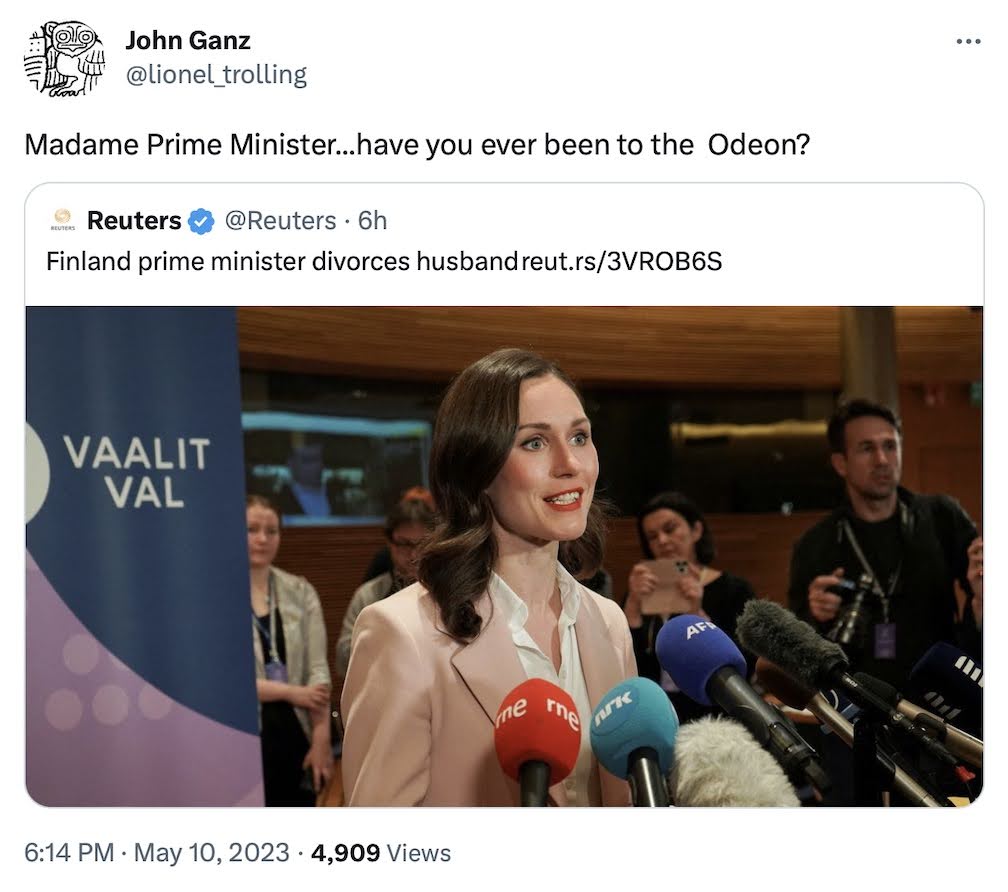
Ganz: Madam Prime Minister...
 Lily Lynch in the  NLR

Finland is gripped by wartime mania. News reports show mothers baking celebratory NATO cakes, online sales of NATO flags are soaring, and a Savonlinna-based brewing company has recently rolled out a NATO-themed beer, Otan olutta (the first word is a play on the French acronym for the North Atlantic Treaty Organization; the full name means ‘I’ll have some beer’ in Finnish). The outgoing Social Democratic Prime Minister Sanna Marin has repeatedly emphasized the similarities between the 1939 Finnish–Russian War and today’s conflict in Ukraine. Hundreds of Finns, including the former chair of the Foreign Affairs Committee, have paid to have personalized messages inscribed on Ukrainian artillery shells fired at Russian forces.

The discourse reached fever-pitch last week when Finland officially entered NATO, almost exactly 75 years after declaring its policy of neutrality. Some 78% of the population supported the move, but this was a recent development. In 2017, that figure stood at only 21%. The newfound Atlanticist fervour has been spearheaded by Marin, whose status as the world’s youngest Prime Minister and penchant for clubbing in Helsinki had already attracted international attention, netting her a luminous profile in British Vogue. Her tough line on Russia later consolidated her stardom. In March she visited Kyiv and laid flowers at the grave of Dmytro Kotsiubailo, a leading figure in the far-right Pravyi Sektor. She also called for heavier arms shipments to Ukraine and backed the construction of a 124-mile fence along Finland’s eastern border, replete with barbed wire to stop Russian men fleeing conscription.

Marin’s Natophilia transformed her into a beacon of hope for Europe’s new progressivism. Light on substance but eminently Instagrammable, this political tendency bases its appeal not on a coherent ideological outlook but on a feel-good millennial relatability. Its modernizing ethos owes more to the New World than the Old; it is just as at home at the Bilderberg Group annual meeting and the WEF stage as it is at the nightclub or pride parade. Under Marin, it has used the moral capital of Nordic pacifism – and the associated traditions of feminism, neutrality and social democracy – in order to destroy it.

...The far right’s rising fortunes have been met with curiously muted concern in foreign media outlets, perhaps mindful not to damage Finland’s standing as it enters NATO. In the days after the election, Atlanticist think-tankers and commentators were quick to point out that Marin’s loss did not signal a rejection of the military alliance. In a narrow sense, they are correct. Yet the fact remains that, following the electoral defeats of North Macedonia’s Zoran Zaev in 2021 and Sweden’s Magdalena Andersson in 2022, Marin is the third European social democrat to have brought their country into NATO before losing the next election to the right. What does this pattern tell us? Perhaps that a single-minded focus on Euro-Atlantic integration has deprived such parties of their historic purpose and neglected more pressing matters.

The Odeon was the hotspot bistro in TriBeCa in the 80s to the 90s. It was great place to come in after midnight, covered in dust after a long day for a martini, some oysters and a steak. It's still around. The last time I was there late it was dead, and not good. And coming in covered in dust isn't acceptable in bistros in Manhattan anymore, or anywhere else in NY for that matter. Amusing that Ganz picked The Odeon and not Balthazar, which I heard bad things about at its height: the food sucked, though the bakery was great. But the Odeon has value as nostalgia, the decadence of the past, and Balthazar is decadence of the present. McNally lost the Odeon to his wife in the divorce.

In related news, the deputy editor of Foreign Policy doesn't know the history of American foreign policy.
---

9/9/23, Euronews: "Finland's former PM Sanna Marin leaves parliament for Blair foundation"

Friday, May 05, 2023

Bamford in the Nation 

On September 29, 2022, a British electronic surveillance plane assigned to NATO took off from RAF Waddington in England, flew over Europe, and headed to the Black Sea. Its mission—codenamed Rivet Joint—was to eavesdrop on military and intelligence communications taking place in Russian-controlled Crimea. The aircraft, an RC-135W (a variant of a Boeing 707), was manned by a crew of about 30, and had an exterior covered with a porcupine-like array of antennas.

It was a very dangerous time. Just three days earlier, in a deliberate act of war, saboteurs had blown up the Nord Stream 1 and 2 pipelines resting on the bottom of the Baltic Sea. Almost immediately—but without offering any evidence—both Russia and the United States began pointing fingers of blame at each other. Thus, by the time the British spy plane began its surveillance flight off the volatile Crimean coast, tensions between the US and Russia had greatly escalated. Adding to Moscow’s anger was the likelihood that the flights—increased from every 10 days to four flights a week—were able to intercept vast amounts of sensitive military communications as well as target its entire “electronic order of battle.”

To counter these flights, Russian fighters would regularly take to the skies to observe, and occasionally harass, the spy planes. According to a Pentagon document marked SECRET/NOFORN (allegedly leaked by Airman Jack Teixeira on a Discord group chat), as the British RC-135W entered the airspace above the Black Sea that September morning, a pair of Russian SU-27 fighters scrambled skyward to shadow him. Then, responding to an order from his command center (likely Belbek Airbase on Crimea) a Russian pilot launched a missile directly at the NATO reconnaissance jet packed with 30 or more Royal Air Force personnel. In that moment, the Russian fighter pilot came very close to igniting World War III. Under NATO’s treaty, if one member of the military alliance falls victim to an armed attack, all members of the alliance are obliged to consider it an attack on all of them—and to collectively respond.

The only thing that saved the dozens of British crew members from what the secret US documents called a “near shoot down” was a technical glitch that caused the missile to miss its target. And it was another glitch that caused the pilot to fire the missile in the first place. As revealed in the massive trove of recently leaked secret Pentagon documents, the firing was due to a miscommunication between the fighter pilot and his base. As a result, the spy planes are now escorted by a pair of British Typhoon fighters while operating over the Black Sea. While protecting the RC-135 aircraft, this change in procedure also increases the danger of an airborne shoot-out between NATO and Russian fighters.

It was covered earlier in the Times, but not seriously. 

"We'll meet again..." 

Saturday, April 15, 2023

Gettier problems: Does the idiot deserve a medal?
Bellingcat, the White Helmets, etc. 
Though Bellingcat surprised me in the past
below from Ames

I don't like Ames, and Blumenthal's an idiot, but reporters don't have to be likable or smart. And Assange'a narcissism is irrelevant.

Saturday, April 01, 2023

Ragozin quote tweeting KyivPost, and adding his own photograph. I combined them for simplicity. 

Sentenced to 10 years in 2016 for war crimes, including kidnapping and torture of civilians, as part of Tornado unit case. Released in 2021 under Savchenko law. In 2022, he returned to the frontline. A neo-nazi turned Islamist. Famous for his tattoos.

KyivPost 

🕯Daniil Liashuk, better known as
Modzhahed died fighting for Ukraine.

Daniil was a citizen of Belarus. During the full-scale war, Modzhahed was seriously wounded twice, but still returned to the frontline. He dreamed of becoming a citizen of Ukraine.

Eternal Glory to the Hero 


Ragozin
Yevgeny “Topaz” Rasskazov of the neo-nazi Rusich unit (part of Wagner) says this Ukrainian poster condemning Russian brutality doesn’t actuality picture Russian army in the wrong light because that’s what it should be like.

Saturday, March 18, 2023

Streeck's funny

Meanwhile, in September 2022, the next test, again a tough one, was the destruction of the Nord Stream 1 and 2 pipelines by, according to Seymour Hersh, an American-Norwegian hit squad. Here the task for the German government was to pretend they had no idea who had done it, to keep silent on the matter, and to get the press either to do the same or tell the public that ‘Putin’ was the culprit. This test was brilliantly passed. When a Bundestag member from the Linkspartei – alone out of 709 MPs – asked the government a few weeks after the event what it knew, she was told that for reasons of Staatswohl – the well-being of the state – no such questions would be answered: not now, not in future. (The day after Hersh had made his findings public, the Frankfurter Allgemeine reported on it under the heading, ‘Kreml: USA haben Pipelines beschädigt’ (Kremlin: US damaged Pipelines).

Yet another loyalty test, this one more protracted and cumulative, conducted in parallel with the battle of the budget, concerned the delivery of arms and ammunition to the Ukrainian army. Ukraine had since 2014 been the one industrialized country with by far the highest yearly increase in defence spending, paid for not by its oligarchs but by the United States, in pursuit of so-called ‘interoperability’ between the Ukrainian army and NATO (officially declared to have been achieved in 2020). While this may have been a cause for concern among Russian generals – who were surely aware of the dereliction of their conventional forces subsequent to Putin’s decision to keep up with the modernization of the American nuclear forces – from the first day of the Russian attack NATO states were asked to send arms to Ukraine, increasingly powerful ones and in growing numbers. As it became obvious that Ukraine would be unable to hold its own without a steady inflow of material support from a revived West, the US insisted that European countries carry a growing share of the burden, particularly those guilty of having neglected their military, above all Germany.

It soon transpired, however, that national armies were less than enthusiastic about having to surrender some of their most precious and prestigious equipment to Ukraine, claiming that this would diminish their capacity to defend their own countries. Underlying their reluctance may have been a fear that what they gave to the Ukrainians might fall into the hands of the enemy, be damaged beyond repair on the battlefield or sold on the international black market, with no hope of reimbursement even for equipment formally just on loan. Another worry concerned prospects for rearmament once the war was over and Ukraine had to be rebuilt – better than ever – by ‘Europe’, as untiringly promised by Brussels. There were also worries, typically expressed in public by retired high-ranking military officers, about European countries being drawn into a war the conduct and aims of which their governments, as demanded by the United States and public opinion, had left to the Ukrainians to determine. Not least, there seems to be a concern that if the war came to an abrupt end, Ukraine would have the biggest and best-equipped ground forces in Europe.

Again it was Germany, by far the largest West European country, that more than all others had to prove, under the watchful eyes of the United States and the international media, its readiness to ‘stand with Ukraine’. At first, the then German defence minister had offered 5,000 helmets and bullet-proof vests for the Ukrainian military, which was widely ridiculed by the country’s allies and, increasingly, its public. In subsequent months ever more powerful weaponry was demanded and supplied, including air defence missiles like the Iris-T system that has not even reached the German troops, and the mighty Tank Howitzer (Panzerhaubitze) 2000. Each time the Scholz government drew a red line, it was forced to cross it under pressure from its allies as well as the two smaller coalition partners, the Greens and the Liberals – the former controlling the foreign ministry, the latter the Bundestag defence committee, chaired by an FDP deputy from Düsseldorf, home of Rheinmetall, one the biggest arms producers in Europe and beyond.

In the winter of 2022 the debate on arming Ukraine began to focus on tanks. Here in particular, Germany had to be pushed step-by-step toward ever more powerful models, from armoured personnel carriers to that famous battle tank, Leopard 2, a global export success built by a consortium led by, well, Rheinmetall. (Around 3,600 such Leopards of the most advanced 2A5-plus product line have been sold all over the world, to such enthusiastic supporters of Western values as Saudi Arabia, to assist them in their tireless effort to bring peace to Yemen.) Partly because German tanks figure prominently in Russian historical memory, but also because there were no signs that Germany would have a say on what its tanks would be used for (it is no more than 500 kilometers from the Ukrainian border to Moscow), Scholz at first, as usual, offered one reason after another why, unfortunately, no Leopards 2 could be supplied. In response, some of Germany’s allies, in particular Poland, the Netherlands and Portugal, let it be known that they were willing to donate their Leopards, even if Germany wasn’t. Poland even announced that they would send Leopards to Ukraine, if need be, without a German license – a legal requirement under German arms export policy.

The way this story played out may have been of formative importance for the future course of events. Cornered by its European allies, Germany no longer objected to sending Leopards to Ukraine, provided the United States also agreed to supply their main battle tank, the M1 Abrams (another worldwide export hit, with a total production up to now of 9,000 pieces). As a ‘first step’, Germany promised to provide 14 of its 320 Leopards, forming a tank regiment to be handed over to Ukraine within three months. From there, it would proceed to build two tank battalions, with 44 Leopard 2 tanks each, out of its own Leopards and those expected from its European partners – training, spare parts and ammunition included – to be turned over battle-ready to the Ukrainian army. (According to expert estimates, Ukraine would require about 100 Leopards of the latest model for a significant improvement of its military capacity.) 

At this point, however, around the time of the Munich Security Conference, two unpleasant surprises ensued. First, it turned out that Germany’s European allies, now that German resistance had been overcome, discovered all sorts of reasons why they had to hold on to their Leopards, export licenses or none, leaving the provision of battle tanks essentially to the Germans. (All in all, NATO armed forces command an estimated total of about 2,100 Leopards, of both the 1 and 2 models.) Second, American investigative reporting, particularly in the Wall Street Journal, revealed that the Abrams tanks would show up on the scene only in a few years’ time if at all, something that the German negotiators seemed to have overlooked, or had been asked to overlook by their American counterparts, and had certainly not been shared with the German public.

In the end, then, the Scholz government was left holding the bag – as practically the sole supplier of battle tanks to Kiev. What made this even more uncomfortable was that precisely on the day the Germans agreed to the Leopards deal, the Ukrainian government declared that, now that this had been achieved, the next items on its wish list would be fighter planes, submarines and battleships, without which there was no hope for Ukraine to win the war. (Ukraine’s former ambassador to Germany, one Andrej Melnyk, having moved back to Kiev where he now serves as deputy foreign minister, tweeted on January 24, in English: ‘Hallelujah! Jesus Christ! And now, dear allies, let’s establish a powerful fighter jet coalition for Ukraine with F-16 & F-35, Eurofighter & Tornado, Rafale & Gripen jets & everything you can deliver to save Ukraine!’) Topping this, at the Munich security conference the Ukrainian delegation asked the US and the UK for cluster bombs and phosphorous bombs, outlawed under international law but, as the Ukrainians pointed out, held in large numbers by their Western allies. (The FAZ, always eager not to confuse its readers, in its report called cluster bombs umstritten – ‘controversial’ – rather than illegal.)

For the German governing coalition, but also the Biden administration, a crucial question with respect to the assignment of a leading role to Germany is whether the country’s postwar pacifism is still strong enough to interfere with it. The answer is that it may not be. Not unlike in the United States, the abolition of the draft seems to have made it easier to consider war an appropriate means in the service of the good: unlike in Ukraine, German sons, boyfriends, husbands are not at risk of having to go to the battlefield. Among large parts of the younger generation, moral idealism covers up the crude materialism of killing and dying. Within and around the Green party, something like a new taste for heroism has emerged, among what was until a short time ago considered a post-heroic generation. No parents, indeed no grandparents are around anymore who can offer firsthand accounts of life and death in the trenches. Dreams have arisen of a sanitized warfare, executed strictly according to the Hague Convention, at least on our side – no longer a matter of war and peace but one of crime and punishment, with the ultimate aim, at the cost of hundreds of thousands of human lives, of Putin having to stand trial in a court of law.

There may also be specifically German factors at work. Within the Green generation, nationalism as a source of social integration has effectively been replaced, more than anywhere else in Europe, by a pervasive Manicheanism that divides the world into two camps, good and evil. There is an urgent need to understand this shift in the German Zeitgeist, which seems to have evolved gradually and largely unnoticed. It implies that, unlike in a world of nations, there can be no peace based on a balance of power and interests, only a relentless struggle against the forces of evil, which are essentially the same internationally and domestically. Clearly this bears some resemblance to an American conception of politics, shared by neocons and Democratic idealists alike, and embodied by someone like Hillary Clinton. The syndrome seems to be particularly strong on the left side of the German political spectrum, which would in the past have been the natural base of an anti-war and pro-peace, or at least pro-ceasefire, movement. Now, however, not even Die Linke would endorse the peace demonstration organized on 25 February by Sahra Wagenknecht and Alice Schwarzer, Germany’s feminist icon, at the risk of breaking the party apart and ceasing to be a political force.

Moreover, postwar Germans have long tended to listen with sympathy to non-Germans attributing to them collective moral deficiencies and demanding humility in one form or another. It is hard to think how else to account for the extraordinary popularity enjoyed by the above-mentioned Ukrainian ambassador to Germany, Melnyk, an unashamed fan of the terrorist, Nazi collaborator and war criminal Stepan Bandera and of his co-leader of the Ukrainian nationalists in the interwar years and under German occupation, also named Andrej Melnyk. Via Twitter, Melnyk has relentlessly lambasted German political figures, from the federal president, Frank-Walter Steinmeier, downwards, for not standing sufficiently with Ukraine, in language that in all other countries would have led to his accreditation being revoked. There was hardly a week when Melnyk was not invited onto one of the weekly television talk shows to accuse German political leaders of genocidal conspiracy with Russia against the Ukrainian people. Named deputy foreign minister in the fall of 2022, Melnyk continued to figure prominently in the German debate on the country’s obligations toward Ukraine. For example, referring to an article in Süddeutsche Zeitung in which Jürgen Habermas advocated a cease-fire in Ukraine to enable peace negotiations, Melnyk tweeted: ‘That Jürgen Habermas is also so brazenly in Putin’s service leaves me speechless. A disgrace for German philosophy. Immanuel Kant and Georg Friedrich Hegel would turn in their graves out of shame.’ (To gauge the tone of much of the discussion, see a tweet from a young aspiring comedian, one Sebastian Bielendorfer: ‘Sahra Wagenknecht is simply the empty shell of a completely mentally and humanly depraved cell cluster. She shouldn’t be invited on talk shows, she should be treated.’ A day later: ‘Twitter has deleted the tweet. Regrettable. The truth remains.’)

There's a lot more. And the ending is great.

repeats. Melnyk

Poland’s foreign ministry has intervened after Ukraine’s ambassador to Germany denied that Ukrainian national leader Stepan Bandera was responsible for the mass murder of ethnic Poles and Jews, and also sought to justify his collaboration with Nazi Germany.

And the other one 

Kyiv City Council voted to name street in Kyiv after Andriy Melnyk - leader of OUN and Nazi collaborator. Melnyk and members of his organization actively assisted Nazis in Holocaust - mass murder of 1, 5 million of Ukrainian Jews.

more twitter comedy

Today, we Latvians, remember our soldiers in WW2 who fought in nazi uniforms. Although they were part of the Waffen SS, they were not nazis and rather fought for their families and land. 

The hottest brand in Ukraine 

Previously on “Ukes, Kooks & Spooks,” we peeked at the far-right underbelly of M-TAC, Ukraine’s “largest and most powerful brand of clothing and equipment in the tactical and military industry,” that became central to Volodymyr Zelensky’s “de facto uniform” after Russia invaded Ukraine. But “Zelensky branded by fascists?” just scratched the surface.

Alexander Karasyov is the founder of M-TAC and the owner of its parent company, Militarist. Looking at his social media, it is apparent that Karasyov is a neo-Nazi. The day before Ukraine celebrated thirty years of independence in August 2021, he shared a point of view shot of himself making a Nazi salute at a Ukrainian flag on Facebook. But Karasyov has been most unhinged on the Russian social media platform VK.

“I will also celebrate the day of the Holocaust. Happy holidays to all!” he declared on International Holocaust Remembrance Day in 2017, reacting to an image of Jewish children in a concentration camp. A few months earlier, he shared former Deputy Führer Rudolf Hess’ last words at the Nuremberg trials. 

Thursday, March 16, 2023

updated etc.
---
kind of incredible, but US Fed's emergency lending to US banks was higher over the past week than during the global financial crisis/Lehman moment in 2008

Violent protests in France over Macron’s retirement age push 

PARIS (AP) — Angry protesters took to the streets in Paris and other cities for a second day on Friday, trying to pressure lawmakers to bring down French President Emmanuel Macron’s government and doom the unpopular retirement age increase he’s trying to impose without a vote in the National Assembly.

A day after Prime Minister Elisabeth Borne invoked a special constitutional power to skirt a vote in the chaotic lower chamber, lawmakers on the right and left filed no-confidence motions to be voted on Monday.

At the elegant Place de Concorde, a festive protest by several thousand, with chants, dancing and a huge bonfire, degenerated into a scene echoing the night before. Riot police charged and threw tear gas to empty the huge square across from the National Assembly after troublemakers climbed scaffolding on a renovation site, arming themselves with wood. They lobbed fireworks and paving stones at police in a standoff.
Exclusive: EU concerned by Ukraine’s controversial labour reforms
Experts say the government is taking advantage of the war to pass otherwise difficult legislation dating from 2020 and 2021. The country is currently under martial law, meaning protest is forbidden.

Other measures passed by the Ukrainian government in the past year include the introduction of zero-hours contracts and a wartime suspension of collective agreements between employers and trade unions.

Parliament has also passed powers permitting the state to confiscate trade union property – despite the fact that the ILO is overseeing two complaints over disputed union property....
Ukrainian social policy analyst Natalia Lomonosova previously told openDemocracy that she feared that the government’s radical wartime socio-economic policy could exacerbate the vulnerable situation of millions of Ukrainians displaced by Russia’s war.
The anonymous European diplomat’s summary was stark: “We are witnessing the breakdown of the social state in Ukraine.
“Everything apart from the military is now outsourced internationally. Social affairs are more and more outsourced to international donors – which is why international donors should pay more attention to this,” they added.
“​​The Washington Consensus has never been more alive than in Ukraine. It is Ukrainian-initiated, but in the West we accepted it,” the European official said, referring to the policy of pushing developing states to move away from state regulation and towards the free market. “And for Ukraine, this is a way to get closer to the West, and to fight the local oligarchs.”
The EU told openDemocracy it would “follow up as appropriate to ensure that commitments under [Ukraine’s] association agreement are properly upheld.”

“​​The Washington Consensus has never been more alive than in Ukraine. It is Ukrainian-initiated,..."

I'm bored 

Thursday, March 09, 2023

Tooze in the FT: The west’s limited support for Ukraine fails to measure up

Europe and the US may sincerely want Kyiv to prevail over Moscow but they are failing to match ends with means

In the first 12 months of the war in Ukraine, the condemnation of Russia and rhetorical backing of Kyiv by the governments of Europe and the US has been intense and largely unanimous. But the economic numbers tell a different story. Judged against current potential and historical standards, the war looks like an exercise in calculated restraint.

This is not necessarily a sign of strategic failure. Though the moral force of war may seem to demand absolute commitment, total war is the dream of fascists or revolutionaries. For the rest of us, total war should be an absolute nightmare. War that does not envision the overthrowing of all order must involve the weighing of means and ends, costs and benefits, even in the face of death. And this is true for both combatants and their allies.

Tooze on Substack

What does it feel like to see a major war coming? Not to “sleepwalk” but to wake to the reality that one state, with deliberation and intent is about to invade another with massive military force? With drastic consequences for millions of people and huge loss of life.

We have experienced this before. For many of us that moment came in 2002 and 2003 when we watched with horror the massing of the “coalition of the willing”, including our own country’s forces, for the invasion of Iraq. Around the world the memory of that moment hangs like a shadow over events today. This, indeed, is one of the points brought out by Politico’s oral history of the Biden administration in the autumn of 2021. This remarkable collage of interview segments conveys vividly what it was like for those who were privy to the most top-level military intelligence to face the dawning realization of Putin’s intent.

Tooze on twitter with a screengrab from Politico 

VICTORIA NULAND: Suffice to say that in December I brought all of my shower stuff, a couple of changes of clothes, things to sleep in, a blanket and a much more nutritious array of snacks into the office, because I knew it was unpredictable what our hours would look like.

Nuland, then and now

repeats: Ragozin, from last October and December 2021, beginning with Zagorodnyuk's article in Foreign Affairs: Ukraine's Path to Victory  

Ragozin. (click the link and read the whole thread):

For context, Zahorodniuk left defence minister’s post on March 4, 2020 - same day as prime minister Honcharuk. Together they soon landed in the US and in the Atlantic Council during the election year devising a new hawkish strategy for resolving Ukrainian conflict.

This resulted in an abrupt change of tack in Zelensky’s policies the moment Biden entered office. It also resulted in Atlantic Council’s radical strategy for resolving the conflict which was published in March 2021, just before Putin started amassing troops at the border.

Enter Biden. His White House takeover in Jan 2021 coincides with Zelensky’s radical change of tack with regards to Russia. Ukraine is suddenly proactive and assertive in the manner that suggests some pre-planning. Ex-PM Oleksiy Honcharuk’s posting to the US is of note here. 

 Le Monde Diplo: Western media as cheerleaders for war

Western journalists are all but unanimous that negotiating with Russia would equal forgiving it its aggression. Nothing short of a crushing victory for Ukraine is conscionable. The risk of escalation is rarely mentioned.

After speeches by British prime minister Rishi Sunak and Ukrainian president Volodymyr Zelensky at a joint press conference on 8 February at a military base in southwest England, it was time for questions. BBC Ukraine correspondent Natalia Goncharova greeted Zelensky with, ‘I would really like to hug you, but I’m not allowed.’ Ignoring his security service, Zelensky got down from the podium and embraced her to general applause. Then Goncharova asked Sunak, ‘You know that Ukrainian soldiers are dying every day. Don’t you think that that decision about warplanes is taking too long?’ In 2003, during the invasion of Iraq, the embedding of journalists with the US military had caused some in the profession to wince; 20 years on, in the Ukraine war, it’s become a journalism of the all-out embrace.

Wapo: In race to arm Ukraine, U.S. faces cracks in its manufacturing might

The war has exposed an inability to rapidly surge production of many weapons needed for Ukraine and for America’s self-defense

SCRANTON, Pa. — A sharp hissing sound fills the factory as red-hot artillery shells are plunged into scalding oil.

Richard Hansen, a Navy veteran who oversees this government-owned munitions facility, explains how the 1,500-degree liquid locks in place chemical properties that ensure when the shells are fired — perhaps on a battlefield in Ukraine — they detonate in the deadly manner intended.

“That’s what we do,” Hansen said. “We build things to kill people.”

Ragozin adds

US arms producers are going to have a decades-long bonanza because of war in Ukraine. Of course it will help them if Putin’s regime remains intact, Ukraine remains a hot or frozen battlefield and a new Cold War ensues.

NYT: Pentagon Blocks Sharing Evidence of Possible Russian War Crimes With Hague Court

President Biden has not acted to resolve a dispute that pits the Defense Department against other agencies.

WASHINGTON — The Pentagon is blocking the Biden administration from sharing evidence with the International Criminal Court in The Hague gathered by American intelligence agencies about Russian atrocities in Ukraine, according to current and former officials briefed on the matter.

American military leaders oppose helping the court investigate Russians because they fear setting a precedent that might help pave the way for it to prosecute Americans. The rest of the administration, including intelligence agencies and the State and Justice Departments, favors giving the evidence to the court, the officials said.

President Biden has yet to resolve the impasse, officials said. 

 The FT: The Iraq war left western societies unchanged

Twenty years on, the political and cultural legacy of a divisive war is minimal

...Yes, US casualties were far higher in Vietnam. Yes, a conscript war scars a society in a way that an all-volunteer one can’t. But Iraq was easily the most controversial war fought by a western state in the past half-century. It set citizen against citizen in Britain and Germany as much as in the US (no European nation participated in Vietnam). Those who lived through it might have assumed it would mark our culture for a generation: that pro and antiwar would become signifiers of one’s wider worldview, even one’s tastes, as Leave and Remain now are in the UK. Instead, it is often an ordeal to persuade the young what a saga it all was.

And that, I think, is what makes this 20th anniversary so eerie. At least within the western world, the Iraq war has left little trace.

Tooze adds: "Discuss"

Marlene Laruelle, "Russian Studies’ Moment of Self-Reflection" Russian Analytical Digest No. 293
Almost the entirety. It's hilarious. From Ragozin and Kevin Rothrock.
Anglophone Russian Studies are largely autarkic, existing with little knowledge of (or at least reference to) what is produced outside of the English-speaking world. The very limited references made to the Russian-language literature belie the richness of Russian publications, as any visit to such Russian intellectual hotspots as the Falanster bookstore in Moscow would have shown—at least until the onset of the full-scale war. And this does not even take into account what is published in Russia’s regional capitals, whose publishing markets are segregated from those in Moscow and St. Petersburg. Even within so-called “Western” academia, publications in French, German, and other national languages rarely transcend their national borders to be engaged by the English-speaking literature. By contrast, history and literature seem to have been better able to integrate locally produced scholarship.

A second feature is that in contrast to old “Sovietology,” social scientists working on contemporary Russia are rarely invited to train in and enter into dialogue with the humanities. How many U.S. political scientists studying Russia have read Viktor Pelevin? More globally and more structurally, social sciences struggle to put into practice their self-proclaimed commitment to multidisciplinarity, or at least crossdisciplinarity. Segments of Anglophone political science on Russia, by stressing the need for causal identification study designs, have contributed to an overreliance on data from surveys with experimental designs at the expense of interactions with history, cultural anthropology, sociology, or geography. Here, too, the segregation is largely internal to the “Western” and especially Anglophone realm: Russian publications display much deeper cross-disciplinary approaches. And except in such marginal subfields as Russia’s Arctic policy, climate change, and sustainability policy, there is even less dialogue between the social sciences, geography, and the natural sciences.

A third feature relates to the succession of prisms or lenses used on Russia that have created distortions in analyses. At least four such prisms can be identified. First is a Putin-centric prism that entails looking at Russia through its president, his professional background, his inner circles, trying to identify his ideological gurus, illuminating his supposedly “irrational mindset,” or offering purely instrumentalist analysis of the regime.

Second is a Moscow-centric vision of Russia in which the capital city and its more liberal-minded residents obscure regional perspectives, which are often ideologically more diverse and are generally more nuanced. Similarly, internationally well-connected Russian scholars from the two capitals are frequently seen as the only legitimate “Russian voices” —because they are the only ones known in the West and able to speak its language, both literally and symbolically.

Third is an ethnic Russian-centric reading of Russia in which the ethnic minorities who were so intensively studied in the 1990s have become one of the blank spots of research. This contributes to the difficulties of capturing potentially “hidden scripts” of ressentiment—aggravated by the general Western lack of knowledge of Russia’s national languages and the marginalization of identity politics, seen as a “sub-area” that cannot explain Russia’s general features.

Last but not least is a Western-centric prism imposed on Russia, its regime and society, which are always com- pared to the West’s as the obvious normative benchmark. This approach, which treats the West as the only mirror of Russia, blatantly excludes views of Russia from non-Western perspectives. Scholars from countries neighboring Russia have increasingly called to be recognized as agents in interpreting Russia on the basis of their own experiences. Scholars from the Global South, too, look at Russia and at the West through their own prisms and experiences, including a vivid postcolonial approach.

Where do we go from here?

Acknowledging academic inequalities in knowledge production—of which there are many—would be a first step. The most obvious starting-point is probably that native scholars and indigenously produced work should be acknowledged as critical additions to the field that cannot be ignored. But there are other knowledge hierarchies, too: of English-speaking works over non-English ones; of Western-centric views over those from the post-Soviet world and from the “Global South”; of political science—the “reigning” discipline through which (Western) understandings of the Russian regime and society are developed—over sociology, cultural anthropology, history, and the humanities.

A second step would be to favor more granular and grassroots approaches that would allow for thicker conceptual knowledge. The Post-Soviet Affairs special issue shows us the path: it would entail, among other things, changing the questions we ask; being cognizant of the issues related to aggregative approaches and the need to blend survey data with qualitative analysis; going back to long-neglected ethnographic methods; looking at societal transformations over the course of generations; focusing on vulnerable segments of the population (both classes and ethnic groups); borrowing from social psychology to study ressentiment-based politics and collective emotions; and opening up to new comparative frameworks.

This is a transformative time for the Russian Studies field. Russia scholars have the opportunity—and duty— to both rethink the systemic features of their field and to contribute to changing the lenses applied to Russia in the hope of contributing modestly to new pathways for the peaceful coexistence of the nations that share the Europe-Asia continent.
Remember, the humanities are dying. "The End of the English Major"
Leiter reads the New Yorker too.

In 2022, though, a survey found that only seven per cent of Harvard freshmen planned to major in the humanities, down from twenty per cent in 2012, and nearly thirty per cent during the nineteen-seventies. From fifteen years ago to the start of the pandemic, the number of Harvard English majors reportedly declined by about three-quarters—in 2020, there were fewer than sixty at a college of more than seven thousand—and philosophy and foreign literatures also sustained losses. (For bureaucratic reasons, Harvard doesn’t count history as a humanity, but the trend holds.) “We feel we’re on the Titanic,” a senior professor in the English department told me.

Students lacked a strong sense of the department’s vaunted standing. “I would never say this to any of my English- or my film-major friends, but I kind of thought that those majors were a joke,” Isabel Mehta, a junior, told me. “I thought, I’m a writer, but I’ll never be an English major.” Instead, she’d pursued social studies—a philosophy, politics, and economics track whose popularity has exploded in recent years. (Policy, students explained, was thought to effect urgent change.) But the conversations bored her (students said “the same three things,” she reported, “and I didn’t want to be around all these classmates railing on capitalism all day”), so she landed uneasily in English after all. “I have a warped sense of identity, where I’m studying something really far removed from what a lot of people here view as central, but I’m not removed from these cultural forces,” she told me.

English professors find the turn particularly baffling now: a moment when, by most appearances, the appetite for public contemplation of language, identity, historiography, and other longtime concerns of the seminar table is at a peak.

"philosophy, politics, and economics track whose popularity has exploded in recent years."

PhD PPE
Isabel Mehta's choices describe the situation of humanism in a world of ideological instrumentalism and moral certainty: positivist, leftist or capitalist. She didn't want to know the history; she can't take it seriously, but she does it anyway, because she needs to tell her stories. Her LinkedIn page reminds me of Nwanevu.

I can't not think of LinkedIn as embarrassing. But that reminds me of my mother's reaction when I told her a friend of a friend had asked me to ask her for an introduction to a friend of hers. Her eyes widened: such things were not done. Mehta went to my high school, which means she probably was there for more. I got in, in the last year of elementary school, through the matriarch of one of the oldest families in Philadelphia, whose grandson was a staff lawyer at the ACLU. These were the days when the ACLU was principled, and frankly fun. The school had a few scholarship kids from my neighborhood but I never thought to mention to anyone that I was the only white or demi-white kid in the school who had a sibling who'd gone to the public school the scholarship kids had succeeded in avoiding. I'm not sure anyone would have gotten the joke. In my 20s I told my mother I was a tradesman. She was horrified. I said I was a carpenter and she was relieved. She's thought I meant I was "in trade".

Agnes Callard again, this time in the New Yorker. She now admits what was always obvious.