But in the earlier and Hungarian phase of his life, Lakatos was a Stalinist revolutionary, the leader of a communist cell who persuaded a young comrade that it was her duty to the revolution to commit suicide, since otherwise she was likely to be arrested by the Nazis and coerced into betraying the valuable young cadres who constituted the group (Bandy 2009: ch. 5; Long 1998 and 2002; Congden 1997). So far from being a fallibilist, the young Lakatos displayed a cocksure self-confidence in his grasp of the historical situation, enough to exclude any alternative solution to the admittedly appalling problems that this group of young and mostly Jewish communists were facing in Nazi-occupied Hungary. (“Is there no other way?” the young comrade asked. The answer, apparently, was “No”: Long 2002: 267.)
Feyerabend tells how, without falling for Adolf Hitler’s charisma, he appreciated Hitler’s oratorial style. Austria was re-unified with Germany in 1938. Jewish schoolmates were treated differently, and Jewish neighbours and acquaintances started disappearing. But, as usual, Feyerabend had no clear view of the situation:
"Much of what happened I learned only after the war, from articles, books, and television, and the events I did notice either made no impression at all or affected me in a random way. I remember them and I can describe them, but there was no context to give them meaning and no aim to judge them by. (pp. 37–8).
For me the German occupation and the war that followed were an inconvenience, not a moral problem, and my reactions came from accidental moods and circumstances, not from a well-defined outlook." (p. 38).
...As far as his army record goes, Feyerabend claims in his autobiography that his mind is a blank. But in fact this is one of the periods he tells us most about. Having passed his final high school exams in March 1942, he was drafted into the Arbeitsdienst (the work service introduced by the Nazis), and sent for basic training in Pirmasens, Germany. Feyerabend opted to stay in Germany to keep out of the way of the fighting, but subsequently asked to be sent to where the fighting was, having become bored with cleaning the barracks! He even considered joining the SS, for aesthetic reasons.
Monday, December 06, 2021
updated, AGAIN, because...
Rawls’s highly abstract and intricate philosophical system was not a flight from the real world’s effects on him, Forrester argues, but rather a direct response to the harrowing experiences, personal and political, that had shaped much of the first three decades of his life.
It was both. And we're back to Calvino. It doesn't matter if it's Chomsky and linguistics-as-physics, or de Man, Robbe-Grillet and Feyerabend, or Quine, who combines them, or Rawls. It's all Post-war intellectual formalism.
In related news, Matt Bruenig is autistic. So fucking perfect.
Philosophy is literature. The history of literature is scholarship.
---
Twice this week I've come across people writing on art and "the arts", critics with a wide following, who are so unsophisticated it makes me howl. If art were made for aesthetes, dandies would be the ideal. They fantasize art without effort, without "the mud and the flies", alongside their twins, self-identified as artless: the junkie bohemians. Working artists are surrounded with these types. They talk and drink with them and fuck them. They make work about them: they're raw material. But artists aren't lazy; they're obsessed with work.
Philosophers try to make art safe or try to ban it. And now we have a generation of earnest college graduates, and above, who either celebrate corporate entertainment as great art or disdain it as inferior. They love "Art". They love to talk about it. And they're endlessly optimistic.
A comment that labeled me a "nihilist":
12 years ago on the subway, I watched a man playing the accordion. My first thought was that he knew how to handle a knife. His playing was hard, cold and precise, but it was turned in an instant from jagged to fluid, from points to curves, swooping and stabbing. The music described the violent moral universe that made him. He was trailed by a stoop-shouldered woman with a cup. The expression on her face was heartbreaking.
He was the sort of man who could side with fascists or republicans, but he wasn't either. He was the sort of man Borges worshipped, but who held Borges in contempt.
Srinivasan mentions "a black queer porn director with a film degree from the San Francisco Art Institute". That brings us back to Laura Kipnis and George Kuchar.
In stead of lowering the Medicare age to 60, why not lower it to 0?
This would be good policy, plus it would have the added bonus of allowing us to make fun of Bernie diehards as they try to angrily explain why Medicare for all isn't Medicare For All...
A few days ago Philip Mirowski opened up a draft of a paper for comments. I'd already made mine before I read the above.
"Democracy, Expertise and the Post-Truth Era: An Inquiry into the Contemporary Politics of STS Version 1.1"
It's a draft and I won't copy his words, but he begins with a quote.
One part of the US vote was a loud vote against expertise. Clinton became, among other things, a symbol for technocracy... Views and debates within STS about the nature of expertise seem oddly irrelevant in this context. The differences between accounts of expertise in realist terms (Collins and Evans, 2002), as institutionally constituted parts of larger regimes (Jasanoff, 2004) or as discrete networks (Eyal, 2013), while stark for readers of this journal, are subtle given the wholesale rejection of expertise by voters and the more selective rejection of expertise being continued in some announced appointments. It seems that optimism about the coexistence of democracy and expertise may be misplaced... (Sismondo, 2017)
The whole thing is a joke. No discussion of what the supposed "experts" achieved, or failed to. No reporting of fact. The history of ideas is rationalism built on priors and hot air. Nothing on the record of Volcker and Rubinomics, Greenspan/Ayn Rand, Krugman, Rodrik and Deaton, Tyler Cowen and Tom Nichols. As for "democracy" I brought up my old standbys: Latour is a neoliberal Catholic and The Church is a monarchy; Feyerabend belongs with de Man and Robbe-Grillet; democracy is relativist as to truth but strict as to form; lawyers are orators not philosophers. "I began to find myself in a dangerous situation as an advocate. I came to believe in the truth of what I was saying." etc. Weber and Kafka. The absurdity of thinking of science as intellectual as opposed to technical. Engineers themselves aren't considered intellectuals, but engineering is seen as a model for intellectual activity, "creating concepts" etc. Game designers are seen as intellectuals, builders of virtual worlds, like philosophers' possible worlds. Science fiction is fantasy. Fantasy is not observation. From my comments:
Science is empiricism. The current wave of "science denial" is a backlash against rationalist bullshit claiming to be science. Shiller and Fama won the non-Nobel prize in economics in the same year for making diametrically opposed arguments. "Teach the conflict"? Angus Deaton won for discovering what they teach in every introduction to systems engineering: efficiency and stability are in inverse proportion. Or as they teach you in kindergarten: don't put all your eggs in one basket.
A repeat from 2013, because the subject came up today.
Read the linked "previous post", and the one at the bottom of the page.
"Heydrich's facial expression as he died betrayed an 'uncanny spirituality and entirely perverted beauty, like a renaissance Cardinal,' according to Bernhard Wehner, a Kripo police official who investigated the assassination."
He's off by a few years, in both directions. But again, there's a difference between a mannered pose or work of art and a mannered life. Repeats: A standard definition of kitsch is to be "more Catholic than the Pope." So I guess this makes it explicit that I'm continuing from the previous post.
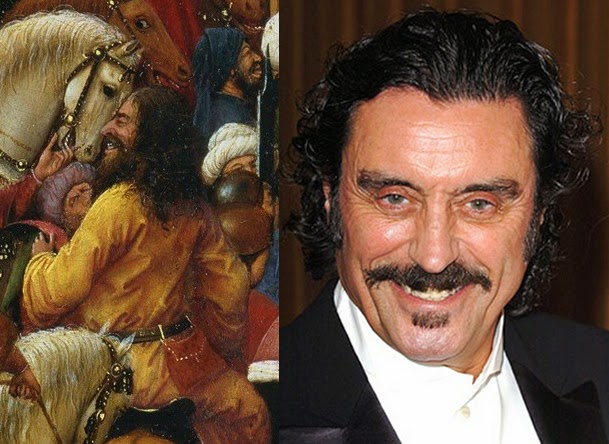
Jean Fouquet, Etienne Chevalier with St. Stephen, left half of the Melun Diptych c.1454
According to his Wikipedia pages Wehner had a rich career after the war, and was chief of criminal investigations for the Dusseldorf police dept. from 1954-70. It's unsourced in the english, but sourced in German.
"As far as his army record goes, Feyerabend claims in his autobiography that his mind is a blank. But in fact this is one of the periods he tells us most about. Having passed his final high school exams in March 1942, he was drafted into the Arbeitsdienst (the work service introduced by the Nazis), and sent for basic training in Pirmasens, Germany. Feyerabend opted to stay in Germany to keep out of the way of the fighting, but subsequently asked to be sent to where the fighting was, having become bored with cleaning the barracks! He even considered joining the SS, for aesthetic reasons. His unit was then posted at Quelerne en Bas, near Brest, in Brittany. Still, the events of the war did not register. In November 1942, he returned home to Vienna, but left before Christmas to join the Wehrmacht's Pioneer Corps.
Their training took place in Krems, near Vienna. Feyerabend soon volunteered for officers' school, not because of an urge for leadership, but out of a wish to survive, his intention being to use officers' school as a way to avoid front-line fighting. The trainees were sent to Yugoslavia. In Vukovar, during July 1943, he learnt of his mother's suicide, but was absolutely unmoved, and obviously shocked his fellow officers by displaying no feeling. In December that same year, Feyerabend's unit was sent into battle on the northern part of the Russian front, but although they blew up buildings, they never encountered any Russian soldiers.
Despite the fact that Feyerabend reports of himself that he was foolhardy during battle, treating it as a theatrical event, he received the Iron Cross (second class) early in March 1944, for leading his men into a village under enemy fire, and occupying it. He was advanced from private soldier to lance corporal, to sergeant, and then, at the end of 1944, to lieutenant. At the end of November that year, he gave a series of lectures to the officers' school at Dessau Rosslau, near Leipzig. Their theme was the (“historicist”) one that “historical periods such as the Baroque, the Rococo, the Gothic Age are unified by a concealed essence that only a lonely outsider can understand” (p. 49). His description of these lectures, and of his notebook entries at the time, reveals the influence of Friedrich Nietzsche in their fascination with this 'lonely outsider', 'the solitary thinker' (p. 48)."
Having returned home for Christmas 1944, Feyerabend again boarded the train for the front, this time for Poland, in January 1945. There he was put in charge of a bicycle company. Although he claims to have relished the role of army officer no more than he later did that of university professor, he must have been at least a competent soldier, since in the field he came to take the place of a sequence of injured officers: first a lieutenant, then a captain, and then a major, before he was shot during another heroic act of carelessness performed in the 1945 retreat westwards from the Russian army. The bullet lodged in his spine left him temporarily paralysed from the waist down, meaning that he spent time in a wheelchair, then on crutches, and thereafter walked with the aid of a stick. The war ended as he was recovering from his injury, in a hospital in Apolda, a little town near Weimar, while fervently hoping not to recover before the war was over. Germany's surrender came as a relief, but also as a disappointment relative to past hopes and aspirations. He later said of his stint in the army that it was 'an interruption, a nuisance; I forgot about it the moment it was over' (p. 111)."
"Heydrich's facial expression as he died betrayed an 'uncanny spirituality and entirely perverted beauty"
"Since it is opportunity which makes not only the thief but also the assassin, such heroic gestures as driving in an open, unarmoured vehicle or walking about the streets unguarded are just damned stupidity, which serves the Fatherland not one whit. That a man as irreplaceable as Heydrich should expose himself to unnecessary danger, I can only condemn as stupid and idiotic"
The world is just a barrel-organ which the Lord God turns Himself. We all have to dance to the tune which is already on the drum.
I shall make a poem out of [about] nothing at all: It will not speak of me or others, Of love or youth, or of anything else, For it was composed while I was asleep Riding on horseback.
NYRB: "The Strange Case of Paul De Man", by Denis Donoghue, in 1989, and by Peter Brooks, in 2014. And Heidegger again. "Heidegger's 'black notebooks' reveal antisemitism at core of his philosophy. New publication shows highly influential philosopher saw 'world Judaism' as driver of dehumanising modernity."
Brecht somewhere called Benjamin a fascist.
"Second to this at least was my parents' recording of Der Jasager, the only opera that has ever made me cry, and which I've thought for years should be staged with the cast in the uniforms of the Hitler Jugend."
"Heydrich's facial expression as he died betrayed an 'uncanny spirituality and entirely perverted beauty, like a renaissance Cardinal,' according to Bernhard Wehner, a Kripo police official who investigated the assassination."
He's off by a few years, in both directions. But again, there's a difference between a mannered pose or work of art and a mannered life. Repeats: A standard definition of kitsch is to be "more Catholic than the Pope." So I guess this makes it explicit that I'm continuing from the previous post.
Jean Fouquet, Etienne Chevalier with St. Stephen, left half of the Melun Diptych c.1454
According to his Wikipedia pages Wehner had a rich career after the war, and was chief of criminal investigations for the Dusseldorf police dept. from 1954-70. It's unsourced in the english, but sourced in German.
"We hereby commit ourselves not to accept invitations to male-only events. We call on others to join us."
on July 19th
"I don't call for an academic boycott of the Feyerabend conference. "
"we should try (i) to get our own academic houses in order (I mention my concern over plagiarism in context) before (ii) we try to use boycotts for other political ends--we end up being way too selective (not to mention futile)"
"I am not a promoter of a 'scientific philosophy,' I inherited it as a tradition (or 'school')"
Mohan Matthen responds:"Let me say that I do NOT support their call. I will NOT decline invitations on this basis." My comment above -quoting Schliesser- appears there.
I wouldn't pay any attention if they were engineers or chemists; I wouldn't expect chemists to have a sophisticated understanding of politics. But that there's no reason either to expect that of philosophy professors is a problem for historians, of philosophy and of the culture at large.
A brilliant one sentence description of a trait that unfortunately he sees only in others, Atrios, on gun nuts blaming the dead: "Heroism isn't generosity to them, just a sense of personal infallibility."
The last few posts: an impressive array of examples of cognitive dissonance.
Myanna Lahsen: Experiences of Modernity in the Greenhouse [PDF]
This paper identifies cultural and historical dimensions that structure US climate science politics. It explores why a key subset of scientists—the physicist founders and leaders of the influential George C. Marshall Institute—chose to lend their scientific authority to this movement which continues to powerfully shape US climate policy. The paper suggests that these physicists joined the environmental backlash to stem changing tides in science and society, and to defend their preferred understandings of science, modernity, and of themselves as a physicist elite—understandings challenged by on-going transformations encapsulated by the widespread concern about human-induced climate change.
You can find a discussion and link to another paper here
[What follows is based on ongoing conversation with my co-author, Merel Lefevere.--ES]
Institutions (that is, legally or corporately sactioned rules to be followed) can be designed or have been developed for solving particular problems or for particular aims. Yet, in the fullness of time outcomes under these institutions can reveal a pattern of unintended side-consequences. Let's say that one such unintended side-consequence is the fixation of certain (informal) norms or a pattern of exclusion. If some group (the insiders) benefits from this side-consequence they will sooner or later notice it often before the people who do not benefit from these. Human nature being what it is, often the disadvantaged outsiders are the first to speak up about the unintended side-consequence. The outsiders are at a disadvantage when they do so because if the side-consequence is really harmful they are fighting it with relatively slender resources while trying to figure out what the hell is going on. One especially pernicious aspect of the toy-example described here is that all the insiders think they have clean hands. While they actively benefit from an outcome pattern, they can always claim that none of them intended it or actively promoted it. So, when individuals are called out on, say, the informal norms and how these facilitate the pattern of exclusion, the more outspoken of the insider will fall back on variants of what we may call "The-Everybody-Did-It Syndrome" or (TEDI). Many other insiders prefer Hiding In the Herd (HITH) and focus on their work, career, etc.
In the real world we find TEDI annd HITH among bankers defending their bonuses even in the face of tax-funded bailouts as much as among academic philosophers defending a shameful pattern of sexual exclusion. TEDI is indicative of collective negligence and, if noticed, it becomes a collective action problem. Short of abolishing the institutions entirely (i.e., revolution, which is always dangerous for its potentially far worse unintended consequences to all), the best that can be hoped for is a change in the informal norms with which the institutions operate. This can happen when enough of the insiders are convinced that it is in their enlightened self-interest to change systematically how the rules are interpreted/applied or to alter the informal norms. Sometimes change comes from moral clarity, but in practice the insiders decide that it is not worth their energy to keep defending a crappy practice (to their peers, tax-payers, etc). The sad thing is that philosophers are no wiser than bankers in these matters.
wrong said...
I am, however, skeptical of all manner of academic efforts that seem primarily aimed at DE-legitimatizing Israel as a Jewish state. I have no trouble admitting that Israel was founded on historic injustice(s) many of which it continues to perpetuate. But I don't think Israel is particularly special in this regard (sadly), and I have never seen an argument for an academic boycott of Israel that wasn't also part of a wider campaign (including the persistent analogy with South Africa)--again, this is not to deny there are all kinds of second class citizens in Israel."
"One need not be a standpoint theorist to realize that not having Palestinians at the main table impoverishes the discussion." [adapted from Schliesser. The original referred to women]
Either "standpoint" is substantive or it is not. There's no need to get into the debates over degree. As often as not that's led to absurdity.
Eric Schliesser said in reply to wrong...
Why would you think I object to the idea that not having Palestinians at the main table impoverishes the discussion? I would very much welcome more inclusive conferences in Israel.
By the way, you clearly think this is some clever attack on me--but I don't call for an academic boycott of the Feyerabend conference. Rather, I think they should cancel and re-group (or revisit their program if that still can be done).
wrong said in reply to Eric Schliesser...
It's not about academic boycotts it's about perspectives, as theory and fact.
You defend an Israeli table as such, as just. People refer to Israel as "a Jewish and a democratic state" Is that possible?
Majorities either can or cannot be said "justly" to speak for minorities: men for women, heterosexuals for homosexuals, whites for black, Germans for Jews, Jews for Palestinians.
Is representative politics -and that's what this debate is about- justifiable as substance or simply as practical necessity, as epitomeology or obligatory annoyance?
I've always assumed representative government was built to accommodate standpoints as fact but now I'm reminded that "standpoint theory" is a recent development.
I'd forgotten things I learned when I dating a graduate student years ago.
The academy and democracy have always had an uneasy relationship.
Eric Schliesser said in reply to wrong...
Wrong, it would be nice that in your attempt to play *gotcha* with me you kept your facts straight. (Given that you are a fake email address, I will give you the benefit of the doubt this once, but if you keep doing that and in the absence of a verifiable email address, I will remove further comment from the thread.) First, I have not used the rhetoric of "a Jewish and democratic state" (certainly not in the thread to which you refer). Even the quote you highlighted above ought to make it clear that I abhor that kind of rhetoric, and I certainly do not defend an "Israeli table as such" (whatever that means). You are conflating me with some imagined evil-doer. Second, in that thread I try to articulate a very minimal principle: that we should try (i) to get our own academic houses in order (I mention my concern over plagiarism in context) before (ii) we try to use boycotts for other political ends--we end up being way too selective (not to mention futile) in (ii). It's that principle which makes my views on these matter relative consistent. (You may not like the principle, but it is at the principle you should direct your sarcasm.) Third, there is an important dis-anology, I am not trying to discredit universities that hot or the topics discussed at male-only-keynoted workshops. All I am trying to do is try change a norm within academic philosophy. Finally, we agree that the academy and democracy have always had an uneasy relationship--something I have written about on this blog.
wrong [posted with working email address] said...
"Why would you think I object to the idea that not having Palestinians at the main table impoverishes the discussion? "
"I am, however, skeptical of all manner of academic efforts that seem primarily aimed at DE-legitimatizing Israel as a Jewish state. "
State=Table
"But I don't think Israel is particularly special in this regard (sadly)" Maybe you don't consider Israel a democratic state, in which case you're defending it as a non-democratic state under the logic of EDI or HITH.
Peter Beinart: "I'm not even asking it to allow full, equal citizenship to Arab Israelis, since that would require Israel no longer being a Jewish state. I'm actually pretty willing to compromise my liberalism for Israel's security and for its status as a Jewish state."
My argument is simple: A Jewish State for a Jewish people iff a German state for a German people.
You may disagree, and I would accept that. I'm asking for either a consistent logic, or a defense of casuistry / situational ethics.
I'm hearing an amalgam that works as neither.
Eric Schliesser said in reply to wrong...
The Germans have their state, too.
You should take your disagremeent with Beinart elsewhere.
wrong said...
The Germans changed theirs laws in 2000. As it is, as Jason Stanley noted a few years ago:
...my own expected happy homecoming into German society wasn't necessarily working out as planned. One of the teachers at the Gymnasium told me that Heinrich Heine wasn't really a "German" poet, but rather was a "European" poet. My absurdly well-meaning and wonderful hostfather regularly repeated that "Deutschland ist kein Einwanderungsland" (which is, as Schneider points out, a common theme among Germans of a certain generation). Whenever I told people I was of German descent, they would argue with me -- then upon discovering that I was Jewish, would say "Oh, so you're not German, you're Jewish" (strangely, I never heard anyone say to someone, upon discovering that they were Christian, "Oh, so you're not German, you're Christian"). Among my German friends, there was a pervasive sense of the strangeness of other cultures, which alternately manifested itself as either irrational disdain or irrational admiration.
Stanley either exhibits or makes use of the common confusion regarding Jews as believers in a faith and as an ethnic group. Christians are not "a people". Israel was founded as a secular state and as a homeland for the Jewish people, not the Jewish religion.
"So, when individuals are called out on, say, the informal norms and how these facilitate the pattern of exclusion..." An explicit attack of the logic of Zionism written by a defender of the thing itself. Schliesser and Smilansky.
---
Schliesser removed the last comment but left the earlier ones, explaining his decision in an email. I appreciate that he left the others up, but not the distinction.
---
more above
---
I've quoted the email since so I'll add the relevant part here as well:
"...as a German Jew living in the Netherlands and working in Belgium, I really do not need your lectures on these matters."