Showing posts with label Joan Didion. Show all posts

Sunday, February 05, 2023


The above, indirectly, from Mary Gaitskill. Read it, and the comment by Tavi Gevinson. If you don't recognize the name, google it. 

Gevinson
Also reminds me of a friend who's reading Bret Easton Ellis's new novel. I haven't read it so here's my friend's description: "the teenaged character is invited to a producer's hotel room who then says 'now you have to do something for me' and essentially rapes him.” In the novel the narrator says something like, “But I wasn’t a victim.” And my friend said that reading the novel, he (my friend) felt like the narrator was clearly pained and trying to reframe it. But in a podcast interview, Ellis talked about how that really did happen to him, and also said something like, “I decided I’m not a victim.” My friend said that in the novel the line felt nuanced, whereas in the interview—especially given that Ellis is typically pretty reactionary--it sounded more like a comment on the culture wars, somehow no longer about one person’s experience and psychology.

I guess this is not a revelation (that fiction can be capacious in a way non-fiction isn’t), but maybe if I have any point it’s that it still feels really important to me that writers grapple with this stuff in nonfiction contexts where the reader knows more about what is at stake for the writer. (Just knowing I May Destroy You was based on Coel's experience made me more attentive to and trusting of the show's ideological arguments, even though it shouldn't be read as purely autobiographical.)

The private world and the public world of politics.

Since our feeling for reality depends utterly upon appearance and therefore upon the existence of a public realm into which things can appear out of the darkness of sheltered existence, even the twilight which illuminates our private and intimate lives is ultimately derived from the much harsher light of the public realm. Yet there are a great many things which cannot withstand the implacable, bright light of the constant presence of others on the public scene; there, only what is considered to be relevant, worthy of being seen or heard, can be tolerated, so that the irrelevant becomes automatically a private matter. This, to be sure, does not mean that private concerns are generally irrelevant; on the contrary, we shall see that there are very relevant matters which can survive only in the realm of the private. For instance, love, in distinction from friendship, is killed, or rather extinguished, the moment it is displayed in public. ("Never seek to tell thy love / Love that never told can be.") Because of Its inherent worldlessness, love can only become false and perverted when it is used for political purposes such as the change or salvation of the world.

What the public realm considers irrelevant can have such an extraordinary and infectious charm that a whole people may adopt it as their way of life, without for that reason changing its essentially private character. Modern enchantment with "small things," though preached by early twentieth-century poetry in almost all European tongues, has found its classical presentation in the petit bonheur of the French people. Since the decay of their once great and glorious public realm, the French have become masters in the art of being happy among "small things," within the space of their own four walls, between chest and bed, table and chair, dog and cat and flowerpot, extending to these things a care and tenderness which, in a world where rapid industrialization constantly kills off the things of yesterday to produce today's objects, may even appear to be the world's last, purely humane corner. This enlargement of the private, the enchantment, as it were, of a whole people, does not make it public, does not constitute a public realm, but, on the contrary, means only that the public realm has almost completely receded, so that greatness has given way to charm everywhere; for while the public realm may be great, it cannot be charming precisely because it is unable to harbor the irrelevant.

With some people I'm always torn between criticism and silence. I'm not sure I'm done with this.

Wednesday, May 25, 2022

unrealized projects. In these last few hours

Still having fun with this one
---

Thinking about Fantin-Latour again, because of Lorentzen and Indiana, again. Lorentzen's foreword to Indiana's new collection at Jacobin.  Jacobin is to the Jacobins what Brooklyn Industries is to... (and that's an old one too).

Lorentzen's blurb is awful.
Indiana is often associated in the popular mind or the minds of magazine editors with the “Downtown” Manhattan of the 1980s, and while this is not wrong—he was living as he does still, some of the time, in the East Village, was present at the Mudd Club, and so on—it is not enough. The vision of his novels, especially his true crime trilogy (Resentment, Three Month Fever, Depraved Indifference) spans the whole of America, and his literary sensibility is rooted in Europe.
For most of the 20th century New York was the place Americans went to escape their country without using a passport. It was last stop before leaving. You'd think a former editor of the LRB should know that, but it was clear a long time ago he didn't. As a gallery director from Vienna told me almost 20 years ago,  NY is provincial now.  
Indiana belongs with Leo Bersani and Dale Peck, and Daniel Harris, and Jayne County: "white faggots" of a certain age and place, sitting around talking, and now facing death threats from their erstwhile epigones. Remember "The Antisocial Thesis in Queer Theory": trash-talking reactionaries, honest, now beatified, cleansed, in academia.

Lorentzen 
Most of the writers, artists, and filmmakers Indiana scrutinizes in these pages are geniuses, and his criticism meets them at their level. From the fictions of Paul Scheerbart to the paintings of the young artist Sam McKinniss,...
I had to use google, and laugh.
McKinniss’s work arouses thoughts about the Leibnizian fuzziness between fiction and documentary reality, about concealment and revelation, about forms of masquerade, the mutability of memory. His paintings evoke a waking dream where figures of fiction, on furlough from their narratives, have real metaphorical force. Celebrities are fictional, whatever else they are; McKinniss’s pictures of them are layered in artifice, approximations of “perfect moments” in the careers of certain images.

McKinniss
Henri Fantin-Latour (1836–1904), whose flower paintings McKinniss frequently copies, has been called “a traditional painter with avant-garde sympathies,” which could apply to contemporary artists like Dike Blair, Maureen Gallace, Billy Sullivan, and McKinniss, who are realist painters of no discernible school, very different in style, innovators in subject matter and formal design. Alex Katz might fit in here, too. However traditional their techniques, their works are recognizably of our time, informed by the convulsive history of modernism and the wider movement of current events. Even McKinniss’s atmospheric copies of Fantin-Latour have a Pierre Menard kind of postmodernity; we see them through the filter of the past hundred years. (I like the knife on the table that features in Still Life with Primroses, Pears and Pomegranates (after Fantin-Latour), 2018—how criminal!)

What Fantin-Latour represents for McKinniss is something close to perfection in paint, the apogee of particular skills and sensitivities that McKinniss also has in abundance. I could be mistaken, but I think McKinniss’s embrace of Fantin-Latour is also his way of telling us he isn’t running for flavor of the month. Both artists are intoxicated by music.

McKinness in the New Yorker, by Jia Tolentino, another young sophisticate who isn't.

Last year, the twenty-year-old New Zealand singer-songwriter Lorde contacted the Brooklyn-based painter Sam McKinniss through mutual friends. She came to visit his studio in Bushwick, and then went to see his exhibition “Egyptian Violet,” which featured, among other works, a life-size oil painting, rendered with Symbolist intensity and high-classical technique, of Prince on a motorcycle. Soon after, she asked McKinniss if he would paint a portrait of her for the cover of her forthcoming album, “Melodrama.”  

Currin
Weyant
Leibnizian fuzziness, flavor of the month. Like Hickey, Indiana sees what the wants to for whatever reason. He uses McInniss as material to talk about his own interests. Obviously there's nothing new in having a feeling for and understanding, or a fantasy, of Fantin-Latour—or  Leibniz and Joan Didion.  Peter Saville saw it in 1983. It's what others recognized in Seurat, a better artist so harder to steal from, a mechanical blankness, a passivity that Seurat could describe but that Fantin-Latour could only manifest. Fantin-Latour is why we have Richter, as Seurat is why we have Warhol. Think also of Degas, like Seurat: painters who responded to photography without being defeated by it. It took years for Maureen Gallace to accept the fact that she's a landscape painter. She started out thinking of her work as formal and conceptual. She needed to lie to herself to do what she wanted to do. Embracing kitsch, or lack of affect, is a defense mechanism, steeling yourself for mockery. Fear made her early work simple, almost Platonic anti-landscapes, complex and interesting. Now that she's out of the closet and painting at the beach, the work is maybe better but also more simply small.

I don't remember the first time I wrote that the irony of pop art came out of a need to find a way to make figurative work and get away with it. Like Robert Wilson—"I  didn't mean anything by it."—or T.S. Eliot. McKinnis is repeating work from 25 years ago, but most don't know, and those who do don't care.  Gagosian now represents both John Currin and a fan, though his female follower is even more a follower of the sexually aggressive Balthus while Currin is voyeur as cuck. But he's also a committed academician. Look at the sleeve on the female figure, The Penitent, from 2004.  I'm 
Currin
sure he can talk for hours about both Titian's paint handling and the chemistry of his paints. It's been interesting to watch his skills mature; he's fully committed now and it shows. But as I said to the girls at the desk a couple of years ago, all the show needed was a portrait of a naked black man with a 10 inch cock. That got a laugh. 

A few years ago at Christie's a young thing in the sales department saw me looking at a Gauguin monotype, one image repeated on a page, saying not too pertly, "It's a nice Warhol". I looked at her, surprised. She smiled. We both smiled. Her bosses may have told her what to to say; it may have been her idea. She may have had an intuitive understanding of what it meant to find the human behind the mechanical as opposed to the mechanical behind the human. Or maybe she was being paid to respond equally to both. At the moment I gave her the benefit of the doubt; that's why the young and attractive are out front. I wished I'd had the money for dinner if not the Gauguin. I would have asked. But at this point Indiana and others who also should know better are just scraping the barrel, or trying to get laid. 

I've said a few times that over the last 25 years I've had more interesting conversations with art dealers than artists, and even more so with gallerists and employees of auction houses who dealt with a broader range of art: 19th century to contemporary, or even older. If I didn't love the good shit I wouldn't be talking about the bad. And what annoys me almost as much as the ignorance that now rules the "artworld" is the "leftist intellectuals" and academics who refer to art—and film—as if it didn't mark them as absolutely bourgeois, and conservative.

Of course I'm a conservative. All leftists are conservatives. Anarchists are liberal idealists.

Untitled, (PCL), 2008, Transparency on lightbox, 96"x 96"

Untitled, (Bat), 2010, Transparency on lightbox, 90"x120"


Monday, January 31, 2022

Still fucking with this thing, and fucking with Adolph Reed.
---

Jäger, a good one

Adolph Reed, is an ass.
Next month, Reed will publish a book that is, in the context of his polemical writing, unusual. Called “The South,” it is an account of growing up in segregated Arkansas and New Orleans, and of navigating, as a young man, Jim Crow’s immediate aftermath. The book read to me as a memoir, a term he adamantly rejects. He told me my interest in the book made him regret writing it; he did not want to receive mainstream attention for his reminiscences. 
Reed is a vanguardist, and vanguardists are snobs.  
What a fucking idiot.
---

I call Reed an idiot—he isn't—because he's a pedant. It is a fact that race is less of an issue. It is a fact that people argue from self-interest and not "truth". It is a fact that "Black Lives Matter is a cry for full recognition within the established terms of liberal democratic capitalism." It is a fact that the fading of race as an issue will return class the the central role that Reed prefers. And it is a fact that Reed is so angry that the peasants aren't intellectuals that he can't think straight.

And elitism, as I've said again and again, has a double edge: the elect are permitted to indulge sins forbidden to the common people: "To the pure all things are pure", "Homosexuality for us, but not the masses" "Don't call it a memoir!!" 

In my twitter days, I trolled Catholic rightists by telling them they wanted people to share their own self-hate. Innocence was a lie. The lack of self-hatred disgusted them. They agreed. I was less trolling them than the liberals reading them who didn't get the point.

"Religion promotes the divine discontent within oneself, so that one tries to make oneself a better person and draw oneself closer to God." A quote attributed to Cyril Cusack, whose performance in Truffaut's Fahrenheit 451 is a pitch-perfect model of the priest to Oskar Werner's boy. I saw the movie as a boy and don't remember if Cusack reminded me of Daniel Berrigan, whom I met as a 5 year old—he stayed at our house for for a few days when he was on the run—or the reverse.  I've never forgotten his face, moving down towards mine as he shook my hand. I recoiled, pulling my head back, and later asked my mother to explain just what it was I'd reacted to. Her reply was, "Unctuous". Years later I saw the same expression in a part-time student, model, hustler, from my circle—not the director of the Halston bio—who'd been raised by Jesuits. He had the smile of a man who wanted to seduce anything alive. Even his friends didn't trust him.  

Reed is offended by the thought that he's been outed as a storyteller, an orator, not a philosopher, and interested in telling a story about himself. Only members of the elite, his own kind, are allowed to know his secret.

Corey Robin makes my job even easier: "I once said that Adolph is the closest thing to Max Weber we've ever had in this country." And as I once said about Weber:  "The fantasy of objectivity is the fantasy of the universal through the elision of the particular, beginning with the elision of the particular self." All of this in various ways goes back to my comments about The Name of the Rose, from 30 (40?) years ago: the decay of scholasticism. And now the rise of the black bourgeoisie, offends the righteous academic left.

I'm sympathetic to elitists. My stockbroker stocks up on marijuana edibles at places that look like Apple stores; it's something out of A Clockwork Orange.  I miss the days when good drugs were left to criminals and serious intellectuals, who understood the cost.
Unlike Reed I get the joke: "Innocence ends when one is stripped of the delusion that one likes oneself."
 
I'm playing cute with all this. It's fun playing at being catty. I take all this shit for granted and I can't write as if anyone has the slightest idea what the fuck I'm talking about, or if they do, that it matters.

Thursday, January 13, 2022

"Someone will write something about Didion and her beginnings as a Goldwater Girl and California libertarianism. But it won't be me." And now I guess they have. 

And the same people now tut-tutting Didion are mourning Terry Teachout.
repeat from 2018
I'd always thought of Teachout as an overly earnest, shallow, self-serving moral conservative, but now nihilism is a moral option.

Teachout was an aesthete. Aestheticism is a form of denial; if nihilism isn't overt it slips out. Didion understood. What artist isn't tempted by nihilism in an age of crisis?

Vice is alluring; then show it as alluring; but it brings with its train peculiar moral maladies and suffering; then describe them.

The Third Man is about the limits of friendship and the seductions of fascism; to claim that fascism is a moral point of view is to already admit being seduced. "Twee fascism". I should've used the phrase, and for Bacharach too. I'm almost curious what he has to say about all this. 

Marfrks: "For academics, ideas are games", without weight, connecting Teachout and Scialabba to technocrats, and why technocrats are gamers. Graeber's inverted technocracy is a form of positivism. Nihilism is an inverted moralism. So we end up with art critics interested in aesthetics but not art, because honesty scares them. Jeet Heer is an earnest liberal Zionist who writes about comics. His conservatism is manifested in the same childishness, again, without weight.
---

Fiat iustitia, et pereat mundus. Conservatism at it's best is human strength identifying itself with/as weakness; Fascism is weakness identifying with/as strength. It's the difference between "I serve the law" and "I am the law". "Unto the pure all things are pure", is a license to anything. Barbarians don't need a license. They accept responsibility for their choices. But if Biden is starving Afghanistan it's because he thinks he had no choice; following the doctrine of double effect he's been granted absolution. Doctors and nurses on the ground, doing their jobs in a crisis, are conservatives; social workers, people wanting to help, are liberals. It's the difference between behavior and ideation. Baudelaire and Didion would get the joke. A lot of people would, and do, but few "philosophers" "theorists" or "social scientists", most of whom identify as liberals. 

An appropriately scathing review of Teachout's biography of Louis Armstrong. "Teachout has tailored Armstrong’s life story along lines that recall Horatio Alger." The art itself becomes meaningless.   

Saturday, January 08, 2022

New York: Sentimental Journeys

I really thought Adam Shatz was better than this. It reads almost like a parody. Switch out Randall Kennedy for some negro intellectual from 1968. And "...my book on Frantz Fanon." Every fucking base. 
"Notes on a Mugging", NYRB 

"My attackers came out of nowhere on a familiar street and didn’t even take my wallet. But they robbed me of something: a New Yorker’s self-assurance."

There is something morbidly instructive about being beaten up by people who are obviously relishing your humiliation. To read about the pleasure people have taken in cruelty is not the same as experiencing it firsthand.

Before I was set upon, assaulted, and robbed, at roughly 9:15 PM, a half-block from my girlfriend A.’s building in Chelsea, December 17 had been a rather good day. I’d outlined one of the last chapters of my book on Frantz Fanon and felt a surge of adrenaline about the work ahead. Then I took a long, satisfying swim, hopped on the train to Manhattan, and had Mexican food and drinks with an old friend—an otherwise normal New York evening that, in this era, felt almost sublime. As I walked to A.’s building, I put on my headphones to listen to the rest of a podcast conversation with my friend Randall Kennedy, about his new book on race and civil rights, Say It Loud. Randy’s voice was the last thing I heard as I turned right on West Seventeenth Street and Ninth Avenue, where my attackers were lying in wait.

Once I noticed them, I knew something was awry. Suddenly, I was aware of being surrounded on all sides by other bodies that should not have been so close to mine. They were three young men, barely old enough to be called that—sixteen or seventeen, I would guess. Then, almost immediately, I was on the pavement. 

"The victim...was a leader, part of what the Times would describe as “the wave of young professionals who took over New York in the 1980’s,” one of those who were “handsome and pretty and educated,”... who, according to the Times, not only “believed they owned the world” but “had reason to.” 

Saturday, December 25, 2021

I've said before: Didion was a conservative. She wasn't a "law and order" conservative. She was an anti-utopian, pessimistic observer of the world. She saw no "beckoning light". 

I return to the same piece because it suits my purposes: the relation of art and politics, individual and collective.

Didion humanized the Central Park 5 without claiming their innocence. She knew the difference between sympathy and pity. Jim Sleeper accused her of being drawn "like a moth to a flame", which she was, but not for the reasons he assumed. She had the journalistic distance of a voyeur, against Sleeper's moralism and his assumptions about the accused. Their exoneration made Sleeper the loser in his argument with Didion, but it does nothing to what Didion wrote, since she wasn't arguing, and their actual guilt or innocence was irrelevant. She was describing something larger. We're back to Baudelaire, Eliot, James, and "disinterest", touched with perversity because turning life and suffering into art is morally ambiguous, and turning others' pain into art is more so. Surgeons enjoy surgery. "I’m a smooth type of fellow, cool, calm, and mellow" rapped Yusef Salaam at his sentencing. When I was placed across the table from Ann Beattie at dinner at Roger Angell's summer house she looked at me as material, cruising me with flat directness, but not for sex. Didion would have been more discreet.  

On misplaced self-respect. Didion's description of the jogger's world, close to her own, and the liberal feminism of "Take Back the Night" is cutting. This is what people forget. She spent paragraphs describing the design process behind Central Park. It wasn't made to be safe at night—a "safe space"—because in a park not in s police state it's impossible. Freedom demands prudence. 

“[T]he wave of young professionals who took over New York in the 1980’s,” has spread out into the boroughs. Brooklyn is the new Upper West Side, the new home of the literary class. The working class is pushed aside. Didion and Dunne lived on the Upper East Side and Beverly Hills. 30 years ago an assistant editor at the NYR, a thin white boy-man sniffed contempt for Didion as someone who had fallen off the perch he'd put her on in high school. "They want it both ways...", LA and NY, Hollywood and whatever he thought was serious. He was a snobbish moralizing self-hating faggot, and he'd worshipped her. Like Bacharach, he'd turned self-hatred in a form of idealism; but unlike him, he'd begun with Didion and not Ayn Rand. I found out years later he'd quit the job in and gone to business school. Bacharach can still celebrate Didion as "camp": a knowing fake and failure. What interests him most about her is in fact her weakest point.
In the recent documentary that her nephew, Griffin Dunne, did for Netflix, he asks her what she thought when she was hanging in Haight-Ashbury and saw a young child high on LSD, and she gets this sly smile and says, shamelessly, “It was gold!” Which is what I would say if I were playing a drag version of her.

He likes the little touch of journalistic nihilism. And it's a quote from a conversation. In her writing she's more careful about crossing the line from observation to indulgence. 

Didion's writing as writing gives me pleasure because I sense the contradictions, in the tone and the precision of the language, as form and representation. I sense them because I'm in sympathy with them, part of me all of the time, or all of me part of the time. That sympathy predates my reading her, so her pulling her interests and herself apart interests me by way of comparison. I learn things about her, the world, and myself. It annoys me no end that Pynchon is incapable of writing an essay without going into cutesy false modesty. Whatcha gonna do? 
 
The last paragraph of "Sentimental Journeys" 

That there might well be, in a city in which the proliferation of and increase in taxes were already driving private-sector payrolls out of town, hardly anyone left to tax for such public works and public-sector jobs was a point not too many people wished seriously to address: among the citizens of a New York come to grief on the sentimental stories told in defense of its own lazy criminality, the city’s inevitability remained the given, the heart, the first and last word on which all the stories rested. We love New York, the narrative promises, because it matches our energy level.

Someone will write something about Didion and her beginnings as a Goldwater Girl and California libertarianism. But it won't be me. 

Friday, October 29, 2021

Updated, for fun this time.

Reed wrote songs about junkies on the corner.
"You know. I'm glad that we met man
It was really nice talking

And I really wish there was a little more time to speak"
Every time I hear that voice I think of a man I knew 35 years ago. I hear Jimmy Santulli, alias James Jubert. I'm pretty sure he's been dead for a long time. 
"Weird Alex" Pareene is weird in his own little world.
 

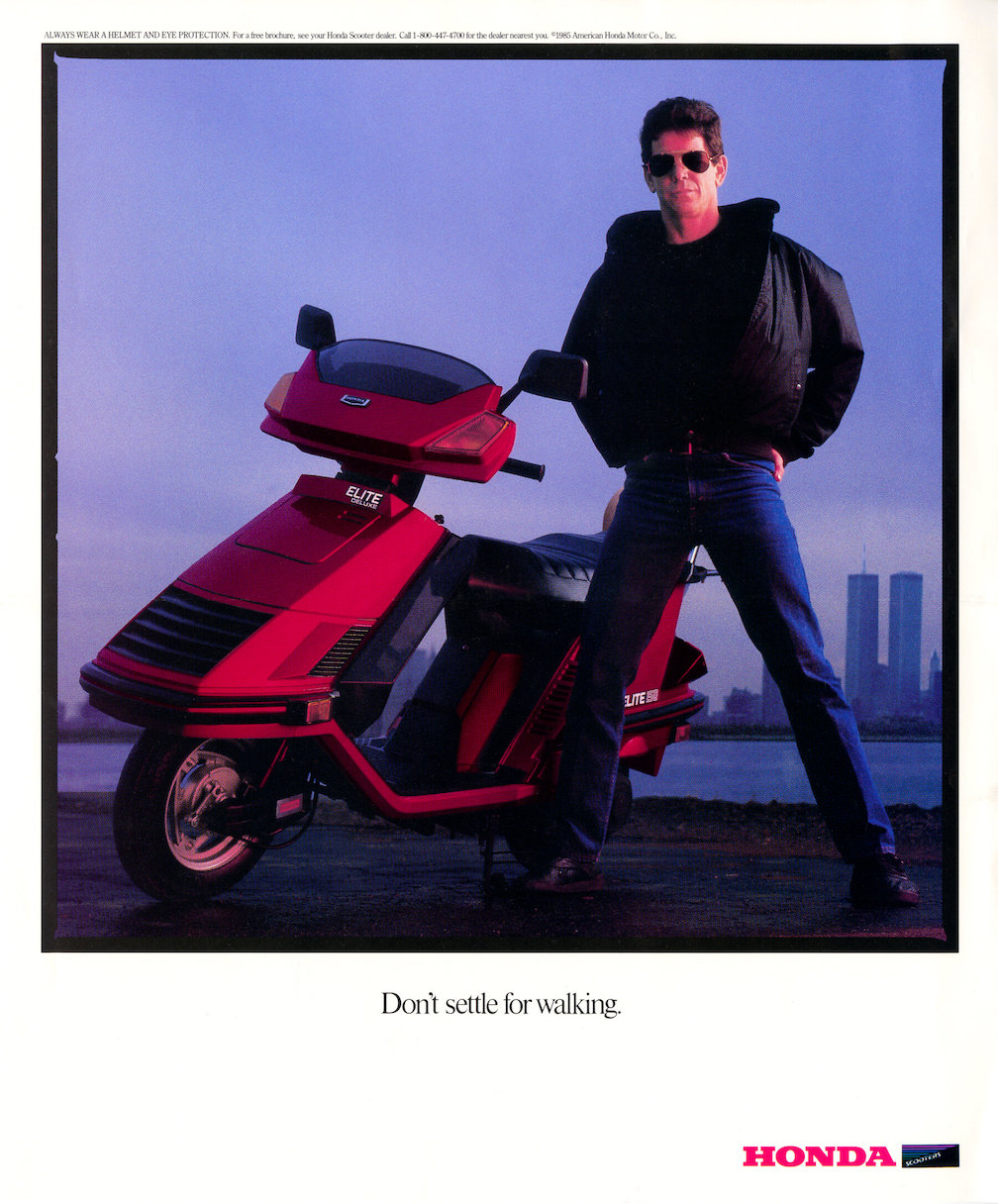
About the time Reed did the ad campaign for Honda, in 86 or so, he was asked to do something for a public service campaign for HIV prevention. He refused, saying he'd never been safe, and he was still alive.

I had dinner with Legs McNeil and a few others at some point in the mid 90s. It may have been after the premier of the film mentioned below. Or it could have been for Billy Name. Billy was there. McNeil went off on political punk. He hated it. He's a moralist.  Moralists are conservative by definition. Genet opposed prison reform because it made him who he was. I've said it before, in the same general context.  John Waters and Mike Kelley agreed, they both still loved the Catholic Church. John's a conservative. I've said that before too. And then there are the Quines 


It's still hard writing for an American audience.


The discussion of Dune and Star Wars among pseudo-leftist pundits is a corollary to Trumpist rage: varieties of childishness. And these overlap with the fanboys and fangirls of the cinematic fanboy Todd Haynes. The film critic on a website for "democratic socialists", named for anti-democratic moralists, violent political puritans, celebrates self-identified heirs of de Sade and Huysmans.

Haynes now has a tag. Haynes, Mad Men, and the nostalgia of Americans for their own childhood, or fantasies of others' youth. "They are not intellectuals, but occasionally dream that they will be. That is their secret ambition." 

Liberals and liberalism, and the whig history of the demimonde.

The Velvet Underground, like most of the self-identified avant-garde were pretentious. Pretension is defensive posturing, signaling insecurity. Lou Reed always got high on his own supply, and he was an asshole. But sometimes fuckups get something something right, describing complexity honestly, That's the basis of a large percentage of what's called "modern art". 

Picasso in 1906 is flying blind. In 1916 he's full of shit, a poseur, but still struggling. The need for easy answers, the indulgence in and struggle against kitsch, lying —to yourself and others—vs honesty,  becomes the conflict between art and pose, rebellion and its marketing.
All the albums I put out after this are going to be things I want to put out. No more bullshit, no more dyed hair, faggot junkie trip. I mimic me better than anyone else so if everybody else is making money ripping me off, I figure maybe I better get in on it. Why not? I created Lou Reed. I have nothing even faintly in common with that guy, but I can play him well, really well. 
All of this is in the context of conservatism, and an honesty that undermines intention. People who say "conservatism is the new punk rock" are right. Punk rock was always self-destructive.

I've repeated this quote from Candy Darling enough. “I’ve been up all night alone, wondering about my identity. Trying to look for an explanation for living this strange, stylized sexuality."

I'll add another, about the lover Reed dumped, from Please Kill Me: The Uncensored Oral History Of Punk.

p. 155

Eileen Polk: Everybody hung out at Max's, and then the New York Dolls played their famous show in drag at the 82 Club. I started hanging out there. The 82 Club was a famous drag-queen bar on Fourth Street, around the corner from CBGB's, which wasn't happening yet. I started going to the 82 Club real early on and made friends with all the drag queens. That's where I met Rachel, Lou Reed's girlfriend. Rachel was a drag queen who was very feminine and really nice. The drag queens liked me, but Rachel was especially nice. One night when she was really drunk she told me that she could never be a guy because she had such a small dick. Then she showed it to me, and it was really small. I said, "That's okay, Rachel. That's okay." And she said, "Well, it better be, because I make a better woman than I do a man."

Then she met Lou Reed, and he was the man of her dreams. Apparently it was love at first sight. Rachel told me, "I've met Lou Reed! I've made it! This is it! I knew this was gonna happen! Something good was gonna happen to me, and this is it and I'm in love!" She was just ecstatic.

Lou would just sit in the corner and Rachel would keep everyone away from him. She announced to everyone, "I don't want anyone near him. I don't want anyone to talk to him. He's mine." And everyone respected that at the 82 Club. All the other drag queens stayed away from him, and all the women did too. Rachel said, "He's mine," but she didn't threaten anybody. I felt like everybody wanted something good to happen for her. And when it did, everyone was happy.

p. 206 

Mary Harron: We all went off to the Locale and none of us had any money and we couldn't order food. I remember Lou Reed ordered a cheeseburger because I was so hungry. Lou was with Rachel, who was the first transvestite I'd ever met. Very beautiful, but frightening. But I mean definitely a guy: Rachel had stubble.

Legs and John were chatting with Lou so I sat next to Rachel, and I asked her what her name was—him, what his name was—and he said, "Rachel."

I thought, Right. That kind of shut me up for a bit. I think I actually sort of tried to make conversation with him, but Rachel wasn't talkative. I think that was the sum total of our conversation.

A review of Halston, on Netflix 

This is not a new lane for Murphy, and once again it seems revolutionary — how rare to make an entire five-episode series dedicated to amplifying such a sour, cynical note — until one realizes there is nowhere for this story to go. Certainly the notion that the modern history of gay life is one as colored by repression and self-loathing as much as by the power of expression is a rich vein throughout Murphy’s work. Just last year, he produced a feature film remake of “The Boys in the Band,” the 1968 play that is the ultimate theatrical howl of isolation and pain. Previously, Ben Platt in “The Politician” and Darren Criss in “The Assassination of Gianni Versace: American Crime Story” played queer men driven by ambition that looks a lot like misdirected rage.

I went to school with the director. He was a screenwriter for I shot Andy Warhol, directed by Mary Harron, quoted above. And both films have the same producer, Christine Vachon, who went to school with Haynes, and has worked him from the beginning of his career. One of my closest friends at the time was a consultant on the Warhol film; we went to the premiere. At some point after that I remember Callie saying, dryly, that it was still safe to assume every homosexual was self-hating until proven otherwise—for Boys in the Band see The Queer Art of Failure and How to be Gay, both from the second decade of this century. Vachon also worked with Cindy Sherman on her only, failed, film; Sherman's work documenting not homosexual but female self-hatred. The absurdity is the lie they tell themselves—if indeed they do—that they're liberal. Maybe it's more that earnest liberals claim them as their own. Liberalism has turned self-hatred, for some, into self-affirmation.

And this brings us back to science fiction,  the geek art of failure unacknowledged, building worlds rather than observing this one. 

Krugman in 2021

The blogger John Rogers once noted that there are two novels that can shape the lives of bookish 14-year-olds: “Atlas Shrugged” and “The Lord of the Rings.” One of these novels, he asserted, is a childish fantasy that can leave you emotionally stunted; the other involves orcs.

Well, I was a bookish 14-year-old, but my touchstones were two different novels: Isaac Asimov’s “Foundation” and Frank Herbert’s “Dune.”

Many social scientists, it turns out, are science fiction readers. For example, quite a few experts on international relations who I know are fanatics about the TV version of “The Expanse.” I think it’s because good science fiction involves building imaginary worlds that are different from the world we know, but in interesting ways that relate to the attempt to understand why society is the way it is.

 Angus Deaton, Dani Rodrik and John Quiggin, and Krugman in 1996

At the deepest level, opposition to comparative advantage -- like opposition to the theory of evolution -- reflects the aversion of many intellectuals to an essentially mathematical way of understanding the world. Both comparative advantage and natural selection are ideas grounded, at base, in mathematical models -- simple models that can be stated without actually writing down any equations, but mathematical models all the same. The hostility that both evolutionary theorists and economists encounter from humanists arises from the fact that both fields lie on the front line of the war between C.P. Snow's two cultures: territory that humanists feel is rightfully theirs, but which has been invaded by aliens armed with equations and computers.

Any systems engineer knows that efficiency in a system is in inverse proportion to stability.

Krugman indulged a fantasy; his preferences were founded in aesthetics before they were founded in ethics: he rationalized a desire, wanted to believe an absurdity, defended it as science and mocked anyone who opposed him as irrational. 

The only thing interesting is that he didn't learn from his mistakes.

How is the philosophy behind Asimov's Foundation less authoritarian than The Fountainhead? Krugman conflates art and illustration, and art and science, "truth and lies".  His link on The Expanse is to Drezner, indulging the horse-race model of political science and IR, the academic origin of the model of journalistic "objectivity" and passivity. Both Krugman and Drezner imagine statements without subtext, themselves without subtext. Their intellects are brittle, though Krugman is "intelligent". The only thing interesting about Dune is how it describes the desires and fantasies of its makers and its audience, and civilization on earth in 2021.

Tagged The Pictures Generation, the aestheticized politics of 80s art, made in the shadow of something worshipped and feared—hated—indulging reaction as radical. That's the mix that turns conservatism into fascism.  Needless to say I have more sympathy for Candy Darling and Rachel Humphreys, who's buried in Potter's Field, than Lou Reed. I have sympathy for them as people.

I want the illusion.
Do you want the illusion or do you want the illusion to be real? 
What’s the difference?
One means that you have an appreciation of the arts. The other means that you’re a fascist.
Art makes the world more interesting than it is. "We tell ourselves stories in order to live."
Living your life as art, and imposing your art on others is more than authoritarianism. Authoritarianism only demands that you behave a certain way. It doesn't demand that you believe. Coerced belief is the definition of fascism. I think Foucault was trying to construct a new conservatism. Neoliberalism ain't it.
[I've used this one before.]


I've made so many riffs on monarchists and monarchism, on liberalism, on the left, and right.
Jean-Marie Straub's film, below, was on Jonathan Rosenbaum's top 10 for 2020. In the link above [reaction as radical] he refers to Sirk and Fassbinder as "more defeatist than progressive". The man in Straub's film is reciting Georges Bernanos. It's hard to get more defeatist than Bernanos. The film is dedicated to Godard.

Sunday, October 03, 2021

updated at bit. It's depressing how unsophisticated the sophisticated have become
---

Jacob Bacharach in the New Republic, 2021: Ayn Rand Made Me a Communist
How an adolescent love affair with "Atlas Shrugged" opened up the world of radical politics.

I don’t suppose that when my parents sent me off to the University of Virginia Young Writers Workshop they imagined I’d return, a few weeks later, both gay and an objectivist.

Bacharach in the New Republic, 2016: I Was a Teenage Nazi Wannabe

The alt-right is a loser's poor fantasy of what a radical revolution looks like. I should know.

I was nearly expelled from high school my senior year, just before graduation. Only my grades, acceptance to a relatively prestigious college, and privileged position as the son of one of the pillars of the local economy prevented it. I was a weird kid: artsy, fay, obsessed with conspiracies, science fiction, Ayn Rand, and the occult.

Bacharach, 2021

...As for me, I’ve never quite figured where to place myself on a left-right spectrum: a moralist but a moral relativist; a queer atheist with an enduring affection for the most traditional of religions; an anarchist by intellect but a collectivist by sentiment. I do count myself a radical, and even if my later development as a political writer and thinker owed a great deal more to Didion and Vidal and Ishmael Reed and a lot of crackpot early-aughts bloggers, then it would still be no exaggeration to say that my earliest, most formative, and most enduring encounter with a radical politics was the high priestess of The Collective herself, Ayn Rand.

“Individual rights are not subject to a public vote; a majority has no right to vote away the rights of a minority; the political function of rights is precisely to protect minorities from oppression by majorities (and the smallest minority on earth is the individual).” Get it, girl!

"Individual rights are not subject to a public vote".  Often, they are. It depends. Didion was a Goldwater girl, and she's still not a "liberal". Gore was always a patrician. This idiot is so confused. He still doesn't know what he is, or what he wants to be.

Bacharach, 2016

We were seniors in 1999, the year of the Columbine massacre. For most of the couple of years preceding, we’d been cobbling together a masterpiece of experimental filmmaking—actually, a semi-related skein of filthy, profane sketch gags centered on the peripatetic wanderings of a character (I use the term loosely) named “Headless,” defined chiefly by the fact that he wore, or was, a full-head rubber Tor Johnson mask. We filmed in our backyards and the woods behind them, in parking lots and alleys, in our bedrooms, and, most ill-advisedly, in the hotel where we stayed on our AP Government trip to Washington, D.C. Then one of us left the VHS master copy sitting on a table in the Laurel Highlands Senior High School cafeteria.

The movie inevitably made its way to our principal. There were plenty of bits to get a decent and unimaginative man riled up—rituals cribbed from Anton LeVay, drug use both simulated and actual, violence, and plenty of fake blood. But I have to believe that the worst moment for that poor administrator and for our poor parents was when they watched another friend of ours, a nice girl from a devoutly Christian family—Lord knows how we cajoled her into participating—crawl between my legs to perform simulated fellatio on a TV remote control. I suspect we meant all this as some kind of commentary on the media. The camera panned up to my contorted face. “Oh yeah, baby,” I growled, “Suck it. Heil Hitler, my dick is your Fuhrer.”

I was already out, the only openly gay kid at my school. I was—I am—a Jew.

John Waters is a conservative. Ask anyone who knows him.
In the 2016 piece he name-checks Nick Land, but doesn't get the point. I'm seeing more and more of this... 

I'm so fucking bored 

"I was a weird kid: artsy, fay, obsessed with conspiracies, science fiction, Ayn Rand, and the occult."

"...he double-majored in music and English and became deeply involved in avant-garde theater, trying out and discarding various radical ideologies like costume changes."


Earlier this year, another hipster wannabe communist and Rand, linking to the history.

Jeet Heer retweeting Krugman on Asimov, and writing about comics. Asimov, the intellectual hero to Krugman and Gingrich and Henry Farrell. I liked Asimov at 12 and knew it was intelligent pop crap. Naked Sun, the one that stayed with me, is detective fiction, the only pulp ever to rise above the name. Ray Bradbury and later Philip K. Dick rose above pulp in other ways.  I read a page of Rand at 17 and knew it was incompetent.  But all of the above, as I've aid a thousand times, documents unsophisticated understanding of art. And change is slow.

More of the same, at a higher level. The brilliance of Steely Dan is inseparable from the limitations. As with the Coen brothers and Nabokov: the poetry of velvet-gloved overdetermination, the late style, not of individual artists but of a form: the Russian novel,  American popular song, Hollywood film. Nabokov is better than Borges because not conceptual or in the service of ideas, not openly reactionary, but too knowing.  Didion belongs on that list too; I think she'd agree. The fans bother me more than the people they worship, even Borges. I  didn't read comics much as a kid, but when I found one by Jack Kirby, from the late 60s, the drawings fascinated me: they combined a rough graphic style with a narrative pull in a way I hadn't seen before. My response was visceral. I recognized that Kirby had succeeded in doing something even if I didn't quite know what it was, so I returned to it. And that's a definition of art.
---

I sent note to Bacharach; we had a bit of a back and forth. I told him he should follow Didion's model and be observant and honest to the point of making others and himself uncomfortable, since that's what makes good writing. He disagreed.

I reminded him of Didion's essay on the Central Park jogger. I told him the top image on the top left, above Lulu, is fascist: the identification with victimhood, and the demand for respect as a victim, of the world, and of being therefore too good for this world. Brooks was too smart to make that generalization. Didion didn't go as far as I have, but she makes the conservative case against individualism and the resulting narcissism. 

Didion is Bacharach's Judy Garland. He's a fan, writing for an audience of fans."Yes! Didion is so camp!" He can't admit to mocking her. He sees himself as a liberal, as liberals do, full of best intentions. 

It might be worth defining fascism as the rebellion of individualism against itself, since fascists are incapable of functioning within a community. 

Thursday, June 24, 2021

Janet Malcolm was famous for reminding American journalists that journalism is sleazy.
She was sophisticated enough to understand the distinction between journalists and writers, but was always more the former, with the passive self-effacement of self-hatred.

The second link above is to Andrew Marr. Below is a passage I've used as a screen shot elsewhere, but never quoted.
Certainly British journalism is not a profession. Over the years they have tried to make it one. In the United States they have mostly succeeded. There, every year, tens of thousands of journalism graduates are turned out in a sophisticated production process – Squish, gloop, plonk journalist! Squish, gloop, plonk journalist! They are taught about the technical skills and the ethics, the heroes of American journalism and its theory. In the process they are moulded and given a protective gloss of self-importance. They have Standards and, in return, they get Status. In Britain it isn’t like this at all. Journalism is a chaotic form of earning, ragged at the edges, full of snakes, con artists and even the occasional misunderstood martyr. It doesn't have an accepted career structure. necessary entry requirements or an effective system of self-policing. Outside organized crime it is the most powerful and enjoyable of the anti-professions. No country in the world has been as journalism-crazed as Britain. Yet. broadly. we do not respect the people who deliver us the very thing we ache for.   
People get into journalism by mistake; or via some obscure trade magazines, or through writing pornography, or family connections. There are well-known journalists today who got in by starting as telephonists, printers or secretaries. Others, the winged ones, floated in from Oxbridge colleges straight to The Economist or Financial Times. Yet others had, besides their talents, the happy good fortune to be brought up in journalistic dynasties - to be a Coren, Lee-Potter, Lawson, Dimbleby, Wintour, Carvel or Dacre.   
However they got in, the vast majority are journalists because of an irresistible, scratchy need. People will sit for years in local news paper offices cold-calling the police and hospitals, try desperately to stay awake in local council planning or water and sewerage meetings, write about garden ornament design, accountancy vacancies for trade journals, and sit being bellowed at by drunken old news editor tyrants. And in the end many fail. We fail sideways; we go off and do something with easier hours and better pay, such as becoming a press officer or public affairs consultant for a company or public body. Or we fail upwards, discovering that we have a greater talent for writing novels, plays or film scripts, and then the good things of life, from mossy territories to first-class plane seats and daughters who know what Verbier is, fall softly into our laps. Or we…just plain. ordinary. everyday damn-it-can’t-pay-the-bills fail. But for those who want to be journalists, the wanting, the urgent desperation to be a hack is the only thing that really matters. 

repeats. back to the beginning.

Wednesday, April 01, 2020

David Weinberger, of the Berkman Center, 2017
If you give people a choice among an infinite supply of media, argues Sunstein, they will gravitate toward content that confirms their existing opinions. Let people connect with whomever they want, and they will connect with those who share their views. Their conversations will then reinforce their beliefs — and, worse, drive them to more extreme versions of those beliefs. They will, in short, form echo chambers. 
The internet satisfies those conditions: it gives us access to a galactic selection of content and enables us to find others who share our beliefs, down to our micro-preferences. For Sunstein, this explains why our culture has become so much more fragmented and polarized. 
According to him, nothing less than the fate of the republic hangs on recognizing and forestalling this danger. At its heart, he argues, the United States is an experiment in deliberative democracy: “[T]he framers’ greatest and most original contribution to political theory,” he writes, was the idea that “heterogeneity, far from being an obstacle, would be a creative force, improving deliberation and producing better outcomes.” Deliberative democracy thus requires that people who disagree be able to talk with one another, constructively and openly, in this way collectively discovering which beliefs are worth holding. Echo chambers, he worries, polarize us to the point that we are unable to have those conversations, and they thus pose a severe threat to democracy itself.
John Quiggin 2008
I’m really, truly, not going to talk about Jonah Goldberg. Instead, I’m going to talk about Cass Sunstein and his idea, reprised in Republic 2.0 that the Internet poses a threat to democracy by virtue of it’s capacity to allow us to avoid information we don’t like. Conservatives are increasingly seeking only conservative views, liberals are seeking only liberal views, and never the twain shall meet.
Sunstein argues that the echo chamber effect tends to reinforce existing views and produce a poisonous partisan divide. 
It seems to me that exactly the opposite is true. The partisan divide in the US is being reinforced because people are more exposed to the other side than before.

Before the Internet, the average liberal or social democrat was largely insulated, on a day-to-day basis, from the kinds of views represented by Free Republic or Little Green Footballs. Similarly, unless we sought out rightwing magazines we were insulated to a large extent from commentators like Goldberg, Michelle Malkin and Ann Coulter. Now we can see them minute-to-minute and it’s obvious that the idea of treating them as part of a legitimate discussion is absurd. 
Quiggin reminds me of Jonah Goldberg's imaginary Pauline Kael, who famously said that Nixon couldn’t have won because she didn’t know anybody who voted for him. And that's understating it. Quiggin is defending the ignorance of Martin Luther King's white moderate.  "I suppose I live a sheltered life." And in 2008 Goldberg's opinions on Israel were just slightly to the right of Crooked Timber.

I always thought Sunstein's point was obvious, especially for any culture founded on individualist liberalism. It's that culture that's given us Facebook and surveillance capitalism and personalized marketing, the virtual store where the displays are changed and items moved to the front to fit your last purchases. Newsfeeds work the same way, reinforcing biases, from narrowcasting to microcasting to the narcissism where the world is reduced to a mirror.

Liberal technocrats see the problem not as lack of information but its excess, and the answer to anger in content moderation, censorship, and limits on speech.

Back to Henry: repeats. You really can't make this shit up.
Liberalism of the small-l kind goes together with a strong emphasis on free speech. The implicit assumption is that we will all be better off in a world where everyone can say whatever they want, to whoever they want, even if it is inconvenient, or wrong minded, or crazy.
"small-l". No, son. And I'll add another name to my list of idiots. I got my fill of her on twitter.

Kate Klonick The New Governors: The People, Rules, and Processes Governing Online Speech
...This Article argues that to best understand online speech, we must abandon traditional doctrinal and regulatory analogies and understand these private content platforms as systems of governance. These platforms are now responsible for shaping and allowing participation in our new digital and democratic culture, yet they have little direct accountability to their users. Future intervention, if any, must take into account how and why these platforms regulate online speech in order to strike a balance between preserving the democratizing forces of the internet and protecting the generative power of our New Governors.
Facebook and Google are functional monopolies, so the high priests are arguing that the techlords need their guidance. The simplest answer is avoided, because the powerful love their own power.

Ban Targeted Advertising
As Mark Zuckerberg testifies to Congress about Facebook's privacy failures, here's a wholesale solution for politicians to consider.
Tech Companies Are Destroying Democracy and the Free Press
Ad revenue that used to support journalism is now captured by Google and Facebook, and some of that money supports and spreads fake news.
The problem isn't too much information but that there's not enough of it. And it's not about "fake" news.  "Real" news is a myth. The people who are conned will believe anything that confirms their worse suspicions and their anger. What made them so paranoid?

I grew up reading The NY Times. When I looked at the paper I saw the decisions of the editors, made for and in the name of a subset of the American public. It was the "paper of record". All the News That's Fit to Print, is a statement of authority. When I go to the library and look through a catalogue I see the record of the decisions of a wider subset and a wider authority. It would bother me if the library catalogue were ordered 'just for me', a subset of one. That's now the model of news and information for the majority, and it's seen as normal. And the liberal technocratic response to the new yellow press is to see it as more confirmation of their own status. Stoller and Dayan are middle class supporters of the middling middle class; they write from self-interest and empiricism not neutrality and rationalism, like Duncan Black but not as lazy and with less snobbery.
Elite liberals can't talk to the conservative base without admitting their own responsibility for disaster. The 'left' can't communicate beyond its base because that would mean to end of its idealism. A popular left can only be a movement reflecting the interests of its members. That their adoring middle class base is so central to Sanders and Warren is part of the problem. Again and again: the distinction between solidarity as idea and fact.
Meanwhile, a small group of senior aides had been pushing Sanders for months to go harder on Biden. 
The problem: Sanders actually liked him. Personally, they got along better than he ever did with Hillary Clinton, aides have said. (The former vice president falls into an exclusive category for the Vermont senator: the people who were nice to Sanders before he mattered, as two aides put it recently.) Back in January, it was the candidate’s decision to personally apologize to Biden after one of his surrogates, Zephyr Teachout, wrote an op-ed about Biden’s “corruption problem.”
Dayen: "The Zephyr situation was when you knew that Sanders wasn't willing to do everything it takes."
Attacking Biden would have kept his base happy, but it wouldn't have expanded it.  

Stoller
I’m just going to cut and paste comments from this story at the Huffington Post on white working class people dying of despair. Keep in mind, the suicide, alcohol, and drug abuse is causing deaths at the level of the AIDS epidemic at its height. This sentiment is common, I just picked comments from one thread on one article. 
“Sorry, not sorry. These people are not worthy of any sympathy. They have run around for decades bitching about poor minorities not “working hard enough,” or that their situation is “their own fault.” Well guess what? It’s not so great when it’s you now, is it? Bunch of deplorables, and if they die quicker than the rest of us that just means the country will be better off in the long run.”
The HuffPo article links to a dead NYT link, an AP article still up elsewhere. The source is Case and Deaton. Deaton: master of the obvious.

Stoller blocked me for reminding him too often how casually he's been consorting with fascists. If this were the UK he'd be a Brexiter, without quite being willing to call it "Lexit". He's a nationalist, an updated cold war liberal, and a Zionist. He's always been a self-important ass. Dayan's a reporter with no pretense; his anger is basic and grounded in experience. Stoller is an "intellectual".

I've always read right wing sites, and I trolled them as much as I trolled the 'left'. I was banned as I was blocked on twitter. I used to tell earnest liberals they should read more, but I always got one answer: "I'm on the web to talk to friends." I'm still following right wing sites and watching the anger that no one left or liberal wants to face directly.

"They are not intellectuals, but occasionally dream that they will be. That is their secret ambition." And 60 years later they got their wish.

Liberalism is a disaster. America has always been a disaster.
Every so often along 99 between Bakersfield and Sacramento there is a town: Delano, Tulare, Fresno, Madera, Merced, Modesto, Stockton. Some of these towns are pretty big now, but they are all the same at heart, one- and two- and three-story buildings artlessly arranged, so that what appears to be the good dress shop stands beside a W.T. Grant store, so that the big Bank of America faces a Mexican movie house. Dos Peliculas, Bingo Bingo Bingo. Beyond the downtown (pronounced downtown, with the Okie accent that now pervades Valley speech patterns) lie blocks of old frame houses—paint peeling, sidewalks cracking, their occasional leaded amber windows overlooking a Foster's Freeze or a five-minute car wash or a State Farm Insurance office; beyond those spread the shopping centers and the miles of tract houses, pastel with redwood siding, the unmistakable signs of cheap building already blossoming on those houses which have survived the first rain. To a stranger driving 99 in an air-conditioned car (he would be on business, I suppose, any stranger driving 99, for 99 would never get a tourist to Big Sur or San Simeon, never get him to the California he came to see), these towns must seem so flat, to impoverished, as to drain the imagination. They hint at evenings spent hanging around gas stations, and suicide pacts sealed in drive-ins. 

---

Jumping forward, to August, on the same subject, and Balkin's "information fiduciaries". 
---
adding this, years later:  "First Things First: Online Advertising Practices and Their Effects on Platform Speech" 

Friday, December 14, 2018

 etc., etc.

Whatever Greenwich Village may once have been or may now be supposed to have been, anyone who has recently strayed down MacDougal Street on a Saturday night knows that now it is a playground. What Coney Island was once to the honest workingman, Greenwich Village is now to the unmarried or ex-married young professional. The Village streets, pads, coffee houses, and bars are jammed with people who look a million times more sensitive, artistic, and "interesting" than William Faulkner or Igor Stravinsky, but who live by teaching economics, analyzing public opinion, writing advertising copy, practicing psychoanalysis, or "doing research" for political candidates. They are not intellectuals, but occasionally dream that they will be. That is their secret ambition. Meanwhile, being young and frisky, they are not yet the "managers" in our highly organized technical society. But they have the skills someday to become managers. Just now they don't want power any more than they want marriage. They want a good time, and a good time is what they go to the Village for, and a good time in the Village is what they get. [i]
“The Village Today: or The Music the Money Makes” Alfred Kazin, in 1960 reviewing a book of Village Voice columns by Bill Manville.  Kazin like MacDonald, a writer from the older tradition, not an academic, a reader of literature not strictly newspapers and social science, a friend of Arendt, still a humanist, a reader for subtext, of the words on the page and not only the arguments they’re claimed to make. “They are not intellectuals, but occasionally dream that they will be. That is their secret ambition.”.  My mother divorced her first husband, she said, because he didn’t understand the tragedy of life. He was an optimist.  He went on work in the White House flacking the Great Society and the Vietnam war. And now almost 60 years later a college graduate with the same optimism can designate himself a “public intellectual” and people will take him at his word. 
Mad Men is a flat screen Disney World for people who grew up on reruns, made by suburban infants of the 60s for an audience of the suburban infants in the 70s and 80s. It’s dirty and sterile. Todd Haynes’ films, the older highbrow version of this are a mashup of Douglas Sirk and Ozzie and Harriet, second hand history and fetishist misogyny. The real subject of course is always the present, but the present is embalmed too, and that specifically is not the subject. There’s so much art, meaning artifice, there’s no room to breathe, and darkness is twisted through technical mastery that the end is not less observation than projection. Haynes' films are worse than a bad Coen brothers film, crueler, because no strained attempt at comedy, just Americans finding ways to avoid responsibility while watching other people fuck up. But there are also good Coen brothers films, and The Wire and Breaking Bad and The Sopranos, and like Warhol, those are black as pitch.   
“Mailer was a left conservative.”[ii]Didion was a Goldwater Girl. MacDonald mocked his own past as a Trotskyite. Liebling, Herr and Page lived through extremes, You can indulge as a craftsman and admit that you’re indulging; you can fight so much to deny something that it shows up in everything you do, but art doesn’t work as symptom. It needs to be made so that someone without the fixations can feel their pull. Works can be  popular when they’re made because the tastes, desires and fears, are common. That doesn’t mean the work will last.  Haynes and Matthew Weiner are like Talese and Wolfe. The perversity is as clear as the desperation to avoid the subject. The problem isn’t the kink; it’s the dishonesty. Didion indulges journalistic sleaze. She’s a voyeur, passive, condescending, but she’s cruel to herself too. That’s enough to keep your sympathy. Art is conservative, or it’s reactionary.

[i]Alfred Kazin, “The Village Today: or The Music the Money Makes”, in Contemporaries, Atlantic-Little Brown, 1962
[ii]  Norman Mailer, The Armies of the Night, Penguin, 1995