

Showing posts with label Jäger. Show all posts
Showing posts with label Jäger. Show all posts
Sunday, October 06, 2024


Tuesday, September 19, 2023
Jäger really is a model high-brow leftist dandy faggot; so attracted to abstract ideas and abstract violence as a kind of pleasure: the violence and melodrama of the avant-garde.
His conflicted relationship to America and American vulgarity; the slumming of a European in LA. the man who fell to earth.
Jäger on Baudrillard
Anti-Americanism might be a moral imperative for Europeans. It certainly is satisfying. But a disinterest in the US is hard to justify politically, let alone strategically expedient. As Nick Burns noted in a reflection on America, Baudrillard’s real message is that “we have to perform American experiments on ourselves”
The first image below reminded me of D2. "I, in fact, don’t think that there are “tragic dilemmas”"
I hadn't thought about that for a while.
The scab could be an immigrant, legal or illegal. His wife or one of his children could be sick, or hungry; they could all be homeless. Solidarity is a double-edged sword, or it's pointless. Dead finks don't talk.
Also Jeff Wall.
Modernity and avant-garde, to you, are two separate things?
JW: We can’t confuse them anymore.
I use modernity and modern-ism, but the references are the same. Jäger is still a modernist; everything he writes—everything he prefers—documents his emotional attachment to a fantasy.
Art and politics are inseparable because language and politics are inseparable: sensibilities are made manifest in form.
Jäger now has a tag.


and "Don't worry. You're still chicken", And that's only a few months ago. I'd forgotten. All I do is repeats.

Friday, August 25, 2023
Working all day makes it easier just to troll than think, but mindless repetition being what it is, sometimes ideas pop into your head.
"Woke" is the knee-jerk response of guilty liberals—if post-war Germans can be defined as liberal—goaded by justified anger of marginalized groups—make your own list—who craft technical fixes to avoid the burden of coming to terms with a given problem. From reconstruction to Brown v Board, the conquests of Liberia and Palestine, to the sterilization of teenagers.
The anti-woke left are all Zionists and aligned with reactionaries: anti-idpol with white identity.[includes Jäger on Charles Maier. see below] It's not even interesting watching Leusder and Jäger anymore; too often one click away from certified race science and fascism. I could write a long list of readers of Razib Khan and Richard Hanania. The last link is to Buppie Bourgeoisie in the NY Times, who does movie reviews with Ganz, the "leftist".
Adam Tooze follows Khan. And Khan follows Emil Kirkegaard; the link is his memorial for Richard Lynn.
Jilani and Scott Alexander again.
Leiter used to be a fan of Lemoine, now a partner in Hanania's absurd little substack "The Center for the Study of Partisanship and Ideology", but that changed at some point.
He still links Freddie deBoer, a man on "the actual left". deBoer interviewed by Razib Khan as a member of the "hereditarian left"


Two repeats, now as a pair.
Tuesday, August 22, 2023
I'd forgotten, Jäger on Charles Maier, previously. Also linked above
--
“We thought we knew the story of the twentieth century,” Charles Maier notes in an announcement for his new book The Project State and Its Rivals. Both haunting and tantalizing, the sentence’s past tense speaks to a profoundly contemporary mood. As the twenty-first century progresses, confident visions about the previous century conceived from the vantage point of the 1990s—the “age of extremes” resolved by a set of liberal settlements—no longer seem safe and secure. In 2023, the European extreme Right is establishing itself as a force of government, populism is going global, and inter-imperial tensions have ushered in a new arms race. In Germany, the Alternative für Deutschland is currently polling above 20 percent, while Modi is set to win another term in India with an approval rating near 80 percent. To the desperation of liberals nostalgic for the 1990s, the “end of the end of history” has arrived.
The project state begins with the Jacobins and continues through to the Zionists. I'm not going to repeat myself, again.

People writing about Andrea Dworkin threatening Allen Ginsberg because he was a member of NAMBLA. And Liberals have no idea what the fuck is going on.
Though I knew it before, the anti-woke left is fully pro-Israel. And the ties to anti-black racism, at best race science curious are clear. Overlapping ecosystems, in and out of academia, with or without advanced degrees.
On twitter following lesbian feminists, detrans teenagers, Ukrainian leftists, Russian and Arab dissidents, Iranians, Palestinians, academics in/from other countries, journalists mostly but not all from other countries. And I'm still bored.
Sunday, July 02, 2023
Proletarian dictatorship is an oxymoron.
back to the top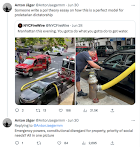
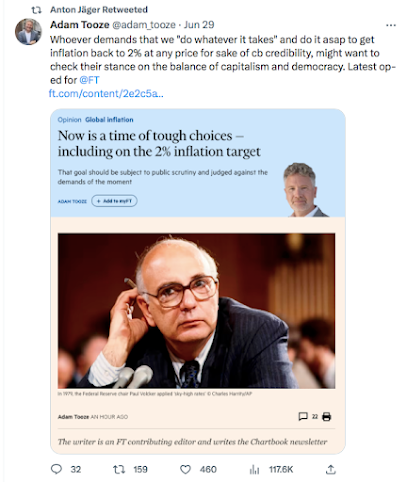
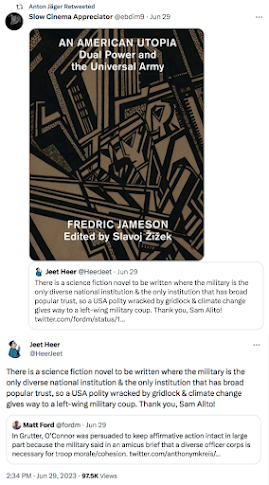
Someone write a pol theory essay on how this is a perfect model for proletarian dictatorship https://t.co/AJrUExJsbV
— Anton Jäger (@AntonJaegermm) June 30, 2023

Dictatorship or democracy: pick one. And that Science fiction fantasy is called Star Trek. Jameson is an idiot.
repeats: "Liberals love benign authoritarianism. The argument is circular: it's benign when they love it."
The argument for freedom or speech is that every one off these assholes defends the Nakba and the Jewish ethnostate in Palestine. Israel is the state of exception liberals and European social democrats accept. The presumption and arrogance is unchanged
"Neither Marx nor Engels lived to see the imperialist epoch of world capitalism, which began not earlier than 1898–1900" Lenin 1916
— Adam Tooze (@adam_tooze) July 1, 2023
The chronological specificity of this is striking. Imperialism =/= Empire or settler colonialism.
Herzl to Rhodes:"How, then, do I happen to turn to you, since this is an out-of-the-way matter for you? How indeed? Because it is something colonial, and because it presupposes understanding of a development which will take twenty or thirty years."
All knowledge is dispersed and perspectival, and the market is vulgar. Googling "Hayek was a utilitarian" doesn't get you much, but it gets you more than "utopianism is fascist"
Danielle Guizzo is at the University of Bristol. On twitter, she follows and is followed by Weber, Gabor, et al. Her reference is to Skidelsky from 2006. Call it progress.
And "wealth" itself is an irrational concept. It is an almost mystical process, the setting of ethical values: Arising from the irrational, transforming the irrational to the rational, yet nonetheless it is the irrational that radiates from within the resulting form." Broch, as always.
If the PRC is the Moses we need against global warming, it should go the same way when the crisis is done. Exception as fact not as theory. It's almost refreshing that the next hegemon won't have the baggage of Christian hypocrisy. Monotheism is disaster.
Tooze isn't actually interested in democracy; he wants government to help the people. Any question of informed consent is secondary.


One minute Western elite was worrying earnestly about balance of democracy and capitalism and announcing a new social contract, next we are assigning both fiscal & monetary policy to hammer inflation & maintain financial stability cos .. TINA. C'mon ...! https://t.co/8jtuOkaHRe pic.twitter.com/0ooUMGcXuJ
— Adam Tooze (@adam_tooze) June 29, 2023
Derek Brower, FT, An energy editor’s farewell reflections
Capitalism won’t deliver the energy transition fast enough . . .
There’s too much to do, and given the urgency and the need to get the solution right, this isn’t a task for your favourite ESG-focused portfolio manager or the tech bros. The sheer scale of the physical infrastructure that must be revamped, demolished or replaced is almost beyond comprehension. Governments, not BlackRock, will have to lead this new Marshall Plan. And keep doing it. The western nations that did so much of the damage will have to finance the transition in the developing world — it is astonishing that this idea is still debated. Massive deficit spending will be necessary, not a new ETF. For all the cleantech advances and renewable deployment in recent decades, fossil fuels’ share of total global energy use was 86 per cent in 2000 and 82 per cent last year.
. . . and nor will Big Oil
Remington was good at typewriters, but not the personal computer. Why expect ExxonMobil or Saudi Aramco to lead — or even survive — a shift from their core business of digging up fossil fuels and selling them? And do you really want them to? In the US, the Joe Biden administration has implored drillers to pump more oil, not less; liquefy more shale gas for export, not less. Shell’s and BP’s share prices have risen since they said they would slow down their retreat from oil.
If we want oil companies to stop selling fossil fuels we should consume less of them and we should vote for governments that make them more expensive, not less. Yes, our physical infrastructure has been built over decades around petroleum use. Yes, oil companies have lobbied forever to preserve this arrangement and slow down alternatives. But no one is compelling those of us in the rich world to fly so much, drive Escalades, devour so much meat, or buy so much stuff.
Oil demand will hit a new record high this year, with almost half of it still burnt in the rich 38 countries of the OECD. Don’t fly across Europe for your skiing holiday or business meeting and then complain that the poor world isn’t doing enough on climate and that BP is still making jet fuel.
Is Russia’s war good for the energy transition?
Optimists think Russia’s weaponisation of gas supplies and brutal violence in Ukraine will speed up the transition from fossil fuels that sustain Vladimir Putin’s regime. Maybe. The IRA and REPowerEU suggest so. Europe certainly isn’t going to be rushing to buy more hydrocarbons from Russia.
But India and China have used western sanctions on Russia as an opportunity to deepen their dependence on its (cheaper) crude. Germany has become a newly minted LNG buyer in less than a year, while Europe’s rush to hoover up cargoes has priced out countries such as Pakistan, forcing them back to coal. The White House was so scared about rising gasoline prices after the invasion that it drained its emergency oil reserves and begged Texas frackers and Saudi Arabia to boost supplies. The G7’s entire goal in the price cap was to keep Russian oil flowing, not stop it. A lesson of the war: western leaders talk a lot, but stomaching fossil fuel supply disruptions is hard.
The next few years will be messy
Either we ignore the consensus of the world’s best scientists and accept an ever-deteriorating climate, or we upend a multitrillion-dollar fossil fuel-based energy system created over decades. For obvious reasons it would be better to decarbonise and clean the energy system, avoiding the trauma of a ever-heating world, while trying to manage the political fallout. But powerful petrostates such as Saudi Arabia and the UAE — in charge of this year’s COP climate conference — won’t go quietly. The transition could put weak petrostates like Iraq in peril. Big Oil lobbyists will fight tooth and nail to stop change and influence elections. Saying the geopolitics of the energy transition will be volatile seems like an understatement.
The beginning made me laugh
Energy professionals are more interesting than others
Mercenaries and inner-city schoolteachers run them close. But there isn’t another sector that combines worldly experience, mechanical knowhow, practical economics and politics. My colleagues covering banks speak to people wearing suits. I got to interview rig-hands in Siberia, warlords, climate activists, solarpanel installers in Texas, ‘wildcatting’ billionaires, and Baghdadi politicians. Objectively, these are more interesting people.
Wednesday, June 28, 2023
AJ rts his co-author
In 1927, Piero Sraffa left Italy for good out of fear of the fascists and became a lecturer in Cambridge. That same year, he was invited by Keynes to give a lecture on the corporative state.His concluding remarks are devastating on liberal's fantasies about a return to normalcy.
Sraffa
The really important question to which the future will give an answer is whether fascism is an abnormal product of the post war psychosis: only suited to the local conditions of Italy or whether it represents a logical and unavoidable outcome of the conditions of modern industrial communities.
The Italian democratic opposition has, at least in the first period of fascism, taken the former view: and it has been confidently expecting the downfall of fascism, which should have occurred so soon as people came back to their senses. Then, fascism would have passed without leaving any permanent trace, everything would have reverted to the liberal system, and the natural order of things would have been restored exactly where it stood in the good old days.
But if experience proves that fascism, apart from its superficial and more picturesque aspects has been originated by more permanent and less futile causes, the case is profoundly different. If it really has represented the last line of resistance from which the present social order must fall bade in order to defend itself against the attacks of organized labour, if in fact it is the only method of consolidating the basis of capitalism when it has reached a stage in which it is no longer possible to preserve it without breaking the forms of political democracy—then the developments of fascism will have a much greater interest in so Far as they will perhaps represent an anticipation of the results to which capitalism may ultimately lead in other countries.
DL rts Alice Evans
Tremendous book on cultural change in 1950s/60s Italy!
By @niamhanncullen

Evans blocked me on her Substack page for a comment I'd already deleted because I'd felt guilty about it. She wants to imagine the best.
Jäger and Leusder, aka minimaldamage, Cooper, Bruenig and Gilman: Individualism and community, the family, Europe and the US, Germany and Greece.
Jäger
This album is such a tragedy for electronic dance music in that every single song on it set the bar so high in 1987 that no one’s surpassed it ever since

Neurodivergent disco is a guaranteed succes[sic]
"Joy Division" "New Order" and autism. Henry Farrell, fan of "My Bloody Valentine" and defender of Truth. The absolute lack of self-awareness. A culture of nostalgia, in an era of engineering and blank violence.
"Atomization, isolation and the illusion of absolute community. The low buzz and hum—the violence and warmth—of neurological overload."
Seth Edenbaum
"Behind the chiliasm of modern man, is the megalomania of self-infinitization."
Daniel Bell
I've given up submitting anything, anywhere.
The adulation for Augustus puzzles me. During the civil war, he, Octavian, would have sons and fathers fight each other to death for entertainment. Just one example. Even for the time this was considered real sicko stuff. Historical distance plays strange tricks on our minds. https://t.co/vMfDVKve8V
— New Left EViews (@NewLeftEViews) June 27, 2023
Leusder again, quoting the New Yorker's music critic on Ernst Jünger
We like to think that novelists possess a special ethical strength, yet the morally compromised writer can project a strange kind of honesty—especially when his society is compromised to the same degree.
"We like to think..." No, we don't.
Fintan O'Toole: Writers are the last people we should look to for moral clarity
For the uncomfortable truth about literature is that morally virtuous people are less likely than morally slippery people to be great writers. Having a clear set of values and sticking to it through trials and tribulations makes for a splendid human being, but seldom for a splendid novel.
My response at the time
No. The ability to face the complexities of the world begins with the acceptance of the possibility of failure. The way to understanding the frailties of others begins with an ability to recognize your own. Most people who consider themselves virtuous haven't been tested, or they're less virtuous than they imagine
right-thinking, bien pensant,
Leusder, Jäger et al. are fans of of all variety of fascist adjacent culture but moralize about those who cross a line, unless of course it's the one about which earnest Europeans hold their tongue.
Memories of Taruskin. Moralists' ideas of art.
And again, both linking back to the same history:
Thug life is barbarism. It needs no written philosophy. It needs no defense. It's not opposed to art. As I've said more than once, maybe not here, if art were about morality, killers wouldn't know how to dance.
A comment that labeled me a "nihilist":12 years ago on the subway, I watched a man playing the accordion. My first thought was that he knew how to handle a knife. His playing was hard, cold and precise, but it was turned in an instant from jagged to fluid, from points to curves, swooping and stabbing. The music described the violent moral universe that made him. He was trailed by a stoop-shouldered woman with a cup. The expression on her face was heartbreaking.
Also from Jäger, Habermas replies:
Please allow me a final intellectual historical observation. Professor Parsons has claimed that Max Weber's teaching is a development towards bringing about the end of ideology. Weber is said to have broken the trilemma of historicism. utilitarianism and Marxism, and to have led the way into the free field of discussion beyond the European fronts of civil war. I envy our American colleagues their political traditions which permit such a generous and (in the best sense of the word) liberal interpretation of Max Weber. We here in Germany, who are still seeking for alibis, would only too gladly follow them. But Weber's political sociology has had a different history here. At the time of the First World War he outlined a sketch of Caesar-like leader-democracy on the contemporary basis of a national-state imperialism. This militant latter-day liberalism had consequences in the Weimar period which we, and not Weber, must answer for. If we are to judge Weber here and now, we cannot overlook the fact that Carl Schmitt! was a ‘legitimate pupil’ of Weber’s. Viewed in the light of the history of influences, the decisionist element in Weber's sociology did not break the spell of ideology, but strengthened it.
No fucking shit.
O'Toole again, on Pinter. All I do is repeats
He goes on to quote, as if from memory, lines from The Duchess of Malfi and The White Devil like "What would it pleasure me to have my throat cut/ With diamonds?"; "There's a plumber laying pipes in my guts"; "My soul, like to a ship in a black storm/Is driven I know not whither"; "I have caught/ An everlasting cold. I have lost my voice/Most irrecoverably." And, of course, "Cover her face; mine eyes dazzle; she died young." He adds, "That language made me dizzy."
These assholes read Brecht as a radical, when he needs to be read as Jünger is, as I read Brecht even as a child.
Reinhard Heydrich on his deathbed reciting the lyrics of his father.
The world is just a barrel-organ which the Lord God turns Himself.
We all have to dance to the tune which is already on the drum.
Saturday, June 24, 2023
1
Unlike most realists, Marx does not see art as precious because it reflects reality. On the contrary, it is most relevant to humanity when it is an end in itself. Art is a critique of instrumental reason. John Milton sold Paradise Lost to a publisher for five pounds, but he produced it ‘for the same reason that a silkworm produces silk. It was an activity wholly natural to him.’ In its free, harmonious expression of human powers, art is a prototype of what it is to live well. It is radical not so much because of what it says as because of what it is. It is an image of non-alienated labour in a world in which men and women fail to recognise themselves in what they create.
The aesthete, then, possesses more of the truth than the political left generally imagines. The point is not to substitute art for life, but to convert life into art. Living like a work of art means fully realising one’s capacities – this is Marx’s ethics. It is also the basis of his politics: socialism is whatever set of institutional arrangements would allow this to happen to the greatest extent. If artistic work is a scandal to the status quo, it is not because it champions the proletariat but because to live abundantly in this way isn’t possible under capitalism. Art prefigures a future in which human energies can exist simply for their own delight. Where art was, there shall humanity be.
Self-realisation, however, must be more than individual, which is the reason Marx adds a crucial rider to this humanist case. You must realise your powers reciprocally, through the equal self-expression of others. Or, as The Communist Manifesto puts it, the free development of each is the condition for the free development of all. This is the way he converts an essentially aristocratic ethic into communism. Oscar Wilde would do much the same in his essay ‘The Soul of Man under Socialism’, in which layabouts like himself who don’t have to work anticipate a socialist order in which this will be true of everybody. In his belief that the political goal is to get rid of labour rather than make it creative, Wilde is closer to Marx than William Morris is, though Morris was a Marxist and Wilde was not.
There are difficulties with the self-realisation thesis, as there are with any form of ethics. It seems to assume that human powers are positive in themselves, and the only problem is that some of them are being blocked. But the urge to shoot down schoolchildren should be restrained whatever the harm to your creativity. The idea also implies that our various capabilities are in harmony with one another, which is far from true. Like postmodern culture, it errs in seeing diversity as inherently valuable. But why should a life rich in a variety of impulses be more worthwhile than one devoted to a single activity? Emma Raducanu may have led a fuller life if she had played less tennis, but people have good reason to envy her all the same.
2
As cash transfers became increasingly popular as a fix to the American welfare state, UBI’s status diminished in the United States, while in Western Europe it gained adherents. The cause for this, the authors argue, was a growing European “left-wing anti-statism and a new post-work sensibility.” Across the continent, large swathes of the Left had come to accept the postindustrial fate of the West, brought about by the increase in free-trade-facilitated international competition, as an unchangeable fact of life. Fordism was apparently bleeding steam, and intellectuals on the order of André Gorz were saying adieu to the working class. The proliferation of European post-work organizations in the late 1970s and early 1980s — the Dutch Council Against the Work Ethic, TUNIX in Germany, as well as French and Italian groups — testified to the Left’s move away from a vision of revolution centered on the industrial working class. In the philosopher George Caffentzis’s words, the excitement surrounding the possibility of a basic income revealed “a failed politics” whose platform presumed that “behind everyone’s back, capitalism [had] ended.”
Of course, UBI’s appeal was premised not on capitalism’s end, but the supremacy of markets. Nowhere was this clearer than in UBI’s surprising discursive turn to the Global South. Jäger and Zamora’s decision to focus on the developing world is both unconventional and welcome. Far from ushering in a postindustrial, post-work, postcapitalist society, in India, Mexico, and Brazil UBI proved itself a useful method for intensifying market relations without actually investing in development. While Julius Nyerere had argued that poor nations could not escape poverty “without industrialization,” the UN, the IMF, and the World Bank pushed poorer nations to adopt transfer payments in lieu of heavy capital investment. In place of an industrial policy to create national independence, transfer payments became the go-to policy in a development scheme that would, ultimately, maintain and reinforce preexisting structures of market exchange.
Eagleton goes up and down, and ends with an absurd note and a bad joke. He needs to see art as teleology: the avant-garde must be a high point rather than a product of immaturity and desperation, honest without being articulate.
For the second, the Brahmin left, Oxbridge bankers and Oxbridge philosophers, and the servants in the first class carriage.
Here, Bruges is a good example of the European garden. Yes, Europe is a garden. We have built a garden. Everything works. It is the best combination of political freedom, economic prosperity and social cohesion that the humankind has been able to build - the three things together. And here, Bruges is maybe a good representation of beautiful things, intellectual life, wellbeing.
The rest of the world – and you know this very well, Federica – is not exactly a garden. Most of the rest of the world is a jungle, and the jungle could invade the garden. The gardeners should take care of it, but they will not protect the garden by building walls. A nice small garden surrounded by high walls in order to prevent the jungle from coming in is not going to be a solution. Because the jungle has a strong growth capacity, and the wall will never be high enough in order to protect the garden.
The gardeners have to go to the jungle. Europeans have to be much more engaged with the rest of the world. Otherwise, the rest of the world will invade us, by different ways and means.
[Josep Borrell apologises for controversial 'garden vs jungle' metaphor but defends speech.]
The myth that Look Back in Anger marked an absolute breach with all that went before has been dispelled over the years. But Soden points out that Coward didn’t merely manage to carry on, he found himself in tune to a surprising degree with the Angry Young Men, the satire boom and the sexually liberated 1960s. He didn’t like postwar England any more than John Osborne did, and he quite liked Look Back in Anger. For his part, Osborne wanted to put on a production of Design for Living, which, like his own play, dramatises a love-hate triangle. Edward Albee got Coward’s work back into print in America and Coward enjoyed Who’s Afraid of Virginia Woolf?, in which the amount of screaming and hurling of household objects is no greater than at the end of Private Lives. Soden also sees parallels with Orton: the dark sexual undertow and the delight in playing with the conventions of farce.
[Osborne] died just after his 65th birthday, on Christmas Eve 1994, and was buried in his Turnbull & Asser smoking jacket with his old copy of “Hamlet” stuffed in a pocket. (It had every part crossed out except Hamlet’s.) He died a club man, an Anglican, a country gentleman, a collector of teddy bears. Not the world he was born into, or that which his early work seemed to inveigh against, but a vanishing world that Osborne identified as England. Only those who had missed the nostalgia in “Look Back in Anger” saw him as a sellout. As Jimmy Porter says of the remnants of Edwardian England in 1956, “if you’ve no world of your own, it’s rather pleasant to regret the passing of someone else’s.”
2
Far from ushering in a postindustrial, post-work, postcapitalist society, in India, Mexico, and Brazil UBI proved itself a useful method for intensifying market relations without actually investing in development.
The book seems less about welfare for markets than welfare for the rich, and restricting the market. The "sovereign consumer" is in the "global north". Like Rodrik's defense of military dictatorship, opposing the creation of a new bourgeoisie in Turkey. It was left to Milanovic to describe the spread of capitalism to the world.
1
The aesthete, then, possesses more of the truth than the political left generally imagines. The point is not to substitute art for life, but to convert life into art.
John Milton was not an "aesthete", and neither were most of the names Eagleton lists that Marx loved and quoted and riffed on. Eagleton's inability to consider the relation of posing to thinking, and his need simply to celebrate adults who never wanted to grow up, Tzara or Benjamin, and we can add Picasso, Duchamp, Wilde, Coward, Osborne, on down the list, all they way to Elvis and Warhol, is just stupid.
Turning life into art is fascism. The desire to turn life into art is born of desperation, and art made out desperation can be very good. Aesthetes are fans who make art out of fandom, and then become fans of themselves.
Before the passages quoted above
Marx is one of the sources of what we now call cultural studies: the single work of fiction to which he devoted most space was the bestselling sensationalist novel The Mysteries of Paris by Eugène Sue. He was also one of the first exponents of the historical study of literature. He championed what he called ‘the present splendid brotherhood of fiction writers in England’, among them Dickens, Thackeray, Gaskell and the Brontë sisters, claiming that they revealed more social and political truths than all the moralists and politicians put together; but like his collaborator and financial backer Friedrich Engels he was wary of literary works that had political designs on the reader. He used the term ‘literature’ to cover all writing of high quality, yet he scorned those who confused the kind of truth appropriate to poetry and fiction with other modes of knowledge. To demand a philosophical system from poets and novelists struck him as absurd. Truth for a writer was not abstract and invariable but unique and specific.
Art is a fine-tuned empiricism, "containing at once the object and the subject, the world external to the artist and the artist himself." Marx was a classicist with no interest in fantasy. He would have hated Benjamin, and all the crap that followed.
on Jäger and Zamora, previously
Monday, June 19, 2023
“For a “big green state” to be conceivable, we have to imagine not just different instruments of policy and a greater degree of state involvement, we have to imagine a shift in the balance of class power.” https://t.co/91cC3oLn8S
— Anton Jäger (@AntonJaegermm) June 17, 2023
Finally, if it is abstract and ahistorical to ignore this wider agenda behind the IRA that makes it more than merely the continuation of derisking in another guise, it is abstract and ahistorical also to ignore the remarkable fusion within the Biden administration between economic policy and the national security state. As Grey Anderson points out in a brilliant contribution in Sidecar, it is a sign of the times that the programmatic statement on economic policy of the Biden administration should be made by the National Security Advisor. Meanwhile, the Treasury Secretary gives speeches on economic relations with China, framed by the question of whether the two countries can avoid war. And the connection runs all the way down the hierarchy. Last week Jigar Shah, of the Department of Energy, tweeted out an image of Rosie the Riveter framed by wind turbines, with an appeal for Americans of today to emulate the greatest generation, who in a matter of a few short years turned American from a military non-valeur into the greatest superpower the world has ever seen.
Shah was tweeting the cover article in The New Republic by Bill McKibben, from September 2016
"A World at War: We’re under attack from climate change—and our only hope is to mobilize like we did in WWII."
Rosie is drawn like a character out of PRC propaganda, and her face is Asian. It's hard to say if the illustrator was editorializing, or if he's just more familiar with Asian graphics. And Tooze doesn't mention or link to McKibben's piece.

Streeck's reply to Tooze in the LRB
Adam Tooze’s outpouring is material for a future anatomy of the class rhetoric of faux cosmopolitanism as it flourishes among a soul-searching urban-academic middle class in the post-Brexit moment (LRB, 5 January). Those of us who do not meet the demanding standards of universalist utopianism can find solace in the fact that when it comes to earthly matters, even the inhabitants of the moral high ground have in the past shown a sense of healthy pragmatism, for example by abstaining from calling for Britain to join the European Monetary Union or the Dublin or Schengen agreements, making one suspect that they, too, distinguish between different institutional constructions of Europeanism or globalism, and between different national needs and interests in relation to them.
My comment on Tooze's post
"we have to imagine a shift in the balance of class power". Yes, a massive increase in the power of technocratic leadership. That has nothing to do with democracy, which is why China leads the green transition.
The EU was designed by an elite playing lip service to democracy while feeding itself, liberals believing their own lies while the poor and the periphery suffer. The leaders of the PRC have no interest in democracy but they like stability, and they worry about the people they rule. Honest realism carries a moral weight; idealism and hypocrisy not so much.
Sunday, June 18, 2023
Is it just me or has competitive green industrial policy spawned meta-competition over how to best typologize said policies? Ive read 3 in the past 24 hours😮 If so, may the most granular, exhaustive, materially grounded and conjuncturally astute 2x2 matrix emerge victorious 🏆
— Thea Riofrancos (@triofrancos) June 17, 2023
Tim Sahay replies: "Oh no, we derisked the private production of a public good 😛"
The transcript is here
More comedy
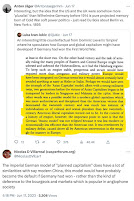
 "The imperial German model of "planned capitalism" does have a lot of similarities with say modern China, this model would have probably become the default if Germany had won - rather than the kind of deference to the bourgeois and markets which is popular in anglophone society"
I'll always go back and forth between the principled defense of democratic freedom and an ironic appreciation of hard realism, and I'll always hate passivity. It's the difference between Borges and the gauchos. I'm not interested in the philosophy of the CCP
More comedy
‘One senior European official quipped that big German industry was “decoupling from the government” on China.’
— Helen Thompson POLIS (@HelenHet20) June 19, 2023
Part of the future will be whether Washington-led state de-risking can prevail over corporate decoupling from western governments. 1/2.https://t.co/9Lh2yCHMEz
Branko talks about "capitalism alone", but this is what it means.
Jäger and his ilk have no understanding of democracy.

"Interesting, but the idea that the US and the UK were somehow more ‘pluralist’ than Wilhelmine Germany before 1914 is pure projected memory born of Cold War soft power politics - just read Du Bois about Berlin vs. New York c. 1895...
They were very different capitalisms, sure, and parts of the old German elite were less taken with liberalism and laissez-faire, but the US got Germany’s full franchise in … 1965"
a reply: "Wilhelmine Germany was basically authoritarian and the UK, US and France were basically democratic. Big difference, no?"
Jäger responds:
"The UK was… democratic before 1914? Germany had a more inclusive suffrage!"
And again, to the same tweet:
"They were more ‘parliamentarian’, yes. But that’s anything but more democratic! The idea of 1914 as a contest of democracies vs. autocracies is one of the wildest ways in which the Anglos have gaslit our sense of history"
Leusder joins in
"It's held that GER was *uniquely* authoritarian, militantly nationalist, chauvinistic, antisemitic. One glance at France, Austria shows this to false. E.g.: Dreyfus Affair would not have happened in GER, and it was there you find the most active women's- and labour movements etc."
The comment aboutDreyfus is a bit much.
As always, Back to Krieger
This book is not designed to cover a section of history. It is designed rather, to provide answers to a definite set of historical questions arising out of the "German problem." The questions are these: Did the Germans‘ failure to achieve, under their own power, a liberal democracy in the western sense mean simply the triumph of conservatism over generic liberalism in Germany or was a peculiar German attitude toward liberty involved in its defeat? If there was such an attitude, what were its ingredients? And finally, given the ingredients at a special German approach to the problems of political freedom, how did that strange historical development work which kept changing the conditions while leaving the ingredients themselves constant?
The first of these questions, on which the others hinge, is easily decided. Without minimizing in the slightest the conservative weight of German authoritarian institutions or the bitterness of the liberal opposition to them during the 19th century, an historical view into any period of modern German history must still acknowledge that the external posture of German liberalism has ever been qualified by its distinctive internal structure. The juxtaposition—indeed, even the connection—of one conception of liberty that could be realized only within the authoritarian state and of another that could be realized only in an absolute realm beyond all states is a commonly remarked German phenomenon. It has been traced back to Luther and up to Hitler. My problem is to show what the connection between these two apparently antithetical conceptions has been and how it has grown.
Jäger retweeted another reply:

And there we go. The future of freedom is Millian, existing only in the context of *benign* authority.
And supporters of that authority will decide when it applies and when it doesn't. Leusder supports Ben Judah and his celebration of a new Europe, while both support a state founded in conquest and separatism. Palestinian citizens of Israel will never have full equality in a Jewish state. That's the point.
Saturday, June 10, 2023


Modernism and its delusions
Somewhere, sometime, the 1950s:
Commonsense notions of development associate it with
capitalistsocialist modernization. Such notions assume that cumulative economic growth enables poor countries to become more like rich ones.To facilitate such growth, policymakers, international institutions, and many academics urge poor countries and their populations to adopt modern ways of thought and action, dispensing with familial or communal loyalties and embracing the benefits of
capitalistsocialismmarketsand impersonal bureaucracies.Those who adopt this perspective insist that such modernization will be beneficial for developing societies in the long run, even though there will always be those who lose out and seek to resist the process. However, since the benefits of economic growth and cultural change outweigh the losses, it is legitimate to forcefully suppress such opposition.
Milanovic, on HBO
What “Succession” serves us is the end of the illusion of ethical capitalism. The issues are the same as they appeared in the beginnings of the commercial society, and were discussed by Bernard Mandeville and Adam Smith. The question was the following: can the unchecked use of what are conventionally considered vices, namely passions for power and wealth, be reconciled with the existence of an ethical society? Can a society that places the acquisition of wealth on the pedestal, considers it the most desirable social attribute, and regards the rich as worthy of emulation, be ethical?
The obvious reply.
The illusion of ethical power is with us more than ever. "Democratic control of the economy" means only that the powerful have a mandate to serve the interests of the majority as they see fit.
There's nothing democratic about that.
Leusder rt's Daniela Gabor
historians of ideas will look back at the 2020-22 COVID period as a rather incredible blip in the hegemony of austerity/monetary dominance.
Defending of the primacy of ideas, or mocking it? Jäger, or Indiana?
Leusder
Academia strikes me as a strange baroque bal masqué: there's a strong incentive for preference falsification, ingratiation and sycophancy, and yet, at the same time, for singling certain people out for public vitriol in order to make a reputation and compete for jobs and grants.
He rt's Harry Crane, a professor of statistics
I used to think peer review served an important purpose.I was wrong.Peer review serves no meaningful purpose, and could be abolished without anyone (except academic's whose livelihoods depend on it) noticing.
The best reply, as always, is Hüppauf
The university belongs, like the church and the military, to the social institutions that are situated at a considerable distance from democracy and adhere to premodern power structures.
Kate Mackenzie
.@MonaAli_NY_US: Centre of gravity of world manufacturing (80%) is in developing countries, yet world finance is concentrated in the transatlantic. "That's the geopolitical tension... one that can be defused or de-escalated."
NLR, "The AMLO Project"
Just a few months into his presidency, AMLO declared the death of Mexican neoliberalism. It was a bold statement, more of an aspiration than a fait accompli. The first signs of its realization were rhetorical. Previously, political discourse focused on the division between a vaguely defined ‘civil society’ and the state. Public officials increasingly conceded the necessity of increasing ‘citizen control’ over ‘governance’. Class antagonism had all but disappeared from mainstream commentary. Yet under AMLO it reemerged in Laclauian guise: as a confrontation between ‘the people’ and ‘the elite’ (fifis and machuchones as he mockingly calls them), the latter defined by their wealth, meritocratic self-delusion and disdain for working-class culture.
This verbal shift was matched by a stark process of party realignment. In the 2018 election, working-class votes were scattered across different parties, including the neoliberal bloc, while AMLO had an edge with middle-class professionals. At that time, 48% of voters with a college degree supported MORENA’s congressional candidates. In the 2021 mid-terms, by contrast, that figure fell to 33%. The inverse occurred at the bottom end of the educational attainment bracket: 42% of people with only elementary school education voted for MORENA in 2018, while 55% did so in 2021. Recent polling shows that those most supportive of AMLO are ordinary workers, the informal sector and peasants, while his most vociferous opponents are businesspeople and college-educated professionals. The ‘Brahmin Left’ phenomenon, which increasingly characterizes voting patterns in Europe and the US, has evidently been reversed in Mexico.
The owner of the lunch counter where I spend too much time, whose wife, son, and youngest daughter just came back from a trip through Spain, Italy, Greece, and Egypt, says AMLO is popular because he gives money to the poor. But the poor aren't greedy and don't ask for a lot. It's everyone else who never has enough, especially the rich. He works seven days a week and he's a cheapskate, though less than he used to be. His son has to pull posts of his travels from Facebook because people in his village get jealous. He works behind the counter and pays his own way on his trips; he went with friends to Russia for the World Cup with stops in Germany and the Netherlands. His father has more property than he used to and some cattle. He's buying a horse. A few years ago he and his wife stopped going home because the cartels had moved in and they worried about being kidnapped. But the cartel now is sticking to business and leaving people alone. He knows AMLO is limited in what he can do. He likes AMLO for doing what he can. He's petty bourgeois through and through, a striver; he complains about crime and parking, but he's still connected to the community that made him. He's still tied to the world of work being a world of jobs as opposed to careers, the world of people and not ideas.
Milanovic is kind of dim, but he's a cosmopolitan in his way, not trapped in the Anglosphere, or even the Eurosphere. His imagination was formed in the culture of the non-aligned movement.

Sunday, May 28, 2023

On a recent rainy night in Manhattan, more than a hundred people gathered at St. Mark’s Church-in-the-Bowery to celebrate the launch of Parapraxis, a new magazine about the century-old practice and theory of psychoanalysis. The party, co-hosted by the journal n+1, primarily consisted of writers, academics, and analysts, most of them young. You could identify some of the analysts by their clothes (fleeces, button-downs) and their jokes (“How many dollars per hour are they charging for this?”). Alex Colston, the 31-year-old deputy editor of Parapraxis, who is training to become a clinical psychologist, set a stack of glossy magazines on a scarred wooden table near the door.
The source is Nick Burns, via Jäger. Both of them must have a very short memories. Click again for context, but read it all. It's no fucking end of annoying that I'm a mathematically illiterate "artist" and I'm with Blyth and Streeck, Piketty, and Milanovic, while these assholes are drowning in narcissism.
But no, it makes perfect sense. I'm with Streeck, Piketty, Milanovic, Gary Indiana, and Warhol: all of us watching narcissists. The pic above is styled after a Polaroid for Interview from 1978.
Indiana
That culture might be powerless to affect the movement of history was a perception Viennese society held in abeyance for half a century, by endorsing every avant-garde that appeared in its arts and literature.
Burns
"In American cultural and intellectual life, New York City sets the tone....Who wins in New York’s clash of cultures is high-stakes for the future of American political culture."
"To be present at the creation is why one lives in America and in New York specifically."
Jäger
The history of events merely provides a series of pegs to hang the history of ideas on, and it is the latter that is of real interest. So, the time has come to turn to that history of ideas.
I can't help laughing.
It's all an absolute farce,

Sunday, May 21, 2023
Jäger rt's Mona Ali
How many of you well-versed in the Lucas paradox knew this? Man, the stars were aligned for his ex.
Six years before Professor Lucas won his Nobel, his estranged wife expressed great faith in his future. Her lawyer inserted a clause in their divorce agreement stipulating that she would receive half of any Nobel money he might receive if the honor was awarded before Oct. 31, 1995. He received the prize barely three weeks before that deadline.

The Lucas 'paradox' doesn't exist. Wall Street invests in the American South and Louisiana isn't rich. European empires built infrastructure because it was necessary to extract wealth. Lucas married a native, a servant, a subaltern—an American college girl, in 1959—and she used his laws against him. Investment is extractive; it's as cheap as it needs to be. But people being social animals things get messy.
"Man, the stars were aligned...." Economics is shallow, but sexism runs deep.
In an agenda with conservative implications for economic policy, Professor Lucas maintained that government spending that supplants private investment is counterproductive; that the money supply is what matters most; and that policies to reduce inequality by redistributing income, though “seductive,” are “in my opinion the most poisonous” to sound economics.
He also favored eliminating taxes on capital gains, or on any income derived from capital. And he embraced supply-side economics, which calls for increasing the supply of goods and services while cutting taxes to promote job creation, business expansion and entrepreneurial activity.
“The supply-side economists,” he said in a 1993 interview, “have delivered the largest genuinely free lunch that I have seen in 25 years of this business, and I believe we would be a better society if we followed their advice.”
What an ass.
Saturday, May 20, 2023
It is precisely in this conclusion, however, that the analytical shortcomings of Welfare for Markets come into view. Can this metaphysic of money do the explanatory work that Jäger and Zamora ask it to do, given that social life has been principally mediated by money and markets in the Global North for several centuries now? After all, as the authors remind us with the book’s first epigraph, Karl Marx already offered a trenchant critique of the “cash nexus” by the 1840s—nearly a century before the height of the solidaristic politics whose downfall the book justifiably laments. If the monetary mediation of life is really so singularly corrosive, one might wonder how the New Deal emerged at all in a country where life insurance has been a mass industry since the Civil War. It is necessary to push deeper since, as Alyssa Battistoni observed in her political reading of Virginia Woolf’s A Room of One’s Own (1929), money is first and foremost a means to life itself. When Woolf marveled at the transubstantiation of the physical money in her hands after a small bequest left her a fixed allowance for life, her elation was entirely unrelated to the possibilities of individualized consumption. “It is remarkable,” Woolf observed, “what a change of temper a fixed income will bring about. No force in the world can take from me my five hundred pounds. Food, house and clothing are mine forever.”
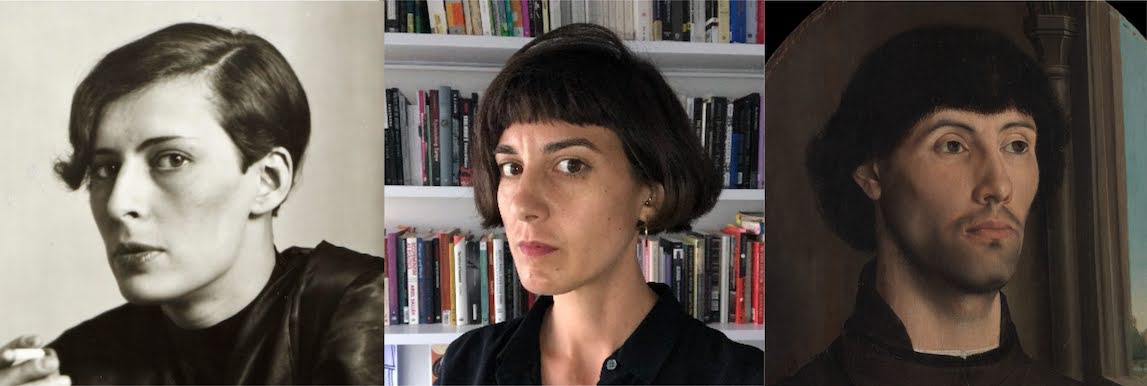
Battistoni, (Harvard/Barnard/Jacobin/Utopia), is in the middle.
I'm bored.
The great majority of nobles either did not know how, or did not wish, to get rich. The great majority of younger sons had no desire to "derogate." They sought the remedy elsewhere, in a growing exclusiveness. Some held that the nobility should form a body like the clergy and be constituted as a closed caste.
New gen European intellectual historians: "You can't give people free money. It's turn them into vulgar materialists!" The new gen American historians. "Well..." The corollary to the Americanization of the world.
Back to the review.
Jäger and Zamora, both Belgian, are historians of modern political thought...
Zamora’s puckishly framed The Last Man Takes LSD: Foucault and the End of the Revolution (2021), co-written with Mitchell Dean, ruffled feathers by exploring what it took to be Michael Foucault’s alleged late career dalliance with the libertarian undercurrents of neoliberal and Californian thinking.
Again too perfect. Back to Baudelaire.
This habitude of military metaphors denotes minds not military, but made for discipline, that is, for conformity, minds born domesticated, Belgian minds, which can think only in society.
Foucault was a libertine. The demimonde is always full of monarchists. The "ruffled feathers" belong to moralists. Genet opposed prison reform because prison made him what he was. It's almost bizarre that I even have to say this shit.
In his mid 30s my brother quit his job, left his apartment and moved into a homeless shelter to work on his chess game. The man on the right is the Representative of the Dutch Ministry of Finance and self-described paleo-libertarian. My brother works as a proofreader. He won the game, winning the tournament and two weeks in Russia.

All of the writers above live lives dedicated to work, competition, argument, posing, and climbing. People who aren't interested in any of those things shouldn't be forced to suffer all the consequences. Oxbridge philosophs and Oxbridge bankers are cut from the same cloth: they like to win and rule.
Give people free money and legalize bloodsport. Bring back politics and stop teaching its theory. Teach history from second grade and leave philosophy as an elective in college. France is different. The relation to the Netherlandish and the Anglosphere is an interesting topic.
---
Torracinta (Boston Review) again
One might expect to encounter this perspective in the words of transfer recipients themselves. Yet in perhaps the biggest shortcoming of the intellectual historical orientation of Welfare for Markets, such voices are entirely absent. Firmly ensconced in the world of planners, economists, utopians, technocrats, philosophers, and the occasional activist, the book notably overlooks the views of the poor, who are portrayed in precisely the same abstract fashion that Jäger and Zamora explicitly decry when it comes to economic theory.
more on Jäger and Zamora
Torracinta, here second row left
Wednesday, May 17, 2023
update at the top. It just gets worse.
Jäger: "Oh buddy"
Fukuyama: “the invasion of Ukraine was such a shock bc in our lifetimes we’ve never witnessed one country militarily invading another.”
Chris Hayes: “Well, Iraq.”
Fukuyama: “Yeah but…well, ok”
Jäger: "We should just cryogenically preserve the Fukuyama of 1991 and not listen to the other versions."
Fukuyama hasn't changed. And they're not talking about the Iran Iraq war. The Israeli invasion of Lebanon doesn't' count. A lot of invasions don't count. Wikipedia has a list.
---
Jäger rt's a pic of a text of Alexander Kluge, with images by Richter. The passage fits every argument I've ever made about the Gothic anti-humanist logic of modernism. It's almost too perfect.
A transcription of texts (just as if evolution had been tinkering with their DNA texts) doesn't only create lines to new, future texts. It can also be reconstructed in the direction of paradise. The way there leads through indeterminacies. (Nearer, my God, to Thee’ was the music played by the orchestra on board the Titanic as the ship went down. But it is also the working instructions to copyists of all countries, who are driven from the omphalos of experience into the parallel world (heterotopia), the pre-world (history) and the future world (the world of our children, who are so attached to life). For copyists, all images are NOW—TIME.

The medieval world of monastic copyists, of the memorization as opposed to interpretation of the Koran, the Talmud, the Bible, or any religious text. Allegiance to dogma: the innocence of the eternal present.
And he rt's this
Schmitt: “... your point on page 215 would change all of present philosophy”
— Julien (@grainofglass) May 16, 2023
Kojève: “Yes, everything essential appears on my page 215”
*Allan Bloom cuts page 197-224 from the English edition*
In order to give to divine Spirit the fullness of being, it is necessary to situate divine Spirit within the World, to conceive of it as the “entelechy” of the World. Now, to conceive of it [215] in this way is to conceive of it as worldly, that is to say, human Spirit, and no longer as God. In short, Man who seeks to understand himself fully and completely as Spirit, can be satisfied only by an atheistic anthropology. And this is why the Schicksal, the Destiny of every Theology, of every Religion, is, in the final analysis, atheism.
And this documents how fascism and other forms of ideologically committed authoritarianism in the 20th century could be "a-theistic". It's all interesting as a matter for history and sociology, but with these idiots we're back to Fukuyama, and the moral imperatives of faith, in ideas, in the word, in a metaphysical reality.
Before that he rt'd Loren Balhorn's sad emoji for the last playlist of Ryuichi Sakamoto, avatar of ironic kitsch pop. Sakamoto was wishfully pretentious, but he had a light sad sense of irony and an awareness his own limitations. And he didn't pretend to be a leftist. Jäger can be good with facts; he says he prefers ideas, but his real preference is fantasy. All of them indulge the waking dreams of people who've watched too many movies
There's an attitude in Godard, despite the assertions of wanting to converse, that says, Don't argue or cross me about such things. And this book does not alter the notion of his brilliant immaturity. The most fascinating point of all applies more broadly than to Godard; it reaches out to anyone who believes that film is more important than the world. Maybe film is not the great new language of engagement with the world that Bazin hoped it would be. Perhaps it is, instead, a vehicle more suited to dreaming, sensationalism and not wanting to grow up. Perhaps language--the construct of words--was always subtler, deeper and more humane.
All art relates to dreams; film is the nearest art to dreaming itself. It's the nearest thing to a drug: that's its weakness. No other art makes it so easy to deny the fact of artifice, but every great film, one way or another puts artifice out front. The corollary is that bad films try to replace reality. "Trash cinema" is credited with giving the lie to smooth commercialism but wouldn't exist without it. It's dependent. Negative dialectics is the sincerest form of flattery.
Subscribe to:
Posts (Atom)