Showing posts with label Up the Bourgeois. Show all posts

Friday, December 15, 2023

Drift, the bourgeoisie, materialism, the press, etc. Change is slow, but when it becomes clear it's kind of electric. 

Prior to the recent attack by Hamas, six in 10 (57%) said the United States should be ready to meet with leaders of Hamas, including half of Republicans (51%), and majorities of Democrats (61%) and Independents (59%).

On most other questions there are great partisan differences. While most Americans preferred the United States take neither side in the conflict (64%), Republicans were equally likely to say they should take Israel’s side (49%) as no side (48%).

The attack pushed Israel over an edge, or what's become an edge.

Sunday, May 14, 2023

repeats, from 2008 and 12: NYT, Religion and Class in Turkey

ISTANBUL : When two women in Islamic head scarves were spotted in an Italian restaurant in this city’s new shopping mall this month, Gulbin Simitcioglu did a double take.

Covered women, long seen as backward peasants from the countryside, “have started to be everywhere,” said Ms. Simitcioglu, a sales clerk in an Italian clothing store, and it is making women like her more than a little uncomfortable. “We are Turkey’s image. They are ruining it.”

As Turkey lurches toward a repeal of a ban on head scarves at universities, the country’s secular upper middle class is feeling increasingly threatened.

Religious Turks, once the underclass of society here, have become educated and middle class, and are moving into urban spaces that were once the exclusive domain of the elite.  

and 2022: From polarization to pluralism 

April 20, Politico.eu

The man seeking to dislodge Recep Tayyip Erdoğan as Turkey’s leader has shaken up next month’s presidential elections by declaring his identity as an Alevi — a member of the country’s main religious minority, which has often suffered discrimination.

The statement by Kemal Kılıçdaroğlu, the joint presidential candidate backed by six opposition parties, came in a Twitter video viewed almost 20 million times in less than 24 hours. The tweet itself was viewed some 70 million times.

While most Turks have long known that Kılıçdaroğlu hails from the Alevi minority, his decision to stress his identity is being widely viewed as a plea for pluralism and tolerance, and an attempt to strike a contrast with Erdoğan, who has based much of his political career on his mainstream Sunni identity.

As always: Fuck Dani Rodrik.

Sunday, January 29, 2023

---

In Rienzi or Lohengrin or Tannhäuser, Hitler, the rejected Academy candidate sitting over his water colors in the reading room of the home for men, recognized magnified aspects of his own confrontation with the world. Both Wagner and Hitler, moreover, possessed a furious will to power, a basically despotic tendency. All of Richard Wagner's art has never been able to conceal to what extent its underlying urge was the boundless need to dominate. From this impulse sprang the taste for massive effects, for pomposity, for overwhelming hugeness. Wagner's first major composition after Rienzi was a choral work for 1,200 male voices and an orchestra of one hundred. This blatant reliance on mass effects, employed to cover up basic weaknesses, this medley of pagan, ritual and music-hall elements anticipated the era of mass hyp. nosis. The style of public ceremonies in the Third Reich is inconceivable without this operatic tradition, without the essentially demagogical art of Richard Wagner.

Another point in common was a kind of cunning knowledge of the popular mind along with a remarkable insensitivity to banality. This combination resulted in an air of plebeian pretentiousness in which again they were remarkably similar. Gottfried Keller once called the composer a "barber and charlatan"; similarly, a contemporary observer described Hitler, with the acuteness born of hatred, as having "the aura of a head-waiter"; another spoke of him as a speechmaking sex murderer. The element of vulgarity and unsavoriness that phrases of this sort tried to catch was present in both Hitler and Wagner. They were masters of the art of brilliant fraudulence, of inspired swindling. And just as Richard Wagner could call himself a revolutionary yet pride himself on his friendship with a king ("Wagner, the government bandleader," Karl Marx said scornfully), so Hitler, in his vague dreams of mounting the social ladder, reconciled his hatred of society with his opportunistic instincts. Wagner dismissed the patent contradictions in his views by declaring that art was the goal of life and that the artist made the ultimate decisions. It was the artist who would intervene to save the situation wherever "the statesman despairs, the politician gives up, the socialist vexes himself with fruitless systems, and even the philosopher can only interpret but cannot prophesy." His doctrine then was that of the aesthetician who would subordinate life entirely to the dictates of the artist. The state was to be raised to the heights of a work of art; politics would be renewed and perfected by the spirit inherent in art. Elements of this program are clearly visible in the theatricalization of public life in the Third Reich, the regime's passion for histrionics, the staginess of its practical politics—a staginess that often appeared to be the sole end of the politics.

---

Since the German word Bildungsbürger, let alone Bildungsbürgertum, is probably untranslatable, Martin Chalmers wisely leaves it in the original and explains the meaning in a footnote. Briefly, a Bildungsbürger was a member of the pre-war bourgeois German elite whose status was marked less by birth than by a solid classical education. Some of the proudest Bildungsbürger were Jews. If sportsmanship, good manners, and fine tailoring were the vaunted signs of the English gentleman, the minimum requirement for a Bildungsbürger was a sound knowledge of Latin and Greek, the classics of European literature, and of course German classical music. The gentleman was shaped by the English public (meaning private) school, the German bourgeois by the Gymnasium.

All of which is to say that Joachim Fest, the acclaimed biographer of Hitler and Albert Speer, cultural editor of the Frankfurter Allgemeine Zeitung from 1973 to 1993, and conservative scourge of the postwar German left, was a paragon of Bildungsbürgertum. His politics were not of the far right; there was no hint of revanchism. Fest was a liberal in the classical European sense, a believer in free-market economics with the habitus of a cultivated banker and a taste for Mozart operas and Italian Renaissance art.

His childhood education during the Third Reich is the subject of Fest’s extraordinary memoir, written in a polished style full of irony and wit, not all of which survives in translation. It is also a trifle self-regarding. Ich Nicht, the German title, conveys this a little more clearly than Not I. Perhaps it should have been Not Me, as it is in the British edition. The point made is that Fest was not one of the vulgar mob that cheered for Hitler. Fest’s nemesis, Günter Grass, whose memoir Peeling the Onion appeared in the same year (2006), may have volunteered for the Waffen SS—“not I.”

Fest points out early in his book that the values of the educated German bourgeoisie were already old-fashioned before the war and discredited after 1945. Leftists who saw fascism as the logical culmination of bourgeois capitalism partly blamed this upper-middle class for the rise of Hitler. Fest responded that “this accusation merely reflects the resentment of spoiled children intent on being morally superior to their parents.” He meant the student rebels of 1968 and their literary mentors, such as Grass. Fest didn’t think much of them, nor they of him.

In fact, the rise of Hitler’s Reich was also the end of Bildungsbürgertum. But the left-wing criticism of that class started much earlier. A prime example was Heinrich Mann’s novel Professor Unrat, better known in its cinematic version, The Blue Angel, directed by Josef von Sternberg, the film that made Marlene Dietrich’s name. The downfall of Professor Raat, ruined by his liaison with a nightclub dancer, is a satire that sticks the knife into the moral pretentions of a typical bourgeois pedagogue. The novel was written in 1905, in the Empire of Wilhelm II, when the prestige of a classical German education was at its height. A devastating world war, a chaotic and weak republic, and the ensuing Nazi catastrophe left the world of Professor Raat in ashes. 

Joachim Fest’s father, Johannes, the hero of his son’s memoir, was in many respects the perfect example of a Bildungsbürger. He taught at a good school in Berlin. He took pride in his complete works of Goethe, Shakespeare, Heine, and Lessing. A bronze bust of Dante stood in his study. From a solid Prussian family of minor officials, Johannes Fest was also a devout Catholic, whose idea of decent Prussian values included a lack of sentimentality and a sense of irony, which may not be everyone’s idea of Prussianness, but to the old man was “the entry ticket to humanity.”

And yet, as Fest points out, his father’s various qualities did not always fit together easily. For example, he could never forgive Thomas Mann, whose literary talent he acknowledged, for writing Reflections of an Unpolitical Man (1918). Mann’s notion of the Bildungsbürger was that he should stay away from politics, which was a sordid business, unworthy of a civilized humanist. Kultur is what mattered, not politics. Most members of his class would have agreed. Johannes Fest did not. Mann’s prejudice, he maintained, had done more to alienate the bourgeoisie from the Weimar Republic than Hitler. 

---

Yet it is here if anywhere that a valid criterion may be found for distinguishing the elite from the mob in the pretotalitarian atmosphere. What the mob wanted, and what Goebbels expressed with great precision, was access to history even at the price of destruction. Goebbels' sincere conviction that "the greatest happiness that a contemporary can experience today" is either to be a genius or to serve one,[57] was typical of the mob but neither of the masses nor the sympathizing elite. The latter, on the contrary, took anonymity seriously to the point of seriously denying the existence of genius; all the art theories of the twenties tried desperately to prove that the excellent is the product of skill, craftsmanship, logic, and the realization of the potentialities of the material.[58] The mob, and not the elite, was charmed by the "radiant power of fame" (Stefan Zweig) and accepted enthusiastically the genius idolatry of the late bourgeois world. In this the mob of the twentieth century followed faithfully the pattern of earlier parvenus who also had discovered the fact that bourgeois society would rather open its doors to the fascinating "abnormal," the genius, the homosexual, or the Jew, than to simple merit. The elite's contempt for the genius and its yearning for anonymity was still witness of a spirit which neither the masses nor the mob were in a position to understand, and which, in the words of Robespierre, strove to assert the grandeur of man against the pettiness of the great.

in re: "The fascism debate" 

Goebbels' sincere conviction that "the greatest happiness that a contemporary can experience today" is either to be a genius or to serve one,...

The world is just a barrel-organ which the Lord God turns Himself.
We all have to dance to the tune which is already on the drum.

Monday, January 10, 2022

Kieran Healy
Something that's happened to me several times when teaching social theory to undergrads at various places is we start reading Weber and then I have to back up and explain what the Reformation was and then one or more students discover to their surprise that they are Protestant.

Noting the failure of American secondary education, ancillary to a discussion of the sociology of American religion.

Also Kieran Healy


The lead character and her husband, modeled on Hanson-Løve's parents, are referred to as "philosophy professors" in American reviews, because of the subplot involving her publisher. They're high school teachers. That's unimaginable in the US.

"I wasn’t hostile to May ’68, but whereas the people who participated in it saw it as a beginning, I saw it rather as an end. May ’68 was the first stone thrown into the pond of Marxism. The ideological collapse of Marxism began in ’68. Because I believe that May ’68, paradoxically, cured many people, including perhaps me, of communism and anticommunism. I think that the kind of Marxist fever that took place after May ’68 carried within it its condemnation and its end, it was a last flare-up. That’s how I saw May ’68, and that is why, personally, I remained absolutely indifferent, serene, with regard to what might happen. I continued with my work."

I'd love to see some bourgeois self-awareness in this country. But self-awareness is pessimistic, and here even comedy, pessimistic by definition, is used to reinforce the optimistic imperative.  Laughter is nothing but a symptom of denial.

"You must look through the surface of American art, and see the inner diabolism of the symbolic meaning. Otherwise it is all mere childishness...."

---

Sunday, January 09, 2022

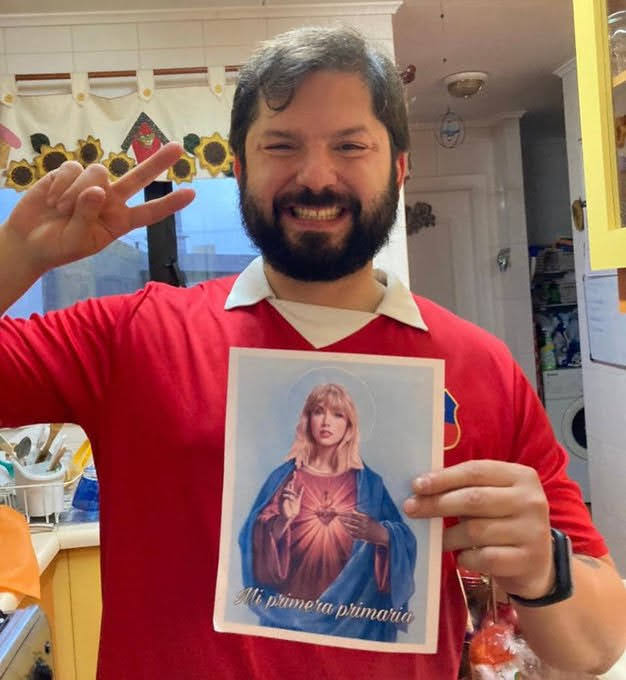
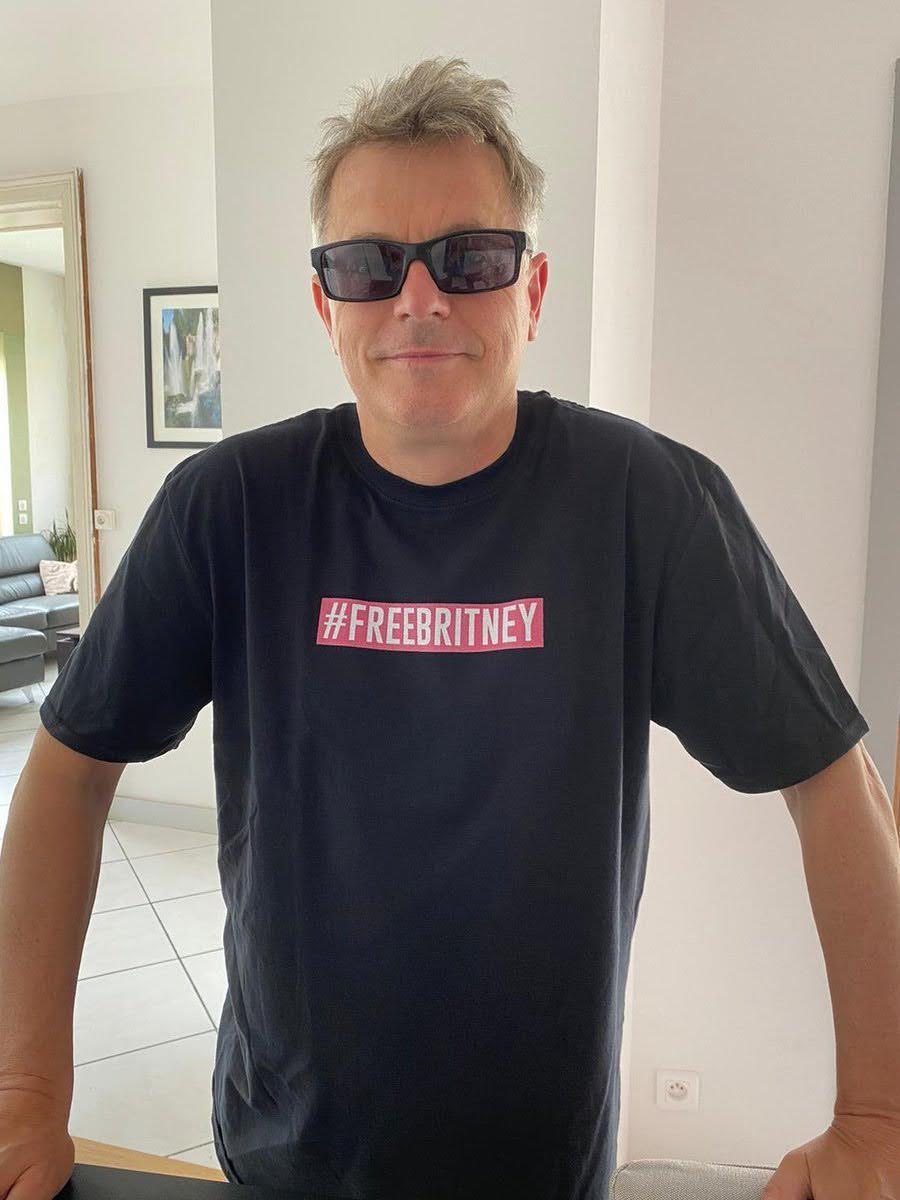
Socialism or Communism/Taylor v Britney


The President-Elect of Chile, and the National Secretary of the French Communist Party.
Comedians in politics are a sign of progress. 

Camila Vergara, in the NLR blog, December 10th
In the upcoming presidential ballot on 19 December, Chileans will be asked to choose between a far-right Pinochet apologist and a social democrat – not, as outlets like the Economist and Financial Times have claimed, between ‘two extremists’ offering different variants of populism....   
Kast’s 2021 presidential programme – promising to ‘restore order’ and reclaim Chile from an alleged communist insurgency – included proposals to lower corporate taxes and eliminate inheritance tax; grant legal immunity to the armed forces and fund the legal defense of police officers accused of using excessive force; give the President sweeping powers to crack down on dissent; establish an International Anti-Radical Left Coalition to ‘identify, arrest and prosecute radicalized troublemakers’; shut down the Human Rights Institute; exit the United Nations; repeal the ILO Convention No. 169 on indigenous peoples; and eliminate the Ministry of Women, offering financial incentives for heterosexual marriage while erasing ‘gender ideology’ from the education curriculum.

Meanwhile, Boric pursued the failed strategy of trying to defeat the far-right on its own terrain. He secured the backing of the Christian Democratic Party after meeting with its leaders and sought to win over the business moguls at the Confederation of Production and Commerce (CPC), opening talks to quell their ‘legitimate anxieties and fears’. Rejecting the popular demand to liberate all those jailed during the uprising, Boric has called for a tough line against protesters accused of ‘burning and looting’, even though such allegations have in many cases been confected by police (indeed, five separate reports have documented human rights violations perpetrated by carabineros and cases of intra marcha agents involved in acts of vandalism, including the destruction of Santiago’s Hotel Principado). As a representative in the lower house, Boric approved the ‘anti-barricade law’ that criminalized protest by imposing prison sentences between two months and five years on those who occupy public spaces or build blockades. He later apologized for backing the reform, conceding that it gave more arbitrary power to police and judges, yet he refuses to support pardons for those who have been jailed because of it.

Boric has been both praised and criticized for his conciliatory attitude towards the right. A month after the uprising in 2019, he was one of the opposition leaders invited by the government to negotiate the terms of the constituent process. A conversation he started in a men’s bathroom with the far-right Senator Juan Antonio Coloma ended fifteen hours later with a ‘social peace agreement’ signed at 2am. This deal stipulated that a two-thirds supermajority in the Constitutional Convention was required to approve new constitutional articles – giving effective veto power to elite interests – and created an obligation to respect existing commercial treaties. (Since then, President Piñera has been pressuring Congress to fast-track the ratification of TPP11, which would force the state to pay crushing fines to private companies for nationalizing natural resources).

Following his swerve to the center-right, Boric has ingratiated himself with the ex-Concertación and even with the government coalition, whom he implores to unite against the threat of fascism. His new campaign manager for the 19 December election, Izkia Siches, has announced that Boric’s government would retain the current Undersecretary for Health, Paula Daza (who asked for unpaid leave to campaign for Kast). Siches also said they would consider bringing on board the other right-wing presidential candidate and former Piñera cabinet minister, Sebastian Sichel. As a result, this electoral alliance can only come at the cost of abandoning the struggle against the neoliberal model and the parties that have administered it for three decades. Although Boric’s coalition is nominally antifascist, his campaign’s decision to incorporate figures like Daza, and its intention to grant more legal power to police and judges, undermines any ostensible commitment to democracy. If this neoliberal ‘Antifa’ can achieve anything, it will most likely be a reconfiguration of establishment forces, aiming to implement what Boric calls a ‘responsible transformation’ that eclipses the radical energies unleashed in 2019.

While Kast’s vote share is expected to reach 40% in the next round, given that all right-wing parties have endorsed him, Boric has the support of all the parties of the ex-Concertación, even if some Christian Democratic leaders remain sceptical. Parisi has refused to endorse Kast but is so far silent on Boric. Nevertheless, the ‘Antifa’ strategy appears to be yielding results, with polls putting Boric three to 13 points ahead of his rival. At this rate, the social democrat is set to win by a comfortable margin; although a legislative stalemate is inevitable since right-wing parties have captured half the seats in both houses of Congress.

Sunday, December 19, 2021

Allende won 36.2% in a three way race. Boric won 56% against one opponent.
The poster was in the stash I donated to MoMA.

Monday, August 23, 2021

Hollywood liberalism is the new leftism.

At bottom, the argument that socialists need to behave virtuously for political reasons is liberal and individualist – the same fallacy seen from Matt Bors' famous Mr. Gotcha. The whole point of leftist politics is to solve problems through collective coordination, not by convincing individuals to behave differently.

Born in New Jersey and raised in Turkey, Piker got his political commentating feet wet working for his uncle, Cenk Uygur, co-founder of The Young Turks, an L.A.-based left wing online news and commentary channel that ranks as the longest-running news and politics show online. Piker created and hosted a couple of programs on The Young Turks, “The Breakdown” and “Agitprop with Hasan Piker” among them, before he left in early 2020 to focus on an independent career as a Twitch streamer.

Now, about one and a half years since he flew the TYT coop, he’s hoovered up enough clout, audience, and revenue to shell out $2.74 million for a spacious home along a pretty, tree-lined street in West Hollywood’s bustling and centrally located Beverly Grove neighborhood. A secured and tightly hedged if otherwise bland and featureless courtyard fronts the roughly 3,800-square-foot pan-Mediterranean style residence that was built in 2014 with white stucco walls and a red tile roof. Arguably, only the exposed wooden eaves give the five-bedroom and 5.5-bath home a smidgen of authentic architectural character.

Twitch Phenom HasanAbi Talks (and Talks) His Way into West Hollywood Home
[The link is dead and it's been wiped from archive.org] 


"Collective coordination" Piker and his cleaning lady, pool boy, etc.. This returns us to Star Trek, Latour, Chalmers, Romer, 
At bottom, the argument that socialists need to behave virtuously for political reasons is liberal and individualist.

Cooper, Bruenig, Duncan Black,  Solidarity is not individualist. "Loyalty is double-edged or it's pointless" Comrades are equals.

A week ago I was on the phone with a gallerist in Dusseldorf, an heir to the Bildungsbürgertum. He prefaced a sentence... "I know it sounds bourgeois,..."  A little ironic self-awareness. 

"The glory of the United States, the thing that makes us the envy of the world, is a philosophy, if that word can even be used here, of personal freedom, combined with a sort of careless irresponsibility. It's been a fun ride, and those from this country who have argued against it most often sound like dry sticks or moralizing bores. There's a real tragedy in the story of the American left. It no longer has any peasants or workers, only priests and dilettantes."
I beat Piketty's research by 20 years. By 30 actually if I go through my files.

The tragedy of the American left is part of the tragedy of America. A culture based on fantasies and lies.

Tooze on Keynes and Keynesianism. 

Keynesianism was an ideology of mobilization, an intellectual project for winning the war. And there were Keynesians everywhere. German economists, aligned with the Nazi regime, made the same discoveries at the same time. They conducted extensive debates in 1943 and 1944 as to whether there was any upper limit to the debt that might constrain the final mobilization for Hitler’s Endsieg. It was dangerous to be a fiscal conservative in Hitler’s Germany, especially as the end approached. More on that another time.

Tooze

Keynes on the Labour party.

However moderate its leaders may be at heart, the Labour Party will always depend for electoral success on making some slight appeal to the widespread passions and jealousies which find their full development in the Party of Catastrophe. I believe that this secret sympathy with the Policy of Catastrophe is the worm which gnaws at the seaworthiness of any constructive vessel which the Labour Party may launch. The passions of malignity, jealousy, hatred of those who have wealth and power (even in their own body), ill consort with ideals to build up a true Social Republic.  

As I've said too many times, I had a beer with him on election night 92. He called Clinton a Republican, and I agreed. Trudeau was a socialist and a corporate lawyer. I know it sounds bourgeois,...
---
Sometimes I play it too cute. "Best to say my hatred of ideological liberals is their unwillingness to accept their own authoritarianism." 

Friday, March 13, 2020

New examples of the same old thing, and slow change. Liberal authoritarianism, the return of the social, of experience, empiricism, etc. The tags explain.

Branko Milanovic
"Swapping my Russian passport for a Dutch one, I realized that while nothing has changed about me as a person, I am treated radically differently anywhere I go. This is the random privilege that contemporary citizenship upholds."
linking to Nils Gilman
Citizenship is a morally repugnant scam whose "key function boils down to the preservation and reinforcement of global inequalities, as well as the distribution of liabilities to the majority of the world’s population, mostly former colonial subjects."
linking to The case against citizenship
When we understand citizenship’s actual functioning in faithful, accurate terms, it cannot under any circumstances be justified.
Citizenship is the foundation of self-government. Liberals support 'guided' democracy and the rule of technocrats, a ruling class searching for 'justice'.

Liberal technocrats support hate speech laws, (a recent example of German perversity).
Efforts by German authorities to clamp down on the Boycott, Divestment and Sanctions (BDS) campaign took a sinister turn recently after a Jewish-German singer and daughter of a Holocaust survivor was warned that a concert in which she is scheduled to perform would be cancelled if she made any remarks in support of BDS. 
The threat, which suggests that German officials are policing how Israel is discussed in arts and cultural events, shows Nirit Sommerfeld receiving a letter in which the singer is warned that if she used the word BDS or anything they deem to be “anti-Semitic” German authorities would cancel the concert in Munich on Saturday. Sommerfeld and her orchestra Shlomo Geistreich are scheduled to hold a conference marking the 20th anniversary of the band.

Videos being passed around twitter of Italians in their apartments, singing songs together out into the street. The Europeans and others are touched. One pompous Oxbridge philosoph, from Rome, posts a thread,  "to celebrate the resilience of ordinary people", with videos from Salerno, Naples, Turin, Benevento, Siena, Florence, Nuoro, Arigento. Himself not being an ordinary person, he's celebrating the fatalism of the weak. No one seems to get that this is a parallel to the inability of Italy to have an organized functioning response to the crisis. An American academic specializing in Europe notes happily that they sang songs in the plague years in 16th century. Of course they did. And it's beautiful, but it's tragic. Those singing get the point.

Arindrajit Dube:
"Maybe one thing Americans have got going for us is that as a people we actually are ok with social distancing from other human beings and don’t need to really even do balcony dances."

I made my usual response

"The essential American soul is hard, isolate, stoic, and a killer."
Milanovic March 19, 2020, Foreign Affairs:
"The Real Pandemic Danger Is Social Collapse. As the Global Economy Comes Apart, Societies May, Too"
Even so, the human toll of the disease will be the most important cost and the one that could lead to societal disintegration. Those who are left hopeless, jobless, and without assets could easily turn against those who are better off. Already, some 30 percent of Americans have zero or negative wealth. If more people emerge from the current crisis with neither money, nor jobs, nor access to health care, and if these people become desperate and angry, such scenes as the recent escape of prisoners in Italy or the looting that followed Hurricane Katrina in New Orleans in 2005 might become commonplace. If governments have to resort to using paramilitary or military forces to quell, for example, riots or attacks on property, societies could begin to disintegrate. 
Thus the main (perhaps even the sole) objective of economic policy today should be to prevent social breakdown. Advanced societies must not allow economics, particularly the fortunes of financial markets, to blind them to the fact that the most important role economic policy can play now is to keep social bonds strong under this extraordinary pressure.
Milanovic, March 30, 2019, the most recent link,  to a post from 2017:
Dining alone…in a hyper-competitive world
Is the life where we “bowl alone”, dine alone, exercise alone, go to concerts alone, live alone our ultimate objective? It seems to be the case. The average size of household has been going down with higher income. Not only do richer countries have lower (or negative) population growth rates, but the richer the country the smaller the household size. The final objective will be to live in a world where each household is composed of one person. Denmark, Norway and Germany are almost there: the average household size is 2.2 (Senegal and Mali have the average household size of 9.1 and 9.5). Japan offers a vision of a society of ultra-competitiveness combined with loneliness.

We should not be surprised by such an outcome. Being together with others always had an economic angle: expenses were less, on a per capita basis, when shared; we needed children to help us in the old age and spouses to pay our bills. But with higher incomes and higher labor participation rates, we can afford expensive utility bills, we can provide for our old age and a comfortable old-age home (so broadly advertised today). Our children (if we have any) will be too far away, cast around by the availability of jobs and hyper-competitiveness to take care of us.

Being alone is both our preference and a response to a world of competitiveness, commodification and higher incomes. The new world that we can glean will not be dystopian. It will be a Utopia, with a twist.

“It will not be a universal concentration camp for it will be guilty of no atrocity. It will not seem insane, for everything will be ordered, and the stains of human passions will be lost amid the chromium gleam. We shall have nothing to lose and nothing to win. Our deepest instincts and our most secret passions will be analyzed, published and exploited. We shall be rewarded with everything our hearts ever desired. And the supreme luxury of the society of technical necessity will be to grant the bonus of useless revolt and an acquiescent smile.” (Jacques Ellul, The technological society, 1954).
Milanovic replying to me in Feb 2018. "We all die alone"
He seems to be learning something, but it's hard to tell.

Capitalism Alone. He's considered to be on the left, which is stupid. He's a hard-wired technocrat struggling to come to terms with the need for a social cohesion that technocracy doesn't supply. I don't quibble with his description of China, and tossing his book at them is the easiest response to earnest American preachers of the end of capitalism.

Gilman's a fan of Hofstadter. He used to read me here, when he was the Chief of staff of the Chancellor at UC Berkeley. He needs his own tag.  From Berkeley to The Berggruen Institute to godawful Breakthrough Institute. Mandarins of the Future indeed.

Milanovic reminds me of Zizek. That's something to write about. I like Yugos. [I changed my mind about Milanovic]
When Europeans talk about Liberalism, they're referring to the state of being of the modern bourgeoisie.
“Achh! you’re so bourgeois!” they say.
That’s the basis of every European conversation.
“Good morning”
“Achh! you’re so bourgeois!”
“Achh! you’re so bourgeois too!”
“Coffee?”
In America at least in big cities when we pretend to like foreigners, we talk about being Liberal instead of being bourgeois, because to attack liberalism seems to imply conservatism, or worse! That puts people in the position of arguing that Grandma’s manicotti is really not as good as the frozen kind because Grandma was a peasant who went to Church three times an hour while waiting for the Second Coming, and frozen manicotti is the wave of the future and besides, it feeds the masses, but anyway you don’t eat frozen manicotti because you go to La Maison de la Casa House or some other such for manicotti that is better than Grandma’s and that only cost $40 so why not? This is modern American liberalism.

Wednesday, July 05, 2017

The frat boy, the liberal, and the actual existing Africans


A memoir is an opportunity for a writer to put his or her life on trial, but few follow through and condemn themselves too. Jeffrey Gettleman, this newspaper’s Pulitzer Prize-winning East Africa correspondent, fell in love with Africa while still a self-described frat boy; at Cornell he met his other great love, Courtenay, an alluring sorority girl. The twisted road that eventually allows him to unite these two conflicting passions takes the reader through a melodrama that squats uncomfortably between “Eat, Pray, Love” and “Heart of Darkness.”

Africa. That vast swell of nations, languages, landscapes and histories has always had a peculiar impact on foreigners, but Gettleman seems to have been hit harder than most. The continent is described as his “imaginary friend,” a place that his fraternity brothers cannot possibly understand: basically a high-five-happy Shangri-La where the people are poor but rarely resentful. 
...I have perceived in many works on Somalia by Western journalists some of the wild-eyed joy you see in photos of youths running with the bulls in Pamplona — a macho thrill that life there is supposed to be short and cheap, an almost sensual delight in, say, the “dark, unblinking eyes” and “chains of bullets.” “Love, Africa” follows in that tradition, but it does a useful thing too: It shows just how impervious that gaze is to the work of African writers, and how the call of the tribe — the media tribe — cuts through whatever good intentions are put before it.

By the end of the memoir, ensconced in comfort in Nairobi, Gettleman strikes a conflicted figure. He is still in love with Africa, though the postelection violence in Kenya as well as the Westgate Mall attack by Al Shabab have torn away some of his illusions. Both he and Courtenay have accepted the wisdom of their predecessors, ruefully recalling what a Zimbabwean farmer told them once at a truck stop near the South African border: “These people can survive on very little. They’re not like us whites. They don’t need a hamburger or an apple. They’ll be fine for a month with a slab of rancid donkey meat.”

After spending years living in Africa, after questioning the inequality he sees around him, and after conversing with numerous politicians, activists and ordinary men and women, Gettleman allows the embittered white farmer to get in a parting shot, which he and his wife seem to take as brutal honesty. This unintentionally amusing scene fits what is a bewildering memoir. The whole narrative reminds me of those books written by colonial adventurers such as Sir Richard Burton, aimed at readers interested in Africa mainly as a site for their dreams and nightmares.
Review by Nadifa Mohamed

the liberal, played by Elon Green

I've never read Gettleman. It should be shocking that he'd ever be hired by the NYT, shocking to defenders of reason and enlightenment. It should be shocking that the NYT defends Zionism. It took an outsider to point out the obvious, a change made possible only because she was given the opportunity to publish in the Times.

I'm tagging this under Freedom of Speech, because it ties so closely to recent posts on censorship and race, Nadifa Mohamed alongside Jordan Peele.

Thursday, June 22, 2017

In all my comments on this I talked around the obvious. I've said it elsewhere dozens of times but it's so front and center here it just slipped by.

Schutz and Neel are called artists. Jordan Peele is a comedian. Neel's success is still the success of the observer, the success of the philosophical, collaborative model associated with fine art and academia, but of an older aristocratic tradition (Hilton Als is no leftist). Neel succeeds in observing the other through sympathy and friendship, not ideas. Smith should have written about her. Peele's comedic adversarialism says "fuck you" to the laziness of white bourgeois assumption, not to Neel and to elite, leisurely, openness and curiosity. True bohemians model themselves aristocrats. That solves none of the problems of aristocratic art, of which Neel remains a practitioner. But Neel is from an older tradition and she's dead.

Get Out is the answer to Hannah Black's self-rightious bourgeois moralizing, Get Out is the necessary criticism of Open Casket.
---

Cultural appropriation, continuing

The difference between the US and the UK. Zadie Smith misses badly.
We have been warned not to get under one another’s skin, to keep our distance. But Jordan Peele’s horror-fantasy—in which we are inside one another’s skin and intimately involved in one another’s suffering—is neither a horror nor a fantasy. It is a fact of our experience. The real fantasy is that we can get out of one another’s way, make a clean cut between black and white, a final cathartic separation between us and them. For the many of us in loving, mixed families, this is the true impossibility. There are people online who seem astounded that Get Out was written and directed by a man with a white wife and a white mother, a man who may soon have—depending on how the unpredictable phenotype lottery goes—a white-appearing child. But this is the history of race in America. Families can become black, then white, then black again within a few generations. And even when Americans are not genetically mixed, they live in a mixed society at the national level if no other. There is no getting out of our intertwined history.
The Root: Get Out Proves That ‘Nice Racism’ and White Liberalism Are Never to Be Trusted
National Review: Fear of a White Village
Breitbart: Jordan Peele’s Horror Movie ‘Get Out’ Casts ‘Liberal Elite’ as the Monster
NYMag: Jordan Peele’s Genius New Horror Movie Shows the Terror of Being Black in World Full of White People

Breitbart and NYM use the same quote quote from Peele.
“It was very important to me for this not to be about a black guy going to the South and going to this red state where the presumption for a lot of people is everybody’s racist there,” Peele told the audience after the film’s midnight screening. “This was meant to take a stab at the liberal elite that tends to believe that ‘We’re above these things.'”
repeats
Can a film be too inflammatory for its own good, or are there times, and places, when only fire will suffice? In an interview with the Times, Peele, whose mother is white, admitted that the movie was originally intended “to combat the lie that America had become post-racial,” and the result is like an all-out attack on a rainbow. Short of making us listen to “Ebony and Ivory” over the closing credits, “Get Out” could hardly be more provocative. There’s a scene with a head-stamping, a scene with an exposed brain, and a truly creepy scene with a bowl of Froot Loops. And yet, despite all that, what makes this horror film horrific is the response that it gives to the well-meaning and problem-solving question “Can’t we just learn to live together?” To which the movie answers, loud and clear, “No.”

Tuesday, June 13, 2017

The main question remains: how does a programme which is so clearly pro-rich and anti-social succeed in appealing to a majority of Americans as it did in 1980 and again in 2016? The classical answer is that globalisation and cut-throat competition between countries leads to the reign of each man for himself. But that is not sufficient: we have to add the skill of the Republicans in using nationalist rhetoric, in cultivating a degree of anti-intellectualism and, above all, in dividing the working classes by exacerbating ethnic, cultural and religious divisions.

As early as the 1960s, the Republicans began to benefit from the gradual transfer of part of the vote of the white and southern working classes, unhappy with the civil rights movement and the social policies, accused of benefitting primarily the Black population. This long and in-depth movement continued with the crucial victory of Nixon in 1972 (faced with the Democrat, McGovern, who suggested implementing a universal basic income at federal level, financed by a new increase in estate duties: this was the summit of the Roosevelt Programme), Reagan in 1980, and finally Trump in 2016 (who had no hesitation in racially stigmatising Obamacare, as Nixon and Reagan had done previously).

In the meantime, the Democrat electorate focussed increasingly on the most highly educated and the minorities, and in the end, in some ways resembled the Republican electorate at the end of the 19th century (upscale Whites and Blacks emancipated), as if the wheel had turned full circle and the Roosevelt coalition uniting the working classes over and above racial differences had ultimately only been a parenthesis.

Let’s hope that Europe, which in some ways is threatened by a similar development with the working classes having greater faith for their defence in the anti-immigrant forces, than in those who describe themselves as progressive – will be capable of learning the lessons of history. And that the inevitable social failure of Trumpism will not lead our “Donald” into a headlong nationalist and military rush, as it has done others before him.
one [or here]
two [or here]

Slavoj The Bear defends Corbyn and bourgeois decency against petty bourgeois moralism (left and right).
Unfortunately, the leftist-liberal public space is also more and more dominated by the rules of tweet culture: short snaps, retorts, sarcastic or outraged remarks, with no space for multiple steps of a line of argumentation. One passage (a sentence, even part of it) is cut out and reacted to. The stance that sustains these tweet rejoinders is a mixture of self-righteousness, political correctness and brutal sarcasm: the moment anything that sounds problematic is perceived, a reply is automatically triggered, usually a PC commonplace.

Although critics like to emphasise how they reject normativity (“the imposed heterosexual norm”, and so on), their stance is one of ruthless normativity, denouncing every minimal deviation from the PC dogma as “transphobia” or “fascism” or whatsoever. Such a tweet culture which combines official tolerance and openness with extreme intolerance towards actually different views simply renders critical thinking impossible. It is a true mirror image of the blind populist rage à la Donald Trump, and it is simultaneously one of the reasons why the left is so often inefficient in confronting rightist populism, especially in today's Europe. If one just mentions that this populism draws a good part of its energy from the popular discontent of the exploited, one is immediately accused of “class essentialism”.

It is against this background that one should compare the Conservative and the Labour electoral campaigns. The Conservative campaign has reached a new low for the political battled in the UK: scaremongering attacks about Corbyn as a terrorist sympathiser, of the Labour party as a hive of anti-Semitism, and all of this culminating in Theresa May joyously promising to rip off human rights – a politics of fear if there ever was one. No wonder Ukip disappeared from the scene: there is no need for it, since May and Johnson have taken over its job.

Corbyn refused to get caught in these dirty games: with an outspoken naivety, he simply addressed the main issues and concerns of ordinary people, from economic woes to terrorist threat, proposing clear countermeasures. There was no rage and resentment in his statements, no cheap populist rabble-rousing, but also no politically correct self-righteousness. Just addressing ordinary people’s actual concerns with a common decency.

The fact that such an approach amounts to no less than a major shift in our political space is a sad sign of the times we live in. But it is also a new confirmation of old Hegel’s claim that, sometimes, naïve outspokenness is the most devastating and cunning of all strategies.
Sam Kriss replies
Kriss' about page includes blurbs from various people, praise or criticism.
"Swiftian. A joy.”
Peter Hitchens 
“Far too odd to easily classify.”
Nick Land
In the end it all dovetails

New tag for Zizek.

Sunday, April 09, 2017

"Ebony and Ivory" over the closing credits

Two in a row

"So was Mr. Rickles a bigot or a mensch? The truth, probably, is that he was both."
...It seems as if the liberal program of attempting to shame and berate people into being more open-minded and tolerant may have backfired. Listening to interviews with Donald Trump’s supporters during his once-implausible rise, I was struck by how many of them mentioned that they admire that “he’s not politically correct.” This was often a not-unbreakable code for saying he was a refreshingly unapologetic bigot. But it’s still worth noticing that apparently telling people they’re not allowed to say certain things or feel certain ways, that their opinions aren’t just incorrect but morally wrong, does not, after all, make them better people; it makes them hate your guts.

“You’re black, I’m white,” Mr. Rickles said to an audience member. “It’s the breaks.” This line is a direct ancestor of a Louis C. K. bit: “I’m not saying white people are better — I’m saying that being white is clearly better.” The comic duo Keegan-Michael Key and Jordan Peele, who have rhetorical dispensation to be funny about such things by virtue of being biracial, like to palpate the touchiest spots in the American racial psyche — playing two upscale yuppies trying out out-black each other at a soul food restaurant by ordering items like cellar doors and human feet, or slaves on the auction block getting increasingly touchy and peeved as they keep not selling. Laughter is a saner, more restorative response to the world’s injustice than self-righteous scolding.

Mr. Rickles’s show that night was weirdly schizoid, alternating between snapping epithets and waxing sentimental about how he loves to make people laugh, his deep love for his mother and Frank Sinatra. The official line was that Mr. Rickles’s pit-bull hostility was a stage persona; his real-life personality was legendarily warm and generous. Of course his insults would never have been funny if he’d actually meant them — his persona is a parody. (Contrast that with alt-right iconoclasts like Milo Yiannopoulos, who confuse authentic bigotry and cruelty with humor.) But all that anger, even if it’s an act, must come from somewhere.

So was Mr. Rickles a bigot or a mensch? The truth, probably, is that he was both. We all are, albeit most of us not in such cartoonishly binary form. Maybe trying to stifle and disown the former makes the latter more brittle and false, more of an act. And maybe it’s venting the former persona onstage, as it were, set off from real life by the quotation marks of humor, that allows us to be more genuinely decent.
It was inevitable that someone would come to play the role Key and Peele are playing.
Can a film be too inflammatory for its own good, or are there times, and places, when only fire will suffice? In an interview with the Times, Peele, whose mother is white, admitted that the movie was originally intended “to combat the lie that America had become post-racial,” and the result is like an all-out attack on a rainbow. Short of making us listen to “Ebony and Ivory” over the closing credits, “Get Out” could hardly be more provocative. There’s a scene with a head-stamping, a scene with an exposed brain, and a truly creepy scene with a bowl of Froot Loops. And yet, despite all that, what makes this horror film horrific is the response that it gives to the well-meaning and problem-solving question “Can’t we just learn to live together?” To which the movie answers, loud and clear, “No.”
"Short of making us listen to 'Ebony and Ivory' over the closing credits"
Black comedy for white people isn't new. Black comedy for white people, directed at white people, is.


Leiter contra Rickles
Not "freedom of speech," but "freedom of [specific kinds of] expression" 
Philosopher Robert Simpson (Monash) comments.
(Thanks to Jerry Dworkin for the pointer.)
I've mocked Leiter for his defense of hate speech laws, and I've mocked others for obliviousness to racism -Christakis et al. have never defended speech they themselves found offensive- but I never caught the obvious point that Leiter is the one academic pundit I know of who both opposes freedom of speech and mocks the fragility that follows from his preference.

Another older link from Leiter.
A year ago I received an invitation from the head of Counseling Services at a major university to join faculty and administrators for discussions about how to deal with the decline in resilience among students. At the first meeting, we learned that emergency calls to Counseling had more than doubled over the past five years. Students are increasingly seeking help for, and apparently having emotional crises over, problems of everyday life. Recent examples mentioned included a student who felt traumatized because her roommate had called her a “bitch” and two students who had sought counseling because they had seen a mouse in their off-campus apartment. The latter two also called the police, who kindly arrived and set a mousetrap for them.
The last paragraph on Rickles again
So was Mr. Rickles a bigot or a mensch? The truth, probably, is that he was both. We all are, albeit most of us not in such cartoonishly binary form. Maybe trying to stifle and disown the former makes the latter more brittle and false, more of an act. And maybe it’s venting the former persona onstage, as it were, set off from real life by the quotation marks of humor, that allows us to be more genuinely decent.
My old description and defense of "expressive" speech as honesty, not just as the best policy for speakers but also strengthening the resilience of an audience, requirements for the burdens of self-government. It's important not to be protected from knowledge of the world.

We live in bubbles that only others can burst. Arguments otherwise by comparison, are brittle and false.
---
Get Out, again

Sunday, March 19, 2017

Dear Verso,
The bourgeoisification and secularization of Islam is the march of capitalism, not a victory for the left. But should I point out the Vermeer reference for the kids who don't get the joke?


etc

etc
etc
etc

Sunday, May 22, 2016


Slavoj The Bear got in some trouble over this, mostly from earnest idiots of one sort or another.
He's not great, and never has been, but he's not bad. And he's willing to state the obvious: that immigrants want to come to Western Europe because they share the dream of Europe that European liberals (the ones the right wing call leftists) mock as shallow hypocrisy. And the same liberals coo over the arrival of dark skinned religious conservatives while expressing contempt for native born white ones.
Anyone wishing to understand why thousands of Western-born Muslims are leaving comfortable homes to fight with Isis would do well to watch Deeyah Khan’s powerful new film Jihad: A British Story.

The award-winning filmmaker spent 18 months interviewing some of the founding fathers of jihad in the UK out of a “personal obsessive curiosity” to find out what was driving young people to sign up to such a violent movement and by doing so, find ways to prevent it.

The film, which will be shown on ITV on June 15 as part of their Exposure series, includes extraordinary interviews with a number of British Muslims who were at the forefront of the movement to recruit, raise funds for and fight in wars ranging from Afghanistan in the 1980s through to Kashmir, Burma, Bosnia and Chechnya.

What many people fail to understand is that “this movement is not new”, says Khan. “It is three decades old in the west. The trend of taking western based people from the UK, Denmark, Belgium, began in the early to mid -80s and since then it’s been one conflict after the other. We are only seeing it now because Isis is so absolutely viscous and so public and they are using cameras to disseminate it. In the west our attention only woke up from 9/11 onwards.”
...Khan grew up in Norway to immigrant parents from Afghanistan and Pakistan and says she “understands very well the culture clash of coming from this in-between place”.

Khan’s father was liberal but rather than “arranging my marriage he forced me into a career that wasn’t (my choice)”. He believed there were only two professions where you were not judged on your gender and race – music or sport - and so he encouraged his daughter to become a singer, throwing away her toys from the age of seven and getting her to undertake intense music lessons.

His plan worked and Khan became a successful pop star at the age of ten, lauded as an example of multicultural Norway, but before long she was receiving death threats from members of the Muslim community who felt that a women should not be performing. Constantly being harassed on the street and fearing for her life, Khan fled to London at the age of 18 but after achieving some success in the UK, the death threats started again and Khan ended up moving to the US and giving up performing music all together.
Deeyah Khan is not a leftist. She's a thoroughly Eurobougie glamour girl, who directed a Peabody winning documentary about honor killing in the UK. And here's the ITV page for the new one.
But she's not attacked by leftists.
Khan in the HuffPo UK.
The UK Government recently announced its Counter Extremism Strategy, a document which refers to 'British values' 54 times. Within this report, extremism is defined as 'the vocal or active opposition to our fundamental values, including democracy, the rule of law, individual liberty and the mutual respect and tolerance of different faiths and beliefs.' These are certainly fine values -- which British governments have consistently failed to support.

Britain has been responsible for the undermining of democracy, turning a blind eye to abuses by its allies, using extraordinary rendition to get around the rule of law, passing over the denial of individual liberties to dissidents, and the evasion of the dismal situation for religious minorities. Ironically, David Cameron's first act after the unveiling of this act was setting trade deals with China, hardly notable for its democracy, rule of law, individual liberty or tolerance for different faiths. This was followed by a rock star reception for Indian PM Narendra Modi, whose rule has seen a shocking increase in Hindu supremacist ideology and attacks on minorities.
Zizek is an intelligent bloviator... we're back to Norman Mailer again, and Houellebecq (the links lead back to here) The worst thing about him is his philosophers' taste in art, which also affects his understanding of politics. But in the end he's a liberal, mostly in the good sense of the word. The worst thing about Khan is probably her music, but I haven't heard it so I can't be sure. Zizek the Stalinist and Khan the immigrant both understand liberalism better than most earnest liberals do.

Thursday, May 12, 2016

Frank Rich, Hillary Clinton's tears, etc. The comedians tag. Liberals used to complain about political commentary as theater criticism. Now they don't.

AXELROD: Talk to be about Hillary Clinton as an opponent to him, and what...
STEWART: I've never run against her, so I don't...
AXELROD: ...what would you be saying about her if you were doing your show right now?
STEWART: What I think about Hillary Clinton is, you know, I imagine to be a very bright woman without the courage of her convictions because I'm not even sure what they are. So, I would suggest that, when I watch her campaign - - when I watch her campaign, it reminds me of -- and again, I'm throwing out references that mean absolutely nothing to anybody, so I will continue to do that -- she reminds me of Magic Johnson's talk show, and I won't say anything else.
AXELROD: You had that thought too, huh?
STEWART: If you ever watch Magic Johnson's tele-- Magic Johnson was a charming individual, but he wasn't a talk show host, and when you watched his show you could almost see Arsenio's advice to him, in real time rendering, so he would sit and he would go, "Uh, my first guest tonight -- Oh, Arsenio said, enthusiasm is something that's sell is -- "my first guess tonight is Cher, everybody." But he never seemed authentic and real to his personality. It seemed like he was wearing an outfit designed by someone else for someone else to be someone else, and that is not to say that she is not preferable to Donald Trump, because at this point, I would vote for Mr. T over Donald Trump. But, I think she will be in big trouble if she can't find a way, and maybe I'm wrong. Maybe a real person doesn't exist underneath there. I don't know.
AXELROD: You worked -- you dabbled on the government side when you were advocating for the Zadroga Act for 9/11 survivors. Did you work with her, when she was Senator of New York, on that?
STEWART: No.
AXELROD: So you never had any...
STEWART: I worked with Kirsten Gillibrand.
AXELROD: Mm-hmm. I see. So, she was out of the Senate by then.
STEWART: She's terrific. Kirsten Gillibrand is terrific.
AXELROD: So, Hillary was out of the Senate by then. Now, you must've had her on your show. STEWART: Yes.
AXELROD: And what was that like?
STEWART: Really cool. It's -- look, there are politicians who are either rendering their inauthenticity in real enough time to appear authentic, and then there are politicians who render their inauthenticity through -- it's like when your computer -- you want to play -- if you have a MAC and you want to play a Microsoft game on it...
AXELROD: Yes, yes.
STEWART: ...and there's that weird lag.
AXELROD: Yes. No, I mean...
STEWART: That's Hillary Clinton.
AXELROD: ...that's big problem. There's like a seven second delay and all the words come out in a perfectly... STEWART: Right.
AXELROD: ...politically calibrated sentence.
STEWART: Right. Now, what gives me hope in that is that there's a delay, which means she's somehow fighting something. I've seen politicians who don't have that delay and render their inauthenticity in real time and that's when you go, "That's a sociopath."
AXELROD: That's an uplifting message there. The...
STEWART: By the way, as far as uplifting messages, I have never in my life experienced what I experienced in my one day of lobbying down in Washington, D.C.
AXELROD: Yeah, I want to ask you about...
STEWART: And let me just say, like for however I painted it on the show, it's so much worse than you could possibly imagine. It is a cesspool. There are some good people trying to survive within the lava, but it's a f---ing horror show. No disrespect.
AXELROD: No. STEWART: There is...
AXELROD: Just the fact that you're at the Institute of Politics where we're trying to encourage young people to get into the public arena.
STEWART: Can I say this? Get into it and don't get it on you. I've never -- I was down there with firefighters who had spent a year on the smoldering remains of the World Trade Center. The guy that I was with, Ray Pfeifer, had a titanium rod in his leg that was breaking because of the metastasized cancer that was roiling through it that he got from being on the pile. We had the scientific evidence with us. You cannot imagine the disrespect, the lack of compassion, that was exhibited towards this man and this cause by individuals in higher ogce. It was -- I will never recover from it.
AXELROD: So, here's my -- here's my theory, because I can't sit in front of a thousand young people and not say this; you know, you have to -- if you turn away, and you walk away from this and you just seed -- seed all of that to the people you're talking about, you're going to get what you get and it seems to me that there's some obligation to go in there and try and change it. You say go in there and don't get it on you...
STEWART: Yes.
AXELROD: ...but, we need that. We need that. We need that. No, but this is the most public spirited...
STEWART: When I say, "Don't get it on you" I don't mean, don't engage. I mean, take appropriate precautions, wear a HAZMAT suit. Bring your ideals. Whenever I speak to -- and we used to do this thing every year where we'd bring the press secretaries for all the Senate and all the House people that wanted to come in and they would say to me, "So, what can my candidate to have a successful appearance on your show?" And I would say, "He could, or she could, say what she thinks about the issues concerning America."
AXELROD: And he says, "Is there any other way to do it?"
STEWART: But they would say, "But what should I tell them? What works best?" "When people say what they believe." "What's that?" And honestly, like, I know you think that I'm being hyperbolic. I recognize that you don't understand this. I am not -- they are as unaware of their own machinations as you could possibly imagine. It's -- and I'm not even saying its malevolence.

Sunday, May 01, 2016

Looking over the responses to the show at MoMA,  people miss the most obvious points. Degas and Turner were trained and successful academic painters who later moved into near abstraction, but Degas was a painter for the age of mechanization. Turner may have ridden trains and painted pictures of them, but his process was anti-mechanical.

 "Heads of a Man and a Woman (Homme et femme, en buste)". c. 1877–80. Monotype on paper, plate: 2 13/16 x 3 3/16” (7.2 x 8.1 cm) . British Museum, London.

Degas was a painter after photography. His blurring is the blurring of motion in a photographic image. His technics is touched by the mechanization of Seurat.

Three Studies of Ludovic Halévy Standing, c. 1876-1877, Charcoal on paper, 12 5/8 x 18 7/8" (32 x 48 cm),
National Gallery of Art, Washington D.C. 
Three Studies of Ludovic Halévy Standing, c. 1876-1877, Charcoal on paper, counterproof,
14 1/8 x 19 1/4" (35.9 x 48.9 cm), National Gallery of Art, Washington D.C. 
He escapes the overdetermined by means of the underdetermined. He undercuts staid academicism not with relaxation but randomness. His work is never casual; it's observational and formalist. He's a conservative, and idealism can't be read into the work after the fact. He's not a painter against 19th century narrative tradition; he's not a Modernist; he's modern, with a connection to the present even greater than Manet, to the age of mechanical representation by way of Renoir (father and son), Jean Vigo, and Mizoguchi, to contemporary academic figuration, Jeff Wall and Thomas Struth, and Richter, and to abstraction by way of Seurat, to Gursky and to Richter again. Needless to say the big contemporary names stand in for the wide number of people with similar preoccupations, for whatever reason.

As I've said, Modernism is dead, modernity isn't.
"Forest in the Mountains (Forêt dans la montagne)” (c. 1890),monotype
in oil on paper, plate: 11 13/16 x 15 3/4 inches, MoMA, New York.
New and overdue tag for Degas

Sunday, April 03, 2016

Karl Bartos comments: "Was für fleissige Roboter! Ihr seid grossartige Musikanten! So einen tollen Musikunterricht hätte ich früher auch gerne gehabt. Schöne Grüße aus Hamburg!"

Wednesday, March 30, 2016


Jian Ghomeshi's lawyer.
This is law. Law is process, not result. It is not "truth". This is legal formalism.
A new tag: Lawyers.  The tag for Law includes judges and philosophers.
"Lawyers are the rule of law."

Philosophers:  Leiter
What "philosophy" looks like when it ceases to be a Wissenschaft... 
...and becomes a set of sophomoric slogans and confusions. Quite amazing, as we've had occasion to note before.
Wissenschaft: the systematic pursuit of knowledge, learning, and scholarship (especially as contrasted with its application). Orig: German, literally ‘knowledge, science.’

Is there "progress in philosophy"?  Do physicists debate whether or not there is progress in physics?
repeats.
The power claimed of philosophy is the power of prescription. As description it’s just another form of literature, and no philosopher will accept what by their own definition would be a drop in status. Philosophers want all the clarity of engineering and the license of poetry. What they end up with is the authoritarianism of the Roman Catholic Church and the metaphysics of hippies. 
"Leiter’s authoritarianism is founded in insecurity, and their defense of civility is founded in fluff."
Did Ghomeshi's trial result in progress? No. And that's not an argument against trials and trial lawyers.

Tuesday, March 01, 2016

John Oliver is weekly on HBO; Jimmy Kimmel is nightly on ABC. Both videos were posted on youtube on the 28th. As of now the Oliver video has 6 million views; the Kimmel video has 260 thousand.
[Midnight 4/3, after the Republican debate, the Oliver video has 16,886,114 views]


A celebrity chat show on a major network ridicules the de facto candidate of one of the two major political parties.

NYT "CNN Poll Points to a Donald Trump-Hillary Clinton Matchup in November"

The CNN poll [PDF]
BASED ON 227 REPUBLICAN/REPUBLICAN LEANING VOTERS NOT SUPPORTING DONALD TRUMP -- SAMPLING ERROR: +/- 6.5 PERCENTAGE PTS.

If Donald Trump won the Republican Party’s nomination for the presidency, would you definitely support him in the general election in November, probably support him, probably NOT support him, or definitely NOT support him in the general election in November?

Feb. 24-27 2016

Definitely support him    25%
Probably support him    27%
Probably not support him    13%
Definitely not support him    35%
No opinion 1%