Showing posts with label Comparative Advantage. Show all posts

Monday, August 14, 2023

Comedy gold

Alloway and Weisanthal, Odd Lots Bloomberg: "Ricardo Hausmann Explains Why Economic Complexity Is So Important"

In general, what we find is that only about a fifth of the countries that were poorer than the US, say, in 1970, have really caught up. Narrowed the gap with the US. Since 1970 onwards, only 20% of countries narrowed their income gap with the US. Those 20% of countries that narrowed their income gap with the US increased their complexity very significantly. The other 80% did not. So I will tell you that sustained growth implies this process of absorbing knowledge, distributing into your society, mobilizing that knowledge to make more things and more complex things because your more complex things are essentially things that require more knowledge and things that require more knowledge require deeper networks of humans collaborating, whether it's in a single firm or in a longer value chain.

Finally a tag for Comparative Advantage 

Saturday, January 21, 2023

IMF: Geoeconomic Fragmentation and the Future of Multilateralism

Prepared by Shekhar Aiyar, Jiaqian Chen, Christian Ebeke, Roberto Garcia-Saltos, Tryggvi Gudmundsson, Anna Ilyina, Alvar Kangur, Tansaya Kunaratskul, Sergio Rodriguez, Michele Ruta, Tatjana Schulze, Gabriel Soderberg, and Juan Pedro Trevino

SDN/ 2023/001

IMF Staff Discussion Notes (SDNs) showcase policy-related analysis and research being developed by IMF staff members and are published to elicit comments and to encourage debate. The views expressed in Staff Discussion Notes are those of the author(s) and do not necessarily represent the views of the IMF, its Executive Board, or IMF management.

2023 Jan.
...

The Current State of Global Economic Integration
...

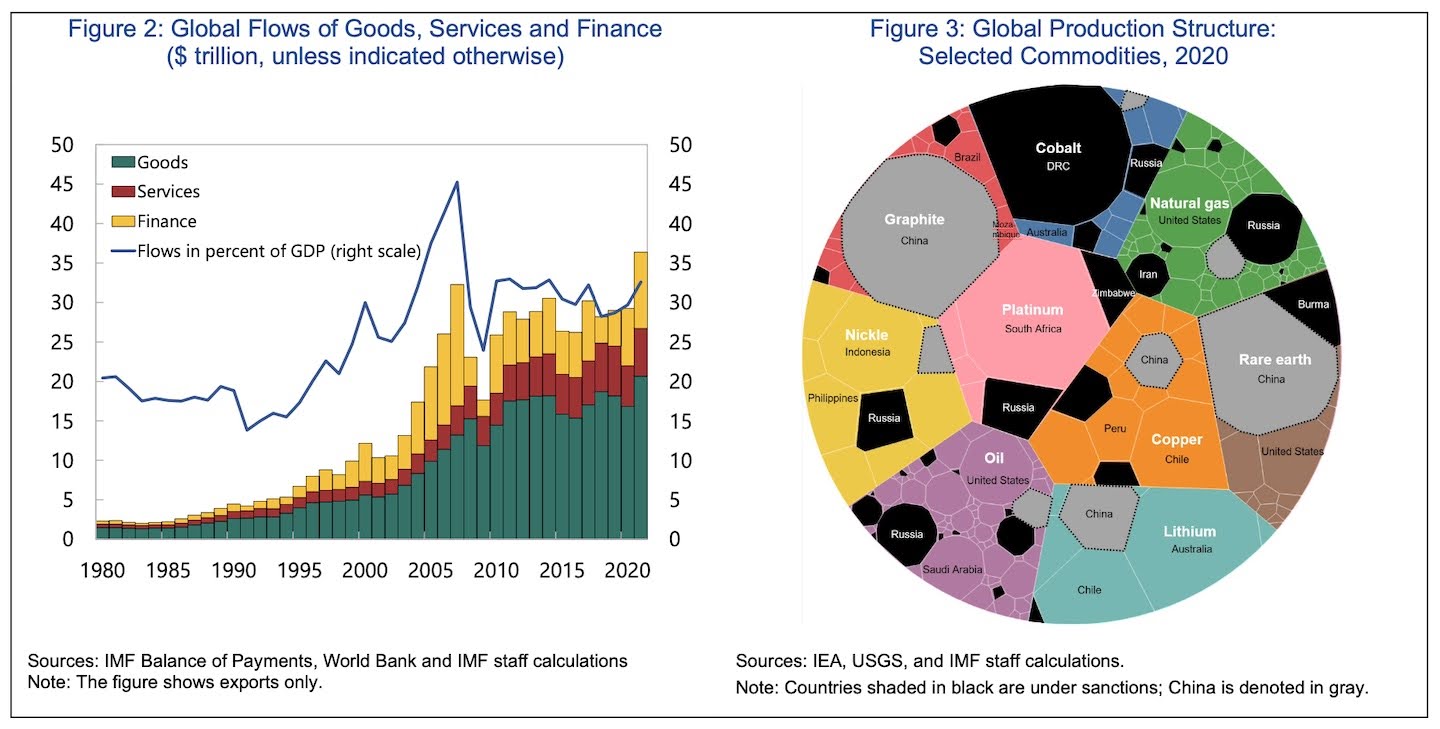
The production of many critical commodities has become highly concentrated. While increased specialization led to efficiency gains, it has also become a source of fragility for global value chains (GVCs). For example, while the United States dominates the supply chain (upstream, refining, and consumption) for oil and gas, China is the dominant player in clean energy minerals. This makes GVCs vulnerable not only to market power and logistical risks but also to geopolitically-induced disruptions, including through trade restrictions (Leruth and others 2022). Figure 3 shows a high concentration in global production of key commodities, exacerbated by the fact that some of the large producers are under sanctions.
While increased specialization led to efficiency gains, it has also become a source of fragility,... 

Saturday, December 03, 2022

The idiot can't imagine that neoliberals would lie, or try to hide their own corruption from themselves. Innocence must have a role to play.
It begins here and here.
David Singh Grewal replying to my email defends Jesuitical mental reservation. That's my gloss of what he wrote, and I'd love to quote him, but safe to say it's never wise to believe everything you read.

Grewal cites Rodrik, on “Premature Deindustrialization”[pdf]
Rodrik will never come to terms with his own past as a neoliberal defender of "self-discovery" and "comparative advantage"

Rodrik on democracy in Turkey.

The military has long set the ground rules of Turkish politics. Its hard line defending secularism has resulted in frequent clashes with political movements it views as "soft" on Islam, such as the Justice and Development Party (AKP), which has governed the country since November 2002. Periodically, the military has intervened, bringing down governments and, on occasion, establishing periods of military rule, most recently from 1980 to 1983. 

 Economist and philosophers: reflection, self-discovery, and self-awareness are for others.

"Have you changed your mind about anything fundamental..."
"For various reasons this is for me a difficult question. One is that I am not terribly interested in the question, and perhaps partly as a result, am often surprised when people point out, with actual quotations, what I wrote on some points in years past."

Rationalists rationalize. Power corrupts. Irony is the glory of slaves. 

Grewal, who told me he taught for Rodrik years ago, ends our exchange admitting I may be right that he's shallow, aestheticizing politics as ideas—see Marfrks quoted on the sidebar of the page, or use google—but telling me I waste my life being angry.

I waste my life in a lot of ways. 

Saturday, October 08, 2022

A long now deleted comment at Zachary Carter's review of DeLong's book (mentioned previously)  We had a back and forth, and at the end of my last comment I said I was going to close my paid account because I didn't want to troll him. And then he deleted everything.

From your review in Dissent 

"For India, one price of expanded trade with the British Isles was the deliberate deindustrialization of the Indian economy. India ceased to manufacture its own textiles, and instead provided raw materials to Britain, which handled the factory work. Under the traditional free trade theory of comparative advantage, this process should have maximized the wealth of both countries."

The last sentence shouldn't have made it past the editor. There is no free trade between masters and subjects.  Everything Delong celebrates is founded of mountains of the dead among Europe's subject peoples. You could have at least mentioned the famines.

"DeLong’s story of hegemony as a driver of stability and growth is extremely compelling—but it’s also a nice way of saying that imperialism isn’t so bad when it works. The neoliberalization of the world that began in the late 1970s not only undermined U.S. fiscal policy management, it decimated America’s effectiveness as an international economic hegemon—a fact that is obscured by the expansion of American military operations over the same period."

Any historian of the of the violence of the post war era is left to shrug.

Korea. It's been called genocide. [the links are repeats]

The bombing was long, leisurely and merciless, even by the assessment of America’s own leaders. “Over a period of three years or so, we killed off — what — 20 percent of the population,” Air Force Gen. Curtis LeMay, head of the Strategic Air Command during the Korean War, told the Office of Air Force History in 1984. Dean Rusk, a supporter of the war and later secretary of state, said the United States bombed “everything that moved in North Korea, every brick standing on top of another.” After running low on urban targets, U.S. bombers destroyed hydroelectric and irrigation dams in the later stages of the war, flooding farmland and destroying crops.

Cambodia 

The still-incomplete database (it has several “dark” periods) reveals that from October 4, 1965, to August 15, 1973, the United States dropped far more ordnance on Cambodia than was previously believed: 2,756,941 tons’ worth, dropped in 230,516 sorties on 113,716 sites. Just over 10 percent of this bombing was indiscriminate, with 3,580 of the sites listed as having “unknown” targets and another 8,238 sites having no target listed at all. The database also shows that the bombing began four years earlier than is widely believed — not under Nixon, but under Lyndon Johnson.

The impact of this bombing, the subject of much debate for the past three decades, is now clearer than ever. Civilian casualties in Cambodia drove an enraged populace into the arms of an insurgency that had enjoyed relatively little support until the bombing began, setting in motion the expansion of the Vietnam War deeper into Cambodia, a coup d’état in 1970, the rapid rise of the Khmer Rouge, and ultimately the Cambodian genocide.

...To put the revised total of 2,756,941 tons into perspective, the Allies dropped just over 2 million tons of bombs during all of World War II, including the bombs that struck Hiroshima and Nagasaki: 15,000 and 20,000 tons, respectively. Cambodia may well be the most heavily bombed country in history. 

Tooze in the FT is at least somewhat better

DeLong’s version of the 20th century is more parochial than either of those. [books by Hobsbawm and Milanovic] It is centred on the political battles that raged around the growth regime of modern American capitalism and continue to shape policy debate in governments and central banks today. This is, you might say, the in-house, post-Clintonian history of the 20th century....

Slouching Towards Utopia reads less like a history than a richly decked out time capsule, a nostalgic throwback... 

The so called serious American intellectual left—the class that used to scorn the NYT-has become more provincial than it was 40 years ago.  DeLong is an arch nationalist "A rising not a setting sun" was his tagline. He was famous for his attacks on the left, his fondness for Gregory Clark's racial Darwinism, and encomiums for war criminals  

"R.I.P. Jeane J. Kirkpatrick

...She was a good friend to my grandfather Earl. She was an American and a world patriot: her counsel--even at its most boneheaded--was always devoted to advancing the security of the United States and the cause of liberty and prosperity around the world."

Jeane Kirkpatrick was not interested in liberty and prosperity around the world. She defended American power.

He replied. Substack forwards comments. I have the email.

You have based this comment on a 180 degree misunderstanding of that line. The entire point is that the traditional theory is wrong. 

He's referring to the line about comparative advantage, as if I were defending it.

I replied saying that most people still assume it's a bad idea to keep all your eggs in one basket, and that systems engineers—of mechanical systems not intellectual ones (the existence of "financial engineers" builds on the same fantasy)—know that efficiency and stability operate in inverse proportion, and that redundancy is key to long term survival, but that even if the logic of comparative advantage made sense it was irrelevant here, because there is no free trade between masters and subjects.

His reply, again from the email

If you'd prefer to say "specialization" rather than "free trade," fine. And you're right, I could have mentioned the famines. There were a lot of them with different causes, and I decided to stick to a simple critique of de-industrialization for brevity's sake, assuming that my audience was familiar with the general outline of British imperial history.

At this point I lost it. Again this is approximate.

I don't know what to say about discussions of the inequality that results from you breaking into my home, killing my father, raping my mother, taking everything we own and putting me and my siblings to work in your factory.  The history of European modernity is founded on European barbarism, mostly but not entirely elsewhere. The inequality that exists now is merely the result. And here we are today.

I added the transcript of Javier Blas, with Joe Weisenthal

Well, clearly the ability of Europe to tap the LNG market has really saved the day for Europe. If this had happened only 10, 15 years ago where the global LNG market was not nearly as developed as it is today. And the ability to reroute cargos was much lower, particularly on the spot market Europe would have had a big problem. And the dependency on Russia was much, much higher.

So the LNG market is offering a relief to Europe in so many ways. One of the things that we are seeing that to me is very interesting is Europe at the moment is outbidding everyone else on the market, taking the LNG. That's one of the reasons we have these very high prices in the market. I mean, on fundamentals as Alex was pointing out, we should not probably have 200 euros per megahour of gas because the inventories are building in the right direction and we should have enough gas if Putin was to keep the flows. But obviously we need to continue outbidding the whole market for LNG supplies.

And for that, we need to sustain very high prices in Europe for that to happen. What's happening there is that a number of countries that were starting to rely on the global LNG market for supplies, middle income and poor countries thinking the likes of Pakistan or Bangladesh, or even India... they're seen now that European nations and European utilities can pay much higher prices.

So they're not getting the cargos that they were expecting. Some of the cargos that would be going into Asia at the moment are rerouted into Europe. And we are seeing power supply problems in Bangladesh or Pakistan, which is affecting the textile industry. So in a way it may be a case where Europe avoids the blackouts that many of us have been talking, but only because the blackouts move somewhere else, where they cannot

really pay the price that Europe is paying for the LNG. And then the blackouts are happening in Pakistan or Bangladesh. And that global LNG market is allowing that arbitrage to happen. Without it, well, it will not be happening. And the blackouts would be happening in Europe because we will not be able to get enough gas

I added another comment that I didn't want to hang out just to troll him so I'd close my account in a day or two. I guess the snark was a bit much. 

Thursday, October 06, 2022

He deleted the comment and the exchange that followed.  They're here
---

I left a long comment at Zachary Carter's post on DeLong's book. I kept a copy if he deletes it. 

Carter's review of DeLong in Dissent

Britain was not so generous with the rest of the world. For India, one price of expanded trade with the British Isles was the deliberate deindustrialization of the Indian economy. India ceased to manufacture its own textiles, and instead provided raw materials to Britain, which handled the factory work. Under the traditional free trade theory of comparative advantage, this process should have maximized the wealth of both countries.... 

By that traditional definition slavery should have maximized the wealth of slaves. The whole thing's a mess.

DeLong has a tag. Comparative advantage doesn't but Dani Rodrik and Angus Deaton do. That should cover it.
---

And I remembered this from the NYT on September 27th. The worst was deleted later.

The failure in Iraq marked a larger blow to America’s influence in the world than the loss of the Vietnam War, and the recent and humiliating withdrawal from Afghanistan, after an effort of more than 20 years of democracy building, did great damage, argued Stefano Pontecorvo, the senior NATO civilian in Afghanistan and one of the last to leave after the Taliban takeover.

At the height of the war, the United States spent $3 billion a year, and for nothing, he said. “The problem with exporting democracy is that it is not natural to these countries,” he said. “You can’t impose your values — you have to accommodate them to the values of the country. It took Britain 250 years to build democracy in India, and we had 20.”

From Isaac Chotiner and The Print

New Delhi: A New York Times article has removed a reference to colonial Britain’s alleged hand in building “democracy in India” over 250 years after a counterblast on social media.

The article published Tuesday quoted former NATO diplomat Stefano Pontecorvo as saying, “You can’t impose your values – you have to accommodate them to the values of the country. It took Britain 250 years to build democracy in India, and we had 20.”

The quote implies Britain’s 200-year repression of India had helped infuse egalitarian values in the country.

The quote on India is also prefaced with the observation: “The problem with exporting democracy is that it is not natural to these countries.”

The quote was first shared on Twitter by Carnegie South Asia director Milan Vaishnav and later retweeted by Observer Research Foundation director and son of India’s External Affairs minister S. Jaishankar, Dhruva Jaishankar.

The US was no more interested in bringing democracy to Afghanistan—or anywhere else—than the British were interested in bringing democracy to India.

We'll have to wait for an Indian or South Asian, non-white, non-European, "perspective" on DeLong's new book.

Sunday, May 01, 2022

continuing. because I kept searching. I'm in a rut, for now.


Ilene Grabel, When Things Don't Fall Apart: Global Financial Governance and Developmental Finance in an Age of Productive Incoherence, MIT Press, Open Access

Foreword by Dani Rodrik
It happens only rarely and is all the more pleasurable because of it. You pick up a manuscript that fundamentally changes the way you look at certain things. This is one such book. Ilene Grabel has produced a daring and delightful reinterpretation of developments in global finance since the Asian financial crisis of 1997–1998.

The book addresses, and resolves, a long-standing puzzle: Why has our present model of financial globalization been so resilient, despite an abysmal track record that includes the most severe global financial crisis since the Great Depression, recurrent sovereign debt crises (in Latin America, East Asia, Russia, and Turkey), and many other disappointments (such as capi- tal flowing “uphill” from poorer to richer nations)? How is it that we have not jettisoned this model for something that is more sensible and works better?

Professor Grabel’s insight is that those of us who were looking for signs of change have had the wrong idea about how real reform often happens. We have been mistaken in searching for evidence of wholesale, programmatic reconsideration of the rules of global finance. Systems of governance rarely change through established blueprints, a master plan, or radical reforms. And besides, such a reform path would suffer from the same kind of hubris that the neoliberal playbook produced.

Instead, she suggests, it is the cracks in the consensus, the local heresies, and the small departures and innovations that matter and lead us in an altogether novel direction. Inconsistency, ambiguity, and incoherence are useful and productive—they are a feature, not a bug.

Rodrik in 2008

It is remarkable to see something in theory work so well in practice. Ricardo Hausmann and I wrote a paper several years ago called "Economic Development as Self-Discovery," where the idea was that entrepreneurship in a developing country consists of discovering the underlying cost structure--what can and cannot be produced profitably. Initial investors in a new line of economic activity face a great amount of uncertainty, since foreign technology always needs some local adaptation. Plus, their cost discovery soon becomes public knowledge--everyone can observe whether their projects are successful or not--so the social value they generate exceeds their private costs. If they succeed, much of the gains are socialized through entry and emulation, whereas if they fail, they bear the full costs.

Some of the what I have been seeing in Ethiopia is a picture perfect illustration of this process at work. Most notable in this respect is the flower industry, which was started by some courageous entrepreneurs who had observed the success of the industry in nearby Kenya and wondered if it could be made to work in Ethiopia as well. Even though much of the technology is standard, local soil conditions make a lot of difference to the economics of growing flowers, and a whole range of other services--from daily cargo flights to high-quality cardboard packaging--has to be in place before the operation can succeed. To its credit, the Ethiopian government understood the need to subsidize these pioneer firms, through cheap land and tax holidays, and the industry took off. Exports have reached $100 million from zero in just a few years. There are now around 90 flower farms in the country, with latecomers the beneficiary of the tinkering that early investors have undertaken.

"Comparative advantage a literature almost as absurd as trolley problems." 

"The open access edition of this book was made possible by generous funding from Arcadia – a charitable fund of Lisbet Rausing and Peter Baldwin."

Rausing. Tetra Pak. When things fall apart: 

Neither sister appears to relish the attention-gathering side of their philanthropy. Sigrid has been willing to slow-grow a public profile, in part to encourage philanthropy in others. She has said she finds interviews "vulgar" but has been tempted to do so to encourage more giving among the wealthy in the UK. "People give a lot of money to art projects here. I think it would be a very good thing if similar kinds of sums can go into refuges for women and refugee causes."... 

Sigrid, for her own part, has spoken of a time in her youth when she was "paranoid" and "ashamed" of her wealth. This was especially the case before the family arrived in the UK from "very progressive" Sweden. "Not a good place to be a capitalist. I spent so many of my teenage years skulking in doorways, hiding away." 

The source of the quotes 

Although she will not put a figure on her own personal wealth, Rausing is surprisingly candid about the fraught relationship she has with money. "I grew up being acutely uncomfortable. In the 1960s and 70s, Sweden was very progressive, not a good place to be a capitalist. I spent so many of my teenage years skulking in doorways, hiding away."

In her early 20s, she says, she lived a simple life. There were no shopping sprees or luxury holidays. Even now, she owns only one car, a Volvo.

"I was very paranoid about anyone finding me out," she says. So has she ever sought therapy to deal with her guilt about being so rich? "Yes, I wanted to be who I was and didn't want to hide anything any more. I know people who are emotionally crippled by money they inherited. It does not help anyone."

She has said she finds interviews "vulgar".  The high bourgeois heirs to the aristocracy.
Read, or scroll down for Henri Lefebvre. 
The great majority of nobles either did not know how, or did not wish, to get rich. The great majority of younger sons had no desire to "derogate." They sought the remedy elsewhere, in a growing exclusiveness. Some held that the nobility should form a body like the clergy and be constituted as a closed caste.
S.E. Working Title: Avant-Garde is Kitsch. 
“...did not know how, or did not wish, to get rich”. Self-interest, beyond a point, was vulgar.

The whole fucking point of Grey Gardens: the distinction between having money and working for it. Better to die in poverty than get a job. Why the idle rich love the idle poor, the lumpenproletariat and demimonde.   

"I grew up being acutely uncomfortable."  Scandinavian conformism. 
And from the year before, with a reference to Janteloven.

I recognized the name of the ex-wife of Joseph Koerner.

Saturday, April 16, 2022

A new book that's causing a still in some circles. The disconnect between the two paragraphs makes my head spin. Or at least it did once. The modern First Estate, ignoring the fact that it exists, speaking as if from the aether.  

Markets are taken as the norm in economics and in much of political and media discourse. But if markets are superior why does the public sector remain so large? Avner Offer provides a distinctive new account of the effective temporal limits on private, public, and social activity. Understanding the Private-Public Divide accounts for the division of labour between business and the public sector, how it changes over time, where the boundaries ought to run, and the harm that follows if they are violated. He explains how finance forces markets to focus on short-term objectives and why business requires special privileges in return for long-term commitment. He shows how a private sector policy bias leads to inequality, insecurity, and corruption. Integrity used to be the norm and it can be achieved again. Only governments can manage uncertainty in the long—term interests of society, as shown by the challenge of climate change.

AVNER OFFER is Chichelc Professor Emeritus of Economic History at Oxford University, Fellow of All Souls College and the British Academy. His books include The Challenge of Affluence: Self-Control and Well-Being in the United States and Britain Since 1950 (2006) and the co-authored The Nobel Factor: The Prize in Economics, Social Democracy, and the Market Turn (2016).

Serendipity

Delinking entails rejecting calls to adjust to a country’s comparative advantage and other forms of catering to foreign interests. This is, of course, easier said than done. Amin noted that it would both require strong domestic support for such a national project and strong South-South cooperation as an alternative to the exploitative economic relations between the core and the periphery. Other aspects of delinking would involve investments in long-term projects, such as infrastructure, with the goal of improving the quality of living for most people in the country, rather than maximising short-term consumption or profit.

I should have a tag for comparative advantage, a literature almost as absurd as trolley problems. I have tags for Angus Deaton and Dani Rodrik and that mostly covers it. Rationalists rationalize decadent scholasticism. 

It's not possible to separate structure from culture, language from speech, so you'd better start thinking about both.
---

I added a tag for comparative advantage about a year later.

Sunday, December 26, 2021


Don't Look Up isn't very good; mostly it's bad, and it's worth thinking about why. But it includes the most gloriously over the top attack on autism as an ideal that I've ever seen. 

Sirota is ballyhooing, and complaining about "elite" critics, attacking corporate media and bragging about success, in corporate media. Blind enthusiasm and self-congratulation are a problem both for the film its makers. The differences between their film and the films they mock aren't as big as they pretend.

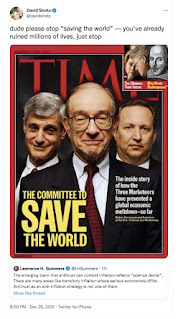
Related, since Larry Summers and antitrust, efficiency and supply-chains are in the news again...

"The emerging claim that antitrust can combat inflation reflects 'science denial'”.  

I searched the archives, but I have a short memory. I didn't have to go very far at all. It's got pretty much everything, including economics and science fiction.

This one's good too, economic pseudoscience, left-liberal utilitarianism and the moralists' understanding of art. 

Also: Saint-Simon

My first reference to the inverse relation of efficiency to stability was an annoyed comment to Dani Rodrik in 2008. It seemed obvious then.

Dani Rodrik, Angus Deaton, Krugman, and Quiggin.

Sunday, April 12, 2020

If he deletes it the text will stay on the page.

A few days ago Philip Mirowski opened up a draft of a paper for comments. I'd already made mine before I read the above.

"Democracy, Expertise and the Post-Truth Era: An Inquiry into the Contemporary Politics of STS Version 1.1"
It's a draft and I won't copy his words, but he begins with a quote.
One part of the US vote was a loud vote against expertise. Clinton became, among other things, a symbol for technocracy... Views and debates within STS about the nature of expertise seem oddly irrelevant in this context. The differences between accounts of expertise in realist terms (Collins and Evans, 2002), as institutionally constituted parts of larger regimes (Jasanoff, 2004) or as discrete networks (Eyal, 2013), while stark for readers of this journal, are subtle given the wholesale rejection of expertise by voters and the more selective rejection of expertise being continued in some announced appointments. It seems that optimism about the coexistence of democracy and expertise may be misplaced... (Sismondo, 2017)
The whole thing is a joke. No discussion of what the supposed "experts" achieved, or failed to. No reporting of fact. The history of ideas is rationalism built on priors and hot air. Nothing on the record of Volcker and Rubinomics, Greenspan/Ayn Rand, Krugman, Rodrik and Deaton, Tyler Cowen and Tom Nichols. As for "democracy" I brought up my old standbys: Latour is a neoliberal Catholic and The Church is a monarchy;  Feyerabend belongs with de Man and Robbe-Grillet; democracy is relativist as to truth but strict as to form; lawyers are orators not philosophers. "I began to find myself in a dangerous situation as an advocate. I came to believe in the truth of what I was saying." etc. Weber and Kafka. The absurdity of thinking of science as intellectual as opposed to technical. Engineers themselves aren't considered intellectuals, but engineering is seen as a model for intellectual activity, "creating concepts" etc. Game designers are seen as intellectuals, builders of virtual worlds, like philosophers' possible worlds. Science fiction is fantasy. Fantasy is not observation. From my comments:
Science is empiricism. The current wave of "science denial" is a backlash against rationalist bullshit claiming to be science. Shiller and Fama won the non-Nobel prize in economics in the same year for making diametrically opposed arguments. "Teach the conflict"? Angus Deaton won for discovering what they teach in every introduction to systems engineering: efficiency and stability are in inverse proportion. Or as they teach you in kindergarten: don't put all your eggs in one basket.
I should have included Schrader

"The Post-Truth Era." And when exactly was the "Era of Truth"?
What Exactly is neoliberalism? etc.

new tag for Video Games

Tuesday, October 13, 2015

updated with more comedy

Angus Deaton has won the non-Nobel Prize in economics.
Chris Blattman describing why he deserves it.
Sudden falls in coffee and oil prices destroyed poor countries in the 1970s and 1980s, especially in Africa. Deaton had done some of the best work, both on the behavior of commodity prices their effects on growth and also on the reasons they caused macroeconomic chaos. He also peeked into what the effect was on coups and political instability. In later years, hundreds upon hundreds of scholars would start using data from many countries to analyze why wars and coups happen. Deaton was one of the very first.
Deaton and Miller: "International Commodity Prices, Macroeconomic Performance, and Politics in Sub-Saharan Africa."
The exports of many Sub-Saharan African countries are concentrated in a relatively small number of primary commodities, commodities for which world prices are volatile and values of which have dropped to histor-ically low levels in recent years. Fluctuations in commodity prices in-duce fluctuations in real national incomes and pose problems for macroeconomic management. These problems are often badly handled, and several observers implicate the commodity-price booms of the 1970s in the debt crises of the 1980s (Krueger, 1987; Greene, 1989; Sachs, 1988). Sachs, for example, notes that when commodity prices are rising more rapidly than the rate of interest on international loans, countries can service debt through fresh borrowing while simultaneously reducing the ratio of debt to exports. In the 1970s, this opportunity was seized by several developing countries that had previously had little or no access to private international capital markets. When the boom in commodity prices came to an end, some of these borrowers found themselves unable to service their accumulated debt. 
Krugman from his free-trader years on comparative advantage. Follow the links. See also Dani Rodrik making the same absurd argument.

Any engineer knows that efficient systems are fragile and that stable systems have high levels of redundancy.
The exports of many Sub-Saharan African countries are concentrated in a relatively small number of primary commodities, commodities for which world prices are volatile and values of which have dropped to historically low levels in recent years.
Awards for discovering the obvious and re-inventing the wheel. Maybe that's too glib. I might be missing something.

More on economics: Quiggin.
Similarly, advertisements work because watching an ad increases the desirability of buying the associated product. This may be because the ad attaches desirable qualities (such as sophistication or sex appeal) to the product or because it engenders dissatisfaction with the alternatives we are currently consuming.

In terms of opportunity cost, it does not matter whether an ad works positively or negatively. Either way, the opportunity cost of alternative products is increased relative to the value of the product being advertised. In the standard terminology of economics, a successful ad is complementary (in consumption) with the product being advertised.

In terms of our happiness, though, there’s a big difference. The net effect of advertising is almost certainly to reduce our satisfaction with the things we buy, because most of the ads we see are designed to make us switch to something else. And of course, the things that are not advertised, such as quiet leisure time with family and friends, where no goods and services are required and no money is spent, are downgraded even further.
The dentist who fired his assistant because she was too sexy might at least have a point.
Coming to the same conclusion as it did in December, the all-male court found that bosses can fire employees they see as threats to their marriages, even if the subordinates have not engaged in flirtatious or other inappropriate behavior. The court said such firings do not count as illegal sex discrimination because they are motivated by feelings, not gender.
For obvious reasons, Quiggin's arguments here are the same as his arguments against art.


Bloviating moralists to the rescue.
Corey Robin defends art.
The problem with our public intellectuals today—and here I’m going to address the work of two exemplary though quite different public intellectuals: Cass Sunstein and Ta-Nehisi Coates—has little to do with their style. It has little to do with their professional location, whether they write from academia or for the little magazines. It has little to do with the suburbs, bohemia, or tenure. The problem with our public intellectuals today is that they are writing for readers who already exist, as they exist.
He's wrong that it has nothing to do with style. And it's a bit pathetic that he doesn't see how much he's placing himself as a superior alternative. And is he saying that Sunstein and Coates "pursue no beckoning light"?

The problem isn't the bubble of the present. The future can only be a fantasy. It's not a question of location as such. The problem for all of them is an inability to the intuit the minds and imaginations of other people. 

Monday, April 15, 2013

continuing from recently, and earlier.
see also comedians, academics, and "intellectuals", below. 

Krugman 2013, The Antisocial Network
The philosophical misconception, however, seems to me to be even bigger. Goldbugs and bitbugs alike seem to long for a pristine monetary standard, untouched by human frailty. But that’s an impossible dream. Money is, as Paul Samuelson once declared, a “social contrivance,” not something that stands outside society. Even when people relied on gold and silver coins, what made those coins useful wasn’t the precious metals they contained, it was the expectation that other people would accept them as payment. 
Actually, you’d expect the Winklevosses, of all people, to get this, because in a way money is like a social network, which is useful only to the extent that other people use it. But I guess some people are just bothered by the notion that money is a human thing, and want the benefits of the monetary network without the social part. Sorry, it can’t be done.
Krugman in 1996 Ricardo's Difficult Idea
In this essay, I will try to offer answers to these questions. The first thing I need to do is to make clear how few people really do understand Ricardo's difficult idea -- since the response of many intellectuals, challenged on this point, is to insist that of course they understand the concept, but they regard it as oversimplified or invalid in the modern world. Once this point has been established, I will try to defend the following hypothesis: 
(i) At the shallowest level, some intellectuals reject comparative advantage simply out of a desire to be intellectually fashionable. Free trade, they are aware, has some sort of iconic status among economists; so, in a culture that always prizes the avant-garde, attacking that icon is seen as a way to seem daring and unconventional. 
(ii) At a deeper level, comparative advantage is a harder concept than it seems, because like any scientific concept it is actually part of a dense web of linked ideas. A trained economist looks at the simple Ricardian model and sees a story that can be told in a few minutes; but in fact to tell that story so quickly one must presume that one's audience understands a number of other stories involving how competitive markets work, what determines wages, how the balance of payments adds up, and so on. 
(iii) At the deepest level, opposition to comparative advantage -- like opposition to the theory of evolution -- reflects the aversion of many intellectuals to an essentially mathematical way of understanding the world. Both comparative advantage and natural selection are ideas grounded, at base, in mathematical models -- simple models that can be stated without actually writing down any equations, but mathematical models all the same. The hostility that both evolutionary theorists and economists encounter from humanists arises from the fact that both fields lie on the front line of the war between C.P. Snow's two cultures: territory that humanists feel is rightfully theirs, but which has been invaded by aliens armed with equations and computers.

Sunday, February 17, 2013

The first time I read discusions of "comparative advantage" I thought immediately of the importance of redundancy for stable systems: efficient systems are fragile; stable systems have high levels of redundancy.

I thought these things were truisms. That's why I've had so much trouble (and this is going back years) following arguments predicated on thinking they weren't. [Taleb etc. here]

Economists and philosophers who defend efficiency defend it as a value system, a type of morality that they associate with science and engineering. But they're not engineers.

Writers of financial contracts are called Financial Engineers. And Joseph Yellow Kid Weil was a confidence engineer.

continuing
Leiter, in his post on Dworkin, includes among others a link to a symposium on one of Dworkin's papers [the link to the original paper is dead, but it's available here: pdf], and to his own "review essay" of recent books by and about Dworkin. The Theory of Esoteric Law for me puts the final nails in the coffin of every argument Leiter or Hart could make on the philosophy of law.  Dworkin's evasiveness is part and parcel of the general inability on the part of philosophers to admit to defending an idea to the extent of it being a form of ideological commitment, but besides that Dworkin's arguments describe pretty much the way things actually work. We create and defend narratives and try to find the "right" way to continue them. We try to justify those narratives and those decisions to those around us. Courts may invent new doctrines but the justification of those doctrines is always predicated on them being seen as the continuation of a tradition. They must be recognized, and recognition is a process of situating the unknown among the known. The focus is on continuity not change. Those who pretend that they themselves are not the product of culture will also pretend that their decisions are removed from it. Others will defend their cultural assumptions without being able or willing to articulate them. Scalia won't be remembered as he'd want to be and his desire, and the record of his social interactions, needs to be considered a part of the cultural and linguistic process of law.

Dworkin begins his response to Simon Blackburn by saying "Blackburn doesn't like lawyers…"
Hart was a barrister for 8 years but unlike Dworkin seems not to learned much from it.

"The argument with Balkin is whether we need to sacralize questions in order to avoid sacralizing things."

Wednesday, December 17, 2008

Continuing from here. Matthew Yglesias, presumably without realizing the implications, makes the case against science as moral principle..
Reader A.L. observes to me that Gerecht is completely mangling La Rouchfoucauld’s maxim here. His point was that even though human frailty often leads people into immoral behavior, the fact that people feel compelled to hypocritically condemn sins that they themselves may commit emphasizes the soundness of the underlying moral principle. For example, any normal parent is going to be a human being who sometimes acts in a greedy and selfish manner. But any decent parent is still going to teach his or her children that greed and selfishness are wrong and that those impulses ought to be resisted. This will, yet, make the parents somewhat hypocritical. But that’s the homage vice pays to virtue — the point being that we really should teach people to eschew greed and selfishness.
My comment
That fact that you refer to the above as a truism is interesting, when of course that’s not how economics is taught. In economics realism is reason, and any argument for idealism even as counterbalance is dismissed. Any argument for the existence of divided consciousness is considered a defense of irrationalism.
---
note taking: my last comment from Rodrik's page
The romantic foibles of comfortable leftists deserve as much mockery as they can draw. But that mockery can turn easily into mockery of the workers themselves. And that, taken to the level of absolute contempt, is embedded in the standard defense of neoliberal economic policy. Go there if you want to witness the celebration of other people's misery. Rodrik knows this (or he should). And if he'd focused on the distinction then there'd be nothing to take offense at; disagreement and offense not being synonyms. As it is his comments are more lazy more symptomatic of intellectual laziness than Klein's.
That's a problem no amount of mathematical calculation can solve.
---
note taking: comment removed by Henry Farrell 
Great art is not cerebral. “Literary” fiction is fiction that has transcended its genre: Jane Austen began with a genre. What comes down to us as literary fiction is the art not of naming but of architecture and description. What is written as literary fiction is often little more than mannerism and affect. Cerebral and speculative fiction, “philosophical art,” begins from ideas and assumption [and ends as illustration]. By the definitions used by all here the Iliad and the Odyssey would be genre fiction.
---
More from Rodrik
Self-discovery in practice

It is remarkable to see something in theory work so well in practice. Ricardo Hausmann and I wrote a paper several years ago called "Economic Development as Self-Discovery," where the idea was that entrepreneurship in a developing country consists of discovering the underlying cost structure--what can and cannot be produced profitably. Initial investors in a new line of economic activity face a great amount of uncertainty, since foreign technology always needs some local adaptation. Plus, their cost discovery soon becomes public knowledge--everyone can observe whether their projects are successful or not--so the social value they generate exceeds their private costs. If they succeed, much of the gains are socialized through entry and emulation, whereas if they fail, they bear the full costs.

Some of the what I have been seeing in Ethiopia is a picture perfect illustration of this process at work. Most notable in this respect is the flower industry, which was started by some courageous entrepreneurs who had observed the success of the industry in nearby Kenya and wondered if it could be made to work in Ethiopia as well. Even though much of the technology is standard, local soil conditions make a lot of difference to the economics of growing flowers, and a whole range of other services--from daily cargo flights to high-quality cardboard packaging--has to be in place before the operation can succeed. To its credit, the Ethiopian government understood the need to subsidize these pioneer firms, through cheap land and tax holidays, and the industry took off. Exports have reached $100 million from zero in just a few years. There are now around 90 flower farms in the country, with latecomers the beneficiary of the tinkering that early investors have undertaken.
A defense of economic monoculture.
Robert Feinman comments
A perfect example of a poor nation getting suckered into providing luxury goods for the wealthy ones.

How is growing flowers (and shipping them by air) helping to solve issues of food shortage, consumption of fossil fuels (transportation, fertilizer and pesticides) and use of scarce tillable land for necessities?

Instead of promoting self sufficiency or regional trade the country gets to become a client state of the west and dependent upon it by supplying a market which it doesn't have any control over. If next year the Europeans decide they don't want flowers anymore then what happens to the local economy?

I see this story, not as a "success", but as yet another example of a new type of economic neo-colonialism.

----

[Farrell is criticizing Kunkel, of N+1, being a snob, in Dissent. https://www.dissentmagazine.org/article/dystopia-and-the-end-of-politics]