Showing posts with label Srinivasan. Show all posts

Thursday, June 22, 2023

"It’s time for some game theory"
In order to maintain free speech, liberalism proposes a norm of reciprocity: it’s in everyone’s interest to defend free speech for their enemies so that their enemies will defend free speech for them.

"Carl Beijer" doesn't know the history of what he's attacking any more than of what he's defending. He thinks politics is about talking to your friends, not about convincing strangers that they should agree with you. He defends the dictatorship of the pure like a moralizing high school student from the American suburbs.  

"Public reason" has become "private reason"  
again, and again
John Quiggin, 2008: "Sunstein argues that the echo chamber effect tends to reinforce existing views and produce a poisonous partisan divide. It seems to me that exactly the opposite is true. "

repeats

I always thought Sunstein's point was obvious, especially for any culture founded on individualist liberalism. It's that culture that's given us Facebook and surveillance capitalism and personalized marketing, the virtual store where the displays are changed and items moved to the front to fit your last purchases. Newsfeeds work the same way, reinforcing biases, from narrowcasting to microcasting to the narcissism where the world is reduced to a mirror.

Twitter changed its algorithm years ago, forcing you to choose between replying to a tweet and quoting it, limiting the exposure of either your followers or those of the person you're replying to. Up to that point a reply appeared on both timelines.

Ryan Cooper 

Have you ever argued with a conservative? They won't learn anything no matter what I say or where I say it. Whatever I say is wrong by definition. 

Amia Srinivasan gives the game away
A graduate student once complained to me and my co-convenor that we had not put a content warning on Catharine MacKinnon’s ‘Feminism, Marxism, Method and the State’, even though we had at the start of the course issued a blanket policy that permitted students to skip any class meeting, without explanation – which we had done in recognition that the reading for the seminar was emotionally demanding. Another student, an undergraduate, told me she didn’t want to read MacKinnon’s work because she had heard (from her brother) that MacKinnon was a ‘TERF’ (she is not). A student asked me why I thought it was worthwhile to discuss in a lecture what sort of metaphysics of gender was required to vindicate the identities of trans women as women and trans men as men, given that he (a trans man) already knew that he was a man.

"a blanket policy that permitted students to skip any class meeting, without explanation – which we had done in recognition that the reading for the seminar was emotionally demanding", like a medical student exempted from class because she can't stand the sight of blood.

"...given that he (a trans man) already knew that he was a man", just like Beijer and Cooper and the rest know that they're a leftists. And no one and nothing should ever be allowed to challenge that. 

Srinivasan has a tag.

When it rains in pours. Fraser McDonald, in the same issue of the LRB 

It’s​ not uncommon for a student to come to my office to tell me they’re not happy with their exam mark. ‘Perhaps you just made a mistake?’ one suggested to me last year. 

"Get the fuck out of my office."

The academy is conservative and authoritarian. That's its strength and weakness. It should be hard to get a governmentally recognized license, and it should be easy to say it's not worth it. These idiots dumb down everything. 

At the University of Edinburgh, where I teach, changes pushed through the Senate will allow students to get degrees ‘on aggregate’ (based on work marked to date) but with a greater number of missing course credits than would previously have been permitted. The same is true across the sector. It’s not unusual for students to graduate with missing coursework – the affordance is called ‘special circumstances’. But universities have now turned this occasional act of compassion into a handy workaround to benefit employers. ‘Special circumstances’ are being redefined, it seems, to apply to the university’s crisis rather than the student’s.

"It is the common fate of the indolent to see their rights become a prey to the active."

Leaders and followers. Hustlers and customers. Who do you blame, the con man or the rube?

Tuesday, October 25, 2022


It's too bad about being on UnHerd, but liberalism, self-blind moralism, is what it is.  
Julie Bindel  

I’ve been involved in the campaign against homophobia for forty years, and I’ve never seen anything like this. For the first time, a tribunal is taking place in which one charity is attempting to strip another of its legal status. Mermaids, which advocates for “gender variant and transgender youth”, has brought a case against LGB Alliance, the only UK-based organisation that focuses exclusively on same-sex attracted people.

Mermaids claims that LGB Alliance was not, in fact, established to support lesbians, gay men and bisexuals — but rather to discredit and disband Mermaids itself. The LGB Alliance, allegedly, “does not have charitable purposes”. If Mermaids wins this case, the consequences will be devastating for lesbians and gays. Any future charity set up to advocate specifically on our behalf will be wide open to legal challenge.

LGB Alliance was founded in 2019, in response to Stonewall’s refusal to engage with concern, voiced by lesbians and gay men, about trans orthodoxy. We are concerned that “same-sex attraction” has been recast as nothing more than a dog whistle for transphobia — an argument made by Mermaids in court. We are concerned, too, that lesbians are being labelled bigots for not wanting to have sex with people who have penises. And we are concerned, most of all, by the wholesale acceptance of this orthodoxy by organisations, such as Stonewall, which are supposed to protect same-sex attracted people. Mermaids’s case is being supported by Gendered Intelligence  and the LGBT Consortium, groups that promote the notion that “gender identity” should carry as much, if not more, weight in law as biological sex. Together, they are arguing that LGB alliance is “denigrating trans people” and does not “serve the public interest”.

repeats 

A lecturer has resigned as trustee of transgender charity Mermaids after it emerged he spoke at a conference organised by a paedophile support group.

Dr Jacob Breslow, an associate professor of gender and sexuality at the London School of Economics, quit Mermaids after The Times revealed that he spoke at an academic conference when he was a PhD student, organised by a group called B4U-ACT, in 2011.

That organisation promotes the use of the term “minor-attracted people” rather than “paedophile” to describe those who say they are sexually attracted to children.

repeats BBC 2021

"I thought I would be called a transphobe or that it would be wrong of me to turn down a trans woman who wanted to exchange nude pictures," one wrote. "Young women feel pressured to sleep with trans women 'to prove I am not a terf'."

One woman reported being targeted in an online group. "I was told that homosexuality doesn't exist and I owed it to my trans sisters to unlearn my 'genital confusion' so I can enjoy letting them penetrate me," she wrote.

One compared going on dates with trans women to so-called conversion therapy - the controversial practice of trying to change someone's sexual orientation.

"I knew I wasn't attracted to them but internalised the idea that it was because of my 'transmisogyny' and that if I dated them for long enough I could start to be attracted to them. It was DIY conversion therapy," she wrote.

Another reported a trans woman physically forcing her to have sex after they went on a date.

"[They] threatened to out me as a terf and risk my job if I refused to sleep with [them]," she wrote. "I was too young to argue and had been brainwashed by queer theory so [they were] a 'woman' even if every fibre of my being was screaming throughout so I agreed to go home with [them]. [They] used physical force when I changed my mind upon seeing [their] penis and raped me."

Amia Srinivasan: 

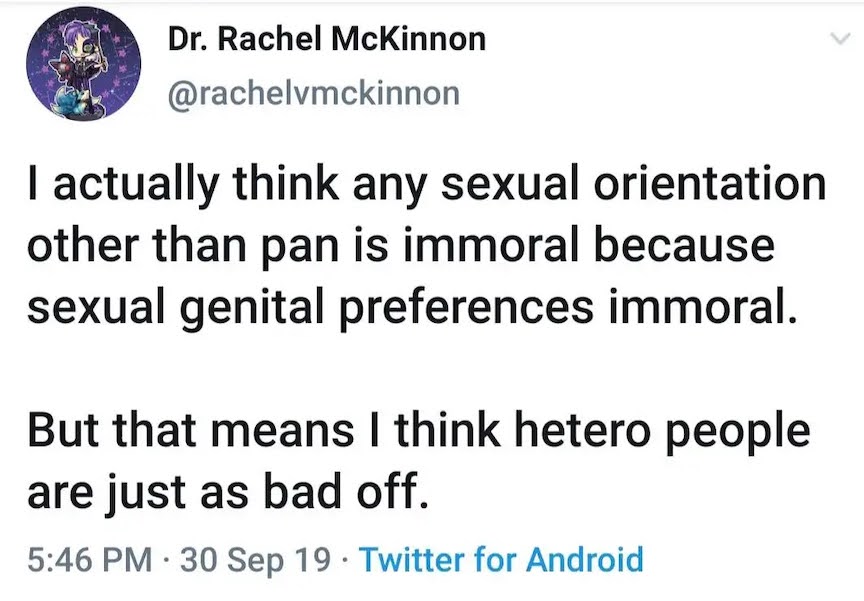
"I find this reduction of sexual orientation to genitalia – what’s more, genitalia from birth – puzzling. Is anyone innately attracted to penises or vaginas?"

"in what sense is political lesbianism, as Andrea Long Chu insists, a failed project?" 

Rachel McKinnon, now Veronica Ivy, (in the BBC piece above), is or was, a philosophy professor.

Friday, July 01, 2022

forthcoming in Oxford Studies in Experimental Philosophy, Volume 5 
John Bronsteen
Loyola University Chicago School of Law 
Brian Leiter
University of Chicago

Jonathan S. Masur
University of Chicago - Law School

Kevin Tobia
Georgetown University Law Center; Georgetown University - Department of Philosophy
Abstract

What constitutes a “good” life—not necessarily a morally good life, but a life that is good for the person who lived it? In response to this question of “well-being," philosophers have offered three significant answers: A good life is one in which a person can satisfy their desires (“Desire-Satisfaction” or “Preferentism”), one that includes certain good features (“Objectivism”), or one in which pleasurable states dominate or outweigh painful ones (“Hedonism”). To adjudicate among these competing theories, moral philosophers traditionally gather data from thought experiments and intuition. In this chapter, we supplement that traditional approach with a pair of experimental studies that examine whether the three theories reflect laypeople’s intuitions about well-being. The empirical studies yield two primary findings. First, they provide evidence for lay "well-being pluralism": laypeople treat desire satisfaction, positive objective conditions, and happiness as all constitutive of well-being. Second, the studies provide evidence of "hedonic dominance": laypeople evaluate an individual’s happiness as more important to an individual’s overall well-being than desire satisfaction or objective conditions.

Introduction... 

We thus set out here to make the first test of whether laypeople view well-being the way that many scholars in economics and philosophy seem to have assumed they do....

III. Experimental Studies...

B. Study 2...  

Jenny teaches ballet in a small studio in a small town. She usually spends her weekends going bowling with her friends.

Jenny is happy. She really enjoys teaching her ballet students, and she also has a lot of fun going bowling with her friends. She feels good when she wakes up in the morning and maintains that happy mood throughout the day until she goes to sleep at night. She often smiles and rarely frowns. She experiences positive emotions like joy and contentment most of the time; and she only rarely experiences negative emotions like sadness, anger, and irritability.

But Jenny doesn’t have what she wants. She always wanted to be a famous ballerina who lives in Paris and spends her weekends going to exclusive parties with other celebrities. That is still the life she would choose if she could choose anything.

Jenny is a famous ballerina who lives in Paris. She usually spends her weekends going to exclusive parties with other celebrities.

Jenny isn’t happy. She feels a lot of pressure to do her job well, and she doesn’t actually enjoy the work. She also feels pressure to impress her celebrity acquaintances so that she keeps getting invited to their parties. This prevents her from really ever enjoying her professional or her personal life. She feels bad when she wakes up in the morning and maintains that unhappy mood throughout the day until she goes to sleep at night. She rarely smiles and often frowns. She experiences negative emotions like sadness, anger, and irritability most of the time; and she only rarely experiences positive emotions like joy and contentment.

Incapable of reading even dime-store novels, let alone "great works of art", the recorded history of the opinions and beliefs of "laypeople" and "folk". But why would they?—since art is about aesthetics and philosophy is about truth. Knobe is credited by "scholars in economics and philosophy" with discovering what the folk and the vast majority of the educated elite would call a truism. 

"My students were all obsessed with sex. Not the idea of sex, or the meaning of sex, but sex!"

"I find this reduction of sexual orientation to genitalia – what’s more, genitalia from birth – puzzling."

"William Blake, I suggest, both embodies that antithesis and proclaims the imperfection of Bentham’s understanding of happiness."  J.H. Burns, first General Editor of the Collected Works of Bentham. 

The Smart and the Folk, and The President and Other Intellectuals, and The Triumph of the Fact 

Knobe and Calllard, autism and sociopathy. The Glimmer Twins were right.


And this goes back to the questions at the beginning of the previous post.
Pedantry is anti-political. Elite liberal opposition to politics ceded politics to the right, and that's why we're where we are.

Tuesday, June 21, 2022

Michelle Goldberg, the NYT,  "The Future isn't Female Anymore"

The Drift, a buzzy literary journal founded by Kiara Barrow and Rebecca Panovka, left-leaning women in their late 20s, published a series of short essays earlier this year under the rubric, “What to Do About Feminism.” “For a long time now, we’ve had the sense that feminism is in trouble,” Barrow and Panovka wrote in the introduction. They described an ambient feeling that feminism has been sapped of cultural vitality, even as an anti-feminist backlash is gathering momentum, and that young people especially were turning against the movement.

Of the eight essays they commissioned to try to make sense of this moment of “profound malaise” in feminism, four used the word “cringe.”... 

“Much of contemporary feminism, like my adolescent self, relies on a defensive posture, its energy driven toward negation. (Save Roe!),” wrote Elisa Gonzalez....

Barrow and Panovka both consider themselves feminists; neither of them takes any pleasure in dissecting what they see as the movement’s stasis. “We’re quite alarmed to see that the people around us, who are our age, are by and large quite disaffected and maybe considered themselves feminists five years ago, but now don’t want to anymore,” said Panovka.

You can extrapolate only so much about broader trends from the mores of up-and-coming intellectuals, though they can be a leading indicator. (Brooklyn literary circles nurtured a millennial socialism  years before the Bernie Sanders presidential campaign.)...

Recently the Southern Poverty Law Center and Tulchin Research commissioned a poll of 1,500 Americans to measure belief in various reactionary sentiments, including the “great replacement” conspiracy theory and the idea that trans people are a threat to children. Because misogyny is so ubiquitous in far-right spaces, Cassie Miller, a senior research analyst at the S.P.L.C., decided to add a question about feminism.

Predictably, most young Republicans agree with the statement, “Feminism has done more harm than good.” What was astonishing was how many young Democrats agreed as well. While only 4 percent of Democratic men over 50 thought feminism was harmful, 46 percent of Democratic men under 50 did. Nearly a quarter of Democratic women under 50 agreed, compared with only 10 percent of those 50 and older....

“I don’t know that I’ve seen a new influx of energy,” said Samhita Mukhopadhyay, co-editor of “Nasty Women: Feminism, Resistance, and Revolution in Trump’s America” and the former executive editor of Teen Vogue.... 

Beyoncé would sample that talk in her song “Flawless,” and in 2014 she performed at the Video Music Awards in front of a giant screen emblazoned “Feminist.” A feminism that valorized the quest for power and prestige suddenly had cultural currency. Taylor Swift, who’d distanced herself from feminism in 2012, embraced it in 2014, with the help of the then it-girl Lena Dunham.

Teen Vogue’s transformation into an explicitly feminist publication was an indication of the movement’s glamour.... 

Recently I emailed Faludi to ask how this moment of backlash compares to the one she chronicled more than three decades ago. In part, she replied, there’s more raw misogyny now. 

The whole thing's hilarious, in a tragic sort of way.  "Brooklyn literary circles... millennial socialism... Bernie Sanders", the link's to Goldberg's own piece in Tablet, where Jewish identitarians and their friends complain about identity politics. 

More links: Vogue, and Beyoncé Knowles, Taylor Swift and Lena Dunham, and "glamour", and again, and again... "Glamour is the performativity of the sexually intimidating woman—intimidating according to conservative gender roles: the woman not as passive but as judge."  

See also fiascos: Comaroff vs/and Ronell and "Cat Person",  Jian Ghomeshi and his lawyer,  Marie Henein.  The last of the "agains" for glamour is about Iran. The difference between the strength in/of performative but reserved feminine sexuality in conservative but modernizing cultures vs the weakness of sexualized femininity in post-feminist cultures. For Beyoncé there's also this, for a laugh, on the purblind reality of Oxbridge idealism.

The Drift, "Steered by the Reactionary"/ What to Do about Feminism

Of the 8 pieces two of them are by transwomen: men who've responded to and mimic the performance of sexualized femininity. Candy Darling, as always.

"I've been up all night alone, wondering about my identity. Trying to look for an explanation for living this strange, stylized sexuality. Realization cuts feeling off. I try to explain my identity as being a male who has assumed the attitudes and somewhat the emotions of a female. I don't know what role to play."

Warhol said Candy Darling and Holly Woodlawn weren't women because "they don't bleed." In the late 90s, a 40 year old woman, a well known artist,  told me me everything she'd learned about being a woman she'd learned from drag queens. The switch is important: from the artifice of femininity built out of biology and culture, out of necessity, to an art built out of fantasy—from representation to mannerism—and then returned to the source.  I've described the process dozens of times. That's why Streeck made me laugh, or maybe as I said just left me "banging my fucking head against the wall." 

In the order that seems to be emerging, social bonds are construed as a matter of taste and choice rather than of obligation, making communities appear as voluntary associations from which one can resign if they require excessive self-denial, rather than as ‘communities of fate’ with which one either rises or goes under.

A definition of woman, not based on the experience of women, but on a male fantasy of women.  And of course what does all of this say to women and girls who have no interest in or ability to trade in glamour, to play off others' desire, who are neither beautiful nor fabulous, but simply female? And on the streets the plain have a disadvantage. The streets are Darwinian. 

One of the pieces was written by Andrea Long Chu, and another by Becca Rothfeld, a biological woman, on Srinivasan. That makes comments easy. On Long Chu, and then the two of them, Chu and Srinivasan, and Katha Pollitt, whom Rothfeld doesn't mention. Chu thinks political lesbianism is a "failed project."  Derrick Bell argued that the decision in Brown v Board was a mistake. Our new liberals who call themselves leftists are beginning to understand his point. But again: "As I said years ago, all that's clear is that blacks as a group get the benefit of a knee-jerk sympathy from liberals that women as a group do not."

The Drift, appears in a link here.  Steered by the reactionary, indeed.  

As an aside it's amusing or something that the liberals protesting that the 11 year old boys voguing at drag shows aren't being sexualized—of course they are—are the same people who call Epstein a pedophile for sleeping with teenage girls.

I though about "I Wanna Be Black" again (a third time), but this song came on at work today and I heard myself singing every word. 


updated. I wanted to add these. The quotes are verifiable. Men are the new women; the asshole is the new vagina. Self-hatred and anti-feminism is the new feminism.
 

Thursday, January 27, 2022

Pollitt on Srinivasan 
The Right to Sex is clever, well-written, and worth reading, but I don’t quite understand why it’s received so much attention. Srinivasan was even profiled in British Vogue, hardly a bastion of socialist feminism. Perhaps her tendency to avoid hard conclusions is part of the appeal. Then, too, attacking earlier generations of feminists is always popular. As is sex. What is most striking to me about the book is the near absence of most of the issues that have historically been feminism’s major concerns. There’s almost nothing about marriage, motherhood, child care, equality with men in the workplace, domestic labor, political representation, reproductive rights, misogynist culture, women’s health, the medical pathologizing of women’s bodies and minds, the continuing power of sexism to shape women’s expectations and behavior from birth, and the myriad obvious or subtle ways so many women are pushed, little by little, into becoming the support system for a man. The urgent and growing threat of fundamentalist religion and semi-fascist nationalist movements around the world goes unmentioned, as do the millions of mothers who were forced out of their jobs, some permanently, when the pandemic closed day-care centers and schools. It’s a truism of reviewing that you have to permit a writer her choice of subject; you can’t blame her for not writing a different book (it’s also true that the overambitious subtitle “Feminism in the Twenty-First Century” is an add-on for the U.S. edition). Still, I found myself wondering if the most important issues in the lives of most women have been around so long, with so little fundamental improvement, that we’d just rather talk about something else. Like incels and pornography and professors who sleep with their students.

Smart but too polite. Since I skimmed the book using word searches I missed some amazing bits of  rationalizing and self-justification.

From, Coda: The Politics of Desire

21. If this is right, in what sense is political lesbianism, as Andrea Long Chu insists, a failed project? 

22. In an interview Chu responded at length to ‘The Right to Sex’. She acknowledges the phenomenon with which I am concerned: ‘Obviously something like “no fats, no femmes, no Asians” is a desire that has a history, and has a politics, that can be described by reference to political processes: imperialism, white supremacy, and also, like, the world-historical defeat of the female sex.’ But she adamantly resists the idea that we can or should do anything about it. ‘I can’t stand body positivity,’ she says, alluding to my discussion of Lindy West. ‘I cannot stand it. It is just anathema to me. It’s moralizing. It’s really fucking hard to figure out a way to tell people to change their desires that isn’t moralistic.’[6]

23. Is there no difference between ‘telling people to change their desires’ and asking ourselves what we want, why we want it, and what it is we want to want? Must the transformation of desire be a disciplinary project (wilfully altering our desires in line with our politics) – or can it be an emancipatory one (setting our desires free from politics)?

[6]- "Wanting Bad Things" Long Chu and Anastasia Berg

ALC:...The story that begins the article is an account of me in high school, long before I’ve transitioned. I’m on the athletics bus as the manager of the girls’ volleyball team, and I’m the only boy on the bus, and we’re driving to an away game. And it was like this really intense erotic experience for me. And one of the things you do as a trans person, especially if you don’t have the luxury that some of us have of sort of always having felt “this way,” is when you do transition you go back and think, Okay, so what are the signs? So I was looking for signs. And this bus ride seemed to be demonstrative of something, of a way that I sort of felt without knowing that I felt that way. So that was where the piece came from in terms of some of the more personal aspects, but it was a lot of things I’d just been thinking about, and sort of dying to say and not feeling like I had a space to say it. 

AB: You conclude the story of being on the bus by saying, “The truth is I have never been able to differentiate liking women from wanting to be like them.” And I think for some readers who are less familiar with how debates within feminist discourse and trans discourse have been going on this could sound pretty innocent. But actually this isn’t very much an innocent statement at all—to talk about liking women and wanting to be like women in one and the same breath—because this is the kind of thing that has been used as an accusation.

ALC: Oh, absolutely. Something that’s kind of lurking in the background in this piece that doesn’t get discussed explicitly, I don’t think, is that the first accounts of transsexuality and transvestitism—we’re talking about Magnus Hirschfeld and the Institute for the Science of Sexuality in Berlin in the early twentieth century—those first accounts are sexual accounts. Transsexuality and transvestitism are understood as being essentially erotic projects, you know. One hears an echo of that in the discourse around the bathrooms, for instance, as if the reason that trans women transition is so that they can have easier access to little girls in bathrooms. As a result, we’ve had a hard time talking about the role that desire, sexual desire, erotic interest—all of those things—play in transition, which is… it’s so—it’s so incredibly real.

AB: Why did that—transsexuality as having to do with desire—become something that got denied and replaced with the model that you discussed of identity?

ALC: Well, the problem with the Hirschfeld model or the models that followed, the difficulty with those accounts is that the sexual valence that was treated to transsexuality was a pathologizing one. That was a part of a way of marking it as a form of perversion, which is something that again continues to today. In recent sexology there’s this largely debunked theory that transsexual women are in fact men, and you can divide them into two categories: homosexual transsexuals, or straight trans women, and autogynephilic transsexuals, men who are aroused by the idea of being women.

An explicit defense of sexual "Orientalism", fetishizing the other. When liberal optimism accepts the demimonde, some pathologies need to be recategorized. Cosmetic surgery for men who want to be women is accepted, and thus also and secondarily, for women who want to become men, but women who want to look younger to attract men are just sad. Political lesbianism may be more necessary than ever.

"They said they would strangle me with a belt if they were in a room with me and Hitler. That was so bizarrely violent, just because I won't have sex with trans women."

And clicking down the rabbit hole of rationalism,  Berg, a professor of philosophy at Hebrew University of Jerusalem and an editor of The Point, recommends an article, by Gal Katz, with a quote: "I’m from Palestine myself, or as I like to call it, 'a place usually designated as Israel."  Men are the new women;  Zionists are the new Palestinians; Rachel Dolezal is still a liar.  As I said years ago, all that's clear is that blacks as a group get the benefit of a knee-jerk sympathy from liberals that women as a group do not.

Back to Srinivasan

48. I find this reduction of sexual orientation to genitalia – what’s more, genitalia from birth – puzzling. Is anyone innately attracted to penises or vaginas? Or are we first attracted to ways of being in the world, including bodily ways, which we later learn to associate with certain specific parts of the body?

49. Consider the gay men who express delighted disgust at vaginas. Consider the idea of the ‘Platinum Star Gay’, the gay man who, birthed via a caesarean, never even made bodily contact with his mother’s vagina. Is this the expression of an innate, and thus permissible revulsion – or a learned and suspect misogyny?

An innate and thus permissible misogyny. What a fucking idiot. Liberalism tying itself into knots.

We've come a long way in the Anglo-American analytic tradition, since 1985—"It was strange. My students were all obsessed with sex.... Not the idea of sex, or the meaning of sex, but sex!"—and then again, we haven't. 

After going through the archives for the various repeats of that story, told by Callie Angel about a grad student returning to Columbia and the Journal of Philosophy after teaching summer school at Princeton, I'll go with this one. 

"The banality of much of the the New York cultural scene is beginning to get to me."  From 2003. My writing's gotten more informal, and less.

Srinivasan now has a tag.

This is still pretty good.

Thursday, December 09, 2021

continuing, on Srinivasan.

The Right to Sex: What the reviewers say. 

For Srinivasan, the notion that people who are fat or transgender or simply don’t fit the white and blond mould are sexually undesirable is a matter for political contestation and moral analysis ... It is a compelling argument ... The book effectively highlights how sexual desire – who we are and are not attracted to – is political and affected by the prevalent injustices in society and relevant to their elimination ...

Srinivasan 2018, LRB

In the hours between murdering three men in his apartment and driving to Alpha Phi, Rodger went to Starbucks, ordered coffee, and uploaded a video, ‘Elliot Rodger’s Retribution’, to his YouTube channel. He also emailed a 107,000-word memoir-manifesto, ‘My Twisted World: The Story of Elliot Rodger’, to a group of people including his parents, his therapist, former schoolteachers and childhood friends. Together these two documents detail the massacre to come and Rodger’s motivation. ‘All I ever wanted was to fit in and live a happy life,’ he explains at the beginning of ‘My Twisted World’, ‘but I was cast out and rejected, forced to endure an existence of loneliness and insignificance, all because the females of the human species were incapable of seeing the value in me.’

He goes on to describe his privileged and happy early childhood in England – Rodger was the son of a successful British filmmaker – followed by his privileged and unhappy adolescence in Los Angeles as a short, bad-at-sports, shy, weird, friendless kid, desperate to be cool. He writes of dyeing his hair blond (Rodger was half-white and half-Malaysian; blond people were ‘so much more beautiful’); of finding ‘sanctuary’ in Halo and World of Warcraft; being shoved by a pretty girl at summer camp (‘That was the first experience of female cruelty I endured, and it traumatised me to no end’); becoming incensed by the sex lives of his peers (‘How could an inferior, ugly black boy be able to get a white girl and not me? I am beautiful, and I am half-white myself. I am descended from British aristocracy. He is descended from slaves’); dropping out of successive schools and then community college; and fantasising about a political order in which he ruled the world and sex was outlawed (‘All women must be quarantined like the plague they are’). The necessary result of all this, Rodger said, was his ‘War on Women’, in the course of which he would ‘punish all females’ for the crime of depriving him of sex. He would target the Alpha Phi sorority, ‘the hottest sorority of UCSB’, because it contained ‘the very girls who represent everything I hate in the female gender ... hot, beautiful blonde girls ... spoiled, heartless, wicked bitches’. He would show everyone that he was ‘the superior one, the true alpha male’.

Late in 2017, the online discussion forum Reddit closed down its 40,000-member ‘Incel’ support group, for ‘people who lack romantic relationships and sex’. 

repeats

"I've had someone saying they would rather kill me than Hitler," says 24-year-old Jennie*.

"They said they would strangle me with a belt if they were in a room with me and Hitler. That was so bizarrely violent, just because I won't have sex with trans women."

Jennie is a lesbian woman. She says she is only sexually attracted to women who are biologically female and have vaginas. She therefore only has sex and relationships with women who are biologically female.

Jennie doesn't think this should be controversial, but not everyone agrees. She has been described as transphobic, a genital fetishist, a pervert and a "terf" - a trans exclusionary radical feminist.

Male self-hatred and misogyny, non-white self-hatred, self-hating Jewish boys and Shiksa Goddesses. Passing. 

Srinivasan in 2021 in the New Yorker

Today’s trans-exclusionary feminists typically claim that they seek to dismantle a gender system that oppresses girls and women. Yet they tend to reinforce the dominant view that certain bodies must present in particular ways. Although officially on the side of butch lesbians, who are, they say, existentially threatened by “gender ideology,” trans-exclusionary feminists support laws that make such women’s access to public spaces precarious: since the start of the “bathroom wars,” butch lesbians in the U.K. report being increasingly harassed in women’s bathrooms. Meanwhile, trans-exclusionary feminists often criticize trans women for embracing stereotypical femininity. A few years ago, the British philosopher Kathleen Stock tweeted, “I reject regressive gender stereotypes for women, which is partly why I won’t submit to an ideology that insists womanhood is a feeling, then cashes that out in sexist terms straight from 50s.” In a new book, “Material Girls: Why Reality Matters for Feminism,” Stock rows back from this sentiment: “It seems strange to blame trans women for their attraction to regressive female-associated stereotypes when apparently so many non-trans women are attracted to them too.” Yet the reprieve is partial. Her view is that being trans—immersing oneself in a “fiction” that one is of the “opposite” sex owing to a strong identification with it—is a species of gender-nonconforming behavior that can be morally tolerated, but not in cases where it might pose any risk to non-trans women. For Stock, that bar is so high she is not sure that even using a trans person’s pronouns clears it. A journalist recently told me that she found a high-profile trans woman’s embrace of femininity “grotesque.” When Shon Faye, the author of “The Transgender Issue,” a powerful new call for trans liberation, was asked to host Amnesty International’s Women Making History event in 2018, one feminist tweeted a photo of her with the description “a biologically male person, performing as a blow up doll.”

At the same time, trans-exclusionary feminists often ridicule trans women who fail to “pass” as cis women. In 2009, Germaine Greer wrote of “people who think they are women, have women’s names, and feminine clothes and lots of eyeshadow who seem . . . to be a kind of ghastly parody.” And such feminists tend to be dismissive of nonbinary people, who, in their refusal of gender distinction, have a good claim to being the truest vanguard of gender abolition.

repeats

The LA police department (LAPD) announced late on Thursday that it had put out an arrest warrant for Darren Merager, who is now facing five felony counts of indecent exposure at Wi Spa in the Koreatown neighborhood. The charges, filed on Monday, come two months after a viral Instagram video from a woman who filmed herself confronting Wi Spa staff about seeing a “man” naked in front of women and girls in the women’s section of the facility.

Merager has been a registered sex offender since 2006, police said, and has a history of previous indecent exposure charges. Merager was convicted of indecent exposure in LA in 2002 and 2003, and pleaded not guilty to seven counts of indecent exposure in an alleged December 2018 case, according to court records. That case is still open.

Liberal intellectuals admit that orientalism is racism. They're opposed to anti-Semitism. And they're Zionists. And now...

googling, I find Schliesser, linking to Srinivasan chatting it up with Tyler fucking Cowen: 

Zionism, "Europe's stability rest[ing] in the capable hands of Angela Merkel", Libertarian Social Darwinism,  and... 

Cowen: You’ve described yourself as a utopian feminist.

Jesus fucking Christ. What a disaster.

Monday, December 06, 2021

updated, AGAIN, because... 

Rawls’s highly abstract and intricate philosophical system was not a flight from the real world’s effects on him, Forrester argues, but rather a direct response to the harrowing experiences, personal and political, that had shaped much of the first three decades of his life.
It was both. And we're back to Calvino. It doesn't matter if it's Chomsky and linguistics-as-physics, or de Man, Robbe-Grillet and Feyerabend, or Quine, who combines them, or Rawls. It's all Post-war intellectual formalism. 
In related news, Matt Bruenig is autistic. So fucking perfect.

Philosophy is literature. The history of literature is scholarship.
---

Twice this week I've come across people writing on art and "the arts", critics with a wide following, who are so unsophisticated it makes me howl. If art were made for aesthetes, dandies would be the ideal. They fantasize art without effort, without "the mud and the flies", alongside their twins, self-identified as artless: the junkie bohemians. Working artists are surrounded with these types. They talk and drink with them and fuck them. They make work about them: they're raw material. But artists aren't lazy; they're obsessed with work.
Philosophers try to make art safe or try to ban it. And now we have a generation of earnest college graduates, and above, who either celebrate corporate entertainment as great art or disdain it as inferior. They love "Art". They love to talk about it. And they're endlessly optimistic.

A comment that labeled me a "nihilist":

12 years ago on the subway, I watched a man playing the accordion. My first thought was that he knew how to handle a knife. His playing was hard, cold and precise, but it was turned in an instant from jagged to fluid, from points to curves, swooping and stabbing. The music described the violent moral universe that made him. He was trailed by a stoop-shouldered woman with a cup. The expression on her face was heartbreaking.

He was the sort of man who could side with fascists or republicans, but he wasn't either. He was the sort of man Borges worshipped, but who held Borges in contempt. 
---

Amia Srinivasan's conflicts are more than skin deep: "The corollary of bro is babe". 

Srinivasan mentions "a black queer porn director with a film degree from the San Francisco Art Institute". That brings us back to Laura Kipnis and George Kuchar.


more on this. It's a fucking disaster.

Saturday, April 25, 2020

As I said I'm seeing more and more of this shit in the US. Vanguardism into fascism,  and Slobodian is too naive and stupid to know what the fuck it means.

Final OverdriveⒶ
@FinalOverdrive
#anarchism #xenofeminism #autistic Storm the Heavens and Conquer Death. Destroy the State, Pronouns: he/him Age:31 *DATA EXPUNGED* Individualist anarchist.
"Storm the Heavens and Conquer Death." "Individualist anarchist." I had to google "xenofeminism".
Laboria Cuboniks@Xenofeminism
If nature is unjust, change nature.
laboriacuboniks @bastardi.netlaboriacuboniks.net 
LSE blog: Repurpose your Desire: Xenofeminism and Millennial Politics.
Xenofeminism. Helen Hester. Polity Press. 2018.
What if you don’t like what you want? Two takes on the politics of desire have turned heads on academic social media in early 2018. Andrea Long Chu, writing for n+1 with admirable boldness, makes the case that the gender experience of trans women like her rests not on identity but on desire. As such, Chu argues, it is not only painful and remains at best half-fulfilled – ‘your breasts may never come in, your voice may never pass, your parents may never call back’ – but it is also bound to defy political ideals. In this instance, trans women’s embodiment of an originally patriarchal aesthetics of femininity clashes with radical feminist demands (whether of the 1970s or 2010s) to abolish the same. Making the point that desire generally arrives unbidden, her conclusion is that ‘nothing good comes of forcing [it] to conform to political principle’. Partially in response to Chu, Amia Srinivasan in the London Review of Books cautiously pursues digital culture’s sexual politics to the example of dating apps and sites. She points out how apparently innocuous ‘personal preference’ categories police romantic and sexual encounters to algorithmically reproduce the mechanisms of domination and exclusion inherent in misogyny, racism, ableism and transphobia. In the face of how technoculture cuts desire down to size, Srinivasan concludes that while there can never be an obligation to desire anyone in particular – ‘nobody wants a mercy fuck’ – there may be a ‘duty to transfigure, as best we can, our desires’.

Two contrasting arguments, they are both based on the acknowledgement of quite how political the personal is; they only differ in their response. Taken together, they also figure as academic instances of what a Janus-faced millennial culture does best, and what is often misunderstood as ‘snowflake’ hypocrisy by a baby-boomer commentariat. For one, there is the remarkable new prevalence of cultural criticism as part of popular culture as such (as opposed to an earlier model of ‘applying’ critical insights to a pop culture separate to them). ‘Wokeness’, whatever its pitfalls, at the very least means that it has become cool to assess your individual social position against the hierarchical structures to which everyone is tied, and this is manifest, on- and offline, in calling out others as much as in ‘checking’ your own privilege. For all that, there is little bra-burning going on and no hair shirts in sight; instead, many reserve just what Chu demands in an interview for The Point podcast: ‘the right to desire what is bad for you’.

Instances are diverse. The ‘slutwalks’ of 2011 were an early sign of a generation of cis and trans women insisting very publicly on the right to wear high femme clothes and make-up alongside the scars of their patriarchal sexist significations. A recent edited collection by Rhian E. Jones and Eli Davies marks the mood in its title: Under My Thumb: Songs that Hate Women and the Women who Love Them.
The last made "Vogue Books of the Year 2017".

Andrea Long Chu, On Liking Women.
The truth is, I have never been able to differentiate liking women from wanting to be like them. For years, the former desire held the latter in its mouth, like a capsule too dangerous to swallow.
On Liking... Jews, or Colored people...

because sadly the obvious is unthinkable.
"Ah, Therese!" he exclaimed one day, full of enthusiasm, "if only you knew this fantasy‘s charms, if only you could understand what one experiences from the sweet illusion of being no more than a woman! incredible inconsistency I one abhors that sex, yet one wishes to imitate it!
repeat, "slutwalks"
flickr
“It is Christmas Eve, and she is about to receive the gift that has been her dream 
since childhood: death by a sexual maniac"
The quote is Louise Brooks' description of Lulu's end. Brooks was honest.
Liberalism turns every conflict it can't resolve into an aspect of its optimism: the pessimistic acceptance of greed became an optimistic philosophy of science and law, and now the sympathetic understanding of self-disgust has become the celebration of freedom, even the freedom to be a slave.
"In the course of the year 1838, the peaceful island of Barbados was rocked by a strange and bloody revolt. About two hundred Negroes of both sexes, all of whom had recently been emancipated by the Proclamations of March, came one morning to beg their former master, a certain Glenelg, to take them back into bondage. An Anabaptist minister, acting as spokesman for the group, read out a list of grievances which he had compiled and recorded in a notebook. Then the discussion began. But Glenelg, either from timidity or because he was scrupulous, or simply afraid of the law, refused to be swayed. At which point he was at first mildly jostled, then set upon and massacred, together with his family, by the Negroes, who that same evening repaired to their cabins, their palavers, their labors, and customary rituals. Swift action on the part of Governor MacGregor succeeded in suppressing the matter, and the emancipation pursued its course. As for the notebook of grievances it has never been recovered."
And searching for an ending, I find Robin and Leiter. Perfect.

More vanguardism/fascist kitsch, from Slobodian.

Sunday, September 16, 2018

Amusing

Kieran Healy
I wonder when potential interviewees are going to start picking up on the fact that Chotiner's column is called "Interrogation" and that he's really very good at it.
The same response from Amia Srinivasan, an earnest, hip, young Oxbridge philosopher.
@IChotiner's interview with Ian Buruma on the NYRB's publication of Jian Ghomeshi's mea culpa is so deeply telling
Interrogation: Why Did the New York Review of Books Publish That Jian Ghomeshi Essay?
We Asked the Editor.

This on the same day The Economist had a polite sit-down with Steve Bannon. The New Yorker was forced to cancel; The Economist stood on principle, principles identical to the principles that govern academia.

repeats: Healy, and his wife

That's why I called it The Discovery of Experience.

On twitter I tried to connect people responding to Bannon to people talking about Buruma and Ghomeshi.  It didn't work. I added my usual points, except I used the word phenomenology.


Isaac Chotiner interrogated Ian Buruma as Marie Henein interrogated the victims of Jian Ghomeshi.
It's a messy business and it needs to be. As I said a few times, if Bannon were questioned as he needs to be he'd walk off the stage. And since people were paying money for the privilege of sitting in the audience that wasn't going to happen. But that's not the reason they used. They take themselves far too seriously to be so honest.
The university belongs, like the church and the military, to the social institutions that are situated at a considerable distance from democracy and adhere to premodern power structures.
Lawyers are craftspeople; craft is empiricism: watching, responding, pushing, digging, even into the minds of others against their will. Interrogation is not a dialogue. Dialogue is for elites; democracy is adversarial. "Lawyers, not judges, are the rule of law."

A new tag for Henein and her client.

Thursday, January 05, 2017

"Dungeons and Dragons and Philosophy" Redux


Third Earthquake: You and your child are trapped in slowly collapsing wreckage, which threatens both of your lives. You cannot save your child's life except by using Black's body as a shield, without her consent, in a way that would crush one of her toes. If you also caused Black to lose another toe, you would save your own life. (vol. 1, 222)
For Parfit, as well as Sidgwick, the lesson is not to overgeneralize from paradigm cases. Just as promises under duress show that not all promises are equally important, Third Earthquake is used by Parfit to argue that not all cases of harming someone in pursuit of ends to which they do not consent amounts to using them as a mere means. If you crush one of Black's toes to save your child's life but sacrifice your own life so that she can have nine toes rather than eight, Parfit notes, you are hardly treating her as a mere means in any intuitive sense.
Once you eliminate the self all kinds of logical puzzles are resolved. Assume a can-opener, assume a virgin birth, assume moral truths.
"If her interests have the same value as his, then my interests must have the same value as yours."
The Research Imperative
The Trolley Problem
The Doctrine of Double Effect

Fallen rock stars of the 70s


Emerson's playing is studious and wooden. It's almost embarrassing alongside Peterson's

Comparing  G.A. Cohen and Parfit I realized what should have been obvious. I've always thought of Cohen as a liberal because he operated in the domain of liberalism. Liberal universalism is the preference for absolutes over virtue ethics, of ideals over decisions in context, of timelessness over time, but I'd never thought enough about the roots of liberal psychology.

I've always known people who've dedicated their lives to service; who've taken, formally or informally a vow of poverty. And I've accepted that following my own definition of morality, they're morally superior to me. All the ratiocination and earnest puffery of philosophical liberalism, and Parfit's thousands of pages, are made in an idealistic defense of those who haven't made that choice. It's a sham idealism to assuage the guilt of a life of self-interest and self-absorption. And the sham becomes the career. I've always made fun of the pretension but never thought about its function.

And never mind Nietzsche; he never had the courage of his barbarism. He was a moralizing anti-moralist, (as he would have to be), the servant of the thing he opposed, without which he'd have no purpose, the man who never left the library telling people they should never enter it, a self-hating slave, indulging another form of immaturity.


Remembering Derek Parfit [Amia Srinivasan]
...Realising we had no idea what Parfit looked like, we asked every man leaving the room if he was Derek Parfit. They all laughed: they must have been twentysomething graduate students. Finally, out came a man with a mane of white hair and a bright red tie tucked into his trousers, wielding a large Smirnoff vodka bottle.

...Five years later, as I was starting doctoral research at Oxford, I was elected to a prize fellowship at All Souls. Parfit – who had been a fellow there since 1967 – was appointed as my college adviser. He wrote to me suggesting we have lunch in college. Over the soup I tried to describe our first meeting, hoping that he would recall my silly earnestness and his enormous generosity. At first he seemed not to hear me. When I tried again, he changed the subject. That our lives had intersected before held no interest for him. He had simply been kind to me then, and now was kind to me again; one thing didn’t have anything to do with the other. 
Instead he wanted to talk about what I intended to do with the seven years of my fellowship. He suggested I spend the first year reading novels, ‘sowing seeds’. He asked if I would like to comment on his work in progress. (The next day I received two hefty boxes of draft pages of the book that would be published in 2011 as On What Matters.) We talked about meta-ethics, and I told him I was inclined towards anti-realism, the view that moral truths are in some sense dependent on the human mind. He was visibly distressed by this – he said it implied that there was nothing wrong with torture – and I had to recant in order to stop him from leaving.

...Until a year ago, Derek read everything I wrote for publication, including my pieces for the LRB, and usually sent them back to me with detailed comments within a few hours. He would point me towards a relevant passage of Nietzsche, or suggest that a metaphor was too violent, or raise a fundamental philosophical objection. I wasn’t special to Derek; many philosophers, young and old, have similar stories. Sometimes I would pass by Derek in college and he would smile at me in a way that did not entirely convince me that I was recognised.

I don’t think it’s unfair to say that Derek didn’t see what is obvious to many others: that there are persons, non-fungible and non-interchangeable, whose immense particularity matters and is indeed the basis of, rather than a distraction from, morality. But in not seeing this, Derek was able to theorise with unusual, often breathtaking novelty, clarity and insight. He was also free to be, in some ways at least, better than the rest of us. After he retired from All Souls, Derek didn’t like to go to the college common room, so we had our last meeting in my study. While jostling his papers he knocked over a glass. He was unfazed. We sat and talked for a few hours, his feet in a pool of water and shattered glass.
Jerry Cohen, a personal appreciation
I first met Jerry during the 1981-2 academic year. I had arrived at University College London as a graduate student but had been assigned to someone else. I wanted to work with Jerry so I knocked on his door. A voice greeted me in French, so I replied in French, and that was how the whole conversation was conducted. Jerry’s disconcerting playfulness at work. Supervision sessions at UCL were usually free-form seminars on historical materialism—I was a bullshit Marxist trying to become a non-bullshit one under the influence of Karl Marx’s Theory of History. Another of his students and I worked out that if we pooled our sessions we’d get twice as many hours, so that’s what usually happened. We’d see him again during the weekly sessions of his two-year cyclical Marxism course and then, later I think, at the seminars where he was trying to grapple with self-ownership and property for the first time. All of those seminars would also feature his old friend Arnold Zuboff who would chip in with often brilliant objections or simply crack jokes. As a graduate supervisor Jerry was very generous with his time. Unlike others, I don’t remember a lot of careful commentary on my work, but I do remember a lot of conversation about matters philosophical and political, walks around Bloomsbury and Hampstead, and conversations on the phone (you could ring him up to discuss ideas!). Some things were sacred though: I once made the mistake of calling him during an episode of Dallas, his favourite TV show of the moment.

...One thing I’m going to find it difficulty to convey is not just how Jerry was, but how he was the way he was. It would be easy to come up with a series of anecdotes that might appal or amuse, depending on the listener. My first supervision session, as a postgraduate student, for example, contained a long digression about Jerry’s itchy arse, and what the doctor had said about it – not really what you expect from your supervisor! But the way Jerry was made some of his chat, his disarming personal questions about bodily functions or personal relationships, and so on, different from how it might have been from someone else. For Jerry was completely lacking in inhibition, and because of that he could say things that in the mouth of a more uncomfortable person would have seemed creepy. Jerry was frequently disconcerting but never creepy. Jerry could say stuff and we’d laugh, because we were thinking it anyway but lacked his unembarrassment.
Their shared home.
There's an anachronistic opulence at All Souls College, Oxford, a college with many eminent scholars, but not a single student. College retainers serve dinner; there's port on offer, and posh cutlery on display.
repeats and repeats and...
I hate the lazy decadence of the unworldly. I hate philosophers, not lawyers.
“Doing these cases,” he wrote, “I began to find myself in a dangerous situation as an advocate. I came to believe in the truth of what I was saying. I was no longer entirely what my professional duties demanded, the old taxi on the rank waiting for the client to open the door and give his instruction, prepared to drive off in any direction, with the disbelief suspended.”