Showing posts with label Arendt. Show all posts

Friday, December 29, 2023

Here again the convergences in the translations are striking. But the minor variants talk to us too. Proust’s narrator speaks of ‘l’idée que je me suis faite du sadisme’. Nelson’s phrase ‘my conception of sadism’ is close to Scott Moncrieff and Carter’s ‘my idea of sadism’, while the original Scott Moncrieff version expands the phrase into a sort of commentary: ‘my idea of that cruel side of human passion called “sadism”’. Kilmartin and Davis respond more openly to the mention of the idea’s making – ‘the notion I was to form’ (Kilmartin), ‘the idea which I formed’ (Davis) – and Grieve does so at greater length: ‘a certain notion of the meaning of sadism was to form ... in my mind.’ The little train of words Proust’s narrator offers to describe Mlle Vinteuil’s ‘air’ as she closes the shutters (‘las, gauche, affairé, honnête et triste’) creates a quietly interesting puzzle. All the translators but one start with ‘weary, awkward’ (Kilmartin goes for ‘languid, awkward’) and they all end with ‘sad’. ‘Affairé’ and ‘honnête’ turn out to be more elusive or questionable. The suggestions here are ‘fussy, prim’ (Nelson), ‘fussy, honest’ (Davis), ‘busy, trustworthy’ (Grieve), ‘bustling, sincere’ (Kilmartin and Carter), ‘preoccupied, sincere’ (Scott Moncrieff). Small differences, but our view of the narrator’s view of Mlle Vinteuil shifts quite a bit as it moves among them. And in this context, the choice between staying with Proust’s grammar and speeding it up is intriguing. Four translations out of six convert Proust’s ‘might perhaps still not have lost faith’ (‘n’eût peut-être pas encore perdu sa foi’) into ‘might still have continued to believe’; Grieve elaborates a little: ‘preserved some scrap of faith’. We are looking perhaps at the difference between relaying meaning and tracking movements of thought.
An hour or two drifting from Levinas on the Talmud, to the Talmud, and then to someone's memories of Quine. It still amazes me how many people search for the meaning in the world itself, as if meanings were subatomic particles. It's the definition of theology, and that's one thing I have no interest in at all.

I've said it all before. My writing's changed. I don't try as hard.
And drifting again, I end back here.

If you're going to spend your life studying Proust or Michelangelo, in the end you're using them to study yourself: your own perceptions of things. It's better to admit you're using them as material. The scholarship of false humility is creepy: the creepiness of biography, and journalism.
---

Philosophers vs historians again, on Arendt.
Geuss vs Pocock, The Machiavellian Moment, 

In terms borrowed from or suggested by the language of Hannah Arendt, this book has told part of the story of the revival in the early modern West of the ancient ideal of homo politicus (the zoon politikon of Aristotle), who affirms his being and his virtue by the medium of political action, whose closest kinsman is homo rhetor and whose antithesis is the homo credens of Christian faith. Following this debate into the beginnings of modern historicist sociology, we have been led to study the complex eighteenth-century controversy between homo politicus and homo mercator, whom we saw to be an offshoot and not a progenitor—at least as regards the history of social perception—of homo creditor. The latter figure was defined and to a large degree discredited by his failure to meet the standards set by homo politicus, and eighteenth-century attempts to construct a bourgeois ideology contended none too successfully with the primacy already enjoyed by a civic ideology; even in America a liberal work ethic has historically suffered from the guilt imposed on it by its inability to define for itself a virtue that saves it from corruption; the descent from Daniel Boone to Willy Loman is seen as steady and uninterrupted. But one figure from the Arendtian gallery is missing, curiously enough, from the history even of the American work ethic: the homo faber of the European idealist and socialist traditions, who served to bridge the gap between the myths of the bourgeoisie and the proletariat. It is not yet as clear as it might be how the emergence of this figure is related to the European debate between virtue and commerce; but because industrial labor in America conquered a wilderness rather than transforming an ancient agrarian landscape, homo faber in this continent is seen as conquering space rather than transforming history, and the American work force has been even less willing than the European to see itself as a true proletariat. The ethos of historicist socialism has consequently been an importation of transplanted intellectuals (even the martyr Joe Hill left word that he "had lived as an artist and would die as an artist"), and has remained in many ways subject to the messianic populisms of the westward movement.

Fun and frustration, mostly frustration. 

In America there are comparatively few who are rich enough to live without profession. Every profession requires an apprenticeship, which limits the time of instruction to the early years of life. At fifteen they enter upon their calling, and thus their education ends at the age when ours begins. 

Davidson is also known for rejection of the idea of a conceptual scheme, thought of as something peculiar to one language or one way of looking at the world, arguing that where the possibility of translation stops so does the coherence of the idea that there is something to translate. 

Beginning in the 1950s and blossoming since 1961, a major scholarly controversy has sucked The Federalist into its gravitational field: What was its role in the great shift from republicanism to liberalism in American political thought? These complex bodies of ideas and practices have almost no direct links to today’s Republican party or modern American liberalism; moreover, these terms have become so vague that many historians have abandoned both words as useless.

Tuesday, July 11, 2023

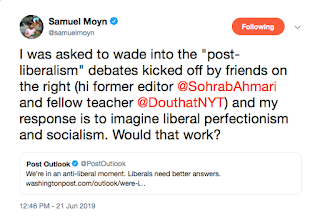
I posted Moyn's piece without starting with the obvious. It's so late in the game for him to be doing this. It's kind of amazing. He has a long history playing cute with reactionaries, but he has no time even for Beinart. It really marks the boundaries of liberal academia, as a thing in the world.
More amusing discoveries. Daniel Steinmetz-Jenkins in Dissent, in 2021, comparing Beinart from 2006 to Moyn in the present. Beinart's changed, but not in any way any of them can accept. Dissent, provincial American "progressivism".  Steinmetz-Jenkins previously.
---

Moyn, "perhaps Arendt... wasn’t Zionist enough"

For this reason, the great use of reading Arendt alongside Cold War liberals in the age of decolonization is to consider the geographical morality they shared. They offered Cold War libertarianism for the transatlantic “West,” an emancipatory statism (with violence if necessary) in their Zionist politics, and a caustic skepticism about the fate of freedom in either form elsewhere, based on an implicitly hierarchical set of assumptions about the world’s peoples. If this is right, their establishment of that special category for Jews in the Middle East is compelling and remarkable, for its very existence—as the sole place in their thought where earlier forms of liberalism with their activism and statism were allowed to survive— represents a fundamental challenge to their call for limits in developed countries and anxieties about meaningless violence in developing ones. To the extent that Zionism allowed a last remnant of the earlier philosophy of liberal emancipation they all liquidated, perhaps Arendt, like the Cold War liberals, wasn’t Zionist enough.

Yerachmiel Kahanovich

E: What is Operation Broom and what was its objective? 

YK: We cleared all the villages…

E: What do you mean?

YK: We cleared one village after another and expelled – expelled them, they fled to the Sea of Galilee and from there to the Galilee. 

E: But how? How? 

YK: You mean by shooting?

E: How do you mean?

YK: We shot, we threw a grenade here and there. Just listen – there's one thing you have to understand: at first, once they heard shots they took off with the intention of returning later. 

E: But, wait a sec, that was before May 15, that was before the Arab armies came. 

Operation Broom, Operation Broom then. How does it happen? Do you receive any information? Is it an organized campaign?

YK: Yeah, sure.

E: Tell me.

YK: It was. Who was it? Yigal Allon himself planned it. We moved from one place to the next. 

E: What places? Can you tell me?

YK: We passed, we passed by Tiberias and moved from one village to the other, from one to the next. 

E: So you had orders to expel and clean up the villages?

YK: And then go home. 

E: But you did see how they ran away?

YK: We saw them, what do you think? I fired at them with that – with the Browning – on the boats. 

E: They fled on boats?

YK: Yes. 

E: On the Sea of Galilee?

YK: Yes. On the other side they had more [villages], except [Kibbutz] Ein Gev [which was the only Jewish settlement on the east bank]. 

E: And who were the people who fled?

YK: Village people, they were fishermen, among other things. Then it was Lod. 

E: Wait a minute. We'll get to that. 

YK: Ramle. We entered the houses only in one place, in Balad al-Sheikh, near Yagur. There it was really, murderous and all that. And he said, you go there with axes. 

E: Who did?

YK: Only one man could – Yigal Allon. And I assume there was no misunderstanding between him and Ben Gurion, no. "So go there with axes, let them get lost, leave no trace. As much as you can, don't use any bullets, so that they won't hear it at the [British] police [station in Yagur] and, so that they won't send them reinforcements. 

E: So what did you do?

YK: We smashed the door and throw a grenade…

E: In Balad al-Sheikh?

YK: And indeed it never rose again, it's gone. 


Arendt, "Zionism Reconsidered"
Not less dangerous and quite in accord with this general trend was the sole new piece of historical philosophy which the Zionists contributed out of their own new experiences; "A nation is a group of people ... held together by a common enemy" (Herzl)-an absurd doctrine containing only this bit of truth: that many Zionists had, indeed, been convinced they were Jews by the enemies of the Jewish people. Thereupon these Zionists concluded that without antisemitism the Jewish people would not have survived in the countries of the Diaspora; and hence they were opposed to any attempt to liquidate antisemitism on a large scale. On the contrary, they declared that our foes, the antisemites, "will be our most reliable friends, the antisemitic countries our allies" (Herzl). The result could only be, of course, an utter confusion in which nobody could distinguish between friend and foe, in which the foe became the friend and the friend the hidden, and therefore all the more dangerous, enemy.

"We were the first fascists" Marcus Garvey.
We are living in a time of exploding nationalisms. The blacks in America are the first to abjure the idea of assimilation, to realize the inherent lie in the concept of melting pot. Through black nationalism has developed a new black pride and hence the ticket to liberation

Today’s young American Jew is a good bit slower. He desperately wants assimilation: Jewishness embarrasses him. He finds the idea of Jewish nationalism, Israel not­ withstanding, laughable. The leftist Jewish student is today’s Uncle Tom. He scrapes along, demons­trating for a John Hatchett, asham­ed of his identity, and obsessed with it. He cannot accept the fact that he is seen as a Jew, that his destiny is that of the Jews, and that his only effectiveness is as a Jew. But he wants to be an “American,” a left­ist American, talking liberation and aspiring WASP. He is a ludicrous figure. 

Sunday, June 18, 2023

Tim Sahay replies: "Oh no, we derisked the private production of a public good 😛"

Watching Gabor and Brusseler nodding and smiling at each other. The men are annoying. I assumed Brusseler was a Euro but she's not, and even her American girl upspeak becomes charming; downplaying her own intelligence, but it's there. The women understand each other, and they take bigger steps. The men have no imagination, or they don't want one. Amaranth is an ex-vp of a hedge fund, so of course he'd prefer carrots to sticks. Only masochists want to be beaten. But one way or another we end up with Welfare for Markets

The transcript is here


More comedy
Reuters, 4/29, Mercedes-Benz CEO: "Cutting ties with China is 'unthinkable'"

Branko talks about "capitalism alone", but this is what it means.

Jäger and his ilk have no understanding of democracy. 

"Interesting, but the idea that the US and the UK were somehow more ‘pluralist’ than Wilhelmine Germany before 1914 is pure projected memory born of Cold War soft power politics - just read Du Bois about Berlin vs. New York c. 1895...

They were very different capitalisms, sure, and parts of the old German elite were less taken with liberalism and laissez-faire, but the US got Germany’s full franchise in … 1965"

a reply: "Wilhelmine Germany was basically authoritarian and the UK, US and France were basically democratic. Big difference, no?"

Jäger responds:
"The UK was… democratic before 1914? Germany had a more inclusive suffrage!"

And again, to the same tweet:
"They were more ‘parliamentarian’, yes. But that’s anything but more democratic! The idea of 1914 as a contest of democracies vs. autocracies is one of the wildest ways in which the Anglos have gaslit our sense of history"
Leusder joins in
"It's held that GER was *uniquely* authoritarian, militantly nationalist, chauvinistic, antisemitic. One glance at France, Austria shows this to false. E.g.: Dreyfus Affair would not have happened in GER, and it was there you find the most active women's- and labour movements etc."
The comment aboutDreyfus is a bit much.

As always, Back to Krieger 
This book is not designed to cover a section of history. It is designed rather, to provide answers to a definite set of historical questions arising out of the "German problem." The questions are these: Did the Germans‘ failure to achieve, under their own power, a liberal democracy in the western sense mean simply the triumph of conservatism over generic liberalism in Germany or was a peculiar German attitude toward liberty involved in its defeat? If there was such an attitude, what were its ingredients? And finally, given the ingredients at a special German approach to the problems of political freedom, how did that strange historical development work which kept changing the conditions while leaving the ingredients themselves constant? 
The first of these questions, on which the others hinge, is easily decided. Without minimizing in the slightest the conservative weight of German authoritarian institutions or the bitterness of the liberal opposition to them during the 19th century, an historical view into any period of modern German history must still acknowledge that the external posture of German liberalism has ever been qualified by its distinctive internal structure. The juxtaposition—indeed, even the connection—of one conception of liberty that could be realized only within the authoritarian state and of another that could be realized only in an absolute realm beyond all states is a commonly remarked German phenomenon. It has been traced back to Luther and up to Hitler. My problem is to show what the connection between these two apparently antithetical conceptions has been and how it has grown. 
Jäger retweeted another reply:

"The imperial German model of "planned capitalism" does have a lot of similarities with say modern China, this model would have probably become the default if Germany had won - rather than the kind of deference to the bourgeois and markets which is popular in anglophone society"

And there we go. The future of freedom is Millian, existing only in the context of *benign* authority.

And supporters of that authority will decide when it applies and when it doesn't. Leusder supports Ben Judah and his celebration of a new Europe, while both support a state founded in conquest and separatism. Palestinian citizens of Israel will never have full equality in a Jewish state. That's the point.


I'll always go back and forth between the principled defense of democratic freedom and an ironic appreciation of hard realism, and I'll always hate passivity. It's the difference between Borges and the gauchos. I'm not interested in the philosophy of the CCP

Friday, May 12, 2023

An amazing photograph; so much there if you choose to make the effort. Self-identifying as a thinker or anything else is meaningless.


serendipity. The secret to comedy. But nobody gets my jokes.


Sunday, May 07, 2023

Sereny again

Into That Darkness 

Shortly before breaking off for lunch – when, I had been told, I would have to give him as much time as he wanted for his meal and rest – I told him that having listened to him for two and a half hours I thought I had better explain what I really wanted. He could then think about it and let me know after lunch whether he wanted to go on. I said that I knew inside out all the things he had said that morning; all of them had been said before by any number of people. And I didn’t wish to argue the right or wrong of any of this; I felt it was pointless. What I had come for was something quite different: I wanted him really to talk to me; to tell me about himself as a child, a boy, a youth, a man; to tell me about his father, his mother, his friends, his wife and his children; tell me not what he did or did not do but what he loved and what he hated and what he felt about the things in his life which had eventually brought him to where he was sitting now. If he didn’t want to do this, but preferred to go on in the vein of that morning’s recital, then I would listen to him, I said, to the end of that afternoon, go back to England, write a little something about the interview, and that would be the end of it. But if, after thinking about it, he decided to help me delve deeper into the past (his past, because things had happened to and inside him which had happened to hardly anyone else, ever) then perhaps we could find some truth together; some new truth which would contribute to the understanding of things that had never yet been understood. If this could be done I would be prepared to stay in Düsseldorf as long as he liked; days or even weeks. I told him, too, that he had to know from the start that I abhorred everything the Nazis had stood for and done, but that I would promise him to write down exactly what he said, whatever it would be, and that I would try – my own feelings notwithstanding – to understand without prejudice.

When I’d finished he didn’t say anything, only nodded. And when a moment later the guard came to take him back to his cell, he left the room with nothing but a small formal bow. I was not at all sure I’d see him again....

Stangl looked indefinably different when he was brought back to the little room on the second floor at 2 p.m. He had taken off his tie and unbuttoned the top button of his shirt, but he still looked spruce – that wasn’t it. He was as well shaved as he had been in the morning – had probably shaved again – yet he no longer looked quite clean-shaven, nor was his skin as taut and young-looking as before....

I’ve thought about what you said,” he told me at once, his voice slightly unsteady. “I hadn’t understood before – I hadn’t understood what you wanted. I think I understand now … I want to do it. I want to try to do it.…”

There were tears in his eyes before we even began to speak of his childhood. “I thought you just wanted – you know – an ‘interview’,” he said, emphasizing that loaded term. I had some English cigarettes and he took one – he was, I soon saw, a chain-smoker. “My childhood,” he began, shaking his head several times, “I’ll tell you.

"Did he perhaps think of you as his friend?" 
"No I don't think he would have dared to think of that. He was very respectful. He a provincial Austrian. I was a Hungarian aristocrat." 

Saturday, May 06, 2023

This is just hilarious.

---
Sereny makes me laugh. She has a good hard understanding of the world. 
Q: This phrase the banality of evil, is that what you're talking about?
A: Ah.. I suppose so. I really dislike that um... sentence. You know, evil is a huge word. Actually there was nothing evil about Stangl.

Arendt's use of "banality" isn't the problem; it's the here use of the word "evil" Arendt could never stop being a philosopher. That was always her weakness. Sereny doesn't need to pretend. 

Earlier, laughing, putting her hand to her chest:"Remembering Stangl and to think of him as being fundamental is always funny." An empty suit, but the suit was a uniform. Deep down he's shallow. Her aristocratic contempt.

Watching Sereny I thought of Stengneth, and my own contempt grew even stronger. Sereny seconds Arendt in a way that Stangneth could never counter. Post-war German Zionism continues pre-war German anti-Semitism, a transition without a break.

Sereny was a journalist and Harris was a lawyer. Empiricism over rationalism

Sereny's description of Speer and Hitler would probably offend a lot of people if they paid attention. 


Tuesday, February 21, 2023

The video's updated.


One of the men in the videos is on the board of the local chapter of NOW.
It's depressing, but it continues the delusions of bourgeois self-regarding "progressivism". "The lowest of the low" is the new normal; "failure" is the new success; "anti-social" is the new social. That they're all pathetic isn't the issue; the issue is their need to impose their fantasies on others, and the response of their enablers.

Liberal individualism is stupid. But I'm wondering if "communitarianism" was just a way to reconstruct community after individualism won out over republicanism: a Hobbesian tribalism on the frontier, a community of individualists who are stuck with each other. It's Puritan. References to the "revival of communitarianism" are absurd. It's a modern invention. Republicanism doesn't destroy the private realm; back to Arendt again.  All of this shit—not just the last video—is masturbation in public.  
in re: masturbation in public. I said it all before.
The experience of the sex act is social, formal, communicative, and if the world is seen as the social realm, world-creating. The moment of orgasm as reflex is aformal, asocial (isolate), ecstatic and if the world is seen as social, world destructive. Sex as performance is a form of communication; orgasm is artless. The pretense of an ‘art’ of orgasm is vulgar. The popular understanding of Pollock’s work is as an ‘act’ of ‘expression,’ as orgasm not structure. Mondrian saw structure. Duchamp thought nothing about cutting off a few inches of Mural (1943) because it was too big for Peggy Guggenheim’s wall. And Pollock didn’t complain. The what and how of communication for Pollock’s work are complex; as complex in their way as the question of orgasm in Beethoven.

What Rosen is debating with Brendel then is the increasing presence of instrumentalism in form: the growing tendency to craft to reflex that reaches its apogee in the illustration and the false community of the fetish: of pure instrument. Wagner is preaching to the choir (and Pollock is in there somewhere); Gerome is a soft-care pornographer playing to an audience, Newton and his audience are almost interchangeable, his form of communication identification with the masturbator which is to say barely communication at all, one step away from the final shift, the final descent from interpersonal communication to masturbation in public.

If communication is a circuit, reflex is a short. The fantasy of the premature ejaculator is a state of eternal orgasm. The mania for progress becomes no more than simply the desire to go faster. If knowledge is measured in conclusions not in processes then the shortest distance between two points, the short circuit, is the obvious choice. This is the crux of the struggle over the human imagination that begins in the 18th century.

Someone should publish it. I've given up trying.

Thursday, February 09, 2023

The Knight First Amendment Institute 

The Knight First Amendment Institute defends the freedoms of speech and the press in the digital age through strategic litigation, research, and public education. Our aim is to promote a system of free expression that is open and inclusive, that broadens and elevates public discourse, and that fosters creativity, accountability, and effective self-government.

We've been here before. 

Heather Whitney, "Search Engines, Social Media, and the Editorial Analogy" 

Recommended to me by David Pozen, the editor of the series this essay is a part of, who didn't understand my question

Whitney's concerns about the "editorial analogy" are entirely about whether Google and Facebook have the right to free speech, not about scale and the ability to regulate public information. The only mention of Section 230 is about Yelp!

Whitney

Large consequences hinge on whether the various choices companies like Facebook and Google make are indeed analogous to editorial “speech.” The answer will partly determine whether and how the state can respond to current challenges ranging from the proliferation of fake news to high levels of market concentration to the lack of ad transparency. Furthermore, algorithmic discrimination and the discrimination facilitated by these platforms’ structures affect people’s lives today and no doubt will continue to do so. But if these algorithms and outputs are analogous to the decisions the New York Times makes on what to publish, then attempts to extend antidiscrimination laws to deal with such discrimination will face an onslaught of potentially insuperable constitutional challenges. In short, these companies’ deployment of the editorial analogy in the First Amendment context poses a major hurdle to government intervention.

She goes into the history of the editorial analogy in court, beginning with Zhang v. Baidu.com, Inc. where plaintiffs lost.

First, the Court noted that the government may not interfere with the content of private writers on matters of public concern. Second, the Court explained this rule is not restricted to the press but afforded to all individuals. 

The dominant search engine in a one-party state, under strict state censorship has "free speech", as judged by the courts in a putative democracy. This calls for an analysis of the court and judicial appointment, but she doesn't do that. 

With no attention paid to the claim that Baidu was acting on behalf of the Chinese government the court saw the relevant precedent as Miami Herald Publishing Co. v. Tornillo. There, the U.S. Supreme Court found unconstitutional a statute that required newspapers to provide political candidates a right of reply to critical editorials. The court in Baidu also saw Hurley v. Irish-American Gay, Lesbian, and Bisexual Group of Boston as an extension of Tornillo, equally applicable to Baidu. In Hurley, the Court ruled that requiring parade organizers to permit a pro-LGBT group to participate would entail unconstitutionally compelling the parade organizers to speak.

The parade in Hurley was nationalist pageantry. If Nazis have the right to march, then conservative Irish organizations have the right too. I doubt that anyone in there was flying the Union Jack. And the Miami Herald isn't exactly monopoly material.

next up:  e-ventures Worldwide, LLC v. Google, Inc, where it won again.

That Google’s actions were commercial and arguably anticompetitive did not matter. That Google was alleged to have made deceptive statements did not matter. On the contrary, the court expressly opined that Google’s free speech rights protect its listing and delisting decisions “whether they are fair or unfair, or motivated by profit or altruism.” The court’s conclusion that if Google’s results were speech, unfair competition laws could not apply is deeply problematic and difficult to square with the obvious fact that laws addressing unfair and deceptive advertising prohibit certain speech all the time. This conclusion underscores the editorial analogy’s powerful influence and what its successful use puts at stake. 

"This conclusion underscores the editorial analogy’s powerful influence". 

If a court decides that there was no incitement when a man is beaten to death after someone on stage points at him and screams "KILL HIM! KILL HIM!", does that show the "powerful influence" of the doctrine of free speech, or maybe influence of another sort?

The writing is observational, not critical. I'd want to know the judges' history. I'd want to know where and how to put pressure not within the justice system but outside it. But she turns it into a philosophy lecture. At the time of writing, Whitney was a PhD candidate in philosophy

Introducing a description of the weaknesses of the editorial analogy. 

Take the action of eating a sundae without permission. If I work at the ice cream shop from which I took that sundae, a reprimand from my employer might be merited. But say instead that I’m a professor. We likely think that it would be absurd for my employer to reprimand me for eating a sundae without permission. In both cases I did the same thing — ate a sundae without permission — but additional facts change what treatment we think that same action merits. Put simply, even when A and B have some similarities, there can be relevant dissimilarities between them that renders treatment y appropriate for one but not the other.

This is lemonade from lemons, but she's enjoying herself. Puzzles are fun.

In response to Volokh's Google-sponsored paper defending Google's first amendment rights, she finds ways to argue that Google's not a publisher. She even resorts to citing J.L Austin, and Stanley Fish. But since the charge of abuse of raw power has has been rendered moot for now at least, this is the best she thinks she can do. She writes pages making the argument that choices made by stores are not speech. 

If any individual or organization who satisfies this “conveys a wide range of information” criterion is deemed analogous to newspaper and book publishers for First Amendment purposes, then we have misunderstood how liberal political theory and free speech theory work. At the heart of liberal political theory is the idea that everyone is free to live according to their own ideals, so long as doing so does not unduly interfere with other people’s ability to do likewise. 

And that's the Panglossian optimism of liberal political theory. The actual justification for freedom of speech is that the government can't be trusted to judge. 

Freedom of speech follows from freedom of inquiry. "Academic freedom predates free speech." as the openly elitist Eric Rauchway says, and so  he defends its primacy even now. This is the reason Brian Leiter and so many others oppose freedom of speech for the masses. (Lehrfreiheit, Krieger, and The German Idea of Freedom.) Liberal political theory is the equivalent of Kantian private reason, the reason of managers.

Liberal political theory is anti-political, because all philosophy is anti-political. Politics is vulgar. "Democracies have freedom of speech not because governments grant it but because the government is not granted the power to take it away." Every lawyer who works in criminal law knows why you represent people you know are guilty. If the cops can fuck the criminals they can fuck anybody. What's that got to do with liberal political theory? 

I repeat that again and again because it's something legal theorists, descending from the anti-democratic origins of philosophy, and Weber's "sovereign", can't accept.

Whitney 

A bookstore selects which books to sell. Wouldn’t we say that its selection of those books is itself speech? And if so, doesn’t that show that curating other people’s speech is necessarily speech itself? Once again, I think the answer is no. First, I hesitate to grant the premise — that we would call a bookseller’s book selections an independent instance of protected speech. I say this because in cases where the state has banned the sale of protected speech, the Court has invoked either the First Amendment rights of speech creators or would-be speech buyers. 

I'm going to open a bookstore. I'm going to name it BUÇH࿕࿕TREME (with the C as a sickle and T as a hammer—this is the best I could do). I'll stock nothing but the best: The Protocols of the Elders of Zion and Mein Kampf, The Complete Diaries of Theodor Herzl and the poetry of Avraham Stern; the complete works of Sayyid Qutb and Pol Pot;  Collected works of The Communist Party of Peru, and Decision of The Central Committee of the Chinese Communist Party Concerning the Great Proletarian Cultural Revolution; The Turner Diaries and the novels of Saddam Hussein, in a boxed set with a case. There's a lot more out there. It would take a lot of work. I'll call it conceptual art. Maybe I could get funding.

This goes back to Tushnet—see the mention of Hurley—and legal scholars who see law as more than a blunt instrument. Law oversimplifies everything out of necessity. Most lawyers understand that, but academics don't. Lawyers keep their arguments as simple as possible because their prime interest is winning. A pornographic book store is probably not going to open next to a high school, but if all his books are banned he's out of business. 

Second, and more fundamentally, even if a bookseller’s choice of which books to sell counts as speech, that still does not show that (1) every time an entity curates third-party speech that curation is itself speech, 

This is the key. Global monopoly is untouchable so she needs a way to get government to regulate speech on the platforms, out of sincere concern for our well-being without. But government serves its own interests. In 2013, after 65 years, the ban on US government propaganda directed at US citizens was repealed. Another mark of change.

And Whitney seems to take reps and corporate lawyers at their word. And her use of "we" and "our" is just annoying.

When we diagnose what went wrong with regard to fake news, we need not conclude that Facebook made the mistake of trying to be too neutral. Instead, we can realize that our (and their) previous conception of what “neutrality” entailed — not privileging certain news sources and treating all sources of “news” the same — was wrong. Facebook, and the rest of us, learned that treating fake news sites on a par with the Wall Street Journal and the New York Times is saying something very not “neutral” about how we should treat information from those sites. Just recently, Facebook announced that it will once again rank news sources, but this time it plans to do so based on user evaluations of those sources. We can debate this method as well, but it represents yet another attempt by Facebook to figure out what “neutral” means and then do it.

Finally, like Google, Facebook and Twitter were asked during recent congressional hearings how they “respond to . . . the growing concerns that [they] and other Silicon Valley companies are putting a thumb on the scale of political debate and shifting it in ways consistent with the political views of [their] employees?” Facebook General Counsel Colin Stretch replied, “Senator, again, we think of ourselves as a platform of all ideas — for all ideas and we aspire to that.” Stretch then discussed training given to prevent bias in its employees, saying, “We want to make sure that people’s own biases are not brought to bear in how we manage the platform.” Responding to the same question, Sean Edgett of Twitter insisted that “our goal and . . . one of our fundamental principles at the company is to remain impartial.”

They would would say that, wouldn't they?"

Her paper is dated Feb 27, 2018

July 2018, in the Guardian: Is Facebook a publisher? In public it says no, but in court it says yes 

Facebook has long had the same public response when questioned about its disruption of the news industry: it is a tech platform, not a publisher or a media company. 

But in a small courtroom in California’s Redwood City on Monday, attorneys for the social media company presented a different message from the one executives have made to Congress, in interviews and in speeches: Facebook, they repeatedly argued, is a publisher, and a company that makes editorial decisions, which are protected by the first amendment. 

If Facebook is a publisher if can be sued for the actionable libel and slander it publishes. But it can't be because of Section 230

Whitney goes through other analogies: law schools, shopping malls, fiduciaries and company towns. She forgets the obvious: the only thing Facebook sells is users' data. And it feeds them crap that reinforces what biases they have. If "the town square" is owned by a corporation, then public space has been privatized. If there are no first amendment rights in the town square, the people have to take it back. Some knots can't be untied; they have to be cut. 

Amnesty International, September 29,  2022

Beginning in August 2017, the Myanmar security forces undertook a brutal campaign of ethnic cleansing against Rohingya Muslims. This report is based on an in-depth investigation into Meta (formerly Facebook)’s role in the serious human rights violations perpetrated against the Rohingya. Meta’s algorithms proactively amplified and promoted content which incited violence, hatred, and discrimination against the Rohingya – pouring fuel on the fire of long-standing discrimination and substantially increasing the risk of an outbreak of mass violence. The report concludes that Meta substantially contributed to adverse human rights impacts suffered by the Rohingya and has a responsibility to provide survivors with an effective remedy.

Whitney's last paragraphs. 

Democratic ideals are invoked by many influential First Amendment scholars to explain and defend U.S. free speech doctrine.197  Building on this tradition, the democratic participation theory of free speech says that speech must be protected in order to ensure “the opportunity for individuals to participate in the speech by which we govern ourselves.”198  How do we decide what counts as “speech” using democratic participation as our normative reference point? We cannot construe the ideal too broadly, such that all parts of social life are part of the project of self-government, for in encompassing everything, the ideal would prioritize nothing. Instead, the ideal of democratic participation requires us to conceptually divide society into two domains: public life, where we act as citizens cooperating in collective self-governance, and private life, where we act independently in the service of our own projects. For free speech principles grounded in democratic participation, “speech” denotes whatever forms of communication are integral to collective self-governance. Of course, there will be complications at the margins, but the basic implications of the democratic participation theory are discernible all the same. Free speech principles are not meant to immunize all communication against legitimate regulatory aims. They are meant to support the project of collective self-government by safeguarding the communicative conduct that is essential to that project’s realization.

With those clarifications in place, the pertinent question for our purposes is which sorts of ostensible “speech” — be it algorithmic outputs in the form of rankings, listing decisions, trending topics, and so on — help the project of democratic self-government and which do not? At this moment, we can certainly appreciate how troll armies, fake accounts, and bots can be anathema to these projects. The economic decisions that companies like Google make in determining which ads to run or whether to privilege their own products against rivals like Yelp and TripAdvisor are, as I said, commercial and need not be seen as worth protecting as “speech” for the sake of democratic self-governance, at least across the board.199 That’s not to say that these decisions should necessarily be regulated but instead to show why, under democratic participation theory, they could be, without running afoul of the First Amendment.

The “thinker-based” theory, recently developed by Seana Shiffrin, identifies “the individual agent’s interest in the protection of the free development and operation of her mind” as the normative keystone of free speech. Whereas other theories situate the value of the thinker in relation to extrinsic ideals or desiderata, this theory identifies a direct and non-contingent link between the value of mental autonomy and the justification for the protected status of communicative conduct. Again, however, not all communication is privileged under such a theory. If we prioritize the “fundamental function of allowing an agent to transmit . . . the contents of her mind to others and to externalize her mental content,” then we will need to have special protections for people sharing all of this “content” with others. This is part of what makes Shiffrin’s theory distinctive: The expression of thoughts about politics and government does not occupy an exalted position relative to the expression of thoughts about everyday life. But crucially, what is especially protected in this theory is not communication as such but the communication of the thought of individuals. And this will tend to assign a less privileged status to much commercial communication. So when we revisit our key questions — whether programs that synthesize, organize, rank, and transmit third-party communication to users are implicated in “the fundamental function of allowing an agent to transmit the contents of her mind to others” — the diagnosis is mixed, as in the previous case.

One interesting consequence of the thinker-based theory is that, unlike the democratic participation theory, it sug- gests that facilitation of everyday online chatter by search engines and social networks may be as much a part of the case for protecting (some of) their operations as their role in facilitating political discourse. But as with the democrat- ic participation theory, much of what these programs do — including running ads and allowing for the creation of bot armies and the spread of fake and inflammatory news — will likely fall outside the scope of free speech coverage by the lights of this normative approach.

CONCLUSION

In debates over tech companies and free speech coverage, neither the gravity of the policy stakes nor the complexity of the things being compared has dampened the willingness of courts and scholars to use ten- uous analogies in charting the way forward. Most everybody seems to agree that search engines and so- cial media platforms should be covered by principles of a free press, if and to the extent that the reasons underlying our protection of the press apply to them. But the point of this paper is that casual analogical methods—observing that both types of things “convey a wide range of information” or “rank and organize content”—do not tell us whether or to what extent they do. There are multiple plausible analogies that might be used, each with different First Amendment implications, and none tells us whether the normative considerations underlying free speech coverage for the one apply to the other. But if those normative considerations are inapplicable, the reason to extend coverage disappears.
---

197 Alexander Meiklejohn, Free Speech and Its Relation to Self-Government 22–27 (1948); Robert Post, The Constitutional Conception of Public Discourse: Outrageous Opinion, Democratic Deliberation, and Hustler Magazine v. Falwell, 103 Harv. L. Rev. 601 (1990).

198 James Weinstein, "Participatory Democracy as the Central Value of American Free Speech Doctrine", 97 Va. L. Rev. 491, 491 (2011).

199 See supra notes 37–38 and accompanying text.

But this too might change. In what Yelp’s vice president of public policy described as the “most significant enforcement event in consumer tech antitrust” since the action against Microsoft in 2000,36 Google was fined a record-breaking €2.4 billion by European regulators in June 2017 for abusing its market dominance by giving an illegal advantage to its own products while demoting rivals in its comparison shopping service, Google Shopping.37 While EU actions do not ensure any movement domestically, they can bring to light information that further tarnishes Silicon Valley’s reputation and thus contributes to the erosion of the basis for its companies’ exceptional treatment to date. Within the United States, moreover, Yelp and TripAdvisor have repeatedly argued that Google deliberately diverts users searching for their sites to Google-owned alternatives. Google has said that some of these results are the result of bugs, but its competitors argue otherwise.38 It is at least possible that a major (and well-funded) lawsuit in the United States — and with it, a vigorous battle over First Amendment coverage, the editorial analogy, and unfair competition laws — may yet materialize.
---
36 Klint Finley, Google’s Big EU Fine Isn’t Just About The Money, Wired (Jun 27, 2017), http://www.wired.com/story/google-big-eu-fine. 

37 Josie Cox, "Google Hit with Record EU Fine over 'Unfair' Shopping Searches", Independent (June 27, 2017), http://www.independent.co.uk/news/business/news/google-eu-fine-latest-competition-shopping-searches-prepare-online-european-commission-results-a7809886.html.

38 Mark Bergen, "Google Says Local Search Results That Buried Rivals Yelp, TripAdvisor Is Just a Bug", Recode (Nov. 24, 2015), http:// www.recode.net/2015/11/24/11620920/google-says-local-search-result-that-buried-rivals-yelp-tripadvisor. now Vox and archive.org

200 Seana Valentine Shiffrin, "A Thinker-Based Approach to Freedom of Speech", 27 Const. Comment. 283, 287 (2011). See generally Seana Valentine Shiffrin, Speech Matters: On Lying, Morality, and the Law (2014). 

"It is at least possible that a major (and well-funded) lawsuit in the United States — and with it, a vigorous battle over First Amendment coverage, the editorial analogy, and unfair competition laws — may yet materialize."  

There's no conflict between the "editorial analogy" and antitrust. That's why "media concentration" is an issue. But Whitney isn't against media concentration. It makes it the government's job easier. 

This is all just a fucking joke. And it gets worse. Remember: "Academics, though it sounds odd to say it, don’t take ideas seriously."

Shiffrin, Speech Matters: On Lying, Morality, and the Law. The blub at Princeton University Press

To understand one another as individuals and to fulfill the moral duties that require such understanding, we must communicate with each other. We must also maintain protected channels that render reliable communication possible, a demand that, Seana Shiffrin argues, yields a prohibition against lying and requires protection for free speech. This book makes a distinctive philosophical argument for the wrong of the lie and provides an original account of its difference from the wrong of deception.

Drawing on legal as well as philosophical arguments, the book defends a series of notable claims—that you may not lie about everything to the “murderer at the door,” that you have reasons to keep promises offered under duress, that lies are not protected by free speech, that police subvert their mission when they lie to suspects, and that scholars undermine their goals when they lie to research subjects.

Many philosophers start to craft moral exceptions to demands for sincerity and fidelity when they confront wrongdoers, the pressures of non-ideal circumstances, or the achievement of morally substantial ends. But Shiffrin consistently resists this sort of exceptionalism, arguing that maintaining a strong basis for trust and reliable communication through practices of sincerity, fidelity, and respecting free speech is an essential aspect of ensuring the conditions for moral progress, including our rehabilitation of and moral reconciliation with wrongdoers.

Somewhere on this page I think I've posted a clip from or a trailer for Liar Liar.  But it's fitting that Princeton was also the publisher of Brennan's Against Democracy.

I'm going to end with a restatement of the only argument for free speech I've ever taken seriously, the only argument my parents took seriously, and which no one above even mentions. It's the opposite of liberal political philosophy. Ira Glasser is a few years younger than my parents. He started later at the ACLU, and he was there as the rot set in. He may have even been responsible for some of it, but this is good.

"Why we must fight for the right to hate"

In my experience, everyone supports the right to freedom of speech, as long as it’s their own speech or the speech of people they agree with. But most speech falls outside that category. Most people would ask: why support the right of people to say things you hate, or fear or that you regard as dangerous?

...The speech that social-justice advocates hate is not the same as the speech that Donald Trump hates. And if it became legal to ban hateful speech, it could just as easily be Trump and people like him, rather than social-justice advocates or people like me, who would most often be in a position to decide whose speech was hateful enough to ban.

Speech restrictions are like poison gas: they seem like a good idea when you’ve got the gas and a deserving target in sight. But then the wind shifts and blows the gas back on you.

In 1974, in England, the National Union of Students succeeded in getting racist speech banned on university campuses. One of the groups supporting the ban was an organisation of Zionist students. In 1977, the NUS decided that Zionism was a form of racism, and banned Zionists from speaking on campuses.

The wind had shifted.

Unless you’re an autocrat, and confident of holding power forever, you don’t want the government having the power to decide whose speech to ban. Because sooner or later, it will be yours.

That's not liberal optimism; it's political realism in the context of principle. And it's not Judith fucking Shklar. 

Leiter pretends to understand—he's lying—or he's more of an idiot than I thought.

This is a version of what I think is the most plausible defense of free speech, [linking to his argument against free speech] namely, distrust of government to figure out which speech actually lacks value.  Of course, it depends on an empirical premise:  namely, that a blanket rule prohibiting suppressing speech based on its content will, in fact be observed by fascists--or, more precisely, that when a judiciary is acclimated to such a rule, they will stick to it were a fascist in power.  I wish I could be confident that is true, but I'm hopeful that in a large country, with a fairly independent judiciary, it will be.

The premise is that a free people, being vigilant, knowing that vigilance is their own responsibility, will choose freedom. Taleb would say they had "skin in the game". A free people takes the plural, which is why liberalism fails: liberal individualism leads to its opposite.

"It is the common fate of the indolent to see their rights become a prey to the active. The condition upon which God hath given liberty to man is eternal vigilance; which condition if he break, servitude is at once the consequence of his crime and the punishment of his guilt."
"What's needed is an argument in defense of the need for citizens in a democratic state to be able to be all kinds of wrong, all kinds of confused, creepy, conflicted, desirous, weepy or hate-filled, so that they may be able to learn to understand and outgrow their childishness. The choice is between a community of adults with a minority of the inveterately childish and criminal or a community of children ruled by moralists and crime lords."
The vigilance of the people. Liberals don't want an educated populace and that's why we don't have one.

Beginning in the 1950s and blossoming since 1961, a major scholarly controversy has sucked The Federalist into its gravitational field: What was its role in the great shift from republicanism to liberalism in American political thought? These complex bodies of ideas and practices have almost no direct links to today’s Republican party or modern American liberalism; moreover, these terms have become so vague that many historians have abandoned both words as useless.

There's a reason there are riots now in France. The French have some sense of the ideals of a republic. I could keep annotating, Weber, Lawrence, Tocqueville, Montesquieu, Arendt. You get there if you if you follow the links.

Sunday, February 05, 2023


The above, indirectly, from Mary Gaitskill. Read it, and the comment by Tavi Gevinson. If you don't recognize the name, google it. 

Gevinson
Also reminds me of a friend who's reading Bret Easton Ellis's new novel. I haven't read it so here's my friend's description: "the teenaged character is invited to a producer's hotel room who then says 'now you have to do something for me' and essentially rapes him.” In the novel the narrator says something like, “But I wasn’t a victim.” And my friend said that reading the novel, he (my friend) felt like the narrator was clearly pained and trying to reframe it. But in a podcast interview, Ellis talked about how that really did happen to him, and also said something like, “I decided I’m not a victim.” My friend said that in the novel the line felt nuanced, whereas in the interview—especially given that Ellis is typically pretty reactionary--it sounded more like a comment on the culture wars, somehow no longer about one person’s experience and psychology.

I guess this is not a revelation (that fiction can be capacious in a way non-fiction isn’t), but maybe if I have any point it’s that it still feels really important to me that writers grapple with this stuff in nonfiction contexts where the reader knows more about what is at stake for the writer. (Just knowing I May Destroy You was based on Coel's experience made me more attentive to and trusting of the show's ideological arguments, even though it shouldn't be read as purely autobiographical.)

The private world and the public world of politics.

Since our feeling for reality depends utterly upon appearance and therefore upon the existence of a public realm into which things can appear out of the darkness of sheltered existence, even the twilight which illuminates our private and intimate lives is ultimately derived from the much harsher light of the public realm. Yet there are a great many things which cannot withstand the implacable, bright light of the constant presence of others on the public scene; there, only what is considered to be relevant, worthy of being seen or heard, can be tolerated, so that the irrelevant becomes automatically a private matter. This, to be sure, does not mean that private concerns are generally irrelevant; on the contrary, we shall see that there are very relevant matters which can survive only in the realm of the private. For instance, love, in distinction from friendship, is killed, or rather extinguished, the moment it is displayed in public. ("Never seek to tell thy love / Love that never told can be.") Because of Its inherent worldlessness, love can only become false and perverted when it is used for political purposes such as the change or salvation of the world.

What the public realm considers irrelevant can have such an extraordinary and infectious charm that a whole people may adopt it as their way of life, without for that reason changing its essentially private character. Modern enchantment with "small things," though preached by early twentieth-century poetry in almost all European tongues, has found its classical presentation in the petit bonheur of the French people. Since the decay of their once great and glorious public realm, the French have become masters in the art of being happy among "small things," within the space of their own four walls, between chest and bed, table and chair, dog and cat and flowerpot, extending to these things a care and tenderness which, in a world where rapid industrialization constantly kills off the things of yesterday to produce today's objects, may even appear to be the world's last, purely humane corner. This enlargement of the private, the enchantment, as it were, of a whole people, does not make it public, does not constitute a public realm, but, on the contrary, means only that the public realm has almost completely receded, so that greatness has given way to charm everywhere; for while the public realm may be great, it cannot be charming precisely because it is unable to harbor the irrelevant.

With some people I'm always torn between criticism and silence. I'm not sure I'm done with this.

Sunday, January 29, 2023

---

In Rienzi or Lohengrin or Tannhäuser, Hitler, the rejected Academy candidate sitting over his water colors in the reading room of the home for men, recognized magnified aspects of his own confrontation with the world. Both Wagner and Hitler, moreover, possessed a furious will to power, a basically despotic tendency. All of Richard Wagner's art has never been able to conceal to what extent its underlying urge was the boundless need to dominate. From this impulse sprang the taste for massive effects, for pomposity, for overwhelming hugeness. Wagner's first major composition after Rienzi was a choral work for 1,200 male voices and an orchestra of one hundred. This blatant reliance on mass effects, employed to cover up basic weaknesses, this medley of pagan, ritual and music-hall elements anticipated the era of mass hyp. nosis. The style of public ceremonies in the Third Reich is inconceivable without this operatic tradition, without the essentially demagogical art of Richard Wagner.

Another point in common was a kind of cunning knowledge of the popular mind along with a remarkable insensitivity to banality. This combination resulted in an air of plebeian pretentiousness in which again they were remarkably similar. Gottfried Keller once called the composer a "barber and charlatan"; similarly, a contemporary observer described Hitler, with the acuteness born of hatred, as having "the aura of a head-waiter"; another spoke of him as a speechmaking sex murderer. The element of vulgarity and unsavoriness that phrases of this sort tried to catch was present in both Hitler and Wagner. They were masters of the art of brilliant fraudulence, of inspired swindling. And just as Richard Wagner could call himself a revolutionary yet pride himself on his friendship with a king ("Wagner, the government bandleader," Karl Marx said scornfully), so Hitler, in his vague dreams of mounting the social ladder, reconciled his hatred of society with his opportunistic instincts. Wagner dismissed the patent contradictions in his views by declaring that art was the goal of life and that the artist made the ultimate decisions. It was the artist who would intervene to save the situation wherever "the statesman despairs, the politician gives up, the socialist vexes himself with fruitless systems, and even the philosopher can only interpret but cannot prophesy." His doctrine then was that of the aesthetician who would subordinate life entirely to the dictates of the artist. The state was to be raised to the heights of a work of art; politics would be renewed and perfected by the spirit inherent in art. Elements of this program are clearly visible in the theatricalization of public life in the Third Reich, the regime's passion for histrionics, the staginess of its practical politics—a staginess that often appeared to be the sole end of the politics.

---

Since the German word Bildungsbürger, let alone Bildungsbürgertum, is probably untranslatable, Martin Chalmers wisely leaves it in the original and explains the meaning in a footnote. Briefly, a Bildungsbürger was a member of the pre-war bourgeois German elite whose status was marked less by birth than by a solid classical education. Some of the proudest Bildungsbürger were Jews. If sportsmanship, good manners, and fine tailoring were the vaunted signs of the English gentleman, the minimum requirement for a Bildungsbürger was a sound knowledge of Latin and Greek, the classics of European literature, and of course German classical music. The gentleman was shaped by the English public (meaning private) school, the German bourgeois by the Gymnasium.

All of which is to say that Joachim Fest, the acclaimed biographer of Hitler and Albert Speer, cultural editor of the Frankfurter Allgemeine Zeitung from 1973 to 1993, and conservative scourge of the postwar German left, was a paragon of Bildungsbürgertum. His politics were not of the far right; there was no hint of revanchism. Fest was a liberal in the classical European sense, a believer in free-market economics with the habitus of a cultivated banker and a taste for Mozart operas and Italian Renaissance art.

His childhood education during the Third Reich is the subject of Fest’s extraordinary memoir, written in a polished style full of irony and wit, not all of which survives in translation. It is also a trifle self-regarding. Ich Nicht, the German title, conveys this a little more clearly than Not I. Perhaps it should have been Not Me, as it is in the British edition. The point made is that Fest was not one of the vulgar mob that cheered for Hitler. Fest’s nemesis, Günter Grass, whose memoir Peeling the Onion appeared in the same year (2006), may have volunteered for the Waffen SS—“not I.”

Fest points out early in his book that the values of the educated German bourgeoisie were already old-fashioned before the war and discredited after 1945. Leftists who saw fascism as the logical culmination of bourgeois capitalism partly blamed this upper-middle class for the rise of Hitler. Fest responded that “this accusation merely reflects the resentment of spoiled children intent on being morally superior to their parents.” He meant the student rebels of 1968 and their literary mentors, such as Grass. Fest didn’t think much of them, nor they of him.

In fact, the rise of Hitler’s Reich was also the end of Bildungsbürgertum. But the left-wing criticism of that class started much earlier. A prime example was Heinrich Mann’s novel Professor Unrat, better known in its cinematic version, The Blue Angel, directed by Josef von Sternberg, the film that made Marlene Dietrich’s name. The downfall of Professor Raat, ruined by his liaison with a nightclub dancer, is a satire that sticks the knife into the moral pretentions of a typical bourgeois pedagogue. The novel was written in 1905, in the Empire of Wilhelm II, when the prestige of a classical German education was at its height. A devastating world war, a chaotic and weak republic, and the ensuing Nazi catastrophe left the world of Professor Raat in ashes. 

Joachim Fest’s father, Johannes, the hero of his son’s memoir, was in many respects the perfect example of a Bildungsbürger. He taught at a good school in Berlin. He took pride in his complete works of Goethe, Shakespeare, Heine, and Lessing. A bronze bust of Dante stood in his study. From a solid Prussian family of minor officials, Johannes Fest was also a devout Catholic, whose idea of decent Prussian values included a lack of sentimentality and a sense of irony, which may not be everyone’s idea of Prussianness, but to the old man was “the entry ticket to humanity.”

And yet, as Fest points out, his father’s various qualities did not always fit together easily. For example, he could never forgive Thomas Mann, whose literary talent he acknowledged, for writing Reflections of an Unpolitical Man (1918). Mann’s notion of the Bildungsbürger was that he should stay away from politics, which was a sordid business, unworthy of a civilized humanist. Kultur is what mattered, not politics. Most members of his class would have agreed. Johannes Fest did not. Mann’s prejudice, he maintained, had done more to alienate the bourgeoisie from the Weimar Republic than Hitler. 

---

Yet it is here if anywhere that a valid criterion may be found for distinguishing the elite from the mob in the pretotalitarian atmosphere. What the mob wanted, and what Goebbels expressed with great precision, was access to history even at the price of destruction. Goebbels' sincere conviction that "the greatest happiness that a contemporary can experience today" is either to be a genius or to serve one,[57] was typical of the mob but neither of the masses nor the sympathizing elite. The latter, on the contrary, took anonymity seriously to the point of seriously denying the existence of genius; all the art theories of the twenties tried desperately to prove that the excellent is the product of skill, craftsmanship, logic, and the realization of the potentialities of the material.[58] The mob, and not the elite, was charmed by the "radiant power of fame" (Stefan Zweig) and accepted enthusiastically the genius idolatry of the late bourgeois world. In this the mob of the twentieth century followed faithfully the pattern of earlier parvenus who also had discovered the fact that bourgeois society would rather open its doors to the fascinating "abnormal," the genius, the homosexual, or the Jew, than to simple merit. The elite's contempt for the genius and its yearning for anonymity was still witness of a spirit which neither the masses nor the mob were in a position to understand, and which, in the words of Robespierre, strove to assert the grandeur of man against the pettiness of the great.

in re: "The fascism debate" 

Goebbels' sincere conviction that "the greatest happiness that a contemporary can experience today" is either to be a genius or to serve one,...

The world is just a barrel-organ which the Lord God turns Himself.
We all have to dance to the tune which is already on the drum.

Saturday, January 07, 2023

The lover leaps in the volcano! It's ten feet deep, And inactive

Nature does not know extinction; all it knows is transformation. Everything science has taught me, and continues to teach me, strengthens my belief in the continuity of our spiritual existence after death.

Wernher von Braun

Perception does not know the concept of infinity; from the very outset it is confined within certain spatial limits imposed by our faculty of perception. And in connection with perceptual space we can no more speak of homogeneity than of infinity. The ultimate basis of the homogeneity of geometric space is that aIl its elements, the "points" which are joined in it, are mere determinations of position, possessing no independent content of their own outside of this relation: it is purely functional and not a substantial reality. Because fundamentally these points are devoid of all content, because they have become mere expressions of ideal relations, they can raise no questions of diversity of context. Their homogeneity signifies nothing other than this similarity of structure, grounded in their common logical function, their common ideal purpose and meaning.

Ernst Cassirer 

Thinking about mannerism and baroque, anti-humanism and humanism, Nabokov and Pynchon, old and new. Pynchon loved Nabokov and the Beats: the overdetermined; the artless and desperate. 

Because still thinking about Smithson. 

Daniel Bell. "Behind the chiliasm of modern man, is the megalomania of self-infinitization."

Arendt

In 1957, an earth-born object made by man was launched into the universe, where for some weeks it circled the earth according to the same laws of gravitation that swing and keep in motion the celestial bodies—the sun, the moon, and the stars. To be sure, the man-made satellite was no moon or star, no heavenly body which could follow its circling path for a time span that to us mortals, bound by earthly time, lasts from eternity to eternity. Yet, for a time it managed to stay in the skies; it dwelt and moved in the proximity of the heavenly bodies as though it had been admitted tentatively to their sublime company.

This event, second in importance to no other, not even to the splitting of the atom, would have been greeted with unmitigated joy if it had not been for the uncomfortable military and political circumstances attending it. But, curiously enough, this joy was not triumphal; it was not pride or awe at the tremendousness of human power and mastery which rilled the hearts of men, who now, when they looked up from the earth toward the skies, could behold there a thing of their own making. The immediate reaction, expressed on the spur of the moment, was relief about the first "step toward escape from men's imprisonment to the earth." And this strange statement, far from being the accidental slip of some American reporter, unwittingly echoed the extraordinary line which, more than twenty years ago, had been carved on the funeral obelisk for one of Russia's great scientists: "Mankind will not remain bound to the earth forever."

Tuesday, December 06, 2022

Arendt,  The Human Condition, 1-3, Eternity Versus Immortality

That the various modes of active engagement in the things of this world, on one side, and pure thought culminating in contemplation, on the other, might correspond to two altogether different central human concerns has in one way or another been manifest ever since "the men of thought and the men of action began to take different paths,"16 that is, since the rise of political thought in the Socratic school. However, when the philosophers discovered—and it is probable, though improvable, that this discovery was made by Socrates himself—that the political realm did not as a matter of course provide for all of man's higher activities, they assumed at once, not that they had found something different in addition to what was already known, but that they had found a higher principle to replace the principle that ruled the polis. The shortest, albeit somewhat superficial, way to indicate these two different and to an extent even conflicting principles is to recall the distinction between immortality and eternity.

Immortality means endurance in time, deathless life on this earth and in this world as it was given, according to Greek understanding, to nature and the Olympian gods. Against this background of nature's ever-recurring life and the gods' deathless and ageless lives stood mortal men, the only mortals in an immortal but not eternal universe, confronted with the immortal lives of their gods but not under the rule of an eternal God. If we trust Herodotus, the difference between the two seems to have been striking to Greek self-understanding prior to the conceptual articulation of the philosophers, and therefore prior to the specifically Greek experiences of the eternal which underlie this articulation. Herodotus, discussing Asiatic forms of worship and beliefs in an invisible God, mentions explicitly that compared with this transcendent God (as we would say today) who is beyond time and life and the universe, the Greek gods are anthropōphyeis, have the same nature, not simply the same shape, as man.17 The Greeks' concern with immortality grew out of their experience of an immortal nature and immortal gods which together surrounded the individual lives of mortal men. Imbedded in a cosmos where everything was immortal, mortality became the hallmark of human existence. Men are "the mortals," the only mortal things in existence, because unlike animals they do not exist only as members of a species whose immortal life is guaranteed through procreation.18 The mortality of men lies in the fact that individual life, with a recognizable life-story from birth to death, rises out of biological life. This individual life is distinguished from all other things by the rectilinear course of its movement, which, so to speak, cuts through the circular movement of biological life. This is mortality: to move along a rectilinear line in a universe where everything, if it moves at all, moves in a cyclical order.

The task and potential greatness of mortals lie in their ability to produce things—works and deeds and words19— which would deserve to be and, at least to a degree, are at home in everlastingness, so that through them mortals could find their place in a cosmos where everything is immortal except themselves. By their capacity for the immortal deed, by their ability to leave non-perishable traces behind, men, their individual mortality notwithstanding, attain an immortality of their own and prove themselves to be of a "divine" nature. The distinction between man and animal runs right through the human species itself: only the best (aristoi), who constantly prove themselves to be the best (aristeuein, a verb for which there is no equivalent in any other language) and who "prefer immortal fame to mortal things," are really hu- man; the others, content with whatever pleasures nature will yield them, live and die like animals. This was still the opinion of Heraclitus,20 an opinion whose equivalent one will find in hardly any philosopher after Socrates.

In our context it is of no great importance whether Socrates himself or Plato discovered the eternal as the true center of strictly metaphysical thought. It weighs heavily in favor of Socrates that he alone among the great thinkers—unique in this as in many other respects—never cared to write down his thoughts; for it is obvious that, no matter how concerned a thinker may be with eternity, the moment he sits down to write his thoughts he ceases to be concerned primarily with eternity and shifts his attention to leaving some trace of them. He has entered the vita activa and chosen its way of permanence and potential immortality. One thing is certain: it is only in Plato that concern with the eternal and the life of the philosopher are seen as inherently contradictory and in conflict with the striving for immortality, the way of life of the citizen, the bios politikos.

The philosopher's experience of the eternal, which to Plato was arrhēton ("unspeakable"), and to Aristotle aneu logon ("without word"), and which later was conceptualized in the paradoxical nunc stans ("the standing now"), can occur only outside the realm of human affairs and outside the plurality of men, as we know from the Cave parable in Plato's Republic, where the philosopher, having liberated himself from the fetters that bound him to his fellow men, leaves the cave in perfect "singularity," as it were, neither accompanied nor followed by others. Politically speaking, if to die is the same as "to cease to be among men," experience of the eternal is a kind of death, and the only thing that separates it from real death is that it is not final because no living creature can endure it for any length of time. And this is precisely what separates the vita contemplativa from the vita activa in medieval thought.21 Yet it is decisive that the experience of the eternal, in contradistinction to that of the immortal, has no correspondence with and cannot be transformed into any activity whatsoever, since even the activity of thought, which goes on within one's self by means of words, is obviously not only inadequate to render it but would interrupt and ruin the experience itself.

Theōria, or "contemplation," is the word given to the experience of the eternal, as distinguished from all other attitudes, which at most may pertain to immortality. It may be that the philosophers' discovery of the eternal was helped by their very justified doubt of the chances of the polis for immortality or even permanence, and it may be that the shock of this discovery was so overwhelming that they could not but look down upon all striving for immortality as vanity and vainglory, certainly placing themselves thereby into open opposition to the ancient city-state and the religion which in- spired it. However, the eventual victory of the concern with eternity over all kinds of aspirations toward immortality is not due to philosophic thought. The fall of the Roman Empire plainly demonstrated that no work of mortal hands can be immortal, and it was accompanied by the rise of the Christian gospel of an ever- lasting individual life to its position as the exclusive religion of Western mankind. Both together made any striving for an earthly immortality futile and unnecessary. And they succeeded so well in making the vita activa and the bios politikos the handmaidens of contemplation that not even the rise of the secular in the modern age and the concomitant reversal of the traditional hierarchy be- tween action and contemplation sufficed to save from oblivion the striving for immortality which originally had been the spring and center of the vita activa.
---

16. See F. M. Cornford, "Plato's Commonwealth," in Unwritten Philosophy (1950), p. 54: "The death of Pericles and the Peloponnesian War mark the mo- ment when the men of thought and the men of action began to take different paths, destined to diverge more and more widely till the Stoic sage ceased to be a citizen of his own country and became a citizen of the universe."

[Cornford, "Plato's Commonwealth," JSTOR

Callicles, in his spirited exhortation to Socrates to give up philosophy and play a man's part in active life, quotes, from the Antiope of Euripides, a famous debate between the Theban brothers, Zethus and Amphion, on this same contrast. Zethus urges Amphion, who had 'built the walls of Thebes with ravishing sound of his melodious lute‘, to give up the effeminate and unprofitable service of the Muse and take to agriculture, war, and politics. It is significant that this contrast between the active life and the contemplative should occur in a play of Euripides. Long ago, in the sixth century, the wise man had been the man of affairs, like Solon the lawgiver and others of the Seven Sages. The death of Pericles and the Peloponnesian War mark the moment when the men of thought and the men of action began to take different paths, destined to diverge more and more widely till the Stoic sage ceased to be a citizen of his own country and became a citizen of the universe. Pericles had been the last philosophic statesman.]

17. Herodotus (i. 131), after reporting that the Persians have "no images of the gods, no temples nor altars, but consider these doings to be foolish," goes on to explain that this shows that they "do not believe, as the Greeks do, that the gods are anthropophyeis, of human nature," or, we may add, that gods and men have the same nature. See also Pindar Carmina Nemaea vi.

18. See Ps. Aristotle Economics 1343b24: Nature guarantees to the species their being forever through recurrence (periodos), but cannot guarantee such being forever to the individual. The same thought, "For living things, life is being," appears in On the Soul 415bl3.

19. The Greek language does not distinguish between "works" and "deeds," but calls both erga if they are durable enough to last and great enough to be re- membered. It is only when the philosophers, or rather the Sophists, began to draw their "endless distinctions" and to distinguish between making and acting (poiein and prattein) that the nouns poiemata and pragmata received wider currency (see Plato's Charmides 163). Homer does not yet know the word pragmata, which in Plato (ta ton anthropon pragmata) is best rendered by "human affairs" and has the connotations of trouble and futility. In Herodotus pragmata can have the same connotation (cf., for instance, i. 155).

20. Heraclitus, frag. B29 (Diels, Fragmente der Vorsokratiker [4th ed.; 1922]).

21. In vita activa fixi permanere possumus; in contemplativa autem intenta mente manere nullo modo valemus (Aquinas Summa theologica ii. 2. 181.4)

[Aquinas: Obj. 3: Further, the more lasting a thing is in itself, the more is it able to endure after this life. But the active life is seemingly more lasting in itself: for Gregory says (Hom. v in Ezech.) that we can remain fixed in the active life, whereas we are nowise able to maintain an attentive mind in the contemplative life. Therefore the active life is much more able than the contemplative to endure after this life.]