A reader did a search of this site looking for the phrase "torture works". Graeber was the first person I met who argued that. He said the reason there was so little terrorism in the USSR during the Afghanistan war was that when the Soviets caught a suspect they'd give him a phone and tell him to call his mother. She'd answer the phone and say there was a man in her house. He laughed when he told that one. David liked stories.
Showing posts with label David Graeber. Show all posts
Showing posts with label David Graeber. Show all posts
Thursday, April 20, 2023


Saturday, April 15, 2023
Andrew-Lloyd-Mother-Fucking-Webber
updated, more than once. rilly.
---


Oduor, previously. It's almost impressive.
And now I'm going to watch Tár, to see if my assumptions were off in any way at all.
There is no "path" from the aesthetic experience to politics; they're inseparable. Your preferences are shown in the record of your actions, not what you claim for them.
---
I'm a few minutes beyond the credits and it's absolute kitsch. She's blurbed as being an EGOT winner, along with Mel Brooks, Audrey Hepburn, Marvin Hamlisch, Whoopi Goldberg, and Andrew Lloyd Motherfucking Webber. It's not a film about art; it's a film about Aaahhrt. And it's just going to get worse. Brooks at least would get the joke. Jäger and everyone else, from the New Yorker and the NLR is fucking blind.
But no. I was wrong. He's following Ruben Östlund, Force Majeure, The Square, and Triangle of Sadness. It's still shallow and reactionary—lazy, obvious, at least to... what, the old? the actually sophisticated? And Brody, Jäger et al. are still fucking blind.
Jäger
This is perhaps why the moralistic commentary on Tár runs into an explanatory impasse; for it is not Lydia’s personal culpability but these impersonal forces that are the real subject of the film.
The most obvious among them is the stratified sphere of classical music – in which the lower ranks can only improve their career prospects by cultivating informal relationships with those higher up the ladder.
He makes it so easy. From Lydia Tár to Avital Ronell, because in fact it's the other way around.
"The university belongs, like the church and the military, to the social institutions that are situated at a considerable distance from democracy and adhere to premodern power structures."
He runs down the list of EGOT winners, cross-cut with shots of Blanchett at work, ending on "...Andrew Lloyd Webber, and of course... Mel Brooks." The audience laughs and Blanchett looks up from the page, as if hearing the laughter. It's not just the cheapness. That one leaves a bad taste.
This is the core issue: the film was made as parody, and being received as serious it's become kitsch. Or maybe Field can't make up his mind what kind of cheap moralist he wants to be. Either way I don't care.
Jäger: "Throughout, Field meticulously evokes the authentic world of the Bildungsbürgertum".
"Authentic" He sounds so American.
And I'd forgotten this.
This could all hinge on my snobbery against others'; never mind the Spaceballs vid. But I've never forgotten the description of Adolph Green's last night, written by his son, and this:
We argued the relative merits of classical composers (any suggestion that Tchaikovsky had a maudlin streak or that von Suppé might not have been the last word in profundity infuriated him).
I don't like Tchaikovsky, but through Strayhorn, there'd be no Ellington without him. My father hated Kerouac but loved Pynchon. He was right about both, but couldn't accept the relation. That more than anything is the beginning of my argument with modernism as ideology as opposed to modernity as fact. Mel Brooks will outlast Andrew Lloyd Webber. Adolph Green knew he loved crap and minor art, and he didn't care. He worked with the maudlin and the sentimental and made something out of it. That's more than Field is capable of, or Östlund for that matter. And Sir Steve McQueen is a good filmmaker, but his politics is not the politics some think it is.
---
My father hated musicals but he could quote lines from A Funny Thing Happened on the Way to the Forum. My parents loved Zero Mostel and Jack Gilford. Gilford was an old friend of David Graeber's parents. My mother's last words were lyrics from Oklahoma.
Friday, January 27, 2023
Martha Nussbaum
It simply is not among the goals that make up the form of life of these creatures to be eaten by predators. Their form of life is their own, and they seek to live it undisturbed, just as we do, even though at times we too are also prey for aggressors. These species would not have survived if they were not pretty good at escape. To say that it is the destiny of antelopes to be torn apart by predators is like saying that it is the destiny of women to be raped. Both are terribly wrong, and demean the suffering of victims.
Yes, it's stupid, but par for the course.
Nussbaum in 1999, attacking Judith Butler.
Feminist thinkers of the new symbolic type would appear to believe that the way to do feminist politics is to use words in a subversive way, in academic publications of lofty obscurity and disdainful abstractness. These symbolic gestures, it is believed, are themselves a form of political resistance; and so one need not engage with messy things such as legislatures and movements in order to act daringly. The new feminism, moreover, instructs its members that there is little room for large-scale social change, and maybe no room at all.
and 2007
I do not plan to discuss the specific facts concerning boycotts of Israeli academic institutions and individuals. There are three reasons for this silence. First, I believe that philosophers should be pursuing philosophical principles—defensible general principles that can be applied to a wide range of cases. We cannot easily tell whether our principles are good ones by looking at a single case only, without inquiring as to whether the principles we propose could be applied to all similar cases.
Butler defended Ronell. Stock defended Tuvel.
It's amazing what you're able to rationalize sitting alone in a room.
The unfairness of caring for your own children
These relationships appear inegalitarian in deep ways. The parties to partial relationships may exclude others from the mutual benefits their association yields and have special responsibilities to one another that give them the right, and sometimes the duty, to further one another’s interests in ways that may interrupt equality. Scheffler calls this observation (when made in an appropriately hostile manner) the ‘distributive objection’ to special responsibilities: ‘the problem with such responsibilities is ...that they may confer unfair benefit. ...special responsibilities give the participants in rewarding groups and relationships increased claims to one another’s assistance, while weakening the claims that other people have on them’.4 Indeed, participants in these protected relationships benefit twice over. They enjoy the relationship itself, and they enjoy the claims that it enables them legitimately to make on one another, to the exclusion of those outside the relationship.
A new one: In all my ignorance I had no idea Jameson was this stupid. It still amazes me that subtle readers of the past, or present, can be desperate babbling idiots about the future.
Specifically military fears include issues of violence, of hierarchy and discipline, of regimentation, and ultimately of aggressivity itself, as that is fantasized to be a fundamental feature of human nature or the human "essence" (feminism has thematized this conception of aggressivity as patriarchy or male violence). It is worth reminding the reader that the universal army here proposed is no longer the professional army responsible for any number of bloody and reactionary coups d'etat in recent times, whose ruthlessness and authoritarian or dictatorial mentality cannot but inspire horror and whose still vivid memory will certainly astonish anyone at the prospect of entrusting a state or an entire society to its control. Removing such justified and visceral fears would certainly be the first task of any utopian therapy, were it not for the situation of dual power from which the new universal army emerges, which begins life as a parallel force alongside the state and its official army and finds its first tasks, and indeed its vocation, in the fulfillment of neglected social services and in a coexistence with the population of a wholly different type. The "nation at arms" which emerges from this situation is above all a general population in which everyone participates and a principled reaction against just such enclaves which enjoy Weber's "monopoly of violence" and have come to lead an autonomous life independent of society in general. (Current American reactions against isolated police forces present ready-made analogies.)
An American Utopia, edited by Zizek. Zizek's a clown and I like him as a clown. He's a liberal trying to give liberalism a foundation in faith of something better. I've always ignored his religious shit, but unlike Americans he's a social animal.
Jameson,
In fact, the possibilities for utopian thinking were always bound up with the fortunes of a more general concern, not to say obsession, with power. The meditation on power was itself an ambiguous project. In the 1960s this project was a utopian one: it was a question of thinking and reimagining societies without power, particularly in the form of societies before power: here Levi-Strauss's revival of Rousseau gave rise to the utopian visions of early Baudrillard, of Marshall Sahlins in his Stone Age Economics, of Pierre Clastres, and of that supreme utopian vision, The Forest People by Colin Turnbull.
Turnbull's book wasn't a vision, let alone a supreme one; it was a description, maybe oversimplified, of a culture where individualism was suppressed, perhaps because it was unnecessary. It's the closest thing I've ever read to a description of actual utopia, but its the opposite in every way of modern individualism.
From the book that includes his essay on Fukuyama, Perry Anderson's review of Marshall Berman:
Any compressed reconstruction of its general scheme must sacrifice the sheer imaginative sweep, the breadth of cultural sympathy, the force of intelligence, that give much of its splendour to All That Is Solid Melts into Air - qualities that over time will make it a classic in its field. Let us simply say at the outset that a stripped-down analysis of the principal case of the book is no adequate measure of the importance, and attraction, of the work to hand.
Berman's visionary argument starts as follows: There is a mode of vital experience—experience of space and time, of the self and others of life's possibilities and perils—that is shared by men and women all over the world today. I will call this body of experience "modernity" To be modern is to find ourselves in an environment that promises us adventure, power, joy, growth, transformation of ourselves and the world—and, at the same time, that threatens to destroy everything we have, everything we know, everything we are. Modern environments and experiences cut across all boundaries of geography and ethnicity of class and nationality, of religion and ideology: in this sense, modernity can be said to unite all mankind.
A friend loaned me Berman's book in the 90s. She loved it and reminded me she wanted it back. We had a falling out a few months later and I've had it ever since. I hated it. And I realized reading through it that she misunderstood my arguments about almost everything we'd ever talked about. But that was because she misunderstood or refused to face her own preoccupations. She was deeply conservative. She loved Kubrick, and Warhol's films.
Berman celebrated individuality and individualism. It's stupid. This goes back to Graeber's asocial, pseudo-social, anarchism, the loneliness that craves community only if it controls it, and the culture of illustrated fantasy.
Streeck wrote this in 2014, reviewing Mair. I was watching it in the 70s in high school, thinking about the fucking hippies. I was raised by their teachers.
Streeck, years too late. Someone should get the joke.
In the order that seems to be emerging, social bonds are construed as a matter of taste and choice rather than of obligation, making communities appear as voluntary associations from which one can resign if they require excessive self-denial, rather than as ‘communities of fate’ with which one either rises or goes under.
And that link is the one that includes Streeck and Eric Rohmer.
Philosophers write about freedom vs egalitarianism or "freedom and equality." The actual issues are freedom and obligation. Equality, as a noun, is passive, saying nothing about how that relation might come to be. It can be imposed by others. Obligation describes a relation of active participants in a situation imposed not by others like us but by gods or nature: the fact of our limits and the limits of the world. The culture of the Mbuti in the Ituri forest is conservative. The only option given the fact of our own individualism—the modern condition, and irreversible—is a willed conservatism. Most people accept that; they themselves as part of a community. Berman's Americanism is a fantasy and a disaster.
The arts are Burkean. I'm with Eisenstein and Antoine Vitez, the communist from the Comédie-Française.
The end of politics is the end of argument, the end of conversation. Wishing for the end of politics is like wishing for immortality.
2008
Cultural acts, directed from within culture, engaging their embeddedness, address the other by definition. "Craft" is always addressed from and to the community. Speech as craft engages both reception and the gap between speaker/author/maker and receiver. Can the vanguard as vanguard ever engage the other? Has it ever engaged craft as communication? If it breaks the bonds of language how can it reach back to the community it left behind? When has a vanguard ever made a new community? The best it's been able to do is teach by failure. All political thinkers should read Eisenstein. The last 20 years of my thinking ended up in that paragraph.
Carlo Ginzburg
Let’s start by quoting the magnificent words of the Sinologist Marcel Granet: ‘The method is the path once you have travelled it.’ Microhistory was the result of a convergence and a common discussion among a group of Italian researchers, but each one arrived at it with different experiences. For me, it was the case study. When I was ten years old, my mother [the writer Natalia Ginzburg, 1916-91] regularly brought me the books published by Einaudi. One day I came across The Film Sense by Sergei Eisenstein. I understood very little of the book’s content, but the impression it made on me was immense, even though I had not yet seen Eisenstein’s films. Then I read his text on the close-up, which became very important for me.
Working on a case in an analytical way is close to this. But, of course, you also have to take into account the off-screen, otherwise the close-up would not make sense. This implies that in any close-up the global perspective is implicit. Every singular case assumes the possibility of a generalisation, and there is a back and forth between the one and the other.
---
My contempt for utopianism goes back as far as I remember. I associate with with Christianity. I was raised a secularist with the understanding that Judaism focused on the responsibilities in this world, not dreams of another, making it relatively easy to sacrifice the religion itself and keep the burden.

Wednesday, December 14, 2022
Cory Robin on Keynes
“The inhabitant of London,” Keynes wrote, “could order by telephone, sipping his morning tea in bed, the various products of the whole earth, in such quantity as he might see fit, and reasonably expect their early delivery upon his doorstep.” The man in London followed the world’s goings-on, whether near or far, and traveled everywhere he could. He was a lot like Keynes, Zachary Carter shows in The Price of Peace, his delightful and penetrating biography of the economist and his afterlives. Keynes toured the Continent, hoping that the “world of art, beauty, and cross-cultural understanding” that he and his wife, Lydia, a Russian ballerina, had created in London could be reproduced elsewhere—if only the right economic arrangements were made.
But, Keynes wondered, what if that man and that world were disappearing? In the twentieth century, it seemed that the most common act of Homo economicus was not intercourse but “abstinence,” a word that reverberates across Keynes’s writings. Most of the time the man in London hid at home, holding on to his money. This was not an entirely new development. As Keynes points out in his essay on Thomas Malthus, capital’s withdrawal from the economy was a problem in the early nineteenth century as well. But it had ceased to be a temporary malady of individuals only. Entire cities, states, and societies now associated the word “economy” with “the negative act of withholding expenditure.” Instead of creating wealth, acts of economy yielded waste—unused materials, unemployed labor, empty factories. No longer the child of eros, economics had become a shepherd of death. Keynes set out to discover why....
The reason money is not a neutral instrument of exchange, then, is not simply that it is a hedge against uncertainty or a salve for anxiety or that we live in an economy of booms and busts. It’s that money becomes more real than the concrete goods we are giving up or in quest of. Forgetting that money is “a means to the enjoyments and realities of life,” not an end, we abandon the reality of the present for the fiction of the future. The person who thinks in money
does not love his cat, but his cat’s kittens; nor, in truth, the kittens, but only the kittens’ kittens, and so on forward for ever to the end of cat-dom. For him jam is not jam unless it is a case of jam tomorrow and never jam today. Thus by pushing his jam always forward into the future, he strives to secure for his act of boiling it an immortality.The danger of money is not that it is abstract, but that it abstracts us. It removes us from the here and now and throws us to that “spurious and delusive immortality” that lies beyond.
So fucking obvious.
1-Aristocrats and high bourgeois: James, Russell, Santayana.
"Real life is, to most men, a long second-best, a perpetual compromise between the ideal and the possible; but the world of pure reason knows no compromise, no practical limitations, no barrier to the creative activity embodying in splendid edifices the passionate aspiration after the perfect from which all great work springs. Remote from human passions, remote even from the pitiful facts of nature, the generations have gradually created an ordered cosmos, where pure thought can dwell as in its natural home, and where one, at least, of our nobler impulses can escape from the dreary exile of the actual world."
"Mathematics seems to have a value for Mr. Russell akin to that of religion. It affords a sanctuary to which to flee from the world, a heaven suffused with a serene radiance and full of a peculiar sweetness and consolation."
2-Arendt, twice. For “spurious and delusive immortality”, see the eternal.
The philosopher's experience of the eternal, which to Plato was arrhēton ("unspeakable"), and to Aristotle aneu logon ("without word"), and which later was conceptualized in the paradoxical nunc stans ("the standing now"), can occur only outside the realm of human affairs and outside the plurality of men, as we know from the Cave parable in Plato's Republic, where the philosopher, having liberated himself from the fetters that bound him to his fellow men, leaves the cave in perfect "singularity," as it were, neither accompanied nor followed by others. Politically speaking, if to die is the same as "to cease to be among men," experience of the eternal is a kind of death, and the only thing that separates it from real death is that it is not final because no living creature can endure it for any length of time. And this is precisely what separates the vita contemplativa from the vita activa in medieval thought. Yet it is decisive that the experience of the eternal, in contradistinction to that of the immortal, has no correspondence with and cannot be transformed into any activity whatsoever, since even the activity of thought, which goes on within one's self by means of words, is obviously not only inadequate to render it but would interrupt and ruin the experience itself.
You will remember that Plato said that only his body still inhabited the City and, in the Phaedo, also explained how right ordinary people are when they say that a philosopher's life is like dying. Death, being the separation of body and soul, is welcome to him; he is somehow in love with death, because the body, with all its demands, constantly interrupts the soul's pursuits.
3-Stephen Turner
What changed? In a word, professionalization. The description on the back of Jencks’ and Riesman’s book describes its message as follows
academic professionalism is an advance over amateur gentility, but they warn of its dangers and limitations: the elitism and arrogance implicit in meritocracy, the myopia that derives from a strictly academic view of human experience and understanding, the complacency that comes from making technical competence an end rather than a means.
Philosophers went from modestly saying, accurately, that they “taught philosophy” to saying they were “philosophers” or even “professional philosophers” to distinguish them from other things that go by the name of philosophy. In sociology, the name of the American Sociological Society was changed to the acronymically less anatomical American Sociological Association to reflect the new status of “profession.” Political sciences became “scientific,” with the behavioralist revolution, whose leaders are now mercifully forgotten. The term “scholar” was consistent with knowing and expounding, and with the value of learning as an end in itself: the term “profession” implied not merely “professing” but possessing a specific set of skills and body of knowledge that was in some sense exclusive—unlike the mere learning of the amateur.
When I lived with him the second time, Graeber used to talk about the destabilizing power of money, because it was invisible. But by the time I moved to Chicago, I'd already read Worlds Apart, so it made perfect sense.
I wonder if any Robin and Carter have any understanding that the root of Keynes is not in social democracy but noblesse oblige. I doubt it. I more than doubt it.
And I remembered Jason Stanley "In short, a university should seek to promote work that will give that university prestige in the future and not in the present."
"Who believes in this? –aside from a few big children in university chairs or editorial offices." Max Weber
A recent exchange with Carter. I forget everything.
Bankers in The City and Oxbridge philosophers. Inseparable. I've said it all before.
Thursday, September 22, 2022
Watching lawyers examining the 11th Circuit decision, picking apart Cannon's, is watching the picking part of form, in the same sense that lawyers praised the DOJ briefs as well crafted.
Leiter links to a 1977 article in the NYT about Kripke.
When Saul Kripke was 3 years old, he walked into the kitchen of his home in Omaha, Neb., and asked his mother if God is truly everywhere. Dorothy Kripke said yes, whereupon the child asked if this meant he had squeezed part of God out of the kitchen by corning in and taking up some of His space. “I Was startled that Saul already seemed to have an intuitive grasp of the notion that two objects cannot occupy the same space at the same time,” recalls Mrs. Kripke. “I found that a sharp question for a 3‐year old “
The Kripke parents soon discovered signs that their son was more than sharp. He was, in fact, possessed of an awesome gift. “It really began to dawn on me when Saul was in the fourth grade,” says his father, Rabbi Myer Kripke. “He came in one day with some numbers he had been playing with. He showed me two numbers. He had multiplied their sum by the difference between them, and he got the same answer as he did when he subtracted the square of the smaller one from the square of the larger one. He said that would be true of any two numbers. For a long time I didn't understand what he was saying, but then I realized that he was expressing something I knew from algebra: That (a + b)(a ‐ b) = a? ‐ b? I was excited but also a little frightened. He had no concept of algebra at that time, and he knew nothing of algebraic notation. He had just seen the idea. By the sixth or seventh grade he had gone through most of algebra that way.” Says Mrs. Kripke: “Saul once told me he would have invented algebra if it hadn't already been invented, because he came upon it naturally.”
Graeber used to tell this story, though I never knew the source, and David used to invent things so I never knew if it was true. But he simplified it, and improved it. But it was the father not the mother. "Daddy, where's God?" "Saul, God is everywhere". "If God is everywhere, why doesn't he displace something?"
Kripke was a pure scholastic, a pure formalist. He would be at home and would lead in any debate about angels and pinheads: formal logic predicated on assumed foundations: angels or can openers The question is the relation of his brilliance to historical importance. Form and representation are distinct and inseparable; that's where it gets tough.
David said that the history of Chinese scroll painting was the history of copies, because the originals were never valued and were lost, so that the art was always of the present. That was his fantasy. I'd call it a lie, but he was lying to himself.
The politics of fantasy is reactionary. I've been saying that since I was a teenager.
Determinism wins.
ROME — Giorgia Meloni, the hard-right leader who is likely to be the next prime minister of Italy, used to dress up as a hobbit.
The writing of cosplay is speculative fiction, like John Rawls and Isaac Asimov. The writing of "literary fiction", detective fiction and romance novels, is formal and descriptive. Jane Austen described the experience of 19th century women of a specific nationality, class, and race. Romance novels serve a function as a fantasy that readers build on. The "art" the "thick description" is after-the-fact, in the minds of the readers. Fantasy is thin by definition.
etc
If I believed in the primacy of ideas, I'd have a hard time figuring who did more damage to the western and then global intellectual tradition in the post war era: Tolkien, Rawls, or the inventors of Dungeons and Dragons. But in the end of course they'd all follow von Neumann.
etc
Someone on twitter made an "alignment chart" for members of her Marx reading group and I realized I'd never looked up the origins. No surprises. [The origin of D&D in desktop military games]
etc.
When met him he read Robert Graves and worshipped the White Goddess. He never stopped being a fantasist. He's one of the reasons I went from having no interest in Dungeons and Dragons to actively hating it. [Graeber]
etc
I say Rawls is Tolkien; Raymond Geuss says Rawls is Rand.
2012
Conceptualism is the intellectualism of preadolescence: imagination before experience, before the influence of sex, and the knowledge of death. The philosophy of D&D is post-war rationalism seen through the eyes of the readers of L. Frank Baum. It's T.S. Eliot without despair and Borges without Nihilism. It's the pathology of cute, and the optimism of the designers of World of Warcraft.
2005
My anger again is not directed at economics or at science in general, but at those who put the cart before the horse, who try to predict and therefore control the future without understanding their relation to the past. Great literature as great art looks backwards; it's retrospective. The mythologies that modern writers of fantasy enjoy so much and try to emulate—and which in doing so they misunderstand entirely—are not products of intention. Their stock characters are not illustrations of ideas but as James Merrill would say are like stones worn smooth by time, the stories like a reduction on a flame.


2002. My first mention of Tolkien. I was repeating myself then
I have no particular interest in Tolkien, C.S. Lewis, or Harry Potter, while the author, Chris Mooney, admits to being a fan of all of them, films included. But they're all predicated on a misconception of the value of mythology and of fiction itself: that of the escape 'from' daily life and 'into' Meaning. Fantasy is made up, and the point of mythology is that it's handed down. A myth tells the story of the people who made it. The Bible is the story of its own creation and of laws, and fiction writing as an art is the description of the world and time that made it. As most novelists will tell you, the value of literature is in description, not plot. You don't create depth, you describe it. I read an essay once by a critic who was a fan of Tolkien. [It was Guy Davenport] He talked about another well known critic who distained him. I forget the names. "He made it all up" the friend said. To my shock the writer added, "I don't know what he meant". Fantasy writers conflate the value of the story with the plot and by trying to 'create' meaning, end with illustration.
That was kind of fun. There's a lot more. I repeat myself, too much.
Thursday, July 21, 2022
I was raised to refer to anyone much older than myself as Mr, Mrs, Miss, Ms. Any old man or woman was the equivalent of a grandparent. They may have been someone else's grandmother or grandfather, but I owed them the same courtesy. It was never hammered into me; I followed my parents' example. I had a sense of a world divided between people who lived their lives as members of a specific community and those who, distancing themselves from any one tribe, served a larger one. Individualism as such was disdained. When we moved into the neighborhood I grew up in we were viewed as blockbusters: Jews buying from a Jewish realtor who were going to fix up and sell, or otherwise change the neighborhood. But the neighborhood didn't change. My sister became friends of our neighbor's daughters—our neighbors whose arrival had been the cause of white flight 25 years before—and my bother made friends of his own. They'd grown up in public school; for them it was nothing new. But the neighborhood changed me. I remember being in rooms with mothers who were bemused to see a polite 7 year old white boy who was now friends with their son. And the woman was a Mrs and I owed her the obeisance due an elder. I bowed my head. The fathers were more incredulous. But I'm left to say that the first community I ever knew, as a community, who accepted me, even tangentially as an outsider, was black and working class.
What this means is that when I was living with Graeber in Chicago, running looking for work and losing patience, the only person I talked to for pleasure, to relax, to calm my nerves, to blow off steam was the super, who'd moved north in the Great Migration. His parents had named him for FDR. He'd been a long-haul truck driver and a lot of other things. I remember sitting on the stoop with him watching a driver back an 18 wheeler around a tight corner and into the loading dock of a supermarket across the street, He describing how hard that was to do, and get it right the first time. And the driver made it look easy. One of my many regrets is not taking him up on his invitation to go to social clubs on the South Side on a Friday night. "You'll be safe. You'll be with me!" I trusted him but I didn't trust his judgment and I should have. I copped out. But he invited me to a family barbecue. We were sitting in his basement apartment, and I remember the Ebony and Jet magazine on his coffee table. I said I thought I'd be out of place. He said "You're out of place now aren't you!" I went with my girlfriend, the former shop steward for the UAW, who was now in grad school at IU. And learned the secret to great ribs.
Roosevelt read Graeber like a book. He'd witnessed things, and knew what they implied. David didn't like him either.
David took me to Harold's Fried Chicken and Valois. But David didn't write Slim's Table. He studied with Bourdieu, but he didn't write Body and Soul, and he's not Alice Goffman. This is the shit David didn't want to deal with. And this is where it gets messy. David's parents were working class, but David never worked a real job for a day in his life. His politics was an idea not an experience. Mitchell Duneier and Loïc Wacquant have both gone Hollywood in a sense, but that's part of the same ambiguity. Wacquant and Duneier are feuding, and I don't have to pick a side. But there's a sense that what got Goffman into trouble was her loyalty, and that, as evidence of friendship trumps proclamations of it.
And this again is why The Wire, Breaking Bad, The Sopranos, are more important, more intellectually serious than David's Dungeons and Dragons.
I played Dungeons and Dragons once in my life, in 1978, sitting on the floor with a teenage grad student in computer science, dialed into the mainframe at U. Penn, reading the printouts from a large format printer.
I should have a tag for The Politics of Fantasy, but Futurism and Data Culture, and Utopia and Intentional Communities cover it. David was a geek from my generation. He was still analog.
Sunday, June 12, 2022
The politics of cosplay

The genius of D&D wasn’t just the way it let players wield halberds, turn into wolves or cast fireball spells, though players (especially young ones) can use it to do only those things if they want. It turned out to serve as a perfect bridge from statistics-oriented, win-or-lose simulations of complex combat (like many video games, or fantasy football) to character creation and story-oriented play (like acting, or novel writing). You set out to find the caves and slay the Balrog, and ten sessions later you’ve fallen in love with Samwise, but Pippin’s fallen in love with you. (D&D’s revival piggybacked on the film-based Tolkien revival too, though the Tolkien estate may not have loved it: the first D&D sets had characters called hobbits, but the makers changed the name to ‘halflings’ after a trademark challenge.) The first role-playing games (RPGs) and the first popular video games appeared at nearly the same time: symptoms, if you like, of an emerging nerd culture, pastimes and ways of life made by, for and about people who preferred graph paper, basements and imagined monsters to what we have been instructed to call the real world.
A lot of those people turned out to be trans.
The writing of cosplay is speculative fiction, like John Rawls and Isaac Asimov. The writing of "literary fiction", detective fiction and romance novels, is formal and descriptive. Jane Austen described the experience of 19th century women of a specific nationality, class, and race. Romance novels serve a function as a fantasy that readers build on. The "art" the "thick description" is after-the-fact, in the minds of the readers. Fantasy is thin by definition.
I googled the author on a hunch before I finished the paragraph above. I won the bet.
The politics of D&D is reactionary. I've said it enough, as I've linked to the stories of women threatened with assault by bitter fantasists, and the long record of liberal optimism and authoritarian technocracy. Wanting to be something you're not is as human as sadness. Playing along is a courtesy. Demanding that others accept your lies as their own is something else entirely. But rationalists rationalize.
---
The pathetic man above isn't a threat to anyone; not every fantasist is a fascist. But the first link above links to this, and to a few pathetic fantasists who are.
Now tell me why this smiling little man reminds me of Borges.
---
We are simultaneously being told that gender differences do not exist and that genders are so profoundly different that irreversible surgery is the only option.
— Elon Musk (@elonmusk) June 11, 2022
Perhaps someone wiser than me can explain this dichotomy.
Musk is right of course. For anyone who sees himself, or herself or itself as happily non-binary, pronouns are irrelevant. But that's not what this is about.
Unlike Forrest Gump, who jogged through the same period blissfully ignorant and unseduced by any particular line, Brand fervently believed in almost everything—at least for a little while. Born into an ownership-class family in Rockford, Ill., he was the youngest of four children. His father was a partner at an advertising agency, but the family money traced to the Midwestern timber boom. Stewart attended prep schools, boarding at Exeter Academy in New Hampshire, where despite his intellectual disposition, he was an unexceptional student, especially compared with a standout older brother. It was here, Markoff writes, that Brand developed a “coping mechanism” that became an “operating manual” for him throughout his life: “Brand figured out that the best way to compete was not to follow the crowd but to instead chart his own iconoclastic path.” For an underachieving elitist, better to be incomparably strange than second-rate.
The author is Malcom Harris, another fantasist.
"For an underachieving elitist, better to be incomparably strange than second-rate." Not always underachieving. Narcissism takes many forms. Harris got his start at OWS, with Justine Tunney. Follow the bouncing ball from The Grateful Dead to techno fascism. Aaron Swartz and Scott Aaronson (and here) and David Graeber, and Stewart Brand, have a lot in common. My parents knew Brand in the 60s. They knew what he was.
Wednesday, February 09, 2022
When I was rooming with Graeber in Chicago we sat on one of the Comaroff's dual seminars. David was done with coursework—he was waiting for funding—but he liked them both and liked to show up. A few minutes in I wanted to jump off my chair but didn't, though David saw me struggle and it annoyed him. John Comaroff was talking about the 1922 South African miner's strike, and shamans' declaration that the mines had become taboo. He called it a great example of political art, and I fought the urge to protest.
"Political art" engages with authority, and is predicated on the existence of what it seeks, or claims to seek, escape from. This was the opposite: the disengagement from authority. The image, or scene, that came to me at the time or shortly after—they're joined in my mind—is of two men sitting on a bench while a man behind them is screaming at them to get back to work. One of the men turns to the other:
"Did you hear something?"
"It's just the wind"
"Want to go fishing?"
"Sure"
And they walk away, while the man screams. Comaroff was right that that it was a brilliant act, but he wasn't able to describe what made it so good. Neither could David of course. Every defender of an independent non-ideological art (the standard argument) would smile at the shamans' refusal.
14. But Harvard’s investigation only exacerbated Plaintiffs’ nightmare. Harvard dragged the process out for over a year, foisted inordinate burdens on Plaintiffs, then willfully ignored the overwhelming evidence they marshalled. During the process, Harvard obtained Ms. Kilburn’s private therapy records without her consent and disclosed them to Professor Comaroff....

66. Professor Comaroff, meanwhile, continued to harass students with impunity. He even boasted about it publicly. At an October 2017 dinner with faculty and graduate students, Professor Comaroff compared himself to Harvey Weinstein, and remarked, “They’re coming for me next!” Professor Jean Comaroff, also in attendance, disparaged women who confront or report sexual violence, commenting, “Whatever happened to rolling with the punches?”
The filing is full of references to Jean Comaroff facilitating her husband's continued abuse. His record goes back to the 70s. I remember her from the seminar, her manner and her scarf. And when I first heard of the case and saw the photographs of the plaintiffs, this one, of Amulya Mandava, stood out.
Feminism and Post-feminism: the defensiveness and anger of "ladies", who willingly spent lives deferring to male attention and authority.
It's not hard for me to imagine women following the same conservative feminine prerogative who would have spit in John Comaroff's face. But maybe they'd be the first to admit their own conservatism.
It's almost too neat: I moved in with Graeber because he was the only person I knew in Chicago when I moved there to hang out at the Art Institute, where I sat in on a class, every week, with Babette Mangolte.
Thursday, January 13, 2022
"Someone will write something about Didion and her beginnings as a Goldwater Girl and California libertarianism. But it won't be me." And now I guess they have.
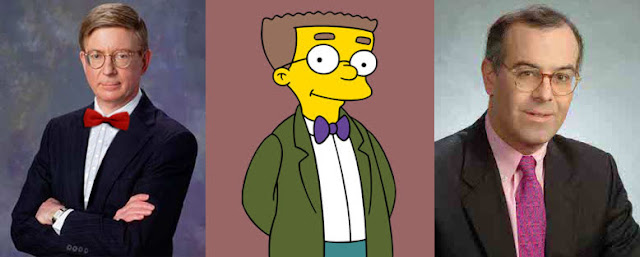
And the same people now tut-tutting Didion are mourning Terry Teachout.
repeat from 2018
I'd always thought of Teachout as an overly earnest, shallow, self-serving moral conservative, but now nihilism is a moral option. If I were to teach a course in how to convey moral complexity in art, I'd show my students "The Third Man." It isn't subtle, but it lays out with great clarity several irreconcilable moral points of view—and doesn't make the mistake of trying to reconcile them in the last reel.— Terry Teachout (@terryteachout) February 12, 2018
Teachout was an aesthete. Aestheticism is a form of denial; if nihilism isn't overt it slips out. Didion understood. What artist isn't tempted by nihilism in an age of crisis?
Vice is alluring; then show it as alluring; but it brings with its train peculiar moral maladies and suffering; then describe them.
The Third Man is about the limits of friendship and the seductions of fascism; to claim that fascism is a moral point of view is to already admit being seduced. "Twee fascism". I should've used the phrase, and for Bacharach too. I'm almost curious what he has to say about all this.
Marfrks: "For academics, ideas are games", without weight, connecting Teachout and Scialabba to technocrats, and why technocrats are gamers. Graeber's inverted technocracy is a form of positivism. Nihilism is an inverted moralism. So we end up with art critics interested in aesthetics but not art, because honesty scares them. Jeet Heer is an earnest liberal Zionist who writes about comics. His conservatism is manifested in the same childishness, again, without weight.
---
Fiat iustitia, et pereat mundus. Conservatism at it's best is human strength identifying itself with/as weakness; Fascism is weakness identifying with/as strength. It's the difference between "I serve the law" and "I am the law". "Unto the pure all things are pure", is a license to anything. Barbarians don't need a license. They accept responsibility for their choices. But if Biden is starving Afghanistan it's because he thinks he had no choice; following the doctrine of double effect he's been granted absolution. Doctors and nurses on the ground, doing their jobs in a crisis, are conservatives; social workers, people wanting to help, are liberals. It's the difference between behavior and ideation. Baudelaire and Didion would get the joke. A lot of people would, and do, but few "philosophers" "theorists" or "social scientists", most of whom identify as liberals.
An appropriately scathing review of Teachout's biography of Louis Armstrong. "Teachout has tailored Armstrong’s life story along lines that recall Horatio Alger." The art itself becomes meaningless.
Sunday, November 28, 2021
Although Graeber and Wengrow concern themselves primarily with humanity’s early history, they begin by examining how Western thinkers have previously treated the subject, and in doing so they first turn to the French Enlightenment. This happens to be my own area of expertise, and I was curious to see what they would make of it. Quite frankly, I was appalled.
The western romance of the other. David never understand culture because he denied that he had one. Utopianism is religious. The White Goddess, and Dungeons and Dragons. I'm not going to spend the money to read Appiah's review.
---
I forgot I have a second NYRB account that I can use to read recent articles. Once you start paying and then let it expire, you lose the option.
Then there’s Mashkan-shapir in Iraq, which flourished four thousand years ago. “Intensive archaeological survey,” we’re told, “revealed a strikingly even distribution of wealth” and “no obvious center of commercial or political power.” Here they’re summarizing an article by the archaeologists who excavated the site—an article that actually refers to disparities of household wealth and a “walled-off enclosure in the west, which we believe was an administrative center,” and, the archaeologists think, may have had an administrative function similar to that of palaces elsewhere. The article says that Mashkan-shapir’s commercial and administrative centers were separate; when Graeber and Wengrow present this as the claim that it may have lacked any commercial or political center, it’s as if a hairbrush has been tugged through tangled evidence to make it align with their thesis.
They spend much time on Çatalhöyük, an ancient Anatolian city, or proto-city, that was first settled around nine thousand years ago. They claim that the archaeological record yields no evidence that the place had any central authority but ample evidence that the role of women was recognized and honored. The fact that more figurines have been found representing women than men signals, they venture, “a new awareness of women’s status, which was surely based on their concrete achievements in binding together these new forms of society.” What they don’t say is that the vast majority of the figurines are of animals, including sheep, cattle, and pigs; it’s possible to be less sanguine, then, about whether female figurines establish female empowerment. You may still find yourself persuaded that a preponderance of nude women among depictions of gendered human bodies is, as Graeber and Wengrow think, evidence for a gynocentric society. Just be prepared to be flexible: when they discuss the Bronze Age culture of Minoan Crete, the fact that only males are depicted in the nude will be taken as evidence for a gynocentric society. Then there’s the fact that 95 percent of Çatalhöyük hasn’t even been excavated; any sweeping claim about its social structure is bound to be a hostage to the fortunes of the dig.
And so it goes, as we hopscotch our way around the planet....
Appiah pretty much disgusts me as a thinker. Graeber only annoys me, for reasons of loyalty if nothing else. Both of them, as "liberal" or "anarchist" are asocial, anti-cosmopolitan individualists. Graeber's model of community is a fantasy dreamed up by someone for whom actual communality, common culture, was impossible.
Wednesday, July 28, 2021
Solidarity Forever
Biles withdrew first from team competition and only later from the individual, but liberals and pseudo-leftists can't make the distinction.
"Antifa as Political Antibodies", by the same author. From Bernard Knox and Ken Graeber, to this.

 |
| July 28 |
I'll take the miners.
Chomsky's annoying; he was right about antifa without understanding what it meant. Anti-fascism is anti-utopian. Ken Graeber was a tradesman. His son was the intellectual.
And the UAW isn't pro-coal; it's pro fair wages and safety.
Wednesday, October 28, 2020
You can't always get what you want
I'm not sure why I called her a sociopath. I guess I just had to up the ante. She's obviously autistic. Leiter says "you've never seen anything like it". A lot of people have, but I was so annoyed I missed the obvious. It's almost comic that a non-autistic academic should be discovering the richness of the stimulus alongside a woman with a cognitive disability. Like a seeing person learning to appreciate vision alongside a blind woman slowly regaining some level of sight. As a narrative it could be lovely, but as philosophy it's absurd. Wittgenstein's desperate formalisms were part and parcel of fin de siècle Vienna. Callard belongs with Leiter, G.A. Cohen, Cowen and the rest. But I've added the Robert Wilson tag.
---
Leiter: philosophy and autism; philosophy and sociopathy.
And again. This time Leiter links to Cowen
COWEN: Let’s turn now to your new book, Aspiration: The Agency of Becoming. There’s a sentence from the book. Let me read it, and maybe you can explain it. “Proleptic reasons allow you to be rational even when you know that your reasons aren’t exactly the right ones.” What’s a proleptic reason?
CALLARD: What I’m trying to explain is, how do people get themselves to care about things that they don’t yet care about? Suppose that you want to come to appreciate a certain kind of music — that’s the example I use in the book — more than you do.
Then there’s the question, why should you do that? Why should you take the music appreciation class? You might say, well, the value of music. Classical music is this great thing, but you don’t see it as valuable, presumably. That’s why you have to take a class.
So there’s a kind of paradox that would suggest we should never try to get ourselves interested or into new things because, in order to have a reason to do that, we’d already have to have the interest.
Proleptic reasons are supposed to solve this problem. They are the reasons that you act on when you are working your way into a new domain of value. What I say characterizes these reasons is that they have two faces. They’re kind of divided. They have two parts.
The one part is like if you were to say, “What’s your reason? Why are you taking this class?” You might say, “Well, the intrinsic value of classical music is one of the great goods that our civilization has produced.” Something like that.
But when you say that, your words are going to be a little bit hollow. If they ask you to say more, you won’t be able to say much. That’s not all of your reason. That’s what I call the distal face of your reason, the face that looks away to the person you’re going to become.
But then there are also going to be bits of your motivation that are a little more embarrassing, like, “A bunch of people I admire are in the class.” Or “I think that people will like me more.” “I have some ideal of, or some image or some fantasy of, a kind of enriched life, and I see classical music as part of that.” I think those are also parts. That’s the proximate face of the proleptic reason, the part that you can now grasp. But you can see that that’s not all of it.
Again Leiter: Callard and Paul win a prize. "Personal Transformation and Practical Reason"
The twists some people have to go through to justify curiosity, and the fact that they're influenced by the choices of others.
there are also going to be bits of your motivation that are a little more embarrassing, like, “A bunch of people I admire are in the class".
"embarrassing" Some people are interested in mathematics. Maybe I should find out why.
Callard, Aspiration: The Agency of Becoming, OUP, 2018 (my underlining)
Becoming someone is a learning process; and what we learn are the new values around which, if we succeed, our lives will come to turn. Agents transform themselves in the process of, e.g., becoming parents, embarking on careers, or acquiring a passion for music or politics. How can such activity be rational if the reason for engaging in the relevant pursuit is available only to the person one will become? How is it psychologically possible to feel the attraction of a form of concern that is not yet one’s own? How can the work done to arrive at the finish line be ascribed to one who doesn’t (really) know what she is doing or why she is doing it? These questions belong to the theory of aspiration. Aspirants are motivated by proleptic reasons, reasons they acknowledge to be defective versions of the reasons they expect to eventually grasp. The psychology of such a transformation is marked by intrinsic conflict between aspirants’ old point of view on value and the one they are trying to acquire. They cannot adjudicate this conflict by deliberating or choosing or deciding—rather, they resolve it by working to see the world in a new way. This work has a teleological structure: by modeling herself on the person she is trying to be, the aspirant brings that person into being. Because it is open to us to engage in an activity of self-creation, we are responsible for having become the kinds of people we are.
Life is responding to events. People transform themselves because they're forced to. Agents are transformed. Adapt or die. Positivist pseudoscience is based on anti-scientific priors.
"It is no secret that contemporary philosophy is under the spell of the Other."
The desperate, pathological, need for there to be a "rational, single self"
The false distinction between cognitive and affective. Computers have no desires. The subject came up yesterday.
“Well, the intrinsic value of classical music is one of the great goods that our civilization has produced.”
Classical music is man-made form, in a natural medium within physical and cultural parameters. An intelligent little green man from Mars would find more of interest in Bach than in most philosophy, and not just because of the math. Aesthetics is such a stupid, useless fucking word.
Everything is nonsense. The history of nonsense is scholarship.
Science is the study of facts and philosophy the study of values. Conflating the two in favor of facts, values become assumed. Values being assumed, all questions are seen as those of expertise. With expertise as the means, terms of measurement are assumed. [with expertise as the means, expertise becomes the goal.] Curiosity becomes defined by the frame, values defined by the frame moral worth defined by the frame.
I wrote that years ago. It's less a defense of a distinction between values and facts than an attack on the presumption of the equivalence of facts and truths. Facts are for argument. All argument is political. Truths are metaphysical.
"Rationalism is low-information rationality"
Autism and sociopathy are disabilities. Philosophy is not a formalism. It's not technical. Being a tone deaf violinist is a limitation. Callard claims to be a Kantian, but she renders it meaningless. An honest defense of tribalism would carry the weight of a conviction, the acknowledgment of a burden and a cost.

Read the first interview with Callard. Her happy, cold, blankness, and the blank acceptance of her enablers. Amy and Leon Kass, Burkean conservatives, are the exception, though obviously they were blind to her for years. Maybe it's less a matter of their disapproval than their realization that their friend and friendship weren't what they'd thought. For the rest it's like the celebration of Aaron Swartz, and to some extent, Graeber, without the tragedy. Callard isn't hiding anything.
Kass, "old fashioned humanist". See the references to Joshua Lederberg, there, and here.
Cowen in 2009, in The CHE: "Autism as Academic Paradigm"
Pedantry is neurological. NFS means no fucking shit.
---
May 2021: Callard and L.A. Paul
Tuesday, September 22, 2020
Someone on twitter made an "alignment chart" for members of her Marx reading group and I realized I'd never looked up the origins. No surprises.
Arneson's role-playing game design work grew from his interest in wargames. His parents bought him the board wargame Gettysburg by Avalon Hill in the early 1960s. After Arneson taught his friends how to play, the group began to design their own games[5] and tried out new ways to play existing games. Arneson was especially fond of naval wargames.[6] Exposure to role-playing influenced his later game designs. In college history classes he role-played historical events, and preferred to deviate from recorded history in a manner similar to "what if" scenarios recreated in wargames.[7] In the late 1960s[5] Arneson joined the Midwest Military Simulation Association (MMSA), a group of miniature wargamers and military figurine collectors in the Minneapolis-St. Paul area that included among its ranks future game designer David Wesely. Wesely asserts that it was during the Braunstein games he created and refereed, and in which other MMSA members participated, that Arneson helped develop the foundations of modern role-playing games on a 1:1 scale basis by focusing on non-combat objectives—a step away from wargaming towards the more individual play and varied challenges of later RPGs.[8][9] Arneson was a participant in Wesely's wargame scenarios, and as Arneson continued to run his own scenarios he eventually expanded them to include ideas from The Lord of the Rings and Dark Shadows.[10] Arneson took over the Braunsteins when Wesely was drafted into the Army, and often ran them in different eras with different settings.[11]:6 Arneson had also become a member of the International Federation of Wargamers by this time.[11]:6 In 1969 Arneson was a history student at the University of Minnesota and working part-time as a security guard.[12] He attended the second Gen Con gaming convention in August 1969 (at which time wargaming was still the primary focus) and it was at this event that he met Gary Gygax,[13][14] who had founded the Castle & Crusade Society within the International Federation of Wargamers in the 1960s at Lake Geneva, Wisconsin, not far from Arneson's home in Minnesota.[5][12] Arneson and Gygax also shared an interest in sailing ship games and they co-authored the Don't Give Up the Ship naval battle rules, serialized from June 1971 and later published as a single volume in 1972 by Guidon Games with a revised edition by TSR, Inc. in 1975.[12][15]
Dungeons and Dragons, Slate Star Codex, "rationalists" Scott Aaronson, Aaron Swartz, David Graeber, Utopia and Intentional Communities, Transhumanism and Transgender, Fascism, Futurism and Data Culture,
Wednesday, September 16, 2020
Graeber being a fool, about 50 mins in.
A mother takes care of a child so that child can grow and thrive of course, but on the immediate level, what are they doing right now to facilitate that child doing, it's mostly so the child can go and play, and play is the ultimate expression of freedom for its own sake... [fading, quickly] One could argue that it's one of the constitutive principles of the universe, [fading out, vocal fry] but that's another... another argument. [Laughter.]
When met him he read Robert Graves and worshipped the White Goddess. He never stopped being a fantasist. He's one of the reasons I went from having no interest in Dungeons and Dragons to actively hating it.
Having no interest is an understatement.
repeats It even mentions David. And he has a tag.

Sunday, September 06, 2020
Utopians and Anti-Utopians
Dear David,
It’s midnight. Tears come and go like tides. Last night under the full moon, you passed away suddenly and left this world that you have been so much part of transforming for the better. In the library on the ZAD (Zone à Défendre, Zone to Defend)—built where the French state wanted to put an airport, in the shadow of an illegal lighthouse erected on the site of a planned control tower—there are eight books on special display. One of them is the French edition of your Bullshit Jobs.
The library is crammed with books about anarchism, occupation movements, the Paris Commune, utopias, territorial and peasant struggles. Strangely, next to the display copy of your book there was a half-empty shelf: the only half-empty shelf in the library. That shelf seemed to be the place to mark your senseless passing, with just enough space to make a small shrine to your memory, your friendship, your brilliance and quirkiness.
We adorned it with candles, flowers from the meadow where they wanted to put the runway, a paving stone from an old barricade from the forty-five-year-long struggle here, and a photo of you smiling and looking up to your left into the air, as if calling the spirits of joyful rebellion to your side. If we followed your gaze, up from the photo across the books, it landed on the shelf marked ACAB (All Cops Are Bastards). You would have laughed your trickster laugh.
Not many libraries have an ACAB shelf, or are built on an occupied autonomous zone against an airport and its world, which worked with self-organization without police for six years. You would have loved the ZAD; it embodied your ideas where direct action became entangled with everyday life. We had often spoken about you and Nika visiting us, giving a talk here, spending time together walking through these farms and wetlands saved from destruction. But life, like revolution, is always unexpected. You were not to visit these four thousand acres which politicians once called the territory lost to the republic. We still can’t believe that we have lost you. Tonight we shot a firework toward the moon for you.
Saturday, September 05, 2020
with.@davidgraeber
— Nika Dubrovsky (@nikadubrovsky) September 4, 2020
from his best school friend Stuard Rockefeller pic.twitter.com/p0TXwpNYz4

Classics at Phillips Andover, 1978. David in the black t-shirt, talking. Stuart in the back, under the chin.
Thursday, September 03, 2020
Graeber was my closest friend for most of the 80s. We were roommates in college in NY and later briefly in Chicago before we had a falling out. We didn't talk for years. I found out 20 years later that he'd dedicated one of his first published essays to me and to his girlfriend at the time. Our last argument was a few years ago.
Wikipedia gets a few things wrong. His father wasn't Jewish. He was German. It links his Lincoln Brigade page. Both his parents had great stories. I remember his mother showing me the Life Magazine spread with new faces in Hollywood, a page of floating headshots in five pointed stars. I recognized her but she pointed to Vincent Price. "It was so hard to be a homosexual in those days." It didn't work out and she ended up back on the shop floor. His father was 46 when David was born. His mother was two years younger. David's father's father was older than that when David's father was born, and David's great-great-grandfather fought in the battles of Leipzig and Waterloo. In his 60s David's father started studying Romani. One day he was walking in the Village and a woman called him over. Gypsy women are never prostitutes but they'll roll you. He let her go on for a few minutes with her arm around his waist before upbraiding her in her native language: "You should be ashamed of yourself!" He laughed describing the expression on her face and her apologies. He'd conned a con. I have other stories. Bella Abzug was "Bella Bets" because when she played poker she never folded. At some point David's father gave me a Roman coin. I have no idea what happened to it. There are other things more personal that I know less about, but they're not mine to talk about either way. I learned a lot from David, and since he admitted it I can say without appearing to brag that he learned a lot from me. He was an ass, but so am I. And he's the first person I've lost from our generation who was important to me, intellectually and as a friend.
The few times in the megillah where I mention friends it's David. Also any references here to "old roommate" etc.
The last time we communicated couple of years ago he sent me a photograph. He said it was me. I said it was him. He said it was me. It's him. It's his parents' apartment. I'm not sure of the painting on the left but the print or drawing on the right is Jack Levine. They knew everyone. I'm sure they had connections to my father, and my parents, but didn't ask. They all knew Harry Bridges.
 Ruth Rubenstein singing Chain Store Daisy, Archive.org
A photo on Flicker, Cornell ILGWU Archive. An interview, but not public.
The hagiographies are coming fast. I'll hold my tongue for now.
 David in 1978, Cropped, from here. I think the pic above is me.
Wikipedia gets a few things wrong. His father wasn't Jewish. He was German. It links his Lincoln Brigade page. Both his parents had great stories. I remember his mother showing me the Life Magazine spread with new faces in Hollywood, a page of floating headshots in five pointed stars. I recognized her but she pointed to Vincent Price. "It was so hard to be a homosexual in those days." It didn't work out and she ended up back on the shop floor. His father was 46 when David was born. His mother was two years younger. David's father's father was older than that when David's father was born, and David's great-great-grandfather fought in the battles of Leipzig and Waterloo. In his 60s David's father started studying Romani. One day he was walking in the Village and a woman called him over. Gypsy women are never prostitutes but they'll roll you. He let her go on for a few minutes with her arm around his waist before upbraiding her in her native language: "You should be ashamed of yourself!" He laughed describing the expression on her face and her apologies. He'd conned a con. I have other stories. Bella Abzug was "Bella Bets" because when she played poker she never folded. At some point David's father gave me a Roman coin. I have no idea what happened to it. There are other things more personal that I know less about, but they're not mine to talk about either way. I learned a lot from David, and since he admitted it I can say without appearing to brag that he learned a lot from me. He was an ass, but so am I. And he's the first person I've lost from our generation who was important to me, intellectually and as a friend.
The few times in the megillah where I mention friends it's David. Also any references here to "old roommate" etc.
The last time we communicated couple of years ago he sent me a photograph. He said it was me. I said it was him. He said it was me. It's him. It's his parents' apartment. I'm not sure of the painting on the left but the print or drawing on the right is Jack Levine. They knew everyone. I'm sure they had connections to my father, and my parents, but didn't ask. They all knew Harry Bridges.

A photo on Flicker, Cornell ILGWU Archive. An interview, but not public.
The hagiographies are coming fast. I'll hold my tongue for now.
---
And now two other people who knew us are saying the pic is me. I'm having a bad day. A third says it's David, but now I don't trust anybody. Friends fuck with you. It's what they're there for.
---

Tuesday, March 14, 2017
The "Smart" and the "Folk"
File under pathology (spot the dissonance, etc.)
Two from Leiter.
1- On the "smart"
The first sentence of the abstract
The inability to intuit even one's own sense of the world. The shallow passivity of false "objectivity" It's either autism or pseudo-autism. The "folk"
Knobe now has his own tag.
"all of us are most people most of the time"
"The President and Other Intellectuals" again,
and...
"Had not fully appreciated until now how much the relentless American drive for optimism resembles abject denial."
"The American has got to destroy. It is his destiny"
Perlstein is a proud defender of Humphrey.
 "Norman Sherman's idea of fun is attending a political convention. He has been active in liberal politics since before he could vote, often as a ghostwriter and editor of speeches and books.
His story describes a life working for Minnesota political leaders: Governors Orville Freeman and Karl Rolvaag, Congressman Don Fraser, Senators Wendell Anderson, Eugene McCarthy, Walter Mondale and Hubert Humphrey. He was press secretary to Vice President Humphrey, including during the 1968 campaign, and edited Humphrey's autobiography. He began his working career as an instructor in humanities at the University of Minnesota and ended it as a professor in the Manship School of Mass Communication at Louisiana State University. He describes the world of politics with good humor and grace."
My mother said she divorced him because he had no sense of the tragedy of life.
"They are not intellectuals, but occasionally dream that they will be. That is their secret ambition. "
Two from Leiter.
1- On the "smart"
A nicely written essay by Rick Perlstein.Perlstein: On the liberal cult of the cognitive elite
Now I better understand why: often, the cult of “smart” is a superstition. In LBJ’s time, to believe in it was “abnormal.” Now, that belief is collective—quite nearly unanimous. Which doesn’t make things easier for the Democrats pushing the ideology of cognitive elitism most assiduously. “Why do working-class Bush voters tend to resent intellectuals more than they do the rich?” David Graeber asked in 2007. “It seems to me the answer is simple. They can imagine a scenario in which they might become rich but cannot possibly imagine one in which they, or any of their children, would become members of the intelligentsia.”
For if you’re not a part of the intelligentsia, well, how can you possibly make the world better for your existence in it? This frustration, however, is precisely what makes perfectly decent people, whose only sin is that a self-arrogated cognitive elite doesn’t consider them particularly useful, such easy pickings for political con men who assure them that they’re actually the smart ones. And that, all in all, is not very smart.2- Psychologists who study "happiness" use a concept unrecognizable to the folk
Joshua Knobe (Yale) discusses.
CORRECTION: This piece is written by Prof. Knobe's co-author, Jonathan Phillips, who took a PhD in philosophy and psychology at Yale, and is a currently a post-doc at Harvard. (Thanks to Bob Gamboa for the correction.)Phillips
Start by imagining a man named Tom:
Tom always enjoys his job as a janitor at a local community college. What he likes most about his job is how it gives him a chance to meet the young female students who are attending the community college. Almost every single day Tom feels good and generally experiences a lot of pleasant emotions. In fact, it is very rare that he would ever feel negative emotions like sadness or loneliness. When Tom thinks about his life, he always comes to the same conclusion: he feels highly satisfied with the way he lives.Now ask yourself about what Tom feels like: Does Tom feel bad? Does he feel satisfied with what he's doing? Does he feel good?
The reason Tom feels this way is that every day he goes from locker to locker and steals belongings from the students and re-sells these belongings to buy himself alcohol. Each night as he's going to sleep, he thinks about the things he will steal the next day.
Okay, regardless of what you thought about those questions. Now just ask yourself this: Is Tom happy?
If you’re anything like the participants in our studies in a new paper in the Jouurnal of Experimental Psychology: General, the answer to these two kinds of questions will come apart. People tend to agree that Tom feels good and is satisfied, but at the same time, they don't agree that he is happy. This seems to suggest that people think there’s more to being happy than just feeling good. Perhaps to truly be happy, you also have to be good.The title of the paper: "True Happiness: The Role of Morality in the Folk Concept of Happiness."
What’s striking about this pattern of judgments is that it suggests ordinary people think about happiness in a way that contradicts the definition that is widely used by scientists. For scientists who research and measure happiness (or politicians who make policy decisions based on increasing happiness), being happy is nothing more than the combination of feeling good and being satisfied — it really doesn't matter why you feel that way.
To investigate why people’s judgments about happiness were being influenced by whether or not the person was living a morally bad life, we conducted a number of further studies.
The first sentence of the abstract
Recent scientific research has settled on a purely descriptive definition of happiness that is focused solely on agents’ psychological states (high positive affect, low negative affect, high life satisfaction). In contrast to this understanding, recent research has suggested that the ordinary concept of happiness is also sensitive to the moral value of agents’ lives."This research was supported by an Office of Naval Research Grant..."
The inability to intuit even one's own sense of the world. The shallow passivity of false "objectivity" It's either autism or pseudo-autism. The "folk"
Knobe now has his own tag.
"all of us are most people most of the time"
"The President and Other Intellectuals" again,
and...
"Had not fully appreciated until now how much the relentless American drive for optimism resembles abject denial."
"The American has got to destroy. It is his destiny"
Perlstein is a proud defender of Humphrey.
"Norman Sherman's idea of fun is attending a political convention. He has been active in liberal politics since before he could vote, often as a ghostwriter and editor of speeches and books.His story describes a life working for Minnesota political leaders: Governors Orville Freeman and Karl Rolvaag, Congressman Don Fraser, Senators Wendell Anderson, Eugene McCarthy, Walter Mondale and Hubert Humphrey. He was press secretary to Vice President Humphrey, including during the 1968 campaign, and edited Humphrey's autobiography. He began his working career as an instructor in humanities at the University of Minnesota and ended it as a professor in the Manship School of Mass Communication at Louisiana State University. He describes the world of politics with good humor and grace."
My mother said she divorced him because he had no sense of the tragedy of life.
"They are not intellectuals, but occasionally dream that they will be. That is their secret ambition. "
Subscribe to:
Posts (Atom)