Showing posts with label Collage Mash-up Remix. Show all posts

Sunday, December 15, 2024

Ali Bati, the ad that became a meme. 

The original drawing was about progress as it gradually became more skillful from left to right.
art vs illustration, intent vs reception, reading images, and time, left to right, in the West. I always liked the meme. I saw it today used to describe the Biden administration and decided to look for the source. That's when I learned that the one move was to flip the drawing. A simple transformation, and brilliant.

Jokes are popular art. Duchamp was a joker. There are a few cases where Bati could sue, but he seems to take in it stride.

Monday, October 02, 2023


I think I've said before; someday someone will do a book and an exhibit of these things.  The two below are far from the best, but they reminded me.  I hate the word "memes". If you want to be determinist then Dennett's arguments and their popularity are as determined as the Taylor Swift's songwriting. In the past I've said Lady Gaga. I'm offended mostly by the sense of superiority of Dennett and Dawkins, Remove that and you get Skinner, who offends more people because he seems so innocent.


NFTs are the perverse inverse: the meaningless but one-of-a-kind as a market substitute for things rich with meaning and/because infinitely reproducible. Paul Pfeiffer began with something similar—working off it, not inventing it; the art world imperative derailed him. Banksy is better. 

But "memes" are the equivalent of children's games, or slang. We know the origins of some but know them mostly as things passed around, less as things made than things chosen for survival, which is why the name of course. MoMA should do the show, but they won't. Paris would be good.

Friday, June 02, 2023

Free verse, or meter. Breaking the frame or the fourth wall. "Never did the 'rules' embarrass any genius", Eliot against Hamlet, etc. The English garden or the French. Straub or Huillet talked about a boom visible in a shot on the stairs in Psycho as a perfect cinematic moment, and that intellectual filmmakers design accidents that come off as false. A brilliant observation, but the rocking camera as an actor walks by on an unstable floor—in their take on Kafka—is as overdetermined as the framing. I was looking for scraps to cover the grey border and the piece I picked up had a tab of pink stapled to it; I'd used it as a support on the back but cut it away and now it was on the front, and it worked: it plays off the stripe on the hood of the car. How do you construct the anarchic, in art or elsewhere? How do you mix the abstract and the figurative and not make it gratuitous—and trite at this point—or just stupid? I don't know.  How do you make something that works for people with whom you have little in common? How do you make something that will outlast you? I don't know.  There's an argument that working for others makes you work harder. It's the argument for the cinematic golden ages of Hollywood and post-revolutionary Iran. It's the argument for HBO, and the Venice Film Festival over the Biennale. I've said this all before.  You never want to get high on your own supply, and you never want to work for fans, but this is my ghetto and this is what I do.

I follow my logic where it takes me, and I ended up with an image of someone trapped. I'm consistent. His expression is perfect but I didn't even notice it, or I wasn't aware that I had. 

Photographs, reject prints from my stockbroker, who used to race at Limerock.  Frank Veteran:


I took it apart and it felt like panel from an altarpiece that had been broken up. I think this is it.

Maybe the tab on the bottom is overdone. It's still only part of a frame, continuing the logic of the central construction. You don't want to tail wagging the dog. But it hags below the frame like the front end of the car, and it matches the dark horizontal stripe. It's the same color-the light'a hitting from a different angle. Maybe it's the added grey not the tab that goes too far. I'm thinking about all this after the fact, but obviously I saw the relations before I was able to articulate them. The reason of sleep. But the three narrow white stripes, on the pink, the bottom left and right, annoy me. I think of them as Viennese: desperate maybe but not serious. But that's how it started. Again, I'm consistent. And the pink is now Franz West. 

Thursday, March 02, 2023

see how long it lasts

Friday, February 17, 2023

He really is dim. It's not like the US didn't threaten to "bring an end to it". 
"It's like arguing with Zionists."

A Stanford endocrinologist advocating for the castration of 10 year olds. 


Cooper's spent the last few days focusing on the fantasies of a subset of a subset, while downplaying the disaster in Ohio. Contempt for the trash is the corollary of the intellectual liberal imperative—Moyn and Balkin—for civility among the elite. The intellectuals play footsie with fascists while the middling pundits piss on their followers.
[I misread the @USDOT tweet. That was stupid. It happens] 

Sirota's new rag has been good. Jeet Heer is a putz, but he's smart enough to keep his priorities straight.
"Buttigieg’s Paralysis After the East Palestine Disaster Is a Gift to the Hard Right" 

The Big Short hasn't aged well; moralizing stockbrokers doesn't work in the long run. Someone needs to make a feature length mashup of The Big Short and Margin Call. That would be an interesting project.

Tuesday, November 15, 2022

Dilla is often said to have reintroduced error into the sound of hip-hop. But that isn’t really the case. His technique wasn’t aleatory, it was precise. He used the MPC’s swing and shift functions to pull some of the drum tracks slightly out of position, into swung time, while leaving other elements of the track in straight time. Snare drums in rap are expected to arrive sharp on the second and fourth beats of the bar. Dilla moved them fractionally forward, so they sounded rushed; he let bass kicks lag and pulled basslines far behind the beat. He kept other parts of the track in strict time, setting up sustained, swirling conflicts between elements. It may not sound like much, but it was revolutionary. What Charnas calls ‘Dilla Time’ is ‘the deliberate juxtaposition of multiple expressions of straight and swing time simultaneously, a conscious cultivation of rhythmic friction for maximum musicality and maximum surprise’. This is nothing like a human, live instrument sound. Drummers don’t do it (not unless they’ve been studying Dilla), and it can’t be achieved by accident.

Dilla rarely gave interviews and so, like King Tubby, another tight-lipped pioneer of music made via machines, he left no account of exactly why or how he came to his innovations. The most we have is a simple assertion: ‘This is my natural rhythm. It’s how I bob my head.’ Detroiters like Dilla, Charnas suggests, ‘had a natural affinity for unnatural sounds’, something that reached back at least as far as Berry Gordy writing the first Motown hits to the industrial rhythms of the Ford production line. And as the age of electronic music dawned the city’s Black club scene had also produced techno, one of the hardest of dance music styles – futuristic, thumping, edged with silver. In some ways it makes perfect sense that Dilla would have used new digital technologies to produce music that didn’t sound like anything a human drummer would make. 

Fred Saunders’s​ wheelwright shop in the village of Sherborne, Gloucestershire, stood not far from the forge and next to the paint shop, where his finished waggons were painted in colours declaring their high Cotswold origins. Fred kept the oak spokes of his wheels narrow and light because the waggons were destined for use in the elevated fields, unlike those made in the Severn Valley, which needed to be fat to resist the riverside mud. Fred turned the hubs out of great lumps of elm, one of the few woods tough enough to withstand the stress of use in the fields. A circle of interconnected ash felloes capped the spokes, forming the circumference of the wheel. The final component was the tyre, made of a loop of iron, half an inch thick. It was placed in the fire until sufficiently expanded, then lifted out with great tongs called tyre-dogs and dropped over the outside of the wheel. Wheel and tyre would then be doused with cold water so that the metal shrank back to its original size, squeezed tightly about the wheel, never to be rattled free by stone or pothole. Fred made haywains, muck-carts and drays, as well as the everyday wooden items required by his neighbours – and their coffins when they died.

Fred lived from 1907 to 1984. He learned his trade as an apprentice and passed it on to his son, Graham, by the same method, continuing a tradition that had existed before the industrial revolution, before mass-production, when objects were closely aligned with the people and processes by which they were made. He possessed the kind of embodied knowledge common to crafters down the centuries, described by Pamela H. Smith in From Lived Experience to the Written Word as acquired through ‘observation and repetitive bodily experience’.  Smith’s study encompasses the period from 1400 to 1800, when practitioners increasingly sought to put their trades into words, composing and publishing craft manuals, guides, treatises, recipe books, tip sheets and diagrams. They were articulating something implicit in their objects: as Smith puts it, ‘the residue of an enormous number of exchanges among individuals, as well as their belief systems, organised practices, networks and accumulated knowledge’. These texts, she argues, enrich our understanding of the theoretical world of European makers, the development of technical writing and, by extension, the birth of modern science.

Two articles on art in LRB. It was a nice touch to put them in the same issue, and in a row. The result is a story that loops back on itself. It's also the story of the relation of composing and performing.   

Saturday, October 29, 2022


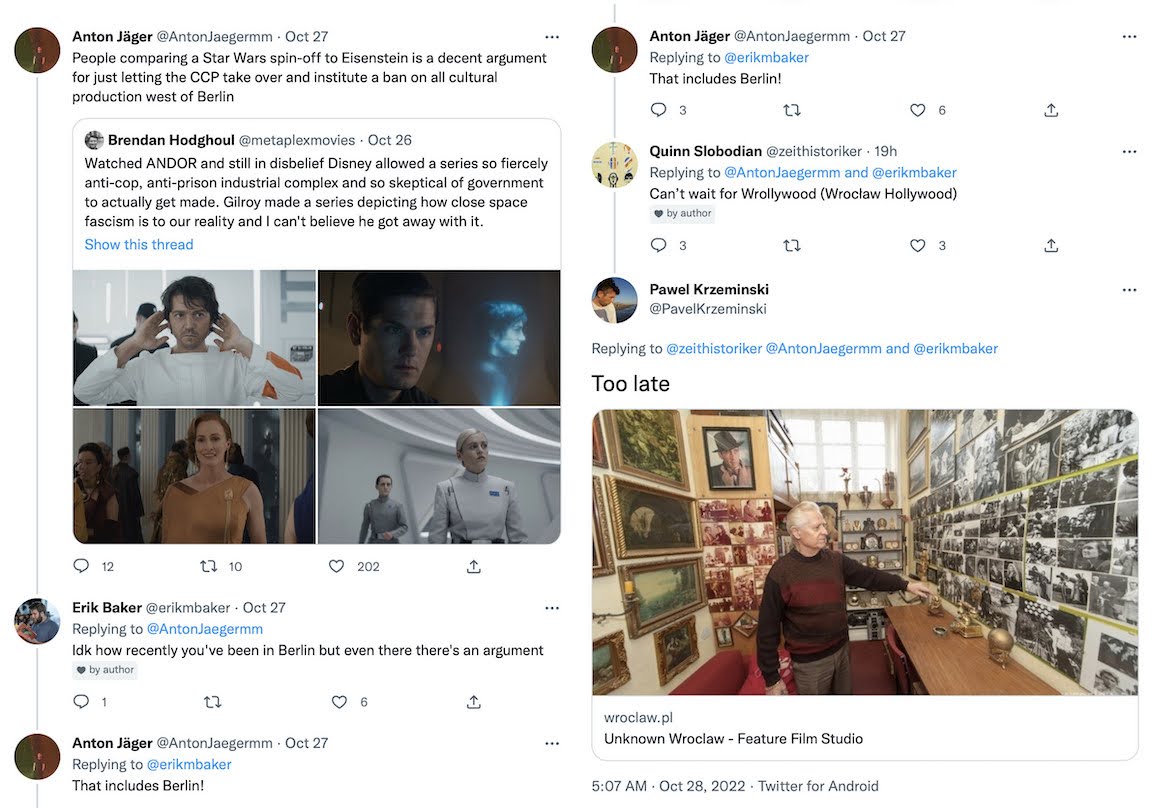
Milanovic defends "a thousand points of light". Jäger and the Slobodian are snobs—Jäger's admitted it— pretentious defenders of what their own seriousness. But Jäger's a proud fan of Fleetwood Mac and I think I may be responsible for Leusder shutting down his Soundcloud account—in embarrassment? And the idiot they're mocking is a fan of Mark Fisher. I don't know where the Eisenstein reference comes from. It's not in the thread, but all the thread is is bragging by citation and in-jokes, academic standard practice. "They then chuckle together in a self-congratulatory academic manner."  

It was common knowledge once that Lucas modeled the stormtroopers' helmets after the Teutonic Knights in Nevsky, and the emperor's cloak and the camera angles after the grand master.

Lucasfilm 
Johnston remembered that early on, Lucas showed him Sergei Eisenstein’s classic film, Alexander Nevsky, whose opening feature featured a battle on ice between medieval warriors. Lucas told him, “I want the battle on Hoth to feel like this. I don’t want it to look like this, but feel like this.” With relative freedom from Lucas, Johnston relished the opportunity to imagine and develop the battle visually.
None of this means the Star Wars film's don't suck. But the first one has the perfection of Casablanca,  

The tragedy of cultural homogenization begins at the top: the fish rots from the head. Jäger, Slobodian and the rest have convinced themselves that only the other elite, the elite they disdain, are decadent. 
Mozart didn’t have luxury to write atonal music most people don’t understand/find ugly. He had to appeal to aristocrats for patronage & middle class who bought seats. It’s when you separate artist from audience (eg give him tenured university chair) that things turn south.

Jäger replies 

And Adorno was right when he said that Schönberg’s dodecaphony presupposes industrial class conflict as a backdrop for the music even to make sense to any audience

The Nazis weren't wrong when they said the work they banned was decadent. But the work they banned  was honest, and the work they promoted was decadence based on dishonesty: idealism as sham, backed by the gun. 

Adorno and Jäger, following Schönberg, by rhetorical sleight of hand—and out of psychological necessity—turn honest decadence into ideal truth, as liberalism and liberal economics does with greed and self-interest . In both cases awareness evinces optimism: the unexamined prior.

Back again to Arendt and Brecht. I repeat myself because everyone else does.

At that time, nobody anticipated that the true victims of this irony would be the elite rather than the bourgeoisie. The avant-garde did not know they were running their heads not against walls but against open doors, that a unanimous success would belie their claim to being a revolutionary minority, and would prove that they were about to express a new mass spirit or the spirit of the time. Particularly significant in this respect was the reception given Brecht's Dreigroschenoper in pre-Hitler Germany. The play presented gangsters as respectable businessmen and respectable businessmen as gangsters. The irony was somewhat lost when respectable businessmen in the audience considered this a deep insight into the ways of the world and when the mob welcomed it as an artistic sanction of gangsterism. The theme song in the play, "Erst kommt das Fressen, dann kommt die Moral," was greeted with frantic applause by exactly everybody, though for different reasons. The mob applauded because it took the statement literally; the bourgeoisie applauded because it had been fooled by its own hypocrisy for so long that it had grown tired of the tension and found deep wisdom in the expression of the banality by which it lived; the elite applauded because the unveiling of hypocrisy was such superior and wonderful fun. The effect of the work was exactly the opposite of what Brecht had sought by it. The bourgeoisie could no longer be shocked; it welcomed the exposure of its hidden philosophy, whose popularity proved they had been right all along, so that the only political result of Brecht's "revolution" was to encourage everyone to discard the uncomfortable mask of hypocrisy and to accept openly the standards of the mob. 

Eisenstein, Film Form, p. 20, defending convention, and tradition. 

We have been visited by the Kabuki theater-a wonderful manifestation of theatrical culture.·

Every critical voice gushes praise for its splendid crafts­manship. But there has been no appraisal of what constitutes its wonder. Its "museum" elements, though indispensable in estimating its value, cannot alone afford a satisfactory esti­mate of this phenomenon, of this wonder. A "wonder" must promote cultural progress, feeding and stimulating the intellec­tual questions of our day. The Kabuki is dismissed in plati­tudes: "How musical!" "What handling of objects!" "What plasticity!" And we come to the conclusion that there is nothing to be learned, that (as one of our most respected critics has announced) there's nothing new here: Meyerhold has already plundered everything of use from the Japanese theater!

Behind the fulsome generalities, there are some real atti­ tudes revealed. Kabuki is conventional! How can such con­ ventions move Europeans! Its craftsmanship is merely the cold perfection of form! And the plays they perform are feudal!—What a nightmare!

More than any other obstacle, it is this conventionalism that prevents our thorough use of all that may be borrowed from the Kabuki.

But the conventionalism that we have learned "from books" proves in fact to be a conventionalism of extremely interesting relationships The conventionalism of Kabuki is by no means the stylized and premeditated mannerism that we know in our own theater, artificially grafted on outside the technical requirements of the premise. In Kabuki this conventionalism is profoundly logical-as in any Oriental theater, for example, in the Chinese theater.

Among the characters of the Chinese theater is "the spirit of the oyster"! Look at the make-up of the performer of this role, with its series of concentric touching circles spreading from the right and left of his nose, graphically reproducing the halves of an oyster shell, and it becomes apparent that this is quite "justified." This is neither more nor less a convention than are the epaulettes of a general. From their narrowly utilitarian origin, once warding off blows of the battle-axe from the shoulder, to their being furnished with hierarchic little stars, the epaulettes are indistinguishable in principle from the blue frog inscribed on the forehead of the actor who is playing the frog's "spirit." 

I've referred to this for 40 years but never quoted it here. Nevsky was my favorite film as a kid, but it doesn't hold up. I still have fun watching it.

Jäger
People comparing a Star Wars spin-off to Eisenstein is a decent argument for just letting the CCP take over and institute a ban on all cultural production west of Berlin

I can play this game

Wednesday, October 26, 2022

"Institute of Art and Ideas"

IAINews, Henry Shevlin, "The artist is dead, AI killed them Can AI be genuinely creative?"

Shelvin

Henry Shelvin, University of Cambridge 

"Our mission at the Leverhulme Centre for the Future of Intelligence (CFI) is to build a new interdisciplinary community of researchers, with strong links to technologists and the policy world, and a clear practical goal: to work together to ensure that we humans make the best of the opportunities of artificial intelligence as it develops over coming decades."

"Henry Shevlin (PhD, CUNY Graduate Center, 2016; BPhil, Oxford, 2009) is a Senior Research Fellow with the Kinds of Intelligence programme and Course Co-leader of the MSt AI Ethics and Society. His work focuses on issues at the intersection of philosophy of mind, cognitive science, and animal cognition, with a particular emphasis on perception, memory, and desire. Since 2015, he has been serving as a student committee member of the Association for the Scientific Study of Consciousness."


Remember Saint-Simon,  the avant-garde and the future of war, and the previous fucking post.  The positivist model of art is kitsch. 

I never stop posting comments, but I don't expect much. Some typos fixed, added links, misc.

If a scholar wrote an essay making an original argument using nothing but quotes from other writers with a few words in-between it would be called plagiarism. Academics don't write well, but there you go. Plagiarism wasn't an issue you 300 years ago and now it is. 

But you have no understanding of what art is. Art isn't forward looking; it's retrospective. It's not "creative" it's observational, that's why it ages well, when it does.

"So what Brasilia became in less than 20 years wasn't the city of tomorrow at all. It was yesterday's science fiction. Nothing dates faster than people's fantasies about the future." Robert Hughes had his weak points, but here he's on the money.

Picasso painted the present in 1906. It's the same present described by TS Eliot. "HURRY UP PLEASE ITS TIME" Plagiarism or collage? 

Most importantly both made art about arrogant schoolboys terrified of women. Les Demoiselles d'Avignon is a castration scene. Eliot and Duchamp were political reactionaries, and Picasso was a cafe communist (who made a fortune speculating on his own artwork). But more importantly they were all brilliant 20th century boys, and they describe that reality—specific to place and race and class-better than their peers, or at least better than those that we know of. They describe their present better than you describe ours.

There's no such thing as AI. Intelligence is animal. Proust wrote about memory and loss: the descriptions of emotion. When you invent a program that fears its own obsolescence or death let me know. But I don't think any of us want a delusional supercomputer.

---

Jason Allen used a program as a tool. He's playing a language game using technology. The tool didn't make the art. And Eno at this point is a designer of sound and image. Design is a subcategory of art, but it doesn't force to rethink anything. His early work, a mixture of the Beatles, Gilbert and Sullivan and coin-tossing, did. But Eric Satie is less a great composer than a charming one. 
I've added this because I'm going to go off as a pedant on what is or is not art. Computers make patterns and patterns are aesthetic by definition. 

If you want to think about the relation of art and design and Warhol soup cans you should watch this film—Inge Druckrey: Teaching to See [no link code allowed: repeat]—and understand how much work goes into the designs we take for granted, and remember that Warhol was both a homosexual and a devout Byzantine Catholic. His printed paintings are both ironic and sincere. The works in his Death and Disaster series are terrifying. Warhol will be remembered for the art he made out of his confusions and fears, because if you pay attention you begin to understand them, through a visceral, animal, neurological, "sympathetic vibration". 

“People say Andy said he was a machine, but he didn’t. He said he wanted to be a machine, and that’s not the same thing at all.” Callie Angell 

It's a common desire these days. In the future people will ask how that came to be. Art ain't rocket science, but it goes along way to describing the minds of rocket scientists.

I spent too much time trying to find the post with the Boston Robotics video.  

Monday, May 16, 2022

archive.org  The first link above, to a Telegram channel, still works.

If you follow the academics, then "conceptual art" is a new form of philosophy, when the good stuff never was or is. There's something Protestant, or Anglo-Protestant-academic, in the need to make modern and supposedly secular philosophy into science, and then "fine art"—historically associated with "truth" (unlike stories or "fiction")—into pedantry. The little gestures above are serious because they undermine pedantry. They're serious because they're funny, and their humor represents everything the state claims to. Sometimes farting in church is a moral act.

I should really make this in to a poster or a t-shirt. In all the years I've put this out there not one person has told me that they simply got the fucking joke. Not one person has laughed. 
Hand-made/factory made, decent/vulgar, public/private, virgin/whore. It's fucking hilarious. And it's Duchamp's joke, not mine.

Saturday, March 20, 2021

A birthday card for a friend (he's on the left). File under visual imagination, or at least memory.

Wednesday, March 17, 2021

"A brilliant quip can lose its sharpness or even its intelligibility taken out of context, but that doesn’t take away from the intelligence of the gesture, only our ability to recognize it." 

I had an introduction to that quote, but it was too much. It's a hilarious "meme" the kind of thing someone would turn into an NFT. But the whole point is that it's infinitely reproducible. The age of mechanical reproduction began with Gutenberg. The cultural significance of the form–demotic commentary–has no relation to money.  

Albrecht Dürer, St. Philip 1526 Engraving, 12.2 x 7.7 mm.

The one I own, printed before final revisions, is worth a lot more than I paid for it. The dealer made a mistake. But I'll never sell it. 

While it is true that commercial art is always in danger of ending up as a prostitute, it is equally true that noncommercial art is always in danger of ending up as an old maid. Non commercial art has given us Seurat's "Grande Jatte" and Shakespeare's sonnets, but also much that is esoteric to the point of incommunicability. Conversely, commercial art has given us much that is vulgar or snobbish (two aspects of the same thing) to the point of loathsomeness, but also Durer's prints and Shakespeare's plays. For, we must not forget that Durer's prints were partly made on commission and partly intended to be sold in the open market; and that Shakespeare's plays—in contrast to the earlier masques and intermezzi which were produced at court by aristocratic amateurs and could afford to be so incomprehensible that even those who described them in printed monographs occasionally failed to grasp their intended significance—were meant to appeal, and did appeal, not only to the select few but also to everyone who was prepared to pay a shilling for admission. 
It is this requirement of communicability that makes commercial art more vital than noncommercial, and therefore potentially much more effective for better or for worse.

Thursday, March 11, 2021

NFTs again. 3/11-Price realised: $69,346,250

He's a commercial illustrator. The pitch is the "innovation". The market is producing the artist and the art.  

The positivist definition of art is illustration. If fine art has devolved into design, it still performs the function of art: the following of sensibility, responding to experiences, perceptions. But to ad men, like philosophers, art is successful communication as seen in metrics, and is designed as computer games are in the service of “fun”. The MIT communication department model of creativity follows the enthusiasm of the designers of Assassin’s Creed, and Gears of War, blind not even to subtext but to direct meaning, a blindness matching the enthusiasts of the “formalism” of the films of Paul Sharits. For all the discussion of the delivery of content, the content itself is seen as meaningless. This is the world of ideas, the academia that claims to provide a foundation for capitalism and anti-capitalism, revolution, Wall St. and Madison Avenue.

It's all here. 

I'm leaving in all the links: telegraphing the hard sell.
As of 6:48 pm on 3/10, the bidding is at $13,250,000 
On 1 May 2007, Mike Winkelmann, aka the digital artist Beeple, posted a new work of art online. He did the same thing the next day and the next, and the next one after that, creating and posting a brand-new digital picture, or ‘everyday’ as he called it, every single day for 13-and-a-half years. Now those individual pieces have been brought together in EVERYDAYS: THE FIRST 5000 DAYS, a unique work in the history of digital art.

Minted exclusively for Christie’s, the monumental digital collage will be offered as a single lot sale concurrently with First Open from 25 February to 11 March. Marking two industry firsts, Christie’s will be the first major auction house to offer a purely digital work with a unique NFT (Non-fungible token) — effectively a guarantee of its authenticity — and to accept cryptocurrency, in this case Ether, in addition to standard forms of payment for the singular lot.

‘Christie’s has never offered a new media artwork of this scale or importance before,’ says Noah Davis, specialist in Post-War & Contemporary Art at Christie’s in New York. ‘Acquiring Beeple’s work is a unique opportunity to own an entry in the blockchain itself created by one of the world’s leading digital artists.’...

His visionary and often irreverent digital pictures have propelled him to the top of the digital art world, winning him 1.8 million followers on Instagram and high-profile collaborations with global brands ranging from Louis Vuitton to Nike, as well as performing artists from Katy Perry to Childish Gambino.

In EVERYDAYS: THE FIRST 5000 DAYS, the artist has stitched together recurring themes and colour schemes into an aesthetic whole. The individual pieces are organised in loose chronological order: zooming in reveals pictures by turn abstract, fantastical, grotesque or absurd, deeply personal or representative of current events. Recurring themes include society’s obsession with and fear of technology; the desire for and resentment of wealth; and America’s recent political turbulence. 

‘Beeple is looking at his whole body of work as it’s presented on Instagram as a kind of Duchampian readymade’ — specialist Noah Davis 

The notable differences between the early and later pictures reveal Beeple’s enormous evolution as an artist. At the project’s inception, ‘everydays’ were basic drawings. When Beeple started working in 3D, however, they took on abstract themes, colour, form and repetition. Over the past five years, they have became increasingly timely, reacting to current events.

‘I almost look at it now as though I’m a political cartoonist,’ Beeple explains. ‘Except instead of doing sketches, I’m using the most advanced 3D tools to make comments on current events, almost in real time.’  

He's an idiot. 

The seriousness of fine art is the connected to the seriousness of philosophy: an artistic and intellectual elite removed from the world through its connections to authority. People forget that fine art was also known as "non-commercial" art, money dealt with discreetly, and buying to flip looked down upon. 

Playboys didn’t buy polo ponies, or football teams, to make money off them, and heiresses collected expensive dresses. The point is the game for the game’s sake, art for art’s sake.

I've said that all before. Rich people can afford to do some things things for love. This is the equivalent of real estate prices going through the roof while the rental income stays the same. It has no foundation, not even the foundation of self-respect still associated with good publishers and movie producers.

“The potential for it to disrupt the traditional art auction model is humongous,” said Noah Davis, the specialist in charge of the first NFT auction at Christie’s. Beyond the record-setting sale of Beeple’s “Everydays,” he said, NFTs’ “lack of objecthood” meant auction houses faced no costs required for storing, handling, cataloging, photographing and insuring a physical work of art, making a “really attractive opportunity” for auction houses.
History repeats, and now no one gets the joke.  I have no problem with Klein or Manzoni.

Guardian, 2012:  The 10 Best Invisible Artworks, etc.
The Florentine intermedios of the manneristic theater (similar to the English masks) abounded in such complicated allegories as seen in the Intermedio of 1585 and 1589 where the conclusion of Plato’s Republic appeared on the stage, including the Planets, the Harmony of the Spheres, the Three Goddesses of Fate, and even Necessity, holding the adamantine axis of the Universe (fig. 40). We happen to possess the diary of a nobleman who saw this play and stated that it was very beautiful but nobody could understand what it was all about. 

Thursday, February 25, 2021


Tarantino's indulgence in racism, and getting away with it, goes back to Scorsese, in a cab talking about killing his wife for fucking a black man. And then the scene above. Violence and comedy. Scorsese and Tarantino are both before anything else students of film. Not the first.  
I wish I could find a video of that included the transition to the street scene. But at the same time, since I'm still doing this, if I were a curator I would do a show of the best of YTMND


Reuters: How a 10-second video clip sold for $6.6 million

“You can go in the Louvre and take a picture of the Mona Lisa and you can have it there, but it doesn’t have any value because it doesn’t have the provenance or the history of the work,”

The provenance of a tulip. 

Sunday, January 31, 2021

The machine as symbolizing its action: the action of a machine—I might say at first—seems to be there in it from the start. What does that mean?—If we know the machine, everything else, that is its movement, seems to be already completely determined.

We talk as if these parts could only move in this way, as if they could not do anything else. How is this—do we forget the possibility of their bending, breaking off, melting, and so on? Yes; in many cases we don't think of that at all. We use a machine, or the drawing of a machine, to symbolize a particular action of the machine. For instance, we give someone such a drawing and assume that he will derive the movement of the parts from it. (Just as we can give someone a number by telling him that it is the twenty-fifth in the series i, 4, 9, 16, . . . .)

"The machine's action seems to be in it from the start" means: we are inclined to compare the future movements of the machine in their definiteness to objects which are already lying in a drawer and which we then take out.——But we do not say this kind of thing when we are concerned with predicting the actual behaviour of a machine. Then we do not in general forget the possibility of a distortion of the parts and so on.——We do talk like that, however, when we are wondering at the way we can use a machine to symbolize a given way of moving—since it can also move in quite different ways.

We might say that a machine, or the picture of it, is the first of a series of pictures which we have learnt to derive from this one.

But when we reflect that the machine could also have moved differently it may look as if the way it moves must be contained in the machine-as-symbol far more determinately than in the actual machine. As if it were not enough for the movements in question to be empirically determined in advance, but they had to be really—in a mysterious sense—already present. And it is quite true: the movement of the machine-as-symbol is predetermined in a different sense from that in which the movement of any given actual machine is predetermined. 

The officer realized that he was in danger of having his exposition of the apparatus held up for a long time; so he went up to the explorer, took him by the arm, waved a hand toward the condemned man, who was standing very straight now that he had so obviously become the center of attention -- the soldier had also given the chain a jerk -- and said: "This is how the matter stands. I have been appointed judge in this penal colony. Despite my youth. For I was the former Commandant's assistant in all penal matters and know more about the apparatus than anyone. My guiding principle is this: Guilt is never to be doubted. Other courts cannot follow that principle, for they consist of several opinions and have higher courts to scrutinize them. That is not the case here, or at least, it was not the case in the former Commandant's time. The new man has certainly shown some inclination to interfere with my judgments, but so far I have succeeded in fending him off and will go on succeeding. You wanted to have the case explained; it is quite simple, like all of them. A captain reported to me this morning that this man, who had been assigned to him as a servant and sleeps before his door, had been asleep on duty. It is his duty, you see, to get up every time the hour strikes and salute the captain's door. Not an exacting duty, and very necessary, since he has to be a sentry as well as a servant, and must be alert in both functions. Last night the captain wanted to see if the man was doing his duty. He opened the door as the clock struck two and there was his man curled up asleep. He took his riding whip and lashed him across the face. Instead of getting up and begging pardon, the man caught hold of his master's legs, shook him, and cried: 'Throw that whip away or I'll eat you alive.' -- That's the evidence. The captain came to me an hour ago, I wrote down his statement and appended the sentence to it. Then I had the man put in chains. That was all quite simple. If I had first called the man before me and interrogated him, things would have got into a confused tangle. He would have told lies, and had I exposed these lies he would have backed them up with more lies, and so on and so forth. As it is, I've got him and I won't let him go. -- Is that quite clear now? But we're wasting time, the execution should be beginning and I haven't finished explaining the apparatus yet." He pressed the explorer back into his chair, went up again to the apparatus, and began: "As you see, the shape of the Harrow corresponds to the human form; here is the harrow for the torso, here are the harrows for the legs. For the head there is only this one small spike. Is that quite clear?" He bent amiably forward toward the explorer, eager to provide the most comprehensive explanations.

It feels a little cheap. I always thought it was obvious in a general sense, but reading the first tonight I saw a chance to go cute. If you don't get the joke, copy and google the two texts.

Wednesday, June 24, 2020

"Behind the chiliasm of modern man, is the megalomania of self-infinitization."


From 2017. I've changed the ending a bit. Lemmy now gets the last word.

I keep thinking of this as a primer: easy to understand, almost obvious, like a lecture in images. I could run down the references and conflicts it it describes point by point. But I think no one gets the joke. And that's why Lemmy gets the last word.

Ubiquitous images of modernity: the grid and the individual imagination; universalism and one point perspective; ideologies of objectivity and subjectivity; fantasies of reason and resulting psychosis; rationalism and irrationalism, but also rationalism vs empiricism, pedants vs ironists, philosophers vs comedians and lawyers.
My lords, ladies and gentleman, we are here also to honour Mr. Fred Timson, leader of the Timson clan, that vast family of South London villains, petty thieves and receivers of stolen property. But, no violence in your record Fred right?
That’s right Mr. Rumpole. 
Mr. Timson conducts his life according to strict monetarist principles. 
So I do Mr Rumpole.
He does not believe in the closed shop. He believes that shops should be open at all hours of the night, preferably with a jemmy.   
Too right Mr Rumpole! 
But, without Fred Timson and his like, how many of us would be out of work? How many brother judges? How many of Her Majesty’s counsel learned in  law? How many Coppers? How many humble Old Bailey Hacks? Indeed, we may all be bundled out under the embankment in cardboard boxes…So my lords, ladies and gentleman, charge your glasses, Henry, fill'em up! I give you a toast to Fred Timson and the criminals of England!
The Museum of Capitalism. The quote is Daniel Bell.
I have to keep trying.

Sunday, June 04, 2017


I fixed a few things.

Have the patience to make it through the first 2 and a half minutes. If the next section bores you, jump to 5:30. If that bores you, give up. Click full screen to read the subtitles, and if you watch the whole thing be warned that later the subtitles conflict with the audio.

I don't know why I'd assume people get the jokes, but the piece is meaningless without them.

Thursday, October 13, 2016

Capitalism, in an irony Marx would have enjoyed, returns us to the ancient past, the Bronze Age: the age of stories. The Golden Age is the age of kings, or at the very least aristocrats; capitalism at its grandest is gilded. Architects now are stage designers. The museum of capitalism is the shopping mall, our greatest art made from the conversations of observers of the scene, sitting and talking under the palm trees at Starbucks. 
The performance ranges. The harmonica playing is mostly bad. He changes the lyrics for the worse.
And he's a performer not a writer. I'm not going to quibble over whether he deserves the award.

Pop stars as artists, artists as pop stars. "Popularity" is a drug. Drugs are problematic.

Sunday, May 22, 2016

Keeping this at the top for now.


A few small changes and a coda, but it's probably still not done. Something I'm tempted to add; I haven't made up my mind.
---

Since I replace the file, this url is always the most recent version.

Thursday, January 21, 2016

Submitted 1/1/16
---
For the Museum of Capitalism: A Dissent
When I heard about the competition I sent in a proposal immediately with an email, a youtube link and a request for the check. Frankly I was surprised to get a response. The writer wrote to call my bluff: anti-proposals were welcome, but I needed to register first.

The video link was a few minutes from D.A. Pennebaker's short film documenting Jean Tinguely's Homage to New York, a self-destructing machine installed in the garden at MoMA in 1960 and switched on in a show of discreet catastrophe for an audience of money-men, their wives, and cognoscenti. The low-res video images are horrifying, maybe more so than the film, hinting at the destruction of the 20th century, air-raids and ovens, Hamburg, Hiroshima and Auschwitz. The event itself was a comic and nihilistic theater of anti-Fordism for an audience of Fords and Rockefellers.

If I were a designer or an architect or an artist interested in conceptual games I suppose I could draw up a proposal for a self-destructing building. But this isn't a proposal for a building, or an argument against a building made via the proposal of an impossible one. Anti-architecture, like anti-art, and anything predicated on opposition, is by definition an angry child, its anger predicated on the existence of a parent. Parents have responsibilities that children don't, and children on their own are no longer children; they have no choice but to be adults before their time.

Artists want the luxury to remain children; we’re always looking for indulgent parents to adopt us so that we can be angry with them. It's a new phenomenon over the last two hundred years. Entertainers are what artists used to be and architects still are: tradesmen and professionals who work to pay the bills. But architects are required to be optimists while entertainers have broader options.

Entertainment is the art of bourgeois capitalism. Art in the age of mechanical reproduction began with Gutenberg and the printing press, and includes both Shakespeare and the modern novel. Fine art, the art and craft of high-value commodities is a holdover from the ancien régime, and its partisans now play a role no less absurd than defenders of the eternal verities and the gold standard.
All fixed, fast-frozen relations, with their train of ancient and venerable prejudices and opinions, are swept away, all new-formed ones become antiquated before they can ossify. All that is solid melts into air, all that is holy is profaned, and man is at last compelled to face with sober senses his real conditions of life, and his relations with his kind. 
The need of a constantly expanding market for its products chases the bourgeoisie over the entire surface of the globe. It must nestle everywhere, settle everywhere, establish connexions everywhere. 
The bourgeoisie has through its exploitation of the world market given a cosmopolitan character to production and consumption in every country. To the great chagrin of Reactionists, it has drawn from under the feet of industry the national ground on which it stood. All old-established national industries have been destroyed or are daily being destroyed. They are dislodged by new industries, whose introduction becomes a life and death question for all civilised nations, by industries that no longer work up indigenous raw material, but raw material drawn from the remotest zones; industries whose products are consumed, not only at home, but in every quarter of the globe. In place of the old wants, satisfied by the production of the country, we find new wants, requiring for their satisfaction the products of distant lands and climes. In place of the old local and national seclusion and self-sufficiency, we have intercourse in every direction, universal inter-dependence of nations. And as in material, so also in intellectual production. The intellectual creations of individual nations become common property. National one-sidedness and narrow-mindedness become more and more impossible, and from the numerous national and local literatures, there arises a world literature.
Capitalism, in an irony Marx would have enjoyed, returns us to the ancient past, the Bronze Age: the age of stories. The Golden Age is the age of kings, or at the very least aristocrats; capitalism at its grandest is gilded. Architects now are stage designers. The museum of capitalism is the shopping mall, our greatest art made from the conversations of observers of the scene, sitting and talking under the palm trees at Starbucks.

The designer of your webpage understood this, maybe unthinkingly. A 3D font is an illusion of physical and architectural space, but your designer chose a font that's doubly fictional, a contradictory illusion, the only appropriate form for a museum built to house them. It was a brilliant choice. My only quibble with the design was that reading the words “call for ideas”, my first thought was, “Where’s the number?”

After registering, I began to work on a film, a montage of youtube videos recorded in groups as screen captures (the web is the greatest library since Alexandria). I approached Werner Herzog about a voiceover, but I’ve been told now that you’re only reviewing static documents.

In the absence of that I offer the words above. Once you open, the film will be available for exhibition, as will my appropriation of your designer’s image, which I’m having enlarged to 11’x17’, in an edition of 3.

Thursday, January 07, 2016

The final, at least something closer to it, is here


Another section. Something I've wanted to do for 20? years. This made it easy. Looking for a translation I remember, I didn't find it. But I found Philip Roth.
For the profundity that is achieved not by complexity but by clarity and simplicity. For the purity of the sentiment about death and parting and loss. For the long melodic line spinning out and the female voice soaring and soaring. For the repose and composure and gracefulness and the intense beauty of the soaring. For the ways one is drawn into the tremendous arc of heartbreak. The composer drops all masks and, at the age of eighty-two, stands before you naked. And you dissolve.
The perfect Shiksa Goddess is a Nazi. A song by a Nazi, sung by a Nazi. The end of an illusion, of a dream and a nightmare. The end of the Reich. And the last of old Europe.

To be clear: the song is high decadence, a form devolved, a few notches about kitsch. It's not Mozart, or Beethoven; it's nostalgia, high mannerism. [update: See Thomas Mann and David Bowie, above.] Kafka laughed reading his stories out loud to friends. The first time I saw the scene above I couldn't help laughing. I still can't. Self-awareness mixes the tragic with the comic.


---


A start.

Something about process. All of the footage obviously is off the web. The sound from the screen capture is external, from the computer mic. I downloaded the videos and used the sound files synced up to the captured image, putting individual video files in the editing timeline where necessary to sync image and sound, and then removing them, but leaving the sound. When you put a small format video into a large format timeline the image becomes is centered automatically. I left the second repeated Godard image in because looking at it while I realized it connected specifically to the Kubrick, the animation, and box/grid imagery, and monocular and binocular vision. It's not a new gesture; it's a trope. It I didn't think of it until I saw it. Not knowing what to expect, I saw something and used it. Art and invention is mostly observation. I don't "create".

The question for me at the moment is whether my manipulation of Godard, to make say him what I want him to, is too tricky. It's never a question about whether my work may or may not represent morality, immorality, humanism, anti-humanism, nihilism, etc. That I'm trying to craft something for an audience is the sum total of my requirements. Questions of whether or not that audience is large or small, what I'm aiming for and whether I succeed or not will be answered and re-answered over time.

What is certain is that the model of philosophic art doesn't spread beyond its core audience. The poetry of academics as academics simply does not last. It assumes too much and is not seen in the future to have described what has become the past. The Wire and Breaking Bad were not made by college professors. Whether anything I do is good or not, is too arcane or just bad, is irrelevant. Whiggish art describes intent, and original intent works for art no more than law.

New tag for Kubrick. And one for Baudelaire. I'm surprised I hadn't made one earlier.