Showing posts with label Saint-Simon. Show all posts

Wednesday, October 26, 2022

"Institute of Art and Ideas"

IAINews, Henry Shevlin, "The artist is dead, AI killed them Can AI be genuinely creative?"

Shelvin

Henry Shelvin, University of Cambridge 

"Our mission at the Leverhulme Centre for the Future of Intelligence (CFI) is to build a new interdisciplinary community of researchers, with strong links to technologists and the policy world, and a clear practical goal: to work together to ensure that we humans make the best of the opportunities of artificial intelligence as it develops over coming decades."

"Henry Shevlin (PhD, CUNY Graduate Center, 2016; BPhil, Oxford, 2009) is a Senior Research Fellow with the Kinds of Intelligence programme and Course Co-leader of the MSt AI Ethics and Society. His work focuses on issues at the intersection of philosophy of mind, cognitive science, and animal cognition, with a particular emphasis on perception, memory, and desire. Since 2015, he has been serving as a student committee member of the Association for the Scientific Study of Consciousness."


Remember Saint-Simon,  the avant-garde and the future of war, and the previous fucking post.  The positivist model of art is kitsch. 

I never stop posting comments, but I don't expect much. Some typos fixed, added links, misc.

If a scholar wrote an essay making an original argument using nothing but quotes from other writers with a few words in-between it would be called plagiarism. Academics don't write well, but there you go. Plagiarism wasn't an issue you 300 years ago and now it is. 

But you have no understanding of what art is. Art isn't forward looking; it's retrospective. It's not "creative" it's observational, that's why it ages well, when it does.

"So what Brasilia became in less than 20 years wasn't the city of tomorrow at all. It was yesterday's science fiction. Nothing dates faster than people's fantasies about the future." Robert Hughes had his weak points, but here he's on the money.

Picasso painted the present in 1906. It's the same present described by TS Eliot. "HURRY UP PLEASE ITS TIME" Plagiarism or collage? 

Most importantly both made art about arrogant schoolboys terrified of women. Les Demoiselles d'Avignon is a castration scene. Eliot and Duchamp were political reactionaries, and Picasso was a cafe communist (who made a fortune speculating on his own artwork). But more importantly they were all brilliant 20th century boys, and they describe that reality—specific to place and race and class-better than their peers, or at least better than those that we know of. They describe their present better than you describe ours.

There's no such thing as AI. Intelligence is animal. Proust wrote about memory and loss: the descriptions of emotion. When you invent a program that fears its own obsolescence or death let me know. But I don't think any of us want a delusional supercomputer.

---

Jason Allen used a program as a tool. He's playing a language game using technology. The tool didn't make the art. And Eno at this point is a designer of sound and image. Design is a subcategory of art, but it doesn't force to rethink anything. His early work, a mixture of the Beatles, Gilbert and Sullivan and coin-tossing, did. But Eric Satie is less a great composer than a charming one. 
I've added this because I'm going to go off as a pedant on what is or is not art. Computers make patterns and patterns are aesthetic by definition. 

If you want to think about the relation of art and design and Warhol soup cans you should watch this film—Inge Druckrey: Teaching to See [no link code allowed: repeat]—and understand how much work goes into the designs we take for granted, and remember that Warhol was both a homosexual and a devout Byzantine Catholic. His printed paintings are both ironic and sincere. The works in his Death and Disaster series are terrifying. Warhol will be remembered for the art he made out of his confusions and fears, because if you pay attention you begin to understand them, through a visceral, animal, neurological, "sympathetic vibration". 

“People say Andy said he was a machine, but he didn’t. He said he wanted to be a machine, and that’s not the same thing at all.” Callie Angell 

It's a common desire these days. In the future people will ask how that came to be. Art ain't rocket science, but it goes along way to describing the minds of rocket scientists.

I spent too much time trying to find the post with the Boston Robotics video.  

Wednesday, August 24, 2022

"Technocracy cannot be dismissed as a mere specter of the paranoid populist imagination."

Technocrats against technocracy, in the Boston Review 

What exactly are we talking about when we talk about technocracy? Though deployed as a term of criticism today, the idea traces its origins to a utopian proposal for government. During the late eighteenth and early nineteenth centuries, Enlightenment thinkers such as Nicolas de Condorcet and utopian socialists such as St. Simon and Auguste Comte anticipated a predictive science of society that would allow for the perfection of government as a rational system of administration. The idea of surpassing politics with technical-scientific rationality such that the “the government of persons is replaced by the administration of things” is often associated with St. Simon, but the originator of the phrase, in fact, was German philosopher (and frequent coauthor of Karl Marx) Friedrich Engels, who believed that the communist state would be an overseer of production rather than a referee of political conflicts. It is in this context that Engels famously anticipates the “withering away” of the state form itself.

 Quinn Slobodian recommends Hari Kunzru, recommending Quinn Slobodian

On May Day 2000, I participated in a “guerrilla gardening” action in London, digging up Parliament Square to plant crops. It was a utopian gesture—one of many made in those years by people opposed to the so-called Washington consensus—intended to reveal a glimpse of the beach beneath the street....

Deep ecology, localism, and opposition to genetically modified food were and still are sometimes associated with a story about natural order threatened by unnatural forces. As the son of an immigrant, working as a freelance technology journalist, I had little interest in back-to-the-land nativism. I carried no intellectual torch for the “natural,” which seemed to me a marketing word, slippery and prone to misuse. All the same I could feel that the culture around me was shifting, that instead of a citizen nurtured from the cradle to the grave, I was expected to be an entrepreneur of the self, striving to respond to market signals. Orthodox opinion held that anything impeding the efficient transmission and reception of those signals was backward and had to be removed. Forms of life that had profound meanings for their participants were to be sacrificed in the name of a capitalist apotheosis, a global market in which we would all engage, blissfully free of non-economic desires and attachments. This seemed to me a sinister kind of perfection.

Precarity and stress were the visible signs of what we were just learning to call neoliberalism, an ideology that for many years I thought of as purely disintegrative, the acid of financialization eating into the social body. Recently, while reading Globalists, Quinn Slobodian’s history of the subject, I began to appreciate the extent to which neoliberalism has also been an institution-building project. Though it seeks deregulation at a national level, the movement has tried to create regulation at the global level, in the form of an economic framework that insulates the market from what its adherents see as its greatest enemy: democracy.

As first articulated in the middle of the last century by economic philosophers such as Friedrich Hayek and Ludwig von Mises, the neoliberal agenda never aimed to “unfetter” the market, as if it were some Promethean agent separate from human a"airs. Neoliberals have always understood the market as a global set of relationships that they want to protect by redesigning laws and institutions—and even states—to prevent the “politicization” of economic decisions. The ideal is pure technocracy. The hyper-rationality of the price signals that emerge from a perfectly noiseless market has to be insulated from the irrational clamor of popular sentiment.

“For the liberal,” Mises wrote, “the world does not end at the borders of the state. . . . His political thinking encompasses the whole of mankind.” 

...So is another world possible? Can you be a globalist without being a cuck for the Davos class? Nationalists wrap themselves in flags and warn of a one-world state, but some problems really are unavoidably global: climate change, pollution, pandemics. Under the current dispensation, some priorities are considered technical, walled off from democratic control. Others are political, part of the hubbub outside. There’s no reason those priorities should not be redefined. What if environmental costs were not abstracted away as externalities, if the plumbing of the international financial system were redesigned to circulate money through different channels, if offshore tax havens were shut down, sending billions of dollars toward infrastructure and social programs?

As the design theorist Benjamin Bratton puts it in The Revenge of the Real, a book about global governance during the pandemic, “It is necessary for a society to be able to sense, model, and act back upon itself, and it is necessary for it to plan and provide for the care of its people.” Pace Hayek, networked wisdom does not preclude planning. It does not preclude setting goals or changing them. We just need to remember that this is something we can do.

The rule of the designers, still without any sense of ironic self-awareness. Hari Kunzru is an entrepreneur of the self. Three years after his guerrilla gardening, he got a £1.25 million advance on his first novel, and his blurb—as the author of that novel—appears across the top of his wife's.  Their bios read like characters of a Rushdie novel from the Bono years: jet-setting heroes and heroines negotiating the twists and turns of life from Zurich to Zanzibar. And not white, but not the same ethnicity either, because capitalism knows no race or creed. If it did, as I've said more than once, white people would still rule the world. 

Benjamin Bratton, the preface for The Stack: On Software and Sovereignty (Software Studies)
This book is both technical and theoretical. It is unapologetically interdisciplinary in its perspective and its project; it is a work of political philosophy, and architectural theory, and software studies, and even science fiction. It draws links between technologies, places, processes, and cultures that may exist at different scales but which are also deeply interrelated. In this crisscross, we observe that “computation” does not just denote machinery; it is planetary-scale infrastructure that is changing not only how governments govern, but also what governance even is in the first place. Computation is a logic of culture, and so also a logic of design. It is both how our culture designs and is itself that which we need to design better, but to do that we need to take a step back and view an emerging big picture that is different from what has been predicted. We may glimpse that another model of political geography is cohering before our eyes. What can we do with it? What does it want from us? The answers depend on our theories and tools, on our models and codes.
Series Preface
Software is deeply woven into contemporary life—economically, culturally, creatively, politically—in manners both obvious and nearly invisible. Yet while much is written about how software is used, and the activities that it supports and shapes, thinking about software itself has remained largely technical for much of its history. Increasingly, however, artists, scientists, engineers, hackers, designers, and scholars in the humanities and social sciences are finding that for the questions they face, and the things they need to build, an expanded understanding of software is necessary. For such understanding they can call upon a strand of texts in the history of computing and new media, they can take part in the rich implicit culture of software, and they also can take part in the development of an emerging, fundamentally transdisciplinary, computational literacy. These provide the foundation for software studies.

Software Studies uses and develops cultural, theoretical, and practice-oriented approaches to make critical, historical, and experimental accounts of (and interventions via) the objects and processes of software. The field engages and contributes to the research of computer scientists, the work of software designers and engineers, and the creations of software artists. It tracks how software is substantially integrated into the processes of contemporary culture and society, reformulating processes, ideas, institutions, and cultural objects around their closeness to algorithmic and formal description and action. Software studies proposes histories of computational cultures and works with the intellectual resources of computing to develop reflexive thinking about its entanglements and possibilities. It does this both in the scholarly modes of the humanities and social sciences and in the software creation/research modes of computer science, the arts, and design. 
The Software Studies book series, published by the MIT Press, aims to publish the best new work in a critical and experimental field that is at once culturally and technically literate, reflecting the reality of today's software culture.

The worst of it is the pretense that the technocratic elite wants to defend democracy, when the goal is to manage it. And it's not that they're lying to others but that they're lying to themselves. How can you talk to someone who doesn't know what they are? What's the point of arguing with pathology? How could you expect them to be good managers?

As I wrote in an email today (to an Oxbridge ass pushing the first article in the Boston Review) the difference between a bureaucrat and a technocrat is a sense of irony. No one wants to be a bureaucrat. It's a job. But technocrats are godlike. Irony at its best is humility. If democracy's a sham I'd prefer the rule of bureaucrats. The link's to Weber which makes me laugh.

For Slobodian, start here. 
Design as Crime, a tag I don't use often enough. And Saint-Simon.
--- 

I was bombarded over the past week texts and phone calls telling me to vote for the "socialist" and today the DSA is celebrating the "People's Republic of Astoria." 

The replacement of communities of obligation formed out of necessity, with fantasies of a community of intention, of isolated individualists desperate to belong, with no sense of anything beyond their own idealism. The comparison of Astoria in 2022 to Milwaukee in 1913, by a writer for Politico, is absurd.

Streeck, again, late to the game. 
"In the order that seems to be emerging, social bonds are construed as a matter of taste and choice rather than of obligation, making communities appear as voluntary associations from which one can resign if they require excessive self-denial, rather than as ‘communities of fate’ with which one either rises or goes under."

Bertram and Tooze, on Streeck. Neither come off well.

I few years ago I saw two young men on the subway platform at Queensboro Plaza, wearing matching t-shirts with "Astoria Social" written across the chest, to make up for the fact that they were neither from Astoria nor social. At an Irish cop bar, with white locals, Mexicans, and Bangladeshis—the same bar where I'd gotten trashed with a former finance minister—an earnest kid asked a Mexican man at the bar where he lived and after the mumbled reply blurted "I live there too! I just moved in last week." Everyone at the bar turned toward the kid. One of his friends, taller, a little older—they all looked like they'd just gotten off the bus from Portland—understood the mistake and managed a shit-eating grin.

Cobb later deleted the tweet.

Sunday, December 26, 2021


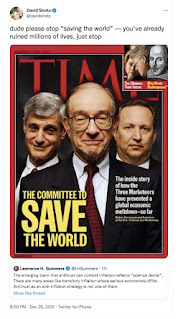
Don't Look Up isn't very good; mostly it's bad, and it's worth thinking about why. But it includes the most gloriously over the top attack on autism as an ideal that I've ever seen. 

Sirota is ballyhooing, and complaining about "elite" critics, attacking corporate media and bragging about success, in corporate media. Blind enthusiasm and self-congratulation are a problem both for the film its makers. The differences between their film and the films they mock aren't as big as they pretend.

Related, since Larry Summers and antitrust, efficiency and supply-chains are in the news again...

"The emerging claim that antitrust can combat inflation reflects 'science denial'”.  

I searched the archives, but I have a short memory. I didn't have to go very far at all. It's got pretty much everything, including economics and science fiction.

This one's good too, economic pseudoscience, left-liberal utilitarianism and the moralists' understanding of art. 

Also: Saint-Simon

My first reference to the inverse relation of efficiency to stability was an annoyed comment to Dani Rodrik in 2008. It seemed obvious then.

Dani Rodrik, Angus Deaton, Krugman, and Quiggin.

Wednesday, March 31, 2021

I should have done this a long time ago. more updates p.12.

Remember Weber… and Saint-Simon, and the first modern* use of “avant-garde” to refer to artists, in a dialogue between an artist, a scientist and an industrialist. 

From Dreams of Happiness: Social Art and the French Left, 1830-1850, by Neil McWilliam.


Taking up Saint-Simon’s belief that in a fully developed industrial society government would be rendered redundant, the artist argues that it is the triumvirate of progressive capacities who best understand popular needs and whose destiny it is to administer the state. Only suspicion and misunderstanding prevent them from assuming this role and bringing about sweeping change in the moral and political order. The remarks placed in his mouth signify the artist’s final admission into ruling circles as the peer of both industrial and savant. His newly recognized powers transform him from an independent professional into a public figure whose work must be dictated by broad considerations of polity. In this respect, Saint-Simon robs him of the autonomous exercise of moral judgment demanded by such eighteenth-century commentators as Diderot and La Font de Saint-Yenne; in return for social eminence, he is obliged to direct his talents toward propagating ideas that emerge from the deliberations of the administrative triumvirate. From this perspective, the artist in the Dialogue foresees his colleagues taking on decisive responsibilities:


It is we artists who will serve as your vanguard, [C'est nous, artistes, qui vous serviront d'avant-garde.] since art’s power has greatest immediacy and rapidity. We have arms of every sort: when we wish to spread new ideas among men, we inscribe them on marble or canvas; we make them popular through poems or melodies; we use in turn the lyre or the flute, odes or songs, stories or the novel; the dramatic stage is also open to us, and it is there above all that we exert an electric and victorious influence.[i]


“L’Artiste, le savant et l’industriel”,  following “Le Catéchisme des Industriels” [Catechism of the Industrialists], sound like contemporary fantasies out of Silicon Valley and MIT, minus the need for deliberation, since the distinctions between the three have vanished. We’ll get to that later. 


Nochlin, in “The Invention of the Avant-Garde” [ii]cites the passage as quoted by Donald Egbert in “The Idea of "Avant-garde in Art and Politics”.[iii]  Neil McWilliam responds to Egbert in a footnote.


Egbert’s suggestion that the phrase avant-garde prefigures its later usage in the sense of an artistic vanguard is entirely misleading. Rather than referencing formal or thematic experimentation, the context in which the term is habitually used within modernism, its deployment here refers exclusively to the political relationship the artist sustains as mediator between the leadership and the people. Valuing the artist only insofar as his talents contribute to the progressive amelioration of society, Saint Simon restricts his discussion to a range of functional priorities entirely indifferent to any formal characteristics intrinsic to the various media embraced within the term beaux-arts. In emphasizing his designation of the artist as being in the avant-garde, Egbert ironically overlooks the term’s appearance in Saint—Simon’s earlier work, where he speaks of a scientific avant-garde in a sense closer to modern usage, albeit in the context of a different discipline.  


As if intellectual history weren’t a game of telephone, of evolution, decay, and transformation. Etymology and philology are the history of change, of ideas and objects signifying one thing at one time and the opposite two centuries on. And Egbert is clear in describing what artists took from Saint-Simon and what they left behind. The history of the avant-garde is a history of visions and revisions. Honest history, partial by definition but stripped of enthusiasms, makes a mockery of fantasies of rational continuity.  McWilliam himself says Saint-Simon is “important in elevating the Middle Ages as a period of exceptional creative achievement.” [p.49] He and his disciples, like the Catholic revivalists, "judged the Renaissance from the perspective of the Middle Ages, and regarded the later period as initiating a critical era of which contemporary society was the inheritor." [p.133]. This is humanism seen from the perspective of anti-humanism, an ideology foundational to modernist purism in both politics and form. 


Nochlin cites Baudelaire’s reply, in his posthumous Mon cœur mis à nu, but doesn’t quote him. 


XXXI

Of love, of the predilection of the French for military metaphors. Here every metaphor wear s a moustache. Militant literature. —To man the breach, —To bear the standard aloft, —To maintain the standard high and firm. —To hurl oneself into the thick of the fight, —One of the veterans. All these fine phrases apply generally to the college scouts and to the do-nothings of the coffee-house.  

XXXII

To add to the military metaphors: Soldier of the judicial press (Bertin). The poets of strife. The litterateurs of the advance guard. [Les poètes de combat. Les littérateurs d’avant-garde] This habitude of military metaphors denotes minds not military, but made for discipline, that is, for conformity, minds born domesticated, Belgian minds, which can think only in society.[iv]


*Matei Călinescu finds an earlier source, in the late sixteenth century. Calinescu, Five Faces of Modernity: Modernism, Avant-garde, Decadence, Kitsch, Postmodernism, Duke, 1987 pp 97-8


[i]Neil McWilliam,  Dreams of Happiness: Social Art and the French Left, 1830-1850, Princeton, 1993, p.46

[ii] Nochlin, “The Invention of the Avant-Garde”, in The Politics of Vision,  Harper and Row, 1989

[iii]Donald D. Egbert, "The Idea of  'Avant-garde' in Art and Politics," The American Historical Review, vol. 73, no.2, 1967

[iv] Baudelaire, “My Heart Laid Bare”, trans. Joseph T. Shipley, in Baudelaire: His Prose and Poetry, ed. T.R. Smith, Modern Library, Boni and Liveright, 1919, p.234


I was in living in Bloomington Indiana when I began this, in 1987, and I didn't know who Matei Călinescu was, or that he lived there. I've posted the quote before but having finally gotten around to putting Saint-Simon in the manuscript I forgot to add it. [now I have, at least as a cite]
The word “avant-garde” (fore-guard) has an old history in French. As a term of warfare it dates back to the Middle Ages, and it developed a figurative meaning at least as early as the Renaissance. However, the metaphor of the avant-garde—expressing a self-consciously advanced position in politics, literature and art, religion, etc.—was not employed with any consistency before the nineteenth century. Among other things, this fact accounts for the indelibly modern appearance of the label “avant-garde. ”Poggioli’s earliest example of the cultural use of the term is from a little-known pamphlet published in 1845 by Gabriel Desire Laverdant, a follower of Charles Fourier. I was convinced, with Donald Drew Egbert, that the cultural notion of the avant-garde had been introduced at least two decades earlier, in 1825, and that the utopian philosophy of Saint-Simon had been responsible for this specific application of the term. Actually, the avant-garde metaphor was applied to poetry almost three centuries earlier, as I found out looking up the word “avant-garde” in the recent and excellent Tresor de la langue frangaise (Paris: Editions du CNRS, 1974, vol. 3, pp.1056-57). During   the second half of the sixteenth century, in a period that anticipates certain themes of the later Quarrel between the Ancients and the Moderns, the French humanist lawyer and historian Etienne Pasquier (1529-1615) wrote in his Recherches de la France:
A glorious war was then being waged against ignorance, a war in which, I would say, Scève, Bèze, and Pelletier constituted the avant-garde; or, if you prefer, they were the fore-runners of the other poets. After them, Pierre de Ronsard of Vendome and Joachim du Bellay of Anjou, both gentlemen of noblest ancestry, joined the ranks. The two of them fought valiantly, and Ronsard in the first place, so that several others entered the battle under their banners.

This interesting passage occurs in chapter XXXVIII of the Feugère edition of Recherches (1849), “De la grande flotte des poetes que produisit le regne du roi Henri deuxième, et de la nouvelleforme de poésie par eux introduite.” The chapter is part of a larger tableau of the overall development of French poetry, one of the first such attempts, in any European country,... 

You can hear the difference between a scholar and a pedant, before anything else,  in their tone: admitting the possibility of error. He's wrong about kitsch, but most people are. 

Thursday, March 11, 2021

NFTs again. 3/11-Price realised: $69,346,250

He's a commercial illustrator. The pitch is the "innovation". The market is producing the artist and the art.  

The positivist definition of art is illustration. If fine art has devolved into design, it still performs the function of art: the following of sensibility, responding to experiences, perceptions. But to ad men, like philosophers, art is successful communication as seen in metrics, and is designed as computer games are in the service of “fun”. The MIT communication department model of creativity follows the enthusiasm of the designers of Assassin’s Creed, and Gears of War, blind not even to subtext but to direct meaning, a blindness matching the enthusiasts of the “formalism” of the films of Paul Sharits. For all the discussion of the delivery of content, the content itself is seen as meaningless. This is the world of ideas, the academia that claims to provide a foundation for capitalism and anti-capitalism, revolution, Wall St. and Madison Avenue.

It's all here. 

I'm leaving in all the links: telegraphing the hard sell.
As of 6:48 pm on 3/10, the bidding is at $13,250,000 
On 1 May 2007, Mike Winkelmann, aka the digital artist Beeple, posted a new work of art online. He did the same thing the next day and the next, and the next one after that, creating and posting a brand-new digital picture, or ‘everyday’ as he called it, every single day for 13-and-a-half years. Now those individual pieces have been brought together in EVERYDAYS: THE FIRST 5000 DAYS, a unique work in the history of digital art.

Minted exclusively for Christie’s, the monumental digital collage will be offered as a single lot sale concurrently with First Open from 25 February to 11 March. Marking two industry firsts, Christie’s will be the first major auction house to offer a purely digital work with a unique NFT (Non-fungible token) — effectively a guarantee of its authenticity — and to accept cryptocurrency, in this case Ether, in addition to standard forms of payment for the singular lot.

‘Christie’s has never offered a new media artwork of this scale or importance before,’ says Noah Davis, specialist in Post-War & Contemporary Art at Christie’s in New York. ‘Acquiring Beeple’s work is a unique opportunity to own an entry in the blockchain itself created by one of the world’s leading digital artists.’...

His visionary and often irreverent digital pictures have propelled him to the top of the digital art world, winning him 1.8 million followers on Instagram and high-profile collaborations with global brands ranging from Louis Vuitton to Nike, as well as performing artists from Katy Perry to Childish Gambino.

In EVERYDAYS: THE FIRST 5000 DAYS, the artist has stitched together recurring themes and colour schemes into an aesthetic whole. The individual pieces are organised in loose chronological order: zooming in reveals pictures by turn abstract, fantastical, grotesque or absurd, deeply personal or representative of current events. Recurring themes include society’s obsession with and fear of technology; the desire for and resentment of wealth; and America’s recent political turbulence. 

‘Beeple is looking at his whole body of work as it’s presented on Instagram as a kind of Duchampian readymade’ — specialist Noah Davis 

The notable differences between the early and later pictures reveal Beeple’s enormous evolution as an artist. At the project’s inception, ‘everydays’ were basic drawings. When Beeple started working in 3D, however, they took on abstract themes, colour, form and repetition. Over the past five years, they have became increasingly timely, reacting to current events.

‘I almost look at it now as though I’m a political cartoonist,’ Beeple explains. ‘Except instead of doing sketches, I’m using the most advanced 3D tools to make comments on current events, almost in real time.’  

He's an idiot. 

The seriousness of fine art is the connected to the seriousness of philosophy: an artistic and intellectual elite removed from the world through its connections to authority. People forget that fine art was also known as "non-commercial" art, money dealt with discreetly, and buying to flip looked down upon. 

Playboys didn’t buy polo ponies, or football teams, to make money off them, and heiresses collected expensive dresses. The point is the game for the game’s sake, art for art’s sake.

I've said that all before. Rich people can afford to do some things things for love. This is the equivalent of real estate prices going through the roof while the rental income stays the same. It has no foundation, not even the foundation of self-respect still associated with good publishers and movie producers.

“The potential for it to disrupt the traditional art auction model is humongous,” said Noah Davis, the specialist in charge of the first NFT auction at Christie’s. Beyond the record-setting sale of Beeple’s “Everydays,” he said, NFTs’ “lack of objecthood” meant auction houses faced no costs required for storing, handling, cataloging, photographing and insuring a physical work of art, making a “really attractive opportunity” for auction houses.
History repeats, and now no one gets the joke.  I have no problem with Klein or Manzoni.

Guardian, 2012:  The 10 Best Invisible Artworks, etc.
The Florentine intermedios of the manneristic theater (similar to the English masks) abounded in such complicated allegories as seen in the Intermedio of 1585 and 1589 where the conclusion of Plato’s Republic appeared on the stage, including the Planets, the Harmony of the Spheres, the Three Goddesses of Fate, and even Necessity, holding the adamantine axis of the Universe (fig. 40). We happen to possess the diary of a nobleman who saw this play and stated that it was very beautiful but nobody could understand what it was all about. 

Sunday, October 13, 2019

Neil McWilliam, Dreams of Happiness: Social Art and the French Left, 1830-1850, 

Saint-Simon’s emphasis on overt didacticism underlines the transitional status of his ideas. While the disciples who took up the banner of industry following the philosopher’s death in 1825 were to cultivate a mystical religiosity where sentiment was given pride of place, Saint-Simon’s own attitude toward imagination and the arts remained qualified by an underlying commitment to reason. Positivist leanings provide a continual bedrock to his thought, surviving, and indeed justifying, the modifications in his practical outlook. In this respect, Saint-Simon displays epiStemological convictions that grow out of the rationalist tradition of Enlightenment philosophy. His promotion of a utilitarian aesthetic, too, has eighteenth-century antecedents, not only in the Revolution but also in ancien regime interest in the morally inspiring impact of art. Yet, in certain respects, Saint-Simon makes a break with the Enlightenment. His perception of contemporary medical theory, with its repudiation of the egalitarian connotations of sensationalism, prompted an acknowledgment of the inherent limitations of reason as a faculty found in developed form only among a small minority. It is in this context that sentiment, whose organic origins apparently guaranteed more universal appeal, acquires a pivotal role in the political equation and leads to the artist’s promotion in Saint-Simon’s later work. Such an appreciation of sentiment, while sharing some of the characteristics advanced in eighteenth-century texts, fundamentally deviates from this earlier tradition in its overall place within an explanation of aesthetic response and differs markedly from the essentially elitist conception of sensiibilité.

Saint-Simon’s attitude toward art is, moreover, unambiguously functional in tone. Beauty is a concept entirely foreign to his concerns; art achieves significance in his eyes only insofar as it can be justified on strictly utilitarian lines. Symptomatically, his aesthetic speculations remain on exclusively abstract plane, eschewing any reference to specific works of literature, painting, or sculpture. Nor did Saint-Simon make conspicuous attempts to acquaint himself with contemporary practice. While he had gone to elaborate lengths to cultivate leading scientists, even contracting a short-lived marriage in 1801 as a means of establishing a fashionable salon in his home near the Ecole de médecine, his familiarity with artists of the period remained slight—though the painter Ary Schefier briefly entered Saint-Simon’s circle in 1816, through friendship with his young collaborator Augustin Thierrlv. This isolation confirms the general indifference with which the artistic community responded to Saint-Simon’s promise of unprecedented social eminence, a promise all too apparently qualified by a highly instrumental understanding of culture as subservient to priorities determined through the superior insights of reason.

The rationalist ballast that holds Saint-Simon’s aesthetic in place was largely jettisoned by his disciples. As the following chapter will demonstrate, their cultivation of pronounced religious overtones had far-reaching implications not only for their interpretation of Saint-Simon’s philosophy of social organization but also for their understanding of art and of the artist’s status, which far surpassed anything their mentor had been willing to allow. In this respect, the movement cast aside much of the Enlightenment inheritance in Saint-Simon’s philosophy and forged an understanding of art social that moved beyond his utilitarian commitment to exert a far more potent appeal on the artistic community in the years after 1830. 

It didn't leave rationalism behind for long.
a new tag for Saint-Simon

And reposting the below from a year ago, because I've been writing about Athens and the Renaissance. Double-consciousness is the foundation of humanism and democracy. It's the foundation for art. Art is always the manifestation of double-consciousness, the acceptable form of release: the illusory world of play where self and other are joined. Du Bois was always a positivist of one sort of another, defending enlightenment model of the "rational, single self". Romantics and irrationalists respond by wanting the make the illusion a reality.

But positivism was always a form of romanticism.
17 … But now we have another problem.What is that?
What if we find out what makes each of us internally consistent? What if I find your proper name, that thing which describes exactly what you are?
Than I will always be honest, or predictable at least. And you will be able to interpret everything I say and never be wrong. And of course I’ll know your name as well.
No dishonesty, no subterfuge, no Freud, no art… Then we can all be logical positivists.
But it doesn’t matter. That dream’s irrelevant.
I want unification.
It’s an illusion.
I want the illusion.
Do you want the illusion or do you want the illusion to be real?
What’s the difference?
One means that you have an appreciation of the arts. The other means that you’re a fascist.
...and a new tag for Simon Blackburn. He deserves one at this point.
---

From Sept 2018:

"Divided consciousness"

"Irony is the glory of slaves."  Milosz

Du Bois.
After the Egyptian and Indian, the Greek and Roman, the Teuton and Mongolian, the Negro is a sort of seventh son, born with a veil, and gifted with second-sight in this American world,—a world which yields him no true self-consciousness, but only lets him see himself through the revelation of the other world. It is a peculiar sensation, this double-consciousness, this sense of always looking at one's self through the eyes of others, of measuring one's soul by the tape of a world that looks on in amused contempt and pity. One ever feels his two-ness,—an American, a Negro; two souls, two thoughts, two unreconciled strivings; two warring ideals in one dark body, whose dogged strength alone keeps it from being torn asunder.
Arendt
But bragging is a common vice, and a more specific, and also more decisive, flaw in Eichmann's character was his almost total inability ever to look at anything from the other fellow's point of view. Nowhere was this flaw more conspicuous than in his account of the Vienna episode. He and his men and the Jews' were all "pulling together," and whenever there were any difficulties the Jewish functionaries would come running to him "to unburden their hearts," to tell him "all their grief and sorrow," and to ask for his help.
A repeat

File under Trolley Problems. A soldier explains what Oxbridge philosophers can't. It's a sign of how far we've fallen that it has to be explained at all.
A thousand years ago when I was about to begin my military career, a wise old retired Marine colonel, a veteran of the carnage at Tarawa, gave me some advice. Paraphrased here, he said
So you want to be a career soldier? Good for you. But remember that the longer you stay in uniform, the less you will really understand about the country you protect. Democracy is the antithesis of the military life; it’s chaotic, dishonest, disorganized, and at the same time glorious, exhilarating and free — which you are not.

After a while, if you stay in, you’ll be tempted to say, “Look, you civilians, we’ve got a better way. We’re better organized. We’re patriotic, and we know what it is to sacrifice. Be like us.” And you’ll be dead wrong, son. If you’re a career soldier, you may defend democracy, but you won’t understand it or be part of it. What’s more, you’ll always be a stranger to your own society. That’s the sacrifice you’ll be making.
"A military in service to a democracy is an authoritarian order in service to a free one: every soldier is simultaneously both a soldier and a citizen." A living breathing contradiction in terms. Before we negotiate with others we negotiate with ourselves.
---

Another recent repeat, an obvious one I missed. Baudelaire
To add to the military metaphors: Soldier of the judicial press (Bertin). The poets of strife. The litterateurs of the advance guard. This habitude of military metaphors denotes minds not military, but made for discipline, that is, for conformity, minds born domesticated, Belgian minds, which can think only in society.

Sunday, July 07, 2019

"To add to the military metaphors: Soldier of the judicial press (Bertin). The poets of strife. The litterateurs of the advance guard. This habitude of military metaphors denotes minds not military, but made for discipline, that is, for conformity, minds born domesticated, Belgian minds, which can think only in society." 
---
New tag for Advertising and Happy Talk 
Unless and until I forget, every post with that tag is also tagged under Utopia and Intentional Communities. Yeah, it's obvious.
---
Nochlin, "The Invention of the Avant-garde" first published in Art News in 1968,  and the opening essay in The Politics of Vision

The first paragraph.
"Art changes only through strong convictions, convictions strong enough to change society at the same time." So proclaimed Theophile Thore, quarante-buitard critic, admirer of Theodore Rousseau, Millet, and Courbet, an art historian who discovered Vermeer and one of the spokesmen for a new, more democratic art, in 1855, in exile from Louis Napoleon's imperial France. Whether or not one agrees with Thore's assertion, it is certainly typical in its equation of revolutionary art and revolutionary politics of progressive thought in the visual arts at the middle of the nineteenth century.

...The very term "avant-garde" was first used figuratively to designate radical or advanced activity in both the artistic and social realms. It was in this sense that it was first employed by the French Utopian socialist Henri de Saint-Simon, in the third decade of the nineteenth century, when he designated artists, scientists, and industrialists as the elite leadership of the new social order:
It is we artists who will serve you as avant-garde [Saint-Simon has his artist proclaim, in an imaginary dialogue between the latter and a scientist] ... the power of the arts is in fact most immediate and most rapid: when we wish to spread new ideas among men, we inscribe them on marble or on canvas.  
...What a magnificent destiny for the arts is that of exercising a positive power over society, a true priestly function, and of marching forcefully in the van of all the intellectual faculties ... !'
My copy has "NO" scrawled above the first line. "The 'convictions' are that society has changed and that the artist is honest enough to admit it."

Nochlin: "Whether or not one agrees with Thore's assertion,..."  She was a smart woman and a serious historian, but aside from some scribbling on margins,  I've just ignored the history before the mid 20th century. I attacked the Pompiers and defended Baudelaire, but I ignored the earnest Socialists.

The direct line from from utopianism to Madison Ave, but I bypassed Saint-Simon.

Nochlin, from "Why Have There Been No Great Women Artists?" 1971
The difficulties imposed by such demands on the woman artist continue to add to her already difficult enterprise even today. Compare, for example, the noted contemporary, Louise Nevelson, with her combination of utter, “unfeminine” dedication to her work and her conspicuously “feminine” false eyelashes; her admission that she got married at 17 despite her certainty that she couldn’t live without creating because “the world said you should get married.” Even in the case of these two outstanding artists—and whether we like The Horsefair or not, we still must admire Rosa Bonheur’s achievement—the voice of the feminine mystique with its potpourri of ambivalent narcissism and guilt, internalized, subtly dilutes and subverts that total inner confidence, that absolute certitude and self-determination, moral and esthetic, demanded by the highest and most innovative work in art. 
Conclusion 
We have tried to deal with one of the perennial questions used to challenge women’s demand for true, rather than token, equality, by examining the whole erroneous intellectual substructure upon which the question “Why have there been no great women artists?” is based; by questioning the validity of the formulation of so-called “problems” in general and the “problem” of women specifically; and then, by probing some of the limitations of the discipline of art history itself. Hopefully, by stressing the institutional—i.e. the public—rather than the individual, or private, pre-conditions for achievement or the lack of it in the arts, we have provided a paradigm for the investigation of other areas in the field. By examining in some detail a single instance of deprivation or disadvantage—the unavailability of nude models to women art students—we have suggested that it was indeed institutionally made impossible for women to achieve artistic excellence, or success, on the same footing as men, no matter what the potency of their so-called talent, or genius. The existence of a tiny band of successful, if not great, women artists throughout history does nothing to gainsay this fact, any more than does the existence of a few superstars or token achievers among the members of any minority groups. And while great achievement is rare and difficult at best, it is still rarer and more difficult if, while you work, you must at the same time wrestle with inner demons of self-doubt and guilt and outer monsters of ridicule or patronizing encouragement, neither of which have any specific connection with the quality of the art work as such. 
What is important is that women face up to the reality of their history and of their present situation, without making excuses or puffing mediocrity. Disadvantage may indeed be an excuse; it is not, however, an intellectual position. Rather, using as a vantage point their situation as underdogs in the realm of grandeur, and outsiders in that of ideology, women can reveal institutional and intellectual weaknesses in general, and, at the same time that they destroy false consciousness, take part in the creation of institutions in which clear thought—and true greatness—are challenges open to anyone, man or woman, courageous enough to take the necessary risk, the leap into the unknown.
--

More history

Călinescu,  Five Faces Of Modernity: Modernism Avant-Garde Decadence Kitsch Postmodernism, Duke, 1987. A reprint of Faces of Modernity, Indiana, 1977, with an additional essay.
The word "avant-garde" (fore-guard) has an old history in French. As a term of warfare it dates back to the Middle Ages, and it developed a figurative meaning at least as early as the Renaissance. However, the metaphor of the avant-garde -- expressing a selfconsciously advanced position in politics, literature and art, religion, etc. -- was not employed with any consistency before the nineteenth century. Among other things, this fact accounts for the indelibly modern appearance of the label "avant-garde." Poggioli's earliest example of the cultural use of the term is from a little-known pamphlet published in 1845 by Gabriel Désiré Laverdant, a follower of Charles Fourier.  I was convinced, with Donald Drew Egbert, that the cultural notion of the avant-garde had been introduced at least two decades earlier, in 1825, and that the utopian philosophy of Saint-Simon had been responsible for this specific application of the term. Actually, the avant-garde metaphor was applied to poetry almost three centuries earlier, as I found out looking up the word "avant-garde" in the recent and excellent Trésor de la langue française ( Paris: Editions du CNRS, 1974, vol. 3, pp. 1056-57). During the second half of the sixteenth century, in a period that anticipates certain themes of the later Quarrel between the Ancients and the Moderns, the French humanist lawyer and historian Etienne Pasquier (1529-1615) wrote in his Recherches de la France: 
A glorious war was then being waged against ignorance, a war in which, I would say, Scève, Bèze, and Pelletier constituted the avant-garde; or, if you prefer, they were the fore-runners of the other poets. After them, Pierre de Ronsard of Vendôme and Joachim du Bellay of Anjou, both gentlemen of noblest ancestry, joined the ranks. The two of them fought valiantly, and Ronsard in the first place, so that several others entered the battle under their banners. 

...Although it is encountered in the language of warfare, the modern notion of “avant-garde has a lot more to do with the language, theory, and practice of a comparatively recent kind of warfare, the revolutionary civil war. In this sense, it is safe to say that the actual career of the term avant-garde was started in the after- math of the French Revolution, when it acquired undisputed political overtones. The first periodical to bear this specific word in its title was, to be sure, a military one, but it left little doubt as to its revolutionary political stance. I am referring to L’Avant-garde de I’armee des Pyrenees orientates, a journal that appeared in 1794 and whose watchword—engraved on the blade of an emblematic sword—was: “La liberte ou la mort.” This journal was committed to the defense of Jacobin ideas and was intended to reach, beyond military circles, a broader audience of “patriots.”We can therefore take the 1790s as a starting point for the subsequent career of the concept of avant-garde in radical political thought. In hindsight, considering the analogical potentialities of the military notion, it is not difficult to explain the appeal of the metaphor for various kinds of revolutionary, and therefore future-oriented, philosophies: their representatives certainly liked the idea of being, at least intellectually, closer to Utopia than the rest of mankind, which was to follow their paths.

It is, therefore, not by chance that the romantic use of avant-garde in a literary-artistic context was directly derived from the language of revolutionary politics. This occurred in 1825, when the term avant-garde was applied to the arts in a dialogue written by one of the closest friends and disciples of Saint-Simon, namely, Olinde Rodrigues. Rodrigues's dialogue, "L'Artiste, le savant et l'industriel," was published in a volume entitled Opinions littéraires, philosophiques et industrielles, which appeared in 1825, the year of Saint-Simon's death. Although generally attributed to Saint-Simon, it is known that this unsigned volume was, in fact, the result of a collaboration, which, beside the work of the master, included those of his disciples: Léon Halévy, Rodrigues, Duvergier, and Bailly. This occurrence of avant-garde was discussed at some length by Donald Drew Egbert but, curiously, the author -- who seems only to have consulted the 1825 edition of Opinions... -- attributes the use of the term avant-garde to Saint-Simon and does not mention the name of Rodrigues, who, even if inspired by Saint-Simon's socialism, actually wrote the dialogue between the artist, the scientist, and the industrialist. 

It all ended up here.  etc