Posner and Verlmeule's op-ed was pulled so quickly that Balkin had to link to a cache file that died within a year. Now the piece has been republished. There's no telling if it's been cut but I'm betting it hasn't. That's how far we've come.
I found out it'd been republished because I had to search for it again after ridiculing a member of the extended PRC apparat who was defending the honor of China against a Foggy Bottom intellectual. The link in his header and the pinned tweet is to an interview with Vermeule.
"A lesson of virtue" in The Beijing Review. Vermeule must follow him because he blocked me, again.
Whining about the Cold War is like asking McDonalds or KFC to stop competing with each other; the difference is the armies and the nukes. The only option is to reject US and Chinese foreign policy goals as such, and look to the small states forced to negotiate a path between them.
I think the reason all these academic intellectuals follow edgelords and fascists, is that their minds are too dead to think for themselves.
updated a few time, this time at the top. It's all so fucking stupid.
The Idiot Tushnet, and co., restating his old argument.
The Supreme Court has unanimously held that Jackson Pollock’s paintings, Arnold Schöenberg’s music, and Lewis Carroll’s poem “Jabberwocky” are “unquestionably shielded” by the First Amendment. Nonrepresentational art, instrumental music, and nonsense: all receive constitutional coverage under an amendment protecting “the freedom of speech,” even though none involves what we typically think of as speech—the use of words to convey meaning.
Jackson Pollock from 1952,
Jackson Pollock, Blue Poles (Number 11)
Daniel Bell 20 years later. "Behind the chiliasm of modern man, is the megalomania of self-infinitization."
Atomization, isolation and the illusion of absolute community. The low buzz and hum—the violence and warmth—of neurological overload.
[Weber] imagines an impersonal relation to the world. It’s a common trope of the literature of the period, but the impersonal in art and technocracy, though the product of the same events are very different things....
By the time anything becomes known as an idea, it’s been around for awhile
From rationalism to positivism to a world of shit.
---
Two from the NYRB
“There is a big secret about sex,” wrote Leo Bersani in 1987. “Most people don’t like it.” The same might be said of translation, which many readers secretly consider a necessary evil.
Translation is transliteration. It's a necessary evil. Utilitarianism turns practical necessity into the ideal, so its weaknesses are now "secrets". And another name for the file of women getting their model of sexuality from homosexual men. Post-feminism is pre-feminism on crank, and rationalism makes you stupid. Or the other way around. An asshole doesn't have a clitoris. Call it female circumcision by category error.
In his films for children, Hayao Miyazaki has used the labor-intensive art of animation to study the major problem of adult life.
That was the subhead, but still. No fucking shit.
The director sticks to a deliberately vague line, one that could be applied to the most anodyne Disney venture, that all his films are about “how to live.” Few scholars or critics have done the work to penetrate this author’s statement. “What’s it about?” asked Nigel Andrews of Spirited Away. “Simple answer: Everything.” Ligaya Mishan writes that Miyazaki’s films seem to “thwart the Western mind.”
A world of idiots.
Miyazaki is the benign ruler of his domain. He's a master and treated as one by his employee/servants. He's a filmmaker and an artist. His wife "hasn't forgiven him" he says, for making her stop working as an animator. Nothing about any of this"thwarts the Western mind". There are many things in his work that are foreign to the Western mind, but French art is foreign to the English. You can't translate Rimbaud, Mallarmé, or Lady Murasaki, but there's nothing to translate in a painting—a material thing—or an image; the difference is in the perception by individuals and members of various groups. Japanese people understand Miyazaki in ways Europeans will not, but the thing absent perception is the same.
Spirited Away is a film about children and the adults who care for them. Miyazaki's closest equivalent in the US is Maruice Sendak. In Europe it's Tove Jansson.
You will never understand the inner workings of another mind; all you have to work with is your perception of their actions, or the record or description of those actions by others, rendered in form. Proust is untranslatable; he could never be an English novelist; the past is another county. Acknowledging these things is the beginning of adulthood and intellectual life. We're ruled by big children in university chairs and editorial offices, and it makes me want to puke.
---
in re: the "Western mind". A commenter, Zina Hitz, on Leiter's post reporting the death of Harry Frankfurt
When I met him at Princeton I was already trained as a scholar in Greek philosophy. But I had not fully realized that I could use philosophy to think about my life or what t means to be a human being.
Princeton philosophy in the 80's
"My students were all obsessed with sex. Not the idea of sex, or the meaning of sex, but sex!"
Rakesh Bhandari comments about Frankfurt's discussion of 1st and 2nd order desires. Maybe Frankfurt will be remembered for teaching geeks that there's more to life than being geeks, the same transition Derrida played a part in. One of them would be amused. I still think I coined the phrase second-order curiosity, meaning the ironic awareness of an interest, as a way of explaining the problems of analytic philosophy. Autism is the model of first order curiosity: subtext, and other people, are irrelevant. "I'm a liberal"; "I'm a nice guy!" "Some of my best friends..." "I have an extended mind!"
Mathematics can't tell you why you wanted to be a mathematician. "Science can't even justify science." Steven Weinberg, whose philosophy justifies Zionism, as Leiter's does.
Two by Tushnet: one pushing his version of the "unitary executive" and another, on free speech and art, again. He belongs with the idiots above.
A few weeks ago, my family went on vacation in Copenhagen, where we ate at several top-of-the-line restaurants. My reaction to the meals? “How incredibly creative of the chef.”
A few weeks ago, my family went to DC, where we met with several top-of-the-line law firms. My reaction to the briefs? “How incredibly creative of the partners.”
None of these cases are about speech; they're about the relation of speech to commerce.
The idiot
A different example, with the same analytic structure, clarifies the problem. Switch from discrimination on the basis of religion to discrimination on the basis of race. Now the chef makes dishes to preserve white culture. An African-American comes to the restaurant, but the chef says, “Sorry, I won’t serve you because my message that these foods are preserving white culture would be diluted if people saw Black people eating at the restaurant.” We might say that the restaurant owner’s choice of a business model is his way of expressing himself: His expressive conduct is his expressive activity.
White Trash Cooking is a cookbook, and anyone can buy it. The KKK can open a restaurant, but it has to serve niggers, gooks, spics, and kikes. Equal access to the market, in a commercial culture: from Wickard vs Filburn to civil rights, the market takes precedence over social and private life.
After Tushnet's open letter:
—NBC, Alabama Republicans refuse to draw a second Black congressional district in defiance of Supreme Court.
Tushnet is a famous opponent of judicial review, and now Alabama Republicans and supporters of the independent state legislature theory have heeded his call. On executive supremacy, Posner and Vermuele at least are consistent. And all of this and everything above, with the same paper-thin idea of language, and politics.
October 18, Open Democracy, "Suella Braverman quietly tries to give herself fresh anti-protest powers"
Suella Braverman is quietly handing herself new powers to clamp down on the government’s political opponents, civil right advocates have warned.
The home secretary pushed through a last-minute amendment to a widely criticised anti-protest bill on Tuesday that would allow her to apply for injunctions against anyone she deems ‘likely’ to carry out protests that could cause ‘serious disruption’ to ‘key national infrastructure’, prevent access to ‘essential’ goods or services, or have a ‘serious adverse effect on public safety’. The proposal would also give police the power to arrest anyone they suspect to be breaching such an injunction.
Leading human rights groups say that the Public Order Bill, which passed a final vote in the Commons yesterday, would align the UK’s anti-protest laws with those in Russia and Belarus.
The bill includes new powers, such as protest banning orders, that the government was forced to exclude from its Police, Crime, Sentencing and Courts Act (PCSC) after they were voted down in the House of Lords earlier this year. Peers could reject the measures once more when the bill progresses to the Lords in the coming weeks.
2015, future former home secretary Suella Fernande [now Braverman] in The Telegraph
The plight of millions of people belies the noble aspirations of the Universal Declaration of Human Rights, adopted by the UN General Assembly those many decades ago.
One reason for this is because the Universal Declaration was never a treaty in the formal sense. It was not ratified by nations, never became international law, and had no real provision for enforcement.
Another reason is that the rights are described in imprecise, aspirational terms which allow governments to interpret them in any way they see fit. The US, for example, did not undertake to outlaw racial segregation until many years later. And there are hundreds of international human rights – rights to work and education, to freedom of expression and religious worship, to non-discrimination, to privacy, to pretty much anything you might think important in a perfect world. The sheer volume and array of rights imply an all-embracing protection. This is impossible, because there will always be trade-offs in which some rights are sacrificed to uphold others.
Professor Eric Posner makes this point forcefully in his book, Twilight of Human Rights Law. In Brazil, there have been several cases of the use of torture by the police in the name of crime prevention. They justify this by putting a general right to live free from crime and intimidation above their rights of those who are tortured. To wipe out torture, the government would need to create robust, well-paid policing and judicial services to guarantee the same results. The government might argue that this money is better spent on new schools and medical clinics, protecting wider rights to freedom of education and health. These sort of value judgments, inherent in the practical application of human rights (whether we agree with them or not), undermine their "universality".
But across most of the West, something else has happened which devalues human rights. A fatal misassumption plagues our whole approach to civil liberties: the predominance of the individual over the communal. The importance of the individual is seen as the defining axiom upon which we should base our policy and gauge its success. Emerging by reference to individual instincts and desires, rights and entitlements are paramount in our society, prevailing over considerations of how our choices affect others, over reference to past experience, or over the consequences for those born later on.
[P]roblems with so-called positive or social rights are well known. Less well known is that the same problem exists for the “negative rights” in the ICCPR, such as the right not to be tortured. One might think that a state could comply with the prohibition on torture at no cost by refraining from torture. But it turns out that local police officials frequently engage in torture even though they are not authorized to do so. To stop torture, then, the government must not only enact laws, but must also invest resources in investigating allegations of torture, punishing torturers, and purging and retraining law enforcement. Thus, the key question for a state is how much of its resources it must devote to countering torture at the expense of building health clinics and public schools. The treaties provide no guidance as to how resources should be allocated. If there is no way to distinguish positive and negative rights, and we are skeptical about whether judges can enforce positive rights, then we ought to be skeptical about whether they can enforce negative rights as well. The real question is not the nature of the rights but the extent to which we can trust judges or other enforcing agents to distribute resources between competing rights.
There is yet another problem. Although not all treaty terms are vague, the actual legal effect of even specific norms is often ambiguous because they conflict with terms in other treaties as well as with broader norms of public international law. Consider sections 3 and 4 of Article 9 of the ICCPR:
3. Anyone arrested or detained on a criminal charge shall be brought promptly before a judge or other officer authorized by law to exercise judicial power and shall be entitled to trial within a reasonable time or to release. . . .
4. Anyone who is deprived of his liberty by arrest or detention shall be entitled to take proceedings before a court, in order that that court may decide without delay on the lawfulness of his detention and order his release if the detention is not lawful.
Whatever else these rights require, they do clearly prohibit a state from detaining people without charging them. Thus, many commentators accused the United States of violating the human rights of Al Qaeda and Taliban suspects by detaining them without charging them and taking them before a judge for a trial. However, the United States argued in response that the ICCPR does not apply to wartime conditions: the Geneva Conventions and other laws of war, which do not require the involvement of courts for detention, are lex specialis, and thus override human rights law.
The principle of lex specialis is well established in international (and domestic) law. Different sources of law conflict, and a principle is needed to resolve such conflicts. Many human rights advocates believe that the human rights treaties provide a moral minimum that other bodies of law can never supersede, much like the rights in the U.S. Bill of Rights. However, the human rights treaties themselves do not say this, nor does any other authoritative source of international law. There is no clear resolution of the dispute between the United States and its critics. [p.89]
1979, Richard Posner, "Utilitarianism, Economics, and Legal Theory",
Among the severest critics of the use of economic theory to explain and sometimes to justify the principles of torts, contracts, restitution and other fields of Anglo-American 'judge-made law' are those who attack the economic underpinnings of the theory as a version of utilitarianism. Their procedure is first to equate economics with utilitarianism and then to attack utilitarianism. Whether they follow this procedure because they are more comfortable with the terminology of philosophy than with that of the social sciences or because they want to exploit the current tide of hostility to utilitarianism is of no moment. The important question is whether utilitarianism and economics are really the same thing. I believe they are not and, further, that the economic norm I shall call "wealth maximization" provides a firmer basis for a normative theory of law than does utilitarianism.
1948, John Houston (and B. Traven)
---
Braverman
But across most of the West, something else has happened which devalues human rights. A fatal misassumption plagues our whole approach to civil liberties: the predominance of the individual over the communal.
1987, Thatcher, the same point from the opposite direction.
I think we have gone through a period when too many children and people have been given to understand ‘I have a problem, it is the Government’s job to cope with it!’ or ‘I have a problem, I will go and get a grant to cope with it!’ ‘I am homeless, the Government must house me!’ and so they are casting their problems on society and who is society? There is no such thing! There are individual men and women and there are families and no government can do anything except through people and people look to themselves first.
It's hard to know what to say, other than what I've said before. Varieties of decadence, and they're all so earnest. But still...
The Decadents knew that Catholicism pairs well with transgression. The Metropolitan Museum of Art knows it, too: It held an exhibition titled “Heavenly Bodies” in 2018, a show that juxtaposed liturgical iconography with high fashion and BDSM paraphernalia. Catholicism embraces the give-and-take between sin and repentance, formalizing it in the sacrament of confession.
An open defense of Catholic decadence from a young "senior editor" at First Things. Homosexuality, and other fun, are welcome, as long as you confess your sodomy on Sunday morning. John Waters read this and he's laughing; and a lot of others too, all older than Julia Yost and Matthew Schmitz. Richard John Neuhaus would be horrified. But what about his goddaughter? And Yost name checks Nick Burns (same link).
Another recent trip down memory lane, because the liberals mocking her are equally so utterly clueless. Left right and center, it's all cosplay.
In the larger sense I've been describing this for decades—the origins of the reactionary politics of truth. What I didn't predict was a literal return to the Church. I've quoted the popular definition of kitsch as something or someone being "more Catholic than the Pope", and now here we are!
Lorentzen has a series of podcast interviews he labels "Truth & Beauty".
The focus on aesthetics in a time of crisis, the false equivalence with "truth", the mix of puffery and denial, irony hiding sincerity, as if we don't have access to the history.
Milanovic rt'd a friend on why he didn't listen to stupid podcasts: the directness of listening to the voice as opposed to reading, the insecurity and fakery becomes obvious and almost unbearable.
Friday, July 08, 2022
Done fucking with this
---
repeats of repeats: The distinction between collaborative reason in the academy its proud imitators and adversarial reason in the world at large.
Continuing from the previous post, and building on it in light of news.
I've quoted this scene for years, and used it as part of a montage without sound, but I've never posted the scene straight. As I said 20 years ago, "When it is so easy to share, people will do it. And whether or not that sharing should be bound in some sense by other forms of obligation is largely irrelevant." "Downloading is theft, but if the opportunity is ubiquitous then theft will be too, and you will need to change your model." Capitalists realized that takedown notices are bad for business and they adapted, so I'm blocked from making money off the video. It's not that "data wants to be free"; it's realism. I didn't expect to be bringing in Aaron Swartz, but there you go. Economic reason is adversarial within the model of markets, but not all social relations are economic. Adversarialism is formal. It's a game, and games have rules. But libertarians don't believe in games. They believe in "truth".
"For the aesthetic in general as an expression of the supreme ultimate value of a system can influence the result of ethical action only secondarily, just as “wealth” is not the main goal but the side effect of individual commercial activity. And “wealth” itself is an irrational concept. It is an almost mystical process, the setting of ethical values: Arising from the irrational, transforming the irrational to the rational, yet nonetheless it is the irrational that radiates from within the resulting form." Hermann Broch
Jack Balkin debates fascists.
The republican tradition certainly hopes that citizens and officials alike will possess civic virtue and be devoted to the common good. At the same time, it does not assume that government officials will in fact have civic virtue and be adequately devoted to the public good. Republican theory focuses instead on the fact that republics are difficult to maintain and easily corrupted; that government officials—and especially executive officials—are likely to engage in self-aggrandizement, self-dealing and a desire to maintain power; that representative government can easily slide into oligarchy; and that public officials will undermine the public good in the process. Anyone who has lived through recent American history can understand the contemporary relevance of these ideas.
Vermeule, by contrast, is comparatively complacent about these questions. Along with Eric Posner, he coined the phrase "tyrannophobia" to describe an excessive concern with government overreaching, self-aggrandizement and illegitimate attempts by rulers to entrench themselves in power.
But what Vermeule regards as a pathology of thought is actually a central idea in the republican tradition—and the liberal tradition as well. It is precisely because of a deep concern that public officials will become corrupt, misbehave, or try to entrench themselves in power that the republican tradition has focused on questions of separation of powers, checks and balances, rule of law limitations, and rights.
Balkin's contribution as part of a symposium that includes more than one: Vermeule and an earnest defender. There's a time for choosing honey over vinegar, and those are Balkin's words, but this ain't it.
repeats: Leiter's model of academic discourse, paraphrased
Universities would deserve criticism for rejecting a presentation by the authors of the Nuremberg Laws, but would be right in rejecting a speech by a rabble-rousing journalist who promotes them.
John Quiggin, 2008: "Sunstein argues that the echo chamber effect tends to reinforce existing views and produce a poisonous partisan divide. It seems to me that exactly the opposite is true. "
repeats
I always thought Sunstein's point was obvious, especially for any culture founded on individualist liberalism. It's that culture that's given us Facebook and surveillance capitalism and personalized marketing, the virtual store where the displays are changed and items moved to the front to fit your last purchases. Newsfeeds work the same way, reinforcing biases, from narrowcasting to microcasting to the narcissism where the world is reduced to a mirror.
Twitter changed its algorithm years ago, forcing you to choose between replying to a tweet and quoting it, limiting the exposure of either your followers or those of the person you're replying to. Up to that point a reply appeared on both timelines.
Ryan Cooper
Have you ever argued with a conservative? They won't learn anything no matter what I say or where I say it. Whatever I say is wrong by definition.
The same is "true"—the same facts hold—for liberals, and for most people. They hold for Cooper.
The web was made by techs and in the Anglosphere self-selected for technocratic culture—I haven't used that link in a while. It's was made for talking to your friends, not for argument. I was told that 20 years ago. It's the model of civility, contempt and passive aggression basic to academia under the pretense that academia, educated liberals, the elite, the licensed vanguard are just that. It was always bullshit. Balkin, practicing "high politics" treats Vermeule as a friend. He's from the same tradition as Panofsky, but he's weaker. He called Vermeule and Posner "fine young scholars", when they defended legalized torture. I had more patience in 2004.
Balkin has a tag. Vermeule has one. I emailed Balkin as I do sometimes, to ask him why he's done it again, ceding ground to opponents of democracy.
I've gotten drunk with honest reactionaries. They're better company than hypocrites. I cede them nothing. But I have more contempt for liberals like Cooper who are blind to what they are.
If everything is political, then high politics and low politics both have their place. There's a time for debate and a time to stand on principle and walk away. If you don't understand both you don't understand either.
The Mortara Case "Why Some Catholics Defend the Kidnapping of a Jewish Boy"
Dreher, 16 days earlier:
The invention of the "Judeo-Christian" tradition, etc.
repeating the link above.
Most arguments against mass surveillance don't respond fully substantively to claims that you shouldn't worry if you "have nothing to hide". Defense of personal freedom isn't enough. What's needed is an argument in defense of the need for citizens in a democratic state to be able to be all kinds of wrong, all kinds of confused, creepy, conflicted, desirous, weepy or hate-filled, so that they may be able to learn to understand and outgrow their childishness. The choice is between a community of adults with a minority of the inveterately childish and criminal or a community of children ruled by moralists and crime lords.
Freedom of speech is the right to argue for freedom of property. Those who defend freedom of property are among the first to oppose freedom of speech. I support Vermeule's right to be a fascist, but an earnest engagement with his ideas is to take fascism seriously as an intellectual position. Allowing the argument to exist does not mean treating it with respect. It means destroying it, again, and again.
"It is the common fate of the indolent to see their rights become a prey to the active. The condition upon which God hath given liberty to man is eternal vigilance; which condition if he break, servitude is at once the consequence of his crime and the punishment of his guilt."
I like Balkin, but he's a law professor, not a lawyer. He's passive. He's not a legal philosopher—they all suck—but he doesn't understand the importance of vulgarity.
I forgot I'd used this with Vermeule already. All I do is repeat myself.
…in a hospital tent at the clearing station I came across a man with a French flag wrapped around his waist; the medics discovered it when they cut his shirt away. He was a hard-looking, blondish chap with a mouthful of gold teeth and a face adorned by a cross-shaped knife scar—the croix de vache with which procurers sometimes mark business rivals. An interesting collection of obscene tattooing showed on the parts of him that the flag did not cover. Outwardly he was not a sentimental type. "Where are you from?" I asked him. "Belleville," he said. Belleville is a part of Paris not distinguished for its elegance. "What did you do in civilian life?" I inquired. That made him grin. "I lived on my income," he said. "Why did you choose the Corps Franc?" "Because I understood," he said.
And again: thugs against fascists
"He was always a loser, a jest/he barely got 50% on his high-school test/with a bribe the rich kid's a fool no more/got 100 diplomas hanging on his door/You crows nesting in our house/why are you ruining all our fun?
We won't do as you tell us/Spare us your face/Cook up your case/That's what the Interior does/I'm arrested and charged as a terrorist/Just for holding a flare and singing Ahly"
We can’t re-fight old battles every time a subject comes up; there are limits to the human capacity for recall. Years after spending time and effort to come to a conclusion it’s the conclusion not the process that sticks in the mind. But that means that no matter how hard we once fought our response now is based on received opinion, even if received from our younger selves. So it’s good occasionally to revisit the past in detail, especially in cases where our relation to the past is the thing under debate.
1
A North Texas school district apologized late Thursday after an administrator advised teachers that if they have books about the Holocaust in their classrooms, they should also include reading materials that have “opposing” perspectives of the genocide that killed millions of Jews.
2
Mr. Döpfner said he plans to grow Politico’s footprint both in the U.S. and overseas by introducing new industry-focused products and services and by broadening the scope of coverage. He said he expects Politico’s main news offerings, now free, to go behind a paywall in the medium term.
He also said he expects Politico staffers to adhere to Axel Springer-wide guiding principles that have raised controversy at times at its German properties—though they won’t be required to sign a written commitment to the principles like employees in Germany. The principles include support for a united Europe, Israel’s right to exist and a free-market economy, among others.
To the people they would vouch for the fact that we do not wish to bring about the impoverishment of the countries that we leave.
At first they must not be given large fees for this; otherwise we shall spoil our instruments and make them despicable as “stooges of the Jews.”
Later their fees will increase, and in the end we shall have only Gentile officials in the countries from which we have emigrated.
The anti-Semites will become our most dependable friends, the anti-Semitic countries our allies. We want to emigrate as respected people.
4
Efforts by German authorities to clamp down on the Boycott, Divestment and Sanctions (BDS) campaign took a sinister turn recently after a Jewish-German singer and daughter of a Holocaust survivor was warned that a concert in which she is scheduled to perform would be cancelled if she made any remarks in support of BDS.
History needs to be re-argued because without the argument history becomes catechism: anti-historical.
"It is the common fate of the indolent to see their rights become a prey to the active. The condition upon which God hath given liberty to man is eternal vigilance; which condition if he break, servitude is at once the consequence of his crime and the punishment of his guilt."
A
We are being told that in effect the decision of the current President and a House of Congress to investigate a violent assault on the seat of government can be stymied by a former President who led the attack! Indeed, the same former President who was put on trial for the crime and had a big majority of the Senate (57 votes for conviction) vote to convict him. And we are told that this is not because of any legitimate authority or privilege but simply because the courts – which are in essence under the management of the highest echelon of the legal profession – can’t decide things quickly enough. And by quickly enough here we mean they can’t process the question in less than a year.
They say – usually in very different contexts – that justice delayed is justice denied. If Shaub’s prediction is right, that is certainly the case here. And that is a grave indictment of the whole legal profession, especially the elite community of law professors who largely define – on the right and left – how the law functions in our society. The legal profession is one of the groups the Republic relies upon for protection and here it’s pretty clearly and disastrously failed.
Shaub: "As for the bottom line, it seems quite likely that the committee is correct that, as a legal matter, it is entitled to most of the information and testimony it seeks. But, as a practical matter, the committee may never receive it."
Shaub is an academic describing the process of lawyering. Academia tends towards passivity or moralism, two forms of evasion. Prosecutors don't socialize with defense attorneys, but academics are all of the same tribe. That's Balkin's weakness. It takes a lot to pull him out of his shell.
And again: when a corporation filters information it becomes a publisher of it. Facebook is not a "platform". But Balkin had a point I didn't admit the first time. Targeted advertising based on public information is protected speech, but filtering at the scale of Facebook and Google is a question of access to information; anti-trust solves the problem within accepted constitutional limits. Either break them up or make them public utilities, or both. Give the search engine to ICANN. And let a thousand flowers bloom. Other smaller networks will thrive.
Thinking about Balkin's ideas and their relation—or better, his relation—to politics, going back 18 years, but also liberals' confusion. I wrote a new post but decided to add it here, and I've rearranged things a bit.
1
More legal academics. Rick Hills, at PrawfsBlawg, in 2011:
Eric Posner's and Adrian Vermeule's op-ed piece in the New York Times, urging President Obama to raise the debt limit unilaterally, is just a specific application of their general theory, outlined in their book, The Executive Unbound: After the Madisonian Republic, that Presidents should be free of legalistic limits on their power to initiate policies. The basic message of the book is both positive and normative. On the positive side, Eric and Adrian retail Terry Moe's line (more recently pressed by William Howell) that Presidential power to make policy unilaterally is inevitable. The public wants Presidents to respond to crises quickly without waiting for Congress' imprimatur, and Presidents will accommodate this public desire, regardless of legalistic limits, because neither Congress (bogged down with collective action problems) nor courts (lacking information) will stop them. On the normative side, Eric and Adrian retail a kinder, gentler Carl Schmitt: We should not worry about Presidents' unilaterally claiming powers to (for instance) raise the debt limit, because they will be adequately cabined by politics. Presidents want to win re-election or a favorable place in history, so they will try to accommodate opposing views to signal to the public that they are not tyrants. The plebiscitory limit of regular presidential elections suffices to constrain Presidents: We do not need law to do so.
There is a lot one could say about this briskly written, energetically argued book, but one simple, blog-worthy point leaps out at me: Eric and Adrian are cynical tough guys in dismissing legal limits, but dewy-eyed and naive idealists when it comes to politics. They have a view of presidential politics that I have seen expressed elsewhere only on the more saccharine episodes of "West Wing" (the ones where Alan Alda, the reasonable conservative guy who would not take the Ethanol Pledge in Iowa, was running against Jimmy Smits, the macho but sensitive lefty). They proclaim that voters will be able to distinguish between phony and genuine signals of Presidential trustworthiness, because “[p]eople who seek the office [of the President] have strong incentives to discover and disclose negative information about those in office,” a task in which they are aided by “powerful institutions that are not part of the constitutional structure – most prominently, the media and political parties.” (Pages 115, 119). But this assessment of press and party strikes me as a tad optimistic coming from guys who believe that members of Congress cannot overcome their own collective action problems to stop an aggressive President.
Take, for instance, the press: There seems to be a lot of evidence that the press is the President's Little Helper (to use Jonathan Zaller's phrase). According to this "indexing" theory of reporting, reporters simply repeat -- "index" -- the press releases of the White House, ignoring rival stories offered by scientists and bureaucrats that (for instance) those aluminum tubes imported to Iraq had nothing to do with WMDs. (See Chapter 6 of William Howell's and John Pevehouse's book, While Dangers Gather: Congressional Checks on Presidential War Powers for exhaustive evidence of the "indexing" theory).
There are limits to the "indexing" theory of Presidential omnipotence over the press, but Eric's and Adrian's urging of a unilateral presidency might seem reasonably calculated to destroy those limits.
Howell, Pevehouse, and Douglas Kriner report, for instance, that, if members of Congress stand up to the President by holding hearings, issuing press releases, and generally making a fuss, then the press reports their opposition, and voters seem to listen. These political scientists do not explain why members of Congress can get public attention that others cannot attract.
Here's a theory of causation: Members of Congress are perceived by the public as being politically relevant actors without whose imprimatur the President cannot lawfully act. Eric and Adrian want to eliminate precisely that perception of Congress by pressing their "legal-authority-does-not-matter" theory. Why would reporters flock to the press conference of a senatorial committee chair whom the President could easily bypass with an executive order? Would not such a blowhard seem just as unnewsworthy as a member of, say, the House of Lords or the European Parliament?
It might be, in short, that constitutional structure has an effect on the behavior of the press. Destroy the structure that makes Congress the preeminent lawmaker, and you destroy the press coverage that members of Congress earn from their constitutional position.
My reply on the page.
The normative changes over time; it's absurd to say otherwise. The Weimarization of American politics may make Posner and Vermeule's arguments relevant as description, but prescription is another matter.
Can we not find a more direct response to fascist logic than to criticize it as romance?
2
"Certainly British journalism is not a profession. Over the years they have tried to make it one. In the United States they have mostly succeeded.... They are taught about the technical skills and the ethics, the heroes of American journalism and its theory. In the process they are moulded and given a protective gloss of self-importance. They have Standards and, in return, they get Status. In Britain it isn’t like this at all. Journalism is a chaotic form of earning, ragged at the edges, full of snakes, con artists and even the occasional misunderstood martyr. It doesn't have an accepted career structure. necessary entry requirements or an effective system of self-policing. Outside organized crime it is the most powerful and enjoyable of the anti-professions."
3
"i'm a journalist, not an american journalist. my job is not to serve as a propagandist for anybody, just to tell stories and my advantage is that i can tell stories that are hard to come by ...imagine if that one taliban commander had not screwed up my plans to go with them when they conducted attacks, and i had seen that too. isnt that interesting? isnt it important to understand who they are? and most importantly, wouldnt it make for a fun read?"
Since it's now a topic: the first time I referred to "polling and passivity" was 2006.
The 'naturalization' of the discourse of law, politics, and even culture has resulted in the dumbing down of democracy to the level of polling and passivity. Intellectuals in the mold of Posner do not educate or explain—they have no interest in dumbing down their own discourse by dealing directly with the populace—they collate and presume. And if the first rule of intellectual life is to know oneself, that capacity is the first thing that's lost. The self-absorption of the logician is not too far from that of the autistic child staring at a spinning fan. If the logical system prevails over its creator, there is no need for self to be anything else but the system. Life becomes simple, and perverse.
Written constitutions? ‘Because of where I came from, these documents seemed profoundly exotic.’ In spite of where she came from, which was England, Linda Colley became many years ago the first English intellectual to explain to her nation just how exotic ‘Britishness’ was. Now, with the same pioneering enthusiasm, she has produced a book about constitutions. Not the unwritten playground rules that supposedly guide the Anglo-British state, but those semi-sacred printed sheets of paper for which men and women in the outside world have been known to die.
The book comes at the right moment. Constitutional storms are massing over the old United Kingdom. One, of course, is territorial: the matter of Scottish secession and perhaps Irish reunion. Another approaching hard rain is less obvious but more dangerous. This is the accelerating offensive of the Westminster executive against its restraints: against rival centres of power in Brussels or Edinburgh, against plural interpretations of history, against law itself. Most British governments since Thatcher’s have sought to stamp out what they see as a spreading ‘European heresy’: the notion that supreme law should stand above parliaments, that judges in a democracy may reverse the will of an elected government if it violates a constitution.
This storm has been brewing for a long time. Take a late 20th-century example: during one of those recurring leak panics, somebody in Whitehall revealed to a journalist that a cabinet minister was lying. In the uproar that followed, a civil servant was challenged to confirm that she owed unconditional loyalty to her minister. But she demurred. ‘At the end of the day, I answer to the little lady at the end of the Mall.’ That reply confirmed that the United Kingdom is still essentially a monarchical structure. Not in terms of direct royal intervention, but as a polity in which power flows from the top down. The idiotic doctrine of parliamentary sovereignty – the late 17th-century transfer of absolutism from kings endowed with divine right to an elected assembly – excludes any firmly entrenched distribution of rights. Popular sovereignty in Britain is a metaphor, not an institution....
One of the virtues of this book is that it isn’t Eurocentric. The Polish constitution of 1791, which so much excited radicals and intellectuals in France and Britain, gets only a passing mention. Instead, Colley discusses the 1821 Plan de Iguala in Mexico, whose famous Twelfth Article overthrew racial (but not sexual) discrimination: ‘All the inhabitants of New Spain, without any distinction between Europeans, Africans or Indians,’ it held, ‘are citizens of this monarchy.’ And she finds a connection between the plan and the extraordinary Calcutta Journal, edited in those years by the radical English wanderer James Silk Buckingham and his friend Rammohan Roy, a high-caste Bengali intellectual who campaigned to reform Hinduism and attacked the ruling East India Company. Both men believed in the reforming power of written constitutions for India and republished the Plan de Iguala in their paper.
Vermeule is back.
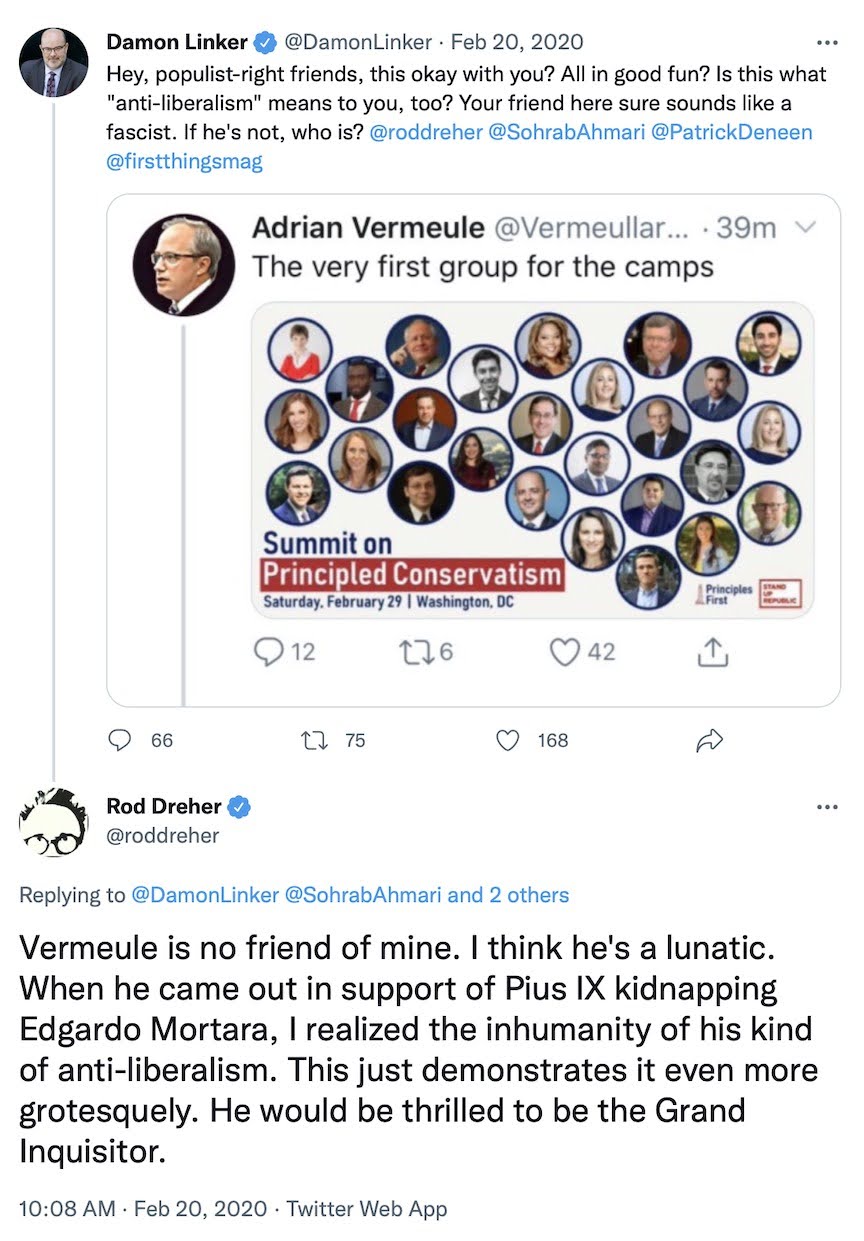
Last time he was defending the kidnapping of Jewish children, and now it's atheists, sending conservatives to the camps, and this.
He has a tag now; so do the Posners. I trolled Vermeule and his old writing partner on twitter awhile ago asking if they were still friends.
I'd forgotten Vermeule at Crooked Timber. They never end up looking good.
repeat from 2011, a comment at Concurring Opinions
Balkin is acting as an advocate, as lawyers do. He’s engaged in an argument with Posner, Vermeule and their ilk. But his logic or his faith force him to fudge his history to defend his vision of democracy, which allows Vermeule to counter as a hardened realist and blablabla [blablabla]. I find myself more and more envious of Canada and the living tree doctrine, which renders all this irrelevant.
Our relation to the Constitution is like our relation to Don Giovanni. And every time Peter Sellars has a new production set in Trump Tower or Las Vegas, we set about arguing whether he made the thing fresh or somehow screwed it up. The only difference between the two debates is I suppose the matters of life and death, or justice and tyranny: the baggage of politics. I love baggage; thinking about baggage takes up a good part of my life. But treating politics as baggage, as vulgar, has its advantages. I see no need to waft about in discussions of faith and redemption; fascism is fascism, why pussyfoot around it? Posner and Vermeule defend what lovers of democracy abhor, what else is there to say? They claim to find support for this in the Constitution but Christian kings found support for the Crusades in the Bible. They claim to defend reason. My response is simple. I’ve said it before and I’ll repeat it: “That authoritarianism has become normative may be a scientific fact, but that does not make authoritarianism itself a scientific truth.”
Balkin is arguing from the past and about the future, but somehow the present is lacking.
Liebling
…in a hospital tent at the clearing station I came across a man with a French flag wrapped around his waist; the medics discovered it when they cut his shirt away. He was a hard-looking, blondish chap with a mouthful of gold teeth and a face adorned by a cross-shaped knife scar—the croix de vache with which procurers sometimes mark business rivals. An interesting collection of obscene tattooing showed on the parts of him that the flag did not cover. Outwardly he was not a sentimental type.
"Where are you from?" I asked him.
"Belleville," he said. Belleville is a part of Paris not distinguished for its elegance.
"What did you do in civilian life?" I inquired.
That made him grin. "I lived on my income," he said.
"Why did you choose the Corps Franc?"
"Because I understood," he said.
In effect, Vermeule and Posner argue that government officials need not follow existing law if it conflicts with the academic theories of a "dynamic" new generation of legal scholars. They argue that critics of the torture memo "have a distinct methodological valence, one with intellectually partisan overtones." But it seems to me that the OLC's memo better fits this description.
Much as I respect Vermeule and Posner's other work, I must confess that I'm deeply worried about the abdication of moral responsibility in this op-ed, as well as its cavalier assumption that the purpose of the OLC is to push a particular ideological agenda heedless of any larger responsibilities to the Nation as a whole. The notion that government officials can simply discard relevant precedent if it gets in the way of ideology is inconsistent with the basic obligations of government lawyers. Is this truly, as Vermeule and Posner tell us, characteristic of the next generation of constitutional scholarship? I shudder at the thought.
Diversity, I will suggest in these pages, arises out of partiality.
As a Zionist and co-author of a paper titled "National Determination" he has no choice but to imagine every culture as an "intentional community", by which logic France started out as the equivalent of a Kibbutz. He has the origins of culture literally reversed. Esperanto is not the model for linguistic development and intentional communities originate in or devolve to kitsch. The model intentional community is fascist. More:
Most forms of legitimate partiality are more or less optional. We may be required to favour our children or friends, but it is up to us whether to have children or friends.
Most of us are required to have parents. see Brighouse. That and the Trolley Problem (start here).
Below is a repeat, since someone else found it today, and it fits. Beginning with a quote from Ernst Cassirer
---
Perception does not know the concept of infinity; from the very outset it is confined within certain spatial limits imposed by our faculty of perception. And in connection with perceptual space we can no more speak of homogeneity than of infinity. The ultimate basis of the homogeneity of geometric space is that aIl its elements, the "points" which are joined in it, are mere determinations of position, possessing no independent content of their own outside of this relation: it is purely functional and not a substantial reality. Because fundamentally these points are devoid of all content, because they have become mere expressions of ideal relations, they can raise no questions of diversity of context. Their homogeneity signifies nothing other than this similarity of structure, grounded in their common logical function, their common ideal purpose and meaning. Hence homogeneous space is never given space, but space produced by construction; and indeed the geometrical concept of homogeneity can be expressed by the postulate that from every point in space it must bc possible to draw similar figures in aIl directions and magnitudes. Nowhere in the space of immediate perception can this postulate be fulfilled. Here there is no strict homogeneity and direction each space has its own mode and its own value. Visual space and tactical space [Tastraum] are both anisotropic and unhomogenious in contrast to the metric space of Euclidian geometry: "the main directions of organization - before-behind, above-below, right-left - are dissimilar in both physiological spaces." [Ernst Mach]
"Seminar on The Priority of Democracy" Technocrats are philosophical elitists of ideas: mediocre people in search of the best of all possible rules, which in the end are "devoid of all content, because they have become mere expressions of ideal relations, they can raise no questions of diversity of context". Adrian Vermeule [history here, then here ] is a participant.
...see also M. Foucault, Liberal Fascism.
William Heckscher on Panofsky. From his memorial essay at the end of Panofsky's Three Essays on Style.
Everything in humanistic scholarship, even the (to him somewhat comical) New Criticism, which he characterized with Pierrot's words, "Je sais bien écrire, mais je ne sais pas lire," he considered acceptable, so long as it was not "institutionalized."
In America, it's always institutionalized, or the author is, if only under sedation.
It's absurd how much is lost when the goal of disinterest devolves into a fiction of objectivity.
But if “using rare words and tropes in place of common words and phrases” is a strategy of “deliberate transgression” of the norms of clear prose characteristic of the dominant classes and is opposed to “the hyper-correction strategies of pretentious outsiders,” then Bourdieu is a master strategist. Words such as lexis, allodoxia, chiastic, askesis, espace hodologique, hysteresis, and of course habitus (and, indeed, hysteresis of habitus) are scattered throughout the text.6 That a work of social science should—”unlike the sometimes illuminating intuitions of the essay”—require an effort on the part of the reader is fair enough. Here, however, reality disappears into the hypertrophied rhetoric of the Ecole Normale.
Politics, in large part, is a response to diversity. It reflects a seemingly incontrovertible condition—any imaginable human population is heterogeneous across multiple, overlapping dimensions, including material interests, moral and ethical commitments, and cultural attachments.
"Politics, in large part, is a response to diversity." No. Politics begins with negotiated intimacy, parents and children, and expands out. System builders start with regulation and end up systematizing familial relations.
This is a book with some important, even profound, ideas about politics, institutions, the virtues of democracy and what it takes to realize them, but it is written so so very, very diffusely that it will will have next to no impact, which is a shame. Let me try to lay out the main path of argument, which is rather lost amid the authors’ digressions and verbiage.
We live in big, complex societies, which means we are thoroughly interdependent on each other, and that we will naturally have different ideas about how our life in common should go, and will have divergent interests. This means that politics we shall always have with us.
Knight and Johnson have produced one of the most profound books in recent memory dealing with the questions of political structure and the processes that are necessary to reconcile our differences and to learn to live better together.
"Peter Boettke is a University Professor of Economics and Philosophy at George Mason University, the BB&T Professor for the Study of Capitalism, and the Director of the F.A. Hayek Program for Advanced Study in Philosophy, Politics, and Economics at the Mercatus Center at GMU."
If democracy is to be justified, it will have to be in consequentialist (or, if we prefer, “pragmatist”) terms; and as it seems prima facie implausible to think that all political and social institutions could or should be democratic in a first-order sense, only a second-order version of the consequentialist case for democracy can succeed.
A review [PDF] of Vermeule's Judging Under Uncertainty
As with statutes, so too with the Constitution. The courts, Vermeule argues, should enforce clear and specific constitutional texts, but should disclaim any role beyond that. Where constitutional texts are ambiguous or open ended, courts should let legislatures interpret them. Under this rule, Vermeule blandly notes, courts would cease enforcing the Bill of Rights and the Fourteenth Amendment. In particular, freedom of speech, due process, and equal protection would all be remitted to legislative enforcement.
Vermeule in 2004, with Eric Posner, defending the OLC torture memo; more here and here, etc. A fascist from a good family.
What are we to make of this essay at The Atlantic? It is easy enough just to be snarky. We could point out that Mr. Ferenstein actually learned something important from his foray into grad school: he was not cut out for the profession. He simply did not like - or was no good at - political science (although it turns out in the comments thread that he had gone off to study political philosophy, which is a whole other thing). Good! Hopefully his talents are better used elsewhere, although this essay is hardly evidence of that. And we might also point out that he seems to have no idea what he is talking about. Example: "The problem is that modern-day "political science" is rarely related to public policy or diplomacy at all. The scientific study of politics is the hyper-analytic mathematical, psychological, and anthropological study of civic behavior" Let's assume that this final sentence makes sense (it doesn't). Let's issue the same complaint about, say, evolutionary biology, which is not really related to direct practical human purposes either.
The perverse esthetics of systems and system-builders: a vampish defense of political science as the equivalent of biology, as if human beings (those other than the author and his copains) are proteins or cogs. That's not a simple defense of the article in the Atlantic. The question is whether political science and political philosophy are themselves anti-political and anti-humanist.
Cohen: I wrote a book called "If you're an Egalitarian How Come You're so Rich?" And the final chapter discusses fourteen reasons people give for not giving away their money when they're rich but they profess belief in equality, twelve of which are, well, rubbish. I think there are two reasonable answers that a person who doesn't give too much of it away can give and one of them has to do with the burden of depressing yourself below the level of your peer group with whom you're shared a certain way of life; and in particular, depriving your children of things that the children around them favor. And also, and slightly separately, the transition from being wealthy to being not wealthy at all can be extremely burdensome and the person who has tasted wealth will suffer more typically from lack of it than someone who's had quote unquote the good fortune never to be wealthy and therefore has built up the character and the orientation that can cope well with it.
It's so much harder to be powerless if you once had power. Pity the rich ex-Marxist.
The foundation of democracy is not in the ability of any given system to regulate conflicts among citizens, but the willingness and the ability of citizens' to face and then negotiate their own contradictory desires. Negotiation with others extends out from negotiation within a divided self.
The focus on technics and ideal organization weakens social bonds by weakening the ability to understand them. The focus exclusively on the world beyond the self does not eliminate the self; it elides it, flattening it. Selflessness requires self-awareness. Self-awareness requires an awareness of internal division. Saying you don't understand why people go to church, watch sports, have a "hometown", is not the same as choosing not to think or behave as they do. It's self-satisfied, incurious, and it means you're blind to your own reflexes and foibles: blind to your own complexity.
"A focus on the mean puts downward pressure on the mean." The performative reinforcement of mediocrity.
Italy's former military intelligence chief was sentenced to 10 years in jail on Tuesday for his role in the kidnapping of an Egyptian Muslim cleric in an operation organized by the United States.
An American former CIA station chief was this month sentenced in absentia to seven years in jail after imam Abu Omar was snatched from a Milan street in 2003 and flown to Egypt for interrogation during the United States' "war on terror".
For the CIA, it is quite clear how explosive the Italian case is for them. At the outset of the investigation, all Spataro had was a list of over 10,000 different cell phone calls. Using that as a basis, and with the help of meticulous research, he produced the entire indictment. At the beginning he believed that only the CIA was involved in the operation -- at the end seven Italian agents also stood in court.
The length of Spataro's final speech to the court alone showed just how extensive his investigations had been. The first part at the beginning of October lasted seven hours by itself, the second part almost nine. He described the course of the investigation to the court using an elaborate PowerPoint presentation. "Otherwise nobody would have understood it," he said.
His opponents have repeatedly tried to stop him. Spataro also investigated the actions of his own government. During the trial, he revealed details of the cooperation between Italian and US intelligence. In March, the Italian Constitutional Court ruled, at the behest of Silvio Berlusconi's government, that all the documents which concerned relations between the intelligence services were state secrets. This was a serious blow for Spataro, as it meant he could no longer use much of the evidence relating to the involvement of Italian agents in the operation. That evidence included recorded phone calls and the testimony of several witnesses, including the former SISMI boss Gianfranco Battelli. Battelli had said that Jeff Castelli, the then-CIA station chief in Rome, had asked him in a conversation to cooperate with the kidnapping of terror suspects
...The defense attorneys had attacked the prosecutor by saying his whole case was inadequate and was based on a permanent violation of state secrets. They had called for acquittals across the board.
In that respect, Judge Magi did not only decide on Wednesday about the guilt or innocence of the Italian and American agents and not only about the legality of kidnapping in the fight against terrorism. He also delivered a verdict as to whether a European government can use the pretext of state secrets to avoid being accountable before the law.
Prosecutor on Rendition Case: Kidnapping a 'Disgrace And Should Be Prosecuted'
A German prosecutor who investigated the CIA's kidnapping of Egyptian cleric Abu Omar in 2003 under the infamous rendition program tells SPIEGEL how he had to close the case due to a lack of information from US organizations. He says the kidnapping was a "disgrace" and that he would have filed indictments, if he had been able to.
Perception does not know the concept of infinity; from the very outset it is confined within certain spatial limits imposed by our faculty of perception. And in connection with perceptual space we can no more speak of homogeneity than of infinity. The ultimate basis of the homogeneity of geometric space is that aIl its elements, the "points" which are joined in it, are mere determinations of position, possessing no independent content of their own outside of this relation: it is purely functional and not a substantial reality. Because fundamentally these points are devoid of all content, because they have become mere expressions of ideal relations, they can raise no questions of diversity of context. Their homogeneity signifies nothing other than this similarity of structure, grounded in their common logical function, their common ideal purpose and meaning. Hence homogeneous space is never given space, but space produced by construction; and indeed the geometrical concept of homogeneity can be expressed by the postulate that from every point in space it must bc possible to draw similar figures in aIl directions and magnitudes. Nowhere in the space of immediate perception can this postulate be fulfilled. Here there is no strict homogeneity and direction; each space has its own mode and its own value. Visual space and tactical space [Tastraum] are both anisotropic and unhomogenious in contrast to the metric space of Euclidian geometry: "the main directions of organization – before-behind, above-below, right-left – are dissimilar in both physiological spaces." [Ernst Mach]
"Seminar on The Priority of Democracy" Technocrats are philosophical elitists of ideas: mediocre people in search of the best of all possible rules, which in the end are "devoid of all content, because they have become mere expressions of ideal relations, they can raise no questions of diversity of context". Adrian Vermeule [history here, then here ] is a participant.
...see also M. Foucault, Liberal Fascism.
William Heckscher on Panofsky. From his memorial essay at the end of Panofsky's Three Essays on Style.
Everything in humanistic scholarship, even the (to him somewhat comical) New Criticism, which he characterized with Pierrot's words, "Je sais bien écrire, mais je ne sais pas lire," he considered acceptable, so long as it was not "institutionalized."
In America, it's always institutionalized, or the author is, if only under sedation.
It's absurd how much is lost when the goal of disinterest devolves into a fiction of objectivity.
But if “using rare words and tropes in place of common words and phrases” is a strategy of “deliberate transgression” of the norms of clear prose characteristic of the dominant classes and is opposed to “the hyper-correction strategies of pretentious outsiders,” then Bourdieu is a master strategist. Words such as lexis, allodoxia, chiastic, askesis, espace hodologique, hysteresis, and of course habitus (and, indeed, hysteresis of habitus) are scattered throughout the text. That a work of social science should—”unlike the sometimes illuminating intuitions of the essay”—require an effort on the part of the reader is fair enough. Here, however, reality disappears into the hypertrophied rhetoric of the Ecole Normale.