Showing posts with label The Press. Show all posts
Showing posts with label The Press. Show all posts
Tuesday, October 08, 2024


Friday, December 29, 2023
Here again the convergences in the translations are striking. But the minor variants talk to us too. Proust’s narrator speaks of ‘l’idée que je me suis faite du sadisme’. Nelson’s phrase ‘my conception of sadism’ is close to Scott Moncrieff and Carter’s ‘my idea of sadism’, while the original Scott Moncrieff version expands the phrase into a sort of commentary: ‘my idea of that cruel side of human passion called “sadism”’. Kilmartin and Davis respond more openly to the mention of the idea’s making – ‘the notion I was to form’ (Kilmartin), ‘the idea which I formed’ (Davis) – and Grieve does so at greater length: ‘a certain notion of the meaning of sadism was to form ... in my mind.’ The little train of words Proust’s narrator offers to describe Mlle Vinteuil’s ‘air’ as she closes the shutters (‘las, gauche, affairé, honnête et triste’) creates a quietly interesting puzzle. All the translators but one start with ‘weary, awkward’ (Kilmartin goes for ‘languid, awkward’) and they all end with ‘sad’. ‘Affairé’ and ‘honnête’ turn out to be more elusive or questionable. The suggestions here are ‘fussy, prim’ (Nelson), ‘fussy, honest’ (Davis), ‘busy, trustworthy’ (Grieve), ‘bustling, sincere’ (Kilmartin and Carter), ‘preoccupied, sincere’ (Scott Moncrieff). Small differences, but our view of the narrator’s view of Mlle Vinteuil shifts quite a bit as it moves among them. And in this context, the choice between staying with Proust’s grammar and speeding it up is intriguing. Four translations out of six convert Proust’s ‘might perhaps still not have lost faith’ (‘n’eût peut-être pas encore perdu sa foi’) into ‘might still have continued to believe’; Grieve elaborates a little: ‘preserved some scrap of faith’. We are looking perhaps at the difference between relaying meaning and tracking movements of thought.
An hour or two drifting from Levinas on the Talmud, to the Talmud, and then to someone's memories of Quine. It still amazes me how many people search for the meaning in the world itself, as if meanings were subatomic particles. It's the definition of theology, and that's one thing I have no interest in at all.
I've said it all before. My writing's changed. I don't try as hard.
And drifting again, I end back here.
If you're going to spend your life studying Proust or Michelangelo, in the end you're using them to study yourself: your own perceptions of things. It's better to admit you're using them as material. The scholarship of false humility is creepy: the creepiness of biography, and journalism.
---
Philosophers vs historians again, on Arendt.
Geuss vs Pocock, The Machiavellian Moment,
In terms borrowed from or suggested by the language of Hannah Arendt, this book has told part of the story of the revival in the early modern West of the ancient ideal of homo politicus (the zoon politikon of Aristotle), who affirms his being and his virtue by the medium of political action, whose closest kinsman is homo rhetor and whose antithesis is the homo credens of Christian faith. Following this debate into the beginnings of modern historicist sociology, we have been led to study the complex eighteenth-century controversy between homo politicus and homo mercator, whom we saw to be an offshoot and not a progenitor—at least as regards the history of social perception—of homo creditor. The latter figure was defined and to a large degree discredited by his failure to meet the standards set by homo politicus, and eighteenth-century attempts to construct a bourgeois ideology contended none too successfully with the primacy already enjoyed by a civic ideology; even in America a liberal work ethic has historically suffered from the guilt imposed on it by its inability to define for itself a virtue that saves it from corruption; the descent from Daniel Boone to Willy Loman is seen as steady and uninterrupted. But one figure from the Arendtian gallery is missing, curiously enough, from the history even of the American work ethic: the homo faber of the European idealist and socialist traditions, who served to bridge the gap between the myths of the bourgeoisie and the proletariat. It is not yet as clear as it might be how the emergence of this figure is related to the European debate between virtue and commerce; but because industrial labor in America conquered a wilderness rather than transforming an ancient agrarian landscape, homo faber in this continent is seen as conquering space rather than transforming history, and the American work force has been even less willing than the European to see itself as a true proletariat. The ethos of historicist socialism has consequently been an importation of transplanted intellectuals (even the martyr Joe Hill left word that he "had lived as an artist and would die as an artist"), and has remained in many ways subject to the messianic populisms of the westward movement.
Fun and frustration, mostly frustration.
In America there are comparatively few who are rich enough to live without profession. Every profession requires an apprenticeship, which limits the time of instruction to the early years of life. At fifteen they enter upon their calling, and thus their education ends at the age when ours begins.
Davidson is also known for rejection of the idea of a conceptual scheme, thought of as something peculiar to one language or one way of looking at the world, arguing that where the possibility of translation stops so does the coherence of the idea that there is something to translate.

Beginning in the 1950s and blossoming since 1961, a major scholarly controversy has sucked The Federalist into its gravitational field: What was its role in the great shift from republicanism to liberalism in American political thought? These complex bodies of ideas and practices have almost no direct links to today’s Republican party or modern American liberalism; moreover, these terms have become so vague that many historians have abandoned both words as useless.
Friday, December 15, 2023
Drift, the bourgeoisie, materialism, the press, etc. Change is slow, but when it becomes clear it's kind of electric.
"Why should they be prohibited from having exactly the same rights as the state of Israel?"
— Piers Morgan Uncensored (@PiersUncensored) December 14, 2023
Piers Morgan questions senior advisor to Benjamin Netanyahu, Mark Reghev, after the Israeli ambassador said that a two-state solution is not possible.@piersmorgan | @MarkRegev | #pmu pic.twitter.com/5weAUUbJS2
"Israel has been waging a war of genocide in Gaza."
— Piers Morgan Uncensored (@PiersUncensored) December 13, 2023
Watch the full debate between Norman Finkelstein and Alan Dershowitz on YouTube: https://t.co/uZCnXzHYRN@AlanDersh | @normfinkelstein | @piersmorgan | #PMU pic.twitter.com/MYonjTM2pH
Prior to the recent attack by Hamas, six in 10 (57%) said the United States should be ready to meet with leaders of Hamas, including half of Republicans (51%), and majorities of Democrats (61%) and Independents (59%).
On most other questions there are great partisan differences. While most Americans preferred the United States take neither side in the conflict (64%), Republicans were equally likely to say they should take Israel’s side (49%) as no side (48%).
The attack pushed Israel over an edge, or what's become an edge.
Monday, December 04, 2023
Granta, "Once Again, Germany Defines Who Is a Jew | Part I"
"Forensic Architecture". I said I was going to write more, but I'm not sure I have the patience.
Weizman: I don’t think it’s controversial to say that freedom of expression needs to be measured in relation to hate speech, and the safety and dignity of survivors.
It's not controversial unless you defend freedom of speech. Giving the state the right to measure speech led to the censorship that he opposes. But of course he follows the German idea of freedom, which is also the academic model for permissible speech.
Kant: A lesser degree of civic freedom, however, creates room to let that free spirit expand to the limits of its capacity.
And this becomes scholastic perversity of Forensic Architecture's "investigative aesthetics", which is the model of journalism as art, and the parallel fantasy that art is "truth".
And we're back the this.
Forensic Architecture: Violence at the Threshold of Detectability, published by Zone, of course.
But the most offensive thing about he piece in Granta is the pathological blindness to things at the core of German- and European-Israel relations. Herzl was right."The anti-Semites will become our most dependable friends, the anti-Semitic countries our allies", once we leave. Weizman and EDB are too close to their German and Zionist roots, too loyal to both, to see the obvious.

Wednesday, November 29, 2023
Granta, "Once Again, Germany Defines Who Is a Jew | Part I"
George Prochnik, Eyal Weizman & Emily Dische-Becker
Forensic Architecture again. The thing made me want to puke. Germany/Israel. I remember the miserable Israeli hipster who broke up with a boyfriend who loved her because she could only marry a Jew. She ended up the second wife of a German who could only marry Jews.
EDB is an old acquaintance. She's a German and a Jew: the schism is internal. She was always tempted by aestheticized politics. So am I, but I'm also tempted by nihilism. And when we used to talk she was a kid, and I didn't want to be an asshole.
More later.
various, recordkeeping. watching change happen
NYT: "Gaza Civilians, Under Israeli Barrage, Are Being Killed at Historic Pace"
Even a conservative assessment of the reported Gaza casualty figures shows that the rate of death during Israel’s assault has few precedents in this century, experts say.
Israel has cast the deaths of civilians in the Gaza Strip as a regrettable but unavoidable part of modern conflict, pointing to the heavy human toll from military campaigns the United States itself once waged in Iraq and Syria.
But a review of past conflicts and interviews with casualty and weapons experts suggest that Israel’s assault is different.
While wartime death tolls will never be exact, experts say that even a conservative reading of the casualty figures reported from Gaza shows that the pace of death during Israel’s campaign has few precedents in this century.
The tunnel arguments and videos were a dud.
ABC News (AP), "Israel reveals signs of Hamas activity at Shifa, but a promised command center remains elusive"
The Israeli military brought journalists, including an Associated Press correspondent, into Gaza on Wednesday to show them what it claimed was a Hamas military facility under Shifa. Soldiers unveiled what appeared to be a subterranean dormitory accessible by a heavily fortified underground tunnel that Israeli authorities say stretches for hundreds of meters (yards). The military said the dormitory lay behind a blast-proof door with an opening meant to be used by Hamas snipers.
The quarters included an air conditioner, kitchen, bathroom and pair of metal cots in a room fashioned from rusty white tile. They appeared to be out of use.
Canberra Times header for the same article: "Removing the tunnel vision on a central Gaza claim"
Newsweek, Fact Check: "Did Israel Build Bunker Under Shifa Hospital?" True
Monday, August 07, 2023
Ten years ago, Israel had prominent, liberal, defenders in American media + academia. It no longer does. https://t.co/lP1MBUxMbi
— Peter Beinart (@PeterBeinart) August 7, 2023
You ten years ago "I'm not asking Israel to be Utopian. I'm not asking it to allow Palestinians... to return to their homes. I'm not even asking it to allow full, equal citizenship,... I'm actually pretty willing to compromise my liberalism."https://t.co/h0jUnO43tc
— Aloise (@AloiseFahyling) August 7, 2023
The Atlantic cut the best passages. Was that or Goldberg? Are you trying to rewrite your past?
— Aloise (@AloiseFahyling) August 7, 2023
I should add the "utopia and intentional communities" tag to every post about Israel. I've added it to most of them I think, after I started it
The new link is to archive.org. I've updated it on a few earlier posts.
I'm not asking Israel to be Utopian. I'm not asking it to allow Palestinians who were forced out (or fled) in 1948 to return to their homes. I'm not even asking it to allow full, equal citizenship to Arab Israelis, since that would require Israel no longer being a Jewish state. I'm actually pretty willing to compromise my liberalism for Israel's security and for its status as a Jewish state. What I am asking is that Israel not do things that foreclose the possibility of a Palestinian state in the West Bank, because if it is does that it will become--and I'm quoting Ehud Olmert and Ehud Barak here--an "apartheid state."
The most he ever wanted was a Bantustan
Friday, July 14, 2023
From April and I was convinced I'd noted it. This is just bookmarking.
Rest of World, Twitter is complying with more government demands under Elon Musk
It’s been exactly six months since Elon Musk took over Twitter, promising a new era of free speech and independence from political bias. But Twitter’s self-reported data shows that, under Musk, the company has complied with hundreds more government orders for censorship or surveillance — especially in countries such as Turkey and India.
The data, drawn from Twitter’s reports to the Lumen database, shows that between October 27, 2022 and April 26, 2023, Twitter received a total of 971 requests from governments and courts. These requests included orders to remove controversial posts, as well as demands that Twitter produce private data to identify anonymous accounts. Twitter reported that it fully complied in 808 of those requests, and partially complied in 154 other cases. (For nine requests, it did not report any specific response.)
Most alarmingly, Twitter's self-reports do not show a single request in which the company refused to comply, as it had done several times before the Musk takeover. Twitter rejected three such requests in the six months before Musk's takeover, and five in the six months prior to that.
More broadly, the figures show a steep increase in the portion of requests that Twitter complies with in full. In the year before Musk's acquisition, the figure had hovered around 50%, in line with the compliance rate reported in the company's final transparency report. After Musk's takeover, the number jumps to 83% (808 requests out of a total of 971).
The full dataset used in this reporting is available here.
Rest of World, About us, the sixth subhead: Hold the powerful accountable
We hold companies, executives, and policymakers accountable for the impact of their work and decisions. In a world where a single product designer in Palo Alto can affect the daily lives of millions of users in New Delhi with one click, it’s critical to confront decision-makers with the impact of their work.
Since the founder is the daughter of Eric Schmidt, she knows whereof she speaks. Holding dad accountable is another question.
Eric Schmidt has been quietly building an investment vehicle blending public and private funds that could grant the former Google CEO unusual influence over U.S. national security policy and, potentially, the opportunity to steer taxpayer money to his own bets.
The Tech Transparency Project, "Holding Big Tech accountable". Funded by Soros and Omidyar
You can't escape billionaires who really want to help.
repeat, from November
FT: "EU and US turn up the heat on Elon Musk over Twitter"
Elon Musk is under renewed pressure from the US and EU over his ownership of Twitter, as regulators clamp down on the billionaire’s push to transform the social network into a freewheeling haven of free speech.The European Commission on Wednesday threatened Musk with a ban unless Twitter abides by strict content moderation rules, as US Treasury secretary Janet Yellen indicated that Washington was reviewing his purchase of the social network.
Tuesday, July 11, 2023
.@realDonaldTrump may be the only thing that stands between us and World War III https://t.co/bgYxKLQqmO
— Roger Stone (@RogerJStoneJr) July 11, 2023
Shouldn't this stuff be banned as disinformation or something? I'm really worried for the future of this country.
The Intercept, "A loose coalition of Democrats and Freedom Caucus Republicans are pushing NDAA amendments that challenge Washington’s foreign policy orthodoxy"
Putin's got to everybody apparently.
Monday, July 10, 2023
A critique of Bidenomics in Phong Bui's Brooklyn Rag, and Phong's letter to readers, after Prigozhin. I'm not going to go over my sociology/genealogy of intellectual hipsterdom, even though Jamie Merchant's essay appears under an ad for an exhibition of luxury commodities made by an insufferably pretentious schmuck, in a luxury boutique owned by a clueless fop, in a town with an economy fueled almost entirely by the "oll bidness".
Grey Anderson and Thomas Meaney in the NYT: "NATO secures American influence in Europe on the cheap". I'm not sure that NATO allies won't end up with more power than the US wants.
It's always good to see interesting things in the mainstream press.
Merchant, "The Economic Consequences of Neo-Keynesianism".
Criticism of the new orthodoxy has been scarce, but not completely absent. In a blog for the New Left Review, the sociologist Dylan Riley threw cold water on the whole prospect of Bidenomics. Taking the March bailout of Silicon Valley Bank as a point of departure, Riley claimed that “the SVB collapse is a beautiful, almost paradigmatic, demonstration of the fundamental structural problem of contemporary capitalism: a hyper-competitive system, clogged with excess capacity and savings, with no obvious outlets to soak them up,” and that “the current vogue for ‘industrial policy’ will do nothing to address this underlying issue.” Consequently, socialists have no business supporting Bidenomics or any other industrial policy for that matter: instead, “the commanding heights of the economy…must be seized all at once.”4
Despite helpfully solving the problem of socialist strategy, Riley’s polemic provoked a flurry of rote Keynesian responses criticizing his ultraleft politics and emphasizing the role of demand as a policy variable. Writing for New York magazine, Eric Levitz pointed to the high rate of US profits, as measured by the US Bureau of Economic Analysis, as evidence against Riley’s contention that overcapacity is suppressing them. “More broadly, overcapacity cannot exist in anything but a relative sense,” he added, “the world does not have more productive capacity than is required to satisfy all the wants and needs of its 7.8 billion people.” The problem, Levitz suggested, is one of “inadequate demand.”5 Similarly, the economist J.W. Mason criticized the theoretical basis of Riley’s overproduction story, claiming that it—unjustifiably—takes demand as a static variable, just as, conversely, mainstream economics usually takes supply as a given factor, unalterable by human activity. Besides, political realities should trump political purism. Rather than dismissing Bidenomics from the standpoint of some idealized socialist movement, progressive activists should welcome it as the flawed but long-awaited arrival of post-neoliberal governance, which for better or worse will form the terrain of political conflict in the years to come. And in the end, isn’t any climate policy better than none?6
Considering the content of the IRA, that's actually debatable. The IRA— billed by its cheerleaders as “the most important climate action in U.S. history”—provides billions in tax credits to generate domestic consumer demand for US-made electric vehicles, along with a host of other measures to incentivize emission reductions and clean energy manufacturing. It also hands out truly massive subsidies to the oil and gas industries, locking in continued windfall profits for oil oligarchs—“courageous visionaries,” in the words of US Energy Secretary Jennifer Granholm—and environmental degradation at the public’s expense for decades to come.7 At the moment, it is unclear if the legislation’s decarbonization measures will even balance out the historic pipeline permit it just handed to the fossil fuel industry not just to continue, but to escalate its campaign to doom human civilization. Beyond the IRA, the speed with which the Biden administration has approved new drilling projects has left even Trump’s cretinous lackeys of industry in the dust.8
That’s not all, though. A key feature of the IRA is its brazen protectionism for US electric automobile manufacturing, which predictably set off alarm bells in Brussels and Seoul, whose exports the Act is explicitly meant to shut out. As a plainly mercantilist policy with the goal of raising US growth at the expense of its competitors, the IRA is already triggering an international arms race toward general mercantilism, with the European Union rushing to implement its own protectionist subsidies. The South Korean government, already acting against its own economic interests to accommodate the US’s trade war against China, was shocked by the US’s apparent willingness to economically decimate a critical ally in its anti-China coalition.9 It has since enacted a new round of subsidies for its domestic industries and is currently considering even bigger ones. Japan is following suit.10 With the IRA’s beggar-thy-neighbor consequences, the US is happily forming a circular firing squad with its supposed “allies,” with signs afoot that a global race to the bottom in protectionism is already underway. This makes the prospects for global cooperation on the climate crisis even bleaker than they already were.11
There's a lot more.
Wednesday, July 05, 2023
NYT Federal Judge Limits Biden Officials’ Contacts With Social Media Sites
The Republican attorneys general of Texas and Florida are defending first-of-their-kind state laws that bar internet platforms from taking down certain political content, and legal experts believe those cases may eventually reach the Supreme Court. The high court this year declined to limit a law that allows the platforms to escape legal liability for content that users post to the sites.
The ruling on Tuesday, in a lawsuit brought by the attorneys general of Louisiana and Missouri, is likely to be appealed by the Biden administration, but its impact could force government officials, including law enforcement agencies, to refrain from notifying the platforms of troublesome content.
Government officials have argued they do not have the authority to order posts or entire accounts removed, but federal agencies and the tech giants have long worked together to take action against illegal or harmful material, especially in cases involving child sexual abuse, human trafficking and other criminal activity. That has also included regular meetings to share information on the Islamic State and other terrorist groups.
The White House said the Justice Department was reviewing the ruling and evaluating its next steps.
“Our consistent view remains that social media platforms have a critical responsibility to take account of the effects their platforms are having on the American people, but make independent choices about the information they present,” the White House said in a statement.
Meta, which owns Facebook and Instagram, declined to comment. Twitter did not have a comment, and Google did not respond to a request for comment.
Democracy Now June 9th: DOJ vs. African People’s Socialist Party: Omali Yeshitela Blasts Charges of Being Russian Agent
Yeshitela's an ass. It's irrelevant. I shouldn't have to say it.
Tampa Bay Times, May 10, St. Petersburg Uhuru members speak for first time since indictment
It’s a matter of free speech, says Omali Yeshitela, the longtime leader of the St. Petersburg-based Uhuru Movement and founder of the African People’s Socialist Party.
Yeshitela was indicted by a federal grand jury in Tampa last month and accused of working with Russian nationals to sow discord in the United States, spread pro-Russian propaganda and influence elections, along with two other members of the Uhuru Movement, Penny Joanne Hess and Jesse Nevel.
On Wednesday, the three Uhuru members spoke to the press for the first time since their indictment.
“I believe in free speech,” Yeshitela said at the news conference. “If I didn’t believe in free speech, I would never have said anything because they kill Black people for talking in this country.”
Twitter said 100 accounts with Russian ties were removed for amplifying narratives that undermined faith in NATO and targeted the United States and the European Union.
"For those of you who have been with us so far, you'll know that we've been thinking and talking a lot about how the First Amendment should adjust to the new challenges of the platform era."
"And that's an important story because tech platforms are perhaps the most important speech regulators in the world."
Republicans want to ban books; Democrats want to ban "disinformation"; it's one syllable or five. But Democrats want corporations to do the dirty work, so Facebook is free to incite in the quest for engagement, and the speech of its captive audience is policed.
All this misinformation being spread these days is getting in the way of disseminating official government propaganda
— Karl Sharro (@KarlreMarks) December 1, 2022
Tuesday, July 04, 2023
A famous philosopher Francis Fukuyama @FukuyamaFrancis joined us in Stanford. Mr. Fukuyama expressed gratitude to Azov @azov_media Sergeant Arseniy Fedosyuk for his service and heroism during Mariupol campaign and uttered support to Ukraine on our sure way to victory. pic.twitter.com/dpqGjI27v8
— Kateryna Prokopenko (@KatProkopenkoUa) June 30, 2023


The Forward, "Why did Stanford students host a group of neo-Nazis?"
Conversations about white supremacy in America today typically center on right-wing media and incendiary politicians who blast out racist dog whistles.But hate doesn’t need demagogues to get mainstreamed; it has also found an outlet at elite universities.On June 29, Stanford University hosted a delegation from the Azov Brigade, a neo-Nazi formation in the Ukrainian National Guard. The panel, during which Azov’s neo-Nazi insignia was projected onto the wall, was attended by noted political scientist Francis Fukuyama, who posed for a photograph with the delegation.This event — and the disturbing lack of reaction from Jewish organizations — showcases the limits of America’s commitment to combating white supremacy.Call it the Ukraine exception.
Moss Robeson, a thread with links:
Yulia Fedosiuk, famous Azov Regiment wife currently touring the US for a 2nd time, makes reference to alt-right / neo-Nazi meme on her way back to Stanford
more:
Denys Redis Prokopenko - 32!
— Hooligans.cz Official (@hooliganscz1999) June 27, 2023
Legend of Ukraine, the Army and Dynamo.
For us it’s a great honor that Denis has come from our movement. The guy with whom we had fights in the city, away matches and concerts with. Today he represents real hope for Ukraine. His leadership in the… pic.twitter.com/8VtEMrdwpL

—Denys Redis Prokopenko - 32!
Legend of Ukraine, the Army and Dynamo.
For us it’s a great honor that Denis has come from our movement. The guy with whom we had fights in the city, away matches and concerts with. Today he represents real hope for Ukraine. His leadership in the defence of Mariupol will go down in military history. The officer with a flame of Idea in his heart and cares deeply about the fate of Europe.
We are very thankful to our comrades from Zagreb, Berlin and Madrid for your congratulations. We will always appreciate who have been with us in than hard time.
Redis will see it personally and he will be shy because he doesn’t like “birthday parties” like many other warriors. Especially when our country is spilling blood. His biggest wish is to return to battle.
“Ukraine belongs to us
Brave, real and loyal
Who have chosen honour and courage”.
We wait for you at home, comman𝕯er!—

Thursday, June 29, 2023
Another tweet that shows how prioritising blue tick replies in the new Twitter world just degrades the Twitter experience. https://t.co/xpWqr4GUq6
— James Ball (@jamesrbuk) June 29, 2023

"And that's an important story because tech platforms are perhaps the most important speech regulators in the world."
Unwilling or unable to recognize recognize the difference between Disney World as a place to visit or the place you live: a company town.


Tuesday, June 13, 2023
1A Disquieting SuggestionImagine that the natural sciences were to suffer the effects of a catastrophe. A series of environmental disasters are blamed by the general public on the scientists. Widespread riots occur, laboratories are burnt down, physicists are lynched, books and instruments are destroyed. Finally a Know-Nothing political movement takes power and successfully abolishes science teaching in schools and universities, imprisoning and executing the remaining scientists. Later still there is a reaction against this destructive move- ment and enlightened people seek to revive science, although they have largely forgotten what it was. But all that they possess are fragments: a knowledge of experiments detached from any knowledge of the theoretical context which gave them significance; pans of theories unrelated either to the other bits and pieces of theory which they possess or to experiment; instruments whose use has been forgotten; half-chapters from books, single pages from articles, not always fully legible because torn and charred. Nonetheless all these fragments are reembodied in a set of practices which go under the revived names of physics, chemistry and biology. Adults argue with each other about the respective merits of relativity theory, evolutionary theory and phlogiston theory, although they possess only a very panial knowledge of each. Children learn by hean the surviving portions of the periodic table and recite as incantations some of the theorems of Euclid. Nobody, or almost nobody, realizes that what they are doing is not natural science in any proper sense at all. For everything that they do and say conforms to cenain canons of consistency and coherence and those contexts which would be needed to make sense of what they are do- ing have been lost, perhaps irretrievably.
In such a culture men would use expressions such as 'neutrino', 'mass', 'specific gravity', 'atomic weight' in systematic and often interrelated ways which would resemble in lesser or greater degrees the ways in which such expressions had been used in earlier times before scientific knowledge had been so largely lost. But many of the beliefs presupposed by the use of these expressions would have been lost and there would appear to be an element of arbitrariness and even of choice in their application which would appear very surprising to us. What would appear to be rival and competing premises for which no funher argument could be given would abound. Subjectivist theories of science would appear and would be criticized by those who held that the notion of truth embodied in what they took to be science was incompatible with subjectivism.
The universe didn't begin with the word; science didn't begin with the the definition of scientific method; no one will ever ban the chemistry of plaster and concrete, the metallurgy of steel, or the mathematics of the arch. Science, like politics, begins in experience and the mud. The "disquieting suggestion" is the portentous language of a moralizing pedant; it's intellectually backwards and it's stupid, the equivalent to claims for the "science" of economics based on the existence of a God.
I'm back in the Berkshires watching MSNBC proclaim the victory of democracy, the Democratic Party, and the United States, over barbarism, Donald Trump, and Russia.
And a last update to the previous post. Politics is for adults.
Trudeau made no pretense to philosophy; he did what he thought was necessary, arguing from the specifics in a crisis, not generalizations from the library. Theory simplifies the messiness and slop of politics, and more than anything it's used as an excuse, as if it could grant permission: "I was only following orders." Trudeau's quote is famous because it was so blunt it still makes people laugh. He takes full credit, or blame, and shrugs. Schmitt was a fascist, defending violence as a general truth about the world, and taking responsibility for nothing. He was a weakling defending weakness. The passivity is the root of the sleaze. Passivity reinforces itself, and political passivity is a biggest threat to democracy. MacIntyre is a putz.
Sunday, May 28, 2023
Mid East Eye. Turkey elections live: Erdogan wins five more years in power
With 99.43 percent of the votes counted, the board’s chairman Ahmet Yener says we have:
Erdogan: 52.14 percent
Kilicdaroglu: 47.86 percent...
Big drop off in Kurdish vote
...Places that did see a large decrease, however, were Turkey’s Kurdish-dominated areas.
Majority Kurdish areas always tend to have a lower turnout than the rest of the country, with some residents complaining of marginalisation, repression and a lack of representation.
In the first round, Kurdish-dominated areas had 81.70 percent. That dropped to 75.74 percent today.
Mardin’s turnout dropped from 82.76 percent to 78.60; Van went from 78.62 to 72.13; Batman fell from 84.93 to 80.17; and in Agri we saw 72.86 plummet to 65.72, according to Anadolu Agency.
That won’t come as a massive surprise to people following the reluctant way Kurdish parties endorsed Kilicdaroglu again for the runoff.
The opposition candidate made a tacit alliance with the pro-Kurdish HDP before the elections, who supported him from outside his Table of Six coalition. Erdogan used that Kurdish support against him, however, calling the opposition “terrorist” due to the HDP’s ideological links with the PKK armed group.
Ahead of the runoff, Kilicdaroglu won the support of the Turkish ultranationalist Victory Party, who signed an agreement with him that promised to maintain a system of choosing trustees in municipalities that Kurdish parties complain is discriminatory...
Ogan voters appear split two ways
One of the most anticipated questions ahead of the run-off was how those who voted for third-placed ultranationalist, anti-refugee candidate Sinan Ogan in the first round would vote this time.
Ogan endorsed President Recep Tayyip Erdogan days before the second round. Ogan's ultranationalist, anti-refugee ally Umit Ozdag and his Victory Party, on the other hand, endorsed the opposition candidate Kemal Kilicdaroglu. Ozdag's party got 2.2 percent of the votes in the parliamentary elections.
---
“You brought more than 10 million refugees in,” he shouts, addressing President Recep Tayyip Erdoğan, over footage of young people climbing through barbed wire and through dusty tracks next to grassland. “I hereby declare that I will send all refugees back as soon as I come to power.”...
When polled, a large majority of voters say the country’s harsh economic crisis is their main concern, but surging far-right elements have scapegoated immigrants, harnessing anti-refugee sentiment across the country and trumpeting racist discourse on immigration in a way that has been taken up by the mainstream and appears set to stay long after the election ends.
Rather than provide alternatives, both presidential candidates have sought to harness support from the ultranationalist right – with both gaining the support of one of the two leading figures in the Victory party. A week after the first-round vote, Oğan said he was backing Erdoğan. Days later, Özdağ declared an alliance with a smiling Kılıçdaroğlu at a press conference. The Victory party leader said he had backed the opposition leader because he believed Kılıçdaroğlu was more likely to enact his policy of immediately deporting refugees.
Venezuelan refugees are a bigger and bigger issue in Colombia and elsewhere. Migrants from Zimbabwe are threatened in South Africa. I've heard nothing, ever, from Bertram and his ilk about the rights of Palestinian refugees, long term residents in Lebanon and Jordan, or about Syrian refugees in those states now. Bangladesh is struggling with the Rohingya. Oxbridge, or European, technocratic universalism is a form of exceptionalism.
In retrospect Bertram's argument was always a highbrow version of "abolish the police".
Thursday, May 11, 2023
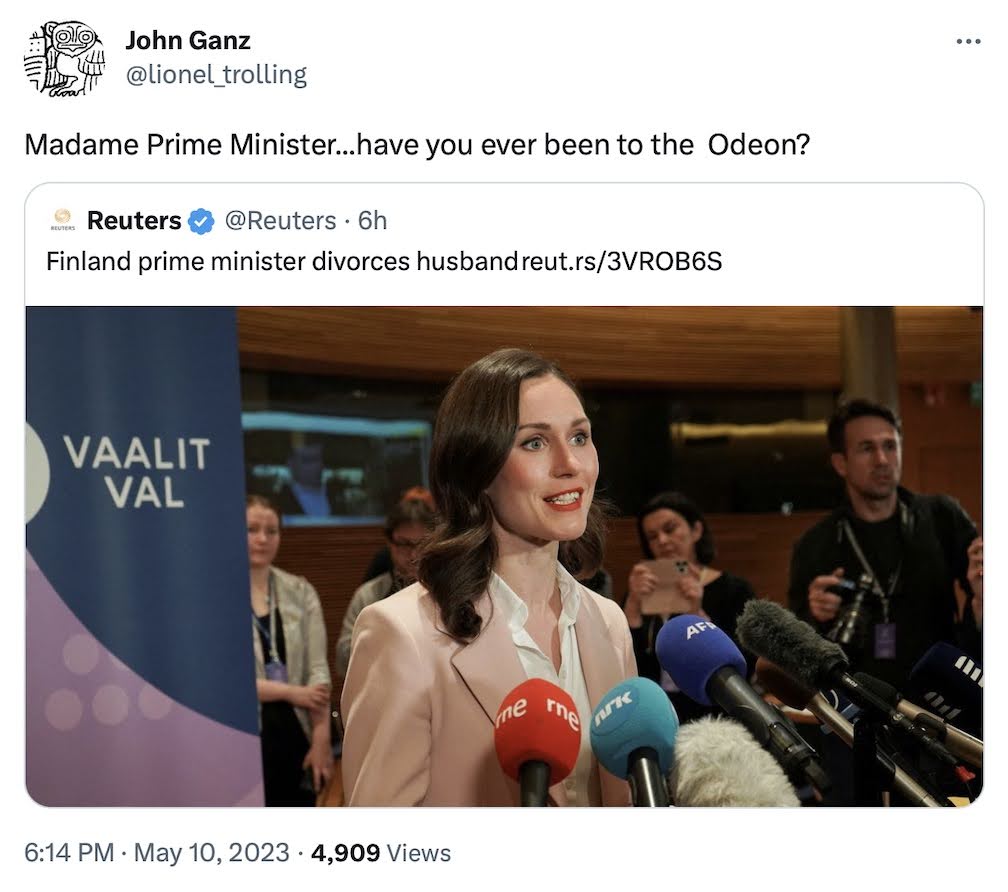
Ganz: Madam Prime Minister...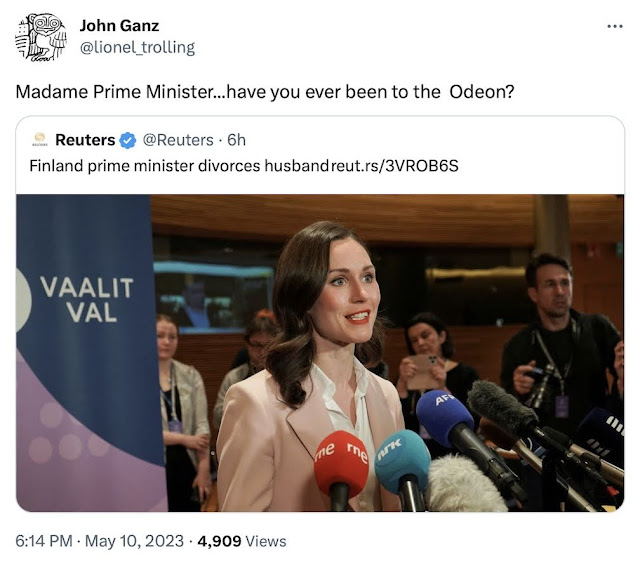 Lily Lynch in the NLR
Finland is gripped by wartime mania. News reports show mothers baking celebratory NATO cakes, online sales of NATO flags are soaring, and a Savonlinna-based brewing company has recently rolled out a NATO-themed beer, Otan olutta (the first word is a play on the French acronym for the North Atlantic Treaty Organization; the full name means ‘I’ll have some beer’ in Finnish). The outgoing Social Democratic Prime Minister Sanna Marin has repeatedly emphasized the similarities between the 1939 Finnish–Russian War and today’s conflict in Ukraine. Hundreds of Finns, including the former chair of the Foreign Affairs Committee, have paid to have personalized messages inscribed on Ukrainian artillery shells fired at Russian forces.
The discourse reached fever-pitch last week when Finland officially entered NATO, almost exactly 75 years after declaring its policy of neutrality. Some 78% of the population supported the move, but this was a recent development. In 2017, that figure stood at only 21%. The newfound Atlanticist fervour has been spearheaded by Marin, whose status as the world’s youngest Prime Minister and penchant for clubbing in Helsinki had already attracted international attention, netting her a luminous profile in British Vogue. Her tough line on Russia later consolidated her stardom. In March she visited Kyiv and laid flowers at the grave of Dmytro Kotsiubailo, a leading figure in the far-right Pravyi Sektor. She also called for heavier arms shipments to Ukraine and backed the construction of a 124-mile fence along Finland’s eastern border, replete with barbed wire to stop Russian men fleeing conscription.
Marin’s Natophilia transformed her into a beacon of hope for Europe’s new progressivism. Light on substance but eminently Instagrammable, this political tendency bases its appeal not on a coherent ideological outlook but on a feel-good millennial relatability. Its modernizing ethos owes more to the New World than the Old; it is just as at home at the Bilderberg Group annual meeting and the WEF stage as it is at the nightclub or pride parade. Under Marin, it has used the moral capital of Nordic pacifism – and the associated traditions of feminism, neutrality and social democracy – in order to destroy it.
...The far right’s rising fortunes have been met with curiously muted concern in foreign media outlets, perhaps mindful not to damage Finland’s standing as it enters NATO. In the days after the election, Atlanticist think-tankers and commentators were quick to point out that Marin’s loss did not signal a rejection of the military alliance. In a narrow sense, they are correct. Yet the fact remains that, following the electoral defeats of North Macedonia’s Zoran Zaev in 2021 and Sweden’s Magdalena Andersson in 2022, Marin is the third European social democrat to have brought their country into NATO before losing the next election to the right. What does this pattern tell us? Perhaps that a single-minded focus on Euro-Atlantic integration has deprived such parties of their historic purpose and neglected more pressing matters.
The Odeon was the hotspot bistro in TriBeCa in the 80s to the 90s. It was great place to come in after midnight, covered in dust after a long day for a martini, some oysters and a steak. It's still around. The last time I was there late it was dead, and not good. And coming in covered in dust isn't acceptable in bistros in Manhattan anymore, or anywhere else in NY for that matter. Amusing that Ganz picked The Odeon and not Balthazar, which I heard bad things about at its height: the food sucked, though the bakery was great. But the Odeon has value as nostalgia, the decadence of the past, and Balthazar is decadence of the present. McNally lost the Odeon to his wife in the divorce.
In related news, the deputy editor of Foreign Policy doesn't know the history of American foreign policy.
---
9/9/23, Euronews: "Finland's former PM Sanna Marin leaves parliament for Blair foundation"
Sunday, May 07, 2023
Sereny again
Into That Darkness
Shortly before breaking off for lunch – when, I had been told, I would have to give him as much time as he wanted for his meal and rest – I told him that having listened to him for two and a half hours I thought I had better explain what I really wanted. He could then think about it and let me know after lunch whether he wanted to go on. I said that I knew inside out all the things he had said that morning; all of them had been said before by any number of people. And I didn’t wish to argue the right or wrong of any of this; I felt it was pointless. What I had come for was something quite different: I wanted him really to talk to me; to tell me about himself as a child, a boy, a youth, a man; to tell me about his father, his mother, his friends, his wife and his children; tell me not what he did or did not do but what he loved and what he hated and what he felt about the things in his life which had eventually brought him to where he was sitting now. If he didn’t want to do this, but preferred to go on in the vein of that morning’s recital, then I would listen to him, I said, to the end of that afternoon, go back to England, write a little something about the interview, and that would be the end of it. But if, after thinking about it, he decided to help me delve deeper into the past (his past, because things had happened to and inside him which had happened to hardly anyone else, ever) then perhaps we could find some truth together; some new truth which would contribute to the understanding of things that had never yet been understood. If this could be done I would be prepared to stay in Düsseldorf as long as he liked; days or even weeks. I told him, too, that he had to know from the start that I abhorred everything the Nazis had stood for and done, but that I would promise him to write down exactly what he said, whatever it would be, and that I would try – my own feelings notwithstanding – to understand without prejudice.
When I’d finished he didn’t say anything, only nodded. And when a moment later the guard came to take him back to his cell, he left the room with nothing but a small formal bow. I was not at all sure I’d see him again....
Stangl looked indefinably different when he was brought back to the little room on the second floor at 2 p.m. He had taken off his tie and unbuttoned the top button of his shirt, but he still looked spruce – that wasn’t it. He was as well shaved as he had been in the morning – had probably shaved again – yet he no longer looked quite clean-shaven, nor was his skin as taut and young-looking as before....
I’ve thought about what you said,” he told me at once, his voice slightly unsteady. “I hadn’t understood before – I hadn’t understood what you wanted. I think I understand now … I want to do it. I want to try to do it.…”
There were tears in his eyes before we even began to speak of his childhood. “I thought you just wanted – you know – an ‘interview’,” he said, emphasizing that loaded term. I had some English cigarettes and he took one – he was, I soon saw, a chain-smoker. “My childhood,” he began, shaking his head several times, “I’ll tell you.

"No I don't think he would have dared to think of that. He was very respectful. He a provincial Austrian. I was a Hungarian aristocrat."
Saturday, May 06, 2023
This is just hilarious.
---
Sereny makes me laugh. She has a good hard understanding of the world. Q: This phrase the banality of evil, is that what you're talking about?A: Ah.. I suppose so. I really dislike that um... sentence. You know, evil is a huge word. Actually there was nothing evil about Stangl.
Arendt's use of "banality" isn't the problem; it's the here use of the word "evil" Arendt could never stop being a philosopher. That was always her weakness. Sereny doesn't need to pretend.
Earlier, laughing, putting her hand to her chest:"Remembering Stangl and to think of him as being fundamental is always funny." An empty suit, but the suit was a uniform. Deep down he's shallow. Her aristocratic contempt.
Watching Sereny I thought of Stengneth, and my own contempt grew even stronger. Sereny seconds Arendt in a way that Stangneth could never counter. Post-war German Zionism continues pre-war German anti-Semitism, a transition without a break.
Sereny was a journalist and Harris was a lawyer. Empiricism over rationalism
Sereny's description of Speer and Hitler would probably offend a lot of people if they paid attention.
Friday, May 05, 2023
Bamford in the Nation
On September 29, 2022, a British electronic surveillance plane assigned to NATO took off from RAF Waddington in England, flew over Europe, and headed to the Black Sea. Its mission—codenamed Rivet Joint—was to eavesdrop on military and intelligence communications taking place in Russian-controlled Crimea. The aircraft, an RC-135W (a variant of a Boeing 707), was manned by a crew of about 30, and had an exterior covered with a porcupine-like array of antennas.
It was a very dangerous time. Just three days earlier, in a deliberate act of war, saboteurs had blown up the Nord Stream 1 and 2 pipelines resting on the bottom of the Baltic Sea. Almost immediately—but without offering any evidence—both Russia and the United States began pointing fingers of blame at each other. Thus, by the time the British spy plane began its surveillance flight off the volatile Crimean coast, tensions between the US and Russia had greatly escalated. Adding to Moscow’s anger was the likelihood that the flights—increased from every 10 days to four flights a week—were able to intercept vast amounts of sensitive military communications as well as target its entire “electronic order of battle.”
To counter these flights, Russian fighters would regularly take to the skies to observe, and occasionally harass, the spy planes. According to a Pentagon document marked SECRET/NOFORN (allegedly leaked by Airman Jack Teixeira on a Discord group chat), as the British RC-135W entered the airspace above the Black Sea that September morning, a pair of Russian SU-27 fighters scrambled skyward to shadow him. Then, responding to an order from his command center (likely Belbek Airbase on Crimea) a Russian pilot launched a missile directly at the NATO reconnaissance jet packed with 30 or more Royal Air Force personnel. In that moment, the Russian fighter pilot came very close to igniting World War III. Under NATO’s treaty, if one member of the military alliance falls victim to an armed attack, all members of the alliance are obliged to consider it an attack on all of them—and to collectively respond.
The only thing that saved the dozens of British crew members from what the secret US documents called a “near shoot down” was a technical glitch that caused the missile to miss its target. And it was another glitch that caused the pilot to fire the missile in the first place. As revealed in the massive trove of recently leaked secret Pentagon documents, the firing was due to a miscommunication between the fighter pilot and his base. As a result, the spy planes are now escorted by a pair of British Typhoon fighters while operating over the Black Sea. While protecting the RC-135 aircraft, this change in procedure also increases the danger of an airborne shoot-out between NATO and Russian fighters.
It was covered earlier in the Times, but not seriously.
Sunday, April 30, 2023
4/28 FT US seizure of oil vessel triggered Iran tanker capture
Authorities in US redirected ship of Iranian oil bound for China in recent days, prompting retaliation from Tehran
US authorities ordered a tanker of Iranian crude oil to redirect towards the US in recent days, in a move officials believe was the trigger for Iran’s decision to capture a US-bound tanker on Thursday.
Three people briefed on the situation said the US had intervened to summon a ship loaded with Iranian crude, originally destined for China, as Washington looks to step up enforcement of sanctions on Tehran. Iran’s navy unsuccessfully tried to pursue the tanker after it began its latest journey.
The people said the US Department of Justice seized the tanker, the Suez Rajan, under a court order with co-operation from at least one company involved with the vessel. The Suez Rajan has been the subject of scrutiny since it was accused last year of taking on board a cargo of Iranian oil, then intended for China, from another ship near Singapore. The DoJ declined to comment.
The previously unreported US action towards the Suez Rajan shines a new light on Iran’s decision to capture the Advantage Sweet, a US-bound tanker of Kuwaiti crude that was chartered by Chevron.
A US official said Thursday’s “seizure appears to be in retaliation for a prior US seizure of Iranian oil, which Iran recently attempted to get back but failed”.
Iran has a history of seizing tankers in retaliation for western countries targeting its crude oil shipments. In 2019, Iran seized two British-flagged tankers shortly after the UK impounded an Iranian vessel that had stopped at Gibraltar en route to Syria. Last year, Iran also took two Greek-flagged vessels in the Strait of Hormuz after Greece had allowed the US to drain the cargo of an Iranian tanker in Greek waters.
From Tom Stevenson of the LRB "There's no global empire, but..."
Saturday, April 29, 2023
As part of our launch on Substack, we’re thrilled to share this fascinating guest essay from the political theorist David Polansky. This piece, like everything we publish, aims to explore the sources of our deepest differences—and the example of Israel, past and present, illustrates these tensions powerfully. In case you missed them, earlier this week, we published Damir’s Monday Note on learning to love democracy as well as a spirited debate between myself and Damir on what makes “the people.”Now on to David Polansky on what makes the nation. We’d love to hear your thoughts, so please join us in the comments to continue the conversation.
—Shadi Hamid
Everything below deleted, including my typos and his reply to me. He did the same thing on twitter years ago, deleting his half of a long exchange, about his stupid book. Islam is secularizing as Judaism did, through the transfer of juridical methods from religious texts to secular. Secularizing protestantism by comparison transferred faith, and the result is delusion.


It would be an excellent idea to call in respectable, accredited anti-Semites as liquidators of property.To the people they would vouch for the fact that we do not wish to bring about the impoverishment of the countries that we leave.At first they must not be given large fees for this; otherwise we shall spoil our instruments and make them despicable as "stooges of the Jews."Later their fees will increase, and in the end we shall have only Gentile officials in the countries from which we have emigrated.The anti-Semites will become our most dependable friends, the anti-Semitic countries our allies.We want to emigrate as respected people. [p.84]
Mr. Cecil Rhodes:For some months mutual friends have been trying on my behalf to arrange a meeting between us. At the moment, however, I am so inordinately busy that it would hardly be possible for me to come to London, unless I knew in advance that you took a serious interest in the matter. This, to be sure, would be a sufficiently strong reason to travel, for I need you. In fact, all things considered, you are the only man who can help me now. Of course, I am not concealing from myself the fact that you are not likely to do so. The probability is perhaps one in a million, if this can be expressed in figures at all.But it is a big—some say, too big—thing. To me it does not seem too big for Cecil Rhodes. This sounds like flattery; however, it does not reside in the words, but in the offer. If you participate, then you are the man. If you don’t, then I have simply made a mistake.You are being invited to help make history. That cannot frighten you, nor will you laugh at it. It is not in your accustomed line; it doesn’t involve Africa, but a piece of Asia Minor, not Englishmen, but Jews.But had this been on your path, you would have done it yourself by now.How, then, do I happen to turn to you, since this is an out-of-the-way matter for you? How indeed? Because it is something colonial, and because it presupposes understanding of a development which will take twenty or thirty years. There are visionaries who look past greater spaces of time, but they lack a practical sense. Then again there are practical people, like the trust magnates in America, but they lack political imagination. But you, Mr. Rhodes, are a visionary politician or a practical visionary. You have already demonstrated this. And what I want you to do is not to give me or lend me a few guineas, but to put the stamp of your authority on the Zionist plan and to make the following declaration to a few people who swear by you: I, Rhodes, have examined this plan and found it correct and practicable. It is a plan full of culture, excellent for the group of people for whom it is directly designed, not detrimental to the general progress of mankind, and quite good for England, for Greater Britain. If you and your associates supply the requested financial aid for this, you will, in addition to these satisfactions, have the satisfaction of making a good profit. For what is being asked for is money.
What is the plan? What is the plan? To settle Palestine with the homecoming Jewish people.[p.1194]
The Zionist Federation of Germany Addresses The New German State (1933)
The emancipation of the Jews, begun at the end of the 18th, beginning of the 19th century, was based on the idea that the Jewish question could be solved by having the nation-state absorb the Jews living in its midst. This view, deriving from the ideas of the French Revolution, discerned only the individual, the single human being freely suspended in space, without regarding the ties of blood and history or spiritual distinctiveness. Accordingly, the liberal state demanded of the Jew, assimilation into the non-Jewish environment. Baptism and mixed marriage were encouraged in political and economic life. Thus it happened that innumerable persons of Jewish origin had the chance to occupy important positions and to come forward as representatives of German culture and German life, without having their belonging to Jewry become visible.
Thus arose a state of affairs which in political discussion today is termed "debasement of Germandom" or "Jewification."
NYT March 20, 1947
Whatever the degree of their superiority complex, however, the Jews are certainly confident of their ability to bring the Arabs to terms—by persuasion if possible, by might if necessary. The program of the largest terrorist group, the Irgun Zvai Leurni, is to evacuate the British forces from Palestine and declare a Zionist state west of the Jordan, and "we will take care of the Arabs."
For example, in 1918, Ben-Gurion – the future founder of the state – was convinced, as were many others, that most of the population of the Land of Israel had not been exiled, but converted to Islam with the Arab conquest, and therefore was clearly Jewish in origin.In 1948, he had already given up on this confused and dangerous idea, and instead asserted that the Jewish people had been exiled by force and had wandered in isolation for 2,000 years.
Ben-Gurion
As to his own religious bellefs, Mr. Ben-Gurion replied:"I believe—l am certain-there is a God. I believe that matter and spirit are the same thing—which really means pantheism. There are many Jews who are pantheists. As far as I know. Spinoza was a pantheist.
"this confused and dangerous idea"
I'll add something that I was sure I'd linked before, but I guess I did that mostly in comments elsewhere years ago.
Jerry Haber
"In A.D. 70, and again in 135, the Roman Empire brutally put down Jewish revolts in Judea, destroying Jerusalem, killing hundreds of thousands of Jews and sending hundreds of thousands more into slavery and exile."
Charles Krauthammer, Washington Post, May 5, 2006
"Well, now: We were expelled from the land and taken into captivity in the year 70 of the Common Era."
Leonard Fein, The Jewish Daily Forward, May 11, 2007–07–23
"After Bar Kochba…Jewish emigration, a more or less permanent feature of ancient Palestinian demography, now assumed alarming proportions."
Salo Baron, A Social and Religious History of the Jews (New York/Philadelphia, 1952), vol. 2, pp. 122-3.
Despite their ideological differences, what unites columnists like Charles Krauthammer and Leonard Fein, and what distinguishes them from Salo Baron,the greatest historian of the Jews in the twentieth century, is inter alia their acceptance of the myth that the Jews were forcibly expelled from the Land of Israel, and taken into captivity by the Romans. To this day, most lay people, Jews and non-Jews, accept the myth of the exile, whereas no historian, Jew or non-Jew, takes it seriously.
This post will look at the disconnect between popular and scholarly belief and try to examine the origin of the myth several centuries after the event occurred. I will follow pretty closely the first part of a comprehensive article on the subject by Hebrew University professor, Yisrael Yuval, which is available here. Because this article is under copyright, I can’t quote more than a few passages, and so I will just be paraphrasing him. But I urge you to read the article, especially his copious footnotes.
The myth was not invented by the Zionists, although it was greatly used by them, in part, to justify the return of the Jews to their ancestral homeland. For the tacit assumption of the Zionists was that if the Jews had left the land willingly, if they had merely “emigrated” because they found opportunities beckoning in the Diaspora, then they would have betrayed their allegiance to the land, and their return would have been less justified. That is one of the reasons why Zionists argued for years that the Palestinians left Palestine of their own free will – if they were forcibly expelled, then somehow their claim to the land would be stronger. Of course, the putative expulsion by the Romans was not the only claim of the Jewish people to the land – many peoples have been exiled from their lands, and the Zionists were not claiming that all of them had a right to return -- but it dovetailed nicely with the historical view of the wandering Jew that finds no rest outside of his native place from which he was expelled.
The first point to make is that well before the revolt against Rome in 66-70 c.e., there were Jewish communities outside Palestine, most notably in Babylonia and in Egypt, but elsewhere as well. References to the dispersal of the Jewish people throughout the civilized world are found in the book of Esther, Josephus, and Philo. There is no indication that these communities were small, satellite communities.
Second, there is no contemporary evidence – i.e., 1st and 2nd centuries c.e. – that anything like an exile took place. The Romans put down two Jewish revolts in 66-70 c.e. and in 132-135 c.e. According to Josephus, the rebels were killed, and many of the Jews died of hunger. Some prisoners were sent to Rome, and others were sold in Libya. But nowhere does Josephus speak of Jews being taken into exile. As we shall see below, there is much evidence to the contrary. There was always Jewish emigration from the Land of Israel, as the quote above from Baron indicates.
Subscribe to:
Posts (Atom)