Showing posts with label Feminism and Post-Feminism. Show all posts

Sunday, August 27, 2023

From 2004, an update

Posner and Verlmeule's op-ed was pulled so quickly that Balkin had to link to a cache file that died within a year. Now the piece has been republished. There's no telling if it's been cut but I'm betting it hasn't. That's how far we've come.
I found out it'd been republished because I had to search for it again after ridiculing a member of the extended PRC apparat who was defending the honor of China against a Foggy Bottom intellectual. The link in his header and the pinned tweet is to an interview with Vermeule.
"A lesson of virtue" in The Beijing Review. Vermeule must follow him because he blocked me, again.

Whining about the Cold War is like asking McDonalds or KFC to stop competing with each other; the difference is the armies and the nukes. The only option is to reject US and Chinese foreign policy goals as such, and look to the small states forced to negotiate a path between them.

I think the reason all these academic intellectuals follow edgelords and fascists, is that their minds are too dead to think for themselves.


Conservative men should read T.S. Eliot. His poems describe the true misery of the conservative male, and reading him will help them escape it.

This list has gone to three

"My students were all obsessed with sex. Not the idea of sex, or the meaning of sex, but sex!"

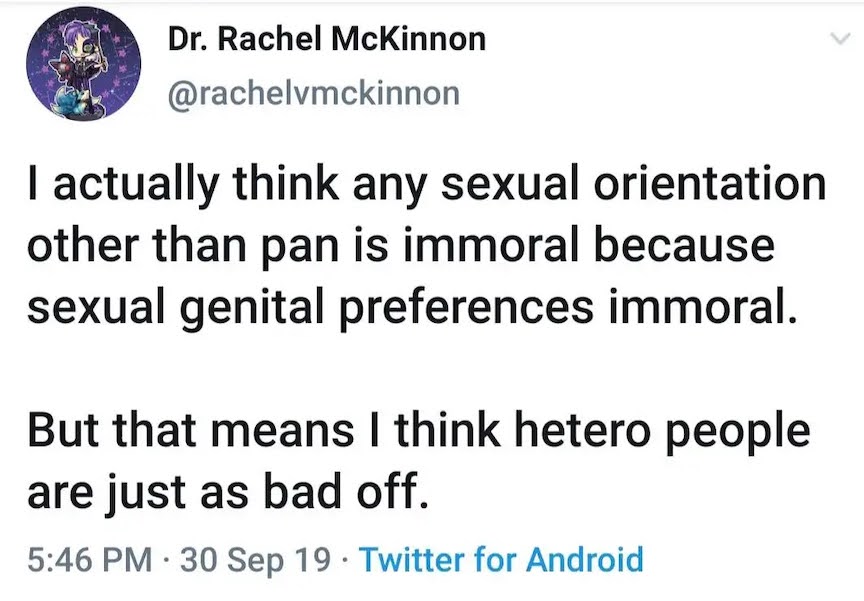
"I find this reduction of sexual orientation to genitalia – what’s more, genitalia from birth – puzzling."

Eliot may well have become more liberal when he was older but it wasn't because of the poetry; it was the sex.

Philip Roth. "Céline is my Proust!" 

Monday, July 17, 2023

Miyazaki hates Otaku.

updated a few time, this time at the top. It's all so fucking stupid.
The Idiot Tushnet, and co., restating his old argument.
The Supreme Court has unanimously held that Jackson Pollock’s paintings, Arnold Schöenberg’s music, and Lewis Carroll’s poem “Jabberwocky” are “unquestionably shielded” by the First Amendment. Nonrepresentational art, instrumental music, and nonsense: all receive constitutional coverage under an amendment protecting “the freedom of speech,” even though none involves what we typically think of as speech—the use of words to convey meaning. 

Jackson Pollock from 1952, 

Jackson Pollock, Blue Poles (Number 11)
Daniel Bell 20 years later. "Behind the chiliasm of modern man, is the megalomania of self-infinitization." 

Atomization, isolation and the illusion of absolute community. The low buzz and hum—the violence and warmth—of neurological overload. 

Lewis Carroll's conservative mathematical fictions.

I've said it all before 
[Weber] imagines an impersonal relation to the world. It’s a common trope of the literature of the period, but the impersonal in art and technocracy, though the product of the same events are very different things....  

By the time anything becomes known as an idea, it’s been around for awhile 

From rationalism to positivism to a world of shit.

---
Two from the NYRB

“There is a big secret about sex,” wrote Leo Bersani in 1987. “Most people don’t like it.” The same might be said of translation, which many readers secretly consider a necessary evil.

Translation is transliteration. It's a necessary evil. Utilitarianism turns practical necessity into the ideal, so its weaknesses are now "secrets". And another name for the file of women getting their model of sexuality from homosexual men. Post-feminism is pre-feminism on crank, and rationalism makes you stupid. Or the other way around. An asshole doesn't have a clitoris.  Call it female circumcision by category error.

In his films for children, Hayao Miyazaki has used the labor-intensive art of animation to study the major problem of adult life.

That was the subhead, but still. No fucking shit.

The director sticks to a deliberately vague line, one that could be applied to the most anodyne Disney venture, that all his films are about “how to live.” Few scholars or critics have done the work to penetrate this author’s statement. “What’s it about?” asked Nigel Andrews of Spirited Away. “Simple answer: Everything.” Ligaya Mishan writes that Miyazaki’s films seem to “thwart the Western mind.”

A world of idiots.

Miyazaki is the benign ruler of his domain. He's a master and treated as one by his employee/servants. He's a filmmaker and an artist. His wife "hasn't forgiven him" he says, for making her stop working as an animator. Nothing about any of this"thwarts the Western mind". There are many things in his work that are foreign to the Western mind, but French art is foreign to the English. You can't translate Rimbaud, Mallarmé, or Lady Murasaki, but there's nothing to translate in a painting—a material thing—or an image; the difference is in the perception by individuals and members of various groups. Japanese people understand Miyazaki in ways Europeans will not, but the thing absent perception is the same. 

Spirited Away is a film about children and the adults who care for them. Miyazaki's closest equivalent in the US is Maruice Sendak. In Europe it's Tove Jansson.

You will never understand the inner workings of another mind; all you have to work with is your perception of their actions, or the record or description of those actions by others, rendered in form. Proust is untranslatable; he could never be an English novelist; the past is another county. Acknowledging these things is the beginning of adulthood and intellectual life. We're ruled by big children in university chairs and editorial offices, and it makes me want to puke. 
---

in re: the "Western mind". A commenter, Zina Hitz, on Leiter's post reporting the death of Harry Frankfurt
When I met him at Princeton I was already trained as a scholar in Greek philosophy. But I had not fully realized that I could use philosophy to think about my life or what t means to be a human being.

Princeton philosophy in the 80's

"My students were all obsessed with sex. Not the idea of sex, or the meaning of sex, but sex!"

Rakesh Bhandari comments about Frankfurt's discussion of 1st and 2nd order desires. Maybe Frankfurt will be remembered for teaching geeks that there's more to life than being geeks, the same transition Derrida played a part in. One of them would be amused. I still think I coined the phrase second-order curiosity, meaning the ironic awareness of an interest, as a way of explaining the problems of analytic philosophy. Autism is the model of first order curiosity: subtext, and other people, are irrelevant. "I'm a liberal"; "I'm a nice guy!" "Some of my best friends..." "I have an extended mind!"

Mathematics can't tell you why you wanted to be a mathematician. "Science can't even justify science." Steven Weinberg, whose philosophy justifies Zionism, as Leiter's does.

Bhandari, in the past, and recently.
---

Two by Tushnet: one pushing his version of the "unitary executive" and another, on free speech and art, again. He belongs with the idiots above.

A few weeks ago, my family went on vacation in Copenhagen, where we ate at several top-of-the-line restaurants. My reaction to the meals? “How incredibly creative of the chef.”

A few weeks ago, my family went to DC, where we met with several top-of-the-line law firms. My reaction to the briefs? “How incredibly creative of the partners.”

Briefs are referred to as well crafted. "Lawyers are tradespeople!"

None of these cases are about speech; they're about the relation of speech to commerce. 

The idiot

A different example, with the same analytic structure, clarifies the problem. Switch from discrimination on the basis of religion to discrimination on the basis of race. Now the chef makes dishes to preserve white culture. An African-American comes to the restaurant, but the chef says, “Sorry, I won’t serve you because my message that these foods are preserving white culture would be diluted if people saw Black people eating at the restaurant.” We might say that the restaurant owner’s choice of a business model is his way of expressing himself: His expressive conduct is his expressive activity.

White Trash Cooking is a cookbook, and anyone can buy it. The KKK can open a restaurant, but it has to serve niggers, gooks, spics, and kikes. Equal access to the market, in a commercial culture: from Wickard vs Filburn to civil rights, the market takes precedence over social and private life. 

After Tushnet's open letter: 

—NBC, Alabama Republicans refuse to draw a second Black congressional district in defiance of Supreme Court.

—National Review[!], Harvard’s Mark Tushnet Wants Joe Biden to Become a Dictator

Tushnet is a famous opponent of judicial review, and now Alabama Republicans and supporters of the independent state legislature theory have heeded his call. On executive supremacy, Posner and Vermuele at least are consistent. And all of this and everything above, with the same paper-thin idea of language, and politics.

Monday, July 10, 2023

Caitlín Doherty, "poetry editor" at a journal so over-the-top that its editors used mocking criticism for its blurbs—

“an overdesigned manual in nihilist navel gazing” “Coffee table architectural favela porn.”

— writes an article attacking contemporary feminism as style, in the NLR.
via Anton Jäger. You can't make this shit up.

Andrea Dworkin

Swimming in the blood of her own body, in labor and in pain, the woman is a half-human who achieves her half-human fate in pregnancy and childbearing. The canal through which the infant is extruded is the man’s place of sex; he enters, not wanting blood to drown him or contaminate him or pollute him; the blood makes her dirty and threatens his pristine penis; this makes her an abomination.

Susie Bright was right, she's a great pornographer. She's wrong to call her a lousy writer; that's a good paragraph. But how do you deal with so much self-loathing; anger directed first at herself and then out at the world? Dworkin did it by making her hate into a kind of art that laws she promoted would ban, or should if they're followed. Far from the first artist to make an art from self-destruction. 

Doherty is no better than the women she's responding to, all of them focused on style to avoid what they can't face, following Dworkin's model rather than trying to understand it. But Doherty can't accept that it's the style that makes it personal; and even the impersonal is a style if it's filled with details. It's those details that make it the communication between one single, specific, individual, person and another or others, and that's what the other writers are responding too. It's the details that make it the writing of "Andrea Dworkin". But Doherty—the poetry editor!—has no interest in the specifics of another life; she can't even read "Fascinating Fascism" for what it is. 

Doherty has to pretend. Programs and positivism: so earnest.

It cannot be overstated how deeply boring all this is. How unthrilling, how inessential, to how few urgent questions this seems to contain the seeds of any possible answers. As Dworkin said of porn (after her friend said it of heroin): ‘The worst thing about it all is the endless repetition.’ We’ve been here before, of course, in the past few years’ debate over Afropessimism. Similar risks adhere to a negative feminism: if the aim is to move from a biological conception of gender, as of race, to one that is socially constructed but no less real for it in its consequences, might it not behoove us to arrive at a category definition that does not condemn all those who fall within it to limitless amounts of pain? Feminism has no absolute right to existence. It must describe something about the world accurately for it to make sense as a political-philosophical position. And that description must contain within it verifiable truths about the current situation of women, or else it will be – only – a style.   

"Afropessimism",  academia like big pharma, evergreening the blues, "double-consciousness", "down by law", the history of black experience, and the experience of the working class, of any race, for the age of buppies; like Zionism and "little Israel".

And then this: "...if the aim is to move from a biological conception of gender" Brilliant. 

"And that description must contain within it verifiable truths about the current situation of women, or else it will be – only – a style."

All of this describes the current situation of women. But it's up to the next generation to read the details and understand the inner lives of the dead.

I've said it before: I was was shocked when I learned, late, that Brecht never recognized his own decadence. It was always the doubleness, contradiction, the violence that made the hairs on my arms stand up, that gave me shivers. I always saw everything for context. Everything's always been double. Or if it wasn't needed to be. If it wasn't double it bored me. But the obliviousness of people now, those who should know better if only because they've read the history, and even teach it! amazes me.

"and the experience of the working class, of any race". Cracker pessimism

Wednesday, June 28, 2023

AJ rts his co-author 

In 1927, Piero Sraffa left Italy for good out of fear of the fascists and became a lecturer in Cambridge. That same year, he was invited by Keynes to give a lecture on the corporative state.His concluding remarks are devastating  on liberal's fantasies about a return to normalcy.

 Sraffa

The really important question to which the future will give an answer is whether fascism is an abnormal product of the post war psychosis: only suited to the local conditions of Italy or whether it represents a logical and unavoidable outcome of the conditions of modern industrial communities. 
The Italian democratic opposition has, at least in the first period of fascism, taken the former view: and it has been confidently expecting the downfall of fascism, which should have occurred so soon as people came back to their senses. Then, fascism would have passed without leaving any permanent trace, everything would have reverted to the liberal system, and the natural order of things would have been restored exactly where it stood in the good old days. 
But if experience proves that fascism, apart from its superficial and more picturesque aspects has been originated by more permanent and less futile causes, the case is profoundly different. If it really has represented the last line of resistance from which the present social order must fall bade in order to defend itself against the attacks of organized labour, if in fact it is the only method of consolidating the basis of capitalism when it has reached a stage in which it is no longer possible to preserve it without breaking the forms of political democracy—then the developments of fascism will have a much greater interest in so Far as they will perhaps represent an anticipation of the results to which capitalism may ultimately lead in other countries.

DL rts Alice Evans

Tremendous book on cultural change in 1950s/60s Italy!
By @niamhanncullen 


Evans blocked me on her Substack page for a comment I'd already deleted because I'd felt guilty about it. She wants to imagine the best.

Jäger and  Leusder,  aka minimaldamage, Cooper, Bruenig and Gilman: Individualism and community, the family, Europe and the US, Germany and Greece.

Jäger 
This album is such a tragedy for electronic dance music in that every single song on it set the bar so high in 1987 that no one’s surpassed it ever since

Neurodivergent disco is a guaranteed succes[sic]
"Joy Division" "New Order" and autism. Henry Farrell, fan of "My Bloody Valentine" and defender of Truth. The absolute lack of self-awareness. A culture of nostalgia, in an era of engineering and blank violence. 

"Atomization, isolation and the illusion of absolute community. The low buzz and hum—the violence and warmth—of neurological overload."
Seth Edenbaum 

"Behind the chiliasm of modern man, is the megalomania of self-infinitization."
Daniel Bell


I've given up submitting anything, anywhere.

Thursday, June 22, 2023

But Pageboy doesn’t read defiant, strong or joyful. It reads sad: the story of a vulnerable girl thrown into the entertainment business at the age of 10; unprotected by her family; struggling with food; closeted, and reminded by the casual homophobia of Hollywood to stay that way; and subjected to sexual assault and harassment by people who should have been trusted colleagues.

In the memoir, Page says: “At certain points I’ve referred to myself using my previous name and pronouns. This is a choice that felt right to me, occasionally, when talking about my past self, but it’s not an invitation for anyone to do the same.” But talking about Page’s past as though it happened to a boy is nonsensical: Ellen’s experiences are tied to her femaleness, and more than that, her lesbianism.

Not that Page refers to his pre-transition sexuality as “lesbian”: “queer” is preferred, and when the word “lesbian” comes up, it’s marked as something held in contempt, by others if not by Page. At one point, Page calls lesbianism a “repugnant” feature that directors cannot allow on-screen.

Any resistance to compulsory femininity — high heels, tight dresses — is cast by the industry as Page being “difficult”. Roles for women are so sexualised that at one point Page describes Juno as representing “a space beyond the boundary”. This is, remember, a film in which Page’s character is pregnant: you could hardly get a more female role. But because Juno is not “hyperfeminised” — because Page wears tees and jeans for the part — the pressure of gender is lifted, somewhat. 

But 2007 was also the year that trans writer Julia Serano published Whipping Girl, which is probably the most influential text in terms of solidifying gender identity theory. In it, Serano argued that “feminine verbal and aesthetic expression” are “driven by intrinsic and deep-seated inclinations that are likely to be the result of biology”. In other words, regardless of your actual sex, if you don’t act or dress “girly”, you might not be a girl at all. 

As this idea gained intellectual purchase, femininity standards in popular culture were growing ever more exacting. This pressure was even dramatised in Juno screenwriter Diablo Cody’s follow-up movie, Jennifer’s Body, which starred ultimate hottie Megan Fox as a cheerleader succubus, and Amanda Seyfried as her hoodie-wearing, jealousy-gnarled best friend. The space for the kind of girl-character Page played — girls who were not limited to being objects of desire — was shrinking.

But Hollywood was only amplifying messages Page had heard from her family. Page’s mother informs her daughter that she can “do anything a boy can do”, but from Page’s perspective, this is never sincere. There is continual maternal pressure for Page to be more girly, as well as an absolute rejection of the possibility of homosexuality. One of the few vignettes in which Page recalls his mother being happy is when Page requests a shopping trip to buy “girl clothes” as a teenager. (Page enjoys the way the new wardrobe alters her social standing, but not the way the clothes make her feel about herself.) When Page initially comes out as gay, her mother’s reaction is to yell: “That doesn’t exist!” 

Becoming a “transgender guy” doesn’t spare Page from judgement and disgust. (Page still seems wounded by a Jordan Peterson tweet that referred to the surgeon who performed Page’s mastectomy as a “criminal”.) But it does resolve the problem of being a lesbian: Page’s mother, at least, seems better able to accept a trans child than a gay one. “She loves her son endlessly,” writes Page. Transition also makes Page’s body safer — a body that has been repeatedly violated and threatened. Page mentions an “acquaintance” who told her, after she came out for the first time, “I’m going to fuck you to make you realise you aren’t gay.” There’s also a male director who “grooms” her, a male crew member on an early film who forces oral sex on her, and a female crew member on another film who sexually assaults her while presenting it to Page as a consensual relationship. Over and over, Page is informed with violence that her body is not hers.

Again, Hollywood reinforces what began in Page’s childhood. Her adversarial relationship with her body can be seen in her reaction to her stepmother’s cooking. Page hears an “internal voice” saying “no, that can’t go inside you” when she’s confronted with food that scares her: a terror of adulteration, of losing control. Puberty inevitably heightens this. Page describes the age of 11 as “the age I sensed a shift from boy to girl without my consent”. This is, I think, a common sensation for girls: puberty ends an era of uncomplicated, happy embodiment, and launches you into a world where your body appears to invite dangerous attention against your will. Not a shift from boy to girl, but a shift from “person” to “thing”. As Hilary Mantel wrote, some girls want out. They starve themselves, or punish their bodies, and now they have the option to disown their sex entirely. 

"It’s time for some game theory"
In order to maintain free speech, liberalism proposes a norm of reciprocity: it’s in everyone’s interest to defend free speech for their enemies so that their enemies will defend free speech for them.

"Carl Beijer" doesn't know the history of what he's attacking any more than of what he's defending. He thinks politics is about talking to your friends, not about convincing strangers that they should agree with you. He defends the dictatorship of the pure like a moralizing high school student from the American suburbs.  

"Public reason" has become "private reason"  
again, and again
John Quiggin, 2008: "Sunstein argues that the echo chamber effect tends to reinforce existing views and produce a poisonous partisan divide. It seems to me that exactly the opposite is true. "

repeats

I always thought Sunstein's point was obvious, especially for any culture founded on individualist liberalism. It's that culture that's given us Facebook and surveillance capitalism and personalized marketing, the virtual store where the displays are changed and items moved to the front to fit your last purchases. Newsfeeds work the same way, reinforcing biases, from narrowcasting to microcasting to the narcissism where the world is reduced to a mirror.

Twitter changed its algorithm years ago, forcing you to choose between replying to a tweet and quoting it, limiting the exposure of either your followers or those of the person you're replying to. Up to that point a reply appeared on both timelines.

Ryan Cooper 

Have you ever argued with a conservative? They won't learn anything no matter what I say or where I say it. Whatever I say is wrong by definition. 

Amia Srinivasan gives the game away
A graduate student once complained to me and my co-convenor that we had not put a content warning on Catharine MacKinnon’s ‘Feminism, Marxism, Method and the State’, even though we had at the start of the course issued a blanket policy that permitted students to skip any class meeting, without explanation – which we had done in recognition that the reading for the seminar was emotionally demanding. Another student, an undergraduate, told me she didn’t want to read MacKinnon’s work because she had heard (from her brother) that MacKinnon was a ‘TERF’ (she is not). A student asked me why I thought it was worthwhile to discuss in a lecture what sort of metaphysics of gender was required to vindicate the identities of trans women as women and trans men as men, given that he (a trans man) already knew that he was a man.

"a blanket policy that permitted students to skip any class meeting, without explanation – which we had done in recognition that the reading for the seminar was emotionally demanding", like a medical student exempted from class because she can't stand the sight of blood.

"...given that he (a trans man) already knew that he was a man", just like Beijer and Cooper and the rest know that they're a leftists. And no one and nothing should ever be allowed to challenge that. 

Srinivasan has a tag.

When it rains in pours. Fraser McDonald, in the same issue of the LRB 

It’s​ not uncommon for a student to come to my office to tell me they’re not happy with their exam mark. ‘Perhaps you just made a mistake?’ one suggested to me last year. 

"Get the fuck out of my office."

The academy is conservative and authoritarian. That's its strength and weakness. It should be hard to get a governmentally recognized license, and it should be easy to say it's not worth it. These idiots dumb down everything. 

At the University of Edinburgh, where I teach, changes pushed through the Senate will allow students to get degrees ‘on aggregate’ (based on work marked to date) but with a greater number of missing course credits than would previously have been permitted. The same is true across the sector. It’s not unusual for students to graduate with missing coursework – the affordance is called ‘special circumstances’. But universities have now turned this occasional act of compassion into a handy workaround to benefit employers. ‘Special circumstances’ are being redefined, it seems, to apply to the university’s crisis rather than the student’s.

"It is the common fate of the indolent to see their rights become a prey to the active."

Leaders and followers. Hustlers and customers. Who do you blame, the con man or the rube?

Thursday, June 01, 2023

updated a bit for added fun.
---

Artforum, 2003. 

Although he becomes only the eighth director in the seven and a half decades of the Whitney’s existence, he is its fourth in just over a dozen years. The board’s 1990 dismissal of Armstrong, who had led the museum since the early ’70s, was widely seen as a sign of newly powerful trustees making a break with the old guard. His replacement, Ross, a risk-taking and famously garrulous advocate of contemporary art, gave the institution a much-needed infusion of energy. But the Whitney’s increased visibility under Ross brought new scrutiny; it soon became the critics’ whipping boy—berated for “political correctness” for shows like the 1993 “Identity Biennial” (as it came to be known) and accused of succumbing to style over substance for its 1994 Richard Avedon exhibition.

I was looking for more old comments on Avedon. 

Michael Kimmelman from 1994. "If Mr. Avedon reminds me of any artist, it is Giovanni Boldini,..."

I lasted two minutes.

Kimmelman has a lousy eye. I don't think he realized how damning the comparison was. John Singer Sargent was a virtuoso, a brilliant technician and a failed composer of pictures. Boldoni was a hack illustrator. Avedon is better than that at least.

Artforum in the 90s was another world. I was there, and I forget. Picked at random and two articles about people from my past. The whole thing was corrupt and cynical, but the cynicism was still out in front, documenting itself. That honesty on "the NY scene" is almost unthinkable now.

May 1994, Rhonda Lieberman "Zen and the Art of Shopping, on Helmut Newton

The first two paragraphs and the last.

Recently, when I had reason to look at a lot of Helmut Newton photos, I underwent a reaction worthy of further investigation. Imaginarily disordered by the elixir of these fabulous images, not unlike Jerry Lewis turning into hipster Buddy Love in The Nutty Professor, I felt so glamorous that I went right into Bendel’s and found something on sale I never would have considered trying on, even venturing into the Fancy section, where I only go when I am feeling especially spirited, and handling really expensive pants. With a bit of reflection, my radical failure of sublimation, the palpable slippage between my enjoyment of the Newton photos and my urge to shop, began to seem less and less strange . . . but would others see it this way?

The conflict between Art and liking nice things has been noted by others greater than I. The intro to a volume of Stendhal’s travel pieces dismisses them as chiefly inspired by the author’s need, despite his 50-something years, to dress at the height of fashion (as if this put their literary merit in question!). Proust suspected Balzac, in his bourgeois novels of ambition, greed, and vanity, of indulging in the reader the very worldly tastes of which Art was supposed to purge you. I realize, through the years, that I have kept a mental file of Great Minds inordinately distracted by clothes and furniture. Kierkegaard was an interesting reverse case, trying to appear as the idle shopper and disowning his brilliantly tortured juvenilia Either/Or as written by someone else: he claimed he happened to find the manuscript in the drawer of a desk he had long coveted and finally bought from a furniture dealer after ogling it, and making daily visits to see it, for weeks, haunted. He describes the stalking process in familiar detail: “My daily route took me past this secondhand dealer and his writing desk, and I never let a day go by without fixing my eyes on it in passing.” In On the Genealogy of Morals, Uncle Friedrich makes short work of the question of one’s personal “interest” in the art object: he mocks Kant as a ridiculous prude for claiming that the Beautiful affects us precisely because it doesn’t affect us personally but appeals to our disinterest; he agrees with Stendhal, who saw in Beauty la promesse de bonheur, the satisfaction of selfish pleasures. Indeed, since galleries and museums are inevitably surrounded by nice stores, the experience of looking at Art has long been confused with shopping for nice things....

Reported on Page Six of the New York Post by Flo Anthony:

The authoress was sighted in the deluxe treatment program for acute mind-body aggravation at the Illinois Home for the Jewish Bewildered, in the exclusive Lee Krasner Memorial Wing, where she busily collects string and continues to dictate her column and to develop her profitable Psychic Whiners Hotline (celebrity spokesmodel Buddy Hackett). She is attended by her adoring photographer, her loyal bodyguard/handbag designer, her perky meditation coach, and fawning hospital staff who mercifully dress in last season’s Chanel and are required by contract to speed recovery by remaining at least ten pounds heavier than the client, like Vivian Vance on I Love Lucy. Her editor/manicurist commutes weekly from NYC to inspire her with rousing lectures on Femininity and Aggression, and makes sure her apartment is free of dust.

Every morning, radiant after thighmastering, she works on her big hook (the one they’re all waiting for!), Identity: Pro or Con?, set in a dry-cleaning store in New Haven, Conn. One of the highlights: just one week after a lobotomy, the heroine wows her audience by delivering a stunning paper on cross-dressing as it subverts culturally constructed gender roles. Snatched up in a record 20 minutes by Yale University Press, the book has already created a startling buzz in the publishing world, the immoderate advance explained only by its uniformly giddy assemblage of unexpected allies including Suzanne Somers (“A fresh approach to the subjectivities of mass culture. It’s great!”), Gloria Steinem (“It did wonders for my self-esteem!”), Slavoj Zižek (“I laughed. I cried. It was better than Cats!”), Harold Bloom (“I keep it in my bathroom!”), and William Buckley (“I love the part about the Jews and the sailboat!”), whose tear-stained reader report gushed, “I keep it with me at all times. One of the most moving and inspiring first-draft manuscripts that I have ever read . . . the drama proceeds savagely, erotically . . . I now read Rhonda daily, there is wisdom on every page.”

In 2014 she's writing for The Baffler, and 2019 The New Republic

repeat

In the late 90s, a 40 year old woman, a well known artist,  told me me everything she'd learned about being a woman she'd learned from drag queens. The switch is important: from the artifice of femininity built out of biology and culture, out of necessity, to an art built out of fantasy—from representation to mannerism—and then returned to the source. 

again

“What’s on the menu?” asks Kissinger, and I can barely restrain myself from shrieking, “What’s on the menu, Henry? Would that be Operation Menu?” 

It all brings back memories of sitting in the basement at the Gramercy Park Hotel listening to Joey Arias channel Billie Holiday.

Lorentzen on Martin Amis in the Financial Times

What magnificent prose and what a peculiar personality underneath it. Amis wrote a long feature on the pornography industry for Tina Brown’s Talk Magazine in 2001 and only at the end confessed to his horror of seeing pricks on screen. He made a speciality of low-life subject matter but he was always a bookworm, always a literary critic, at heart.

"Prick" and "dick", because "cock" forms the mouth into an orifice. The displaced/transposed O: "horror of seeing pricks" for "fear of seeing cocks".

His heroes across the Atlantic were Saul Bellow and Vladimir Nabokov, but the American writer that Martin Amis — who has died aged 73 — most resembled was Norman Mailer.

Because Lorentzen is unable to say "Hitchens".  Mailer himself said he was less a reader of literature than a practitioner of it.

Lorentzen, and n+1, etc: the literary culture of gentrified Brooklyn in post-9/11 New York; inward-looking, earnest, provincial.

Thursday, May 25, 2023

in re:the last two posts

Her only piece of writing advice, if it can be called that, is: “If it’s not a risk then it’s nothing.”

What's the relation between those who want risk and those who want to be left the fuck alone?  Or those who've acclimated to risk and those who haven't? I'm not sure Annie Ernaux has thought that far ahead. She's an alienated individualist, in the sense of dedicating her life to the recording of her own experience, but she uses others as material only in the production of words. She instrumentalizes people from her past, expressing her superiority as an author controls characters, at the same time defending people as a whole, as a community, against those who would instrumentalize them in life in the service of wealth. Her life is dedicated to noblesse oblige. It's the moral superiority of a whore. "Better a victim than a victimizer" as my mother used to say. And my mother had a deep respect for whores. Leftism, Iris Murdoch and The Story of O. 

"No idea's original, there's nothing new under the sun"

Sunday, May 21, 2023

Jäger rt's Mona Ali

How many of you well-versed in the Lucas paradox knew this? Man, the stars were aligned for his ex.

Six years before Professor Lucas won his Nobel, his estranged wife expressed great faith in his future. Her lawyer inserted a clause in their divorce agreement stipulating that she would receive half of any Nobel money he might receive if the honor was awarded before Oct. 31, 1995. He received the prize barely three weeks before that deadline.

A screen-grab. the source.

The Lucas 'paradox' doesn't exist. Wall Street invests in the American South and Louisiana isn't rich. European empires built infrastructure because it was necessary to extract wealth. Lucas married a native, a servant, a subaltern—an American college girl, in 1959—and she used his laws against him. Investment is extractive; it's as cheap as it needs to be. But people being social animals things get messy.

"Man, the stars were aligned...." Economics is shallow, but sexism runs deep.

In an agenda with conservative implications for economic policy, Professor Lucas maintained that government spending that supplants private investment is counterproductive; that the money supply is what matters most; and that policies to reduce inequality by redistributing income, though “seductive,” are “in my opinion the most poisonous” to sound economics.

He also favored eliminating taxes on capital gains, or on any income derived from capital. And he embraced supply-side economics, which calls for increasing the supply of goods and services while cutting taxes to promote job creation, business expansion and entrepreneurial activity.

“The supply-side economists,” he said in a 1993 interview, “have delivered the largest genuinely free lunch that I have seen in 25 years of this business, and I believe we would be a better society if we followed their advice.”

What an ass. 

Sunday, April 30, 2023

Follow the bouncing ball, back to the beginning. 
 
Wait, society is Patriarchal?
Always has been
A reasonable hypothesis

evolved (cognitive) sex differences between human males and females explain the universality of patriarchy
Patriarchy and the Original Position 
If politics is the art of the possible, political philosophy is the science of the possible. What kinds of societies could there be, not just for Homo economicus, but for Homo sapiens, a recent product of a long lineage of primate ancestors? One obvious—in political philosophy, often ignored—feature of sapiens is sex. Unlike economicus, humans come in two distinct sexed forms, female and male. And one striking apparently universal feature of past human societies (including at least many contemporary societies), is patriarchy: the dominance of males in political and social decision-making. As the historian Yuval Noah Harari says, it is plausible that some ‘universal biological reason’ accounts for patriarchy. If that is right, then patriarchy may seem inevitable, or at least hard to avoid. The first part of the paper outlines some evidence for Harari’s ‘universal biological reason’. The second part brings the first part to bear on Rawls’s use of the original position, and the subsequent feminist adoption of it by Susan Okin. I will argue that ignorance of one’s sex in the original position fails to deal with the problem of patriarchy, and that the Rawlsian approach should be abandoned.

The best exchange at the time.

You do realize that others may still hold the position that the entire talk was suggestive of inferiority while conceding this point. Also, sometimes someone will say "yeah, okay, thanks" just be done with something. Doesn't mean they accept the response.

Do you yourself, new twitter account holder, accept that “cognitive” doesn’t mean intelligence?

Relevance? Doesn't matter what I think--I'm making a logical point.

The snide response is Brandon Warmke.

Labeled "Transhumanism and Transgender" because misogyny is universal.

"political philosophy is the science of the possible" is the most ridiculous thing I'd read in days, but it takes me back. 

As I tried to remind Kathleen Stock, the transgender fantasy, like all fantasy, begins in rationalism: the rationalism that says a philosopher is a scientist, or an ethnonationalist a liberal. "I'm a philosopher" "I'm a liberal" "I'm a woman". Men are the new women, iff rationalism is the new empiricism. Sorry, no.

I added this from archive.org, to the link above, since she deleted the tweet awhile ago. It makes me laugh. 

"Philosopher" Peter Ludlow: "I gave myself the gold star".

It's a good post, but a long one. I used a trick to add extra tags, but the trick doesn't work anymore so I can't fix a broken link to Ludlow's interview. I fixed it here

Imagine Oxford rescinding an offer to publish Nigel Biggar's Colonialism. That would be funny. Academia vs real politics. I'm just going to shrug.

Sunday, March 26, 2023

"there is a mountain of evidence that sex is a huge predictor of all sorts of outcomes, from health to pay to crime, to voting, to religion; anything you can think of....  scientifically speaking the view that sex matters is not remotely controversial. Yet many academics and students of course are too afraid to say it... This isn't just an attempt to stop us from speaking; it's an attempt to stop us from knowing.  Why are gender identity activists so outraged by data collection on sex?...  I think the only answer to that question is that data on sex allows us to state certain facts. And those facts about sex are really inconvenient for gender identity theory." 

Sullivan at Sex Matters and in the TLS 

Sunday, February 26, 2023

It was a good idea. 
The show is getting bigger. The installation's a little off but it's ok for now.

Saturday, February 11, 2023

More than once I've said that arguing with liberals about trans issues is like arguing with liberals about Zionism. They don't like Bari Weiss, but they agree with her about the founding of Israel and expulsion of three quarters of a million Palestinians. I don't.

This is on Bari Weiss's page. She didn't write it.

I am a 42-year-old St. Louis native, a queer woman, and politically to the left of Bernie Sanders. My worldview has deeply shaped my career. I have spent my professional life providing counseling to vulnerable populations: children in foster care, sexual minorities, the poor. 

For almost four years, I worked at The Washington University School of Medicine Division of Infectious Diseases with teens and young adults who were HIV positive. Many of them were trans or otherwise gender nonconforming, and I could relate: Through childhood and adolescence, I did a lot of gender questioning myself. I’m now married to a transman, and together we are raising my two biological children from a previous marriage and three foster children we hope to adopt. 

All that led me to a job in 2018 as a case manager at The Washington University Transgender Center at St. Louis Children's Hospital, which had been established a year earlier. 

The center’s working assumption was that the earlier you treat kids with gender dysphoria, the more anguish you can prevent later on. This premise was shared by the center’s doctors and therapists. Given their expertise, I assumed that abundant evidence backed this consensus. 

During the four years I worked at the clinic as a case manager—I was responsible for patient intake and oversight—around a thousand distressed young people came through our doors. The majority of them received hormone prescriptions that can have life-altering consequences—including sterility. 

I left the clinic in November of last year because I could no longer participate in what was happening there. By the time I departed, I was certain that the way the American medical system is treating these patients is the opposite of the promise we make to “do no harm.” Instead, we are permanently harming the vulnerable patients in our care.

Today I am speaking out. I am doing so knowing how toxic the public conversation is around this highly contentious issue—and the ways that my testimony might be misused. I am doing so knowing that I am putting myself at serious personal and professional risk.

Almost everyone in my life advised me to keep my head down. But I cannot in good conscience do so. Because what is happening to scores of children is far more important than my comfort. And what is happening to them is morally and medically appalling.

The Floodgates Open

Soon after my arrival at the Transgender Center, I was struck by the lack of formal protocols for treatment. The center’s physician co-directors were essentially the sole authority.

At first, the patient population was tipped toward what used to be the “traditional” instance of a child with gender dysphoria: a boy, often quite young, who wanted to present as—who wanted to be—a girl. 

Until 2015 or so, a very small number of these boys comprised the population of pediatric gender dysphoria cases. Then, across the Western world, there began to be a dramatic increase in a new population: Teenage girls, many with no previous history of gender distress, suddenly declared they were transgender and demanded immediate treatment with testosterone. 

I certainly saw this at the center. One of my jobs was to do intake for new patients and their families. When I started there were probably 10 such calls a month. When I left there were 50, and about 70 percent of the new patients were girls. Sometimes clusters of girls arrived from the same high school. 

This concerned me, but didn’t feel I was in the position to sound some kind of alarm back then. There was a team of about eight of us, and only one other person brought up the kinds of questions I had. Anyone who raised doubts ran the risk of being called a transphobe. 

The girls who came to us had many comorbidities: depression, anxiety, ADHD, eating disorders, obesity. Many were diagnosed with autism, or had autism-like symptoms. A report last year on a British pediatric transgender center found that about one-third of the patients referred there were on the autism spectrum.

Frequently, our patients declared they had disorders that no one believed they had. We had patients who said they had Tourette syndrome (but they didn’t); that they had tic disorders (but they didn’t); that they had multiple personalities (but they didn’t). 

The doctors privately recognized these false self-diagnoses as a manifestation of social contagion. They even acknowledged that suicide has an element of social contagion. But when I said the clusters of girls streaming into our service looked as if their gender issues might be a manifestation of social contagion, the doctors said gender identity reflected something innate.

To begin transitioning, the girls needed a letter of support from a therapist—usually one we recommended—who they had to see only once or twice for the green light. To make it more efficient for the therapists, we offered them a template for how to write a letter in support of transition. The next stop was a single visit to the endocrinologist for a testosterone prescription. 

That’s all it took.

Read the whole thing. It gets a lot worse. 

Tuesday, February 07, 2023

 Gavinson on Tár, in the New Yorker.

I grew up worshipping artists and the exchanges they have with their audiences. My dad is a high-school English teacher who shares and interprets canonical works; my mom is an artist who weaves tapestries inspired by sacred Jewish texts and traditions. When I started writing, I saw myself in part as a professional fan. Through a fashion blog that I started when I was eleven years old, and then through an online magazine that I created for teen-agers, I was able to interview artists I admired, siphoning their wisdom, believing that creative ability and strength of character went hand in hand. The magazine, Rookie, celebrated fandom in all its forms. Our writers wrote of artists as queens, kings, gods, goddesses, dream B.F.F.s. Our readers sent in photos of homemade shrines to their heroes. In regular columns, famous artists gave our readers life advice. I delivered talks at universities and lecture halls arguing that the fan’s capacity for enthusiasm was as holy as the works of art we lived by. I would quote a passage from Salinger’s “Franny and Zooey” comparing a performer’s audience to “Christ Himself,” a righteous entity worthy of serving. I found similar comfort in a scene from “Manhattan” in which Woody Allen’s character asks what makes life worth living, then rattles off a mix of cultural touchstones (before landing, of course, on “Tracy’s face”). At nineteen, I wrote in a private journal that “the knowledge that anything I feel has already been expressed in a work of art” was my version of feeling watched over by a higher power. 

The first time I saw Chloe Sevigny, sometime before or after, she was a lower east side street urchin, huddled in a corner on the floor with her boyfriend, head down. We were in the same, extended, circle, though I was in and out by choice. The last time I saw her she cruised me like a movie star, and that was still years before this pic. 

Watching smart people who grew up with no knowledge of the past find their way. And I'm one of them. The "New York intellectuals" were petty bourgeois snobs, the bookish children of immigrants, reinventing the past. But I was left to figure that out for myself, and I'm an heir, literally of that "tradition". My parents' book collection was called the best private library in Philadelphia, and still they knew nothing. Their world began with them. And this is the future. Humanism is reduced to an an appreciation of ambiguity in a world ruled by greed and pedantry. Or maybe that's what it always was. But more and more history is lost. I want to give Gevinson credit, but then I don't. I haven't seen Tar. I have a bet with myself that it's just kitsch; like Todd Haynes, a fantasy of art and women, voyeurism and in this case, overt misogyny, putting a woman on a pedestal to watch her fall.

At nineteen, I wrote in a private journal that “the knowledge that anything I feel has already been expressed in a work of art” 

I would've been embarrassed to write that at 19 or admit it at 26. And the Woody Allen reference. To Allen's credit I've always thought he married his step-daughter because she was more of a critic than a fan. It was the best of both worlds: he met his mother before she met his father. 

Gevinson

One of the few characters to challenge Lydia directly—a “bipoc pangender”-identifying Juilliard student who struggles to connect with Bach because of his “misogynistic life”—is not given the time to make a full or coherent argument for a more inclusive canon.   

Richard Brody

Yet, at the same time, Field has the chutzpah to liken today’s #MeToo era—in which, one character claims, to be accused is to be considered guilty—to the supposed excesses and false accusations of Germany’s postwar period of de-Nazification.

Brody has always annoyed me, but the disconnect is wild. My mother described Mahler as a writer of art songs who never understood symphonic form. I'm sure she got that from somebody but she agreed, and so do I. Frère Jacques played slowly in a minor key is just a cover.  Tár reeks of kitsch, and the moralizing about Nazis seals it. But Gevinson is very smart, and Brody's pretension annoys me more.

Gaitskill, Gevinson and Didion: Holly Golightly, and Louise Brooks


I have two connections to Leacock, through one of his daughters and one of his girlfriends in the mid 80s. He told her she reminded him of Brooks, an ex lover. Brooks in old age reminds me of my mother.
---

I've watched as much of Tár as I could take. It's a moralizing parody. Field is cribbing from Ruben Östlund. That no one gets the joke—including Field?—is sort of amazing. 

Sunday, February 05, 2023


The above, indirectly, from Mary Gaitskill. Read it, and the comment by Tavi Gevinson. If you don't recognize the name, google it. 

Gevinson
Also reminds me of a friend who's reading Bret Easton Ellis's new novel. I haven't read it so here's my friend's description: "the teenaged character is invited to a producer's hotel room who then says 'now you have to do something for me' and essentially rapes him.” In the novel the narrator says something like, “But I wasn’t a victim.” And my friend said that reading the novel, he (my friend) felt like the narrator was clearly pained and trying to reframe it. But in a podcast interview, Ellis talked about how that really did happen to him, and also said something like, “I decided I’m not a victim.” My friend said that in the novel the line felt nuanced, whereas in the interview—especially given that Ellis is typically pretty reactionary--it sounded more like a comment on the culture wars, somehow no longer about one person’s experience and psychology.

I guess this is not a revelation (that fiction can be capacious in a way non-fiction isn’t), but maybe if I have any point it’s that it still feels really important to me that writers grapple with this stuff in nonfiction contexts where the reader knows more about what is at stake for the writer. (Just knowing I May Destroy You was based on Coel's experience made me more attentive to and trusting of the show's ideological arguments, even though it shouldn't be read as purely autobiographical.)

The private world and the public world of politics.

Since our feeling for reality depends utterly upon appearance and therefore upon the existence of a public realm into which things can appear out of the darkness of sheltered existence, even the twilight which illuminates our private and intimate lives is ultimately derived from the much harsher light of the public realm. Yet there are a great many things which cannot withstand the implacable, bright light of the constant presence of others on the public scene; there, only what is considered to be relevant, worthy of being seen or heard, can be tolerated, so that the irrelevant becomes automatically a private matter. This, to be sure, does not mean that private concerns are generally irrelevant; on the contrary, we shall see that there are very relevant matters which can survive only in the realm of the private. For instance, love, in distinction from friendship, is killed, or rather extinguished, the moment it is displayed in public. ("Never seek to tell thy love / Love that never told can be.") Because of Its inherent worldlessness, love can only become false and perverted when it is used for political purposes such as the change or salvation of the world.

What the public realm considers irrelevant can have such an extraordinary and infectious charm that a whole people may adopt it as their way of life, without for that reason changing its essentially private character. Modern enchantment with "small things," though preached by early twentieth-century poetry in almost all European tongues, has found its classical presentation in the petit bonheur of the French people. Since the decay of their once great and glorious public realm, the French have become masters in the art of being happy among "small things," within the space of their own four walls, between chest and bed, table and chair, dog and cat and flowerpot, extending to these things a care and tenderness which, in a world where rapid industrialization constantly kills off the things of yesterday to produce today's objects, may even appear to be the world's last, purely humane corner. This enlargement of the private, the enchantment, as it were, of a whole people, does not make it public, does not constitute a public realm, but, on the contrary, means only that the public realm has almost completely receded, so that greatness has given way to charm everywhere; for while the public realm may be great, it cannot be charming precisely because it is unable to harbor the irrelevant.

With some people I'm always torn between criticism and silence. I'm not sure I'm done with this.

Monday, October 31, 2022

I repeat things because others do.
Leiter quotes a brief in the Harvard affirmative action case. 

Shortly after Grutter was decided, the defendant in that case confessed that he had pressed “the ‘diversity’ rationale” as a litigation strategy. Bollinger, A Comment on Grutter and Gratz v. Bollinger, 103 Colum. L. Rev. 1589, 1590-91 (2003). Bollinger bemoaned that he could not defend racial preferences as “a ‘remedy’ for past societal discrimination”—what everyone in higher education “really believed.” Id. Bollinger is hardly alone. Shortly before Grutter was decided, Harvard’s Randall Kennedy said, “Let’s be honest: Many who defend affirmative action for the sake of ‘diversity’ are actually motivated by … social justice.” Kennedy, Affirmative Reaction, Am. Prospect (Feb. 19, 2003), bit.ly/3EJc5To. They would defend racial preferences “even if social science demonstrated uncontrovertibly that diversity (or its absence) has no effect (or even a negative effect) on the learning environment.” Id. NYU’s Samuel Issacharoff likewise knows “‘[t]he commitment to diversity is not real,’” and Columbia’s Kent Greenawalt has “‘yet to find a professional academic who believes the primary motivation for preferential admission has been to promote diversity.’” Fitzpatrick, The Diversity Lie, 27 Harv. J.L. & Pub. Pol’y 385, 395-96 (2003). The list goes on. See id.; Schuck, Affirmative Action: Past, Present, and Future, 20 Yale L. & Pol’y Rev. 1, 34-36 (2002); Levinson, Diversity, 2 U. Pa. J. Const. L. 573, 601 (2000).

I've also argued previously that "diversity" is a weak and implausible rationale for affirmative action. 

Leiter: There's no epistemological need to have blacks, or women, or homosexuals, or Palestinians, tell their own stories, or judge others' stories. 

On affirmative action, constitutional or not—and contra Leiter, there's an argument to be made that strictly speaking it never was—times change.
---

To be clear because I've said it before: affirmative action may have been unconstitutional, but it was necessary. 

Tuesday, October 25, 2022


It's too bad about being on UnHerd, but liberalism, self-blind moralism, is what it is.  
Julie Bindel  

I’ve been involved in the campaign against homophobia for forty years, and I’ve never seen anything like this. For the first time, a tribunal is taking place in which one charity is attempting to strip another of its legal status. Mermaids, which advocates for “gender variant and transgender youth”, has brought a case against LGB Alliance, the only UK-based organisation that focuses exclusively on same-sex attracted people.

Mermaids claims that LGB Alliance was not, in fact, established to support lesbians, gay men and bisexuals — but rather to discredit and disband Mermaids itself. The LGB Alliance, allegedly, “does not have charitable purposes”. If Mermaids wins this case, the consequences will be devastating for lesbians and gays. Any future charity set up to advocate specifically on our behalf will be wide open to legal challenge.

LGB Alliance was founded in 2019, in response to Stonewall’s refusal to engage with concern, voiced by lesbians and gay men, about trans orthodoxy. We are concerned that “same-sex attraction” has been recast as nothing more than a dog whistle for transphobia — an argument made by Mermaids in court. We are concerned, too, that lesbians are being labelled bigots for not wanting to have sex with people who have penises. And we are concerned, most of all, by the wholesale acceptance of this orthodoxy by organisations, such as Stonewall, which are supposed to protect same-sex attracted people. Mermaids’s case is being supported by Gendered Intelligence  and the LGBT Consortium, groups that promote the notion that “gender identity” should carry as much, if not more, weight in law as biological sex. Together, they are arguing that LGB alliance is “denigrating trans people” and does not “serve the public interest”.

repeats 

A lecturer has resigned as trustee of transgender charity Mermaids after it emerged he spoke at a conference organised by a paedophile support group.

Dr Jacob Breslow, an associate professor of gender and sexuality at the London School of Economics, quit Mermaids after The Times revealed that he spoke at an academic conference when he was a PhD student, organised by a group called B4U-ACT, in 2011.

That organisation promotes the use of the term “minor-attracted people” rather than “paedophile” to describe those who say they are sexually attracted to children.

repeats BBC 2021

"I thought I would be called a transphobe or that it would be wrong of me to turn down a trans woman who wanted to exchange nude pictures," one wrote. "Young women feel pressured to sleep with trans women 'to prove I am not a terf'."

One woman reported being targeted in an online group. "I was told that homosexuality doesn't exist and I owed it to my trans sisters to unlearn my 'genital confusion' so I can enjoy letting them penetrate me," she wrote.

One compared going on dates with trans women to so-called conversion therapy - the controversial practice of trying to change someone's sexual orientation.

"I knew I wasn't attracted to them but internalised the idea that it was because of my 'transmisogyny' and that if I dated them for long enough I could start to be attracted to them. It was DIY conversion therapy," she wrote.

Another reported a trans woman physically forcing her to have sex after they went on a date.

"[They] threatened to out me as a terf and risk my job if I refused to sleep with [them]," she wrote. "I was too young to argue and had been brainwashed by queer theory so [they were] a 'woman' even if every fibre of my being was screaming throughout so I agreed to go home with [them]. [They] used physical force when I changed my mind upon seeing [their] penis and raped me."

Amia Srinivasan: 

"I find this reduction of sexual orientation to genitalia – what’s more, genitalia from birth – puzzling. Is anyone innately attracted to penises or vaginas?"

"in what sense is political lesbianism, as Andrea Long Chu insists, a failed project?" 

Rachel McKinnon, now Veronica Ivy, (in the BBC piece above), is or was, a philosophy professor.

Thursday, October 13, 2022

I added the first video to the post below, for obvious reasons.
[With Puberty blockers and estrogen] Avery’s testes never developed. In fact she does not make any sperm. And her reproductive capability to be a biological parent has been eliminated. Her testes are nonfunctional. In medicine, don't we often recommend the removal of nonfunctional organs?"

Avery is 12 years old. The video is cued up the that point but scroll back and watch the whole thing. The mother "knew" that her child was "trans" in infancy and raised a biological boy as a girl. Now she and her husband and medical professionals have castrated him.

The speaker in the second video says we now know that boys who've taken estrogen and blockers at the beginning of puberty will never be able to have an orgasm. But no mention of sterility.


The second video is also making the rounds of lesbians, feminists, and Christian fascists. Here's a link to the symposium. The full video on FB is now private.
It's just another fantasy that's going to be looked back on in horror.

Wednesday, October 12, 2022

updated at the bottom
---

A French "anthropologist" and "sociologist" of scientific practice, his work was quite influential in the field of "science and technology studies." Latour earned his Ph.D. in "philosophical theology,"
Leiter using scare quotes. Theology is a "wissenschaft", until it isn't.

I have no patience either for Leiter or Latour.  I've been thinking about Latour recently, I'll add to this.

---
Bruno Latour and the "collective" that includes animals;  David Chalmers and the "extended mind" that includes other human beings; John Romer and the liberalism of "charter cities" that are ruled as colonies. For all those, start here. 
And from there to "Xenofeminism", "family abolition" and "Critical Childhood Studies"
A 2021 online book launch by Jacob Breslow, a lecturer at the London School of Economics, mentioned the “violence of childhood.” Three Critical Childhood scholars gave speeches at the event, hosted by LSE Gender.

In her contribution, Erica Meiners claimed that the “categorizations-adult, child, youth perform a kind of violence and ontological disqualification.” She added there is “ violence incurred by the ontological register of childhood.”

Besides violence, according to CCS scholars, childhood causes injustice. Speaking at the same event, Mary Zaborskis claimed that childhood enables “racism, transmisogyny, heteronormativity and the violence of the border.” Death was also evoked. In Zaborskis’ words, “childhood itself is ambivalent at best and deadly at worst.”

Zaborskis also argued against child safeguarding. According to her, “making bids for expanded inclusion or representation or care for the child can often be a guise for violence.” The scholar added that “childhood innocence,” is a “pernicious racialized construction.”

The third guest speaker, Jules Gill-Peterson, took it a step further with his stated wish to “abolish childhood.” According to him, “the world would simply be better without the concept of childhood.” But, as this trans-identified male scholar added in disappointment, such a “conclusion is a bit of magical thinking.”

This was not the first time Gill-Peterson, allegedly, dreamed aloud of abolishing childhood. Erica Meiners brought back a memory:

“At a small scholarly convening on Childhood studies in the city of Pittsburgh several years ago, I was at a session and during the session and during the Q&A someone, I'm kind of sure it was you, Jules, but maybe not, energetically identified as a child abolitionist.”
What is a world with no childhood?

If, as Gill-Peterson advocates, society abolished childhood, what would this look like? In a glance back to the 17th century, kids would be considered “little adults.” As such, they would not only lose protections, but gain rights too.

There may be some lines in childhood that are arbitrary — for example, the fact that in the US a teenager can drive at 16, vote at 18, and drink alcohol at 21. An honest examination of the logic and science behind when certain rights are granted to people as they come of age could certainly be warranted.

However, a toddler would hardly be empowered by voting, running for office, owning property, and working for money.

Prior to the child labor laws enacted after the industrial revolution, children from poor families often began to work in factories between the ages of eight to ten. This work was grueling and dangerous. Modern laws that recognize children as needing protection help prevent this sort of abuse. With the abolition of childhood, “tiny adults” would lose safeguards against exploitation. This includes, of course, child protection laws against sexual abuse.
“...the topic of ‘child sex’ regularly pops up in Childhood Studies.”

PinkNews

A lecturer has resigned as trustee of transgender charity Mermaids after it emerged he spoke at a conference organised by a paedophile support group.

Dr Jacob Breslow, an associate professor of gender and sexuality at the London School of Economics, quit Mermaids after The Times revealed that he spoke at an academic conference when he was a PhD student, organised by a group called B4U-ACT, in 2011.

That organisation promotes the use of the term “minor-attracted people” rather than “paedophile” to describe those who say they are sexually attracted to children.

I've said it a thousand times: I'm not a moralist. I had friends male and female who were turning tricks at 16. I had a classmate who wrecked our high school english teacher and laughed about it. I knew a woman who left home at 16 to move in with a 40 year old, breaking up a marriage. But the contemporary joining of libertine amorality, fascist anti-humanism,  philosophical liberalism, and leftist theory is just bizarre. 

It's only possible because everyone involved is indulging in the equivalent of cosplay. They're historically literate enough to know the surface of things but they can't intuit the depth, or they're fully invested in denying it. 

10/13
Christopher Rufo posted a clip of this two days ago. It's from March 2019, and here is from April. 
Remember that puberty blockers are claimed to be reversible.  
[With Puberty blockers and estrogen] Avery’s testes never developed. In fact she does not make any sperm. And her reproductive capability to be a biological parent has been eliminated. Her testes are nonfunctional. In medicine, don't we often recommend the removal of nonfunctional organs?"

Avery was raised as a girl from infancy and in 2019, or the the video was shot, was 12 years old.