Showing posts with label Turkey. Show all posts

Sunday, May 28, 2023

Mid East Eye. Turkey elections live: Erdogan wins five more years in power 

With 99.43 percent of the votes counted, the board’s chairman Ahmet Yener says we have:

Erdogan: 52.14 percent

Kilicdaroglu:  47.86 percent...

Big drop off in Kurdish vote

...Places that did see a large decrease, however, were Turkey’s Kurdish-dominated areas.

Majority Kurdish areas always tend to have a lower turnout than the rest of the country, with some residents complaining of marginalisation, repression and a lack of representation.

In the first round, Kurdish-dominated areas had 81.70 percent. That dropped to 75.74 percent today.

Mardin’s turnout dropped from 82.76 percent to 78.60; Van went from 78.62 to 72.13; Batman fell from 84.93 to 80.17; and in Agri we saw 72.86 plummet to 65.72, according to Anadolu Agency.

That won’t come as a massive surprise to people following the reluctant way Kurdish parties endorsed Kilicdaroglu again for the runoff.

The opposition candidate made a tacit alliance with the pro-Kurdish HDP before the elections, who supported him from outside his Table of Six coalition. Erdogan used that Kurdish support against him, however, calling the opposition “terrorist” due to the HDP’s ideological links with the PKK armed group.

Ahead of the runoff, Kilicdaroglu won the support of the Turkish ultranationalist Victory Party, who signed an agreement with him that promised to maintain a system of choosing trustees in municipalities that Kurdish parties complain is discriminatory...

Ogan voters appear split two ways 

One of the most anticipated questions ahead of the run-off was how those who voted for third-placed ultranationalist, anti-refugee candidate Sinan Ogan in the first round would vote this time.

Ogan endorsed President Recep Tayyip Erdogan days before the second round. Ogan's ultranationalist, anti-refugee ally Umit Ozdag and his Victory Party, on the other hand, endorsed the opposition candidate Kemal Kilicdaroglu. Ozdag's party got 2.2 percent of the votes in the parliamentary elections. 

---

“You brought more than 10 million refugees in,” he shouts, addressing President Recep Tayyip Erdoğan, over footage of young people climbing through barbed wire and through dusty tracks next to grassland. “I hereby declare that I will send all refugees back as soon as I come to power.”...

When polled, a large majority of voters say the country’s harsh economic crisis is their main concern, but surging far-right elements have scapegoated immigrants, harnessing anti-refugee sentiment across the country and trumpeting racist discourse on immigration in a way that has been taken up by the mainstream and appears set to stay long after the election ends.

Rather than provide alternatives, both presidential candidates have sought to harness support from the ultranationalist right – with both gaining the support of one of the two leading figures in the Victory party. A week after the first-round vote, Oğan said he was backing Erdoğan. Days later, Özdağ declared an alliance with a smiling Kılıçdaroğlu at a press conference. The Victory party leader said he had backed the opposition leader because he believed Kılıçdaroğlu was more likely to enact his policy of immediately deporting refugees. 


Venezuelan refugees are a bigger and bigger issue in Colombia and elsewhere. Migrants from Zimbabwe are threatened in South Africa. I've heard nothing, ever, from Bertram and his ilk about the rights of Palestinian refugees, long term residents in Lebanon and Jordan, or about Syrian refugees in those states now. Bangladesh is struggling with the Rohingya. Oxbridge, or European, technocratic universalism is a form of exceptionalism. 

In retrospect Bertram's argument was always a highbrow version of "abolish the police".

Sunday, May 14, 2023

repeats, from 2008 and 12: NYT, Religion and Class in Turkey

ISTANBUL : When two women in Islamic head scarves were spotted in an Italian restaurant in this city’s new shopping mall this month, Gulbin Simitcioglu did a double take.

Covered women, long seen as backward peasants from the countryside, “have started to be everywhere,” said Ms. Simitcioglu, a sales clerk in an Italian clothing store, and it is making women like her more than a little uncomfortable. “We are Turkey’s image. They are ruining it.”

As Turkey lurches toward a repeal of a ban on head scarves at universities, the country’s secular upper middle class is feeling increasingly threatened.

Religious Turks, once the underclass of society here, have become educated and middle class, and are moving into urban spaces that were once the exclusive domain of the elite.  

and 2022: From polarization to pluralism 

April 20, Politico.eu

The man seeking to dislodge Recep Tayyip Erdoğan as Turkey’s leader has shaken up next month’s presidential elections by declaring his identity as an Alevi — a member of the country’s main religious minority, which has often suffered discrimination.

The statement by Kemal Kılıçdaroğlu, the joint presidential candidate backed by six opposition parties, came in a Twitter video viewed almost 20 million times in less than 24 hours. The tweet itself was viewed some 70 million times.

While most Turks have long known that Kılıçdaroğlu hails from the Alevi minority, his decision to stress his identity is being widely viewed as a plea for pluralism and tolerance, and an attempt to strike a contrast with Erdoğan, who has based much of his political career on his mainstream Sunni identity.

As always: Fuck Dani Rodrik.

Wednesday, February 08, 2023

"Didn't even need to send tanks!" If the reference had been Israel, Hebdo would be in court.

Thursday, December 22, 2022

Jäger 2020. the context is preserved here.

Here for it. 
The history of events merely provides a series of pegs to hang the history of ideas on, and it is the latter that is of real interest. So, the time has come to turn to that history of ideas,

2022

I'd rephrase as "potentially positive in the wake of the bourgeois revolutions", which happened about two centuries ago. This sounds like we still have to crush the estates system. 

individuals stripped of all previous historical ties and identities are the human material necessary for creating a classless society. atomization is painful, but positive.

Plenty of countries haven't even had their "bourgeois revolution" yet, because they don't have a real bourgeoisie! Turkey and Iran have one now, thanks to Khomeini and Erdoğan. The middle class is rising all over the world, but not the world these assholes know.

Bowling Alone

Putnam was right, but for the wrong reasons: associationalism matters for democracy, but it hardly matters to capital — and might even threaten it. For those contemplating a 2024 Bernie Sanders run, the question of the legacy the campaign leaves behind seems of even greater importance than what it accomplishes, let alone whether it will allow Bernie to ascend to the presidency. Only in that case will we see a true test of constitutional loyalty for capital, and only then can we gauge money’s alignment with liberal democracy. In the absence of this threat, both on left and right, we will keep on bowling alone.

America and America

All this grants Baudrillard’s book a refreshing contemporaneity. From Silicon Valley to evangelicalism to Trump to polyamory to the military-industrial complex: each receives due mention in America, placed in a stream of consciousness that makes up the book’s main body:

“Take this white Christ carrying a heavy cross down Main Street, Venice. It is a very hot day. You want to tell him it has already been done, 2,000 years ago. But he is not trying to do anything new. He is just carrying his cross the same way as other people carry ‘Jesus Saves’ or ‘Know Jesus’ badges on their cars. You could point out that no one — not a single person — is watching, and that he is accorded only indifference and derision as he passes. But he would tell you that was exactly how it was 2,000 years ago.”

Compare these to a description of a flight into Los Angeles, a “luminous, geometric, incandescent immensity, stretching as far as the eye can see, bursting out from the cracks in the clouds. Only Hieronymus Bosch’s hell can match this inferno effect.” “Once you are beyond the mountain”, however,

“a city ten times larger hits you. You will never have encountered anything that stretches as far as this… The irregular, scattered flickering of European cities does not produce the same parallel lines, the same vanishing points, the same aerial perspectives either. They are medieval cities. This one condenses by night the entire future geometry of the networks of human relations, gleaming in their abstraction, luminous in their extension, astral in their reproduction to infinity.”

Such paragraphs are interspersed with a cooler assessment of the United States as the first nation to arrive in post-history. Here is “the post-orgy world”, “the electronic tribalism of Silicon Valley”, with its “reduced pace of work, decentralisation, air-conditioning, soft technologies”. “Culture itself is a desert there,” he notes about California, “and culture has to be a desert so that everything can be equal and shine out in the same supernatural form.” This might be “paradise”, Baudrillard concluded, “but a very slight modification, a change of just a few degrees, would suffice to make it seem like hell”. Do we possess a more vivid depiction of the US in 2022?

Anti-Americanism might be a moral imperative for Europeans. It certainly is satisfying. But a disinterest in the US is hard to justify politically, let alone strategically expedient. As Nick Burns noted in a reflection on America, Baudrillard’s real message is that “we have to perform American experiments on ourselves”. Baudrillard’s book is Democracy in America for the coming century.  For better and for worse, America’s politics are our politics, and the only way out is always through, as Baudrillard already concluded in 1982. 

Nick Burns

In American cultural and intellectual life, New York City sets the tone. As the main hub for the country’s media and frequent originator of trends that percolate through US society, 

Both of those statements are laughable, and have been for decades.

Gary Indiana (at the link above)...

That culture might be powerless to affect the movement of history was a perception Viennese society held in abeyance for half a century, by endorsing every avant-garde that appeared in its arts and literature.

or Jäger? 

The history of events merely provides a series of pegs to hang the history of ideas on, and it is the latter that is of real interest. So, the time has come to turn to that history of ideas,

Arendt

You will remember that Plato said that only his body still inhabited the City and, in the Phaedo, also explained how right ordinary people are when they say that a philosopher's life is like dying. Death, being the separation of body and soul, is welcome to him; he is somehow in love with death, because the body, with all its demands, constantly interrupts the soul's pursuits.

I hated City of Quartz, a decadent book about decadence, without the honesty that might make it art. Baudrillard's America was indulgent and obvious.

Alex Hochuli mocks Verso and Sophie Lewis' family abolition fantasies. Maybe he needs some new friends. 

Avant-Garde is Kitsch. I need to get back to work on the thing. I really fucked up. But these days no one would even know it. I should send a link to Gary Indiana. He'd get the joke. 

Thursday, September 29, 2022

Turkey: from polarisation to pluralism 

On September 5th Kemal Kılıçdaroğlu, the leader of Turkey’s main opposition party, the social-democratic Republican People’s Party (CHP), announced his willingness to run as a presidential candidate in next year’s election—should the centrist electoral alliance of which the CHP is part agree.

Besides the social democrats, that opposition ‘Nation Alliance’ includes nationalists, conservatives, Islamists and liberals. The six parties to it have pledged to overhaul the current constitution, which gives unchecked powers to the president, restoring power to the parliament and securing the autonomy of the judiciary.

The polls show that Recep Tayyip Erdoğan, president since 2014, has lost ground and that the candidate of a unified, centrist opposition stands a realistic chance of winning. Erdoğan’s economic policies have impoverished the broad masses: consumer inflation exceeds 80 per cent and the number of poor increased by 3.2 million during the last two years, reaching ten million. While in 2012 per capita income exceeded $12,000, it has since fallen by a third.
repeats of repeats of repeats: 
The Islamic revolution in Iran and the rise of the AKP  created the middle class that made these changes possible. Apart from rhetoric, there's nothing radical about the protests in Iran. That's their strength.

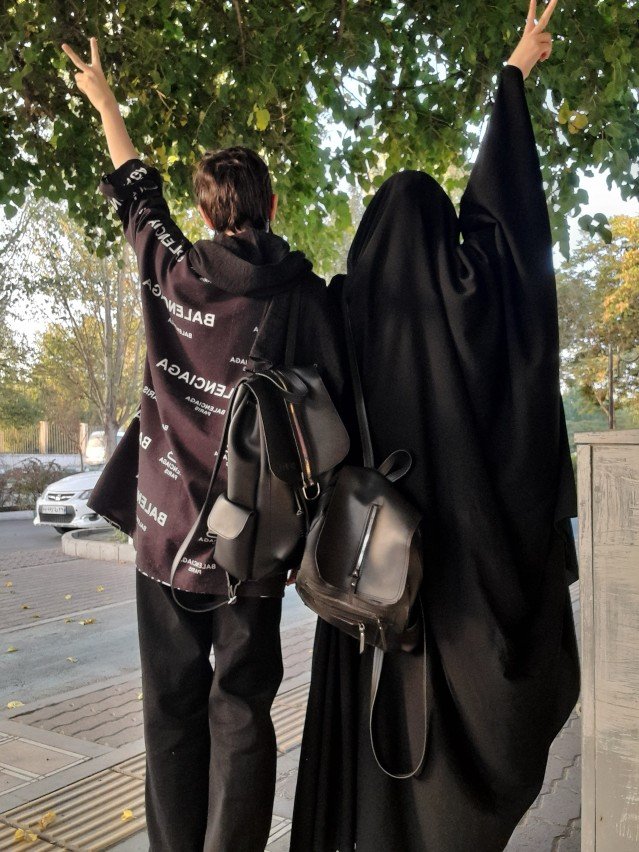
The flipped image is interesting (the Balenciaga hoodie). It looks better this way, but that's another subject. The whole thing's staged, probably by a professional. No crowds, they're signaling at a mostly empty street. The symmetry, the $700 hoodie and leather bags. The short hair and the chador flowing down the back of the head is a nice detail. (source) 

Sunday, June 07, 2015

In the distance: Kurds protest yesterday, with communists and others, against Erdogan and the AKP, outside the National Gallery. I made my usual comment to a couple of the marchers, that I would have voted for him the first or second time but like Churchill and Moses, after the job is done it's time to go. "Thank you, and goodbye."  I wasn't sure if they were in the mood for a joke but they were. They nodded and laughed. Erdogan changed the game but the change will outlast him.
see also Tunisia and the tragedy of Egypt
http://blog.edenbaumstudio.com/2015/02/necessity-is-mother-of-invention.html
html

Sunday, January 18, 2015

Salaita is a fucking idiot; the Israelis are insane. Pfeffer is supposed to be a critic of Bibi, but he's making the same arguments.

Mondoweiss
Avraham Burg, once leader of the Knesset, hasn’t retired to France yet, though he secured French citizenship after he left the political arena some years ago. At different times, Burg has encouraged other Israelis to secure foreign passports as well. Nonetheless, once in awhile Burg steps back into the political arena as a provocateur, as he did in an interview with YNet a few days ago.
"Zionism is over"
We are now at a critical juncture. In 20 years, the country will be in one of two places – either it will be a fundamentalist religious republic with Moshe Feiglin, or it will recover from the wars of the Jews over religion and state, and between the Jordan and the sea we will see the establishment of an Israel-Palestine confederation with open borders.

Palestine will be ruled by a party that has managed to eradicate the occupation by means of a non-violent civil uprising, and the two countries will share a constitution. Both will also be part of a regional union that will include Jordan, Egypt, Turkey and Cyprus. Israel’s police, defense and foreign affairs ministers will come from the Arab community.

The Israel Defense Forces will be a professional army; and just like in the police or fire department, it will include people from all sectors. In a country that belongs to all its citizens, the army, too, belongs to all its citizens.

Wednesday, September 17, 2014

 The Guardian
Qatar-Gulf deal forces expulsion of Muslim Brotherhood leaders
Move comes under heavy pressure from Saudi Arabia, UAE and other neighbours, with threat posed by Isis used as lever....

Turkish media reported that the country's president, Recep Tayep Erdoğan, had extended a welcome to the exiled leaders.
DefenseNews
Netanyahu: Sunni Arab states "understand that Israel is not their enemy but their ally."
Haaretz
Netanyahu: Don't strengthen Iran to weaken Islamic State
The logical strategy would be to use the divide between Turkey and the Gulf states by offering qualified support to the Brothers, then to pressure Erdogan to staunch the flow of fighters going to Syria. But instead of siding with Sunni and Shiite conservatives -the MB, Turkey, Iran, Hezbollah and Hamas, all of whom have some relation to democratic politics- against sectarian extremists, we're backing extremists, and monarchists, against their own and hoping our allies are as serious as we are. And of course they're not. People I follow on twitter are banging their heads against the nearest wall, in awe without shock. US policy is nothing if not predictable.

WaPo
For a long time, Western and Arab states supported the Free Syrian Army not only with training but also with weapons and other materiel. The Islamic State commander, Abu Yusaf, added that members of the Free Syrian Army who had received training — from the United States, Turkey and Arab military officers at an American base in Southern Turkey — have now joined the Islamic State. “Now many of the FSA people who the West has trained are actually joining us,” he said, smiling.
AP
...The prosecution is asking that al-Nimr be executed and crucified. In Saudi Arabia, most death sentences are carried out by beheading. Crucifixion in this context would mean that the body and head would then be put on display.

Such a punishment is rare in the kingdom and reserved for only the most serious crimes. It is meant as a warning to others.

The 54-year-old cleric is a longtime critic of Saudi Arabia's treatment of its Shiite minority and is revered among many young Shiites. He led Shiite protests in 2011 in Saudi Arabia's Eastern Province and openly criticized the Sunni government of Bahrain's handling of Shiite protests there.
The Saudis have executed 19 people since August 4th, at least 34 this year and at least 78 last year.

Monday, February 24, 2014

More on Kristof.
Josh Marshall: "I was supposed to be a history professor"
Atrios was supposed to be an economics professor.

Bertram on Ukraine and Farrell on Snowdon are sincere, admonishing, superior, self-serving.
The End of Hypocrisy. No end to irony.

Victoria Nuland: "Matt, as you have made clear again and again in this room, we are not always consistent."

notetaking. a comment (mine) at The Immanent Frame
Humanism is defined by irony; modernity as it’s come down to us now knows irony mostly in it’s blackest form. Cries of “God is dead” were the cries of people who once believed now desperate to find a replacement, the secularism of the ex-theologian not the bemused and maybe slightly drunken village atheist. More’s the pity. The secularism of scientific determinism is secular anti-humanism. Compared to the author of “In Praise of Folly” the author of “Discourse on Method” wasn’t much of a humanist, so the pleasures of architecture lost out to the moral imperatives of engineering.
The rise of political Islam is a modern phenomenon in reaction to modern pressures -an ideology to meet what was perceived as ideology- but it’s also the result of partnerships of conservative elites with Western interests. It’s impossible to separate modern Saudi from the history of oil. Perhaps the author should do a bit more research on 20th century Arab secularism.
Still Iran today is more modern than it was under the Shah. The Iranian revolution has produced a broader based middle class than existed before. The same is true for Turkey under Erdogan. And secularization follows, always. The hope is that it follows the secularization of European Judaism rather than European Christianity, for which it was such a crisis. Europe’s Muslims are the new Jews. They’re where the next generation of European humanists will come from, or are already.
"Meine beiden Klempner"
German Humanists disdained science. Naturwissenschaft. Geisteswissenschaft. Scientific socialism was Engels, the British factory owner. Marx was a journalist and gave lectures in workingmen's clubs. He exchanged letters with American presidents. knew much of Shakespeare by heart. How did this turn into the Frankfurt School?
To add to the military metaphors: Soldier of the judicial press (Bertin). The poets of strife. The litterateurs of the advance guard. This habitude of military metaphors denotes minds not military, but made for discipline, that is, for conformity, minds born domesticated, Belgian minds, which can think only in society. 
"the advance guard".
---

2/25 Marshall again
My old college professor Tony Grafton rightly made the point that scholars aren't narrowing their fields of inquiry for the hell of it. Narrowing of focus is often the price of discovering genuinely new information, opening doors to new knowledge. And narrowness itself is probably too ambiguous a word to be useful in this context.
It's sad that Grafton would fall for that, especially since the past is what's being forgotten, in the academy as much as outside it.

"The sociology of modern knowledge production..." etc.

Sunday, November 24, 2013

ABC: "Zbig Brzezinski: Obama Administration Should Tell Israel U.S. Will Attack Israeli Jets if They Try to Attack Iran."

The use of the diminutive is cute.

Not entirely happy hearing a Pole lecture the Jews about anything, but that's not the issue at the moment. The Saudis sponsoring Salafists and Al Qaeda in Syria scare the US more than Iran does; Israel's new partner is forcing the US to make the obvious choice.
Iran got much less than it was asking for, but it got its most important demand: respect. Iran and the west -and the world at large- have common interests. Iran, Turkey/Shia and Sunni, etc.  Realists never let religion or ideology get in the way of commerce, and most businessmen are not in the business of chaos.

WSJ
Calls came in to the presidential palace from Syrian allies Russia and Iran, as well as from Hezbollah, the Lebanese militant group whose fighters were inadvertently caught up in the gassing, according to previously undisclosed intelligence gathered by U.S., European and Middle Eastern spy agencies. The callers told the Syrians that the attack was a blunder that could have profound international repercussions, U.S. officials say.
The US joining the adults in the room. Our children is learning.
---

The Israeli stock market is up

Wednesday, July 03, 2013

AA
Is there any question about it? The liberal-Nasserist-AUC Leftist-Fulul opposition in Egypt has proven to be more undemocratic than the Ikhwan.
No question.

7/04 AA again
Question
Will Bassem Youssef be allowed to mock the new president and Sisi?

Press freedoms in Egypt
A comrade from Egypt writes to me: it seems that people under the Ikhwan rule (during Morsi's tenure as bad as it was) were able to insult them and attack them and mock them, but that you can't do that to the new regime now. From bad to worse.
Repeating what I wrote on fb:
Morsi blew it. Erdogan was smarter. In Egypt liberals won; democracy lost; liberalism itself is set back. The Saudis and the Israelis breathe sighs of relief. The clock keeps ticking.

Wednesday, June 05, 2013

A couple of days old
The military is an extremely important actor in Turkish politics. Traditionally, there has been a faustian pact between Turkish society and its armed forces to ensure the government could not endanger Turkey’s sacrosanct secularism. But over the past decade, the military has been unprecedentedly co-opted into supporting the AKP party. A series of high-profile sackings of generals set the stage for a neutered military leadership, despite the fact that many below top level may feel differently.

Over the course of the past day though, they have been quietly supporting the protesters. They have refused to cooperate with Police requests to use military zones for transportation. At a military hospital in Istanbul they refused to treat police officers, instead handing out gas masks to dissidents. As this exchange between a policeman and soldier attests, relations between the two armed groups are indeed frosty at present. Part of the dialogue translates as:  
Policeman: “Next time we should also throw gas bombs here [a military zone].”
Soldier: “If you do it, we will find something to throw to you as well, rest assured.”
From Arabist

Erdogan's won every election.

Tuesday, May 21, 2013

note taking my comments elsewhere.
"a class of people who are better than the rest of us, on whom we depend for our salvation and prosperity"

That sentence is a hoot. We're left to choose between the elitism of the rich or of economists and technocrats. Philosophy professors refer to "the folk". Somehow I doubt James Kwak and Mark Thoma would consider themselves folk. And DeLong?

It drives me nuts that our technocratic elite, with their fixation on ideas are so willfully ignorant of their own complexities, simply as people.

Logicians and moralists divide the world in twos, but the law of non-contradiction doesn't apply to books any more than people.  Nietzsche connects to fascism; a lot of people did and do. The problem he faced as we do is how to come to terms with the modern desires for "equality" and "liberty".  Hayek and Rand are secondary and minor figures facing the same questions.

The old aristocracy and the intellectuals around it were both anti-bourgeois and anti-capitalist, and in their contempt for mediocrity in bourgeois culture they had a point, which is why so much of the cultural left over the past 200 years has been intellectually aristocratic.  Foucault learned from the Surrealists and Symbolists, Baudelaire, Stendhal and Tocqueville.  The flaneur is aristocratic observer. Technocracy qua technocracy, in service to itself, gets us this:
"Italian rules allowing candy makers to label their products as “pure chocolate” breach European Union law, the region’s highest court said.
Permitting chocolate made from pure cocoa butter to be called “cioccolato puro,” or “pure chocolate,” clashes with EU-wide measures which allow chocolate laced with vegetable fats to be marketed as chocolate, the tribunal in Luxembourg said."
That's not an important example but it's part for whole.
A focus on the mean puts downward pressure on the mean.

Robin mocks [links below]: “The ancients sought virtue, a life of excellence lived in and through the polis; the moderns (Machiavelli, Descartes, Bacon, Hobbes, and Locke) perpetrate ‘a lowering of aims.’ ”

If everyone is equal then its just a small shift to say we can refer only to averages: the average man becomes the benchmark for analysis by the new elite. And there is a new elite. What do you think it means every time Krugman says "it's a bit technical". Equality? No.  And of course experts can make stupid mistakes, and who's the first to get hurt? Any engineer can lecture you on efficiency, redundancy and stability, but somehow efficiency makes economics take on the character of a morality play. If I were less of a determinist I'd be shocked.

An exchange with Chris Bertram:
SE: "Arguments for the nobility of greed are a recent development."Bertram: "If, by “recent” you mean 1705, you may be right."
I wasn't raised to think of greed as noble. Yet somehow in the minds of technocratic liberals, facts became ideals, and actions became secondary, so we get elitists preaching equality, meaning the equivalence of everyone in the majority to each other, while taking their own superiority for granted. Technocracy is not democracy.

Democracy is founded on obligations before freedoms.  Libertarians are finally open in their dislike for democracy; maybe it's time defenders of democracy should develop a healthy skepticism regarding freedom defined as individualism. Freedom of speech serves the health of the polis.  And maybe compulsory education should extend over the course of a life.

If you pay attention to the culture that produced you, you'll understand your contradictions. If you think you're not contradictory, you're wrong. Too many liberals think saying "I'm a nice guy" makes it so. And of course, if I am what I say I am, others are what I say they are too.  According to Cory Robin, Nietzsche and Burke are bad guys.  Robin's arguments are based in simplistic assumptions about history, historical figures, and himself. His writing is shallow and obvious.  His primary politics is self-promotion.

US mythology includes puritans and drunks, Carry Nation and John Wayne; individualized self-righteousness is the only universal. Scandinavian mythology includes Janteloven. Social democracy wasn't the product of an idea; the ideas were the product of a culture.  If you want to debate social democracy, as I've it would make sense to read Henning Mankell before John Rawls, and read for contradictions and questions not ideas.
---

Responding to two comments:

1-"The wealthy are not better than the rest of us. The 1% have taken the opportunity of the past 40 years and managed all the gains in production…"

The US has 4.5% of the population of the planet. Think, just for a minute.

2-"I'm not particularly a Hayek fan, but bald statements like this are pitiful.
'Hayek cared about liberty for ultimately elitist reasons: liberty is not an end in itself, but a condition that enables the select few to make the world a better place'
How about a citation that doesn't require starting with an assumption of corrupt motives?"

Technocrats left and right refer to the need to foster "progress" and "innovation". What percentage of the population does that directly refer to? The majority are supposed to benefit from these policies only because as employees they've been given jobs. Pundits demand increased funding for education in science and technology for a new generation of leaders not for teaching all 5th graders, brilliant or not, the foundations of the Bill of Rights. A popular econ blogger (or at least one with a PhD in economics) says: 
"I'm not sure why people are surprised and even upset that some teenagers don't know who the hell bin Laden is." 
I won't even ask if they know anything about the Vietnam war, or any one before it.
But I'm sure his friends kids know something. They're the educated elite.

Another blogger, an academic whom I doubt any of you would read says:
"Yesterday, I asked 130 students in my American Government class: who has never ever heard of a country called Lebanon? Some 40 students raised their hands."
Leave it to someone born in another country to make the point a native born American would not. It's safe to say I won't be able to talk to most of you about economics for the same reason I won't be able to talk to you about foreign policy. One is no more or less based on science than the other.

The American Dream has done more damage to the world than born again Christianity, but American liberals defend one while being horrified by the other, as if they had no relation.

"They have the power. Look around and see what they have done with it."
Yes we do. And power corrupts.
---

Read the Krugman link above. It's not just wrong it's stupid. Krugman is fond of saying the economics is not a morality play, but the his defense of free trade is founded on cheap moralism.

Dean Baker complains that proposals to eliminate SS income for billionaires would be unfair. That's an argument from normative American morality, not logic.

The debate on blogs like this one is part of a debate among the elite in and out of power.
DeLong:
"R.I.P. JEANE J. KIRKPATRICK
Let me express my condolences to her two surviving sons John Evron and Stuart Alan Kirkpatrick, whom she loved beyond all measure.
She was a good friend to my grandfather Earl. She was an American and a world patriot: her counsel--even at its most boneheaded--was always devoted to advancing the security of the United States and the cause of liberty and prosperity around the world."
"Efrain Rios Montt." The three words you need to know this week.

Dani Rodrik's defense of his father in law, a Turkish General.
"The military has long set the ground rules of Turkish politics. Its hard line defending secularism has resulted in frequent clashes with political movements it views as "soft" on Islam, such as the Justice and Development Party (AKP), which has governed the country since November 2002. Periodically, the military has intervened, bringing down governments and, on occasion, establishing periods of military rule, most recently from 1980 to 1983."
Kwak: "Corey Robin's fascinating article on nineteenth-century European culture".
That sentence is bizarre. It's written from the logic of an elite happily unaware of its place as an elite. "Oh, I don't know anything about power, I only deal in numbers and logic".

The logical foundation to any argument by American liberals is that other people are the problem. Just as American individualist liberalism is the product of American culture, "the Scandinavian anomaly" in economics is the product of Scandinavian culture. There is nothing new in Robin's article. What he adds is moralism.

"We hold these truths to be self-evident, that all men are created equal". DeLong doesn't believe that; Krugman doesn't believe that; Rodrik doesn't believe that; I don't believe that; and neither do you. Robin wants to pretend he does, so he needs to describe a Manichean world. He writes for a journal published by graduates of Phillips Exeter and Harvard and named for 18th century revolutionary terrorists. In 200 years another crew will name their journal "Hamas". It's safe to say I won't be able to talk to most of you about economics for the same reason I won't be able to talk to you about foreign policy, because that obvious point, a cheap observation about cheap politics, is lost on you.
"I like to walk about among the beautiful things that adorn the world; but private wealth I should decline, or any sort of personal possessions, because they would take away my liberty." George Santayana
Santayana was not a liberal. I am. But I learn from him as I learn from Burke. I learn from Nietzsche. I learn as much from Robin as I learn from Ayn Rand, or Hayek, or Likudniks and Salafists. I learn about fear and pathology.
---

Libertarianism isn't an idea it's an ideology, extended from ideas most of you share; that why you go over it as much as you do. Hayek is debated in American academia the way Islamic scholars in other countries argue over Sayyid Qutb. The myopia is the same.
In the end, all simply product of the times.

Sunday, September 23, 2012

The Guardian Sept 22: Turkish court sentences ex-generals to 20 years for attempted coup.

repeat. Dani Rodrik, at Crooked Timber in 2008, and in 2010, defending his father-in-law in Foreign Policy
On Feb. 22, Cetin Dogan, a retired four-star Turkish Army general, was detained and subsequently imprisoned by Turkish prosecutors, accused of masterminding an elaborate plot in 2002 and 2003 to topple the country's newly elected conservative Islamist government.

The military has long set the ground rules of Turkish politics. Its hard line defending secularism has resulted in frequent clashes with political movements it views as "soft" on Islam, such as the Justice and Development Party (AKP), which has governed the country since November 2002. Periodically, the military has intervened, bringing down governments and, on occasion, establishing periods of military rule, most recently from 1980 to 1983. 
more on his page.
The second paragraph above isn't defending Dogan; it's defending the history of military interference. Given that, I'm not sure I care about the specifics of the case.

repeat. The Times in 2008: Tension About Religion and Class in Turkey
When two women in Islamic head scarves were spotted in an Italian restaurant in this city’s new shopping mall this month, Gulbin Simitcioglu did a double take.

Covered women, long seen as backward peasants from the countryside, “have started to be everywhere,” said Ms. Simitcioglu, a sales clerk in an Italian clothing store, and it is making women like her more than a little uncomfortable. “We are Turkey’s image. They are ruining it.”

As Turkey lurches toward a repeal of a ban on head scarves at universities, the country’s secular upper middle class is feeling increasingly threatened.

...Meanwhile, universities across Turkey are preparing for the final approval of the ban’s repeal, which will go into effect after Mr. Gul signs it into law this week. Faruk Karadogan, the rector of Istanbul Technical University, said he was expecting confusion.

“The problem is not the scarf; it’s their way of thinking, their minds,” he said of observant Turks. “If you have somebody brainwashed like that, it’s very hard to get her back to a way of contemporary thinking.”

But a few buildings away, Ece Ulgen, 20, a chemistry student whose classmates include covered women (they wear hats or wigs), offered a different view.

“I have many friends who wear the head scarf,” she said. “I enjoy their friendship. They’re clever, smart women. Not like what people say: Unscientific and only interested in religion.”
repeat. The Times, Sept.14th
CAIRO — Following a blunt phone call from President Obama, Egyptian leaders scrambled Thursday to try to repair the country’s alliance with Washington, tacitly acknowledging that they erred in their response to the attack on the United States Embassy by seeking to first appease anti-American domestic opinion without offering a robust condemnation of the violence.
The Times, Sept. 22nd
Mr. Morsi, who will travel to New York on Sunday for a meeting of the United Nations General Assembly, arrives at a delicate moment. He faces political pressure at home to prove his independence, but demands from the West for reassurance that Egypt under Islamist rule will remain a stable partner.

Mr. Morsi, 61, whose office was still adorned with nautical paintings that Mr. Mubarak left behind, said the United States should not expect Egypt to live by its rules.

“If you want to judge the performance of the Egyptian people by the standards of German or Chinese or American culture, then there is no room for judgment,” he said. “When the Egyptians decide something, probably it is not appropriate for the U.S. When the Americans decide something, this, of course, is not appropriate for Egypt.”

He suggested that Egypt would not be hostile to the West, but would not be as compliant as Mr. Mubarak either.

“Successive American administrations essentially purchased with American taxpayer money the dislike, if not the hatred, of the peoples of the region,” he said, by backing dictatorial governments over popular opposition and supporting Israel over the Palestinians.

He initially sought to meet with President Obama at the White House during his visit this week, but he received a cool reception, aides to both presidents said. Mindful of the complicated election-year politics of a visit with Egypt’s Islamist leader, Mr. Morsi dropped his request.

His silence in the immediate aftermath of the embassy protest elicited a tense telephone call from Mr. Obama, who also told a television interviewer that at that moment he did not consider Egypt an ally, if not an enemy either. When asked if he considered the United States an ally, Mr. Morsi answered in English, “That depends on your definition of ally,” smiling at his deliberate echo of Mr. Obama. But he said he envisioned the two nations as “real friends.”

Monday, November 28, 2011

Swoop November 28th – December 4th, 2011
Despite the elaborate rhetoric surrounding the “pivot” to the Pacific represented by President Obama’s Asian trip, the ongoing reality of the US engagement in the Middle East continues to intrude. The imposition of new Iran sanctions, rising worries about Egypt and urgent exchanges with allies about Western policy toward Syria indicate that traditional US concerns will not fade. Further, the November 22nd Republican foreign policy debate in which the Administration faced strong criticism for its Iraq and Afghan policies ensure that these non-Asian issues will remain current. Indeed, the renewed turmoil in Egypt has rekindled an age-old debate in Washington regarding the tension between stability and democracy. The State Department’s public position has been to urge to military authorities to press forward as quickly as possible to civilian rule. Behind the scenes, however, there are rising concerns that public order is at risk - which in turn might open the door to extremists. In private messages, the Saudis have urged Washington to play things cautiously. US officials are taking encouragement from what they see as positive developments in Bahrain, Yemen, and Libya but nonetheless remain acutely aware that a peaceful transition in Egypt holds the key to regionalstability. Anything short of that risks throwing the region into disarray. At a time when the Administration is seeking to generate regional solidarity on a tougher policy toward Iran this possibility is most unwelcome. In the same region, US relations with Turkey remain of interest. Officials much welcome Turkey’s tough attitude to Syria, but are concerned by what they see as Turkey’s increasingly increasingly strident criticism of Israel. Overall they see Turkey as trying to “rewrite the rules of the Middle East” in ways that are challenging to the US. To return to Asia, there are signs that the tensions between China and the US over green technology support are worsening. Each side has now started an investigation of the other. Overall, trends in US-China relations tend to emphasize scratchy disagreements rather than areas of cooperation.

Tuesday, November 15, 2011

Jadaliyya
Turkish Politics, Kurdish Rights, and the KCK Operations: An Interview with Asli Bali
I think the AKP has shown itself to be truly in the model of its own former opponents on the Kemalist or secular side of Turkey, organizing precisely around the same ultra-nationalist positions as those parties did; whether in terms of its orientation towards Abdullah Öcalan, who remains in detention in Turkey and was convicted and is serving his prison sentence, or whether in terms of the general attitudes towards peaceful political organizing, or in terms of their tolerance for elected political officials, or in terms of the reach of their operations against academics, progressive publishers, basically every potential part of civil society that supports Kurdish autonomous political organizing. So the AKP has shown itself to not be a source of hope on this question.
AFP
The United States has deployed Predator drones to Turkey from Iraq for surveillance flights in support of Ankara's fight against Kurdish rebels, a Pentagon spokesman said Monday.
Richard Silverstein
The Guardian’s Julian Borger quotes a former Iranian government official as conceding that the explosion at an Iranian missile base was the work of the Mossad, news I was the first to report here based on a confidential authoritative Israeli source
AT
TEHRAN - Deadly explosions at a military base about 60 kilometers southwest of Tehran, coinciding with the suspicious death of the son of a former commander of the Islamic Revolutionary Guards Corps (IRGC) in Dubai in the United Arab Emirates, have triggered speculation in Iran on whether or not these are connected to recent United States threats to resort to extrajudicial executions of IRGC leaders.
Craig Murray
"... Since I became a notorious whistleblower, several of my ex-friends and contacts have used me to get out information they wanted to leak, via my blog. A good recent example was a senior friend at the UN who tipped me off in advance on the deal by which the US agreed to the Saudi attack on pro-democracy demonstrators in Bahrain, in return for Arab League support for the NATO attack on Libya. But this was rather different, not least in the apparent implication that our Ambassador to Israel, Matthew Gould, was engaged in something with Werritty which went beyond official FCO policy.

...My source says that co-ordinating with Israel and the US on diplomatic preparation for an attack on Iran was the subject of all these meetings. That absolutely fits with the jobs Gould held at the relevant times. The FCO refuses to say what was discussed. My source says that, most crucially, Iran was discussed at the Tel Aviv dinner, and the others present represented Mossad. The FCO again refuses to say who was present or what was discussed...
Links from FLC, AA, and elsewhere.

AA: "Is there a doubt that Western and Arab attitude toward the Syrian regime has nothing to do with its repression and killing?"

Repeat. Crooke: The Great Game in Syria

Tuesday, September 14, 2010

Daily press from the IPA

Turkey’s “Yes”

US Saudi weapons sale. Pat Lang
The Iranian threat? Oh, yes, of course... Somehow I think this is as much to do with "commissions" passed around in the royal family/courtier crowd. 5% of 90 billion plus will go a long way.

Saturday, March 06, 2010

Hillary Clinton in Latin American
But she has been even more diplomatically clumsy that Bush, who at least recognised that there were serious problems and knew what not to say. "The Honduras crisis has been managed to a successful conclusion," Clinton said in Buenos Aires, adding that "it was done without violence."

This is rubbing salt into her hosts' wounds, as they see the military overthrow of President Mel Zelaya last June, and subsequent efforts by the US to legitimise the dictatorship there as not only a failure but a threat to democracy throughout the region.

It is also an outrageous thing to say, given the political killings, beatings, mass arrests, and torture that the coup government used in order to maintain power and repress the pro-democracy movement. The worst part is that they are still committing these crimes.

[...]In Brazil, Clinton continued her cold war strategy by throwing in some gratuitous insults toward Venezuela. This is a bit like going to a party and telling the host how much you don't like his friends. After ritual denunciations of Venezuela, Clinton said "We wish Venezuela were looking more to its south and looking at Brazil and looking at Chile and other models of a successful country."

Brazilian foreign minister Celso Amorim responded with diplomacy, but there was no mistaking his strong rebuff to her insults: he said that he agreed with "one point" that Clinton made, "that Venezuela should look southwards more … that is why we have invited Venezuela to join MERCOSUR as a full member country." Clinton's rightwing allies in Paraguay's legislature – the remnants of that country's dictatorship and 60 years of one-party rule – are currently holding up Venezuela's membership in the South American trade block. This is not what she wanted to hear from Brazil.

The Brazilians also rejected Clinton's rather undiplomatic efforts to pressure them to join Washington in calling for new sanctions against Iran. "It is not prudent to push Iran against a wall," said Brazilian president Lula da Silva." The prudent thing is to establish negotiations."

"We will not simply bow down to an evolving consensus if we do not agree," Amorim said at a press conference with Clinton.
Two links from Helena Cobban on Turkish democracy, the Armenians and Israel. The second link to M.J. Rosenberg, continuing his long march to the left. He links to the JTA: The Zionist right was against genocide resolutions when the Turkish military were in control.

The religious parties in Turkey are more modern than the secular military. As I've said before, the facts of cosmopolitan modernity undermine the logical ideas of rationalist anti-cosmopolitan modernism.

Related: reading Quine.
Modern empiricism has been conditioned in large part by two dogmas. One is a belief in some fundamental cleavage between truths which are analytic, or grounded in meanings independently of matters of fact and truths which are synthetic, or grounded in fact. The other dogma is reductionism: the belief that each meaningful statement is equivalent to some logical construct upon terms which refer to immediate experience. Both dogmas, I shall argue, are ill founded. One effect of abandoning them is, as we shall see, a blurring of the supposed boundary between speculative metaphysics and natural science."
Another refutation of the law of non-contradiction as applied to communicative acts: a brilliant man can be an idiot. That's a truism (and the dictionary says Truism is a synonym for Cliché).

Numbers are in formal relation to one another and that formal relation is seen roughly to parallel the world of facts, words are in a formal relation to one another and simultaneously are used to "represent" the world of facts. Parallelism is not representation. Quine ignores perception and perspective and the psychological weight that accrues to both. If numbers operated on a formalism akin to natural language the French would eat with their assholes and shit from their mouths, and the writings of Georges Bataille would be considered treatises on physiology.
Once the theory of meaning is sharply separated from the theory of reference, it is a short step to recognizing as the business of the theory of meaning simply the synonymy of linguistic forms and the analyticity of statements; meanings themselves, as obscure intermediary entities, may well be abandoned
The willing away of debate over meanings is the end of politics, whether in the name of naming or of the holy name of god.

Quine's empiricism of ideal forms (or idealized relations), Weinberg's straight Platonism. and Chomsky's theoretical rationalism (as well as the empiricist practice that is the only basis for his continuing fame) are all varieties of formal systems as enclosed as the ideologies of the Turkish military the American foreign policy elite or the founders of Zionism, in the service of rationalized but otherwise irrational ends.

Tuesday, June 16, 2009

The Revolutionary Bourgeois
I've been making that argument for a long time. The dictators' modernity of Saddam Hussein, the Shah, Sadat, the Turkish military et al. were a sham modernity. What we've been seeing in Turkey and what we're seeing now in Iran is the bourgeois revolution. I linked to this a few days ago:
"You know why so many poorer women voted for Ahmadinejad? There are three million of them who make carpets in their homes. They had no insurance. When Ahmadinejad realised this, he immediately brought in a law to give them full insurance. Ahmadinejad's supporters were very shrewd. They got the people out in huge numbers to vote – and then presented this into their vote for Ahmadinejad."
So Ahmadinejad won the Luddite vote.

This post transcribes a conversation about the vote count:
"(edited only to remove my own ‘yes’ and ‘ok’ and ‘exactly’ and ‘i cannot stand makhmalbaf’ asides)"
And all the great ironic modern Iranian films of course are bourgeois culture, and document the birth of bourgeois culture. As usual, all basic stuff.

Friday, June 12, 2009

The basic scheme is to weaken Iran, Hezbollah, Hamas, and democracy in the middle east in favor of dictatorships, monarchies, Israel, and 'stability.'

But it won't work that way. Hamas and Hezbollah know that political gamesmanship can wield as much force as military action. Israel's leadership by comparison is immature. And Turkey is engaging Israel not supporting it. Assad is trying to hold on, but better for the Syrian dictatorship to fail slowly. The Saudis as well. Egypt can move faster. Iran of course even more quickly. But the losers in the long run will be the US, the Saudis, the dictators and the Israelis.
The danger in the middle east comes from the Saudis, the Israelis and the US. Of the three the US is the one capable of playing the game and accepting defeat like an adult. That's the change.