Showing posts with label Eisenstein. Show all posts

Friday, January 27, 2023

Martha Nussbaum 

It simply is not among the goals that make up the form of life of these creatures to be eaten by predators. Their form of life is their own, and they seek to live it undisturbed, just as we do, even though at times we too are also prey for aggressors. These species would not have survived if they were not pretty good at escape. To say that it is the destiny of antelopes to be torn apart by predators is like saying that it is the destiny of women to be raped. Both are terribly wrong, and demean the suffering of victims.

Yes, it's stupid, but par for the course.

Nussbaum in 1999, attacking Judith Butler. 

Feminist thinkers of the new symbolic type would appear to believe that the way to do feminist politics is to use words in a subversive way, in academic publications of lofty obscurity and disdainful abstractness. These symbolic gestures, it is believed, are themselves a form of political resistance; and so one need not engage with messy things such as legislatures and movements in order to act daringly. The new feminism, moreover, instructs its members that there is little room for large-scale social change, and maybe no room at all.

and 2007

I do not plan to discuss the specific facts concerning boycotts of Israeli academic institutions and individuals. There are three reasons for this silence. First, I believe that philosophers should be pursuing philosophical principles—defensible general principles that can be applied to a wide range of cases. We cannot easily tell whether our principles are good ones by looking at a single case only, without inquiring as to whether the principles we propose could be applied to all similar cases.

Butler defended Ronell. Stock defended Tuvel.

It's amazing what you're able to rationalize sitting alone in a room.

The unfairness of caring for your own children

These relationships appear inegalitarian in deep ways. The parties to partial relationships may exclude others from the mutual benefits their association yields and have special responsibilities to one another that give them the right, and sometimes the duty, to further one another’s interests in ways that may interrupt equality. Scheffler calls this observation (when made in an appropriately hostile manner) the ‘distributive objection’ to special responsibilities: ‘the problem with such responsibilities is ...that they may confer unfair benefit. ...special responsibilities give the participants in rewarding groups and relationships increased claims to one another’s assistance, while weakening the claims that other people have on them’.4 Indeed, participants in these protected relationships benefit twice over. They enjoy the relationship itself, and they enjoy the claims that it enables them legitimately to make on one another, to the exclusion of those outside the relationship.

A new one: In all my ignorance I had no idea Jameson was this stupid. It still amazes me that subtle readers of the past, or present, can be desperate babbling idiots about the future.

Specifically military fears include issues of violence, of hierar­chy and discipline, of regimentation, and ultimately of aggressiv­ity itself, as that is fantasized to be a fundamental feature of human nature or the human "essence" (feminism has thematized this conception of aggressivity as patriarchy or male violence). It is worth reminding the reader that the universal army here proposed is no longer the professional army responsible for any number of bloody and reactionary coups d'etat in recent times, whose ruth­lessness and authoritarian or dictatorial mentality cannot but inspire horror and whose still vivid memory will certainly astonish anyone at the prospect of entrusting a state or an entire society to its control. Removing such justified and visceral fears would certainly be the first task of any utopian therapy, were it not for the situation of dual power from which the new universal army emerges, which begins life as a parallel force alongside the state and its official army and finds its first tasks, and indeed its vocation, in the fulfillment of neglected social services and in a coexistence with the population of a wholly different type. The "nation at arms" which emerges from this situation is above all a general population in which everyone participates and a principled reac­tion against just such enclaves which enjoy Weber's "monopoly of violence" and have come to lead an autonomous life independent of society in general. (Current American reactions against isolated police forces present ready-made analogies.)

An American Utopia, edited by Zizek. Zizek's a clown and I like him as a clown. He's a liberal trying to give liberalism a foundation in faith of something better. I've always ignored his religious shit, but unlike Americans he's a social animal.

Jameson, 

In fact, the possibilities for utopian thinking were always bound up with the fortunes of a more general concern, not to say obsession, with power. The meditation on power was itself an ambiguous project. In the 1960s this project was a utopian one: it was a question of thinking and reimagining societies without power, particularly in the form of societies before power: here Levi-Strauss's revival of Rousseau gave rise to the utopian visions of early Baudrillard, of Marshall Sahlins in his Stone Age Economics, of Pierre Clastres, and of that supreme utopian vision, The Forest People by Colin Turnbull.

Turnbull's book wasn't a vision, let alone a supreme one; it was a description, maybe oversimplified, of a culture where individualism was suppressed, perhaps because it was unnecessary. It's the closest thing I've ever read to a description of actual utopia, but its the opposite in every way of modern individualism. 

From the book that includes his essay on Fukuyama, Perry Anderson's review of Marshall Berman:

Any compressed reconstruction of its general scheme must sacrifice the sheer imaginative sweep, the breadth of cultural sympathy, the force of intelligence, that give much of its splendour to All That Is Solid Melts into Air - qualities that over time will make it a classic in its field. Let us simply say at the outset that a stripped-down analysis of the principal case of the book is no adequate measure of the importance, and attraction, of the work to hand.

Berman's visionary argument starts as follows: There is a mode of vital experience—experience of space and time, of the self and others of life's possibilities and perils—that is shared by men and women all over the world today. I will call this body of experience "modernity" To be modern is to find ourselves in an environment that promises us adventure, power, joy, growth, transformation of ourselves and the world—and, at the same time, that threatens to destroy everything we have, everything we know, everything we are. Modern environments and experiences cut across all boundaries of geography and ethnicity of class and nationality, of religion and ideology: in this sense, modernity can be said to unite all mankind.

A friend loaned me Berman's book in the 90s. She loved it and reminded me she wanted it back. We had a falling out a few months later and I've had it ever since. I hated it. And I realized reading through it that she misunderstood my arguments about almost everything we'd ever talked about. But that was because she misunderstood or refused to face her own preoccupations. She was deeply conservative. She loved Kubrick, and Warhol's films. 

Berman celebrated individuality and individualism. It's stupid. This goes back to Graeber's asocial, pseudo-social, anarchism, the loneliness that craves community only if it controls it, and the culture of illustrated fantasy.

Streeck wrote this in 2014, reviewing Mair. I was watching it in the 70s in high school, thinking about the fucking hippies. I was raised by their teachers.

Streeck, years too late. Someone should get the joke.

In the order that seems to be emerging, social bonds are construed as a matter of taste and choice rather than of obligation, making communities appear as voluntary associations from which one can resign if they require excessive self-denial, rather than as ‘communities of fate’ with which one either rises or goes under.

And that link is the one that includes Streeck and Eric Rohmer.

Philosophers write about freedom vs egalitarianism or "freedom and equality." The actual issues are freedom and obligation. Equality, as a noun, is passive, saying nothing about how that relation might come to be. It can be imposed by others. Obligation describes a relation of active participants in a situation imposed not by others like us but by gods or nature: the fact of our limits and the limits of the world. The culture of the Mbuti in the Ituri forest is conservative. The only option given the fact of our own individualism—the modern condition, and irreversible—is a willed conservatism. Most people accept that; they themselves as part of a community. Berman's Americanism is a fantasy and a disaster.

The arts are Burkean. I'm with Eisenstein and Antoine Vitez, the communist from the Comédie-Française. 

The end of politics is the end of argument, the end of conversation. Wishing for the end of politics is like wishing for immortality.

2008

Cultural acts, directed from within culture, engaging their embeddedness, address the other by definition. "Craft" is always addressed from and to the community. Speech as craft engages both reception and the gap between speaker/author/maker and receiver. Can the vanguard as vanguard ever engage the other? Has it ever engaged craft as communication? If it breaks the bonds of language how can it reach back to the community it left behind? When has a vanguard ever made a new community? The best it's been able to do is teach by failure. All political thinkers should read Eisenstein. The last 20 years of my thinking ended up in that paragraph.

Carlo Ginzburg

Let’s start by quoting the magnificent words of the Sinologist Marcel Granet: ‘The method is the path once you have travelled it.’ Microhistory was the result of a convergence and a common discussion among a group of Italian researchers, but each one arrived at it with different experiences. For me, it was the case study. When I was ten years old, my mother [the writer Natalia Ginzburg, 1916-91] regularly brought me the books published by Einaudi. One day I came across The Film Sense by Sergei Eisenstein. I understood very little of the book’s content, but the impression it made on me was immense, even though I had not yet seen Eisenstein’s films. Then I read his text on the close-up, which became very important for me.

Working on a case in an analytical way is close to this. But, of course, you also have to take into account the off-screen, otherwise the close-up would not make sense. This implies that in any close-up the global perspective is implicit. Every singular case assumes the possibility of a generalisation, and there is a back and forth between the one and the other. 

---

My contempt for utopianism goes back as far as I remember. I associate with with Christianity. I was raised a secularist with the understanding that Judaism focused on the responsibilities in this world, not dreams of another, making it relatively easy to sacrifice the religion itself and keep the burden. 

Sunday, January 08, 2023

Example 1.1 (The Miners Problem)

Ten miners are trapped in a shaft and threatened by rising water. You don’t know whether the miners are in shaft 𝐴 or in shaft 𝐵. You have enough sandbags to block one shaft, but not both. If you block the right shaft, all miners will survive. If you block the wrong shaft, all of them will die. If you do nothing, both shafts will fill halfway with water and one miner (the shortest of the ten) will die.

Act II

The chorus explains that the teacher, the boy, and three older students are on the way back, and the boy is exhausted ("Die Leute haben die Reise in die Berge"). As they approach their shelter, the boy confesses that he is not well ("Wir sind schnell hinangestiegen"). The teacher tells him it is forbidden to say such things on the journey, but the three students have overheard and demand to speak to the teacher. He admits that the boy is ill, and the students remind him of the strict old custom that whoever falls ill during the journey over the mountains must be hurled into the valley ("Wir wollen es dem Lehrer sagen"). The teacher reminds them that the sick person may also demand that the entire party turn back. Then he goes to the boy and offers him the choice ("Höre gut zu"). The boy decides that he knew the risks and should not impede the expedition. He asks only that the three students fill his jar with medicine and take it to his mother, and they agree. Then the three students bear him gently to the cliff and throw him over. The chorus reiterates the theme ("Wichtig zu lernen" reprise).

FRATERNIZATION

Key references: Article 134, UCMJ; U.S. NAVY REGULATIONS 1165 (applies to both Navy and Marine Corps); OPNAVINST 5370.2C (applies only to Navy); Marine Corps Manual 1100.4 (applies only to MC).

Background: The U.S. Navy has historically relied upon custom and tradition to define the bounds of acceptable personal relationships among its members and unduly familiar relationships between officers and enlisted members have traditionally been contrary to Naval custom, because they undermine the respect for authority. Acceptable conduct varies between the services based on differences in custom and tradition.

Definition: Generally, fraternization is an unduly familiar personal relationship between an officer member and an enlisted member that does not respect the difference in rank or grade. Relationships between officer members and between enlisted members that are prejudicial to good order and discipline or of a nature to bring discredit on the Naval service are unduly familiar and also constitute fraternization.

So fucking bored with philosophy.
---

Using Brecht as a model of tradition and community doesn't work. I need to distinguish the libretto from its source,  decadence from classicism, formalism from formality. Brecht's theater is mannerist: simultaneously moralizing and corrupt.

Martin Puchner, Stage Fright: Modernism, Anti-Theatricality, and Drama

What is neglected in these accounts of Brecht’s lasting success in the theater is that his work is not so much a modernist reform of the theater as one directed against it. Indeed, the most central features of Brecht’s theater arise from a vehement and at times fundamental polemic against actors and the audience. And so we must recognize that Brecht counts as one of modernism’s most successful theater reformers because he was most successful in making his resistance to the theater productive for a reform of the theater. This resistance to the theater is visible in Brecht’s attacks on expressionist plays, on the theater industry, and on Max Reinhardt’s seductive spectacles. His most categorical and fundamental condemnation of the theater emerges, however, when he, like many turn-of-the-century and early-twentieth-century reformers, speaks against the figure whose exploitation of theatricality never ceased to haunt modern theater, namely, Richard Wagner. 
Neither Wagner nor Brecht are useful as models. It looks like an interesting book, but he's still more partisan than observer. I loved Brecht's operas because they set my skin on fire, and then I had to ask why. Brecht vs Eisenstein.
---

I'm getting old. I forget everything!

In for a penny... and an overdue tag for Eisenstein

"Dickens, Griffith, and the Film Today" (1944)

People talked as if there had been no dra­matic or descriptive music before Wagner; no impressionist painting before Whistler; whilst as to myself, I was finding that the surest way to produce an effect of daring innovation and originality was to revive the ancient attraction of long rhetorical speeches; to stick closely to the methods of Moliere; and to lift characters bodily out of the pages of Charles Dickens.
George Bernard Shaw

...When Griffith proposed to his employers the novelty of a parallel "cut-back" for his first version of Enoch Arden (After Many Years, 1908), this is the discussion that took place, as recorded by Linda Arvidson Griffith in her reminiscences of Biograph days:
When Mr. Griffith suggested a scene showing Annie Lee wait­ ing for her husband's return to be followed by a scene of Enoch cast away on a desert island, it was altogether too distracting. "How can you tell a story jumping about like that? The people
won't know what it's about."
"Well," said Mr. Griffith, "doesn't Dickens write that way?" "Yes, but that's Dickens; that's novel writing; that's different." "Oh, not so much, these are picture stories; not so different." 
But, to speak quite frankly, all astonishment on this subject and the apparent unexpectedness of such statements can be ascribed only to our—ignorance of Dickens. 
All of us read him in childhood, gulped him down greedily, without realizing that much of his irresistibility lay not only in his capture of detail in the childhoods of his heroes, but also in that spontaneous, childlike skill for story-telling, equally typical for Dickens and for the American cinema, which so surely and delicately plays upon the infantile traits in its audi­ ence. We were even less concerned with the technique of Dickens's composition: for us this was non-existent—but cap­tivated by the effects of this technique, we feverishly followed his characters from page to page, watching his characters now being rubbed from view at the most critical moment, then see­ ing them return afresh between the separate links of the parallel secondary plot.

As children, we paid no attention to the mechanics of this. As adults, we rarely re-read his novels. And becoming film­ workers, we never found time to glance beneath the covers of these novels in order to figure out what exactly had captivated us in these novels and with what means these incredibly many­ paged volumes had chained our attention so irresistibly. 
Apparently Griffith was more perceptive...

But before disclosing what the steady gaze of the American film-maker may have caught sight of on Dickens's pages, I wish to recall what David Wark Griffith himself represented to us, the young Soviet film-makers of the 'twenties.

To say it simply and without equivocation: a revelation. 
Try to remember our early days, in those first years of the October socialist revolution. The fires At the Hearthsides of our native film-producers had burnt out, the Nava's Charms of their productions had lost their power over us and, whis­ pering through pale lips, "Forget the hearth," Khudoleyev and Runich, Polonsky and Maximov had departed to oblivion; Vera Kholodnaya to the grave; Mozhukhin and Lisenko to expatri­ation.

The young Soviet cinema was gathering the experience of revolutionary reality, of first experiments (Vertov), of first systematic ventures (Kuleshov), in preparation for that un­ precedented explosion in the second half of the 'twenties, when it was to become an independent, mature, original art, immediately gaining world recognition.

In those early days a tangle of the widest variety of films was projected on our screens. From out of this weird hash of old Russian films and new ones that attempted to maintain "tradi­tions," and new films that could not yet be called Soviet, and foreign films that had been imported promiscuously, or brought down off dusty shelves-two main streams began to emerge.

On the one side there was the cinema of our neighbor, post­ war Germany. Mysticism, decadence, dismal fantasy followed in the wake of the unsuccessful revolution of 1923, and the screen was quick to reflect this mood. Nosferatu the Vampire, The Street, the mysterious Warning Shadows, the mystic crim­inal Dr. Mabuse the Gambler,· reaching out towards us from our screens, achieved the limits of horror, showing us a future as an unrelieved night crowded with sinister shadows and crimes. . . .

The chaos of multiple exposures, of over-fluid dissolves, of split screens, was more characteristic of the later 'twenties (as in Looping the Loop or Secrets of a Soul ), but earlier Germman films contained more than a hint of this tendency. In the over-use of these devices was also reflected the confusion and chaos of post-war Germany.

All these tendencies of mood and method had been fore­ shadowed in one of the earliest and most famous of these films, The Cabinet of Dr. Caligari (1920), this barbaric carnival of the destruction of the healthy human infancy of our art, this common grave for normal cinema origins, this combination of silent hysteria, particolored canvases, daubed flats, painted faces, and the unnatural broken gestures and actions of mon­strous chimaeras.

Expressionism left barely a trace on our cinema. This painted, hypnotic "St. Sebastian of Cinema" was too alien to the young, robust spirit and body of the rising class.

It is interesting that during those years inadequacies in the field of film technique played a positive role. They helped to restrain from a false step those whose enthusiasm might have pulled them in this dubious direction. Neither the dimensions of our studios, nor our lighting equipment, nor the materials available to us for make-up, costumes, or setting, gave us the possibility to heap onto the screen similar phantasmagoria. But it was chiefly another thing that held us back: our spirit urged us towards life—amidst the people, into the surging actuality of a regenerating country. Expressionism passed into the formative history of our cinema as a powerful factor—of re­pulsion.

There was the role of another film-factor that appeared, dashing along in such films as The Gray Shadow, The House of Hate, The Mark of Zorro. There was in these films a \vorld, stirring and incomprehensible, but neither repulsive nor alien. On the contrary—it was captivating and attractive, in its own way engaging the attention of young and future film-makers, exactly as the young and future engineers of the time were attracted by the specimens of engineering techniques unknown to US, sent from that same unknown, distant land across the ocean.

What enthralled us was not only these films, it was also their possibilities. Just as it was the possibilities in a tractor to make collective cultivation of the fields a reality, it was the boundless temperament and tempo of these amazing (and amazingly useless!) works from an unknown country that led us to muse on the possibilities of a profound, intelligent, class­ directed use of this wonderful tool.

The most thrilling figure against this background was Grif­fiths, for it was in his works that the cinema made itself felt as more than an entertainment or pastime. The brilliant new methods of the American cinema were united in him with a profound emotion of story, with human acting, with laughter and tears, and all this was done with an astonishing ability to preserve all that gleam of a filmically dynamic holiday, which had been captured in The Gray Shadow and The Mark of Zorro and The House of Hate. That the cinema could be incomparably greater, and that this was to be the basic task of the budding Soviet cinema-these were sketched for us in Griffith's creative work, and found ever new confirmation in his films.

Our heightened curiosity of those years in construction tmd method swiftly discerned wherein lay the most powerful affec­tive factors in this great American's films. This was in a hith­erto unfamiliar province, bearing a name that was familiar to us, not in the field of art, but in that of engineering and elec­trical apparatus, first touching art in its most advanced sec­tion—in cinematography. This province, this method, this prin­ciple of building and construction was montage.

Monday, December 05, 2022

A new Smithson tag, mostly now for notes. All the below will have to be fit into the manuscript continuing or expanding on this.

I always understood the weakness in Smithson's work, that his preoccupations were transitional, but I loved them for describing the situation we were in: the negative idealism, the association of narrative with banality, searching for an absolute of some sort.

Humanism at its most mature is a focus on man as she is—I'll be cute and mix it up—not as she want to be; even the use of prescriptive rhetoric only overlays a descriptive core. So the greatest art of humanism achieves a balance not out of ideology or pedantry but respect for the things being balanced, including sobriety and drunkenness. In art, communicative form, drunkenness is the description of the experience, not the thing itself, but it's hard to give due credit without experience. 

"Perception does not know the concept of infinity"

The Baroque was the last flowering of absolutism, manifest in hierarchy able to describe itself as flexible without losing its authority. At the same time its scholasticism can produce an art that rather than describing a mechanism or a function begins to follow it.  

Reading Smithson he's the mirror of Fried: a decadent moralist, a reactionary post-humanist (seeing humanism only as pedantry), elitist, anti-democratic, etc. 

—Jorge Luis Borges begins his From Allegories to Novels by saying, "For all of us, the allegory is an aesthetic error."

—Duchamp shares Shakespeare's disgust when it comes to the elevation of expressive naturalism over the rules of the game.  

Like Borges, he only understands the novel from the world of allegories, and like him they're all he's good for. His comment about Duchamp and Shakespeare is absurd. He reduces the rules of the game to a mechanism which his own work serves only to illustrate. He's closer to Frampton than he admits. But he would've gotten a kick of David Thomson on Godard.

Craig Owens, "The Allegorical Impulse: Toward a Theory of Postmodernism", October, Vol 12. (Spring, 1980) JSTOR  

A week or so ago I updated a post mentioning October.

I've always hated Borges, but not Smithson.

Vesely, (again)  p 207

The problem of infinity was not new. It was discussed in antiquity, during the Middle Ages, and throughout the Renaissance, but always with reference to the transcendental nature of divine reality. From the human point of view, infinity could be only potentially present in a world that was by definition finite. This situation had changed by the end of the sixteenth and the beginning of the seventeenth century, when, for the first time, infinity was thought of and experienced as a plausible actuality. The new appreciation of infinity has much to do with developments in mathematics and with the appropriative nature of introverted representation. The contrast between the introverted experience and the indeterminate beyond, which could not be grasped but could no longer be ignored, was probably the main source of the anxiety often expressed in seventeenth-century writing. The contemplation of infinity. Kepler writes "parries with it I don't know what secret hidden horror: indeed one finds oneself wandering in this immensity to which are denied limits and center and therefore all determinate places. His tone comes close to that of the famous fragment by Pascal: "the eternal silence of these infinite spaces terrifies me."

This fear of the infinite is not shared by Guarini, but it finds its place in his commitment to move beyond the uncertainties and ambiguities of the finite, sensible world and in his elaborate effort to come to terms with the problem of infinity. Guarini's commitment was based on a deep faith in the continuity between the finite human world and the infinity of the divine mind. This faith was combined with an awareness, common in the Aristotelian tradition. that there is not a direct proportion between finite and infinite things or realities. However, if the traditional proportions are raised the level of universal proportions, the ratios can be generated toward infinity. This possibility is a key to Guarini's universal mathematics and metaphysics (prima philosophical, which rests on the assumption that geometrical proportion is both generic and universal in relation to all other proportions.

The important step that Guarini takes is to contemplate approaching the problem of infinity through the continuous progression of ratios in asymptotic approximation. As he himself acknowledges, "the boundary of progression is the end of a series to which no progression can approach, even if it is contained in infinity[,]... but it approaches it in perpetuity" (E.A 213) The progression of ratios to infinity closely corresponds to the principle of diminishing proportions in Renaissance perspective. But there is an important difference: the shift from the human to the divine point of view and from perspective to projection. This shift is readily apparent in the discussion of proportions in the Euclides adauctus, which leads to a consideration of the problem of continuity and culminates in the interpretation of the continuous geometrical proportion of surfaces and their projective relationships. Surface plays a unique role in Guarini's thinking because it is continuous and infinite, and generates geometrical proportions by its very nature--that is, by being a surface. This may explain why Guarini uses the planimetric figure of the hexagon as a primary element in the construction of the Sindone dome. The pyramidal stacking of the hexagons follows the rule of gnomonic difference, which is a proportional difference between individual figures. The sequence may be developed into an infinite series of terms belonging to the same continuous analogy. The key to this idea of the construction of the dome is a relatively little known drawing preserved in the Archivio di Stato in Turin. showing the stereographic pyramidal projection of its triangular elements. (figure 4.16)

The Trinitarian meaning of the triangle is preserved in its transformation into a hexagon. as well as in the twelve rays of the sun achieved by the hexagon's rotation. But the hexagon in the dome is open to more than one interpretation. We can see its meaning as a fulfillment of the primary theme of the chapel, the Passion culminating as a resurrection on the first day of the new creation (the day of sun)in other words, as a new expression of the cosmogonic role and meaning of light in the six days of creation (hexaemeron). Supporting this interpretation is another rather interesting, important fact: the dome is composed of six hexagons (six steps in the journey toward the sun; figures 4.17 and 4.18). [14.18 see below s.e.]

Guarini's geometrical language becomes comprehensible only in the context of his oeuvre as a whole, which also helps us to enter into the culture of the Baroque in which his architecture was received and understood. Broadly speaking, the Baroque culture of the seventeenth century was still dominated by symbolic thinking, which included mathematical speculation and representation (figure 4.19). More specifically, symbolic representation was sustained by dialectical thinking. It is probably no accident that Guarini titled Expensio V of his Euclides "De proportione dialectica." The section treats the dialectical relationship between quantitative entities (magnitudes) and their qualitative meaning. However, the title refers more specifically to the dialectics of geometrical operations in their relation to theological or philosophical discourse. What is new in Guarini's dialectics is its hidden and often enigmatic nature, which must be discerned behind apparently pure geometrical constructions and arguments. This aspect of Guarini's thinking is brought out by his references to Proclus and Nicholas of Cusa, the authors he followed most closely.

Smithson, The Collected Writings,

Jack Flam's introduction

p. XV

In a way, Smithson saw and treated the world as an enormous text, reminiscent of the library in Borges's "Library of Babel," which is synonymous with the universe itself, "composed of an indefinite and perhaps an infinite number of hexagonal galleries"-which seem to prefigure the crystalline structures that Smithson himself favored. Borges's library, moreover, is defined as "a sphere whose exact center is any one of its hexagons and whose circurriference is inaccessible," recalling Smithson's favorite quote from Pascal, that "Nature is an infinite sphere whose center is everywhere and whose circumference is nowhere." Significantly, in a 1968 citation of Pascal's statement, Smithson added "or language becomes an infinite museum whose center is everywhere and whose limits are nowhere."

p.52  Towards The Development of an Air Terminal Site (1967)

p 59

Tony Smith writes about "a dark pavement" that is "punctuated by stacks, towers, fumes and colored lights." (Artforum, December 1966.) The key word is "punctuated." In a sense, the "dark pavement" could be considered a "vast sentence," and the things perceived along it,"punctuation marks.""... tower ..." =the exclamation mark(!)."... stacks . . ."= the dash(-).". . .fumes ..."= the question mark(?)."... colored lights .. ." = the colon (:).Of course, I form these equations on the basis of sense-data and not rational-data. Punctuation refers to interruptions in "printed matter." It is used to emphasize and clarify the meaning of specific segments of usage. Sentences like "skylines" are made of separate "things" that constitute a whole syntax. Tony Smith also refers to his art as "interruptions" in a "space-grid."

p. 66 Letter to the Editor, Artforum (1967)

Sirs:

France has given us the anti-novel, now Michael Fried has given us the anti-theater. A production could be developed on a monstrous scale with the Seven Deadly Isms, verbose diatribes, scandalous refutations, a vindication of Stanley Cavell, shrill but brilliant disputes on "shapehood" vs. "objecthood," dark curses, infamous claims, etc. The stage should subdivide into millions of stages.

The following is a "prologue" from an unwritten TV "spectacular" called The Tribulations of Michael Fried.

. . . there will be no end to this exquisite, horrible misery, when you look forward you shall see a long forever, a boundless duration before you, which will swallow up your thoughts.

Jonathan Edwards

Michael Fried has in his article "Art and Objecthood" (Artforum, June 1967) declared a "war" on what he quixotically calls "theatricality." In a manner worthy of the most fanatical puritan, he provides the art world with a long-overdue spectacle-a kind of ready-made parody of the war between Renaissance classicism (modernity) versus Manneristic anti-classicism (theater) . Fried, without knowing it, has brought into being a schism complete with all the "mimic fury" (Thomas Carew) of a fictive inquisition. He becomes, I want to say, in effect the first truly manneristic critic of "modernity." Fried has set the critical stage for manneristic modernism, although he is trying hard not to fall from the "grip" of grace. This grace he maintains by avoiding appearance, or by keeping art at "arm's length." Fried discusses this "grip" in Anthony Caro and Kenneth No/and—Some Notes on Not Composing (The Lugano Review, 1965/III-IV). What Fried fears most is the consciousness ofwhat he is doing—namely being himself theatrical. He dreads "distance" because that would force him to become aware of the role he is playing. His sense of intimacy would be annihilated by the "God" Jonathan Edwards feared so much. Fried, the orthodox modernist, the keeper of the gospel of Clement Greenberg has been "struck by Tony Smith," the agent of endlessness. Fried has declared his sacred duty to modernism and will now make combat with what Jorge Luis Borges calls "the numerous Hydra (the swamp monster which amounts to a prefiguration or emblem of geometric progressions) ... ", in other words "Judd's Specific Objects, and Morris's gestalts or unitary forms, Smith's cube ... " This atemporal world threatens Fried's present state of temporal grace - his "presentness." The terrors of infinity are taking over the mind of Michael Fried. Corrupt appearances of endlessness worse than any known Evil. A radical skepticism, known only to the dreadful "literalists" is making inroads into intimate "shapehood." Non-durational labyrinths of time are infecting his brain with eternity. Fried, the Marxist saint, shall not be tempted into this awful sensibility, instead he will cling for dear life to the "surfaces" of Jules Olitski's Bunga. Better one million Bungas than one "specific object." Yet, little known "specific demons" are at this moment, I want to say, "breaking the fingers" of Fried's grip on Bunga. This "harrowing" of hellish objecthood is causing modernity much vexation and turmoil-not to say "gnashing of teeth."

At any rate, eternity brings about the dissolution of belief in temporal histories, empires, revolutions, and counter-revolutions—all becomes ephemeral and in a sense unreal, even the universe loses its reality. Nature gives way to the incalculable cycles of nonduration. Eternal time is the result of skepticism, not belief. Every refutation is a mirror of the thing it refutes-ad infinitum. Every war is a battle with reflections.What Michael Fried attacks is what he is. He is a naturalist who attacks natural time. Could it be there is a double Michael Fried-the atemporal Fried and the temporal Fried? Consider a subdivided progression of "Frieds" on millions of stages.

p 138 A Cinematic Atopia (1971)

Going to the cinema results in an immobilization of the body. Not much gets in the way of one's perception. All one can do is look and listen. One forgets where one is sitting. The luminous screen spreads a murky light throughout the darkness. Making a film is one thing, viewing a film another. Impassive, mute, still the viewer sits. The outside world fades as the eyes probe the screen. Does it matter what film one is watching? Perhaps. One thing all films have in common is the power to take perception elsewhere. As I write this, I'm trying to remember a film I liked, or even one I didn't like. My memory becomes a wilderness of elsewheres. How, in such a condition, can I write about film' I don't know. I could know. But I would rather not know. Instead, I will allow the elsewheres to reconstruct themselves as a tangled mass. Somewhere at the bottom of my n1.emory are the sunken remains o fall the films I have ever seen, good and bad they swarm together forming cinematic mirages, stagnant pools of images that cancel each other out. A notion of the abstractness of films crosses my mind, only to be swallowed up in a morass of Hollywood garbage. A pure film of lights and darks slips into a dim landscape of countless westerns. Some sagebrush here, a little cactus there, trails and hoofbeats going nowhere. The thought of a film with a "story" makes me listless. How many stories have I seen on the screen? All those "characters" carrying out dumb tasks. Actors doing exciting things. It's enough to put one into a permanent coma.

Let us assume I have a few favorites. Ikiru? also called Living, To Live, Doomed. No, that won't do. Japanese films are too exhausting. Taken as a lump, they re- mind me of a recording by Captain Beef Heart[sic] called Japan in a Dishpan. There's always Satyajit Ray for a heavy dose of tedium, if you're into tedium. Actually, I tend to prefer lurid sensationalism. For that I must turn to some English director, Alfred Hitchcock will do. You know, the shot in Psycho where Janet Leigh's eye emerges from the bathtub drain after she's been stabbed. Then there's always the Expanded Cinema, as developed by Gene Youngblood, complete with an introduction by "Bucky" Fuller. Rats for Breakfast could be a hypothetical film directed by the great utopian himself. It's not hard to con- sider cinema expanding into a deafening pale abstraction controlled by computers. At the fringes of this expanse one might discover the deteriorated images of Hollis Frampton's Maxwell's Denton? After the "structural film" there is the sprawl of entropy. The monad of cinematic limits spills out into a state of stupefaction. We are faced with inventories of limbo.

p. 349  Ivan the Terrible to Roger Corman or Paradoxes of Conduct in Mannerism as reflected in he Cinema (1967)

p. 350 

Manneristic art is often called pseudo, sick, perverse, false, phony and decadent by the naturalists or truth tellers, yet it seems to me that what the Mannerist esthetic does disclose or recover is a sense of primal evil. Both Eisenstein and Poe seem to have been acutely aware of such a malevolent condition. Parker Tyler in his Classics ofForeign Films has this to say, "Eisenstein knew perfectly well that 'Mephistofeles' and 'wild beast,' the labels he had given Ivan, also applied to himself, to the history of his career as man and film artist." Such an awareness not only locates him within the Mannerist esthetic, but also makes him an artist of the first order.

The Mannerist is not innocent of corruption. He casts a cold eye, and what he sees he treats with humor and terror. A great example of pictorial humor and terror is The Allegory ofEurope or the Beheading ofJohn the Baptist by an unknown Mannerist master (collection of the Prado).The very word "allegory" is enough to strike terror into the hearts of the expressive artist; there is perhaps no device as exhausted as allegory. But strangely enough Allan Kaprow has shown interest in that worn-out device. Jorge Luis Borges begins his From Allegories to Novels by saying, "For all of us, the allegory is an aesthetic error."

p. 352 

Duchamp shares Shakespeare's disgust when it comes to the elevation of expressive naturalism over the rules of the game. 

Sam Wagstaff, "Talking with Tony Smith", Artforum (1966)

I’m not aware of how light and shadow falls on my pieces. I’m just aware of basic form. I’m interested in the thing, not in the effects—pyramids are only geometry, not an effect.

—————————

My speculations with plane and solid geometry and crystal forms led me to making models for sculpture, but what I did always made use of the 90-degree angle, like De Stijl. I only began to use more advanced relationships of solids after working with Wright and then related the thirty and sixty-degree angles to the ninety-degree angles.

—————————

We think in two dimensions—horizontally and vertically. Any angle off that is very hard to remember. For that reason I make models—drawings would be impossible.

—————————

I’m very interested in Topology, the mathematics of surfaces, Euclidian geometry, line and plane relationships. “Rubber sheet geometry,” where facts are more primary than distances and angles, is more elemental but more sophisticated than plane geometry.

————————— 

When I was teaching at Cooper Union in the first year or two of the fifties, someone told me how I could get on to the unfinished New Jersey Turnpike. I took three students and drove from somewhere in the Meadows to New Brunswick. It was a dark night and there were no lights or shoulder markers, lines, railings, or anything at all except the dark pavement moving through the landscape of the flats, rimmed by hills in the distance, but punctuated by stacks, towers, fumes, and colored lights. This drive was a revealing experience. The road and much of the landscape was artificial, and yet it couldn’t be called a work of art. On the other hand, it did something for me that art had never done. At first I didn’t know what it was, but its effect was to liberate me from many of the views I had had about art. It seemed that there had been a reality there which had not had any expression in art. 

 The experience on the road was something mapped out but not socially recognized. I thought to myself, it ought to be clear that’s the end of art. Most painting looks pretty pictorial after that. There is no way you can frame it, you just have to experience it. Later I discovered some abandoned airstrips in Europe—abandoned works, Surrealist landscapes, something that had nothing to do with any function, created worlds without tradition. Artificial landscape without cultural precedent began to dawn on me. There is a drill ground in Nuremberg, large enough to accommodate two million men. The entire field is enclosed with high embankments and towers. The concrete approach is three sixteen-inch steps, one above the other, stretching for a mile or so.

--- 

Gregory of St Vincent, 1647 
Guarini, Cappella della Sacra Sindone, completed in 1694 
Tony Smith Model for Smoke, 1967
Tony Smith, Smug, 1973
Robert Smithson, Alogon #2, 1966
Mirror Stratum, 1966
Spiral Jetty, 1970 
Gyrostasis, 1968
Plunge, 1966 


Sunday, October 30, 2022

updated
---

I put this passage in a post just below, but it reminded me of something I've avoided.

Eisenstein, Film Form, p. 20, defending convention, and tradition. 

We have been visited [1928] by the Kabuki theater-a wonderful manifestation of theatrical culture.

Every critical voice gushes praise for its splendid crafts­manship. But there has been no appraisal of what constitutes its wonder. Its "museum" elements, though indispensable in estimating its value, cannot alone afford a satisfactory esti­mate of this phenomenon, of this wonder. A "wonder" must promote cultural progress, feeding and stimulating the intellec­tual questions of our day. The Kabuki is dismissed in plati­tudes: "How musical!" "What handling of objects!" "What plasticity!" And we come to the conclusion that there is nothing to be learned, that (as one of our most respected critics has announced) there's nothing new here: Meyerhold has already plundered everything of use from the Japanese theater!

Behind the fulsome generalities, there are some real atti­tudes revealed. Kabuki is conventional! How can such con­ ventions move Europeans! Its craftsmanship is merely the cold perfection of form! And the plays they perform are feudal!—What a nightmare!

More than any other obstacle, it is this conventionalism that prevents our thorough use of all that may be borrowed from the Kabuki.

But the conventionalism that we have learned "from books" proves in fact to be a conventionalism of extremely interesting relationships The conventionalism of Kabuki is by no means the stylized and premeditated mannerism that we know in our own theater, artificially grafted on outside the technical requirements of the premise. In Kabuki this conventionalism is profoundly logical-as in any Oriental theater, for example, in the Chinese theater.

Among the characters of the Chinese theater is "the spirit of the oyster"! Look at the make-up of the performer of this role, with its series of concentric touching circles spreading from the right and left of his nose, graphically reproducing the halves of an oyster shell, and it becomes apparent that this is quite "justified." This is neither more nor less a convention than are the epaulettes of a general. From their narrowly utilitarian origin, once warding off blows of the battle-axe from the shoulder, to their being furnished with hierarchic little stars, the epaulettes are indistinguishable in principle from the blue frog inscribed on the forehead of the actor who is playing the frog's "spirit." 

I've linked to this a few times since I read it, because most of it is about Zizek playing the fool, and being one, in Ramallah. But a passage stuck with me that as I said above, I've avoided. Think about the relationship of form to meaning—not "content"

Darwish directed a series of Palestine Liberation Organization (PLO)-funded films from the early 1970s. He was a pioneer—his shorts that dealt with the armed struggle, first in Jordan, then in Lebanon, were critical documents for any student of the period. More than that, each film text experimented with a particular element of cinematography. They may have all focused on the armed resistance, but the first one was really “about” framing, the second on montage, the third on sound, and so on. These films had long been forgotten save by old comrades and an enthusiastic group of recent devotees. When I found out that he had studied at the Moscow Institute, I asked him about Sonallah and Malas, and he told me how they had all been there together. I asked if he had worked with Godard in Jordan, “Yes! How’d you guess? I was his production assistant. He was there for only a few months, but while he was here, he worked. He never rested. I’ve never seen that sort of ethic. After what happened, he didn’t know what to do for a couple years with all that footage.” 

Godard the Maoist, etc. Politicized aesthetics is aestheticized politics. Sincerity of intention means nothing. Another pithy sentence I wrote once. "The romance of orthodoxy is mannerism." Attaching formal games to political engagement is a kind of decadence. Eisenstein was younger that Panofsky and Kracauer but they all grew up and into he new age of film and their relation to it was organic. 

Film art is the only art the development of which men now living have witnessed from the very beginnings; and this development is all the more interesting as it took place under conditions contrary to precedent. It was not an artistic urge that gave rise to the discovery and gradual perfection of a new technique; it was a technical invention that gave rise to the discovery and gradual perfection of a new art.
—
For me, there is nothing that anyone has written on cinema that is more moving than Kracauer’s recollection of the first motion picture he saw, as a young boy in the early twentieth century: “What thrilled me so deeply was an ordinary suburban street, filled with lights and shadows which transfigured it.”
Several trees stood about, and there was in the foreground a puddle reflecting invisible house façades and a piece of the sky. Then a breeze moved the shadows, and the façades with the sky below began to waver. The trembling upper world in the dirty puddle—this image has never left me.

If Eisenstein turned to politics in a time of revolutionary hope, the hope was more important than doctrine, because possibilities were more important than limits. But defending conventionalism within his understanding of art, he set limits for himself. "The arts are Burkean".  That's another one.

I once spent a long train ride picking apart a copy of October, a special issue, maybe dedicated to Buchloh but centering on formalism and collage and the superiority of early Soviet experiments over later fascist versions. The writing was pretentious, defensive, overintellectualized and overdetermined, and every writer ignored the simplest and least intellectual observation: that the early Soviet stuff was formally fresh and open, and the designs gave an audience room to breathe. But accepting that means accepting art as something other than "a plastic art which sets itself up in place of books."

repeats from 2010 and 2003 on art and original intent. "Show us yer arse!"

---

I found it. Vol. 30, (Autumn, 1984)  Buchloh's in it but it's not s special issue and he's the only one wring about Soviet art. But my description of the language applies to all of it. I picked apart figuratively and literally. I keep it in a binder. Now it's conceptual art.

Saturday, October 29, 2022


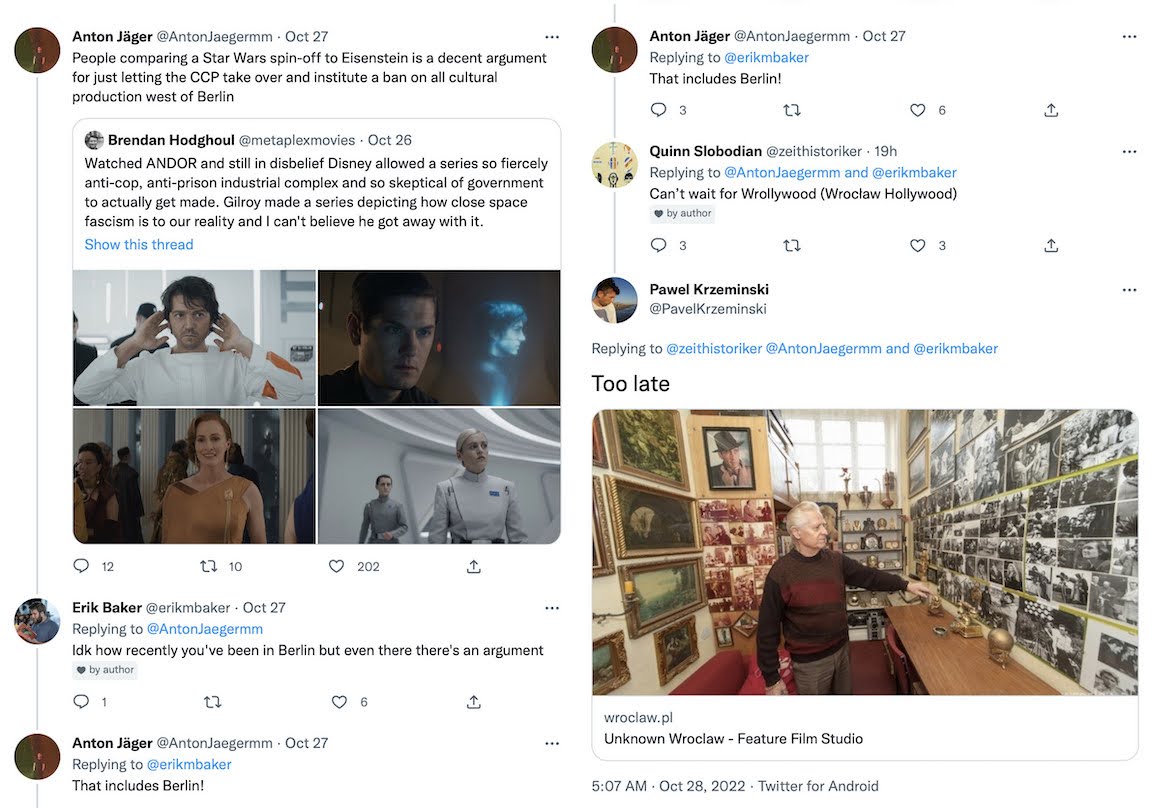
Milanovic defends "a thousand points of light". Jäger and the Slobodian are snobs—Jäger's admitted it— pretentious defenders of what their own seriousness. But Jäger's a proud fan of Fleetwood Mac and I think I may be responsible for Leusder shutting down his Soundcloud account—in embarrassment? And the idiot they're mocking is a fan of Mark Fisher. I don't know where the Eisenstein reference comes from. It's not in the thread, but all the thread is is bragging by citation and in-jokes, academic standard practice. "They then chuckle together in a self-congratulatory academic manner."  

It was common knowledge once that Lucas modeled the stormtroopers' helmets after the Teutonic Knights in Nevsky, and the emperor's cloak and the camera angles after the grand master.

Lucasfilm 
Johnston remembered that early on, Lucas showed him Sergei Eisenstein’s classic film, Alexander Nevsky, whose opening feature featured a battle on ice between medieval warriors. Lucas told him, “I want the battle on Hoth to feel like this. I don’t want it to look like this, but feel like this.” With relative freedom from Lucas, Johnston relished the opportunity to imagine and develop the battle visually.
None of this means the Star Wars film's don't suck. But the first one has the perfection of Casablanca,  

The tragedy of cultural homogenization begins at the top: the fish rots from the head. Jäger, Slobodian and the rest have convinced themselves that only the other elite, the elite they disdain, are decadent. 
Mozart didn’t have luxury to write atonal music most people don’t understand/find ugly. He had to appeal to aristocrats for patronage & middle class who bought seats. It’s when you separate artist from audience (eg give him tenured university chair) that things turn south.

Jäger replies 

And Adorno was right when he said that Schönberg’s dodecaphony presupposes industrial class conflict as a backdrop for the music even to make sense to any audience

The Nazis weren't wrong when they said the work they banned was decadent. But the work they banned  was honest, and the work they promoted was decadence based on dishonesty: idealism as sham, backed by the gun. 

Adorno and Jäger, following Schönberg, by rhetorical sleight of hand—and out of psychological necessity—turn honest decadence into ideal truth, as liberalism and liberal economics does with greed and self-interest . In both cases awareness evinces optimism: the unexamined prior.

Back again to Arendt and Brecht. I repeat myself because everyone else does.

At that time, nobody anticipated that the true victims of this irony would be the elite rather than the bourgeoisie. The avant-garde did not know they were running their heads not against walls but against open doors, that a unanimous success would belie their claim to being a revolutionary minority, and would prove that they were about to express a new mass spirit or the spirit of the time. Particularly significant in this respect was the reception given Brecht's Dreigroschenoper in pre-Hitler Germany. The play presented gangsters as respectable businessmen and respectable businessmen as gangsters. The irony was somewhat lost when respectable businessmen in the audience considered this a deep insight into the ways of the world and when the mob welcomed it as an artistic sanction of gangsterism. The theme song in the play, "Erst kommt das Fressen, dann kommt die Moral," was greeted with frantic applause by exactly everybody, though for different reasons. The mob applauded because it took the statement literally; the bourgeoisie applauded because it had been fooled by its own hypocrisy for so long that it had grown tired of the tension and found deep wisdom in the expression of the banality by which it lived; the elite applauded because the unveiling of hypocrisy was such superior and wonderful fun. The effect of the work was exactly the opposite of what Brecht had sought by it. The bourgeoisie could no longer be shocked; it welcomed the exposure of its hidden philosophy, whose popularity proved they had been right all along, so that the only political result of Brecht's "revolution" was to encourage everyone to discard the uncomfortable mask of hypocrisy and to accept openly the standards of the mob. 

Eisenstein, Film Form, p. 20, defending convention, and tradition. 

We have been visited by the Kabuki theater-a wonderful manifestation of theatrical culture.·

Every critical voice gushes praise for its splendid crafts­manship. But there has been no appraisal of what constitutes its wonder. Its "museum" elements, though indispensable in estimating its value, cannot alone afford a satisfactory esti­mate of this phenomenon, of this wonder. A "wonder" must promote cultural progress, feeding and stimulating the intellec­tual questions of our day. The Kabuki is dismissed in plati­tudes: "How musical!" "What handling of objects!" "What plasticity!" And we come to the conclusion that there is nothing to be learned, that (as one of our most respected critics has announced) there's nothing new here: Meyerhold has already plundered everything of use from the Japanese theater!

Behind the fulsome generalities, there are some real atti­ tudes revealed. Kabuki is conventional! How can such con­ ventions move Europeans! Its craftsmanship is merely the cold perfection of form! And the plays they perform are feudal!—What a nightmare!

More than any other obstacle, it is this conventionalism that prevents our thorough use of all that may be borrowed from the Kabuki.

But the conventionalism that we have learned "from books" proves in fact to be a conventionalism of extremely interesting relationships The conventionalism of Kabuki is by no means the stylized and premeditated mannerism that we know in our own theater, artificially grafted on outside the technical requirements of the premise. In Kabuki this conventionalism is profoundly logical-as in any Oriental theater, for example, in the Chinese theater.

Among the characters of the Chinese theater is "the spirit of the oyster"! Look at the make-up of the performer of this role, with its series of concentric touching circles spreading from the right and left of his nose, graphically reproducing the halves of an oyster shell, and it becomes apparent that this is quite "justified." This is neither more nor less a convention than are the epaulettes of a general. From their narrowly utilitarian origin, once warding off blows of the battle-axe from the shoulder, to their being furnished with hierarchic little stars, the epaulettes are indistinguishable in principle from the blue frog inscribed on the forehead of the actor who is playing the frog's "spirit." 

I've referred to this for 40 years but never quoted it here. Nevsky was my favorite film as a kid, but it doesn't hold up. I still have fun watching it.

Jäger
People comparing a Star Wars spin-off to Eisenstein is a decent argument for just letting the CCP take over and institute a ban on all cultural production west of Berlin

I can play this game

Monday, September 12, 2022

I first heard of Edward Tufte when I began seeing this image in an ad for The Visual Display of Quantitative Information in the NYRB, decades ago. 
It's a beautiful graphic, but it's still a graphic. It does its job extremely well, so well that it becomes interesting in itself, but not that interesting. Later as he became famous, Tufte moved into art, or what he thinks is art, opening a sculpture park, and in 2010 a gallery in NY. The gallery's been closed for years. It was always obvious he didn't get the point, but that was interesting too. 

Design is function and form. Tufte could have gone into industrial design but he wanted something else. He doesn't understand that art is more than design: it's idiosyncrasy and idiosyncratic specificity. And now I have to back up.

Art is not utilitarian. It's always the continuation of a tradition. In periods of crisis, when the traditions seem no longer to make sense, they're never thrown away: they're transformed. Clicking the link, and clicking again you''ll read this
If a character in a novel lights a cigarette, the cigarette is part of a work of art. In a play the cigarette is a prop. In the older definition of art objects the craft supplied a formal logic internal to the piece. The iconography supplied a formal logic external to it. For relics as opposed to artworks the logic was external only: absent its place in a narrative a thighbone is a thighbone, a cigarette is just a cigarette, a madeleine... etc.

That's from a discussion of Duchamp. He made pieces of design into art by placing them within a narrative. Picasso as a craftsman, a maker of things, found another way to continue a tradition, but at his best he didn't know what the fuck he was doing. He kept his best painting rolled up under his bed for years, because he didn't know what to think of it.

But I've gotten ahead of myself. Of course design, qua design, can be more. 
A link to the manuscript. [p 74]

Eric Hobsbawm:

Why brilliant fashion designers, a notoriously non-analytic breed, sometimes succeed in anticipating the shape of things to come better than professional predictors, is one of the most obscure questions in history; and for the historian of culture, one of the most central.

Yves Saint Laurent was three when he pointed out to his aunt that her shoes and dress didn’t match. His statement can be designated an objective truth in the terms of the system in which he had already, and precociously, educated himself. At the age of three he was acknowledged as a Judge. But systems are always changing and are always in the process of becoming. Representational systems ossify into formal systems that outlast their role as representation: forms are still used even as they become brittle. And as I described in Manet and Picasso, and Duchamp and Warhol, this is the crisis that defines modern art, which is no more or less than the art of a culture in crisis. Sometimes forms are taken up in new ways, as in Duchamp’s literary objects. Eisenstein’s favorite author was Dickens. With film the 19th century tradition moved onto a different track, but in art school we studied Vertov by which definition Eisenstein was simply a maker of popular film.

And all of that brings me to this. A short film produced by Tufte about a design teacher. The talking heads are former students, all of them in commercial design and advertising. It's a wonderful primer on design but it's also an art history lesson on the origins of Pop art. Most people don't know that the designer of the pattern on the Brillo boxes Warhol copied was a "fine artist" an abstract expressionist, with a day job. And one of my old teachers, Abe Ajay, gave Warhol his first job in NY.  

...an arch modernist, a friend of Ad Reinhardt who worked with him at The New Masses, [Abe] used to complain that Beethoven ruined his music with images. "All those wonderful notes and then... Birds!!" [p.65] 

Abe was a snob, and conflicted beyond reason. 

Design, as design, is a craft. Craft so specific that it draws an audience back to it again and again, is art. Much of post-war "modern art" is the art of students of design who turned to making something no longer utilitarian, something without function. They used what they knew to make something more.

But again, because I've said this so many times, the fact remains that filmmakers have a better, richer, understanding of pictorial art than those who now called themselves "artists". And this is a little film about design. A bad film by Scorsese is still a better example of "art".

Monday, April 11, 2022

If Musk buys twitter I wonder if that means I'll be let back on.
---
 
Gilbert Harman has been consigned to history.

At first I had the links reversed but it works better this way.

For fun, searching Milanovic for references to Hegel. I've always been allied to the followers of the materialist long view, so with historians and from that to historically minded bureaucrats. I'm not opposed to academia any more than I'm opposed to the post office. I mocked Bourdieu for having the mind of a postal clerk who could chart the French postal system but couldn't write an interesting letter. If readers of books are one step removed from the minds of those who write them, librarians and their love of filing systems are two steps removed. Legal philosophers debate ideas; lawyers are functionaries, performers and ironists. Thinking about Eisenstein again.

Milanovic in China Daily [Stay Informed. This links to a China state—affiliated media website]

Joking aside, the collaborative relation of governments and academy is part and parcel of neoliberalism, and collaborations with monarchies and one party states are a logical extension.

“Apparently the tide is beginning to turn, though for the wrong reasons,” Sahlins said. “As I said in my Inside Higher Ed op-ed last year, we are now in a pick-your-poison, lose-lose situation: either keep the CIs or allow the U.S. government to interfere in the curriculum -- mimicking the Chinese [Communist] Party-State.”

Corrupt democracies are not dictatorships and liberal hypocrisy is not fascist. The slope is not the pit. Technocrats and libertarians are two sides of the same coin.

Tuesday, April 05, 2022

If it hasn't been done someone should write a history of bureaucracy looking beneath the mechanics. Weber the historian is more interesting than Weber the prognosticator. 

For twelve centuries social rank in China has been determined more by qualification for office than by wealth. This qualification, in turn, has been determined by education, and especially by examinations. China has made literary education the yardstick of social prestige in the most exclusive fashion, far more exclusively than did Europe during the period of the humanists, or as Germany has done. Even during the period of the Warring States, the stratum of aspirants for office who were educated in literature—and originally this only meant that they had a scriptural knowledge—extended through all the individual states. Literati have been the bearers of progress toward a rational administration and of all 'intelligence.'

As with Brahmanism in India, in China the literati have been the (decisive exponents of the unity of culture. Territories (as well as enclaves) not administered by officials educated in literature, according to the model of the orthodox state idea, were considered heterodox and barbarian, in the same way as were the tribal territories that were within the territory of Hinduism but not regulated by the Brahmans, as well as landscapes not organized as polis by the Greeks. The increasingly bureaucratic structure of Chinese polities and of their carriers has given to the whole literary tradition of China its characteristic stamp. For more than two thousand years the literati have definitely been the ruling stratum in China and they still are. Their dominance has been interrupted; often it has been hotly contested; but always it has been renewed and expanded. According to the Annals, the Emperor addressed the literati, and them alone, as 'My lords'  for the first time in 1496.

It has been of immeasurable importance for the way in which Chinese culture has developed that this leading stratum of intellectuals has never had the character of the clerics of Christianity or of Islam, or of Jewish rabbis, or Indian Brahmans, or Ancient Egyptian priests, or Egyptian or Indian scribes. It is significant that the stratum of literati in China, although developed from ritual training, grew out of an education for genteel laymen. The 'literati' of the feudal period, then officially called puo che, that is, 'living libraries,' were first of all proficient in ritualism. They did not, however, stem from the sibs of a priestly nobility, as did the Rishi sibs of the Rig-Veda, or from a guild of sorcerers, as did in all likelihood the Brahmans of the Atharva-Veda.

In China, the literati go back, at least in the main, to the descendants, probably the younger sons, of feudal families who had acquired a literary education, especially the knowledge of writing, and whose social position rested upon this knowledge of writing and of literature. A plebeian could also acquire a knowledge of writing, although, considering the Chinese system of writing, it was difficult. But if the plebeian succeeded, he shared the prestige of any other scholar. Even in the feudal period, the stratum of literati was not hereditary or exclusive—another contrast with the Brahmans.

"It has been of immeasurable importance for the way in which Chinese culture has developed that this leading stratum of intellectuals has never had the character of the clerics of Christianity or of Islam, or of Jewish rabbis, or Indian Brahmans,..."

The bureaucracy of poets and literary critics is closer to the rule of lawyers than the rule of philosophers, who by definition are descended from theologians. Again...

The passage above is the result of the fact that I knew if I wanted to make a generalization about the modern idea of bureaucracy relating to China I should check Weber. I'm an amateur and a sloppy scholar, but I knew what to search for, and I've used Weber's words make my point.

Now I guess I should look up Foucault on bureaucracy under monarchy and liberalism. I'm not assuming he said anything directly, and I'm not sure I care. I'm interested in thick descriptions of thick culture.  My first scribbling on this are in the margins of my copy of Eisenstein's Film Form that I bought in 1984. Eisenstein was desperate to build a conventionalism in post-revolutionary Russia to match the conventionalism the revolution had destroyed.  He wanted to add meat to the bones of ideology. I was repeating myself in 2003. The writing is sloppy but it makes the point. Bureaucracy can be a thick mode of performance.  The justice system is a bureaucracy. etc. etc. Weber's misery is based on an his delusions.
---
Weber and China previously. (I'd forgotten)

Sunday, July 28, 2019

From 2010, linked in the previous post, but it fits with other recent posts. I should use it.
---
For a couple of decades the lowly plastic cassette tape, full of good sounds, cheaply copied and passed around like samizdat, served as creative raw material mostly in the indie-music world and the college dorm room.
But in London in the early 1970s, a conceptual artist named William Furlong began harnessing the cassette for his unlikely purposes in the visual arts. The motivation wasn’t dauntingly conceptual: he and his friends talked a lot and listened to the conversations of other artists and realized something.
“It became apparent to us,” Mr. Furlong said in a telephone interview last week from his home and modest recording studio in the Clapham section of London, “that none of that talk and none of our interests were being met by any traditional arts publications.”
Phaidon Press has now published “Speaking of Art,” a small sampling of the immense undertaking that resulted from that dissatisfaction. Beginning in 1973, with the help of a few collaborators, Mr. Furlong created Audio Arts, a no-budget “magazine” composed solely of cassette recordings of interviews with artists Mr. Furlong found interesting. He mailed them to friends and subscribers, at first hundreds and then thousands.

...Mr. Furlong considers the magazine a work of art itself: a monumental audio sculpture.
Considering himself a sculptor he refers to his projects as sculptures; whether they're best defined as that is irrelevant. His pretense fits with the history of video and performance art and of every other process of cultural transformation wherein one formal system acclimates itself to change while maintaining a pretense of continuity.

Culture in the 1960's continued the fraught process of return to a model of non-ideal representation, of representation involving time rather than timelessness, the fine arts specifically struggling to accept what photography and film took for granted. But art was art and movies and theater were entertainment. This is the tension as I've said that marks the mixture of smart observation and absurd prescription in Michael Fried's Art and Objecthood, as well as art-school teachers' fondness for Vertov and indifference to Eisenstein.

This brings us (since I was lucky enough to find both last week) to another example of the same process of change: philosophy, poaching on experimental psychology as "experimental philosophy"

Joshua Knobe, and the "Knobe Effect"
Rather than consulting his own philosophical intuitions, Knobe set out to find out how ordinary people think about intentional action. In a study published in 2003, Knobe presented passers-by in a Manhattan park with the following scenario. The CEO of a company is sitting in his office when his Vice President of R&D comes in and says, ‘We are thinking of starting a new programme. It will help us increase profits, but it will also harm the environment.’ The CEO responds that he doesn’t care about harming the environment and just wants to make as much profit as possible. The programme is carried out, profits are made and the environment is harmed.

Did the CEO intentionally harm the environment? The vast majority of people Knobe quizzed – 82 per cent – said he did. But what if the scenario is changed such that the word ‘harm’ is replaced with ‘help’? In this case the CEO doesn’t care about helping the environment, and still just wants to make a profit – and his actions result in both outcomes. Now faced with the question ‘Did the CEO intentionally help the environment?’, just 23 per cent of Knobe’s participants said ‘yes’ (Knobe, 2003a).

This asymmetry in responses between the ‘harm’ and ‘help’ scenarios, now known as the Knobe effect, provides a direct challenge to the idea of a one-way flow of judgments from the factual or non-moral domain to the moral sphere. ‘These data show that the process is actually much more complex,’ argues Knobe. Instead, the moral character of an action’s consequences also seems to influence how non-moral aspects of the action – in this case, whether someone did something intentionally or not – are judged.
The fact that people are held responsible for thoughtlessness that results in a bad outcome while not given credit for thoughtlessness that results in a good one -an "asymmetry in responses"- is common knowledge.  Here it's somehow a new and surprising thing, named for its "discoverer". Knobe may want to make a distinction between intention and responsibility but the author of the passage doesn't give it much thought, slipping from one to the other just as I assume the "folk" Knobe interviewed did.  It's as if Knobe were surprised to see a woman on the street wearing a bikini while he doesn't notice that the road is running by a beach. Taking a break from his life in the library stacks -and not the stacks in the law library where he'd find discussion of why "ignorance of the law is no excuse"- he thinks he's discovered something new.

Law is a function of organized society. Its job is the management of conflict, and needs to be consistent in its application. No one has ever insisted that it's absolutely consistent in its formal structure. Similarly there's no reason that people's responses are internally consistent according to one definition of rationality. Responses may be predictable, but that's not the same thing.

People argue from values. The respondents transposed questions of intent into questions of praiseworthiness. Should the CEO be praised by helping the environment without caring one way or the other? No.
Modern empiricism has been conditioned in large part by two dogmas. One is a belief in some fundamental cleavage between truths which are analytic, or grounded in meanings independently of matters of fact and truths which are synthetic, or grounded in fact. The other dogma is reductionism: the belief that each meaningful statement is equivalent to some logical construct upon terms which refer to immediate experience. Both dogmas, I shall argue, are ill founded. One effect of abandoning them is, as we shall see, a blurring of the supposed boundary between speculative metaphysics and natural science. Another effect is a shift toward pragmatism.
The penultimate sentence in that paragraph is more absurd, and more perverse, than anything by Derrida, and it's done more lasting harm.

I posted this before but again it's apropos. The meanings of words change over time. Here's some mainstream left-liberalism from 1965. It does not represent mainstream left-liberalism now.


Language games describe the era in which they're used. There is no access to the language of the past without both an imaginative sympathy and a knowledge of function. There is no valid empiricism absent an (empirically derived) knowledge of history and of historical change. The rigors of formal logic brought into the world become pedantry.