Showing posts with label Branko Milanovic. Show all posts

Tuesday, February 18, 2025

A resonant encounter occurs at the point in Freedom, Merkel’s memoir, where the story passes from her first life into her second. At the beginning of November 1990, she had just been preselected as the Christian Democratic Union candidate for Stralsund-Rügen-Grimmen on the coast of the Baltic Sea. The GDR had ceased to exist a month before; the first elections of the newly unified Germany were a month away. As she toured her prospective constituency, she met with fishermen in a little town called Lobbe on the island of Rügen. She sat with them in their hut amid bottles, rubbish and equipment, making hesitant conversation but also enjoying their ‘sociable silence’. It was a complicated moment: the fishermen, hardy men of the Baltic coast, knew it was unlikely that their industry would survive the restructuring ahead. Most of them eventually went out of business. To them, Merkel writes, European fisheries policy seemed ‘a monstrous bureaucratic machine impervious to their concerns’. But at the heart of her recollection of this scene, we find the sentence: ‘It was the first time I had ever held a turbot in my hands and felt its distinctive stone-like bumps.’...

Putin struck her as a flawed individual, hypersensitive to slights yet always ready to dish them out to others. One could find all of this ‘childish and reprehensible’, she writes, ‘but there Russia was, still on the map.’

As these last words make clear, the problem of Putin and the question of Russia always remained separate in Merkel’s thinking. Merkel excelled in Russian at school and acquired a respect for Russian culture that has never left her. She represented her school in East Germany’s annual Russian language Olympiad, and by the age of fifteen she was the national champion in the language of the occupying power. Her youthful trips to Russia were moments of high excitement and expanding horizons. In 1969, she found that unlike in the GDR, you could get the Beatles on vinyl in Moscow (she promptly bought Yellow Submarine). She met young Russians with outspoken, dissenting opinions. She was astonished to be told by some members of the Komsomol (the Communist Youth League) in Moscow that the division of Germany was unnatural and that it was only a matter of time before the country would be unified again. She was ‘like a sponge’ on these journeys, she writes, ‘absorbing anything that could broaden my horizons beyond East Germany’. 

A Bulgarian I know went to Cuba on vacation. He ended up hanging out with one of Che Guevara's sons. But he also met a man who was happy to speak Bulgarian again; he'd studied there in the 60s. Merkel's conservatism isn't cold war Western. Her openness to immigrants is something from the conservatism of the communist east. Milanovic gets the joke. 

Saturday, August 05, 2023

I don't know if it was Altman who told it but I remember a story about a Hollywood director from the classic years who said if you need the script to tell the story you're in trouble. Even after the talkies film is visual. That's the origin of this scene. Television changed things. I'd have no problem making a film from an AI script.  Godard would have had a problem but he'd try. You can get rid of actors too, but not cinematographers or editors.

Branko, back his old stupidity, asks if the novel was born and died with the end of bourgeois society. 
So I get to defend bourgeois capitalism against oligopoly: 

It might be good if large scale productions are reduced entirely to garbage. A24 and other independents aren't part of the AMPTP. 
                   
- Great. Let's start.
- Larry was in the middle of something.
No, I wasn't. I was just killing time
waiting for Griffin.
No, finish.
What were you saying?
I was saying I've yet to meet a writer
who could change water into wine...
...and we have a tendency
to treat them like that.
Not at this studio.
A million and a half of these scripts.
It's nuts.
And I think avoidable.
Let me ask you. When was the last time
you bought a ticket to see a movie?
- You actually paid your own money?
- Last night.
Pasadena. The Bicycle Thief.
- You saw The Bicycle Thief?
- I love that. It's a great film.
It's an art movie. It doesn't count.
We're talking about movie movies.
Jesus, people.
I'm just saying there's time
and money to be saved...
...if we came up with these stories
on our own.
- Where are these stories coming from?
- Anywhere. It doesn't matter.
The newspaper.
Pick any story.
'Immigrants protest budget cuts
in literacy program. '
Human spirit overcoming human adversity.
Sounds like Horatio Alger in the barrio.
Put Jimmy Smits in it and you've got
a sexy Stand and Deliver.
- Next. Come on.
- This isn't my field.
It doesn't matter. Give it a shot. You can't lose here.
How about 'Mud slide kills 60
in slums of Chile'?
That's good. Triumph over tragedy.
Sounds like a John Boorman picture.
Slap a happy ending on it,
the script will write itself.
- Bonnie. Give me the paper.
- I don't know, Larry.
Give it a shot.
'Further bond losses
push Dow down 7.15.'
- I see Connery as Bond.
- That's funny.
It's a good thing Oliver Stone wasn't
listening to you. Where would we be?
We would have been spared
sitting through Wall Street.
- What did Wall Street do worldwide?
- 70, 75, maybe 80.
$80 million,
a couple Oscars.
I think Larry's point is well taken.
Let's move on.
Can you give us an update
on the Taylor Hackford project?
Griffin?
Yeah.
I was thinking what
an interesting concept it is
to eliminate the writer
from the artistic process.
If we can get rid of the actors and
directors, maybe we've got something.
Hello, Walter.
Make yourself at home.

Altman, in 2001

Q: You said once that there had never been a truly great film because film relies so heavily on literature and theatre. Have you seen one since?

RA: No. I think they’re getting worse! I had been quoted as saying a really good film had not been made yet, and I think the possibilities of film have not really been explored yet. Maybe there is somebody lying in a crib somewhere that will end up doing it. We still connect it too much to theatre and literature and not enough to just the image. Music has become background for it rather than something that is indigenous to the material. we give awards for the best film and awards for the best soundtrack and one doesn’t necessarily have anything to do with the other. It’s a strange, bastardised type of artform and it draws on all this. It draws on theatre, the visual, performance art, literature. You can’t say, ‘This is the best film.’ This is a different film. As varied as people are.

I think the reference is to an earlier interview with Dick Cavett I discussed here

And it all connects to something I've repeated a lot recently.
That link starts a chain that begins in 2004. 

The most fascinating point of all applies more broadly than to Godard; it reaches out to anyone who believes that film is more important than the world. Maybe film is not the great new language of engagement with the world that Bazin hoped it would be. Perhaps it is, instead, a vehicle more suited to dreaming, sensationalism and not wanting to grow up.

And this connects again to something I haven't repeated: a short chain, two hops, to Hans Hotter, and "beloved but flawed art". I could add  "Im Abendrot" again, but that would be too much. 

Why not: Scroll down for Strauss and Riefenstahl

Saturday, June 24, 2023

1 

Unlike most realists, Marx does not see art as precious because it reflects reality. On the contrary, it is most relevant to humanity when it is an end in itself. Art is a critique of instrumental reason. John Milton sold Paradise Lost to a publisher for five pounds, but he produced it ‘for the same reason that a silkworm produces silk. It was an activity wholly natural to him.’ In its free, harmonious expression of human powers, art is a prototype of what it is to live well. It is radical not so much because of what it says as because of what it is. It is an image of non-alienated labour in a world in which men and women fail to recognise themselves in what they create.

The aesthete, then, possesses more of the truth than the political left generally imagines. The point is not to substitute art for life, but to convert life into art. Living like a work of art means fully realising one’s capacities – this is Marx’s ethics. It is also the basis of his politics: socialism is whatever set of institutional arrangements would allow this to happen to the greatest extent. If artistic work is a scandal to the status quo, it is not because it champions the proletariat but because to live abundantly in this way isn’t possible under capitalism. Art prefigures a future in which human energies can exist simply for their own delight. Where art was, there shall humanity be.

Self-realisation, however, must be more than individual, which is the reason Marx adds a crucial rider to this humanist case. You must realise your powers reciprocally, through the equal self-expression of others. Or, as The Communist Manifesto puts it, the free development of each is the condition for the free development of all. This is the way he converts an essentially aristocratic ethic into communism. Oscar Wilde would do much the same in his essay ‘The Soul of Man under Socialism’, in which layabouts like himself who don’t have to work anticipate a socialist order in which this will be true of everybody. In his belief that the political goal is to get rid of labour rather than make it creative, Wilde is closer to Marx than William Morris is, though Morris was a Marxist and Wilde was not.

There are difficulties with the self-realisation thesis, as there are with any form of ethics. It seems to assume that human powers are positive in themselves, and the only problem is that some of them are being blocked. But the urge to shoot down schoolchildren should be restrained whatever the harm to your creativity. The idea also implies that our various capabilities are in harmony with one another, which is far from true. Like postmodern culture, it errs in seeing diversity as inherently valuable. But why should a life rich in a variety of impulses be more worthwhile than one devoted to a single activity? Emma Raducanu may have led a fuller life if she had played less tennis, but people have good reason to envy her all the same. 

2

As cash transfers became increasingly popular as a fix to the American welfare state, UBI’s status diminished in the United States, while in Western Europe it gained adherents. The cause for this, the authors argue, was a growing European “left-wing anti-statism and a new post-work sensibility.” Across the continent, large swathes of the Left had come to accept the postindustrial fate of the West, brought about by the increase in free-trade-facilitated international competition, as an unchangeable fact of life. Fordism was apparently bleeding steam, and intellectuals on the order of André Gorz were saying adieu to the working class. The proliferation of European post-work organizations in the late 1970s and early 1980s — the Dutch Council Against the Work Ethic, TUNIX in Germany, as well as French and Italian groups — testified to the Left’s move away from a vision of revolution centered on the industrial working class. In the philosopher George Caffentzis’s words, the excitement surrounding the possibility of a basic income revealed “a failed politics” whose platform presumed that “behind everyone’s back, capitalism [had] ended.”

Of course, UBI’s appeal was premised not on capitalism’s end, but the supremacy of markets. Nowhere was this clearer than in UBI’s surprising discursive turn to the Global South. Jäger and Zamora’s decision to focus on the developing world is both unconventional and welcome. Far from ushering in a postindustrial, post-work, postcapitalist society, in India, Mexico, and Brazil UBI proved itself a useful method for intensifying market relations without actually investing in development. While Julius Nyerere had argued that poor nations could not escape poverty “without industrialization,” the UN, the IMF, and the World Bank pushed poorer nations to adopt transfer payments in lieu of heavy capital investment. In place of an industrial policy to create national independence, transfer payments became the go-to policy in a development scheme that would, ultimately, maintain and reinforce preexisting structures of market exchange. 

Eagleton goes up and down, and ends with an absurd note and a bad joke. He needs to see art as teleology: the avant-garde must be a high point rather than a product of immaturity and desperation, honest without being articulate.

For the second, the Brahmin left, Oxbridge bankers and Oxbridge philosophers, and the servants in the first class carriage.

Here, Bruges is a good example of the European garden. Yes, Europe is a garden. We have built a garden. Everything works. It is the best combination of political freedom, economic prosperity and social cohesion that the humankind has been able to build - the three things together. And here, Bruges is maybe a good representation of beautiful things, intellectual life, wellbeing. 

The rest of the world – and you know this very well, Federica – is not exactly a garden. Most of the rest of the world is a jungle, and the jungle could invade the garden. The gardeners should take care of it, but they will not protect the garden by building walls. A nice small garden surrounded by high walls in order to prevent the jungle from coming in is not going to be a solution. Because the jungle has a strong growth capacity, and the wall will never be high enough in order to protect the garden.  

The gardeners have to go to the jungle. Europeans have to be much more engaged with the rest of the world. Otherwise, the rest of the world will invade us, by different ways and means.

[Josep Borrell apologises for controversial 'garden vs jungle' metaphor but defends speech.] 
The myth that Look Back in Anger marked an absolute breach with all that went before has been dispelled over the years. But Soden points out that Coward didn’t merely manage to carry on, he found himself in tune to a surprising degree with the Angry Young Men, the satire boom and the sexually liberated 1960s. He didn’t like postwar England any more than John Osborne did, and he quite liked Look Back in Anger. For his part, Osborne wanted to put on a production of Design for Living, which, like his own play, dramatises a love-hate triangle. Edward Albee got Coward’s work back into print in America and Coward enjoyed Who’s Afraid of Virginia Woolf?, in which the amount of screaming and hurling of household objects is no greater than at the end of Private Lives. Soden also sees parallels with Orton: the dark sexual undertow and the delight in playing with the conventions of farce.

[Osborne] died just after his 65th birthday, on Christmas Eve 1994, and was buried in his Turnbull & Asser smoking jacket with his old copy of “Hamlet” stuffed in a pocket. (It had every part crossed out except Hamlet’s.) He died a club man, an Anglican, a country gentleman, a collector of teddy bears. Not the world he was born into, or that which his early work seemed to inveigh against, but a vanishing world that Osborne identified as England. Only those who had missed the nostalgia in “Look Back in Anger” saw him as a sellout. As Jimmy Porter says of the remnants of Edwardian England in 1956, “if you’ve no world of your own, it’s rather pleasant to regret the passing of someone else’s.”  

2

Far from ushering in a postindustrial, post-work, postcapitalist society, in India, Mexico, and Brazil UBI proved itself a useful method for intensifying market relations without actually investing in development.

The book seems less about welfare for markets than welfare for the rich, and restricting the market. The "sovereign consumer" is in the "global north". Like Rodrik's defense of military dictatorship, opposing the creation of a new bourgeoisie in Turkey.  It was left to Milanovic to describe the spread of capitalism to the world. 

1

The aesthete, then, possesses more of the truth than the political left generally imagines. The point is not to substitute art for life, but to convert life into art.

John Milton was not an "aesthete", and neither were most of the names Eagleton lists that Marx loved and quoted and riffed on. Eagleton's inability to consider the relation of posing to thinking, and his need simply to celebrate adults who never wanted to grow up, Tzara or Benjamin, and we can add Picasso, Duchamp, Wilde, Coward, Osborne, on down the list, all they way to Elvis and Warhol, is just stupid.

Turning life into art is fascism. The desire to turn life into art is born of desperation, and art made out desperation can be very good. Aesthetes are fans who make art out of fandom, and then become fans of themselves. 

Before the passages quoted above

Marx is one of the sources of what we now call cultural studies: the single work of fiction to which he devoted most space was the bestselling sensationalist novel The Mysteries of Paris by Eugène Sue. He was also one of the first exponents of the historical study of literature. He championed what he called ‘the present splendid brotherhood of fiction writers in England’, among them Dickens, Thackeray, Gaskell and the Brontë sisters, claiming that they revealed more social and political truths than all the moralists and politicians put together; but like his collaborator and financial backer Friedrich Engels he was wary of literary works that had political designs on the reader. He used the term ‘literature’ to cover all writing of high quality, yet he scorned those who confused the kind of truth appropriate to poetry and fiction with other modes of knowledge. To demand a philosophical system from poets and novelists struck him as absurd. Truth for a writer was not abstract and invariable but unique and specific.

Art is a fine-tuned empiricism, "containing at once the object and the subject, the world external to the artist and the artist himself." Marx was a classicist with no interest in fantasy. He would have hated Benjamin, and all the crap that followed.

on Jäger and Zamora, previously

Saturday, June 10, 2023


Modernism and its delusions 
Somewhere, sometime,  the 1950s:

Commonsense notions of development associate it with capitalist socialist modernization. Such notions assume that cumulative economic growth enables poor countries to become more like rich ones.

To facilitate such growth, policymakers, international institutions, and many academics urge poor countries and their populations to adopt modern ways of thought and action, dispensing with familial or communal loyalties and embracing the benefits of capitalist socialism markets and impersonal bureaucracies.

Those who adopt this perspective insist that such modernization will be beneficial for developing societies in the long run, even though there will always be those who lose out and seek to resist the process. However, since the benefits of economic growth and cultural change outweigh the losses, it is legitimate to forcefully suppress such opposition.

Milanovic, on HBO

What “Succession” serves us is the end of the illusion of ethical capitalism. The issues are the same as they appeared in the beginnings of the commercial society, and were discussed by Bernard Mandeville and Adam Smith. The question was the following: can the unchecked use of what are conventionally considered vices, namely passions for power and wealth, be reconciled with the existence of an ethical society? Can a society that places the acquisition of wealth on the pedestal, considers it the most desirable social attribute, and regards the rich as worthy of emulation, be ethical?

The obvious reply. 

The illusion of ethical power is with us more than ever. "Democratic control of the economy" means only that the powerful have a mandate to serve the interests of the majority as they see fit.

There's nothing democratic about that.

Leusder rt's Daniela Gabor 

historians of ideas will look back at the 2020-22 COVID period as a rather incredible blip in the hegemony of austerity/monetary dominance. 

Defending of the primacy of ideas, or mocking it? Jäger, or Indiana?

Leusder

Academia strikes me as a strange baroque bal masqué: there's a strong incentive for preference falsification, ingratiation and sycophancy, and yet, at the same time, for singling certain people out for public vitriol in order to make a reputation and compete for jobs and grants.

He rt's Harry Crane, a professor of statistics 

I used to think peer review served an important purpose.
I was wrong.
Peer review serves no meaningful purpose, and could be abolished without anyone (except academic's whose livelihoods depend on it) noticing.

The best reply, as always, is Hüppauf 

The university belongs, like the church and the military, to the social institutions that are situated at a considerable distance from democracy and adhere to premodern power structures.

Kate Mackenzie

.@MonaAli_NY_US: Centre of gravity of world manufacturing (80%) is in developing countries, yet world finance is concentrated in the transatlantic. "That's the geopolitical tension... one that can be defused or de-escalated."

 NLR, "The AMLO Project"

Just a few months into his presidency, AMLO declared the death of Mexican neoliberalism. It was a bold statement, more of an aspiration than a fait accompli. The first signs of its realization were rhetorical. Previously, political discourse focused on the division between a vaguely defined ‘civil society’ and the state. Public officials increasingly conceded the necessity of increasing ‘citizen control’ over ‘governance’. Class antagonism had all but disappeared from mainstream commentary. Yet under AMLO it reemerged in Laclauian guise: as a confrontation between ‘the people’ and ‘the elite’ (fifis and machuchones as he mockingly calls them), the latter defined by their wealth, meritocratic self-delusion and disdain for working-class culture.

This verbal shift was matched by a stark process of party realignment. In the 2018 election, working-class votes were scattered across different parties, including the neoliberal bloc, while AMLO had an edge with middle-class professionals. At that time, 48% of voters with a college degree supported MORENA’s congressional candidates. In the 2021 mid-terms, by contrast, that figure fell to 33%. The inverse occurred at the bottom end of the educational attainment bracket: 42% of people with only elementary school education voted for MORENA in 2018, while 55% did so in 2021. Recent polling shows that those most supportive of AMLO are ordinary workers, the informal sector and peasants, while his most vociferous opponents are businesspeople and college-educated professionals. The ‘Brahmin Left’ phenomenon, which increasingly characterizes voting patterns in Europe and the US, has evidently been reversed in Mexico. 

The owner of the lunch counter where I spend too much time, whose wife, son, and youngest daughter just came back from a trip through Spain, Italy, Greece, and Egypt, says AMLO is popular because he gives money to the poor. But the poor aren't greedy and don't ask for a lot. It's everyone else who never has enough, especially the rich. He works seven days a week and he's a cheapskate, though less than he used to be. His son has to pull posts of his travels from Facebook because people in his village get jealous. He works behind the counter and pays his own way on his trips; he went with friends to Russia for the World Cup with stops in Germany and the Netherlands. His father has more property than he used to and some cattle. He's buying a horse. A few years ago he and his wife stopped going home because the cartels had moved in and they worried about being kidnapped. But the cartel now is sticking to business and leaving people alone. He knows AMLO is limited in what he can do. He likes AMLO for doing what he can. He's petty bourgeois through and through, a striver; he complains about crime and parking, but he's still connected to the community that made him. He's still tied to the world of work being a world of jobs as opposed to careers, the world of people and not ideas.

Milanovic is kind of dim, but he's a cosmopolitan in his way, not trapped in the Anglosphere, or even the Eurosphere. His imagination was formed in the culture of the non-aligned movement.

Saturday, May 27, 2023

Aaron Ross Powell and Brian Albrecht

Powell: I’m disappointed to see Substack giving prime promotional real estate to Robert Reich. Reich is probably best characterized as the progressive Ben Shapiro. He sounds smart and persuasive to partisans, and they like to think he’s “destroyed” the views of people they don’t like, but his arguments are thin, almost always misleading, and people with a deep understanding of the issues he’s talking about, even those sympathetic to his positions, generally view him as an unserious thinker. Progressives can do a lot better.

Albrecht: I’ve been thinking a lot about this. I wonder to what extent it is reasonable to expect Substack to know the difference. They see who generates readers and subscribers. Can I really expect them to independently identify experts across fields?

P: Not in every case, no. But there are obviously cases where one really ought to know if someone purporting to be an expert in fact isn’t. “How could we have known RFK Jr. isn’t actually a well-regarded expert on vaccines?” But I don’t know how or where to draw that line. I was mainly expressing broader frustration at how many people don’t know that Reich is a charlatan.

A: That’s my frustration too.

Substack Speaks, defending Robert Reich 

This publication is a place for thoughtful discussion around writers’ work. Substack is also founded on the belief that writers and their work deserve respect.

We ask that writers keep conversations civil in the comments of this publication and other Substack spaces where we gather writers, such as events. That means respecting one other’s perspectives and life experiences in your conversations, and refraining from cruel or derogatory language. It is not a place for irrelevant rants or off-topic digressions.

As such we are disabling comments on this post. You can read more about our approach to the comments and community interactions in this publication here: https://on.substack.com/p/community-guidelines

These Community Guidelines only apply to spaces that we manage, like our company publications, events, and programs, and are completely separate and distinct from the Substack Content Guidelines, which outline what is and is not acceptable on the Substack platform as a whole as part of our hands-off approach to moderation that puts writers and readers in charge - https://on.substack.com/p/substacks-view-of-content-moderation.

Leighten Woodhouse is concerned: "Can someone at Substack explain why so many comments here were removed? I’m open to there being a good reason but on its face it looks a bit alarming." 

Specialist writing for a general audience at best is writing for an audience as you would like to imagine it, while trying not to be esoteric, obscure, needlessly technical or consciously high-brow.  Writing for profit can become writing for fans. It's amazing how much conversation on Substack revolves around either claims of censorship or bragging rights.

Artists are better than academics at negotiating the politics of popularity. Not that they don't mostly fail, but pedants fall hard. DeLong and Noah Smith are unbearable. Reich and Krugman are political figures and it's useless to pretend otherwise. But it's equally useless to pretend Substack isn't a publisher and that all the competition for hits is about impressing the techbro editors above. And it's interesting or not how much racial-rationalism tecbros approve. The moral indignation of Lorentzen and Taibbi are more related than one of them at least might want to admit. 

Ganz writes a piece on right-wing nostalgia for left-wing authoritarianism. 

"First off, Compact itself exists to peddle this sort of hybridization of Left and Right themes, which I have elsewhere called an “unholy alliance.” (As a quick aside, in a recent piece, Slavoj Zizek, who sadly is a contributor to Compact, used this very term in a recent essay, writing, “We live in an era of unholy alliances, a combination of ideological elements which violate the standard opposition of Left and Right.”)

As I point out in that piece, the attempt to find such a Left-Right synthesis is an old and dishonorable tradition."

You'd hope he'd have learned something by now—and this still makes me laugh. I reminded him that Sohrab Ahmari is a fan of Mike Davis.

...I devoured City of Quartz, and then I read everything else Davis had written up to that point, and I was left wanting more.
Ganz replied that he was too, which, after all was my point. I quoted T.J. Clark (see the link) and said as I always do that apocalyptic romance is where radicalism meets fascism, adding that if he read Davis as more than a passive writer of elegiac prose he would have at least when he was living in Bushwick spent some time at the end of a night in the back of a bodega with a last beer and a couple of tacos sitting with workers home from a late shift, or smoking a cigarette with a bakery worker on a break. But he's admitted that he has no social ties outside his scene. 

Ganz writes for dollars communing to his followers. Journalists write on Substack as a way to get things out and make some extra cash. They bring their own readers. I'm not quibbling. Milanovic just posts like an academic blogger, without a paywall. But this is what Substack was made for. Found via a "thank you!" from a writer recommended by Lorentzen.
A European monarch once awarded me a medal for extraordinary service, an oil baron unknowingly gave me millions of dollars to do some focus groups, and a Pulitzer Prize winner convinced me to buy a trailer park.

Oddly, the thread that ties these random random facts of my life together is a weird junior high school I went to that mashed 6th, 7th, and 8th graders together, didn’t have formal subjects, and emphasized writing as a tool to understand the world.

I didn’t realize how much I missed that experience until I started sifting the sands of Substack, unearthing writing that dissolved the boundaries that I thought existed between me and the world. 

My goal with my Substack is to help you feel more peaceful, more understood, and more human, by recommending my favorite Substack articles. I also hope that, perhaps once a year, something that I write will bring you bliss.

Pablum and happy talk, from and ex-congressional staffer now at the Pew Charitable Trusts. 

Milanovic

Van Bavel’s key idea is as follows.  In societies where non-market constraints are dominant (say, in feudal societies), liberating factor markets is a truly revolutionary change. Ability of peasants to own some land or to lease it, of workers to work for wages rather than to be subjected to various types of corvées, or of the merchants to borrow at a more or less competitive market  rather than to depend on usurious rates, is liberating at an individual level (gives person much greater freedom), secures property, and unleashes the forces of economic growth. The pace of activity quickens, growth accelerates (true, historically, from close to zero to some small number like 0.5% per year) and even inequality, economic and above all social, decreases. This is the period so well recognized and analyzed by Adam Smith. Van Bavel, in a nod to Braudel, shows that very similar “essors”  have existed in the pre-medieval Iraq (then the most developed part of the world), medieval Central and Northern Italy (Florence, Venice, Milan, Genoa..) and on the cusp between the late medieval Europe and early modern period in the Low Countries.

But the process, Bavel argues, contains the seeds of its destruction. Gradually factor markets cover more and more of the population: Bavel is excellent in providing numerical estimates on, for example, the percentage of wage-earners in Lombardy in the 14th century or showing that in Low Countries wage labor was, because of guilds, less prevalent in urban than in rural areas.  One factor market, though, that of capital and finance, gradually begins to dominate. Private and public debt become most attractive investments, big fortunes are made in finance, and those who originally asked for the level playing field and removal of feudal-like constraints, now use their wealth to conquer the political power and impose a serrata, thus making the rules destined to keep them forever on the top. What started as an exercise in political and economic freedom begins to look like an exercise in cementing the acquired power, politically and economically. The economic essor is gone, the economy begins to stagnate and, as happened to Iraq, Northern Italy and Low Countries, is overtaken by the competitors.*

As this short sketch shows, Bavel’s theory has many links, or can be juxtaposed, to several contemporary views of economic history. Bavel is dismissive of a unilinear view that regards the ever widening role of factor markets, including the financial, as leading to ever higher incomes and greater political freedom. His view, although not fully cyclical (on which I will say a bit  more at the very end of the review) is “endogenously curvilinear”: things which were good originally, when they hypertrophy, become a hindrance to further growth. It is thus a story of the rise and fall where, like in Greek tragedies, the very same factors that brought the protagonists grandeur, eventually hurl them into the abyss.

...It is not only the plausibility of the mechanism of decline that gives strength to Bavel’s thesis; it is also that he lists the manifestation of the decline, observable in all six cases. Financial investments yield much more than investments in the real sector, the economy begins to resemble a casino, the political power of the financiers becomes enormous. The richest among the financiers either directly or indirectly enter politics, they become patrons of arts,  sponsors of sports and education,  and we witness simultaneously (1) oligarchic politics, (2) slower growth and lower level of real investments, (3) higher inequality, (4) domination of finance and (5) artistic efflorescence.  What the ancient writers describe as “decadence” clearly sets it, but, as Bavel is at pains to note, it is not caused by moral defects of the ruling class but by the type of economy that is being created.  Extravagant bidding for assets whose quantity is fixed (land and art) is a further manifestation of such an economy: the bidding for fixed assets reflects lack of alternative profitable investments as well as the expectation that, as inequality increases, there would be some even crazier and richer investors who would pay even more for a work of art, thus enabling the realization of a capital gain. 

I'm torn between nodding and saying no fucking shit, but it's a good description of the economic origins of apocalyptic romance.  Materialism is the least romantic worldview imaginable, but that's why a passive romanticism attaches itself. And though it should be obvious, that includes Gerhard Richter. 

I'm not immune, but I'm not immune to anything I've ever written about. Nothing human is alien to me. That's the point right? The last thing I said to Ganz is that I'm torn between art and politics. Art usually wins, but that makes me a bit cranky.
---

I really hate Lorentzen. His world is petty and pathetic. This is just sad. But he's managed to remind me that I shouldn't have turned down the job with David Salle in 1986—I didn't want to move the the Hamptons and I'd decided to go back to school. Lorentzen is nostalgic for a decadence that I'm closer to than he can ever be. But I kept my distance at the time, and what's replaced it is worse. I have so many regrets. I missed my chance. I missed a lot of fun. Then again I'd never had had the patience. And Salle's work was never what he thought or pretended it was.

Sunday, May 14, 2023

Milanovic 

If you think neoliberalism at its peak (20y ago) ideologically meant globalization (in danger now as trade blocs are being formed), privatization (which has been discontinued), no industrial policies (which are being reintroduced), no export controls (which are making a comeback)

no attention to workers' rights (see Jake Sullivan recent speech), development investment in institution-building (which both BRI and US AID now deride), no price controls (which are being introduced), it is not clear to me how it has not been rejected.

A good reply

Neoliberalism is also deeply connected to financialization, i.e. the proliferation of financial relationships (e.g supermarkets selling insurance, small farmers' incorporation into global financial networks) and the political power of financial actors, both of which continue now 
A better one

repeat 

For those of you who have been with us so far, you'll know that we've been thinking and talking a lot about how the First Amendment should adjust to the new challenges of the platform era.

Varieties of technocratic authoritarianism.  "Looping back from a post-communist romance with libertarianism, to begin again."

Tuesday, December 13, 2022

Discovering the obvious/reinventing the fucking wheel, again and again and...

"my left-wing defence of Putnam’s ‘Bowling Alone’, or how capital’s controlled demolition of the public sphere in the 1980s and 1990s made society both more lonely and less fascist."

"In the six years since Donald Trump’s election, a waspish debate on whether he should be classified as a fascist has overtaken American and European academia. The January 6 riots proved shocking and unsurprising to these observers."

Academics quibbling about the meaning of fascism, without understanding the roots of fascism—Stanley and Robin are moralizing idiots. Meanwhile, Jan 6th was an attempted coup.

Weimar: elite alienation, intellectual distance, aestheticized politics, and passivity.

It's unlocked so I read the thing. Jesus.

Last year, the Survey Center on American Life published a study tracking friendship patterns in the United States. The report was anything but heartening. Registering a “friendship recession,” the report noted how Americans were increasingly lonely and isolated: 12 percent of them now say they do not have close friendships, compared to 3 percent in 1990, and almost 50 percent said they lost contact with friends during the COVID-19 pandemic. The psychosomatic fallout was dire: heart disease, sleep disruptions, increased risk of Alzheimer’s. The friendship recession has had potentially lethal effects.

The center’s study offered a miniaturized model of a much broader process that has overtaken countries beyond the United States in the last thirty years. As the quintessential voluntary association, friendship circles stand in for other institutions in our collective life — unions, parties, clubs. In his memoirs, French philosopher Jean-Claude Michéa said that one of the most disconcerting moments of his childhood was the day he discovered that there were people in the village who were not members of the Communist Party. “That seemed unimaginable,” he recalled, as if those people “lived outside of society.” Not coincidentally, in May 1968, French students sometimes compared the relationship of workers to the Communist Party with that of Christians to the church. The Christians yearned for God, and the workers for revolution. Instead, “the Christians got the church, and the working class got the party.”

Branko again. No Fucking Shit, again.

Now, almost half-a-century later, as I was writing about the war, I realized how Marxism in that case really fulfilled the essential functions of a religion. 

 Ad infinitum, ad nauseam  

"Perhaps more than an ambiguity, it was an irony of history. The real legacy of May ’68, as we see in France today, is individualism, the rejection of civic sense and ideology, the rehabilitation of the idea that personal and financial success is a worthy pursuit — in short, a revival of capitalism. To borrow an expression of Lenin’s, we were useful idiots. Indeed, the uprising was more a counterrevolution than a revolution....

It was the strike, not the student revolt, that truly paralyzed the country for three long weeks. The paradox is that these two movements never encountered each other. The students marching toward the factories to “meet the workers” found the doors closed. The unions didn’t want them: the workers found the students disorganized and irresponsible." 

"What has happened politically, economically, culturally and socially since the sea change of the late ’60s isn’t contradictory or incongruous. It’s all of a piece. For hippies and bohemians as for businesspeople and investors, extreme individualism has been triumphant. Selfishness won." 

Eric Rohmer

"I wasn’t hostile to May ’68, but whereas the people who participated in it saw it as a beginning, I saw it rather as an end. May ’68 was the first stone thrown into the pond of Marxism. The ideological collapse of Marxism began in ’68. Because I believe that May ’68, paradoxically, cured many people, including perhaps me, of communism and anticommunism. I think that the kind of Marxist fever that took place after May ’68 carried within it its condemnation and its end, it was a last flare-up."

--- 

12/11

And again, remembering the obvious, because I've used it so many times: Branko the jackass. I'd forgotten he even makes the reference!
Is the life where we “bowl alone”, dine alone, exercise alone, go to concerts alone, live alone our ultimate objective? It seems to be the case....

Being alone is both our preference and a response to a world of competitiveness, commodification and higher incomes. The new world that we can glean will not be dystopian. It will be a Utopia, with a twist.
And maybe this is why Leusder just shut down his Soundcloud account. Klub kid wants to grow up.
---

12/6  more later, yes.

Jäger, Nov 8 

I’m in this spicy new issue with a left-wing defence of Robert Putnam’s Bowling Alone — assessing the argument twenty years later, and how the book still speaks to our era of class dealignment and resurgent ‘fascism’.

Because Putnam's obvious points in earnest language weren't spicy the first time; only their rediscovery by intellectual edgelords years makes them hot. 
---

12/5 more later maybe.

2016

Americans and Europeans share many things: a commitment to fundamental democratic principles, a strategic alliance that has shaped the world order for more than half a century, and despite serious economic challenges in recent years, some of the highest living standards in the world. Still, there are notable differences across the Atlantic. As our polling has found over the years, Americans and Europeans often have different perspectives on individualism, the role of government, free expression, religion and morality.


 2017 

There's an apparent paradox in modern life: Society as a whole is getting smarter, yet we aren't any closer to figuring out how to all get along. "How is it possible that we have just as many, if not more, conflicts as before?" asks social psychologist Igor Grossmann at the University of Waterloo in Canada.

The answer is that raw intelligence doesn't reduce conflict, he asserts. Wisdom does. Such wisdom—in effect, the ability to take the perspectives of others into account and aim for compromise—comes much more naturally to those who grow up poor or working class, according to a new study by Grossman and colleagues.

"This work represents the cutting edge in wisdom research," says Eranda Jayawickreme, a social psychologist at Wake Forest University in Winston-Salem, North Carolina.

 2018

Drawing on recent research on the psychology of social class, I argue that the material conditions in which people grow up and live have a lasting impact on their personal and social identities and that this influences both the way they think and feel about their social environment and key aspects of their social behaviour. Relative to middle-class counterparts, lower/working-class individuals are less likely to define themselves in terms of their socioeconomic status and are more likely to have interdependent self-concepts; they are also more inclined to explain social events in situational terms, as a result of having a lower sense of personal control. Working-class people score higher on measures of empathy and are more likely to help others in distress. The widely held view that working-class individuals are more prejudiced towards immigrants and ethnic minorities is shown to be a function of economic threat, in that highly educated people also express prejudice towards these groups when the latter are described as highly educated and therefore pose an economic threat. The fact that middle-class norms of independence prevail in universities and prestigious workplaces makes working-class people less likely to apply for positions in such institutions, less likely to be selected and less likely to stay if selected. In other words, social class differences in identity, cognition, feelings, and behaviour make it less likely that working-class individuals can benefit from educational and occupational opportunities to improve their material circumstances. This means that redistributive policies are needed to break the cycle of deprivation that limits opportunities and threatens social cohesion.

2022

Psychologists have increasingly come to recognise the role that social and cultural factors play in shaping how we think and behave. While some human experiences may be universal, research has shown that the society we come from can have a profound influence on everything from our perception of music to the way we interpret emotions. 

There has been less of a focus on how social class is reflected in our psychology. And yet, a growing number of studies finds that much like our culture, our class background also influences our thoughts and behaviour. What’s more, research suggests that in a society where middle class norms and ways of thinking are prioritised, these differences can end up further disadvantaging individuals from lower-class backgrounds.

Class: A form of culture?

In some ways, class is a form of culture: people from different class backgrounds grow up in environments with particular norms and values, and this shapes their behaviour and sense of identity. For instance, note Michael W. Kraus and colleagues in their 2019 book chapter Social class as culture, for working class individuals the ‘self’ tends to be tied more to others, and there is an emphasis on strong social bonds. In contrast, middle class individuals tend to define themselves as separate from others and more focused on their own uniqueness. Young children are taught these identities from early on, the researchers write: middle class parents are more likely than working class parents to encourage their kids to speak up at school, for instance, or choose their own hobbies.

Alex Rosenberg now has a tag.

Consciousness tells us that we employ a theory of mind, both to decide on our own actions and to predict and explain the behavior of others. According to this theory there have to be particular belief/desire pairings somewhere in our brains working together to bring about movements of the body, including speech and writing. Which beliefs and desires in particular? Roughly speaking it’s the contents of beliefs and desires—what they are about—that pair them up to drive our actions. The desires represent the ends, the beliefs record the available means to attain them. It is thus that we give meaning to our actions, and make sense of what others do....

Several sources of evidence suggest that we have an innate mind-reading ability more powerful than other primates. It’s an ability to track other people’s actions that is triggered soon after birth.  Child psychologists have established its operation in pre-linguistic toddlers, while primatologists have shown its absence in other primates even when they exceed infants in other forms of reasoning. Social psychologists have established deficiencies in its deployment among children on the Autism spectrum. fMRI and transcranial magnetic stimulation studies have localized a brain region that delivers this mind-reading ability. Evolutionary anthropology, game theory and experimental economics have established the indispensability of powerful mind reading for the cooperation and collaboration that resulted in Hominin genus’s rapid ascent of the African savanna’s food chain.

Humanity has converted this innate mind reading ability into a theory of mind with a powerful but nearly invisible role in our understanding of human action. We’ve built our cultural, legal and political institutions on this theory that people’s actions are caused by choices made rational in the light of their beliefs and their desires.

The theory of mind we all carry around with us almost since birth creates our craving for stories with plots, narratives about human achievements, with intriguing beginnings, tension filled middles, satisfying denouements. The taste for narrative driven by the theory of mind fosters our demands for history and for historical fiction—for stories–true or artfully created.

But here’s the problem: the theory of mind we call carry around with us and use every day has no basis in what neuroscience—Nobel Prize winning neuroscience–tell us about how the brain works. Neuroscience has revealed that the theory is quite as much of a dead end as Ptolemaic astronomy. It’s been around for such a longtime only because it was the predictive device natural selection came up with, in spite of being fundamentally mistaken about how things were really arranged.

I remember when Yasmina Reza's play Art was performed in the US, and discussion of the disconnect between French and American audiences, forms of male friendship, and the meaning of copain. 
Capitalism has never been that popular in France, and "Americans aren't social!"
I never argued with Rosenberg's determinism, only that he exempts himself. But if autism is the future, then the future is the the future of managers and the hive.
---

Jäger will always end up confirming that his preferences are not what he claims.

Saturday, October 29, 2022


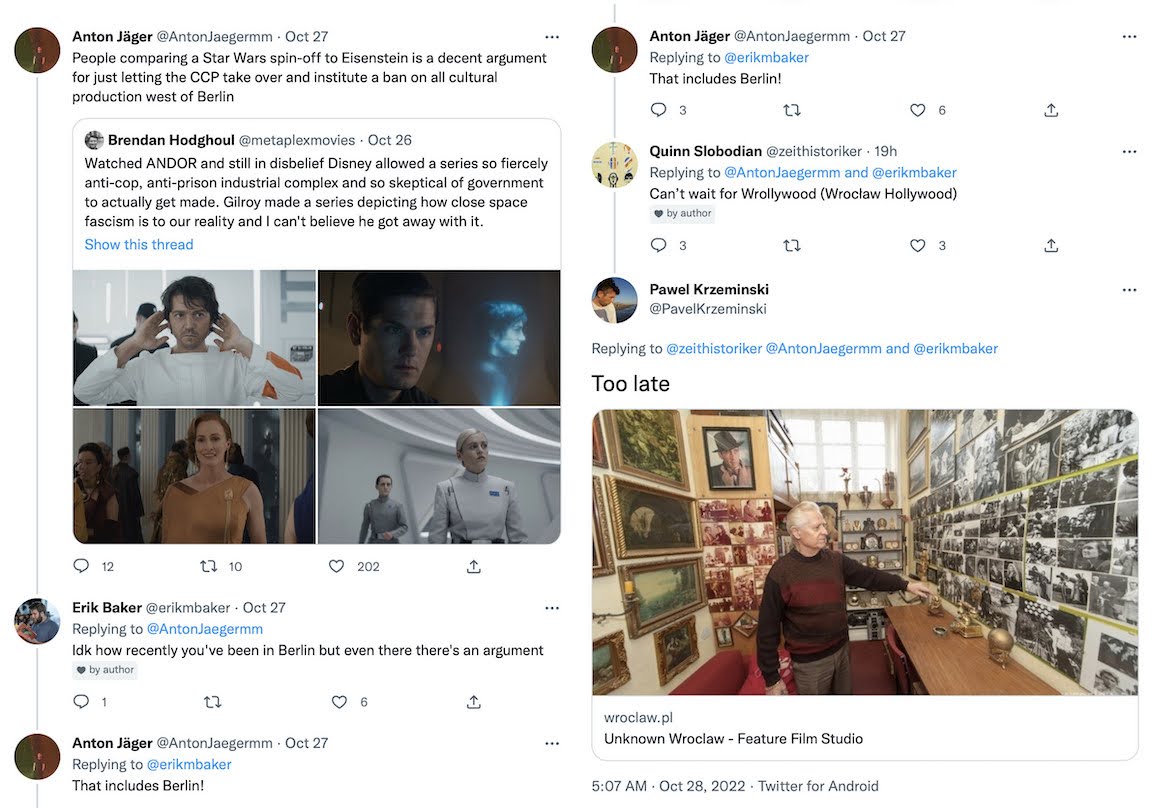
Milanovic defends "a thousand points of light". Jäger and the Slobodian are snobs—Jäger's admitted it— pretentious defenders of what their own seriousness. But Jäger's a proud fan of Fleetwood Mac and I think I may be responsible for Leusder shutting down his Soundcloud account—in embarrassment? And the idiot they're mocking is a fan of Mark Fisher. I don't know where the Eisenstein reference comes from. It's not in the thread, but all the thread is is bragging by citation and in-jokes, academic standard practice. "They then chuckle together in a self-congratulatory academic manner."  

It was common knowledge once that Lucas modeled the stormtroopers' helmets after the Teutonic Knights in Nevsky, and the emperor's cloak and the camera angles after the grand master.

Lucasfilm 
Johnston remembered that early on, Lucas showed him Sergei Eisenstein’s classic film, Alexander Nevsky, whose opening feature featured a battle on ice between medieval warriors. Lucas told him, “I want the battle on Hoth to feel like this. I don’t want it to look like this, but feel like this.” With relative freedom from Lucas, Johnston relished the opportunity to imagine and develop the battle visually.
None of this means the Star Wars film's don't suck. But the first one has the perfection of Casablanca,  

The tragedy of cultural homogenization begins at the top: the fish rots from the head. Jäger, Slobodian and the rest have convinced themselves that only the other elite, the elite they disdain, are decadent. 
Mozart didn’t have luxury to write atonal music most people don’t understand/find ugly. He had to appeal to aristocrats for patronage & middle class who bought seats. It’s when you separate artist from audience (eg give him tenured university chair) that things turn south.

Jäger replies 

And Adorno was right when he said that Schönberg’s dodecaphony presupposes industrial class conflict as a backdrop for the music even to make sense to any audience

The Nazis weren't wrong when they said the work they banned was decadent. But the work they banned  was honest, and the work they promoted was decadence based on dishonesty: idealism as sham, backed by the gun. 

Adorno and Jäger, following Schönberg, by rhetorical sleight of hand—and out of psychological necessity—turn honest decadence into ideal truth, as liberalism and liberal economics does with greed and self-interest . In both cases awareness evinces optimism: the unexamined prior.

Back again to Arendt and Brecht. I repeat myself because everyone else does.

At that time, nobody anticipated that the true victims of this irony would be the elite rather than the bourgeoisie. The avant-garde did not know they were running their heads not against walls but against open doors, that a unanimous success would belie their claim to being a revolutionary minority, and would prove that they were about to express a new mass spirit or the spirit of the time. Particularly significant in this respect was the reception given Brecht's Dreigroschenoper in pre-Hitler Germany. The play presented gangsters as respectable businessmen and respectable businessmen as gangsters. The irony was somewhat lost when respectable businessmen in the audience considered this a deep insight into the ways of the world and when the mob welcomed it as an artistic sanction of gangsterism. The theme song in the play, "Erst kommt das Fressen, dann kommt die Moral," was greeted with frantic applause by exactly everybody, though for different reasons. The mob applauded because it took the statement literally; the bourgeoisie applauded because it had been fooled by its own hypocrisy for so long that it had grown tired of the tension and found deep wisdom in the expression of the banality by which it lived; the elite applauded because the unveiling of hypocrisy was such superior and wonderful fun. The effect of the work was exactly the opposite of what Brecht had sought by it. The bourgeoisie could no longer be shocked; it welcomed the exposure of its hidden philosophy, whose popularity proved they had been right all along, so that the only political result of Brecht's "revolution" was to encourage everyone to discard the uncomfortable mask of hypocrisy and to accept openly the standards of the mob. 

Eisenstein, Film Form, p. 20, defending convention, and tradition. 

We have been visited by the Kabuki theater-a wonderful manifestation of theatrical culture.·

Every critical voice gushes praise for its splendid crafts­manship. But there has been no appraisal of what constitutes its wonder. Its "museum" elements, though indispensable in estimating its value, cannot alone afford a satisfactory esti­mate of this phenomenon, of this wonder. A "wonder" must promote cultural progress, feeding and stimulating the intellec­tual questions of our day. The Kabuki is dismissed in plati­tudes: "How musical!" "What handling of objects!" "What plasticity!" And we come to the conclusion that there is nothing to be learned, that (as one of our most respected critics has announced) there's nothing new here: Meyerhold has already plundered everything of use from the Japanese theater!

Behind the fulsome generalities, there are some real atti­ tudes revealed. Kabuki is conventional! How can such con­ ventions move Europeans! Its craftsmanship is merely the cold perfection of form! And the plays they perform are feudal!—What a nightmare!

More than any other obstacle, it is this conventionalism that prevents our thorough use of all that may be borrowed from the Kabuki.

But the conventionalism that we have learned "from books" proves in fact to be a conventionalism of extremely interesting relationships The conventionalism of Kabuki is by no means the stylized and premeditated mannerism that we know in our own theater, artificially grafted on outside the technical requirements of the premise. In Kabuki this conventionalism is profoundly logical-as in any Oriental theater, for example, in the Chinese theater.

Among the characters of the Chinese theater is "the spirit of the oyster"! Look at the make-up of the performer of this role, with its series of concentric touching circles spreading from the right and left of his nose, graphically reproducing the halves of an oyster shell, and it becomes apparent that this is quite "justified." This is neither more nor less a convention than are the epaulettes of a general. From their narrowly utilitarian origin, once warding off blows of the battle-axe from the shoulder, to their being furnished with hierarchic little stars, the epaulettes are indistinguishable in principle from the blue frog inscribed on the forehead of the actor who is playing the frog's "spirit." 

I've referred to this for 40 years but never quoted it here. Nevsky was my favorite film as a kid, but it doesn't hold up. I still have fun watching it.

Jäger
People comparing a Star Wars spin-off to Eisenstein is a decent argument for just letting the CCP take over and institute a ban on all cultural production west of Berlin

I can play this game

Saturday, October 08, 2022

A long now deleted comment at Zachary Carter's review of DeLong's book (mentioned previously)  We had a back and forth, and at the end of my last comment I said I was going to close my paid account because I didn't want to troll him. And then he deleted everything.

From your review in Dissent 

"For India, one price of expanded trade with the British Isles was the deliberate deindustrialization of the Indian economy. India ceased to manufacture its own textiles, and instead provided raw materials to Britain, which handled the factory work. Under the traditional free trade theory of comparative advantage, this process should have maximized the wealth of both countries."

The last sentence shouldn't have made it past the editor. There is no free trade between masters and subjects.  Everything Delong celebrates is founded of mountains of the dead among Europe's subject peoples. You could have at least mentioned the famines.

"DeLong’s story of hegemony as a driver of stability and growth is extremely compelling—but it’s also a nice way of saying that imperialism isn’t so bad when it works. The neoliberalization of the world that began in the late 1970s not only undermined U.S. fiscal policy management, it decimated America’s effectiveness as an international economic hegemon—a fact that is obscured by the expansion of American military operations over the same period."

Any historian of the of the violence of the post war era is left to shrug.

Korea. It's been called genocide. [the links are repeats]

The bombing was long, leisurely and merciless, even by the assessment of America’s own leaders. “Over a period of three years or so, we killed off — what — 20 percent of the population,” Air Force Gen. Curtis LeMay, head of the Strategic Air Command during the Korean War, told the Office of Air Force History in 1984. Dean Rusk, a supporter of the war and later secretary of state, said the United States bombed “everything that moved in North Korea, every brick standing on top of another.” After running low on urban targets, U.S. bombers destroyed hydroelectric and irrigation dams in the later stages of the war, flooding farmland and destroying crops.

Cambodia 

The still-incomplete database (it has several “dark” periods) reveals that from October 4, 1965, to August 15, 1973, the United States dropped far more ordnance on Cambodia than was previously believed: 2,756,941 tons’ worth, dropped in 230,516 sorties on 113,716 sites. Just over 10 percent of this bombing was indiscriminate, with 3,580 of the sites listed as having “unknown” targets and another 8,238 sites having no target listed at all. The database also shows that the bombing began four years earlier than is widely believed — not under Nixon, but under Lyndon Johnson.

The impact of this bombing, the subject of much debate for the past three decades, is now clearer than ever. Civilian casualties in Cambodia drove an enraged populace into the arms of an insurgency that had enjoyed relatively little support until the bombing began, setting in motion the expansion of the Vietnam War deeper into Cambodia, a coup d’état in 1970, the rapid rise of the Khmer Rouge, and ultimately the Cambodian genocide.

...To put the revised total of 2,756,941 tons into perspective, the Allies dropped just over 2 million tons of bombs during all of World War II, including the bombs that struck Hiroshima and Nagasaki: 15,000 and 20,000 tons, respectively. Cambodia may well be the most heavily bombed country in history. 

Tooze in the FT is at least somewhat better

DeLong’s version of the 20th century is more parochial than either of those. [books by Hobsbawm and Milanovic] It is centred on the political battles that raged around the growth regime of modern American capitalism and continue to shape policy debate in governments and central banks today. This is, you might say, the in-house, post-Clintonian history of the 20th century....

Slouching Towards Utopia reads less like a history than a richly decked out time capsule, a nostalgic throwback... 

The so called serious American intellectual left—the class that used to scorn the NYT-has become more provincial than it was 40 years ago.  DeLong is an arch nationalist "A rising not a setting sun" was his tagline. He was famous for his attacks on the left, his fondness for Gregory Clark's racial Darwinism, and encomiums for war criminals  

"R.I.P. Jeane J. Kirkpatrick

...She was a good friend to my grandfather Earl. She was an American and a world patriot: her counsel--even at its most boneheaded--was always devoted to advancing the security of the United States and the cause of liberty and prosperity around the world."

Jeane Kirkpatrick was not interested in liberty and prosperity around the world. She defended American power.

He replied. Substack forwards comments. I have the email.

You have based this comment on a 180 degree misunderstanding of that line. The entire point is that the traditional theory is wrong. 

He's referring to the line about comparative advantage, as if I were defending it.

I replied saying that most people still assume it's a bad idea to keep all your eggs in one basket, and that systems engineers—of mechanical systems not intellectual ones (the existence of "financial engineers" builds on the same fantasy)—know that efficiency and stability operate in inverse proportion, and that redundancy is key to long term survival, but that even if the logic of comparative advantage made sense it was irrelevant here, because there is no free trade between masters and subjects.

His reply, again from the email

If you'd prefer to say "specialization" rather than "free trade," fine. And you're right, I could have mentioned the famines. There were a lot of them with different causes, and I decided to stick to a simple critique of de-industrialization for brevity's sake, assuming that my audience was familiar with the general outline of British imperial history.

At this point I lost it. Again this is approximate.

I don't know what to say about discussions of the inequality that results from you breaking into my home, killing my father, raping my mother, taking everything we own and putting me and my siblings to work in your factory.  The history of European modernity is founded on European barbarism, mostly but not entirely elsewhere. The inequality that exists now is merely the result. And here we are today.

I added the transcript of Javier Blas, with Joe Weisenthal

Well, clearly the ability of Europe to tap the LNG market has really saved the day for Europe. If this had happened only 10, 15 years ago where the global LNG market was not nearly as developed as it is today. And the ability to reroute cargos was much lower, particularly on the spot market Europe would have had a big problem. And the dependency on Russia was much, much higher.

So the LNG market is offering a relief to Europe in so many ways. One of the things that we are seeing that to me is very interesting is Europe at the moment is outbidding everyone else on the market, taking the LNG. That's one of the reasons we have these very high prices in the market. I mean, on fundamentals as Alex was pointing out, we should not probably have 200 euros per megahour of gas because the inventories are building in the right direction and we should have enough gas if Putin was to keep the flows. But obviously we need to continue outbidding the whole market for LNG supplies.

And for that, we need to sustain very high prices in Europe for that to happen. What's happening there is that a number of countries that were starting to rely on the global LNG market for supplies, middle income and poor countries thinking the likes of Pakistan or Bangladesh, or even India... they're seen now that European nations and European utilities can pay much higher prices.

So they're not getting the cargos that they were expecting. Some of the cargos that would be going into Asia at the moment are rerouted into Europe. And we are seeing power supply problems in Bangladesh or Pakistan, which is affecting the textile industry. So in a way it may be a case where Europe avoids the blackouts that many of us have been talking, but only because the blackouts move somewhere else, where they cannot

really pay the price that Europe is paying for the LNG. And then the blackouts are happening in Pakistan or Bangladesh. And that global LNG market is allowing that arbitrage to happen. Without it, well, it will not be happening. And the blackouts would be happening in Europe because we will not be able to get enough gas

I added another comment that I didn't want to hang out just to troll him so I'd close my account in a day or two. I guess the snark was a bit much. 

Saturday, September 10, 2022

Milanovic 

What had we learned in economics this year?
Foreign govt reserves can be seized
Foreign private assets can be frozen
Price controls can be imposed.
Now, go back to Econ 101
Watching Europeans govt's argue in favor of price controls while their own representatives have spent half-a-century voting for IMF programs that would abolish price controls anywhere else is...well, a spectacle.

 The first two read as simple and sharp irony. but then he blows it.

Some of the comments I got on my tweet pointing out a glaring inconsistency between supporting price control in own country A, while being against them, and making sure they are abolished, in countries B to Z, reminded me of a possibly worst intellectual experience I had.

I was invited to join a list that seemed to have been composed liberal Dems. In those days I thought such people are some kind of US social-democrats. It turned out they were far from it. But the really bad part of the experience was their pervasive "mauvaise foi".

I have never encountered, even among the most dogmatic Stalinists, such hypocrisy and lying which for them, having practiced it so much, has become a way of life. They were also smart. So every argument that was going against their PoV was twisted, distorted, repackaged,

intentionally misinterpreted with the sole objective that every mistake, every hypocrisy, every lie would be covered up. I quickly realized that they were utterly uninterested in truth.

Their twisting of truth had in addition a certain malignant or perverse character. One could feel they were very happy to have shown themselves clever enough to demonstrate that the obvious truth really was not true.

He's describing the experience of structural outsiders in every system. The politics of truth is always a fantasy of uncorrupted power.  That's why his "paleo-left agenda" is so conflicted.

Friday, June 03, 2022

Branko discovers the night.

update because I'm afraid I have to explain every fucking reference.

The author’s (Lakicevic) path to graduate education was somewhat less flamboyant, but it is his story that I find most interesting. Both Djindjic and Lakicevic were almost totally penniless, living on irregular and minute stipends, and surviving by doing odd jobs (from construction to night clubs and smuggling), mixing up with Yugoslav and Turkish gastarbeiters, and being treated by them or accidental women they seduced to dinners and drinks.   

It is the contrast between the day life composed of philosophy lectures at a prestigious and orderly university, where professors appear exactly on time, give appointments one month in advance, deliver lectures on social contract, alienation, ontology, epistemology….where libraries are immense and quiet, books arrive quickly, carried by the silent helpers, and the world of the night–when our heroes return to their lair—that is striking.

...When the night is over, Lakicevic goes back to the world of learning where the discussion is about the best ways to organize a community, citizens’ rights and duties, working class and bourgeoisie, l’etre et le néant. But the world of the day and the world of the night have nothing in common. It is not solely that the people of the day and the people of the night have different interests and backgrounds. The two cannot be said, in any meaningful way, to belong to the same community. They are two worlds.

Naipaul saw the same duality between the whites and  the enslaved and miserable African populations. In a beautiful passage he writes:  

“There was the world of the day; that was the white world. There was the world of the night; that was the African world, of spirits and magic and the true gods. And in that world, ragged men, humiliated by day, were transformed--in their own eyes, and in the eyes of their fellows--into kings, sorcerers, herbalists, men in touch with the true forces of the earth and possessed of complete power... "

The quote continues but that's enough. As to whether he ignores Naipaul's racism or just doesn't get it, my bet is it's the latter.  

"But the world of the day and the world of the night have nothing in common." They have nothing in common in the world of philosophical liberalism, or in the earnest Catholicism of Reed and Geuss,  but in the world of history, facts and events, in the world of politics—real politics—they're as inseparable as youth and sex. "Not the idea of sex, or the meaning of sex, but sex!" 
The life of the world or the life of the library.

"mixing up with Yugoslav and Turkish gastarbeiters, and being treated by them or accidental women they seduced to dinners and drinks." A classic tale of student bohemia. The tale of Djindjic climbing through the window and scaring the famous professor fits almost too perfectly.

Serendipity again. Compare that scene to this one.

Sunday, April 17, 2022

"Cheap Speech" again. Rick Hasen is an idiot.

As the 2020 election season came to its dramatic end, and as Trump refused to concede, Facebook temporarily tweaked its algorithm—the set of rules Facebook’s computers use to determine the content that users receive. [p. 8]

There is no doubt that the rise of the Internet and social media has had many free speech benefits. We worry much less about media consolidation and scarcity of information than we did when there were just three main broadcast television networks and a handful of local newspapers in each area. Today, readers and viewers receive information from vastly more, and more diverse, sources. [p. 31]

The advertising money that once supported newspapers is now flowing to digital media platforms, mostly Facebook and Google. [p.32] 

There are many problems with Thomas’s analysis. To begin with, as Eric Goldman has pointed out, the platforms are not neutral carriers such as telephone companies. They curate content all the time, as when they remove hate speech or pornography or when they promote certain content over others. And the platforms are hardly natural monopolies—Twitter and Facebook compete with one another or others—the usual defense of common carrier regulation. [p. 125]

There's plenty more. 
The first quote in context is even more damning.
As the 2020 election season came to its dramatic end, and as Trump refused to concede, Facebook temporarily tweaked its algorithm—the set of rules Facebook’s computers use to determine the content that users receive. Rather than show users just the stuff they wanted to see as driven by their data profile and what they had already clicked on—potentially including unreliable content from right-wing Breitbart or left-wing Occupy Democrats—the company favored more reputable sources such as CNN, the New York Times, and NPR. But this “calmer, less divisive Facebook,” as the New York Times called it, was short-lived, temporarily employing an algorithm designed only for the “break [the] glass” moment when Trump and others fundamentally challenged the election’s integrity on social media. Facebook soon restored its original algorithm, feeding up falsehoods and bile.”

If they determine the content, "platforms" are publishers. If they control the advertising market, they're monopolies. Eliminate the algorithms. Preserve freedom of speech. Preserve freedom of inquiry. I've said it all before.

I grew up reading The NY Times. When I looked at the paper I saw the decisions of the editors, made for and in the name of a subset of the American public. It was the "paper of record". All the News That's Fit to Print, is a statement of authority. When I go to the library and look through a catalogue I see the record of the decisions of a wider subset and a wider authority. It would bother me if the library catalogue were ordered 'just for me', a subset of one. That's now the model of news and information for the majority, and it's seen as normal. And the liberal technocratic response to the new yellow press is to see it as more confirmation of their own status. 

The powerful need to feel morally superior, to defend against the crude, the vulgar, the bitter, inarticulate and poor, all "outsiders" and wrong by definition.
---

Just for fun, and the timing was right. Milanovic on misinformation and the falsification of history in the "reputable sources" of the MSM

Because many people never got to the second tweet, I have to repeat my point. Here is an example, among many, how an *entirely* false narrative, propagated by MSMs, has taken hold in the West re. the 1990s in Russia. 
The author I quote below never seem to have consulted

any data: on GDP decline >> the US depression, on deaths of despair, on the largest decline in life expectancy in peacetime ever, on huge inequality, on homicides and suicides, on wage arrears up to a year for many workers, on stealing of govt pensions by private sector banking,

on skyrocketing poverty, on the bombing of MPs who impeached Yeltsin, on oligarch-inspired street battles, on the destruction of entire economic sectors. This just dd not exist.

[Link: A New Era of Containment?]