Showing posts with label Godard. Show all posts

Thursday, February 20, 2025

“No one does ‘existential dread’ as well as Philip Glass”

If there's one filmmaker I hate, to the point of wanting to beat him to a pulp, it's Errol Morris 

TR: What other documentary filmmakers do you admire?

EM: Certainly Fred Wiseman. We both live in Cambridge too, and he’s a friend of mine. I find this kind of universe he’s created, the Fred Wiseman universe, the Fred Wiseman cosmology, to be endlessly fascinating. I often am perplexed at how he is perceived as a kind of sociologist, as if he is going from one institution to another and chronicling it much as a sociologist might study organisations by examining each of them in turn. But I think his enterprise is very, very different from that, and that Fred has created a whole sort of deeply expressionistic, surreal films. Very much Samuel Becket-like in their essence. If you like, various theatres of the absurd. And he also strikes me as one of the most truly perverse filmmakers, maybe the most perverse filmmaker of all time.

TR: In what sense?

EM: Because he has created one nightmare after another. Man at his most dysfunctional. And insane.

TR: But surely he would say that he simply sits back and watches?

EM: Well, yes, he does. But the end result of his watching is something that is so much about Fred and about how Fred sees the world, which is a wonderful thing, not a bad thing. It seems like the enterprise and the essence of art. Fred has actually managed to create a kind of personal universe on film that I find compelling. I call him the king of misanthropic cinema.

TR: And his response is?

EM: I think he takes it, as well he should, as a compliment.

I followed the Morris/Kuhn fracas, probably through Leiter. I thought I must have written something here, but I didn't. I've mentioned him and my dislike twice. 

I hated The Thin Blue Line. I saw it when it came out, and I knew what it was. I already knew what Philip Glass had become. I probably saw it Chicago, when I was living with Graeber again, and sitting in with Babette Mangolte. I'd published my piece the year before, and I was already working on the megillah.

If the point is to get an innocent man out of prison, then everything else is irrelevant. If the point is the creation of "art", then the life of the man in front of the camera is secondary. Morris reduces art to illustration, but then indulges aestheticized artiness He believes in "truth", so art is emptiness. Then why even bother? It's the definition of scholastic decadence, Mannerism without irony.  He calls Wiseman "the king of misanthropic cinema" because Wiseman says his films are "fictional".  Morris, the condescending hypocrite and pedant, accuses Wiseman of nihilism. 

As has been said many times over the past year, every accusation is a confession.
---

I found of video of Wiseman on a French TV, chatting in French. I've never seen him so comfortable in an interview. He's always been a sort of honest conservative classicist.

Godard on Leacock.
"There's no point in having sharp images if you've got fuzzy ideas. Leacock's lack of subjectivity leads him ultimately to a lack of objectivity. He doesn't even know he's a metteur-en-scene, that pure reportage doesn't exist."

Saturday, August 05, 2023

I don't know if it was Altman who told it but I remember a story about a Hollywood director from the classic years who said if you need the script to tell the story you're in trouble. Even after the talkies film is visual. That's the origin of this scene. Television changed things. I'd have no problem making a film from an AI script.  Godard would have had a problem but he'd try. You can get rid of actors too, but not cinematographers or editors.

Branko, back his old stupidity, asks if the novel was born and died with the end of bourgeois society. 
So I get to defend bourgeois capitalism against oligopoly: 

It might be good if large scale productions are reduced entirely to garbage. A24 and other independents aren't part of the AMPTP. 
                   
- Great. Let's start.
- Larry was in the middle of something.
No, I wasn't. I was just killing time
waiting for Griffin.
No, finish.
What were you saying?
I was saying I've yet to meet a writer
who could change water into wine...
...and we have a tendency
to treat them like that.
Not at this studio.
A million and a half of these scripts.
It's nuts.
And I think avoidable.
Let me ask you. When was the last time
you bought a ticket to see a movie?
- You actually paid your own money?
- Last night.
Pasadena. The Bicycle Thief.
- You saw The Bicycle Thief?
- I love that. It's a great film.
It's an art movie. It doesn't count.
We're talking about movie movies.
Jesus, people.
I'm just saying there's time
and money to be saved...
...if we came up with these stories
on our own.
- Where are these stories coming from?
- Anywhere. It doesn't matter.
The newspaper.
Pick any story.
'Immigrants protest budget cuts
in literacy program. '
Human spirit overcoming human adversity.
Sounds like Horatio Alger in the barrio.
Put Jimmy Smits in it and you've got
a sexy Stand and Deliver.
- Next. Come on.
- This isn't my field.
It doesn't matter. Give it a shot. You can't lose here.
How about 'Mud slide kills 60
in slums of Chile'?
That's good. Triumph over tragedy.
Sounds like a John Boorman picture.
Slap a happy ending on it,
the script will write itself.
- Bonnie. Give me the paper.
- I don't know, Larry.
Give it a shot.
'Further bond losses
push Dow down 7.15.'
- I see Connery as Bond.
- That's funny.
It's a good thing Oliver Stone wasn't
listening to you. Where would we be?
We would have been spared
sitting through Wall Street.
- What did Wall Street do worldwide?
- 70, 75, maybe 80.
$80 million,
a couple Oscars.
I think Larry's point is well taken.
Let's move on.
Can you give us an update
on the Taylor Hackford project?
Griffin?
Yeah.
I was thinking what
an interesting concept it is
to eliminate the writer
from the artistic process.
If we can get rid of the actors and
directors, maybe we've got something.
Hello, Walter.
Make yourself at home.

Altman, in 2001

Q: You said once that there had never been a truly great film because film relies so heavily on literature and theatre. Have you seen one since?

RA: No. I think they’re getting worse! I had been quoted as saying a really good film had not been made yet, and I think the possibilities of film have not really been explored yet. Maybe there is somebody lying in a crib somewhere that will end up doing it. We still connect it too much to theatre and literature and not enough to just the image. Music has become background for it rather than something that is indigenous to the material. we give awards for the best film and awards for the best soundtrack and one doesn’t necessarily have anything to do with the other. It’s a strange, bastardised type of artform and it draws on all this. It draws on theatre, the visual, performance art, literature. You can’t say, ‘This is the best film.’ This is a different film. As varied as people are.

I think the reference is to an earlier interview with Dick Cavett I discussed here

And it all connects to something I've repeated a lot recently.
That link starts a chain that begins in 2004. 

The most fascinating point of all applies more broadly than to Godard; it reaches out to anyone who believes that film is more important than the world. Maybe film is not the great new language of engagement with the world that Bazin hoped it would be. Perhaps it is, instead, a vehicle more suited to dreaming, sensationalism and not wanting to grow up.

And this connects again to something I haven't repeated: a short chain, two hops, to Hans Hotter, and "beloved but flawed art". I could add  "Im Abendrot" again, but that would be too much. 

Why not: Scroll down for Strauss and Riefenstahl

Sunday, July 02, 2023

Role Play indeed.

Dylan Riley, Director, Interdisciplinary Studies Field, dept. of Sociology, UC Berkeley, 
in NLR, "Decapitalizing Culture", (filed under society) 
There are countless debates among sociologists and economists concerning the terms ‘human capital’ and ‘cultural capital’. The general view is that the former implies a rational instrumental attitude to the attainment of skills, whereas the latter suggests an investment in what Bourdieusians call illusio: the denial that the game of culture is in fact a game. Iván Szelényi once characterized the distinction slightly differently, writing that human capital denoted skills that are rewarded because of their contribution to productivity, while cultural capital was fundamentally a claim to rent. It seems to me, however, that we ought to be raising a different set of questions. In particular, it is important to ask: under what historical conditions does culture take the form of an ‘asset’ or ‘quasi-asset’? 

John-Baptiste Oduor, editor at Hamasmag, in NLR, "Role Play", (filed under culture)

Untitled (Woman Standing Alone) from Kitchen Table Series, 1990, © Carrie Mae Weems. Courtesy of the artist, Jack Shainman Gallery, New York / Galerie Barbara Thumm, Berlin.

Oduor previously, on Charles Mills, and Lynette Yiadom-Boakye. Weems belongs with Hammons.

repeat. It's absurd how much is lost when the goal of disinterest devolves into a fiction of objectivity.

Stanley Hoffman reviews Distinction 

But if “using rare words and tropes in place of common words and phrases” is a strategy of “deliberate transgression” of the norms of clear prose characteristic of the dominant classes and is opposed to “the hyper-correction strategies of pretentious outsiders,” then Bourdieu is a master strategist. Words such as lexis, allodoxia, chiastic, askesis, espace hodologique, hysteresis, and of course habitus (and, indeed, hysteresis of habitus) are scattered throughout the text. That a work of social science should—”unlike the sometimes illuminating intuitions of the essay”—require an effort on the part of the reader is fair enough. Here, however, reality disappears into the hypertrophied rhetoric of the Ecole Normale.

Simply as a critic, never mind the pretension to politics, Oduor doesn't know enough. A first person essay about why he likes the work, what it means to him as a writer, would be the only honest choice, but he'd never make it.

"There's no point in having sharp images if you've got fuzzy ideas. Leacock's lack of subjectivity leads him ultimately to a lack of objectivity. He doesn't even know he's a metteur-en-scene, that pure reportage doesn't exist."

“Documentaries are thought to have the same relation to social change as penicillin to syphilis.”
Jeff Wall: [Referring to Delacroix] Violence is only a theme in this kind of art; the art itself isn’t violent. That makes it very different from, even opposed to, the art of the avant-garde, which expresses aggression against the idea of art itself. This aggression is no longer viable. I don’t think its necessary or possible to go beyond the idea of bourgeois art -that is of autonomous art- towards a fusion of art and its context. Or if its possible it isn’t very desirable. We have learned how the aggression against autonomous art was consistent with aspects of totalitarianism, from the Stalinist period for example, and how state violence could benefit from that kind of aesthetic. The concept of art as autonomous, and therefore less amenable to that kind of instrumentalization, is a central concern of the modern, and I’m most sympathetic to that. 

A-MB/RM: Modernity and avant-garde, to you, are two separate things? 

JW: We can’t confuse them anymore. 

"A Democratic, a Bourgeois Tradition of Art: a Conversation with Jeff Wall" 
Jeff Wall: Selected Essays and Interviews 

Chevrier, cited by Odour, is in the same volume. I have a lot of respect for Wall, and I've watched him work a room. See previously on Hammons. Fine art is conservative, or it's reactionary. And Fried is a fucking idiot. Always a moralist, I should have guessed that when when he adapted to change he'd become a fan of Greuze.

Wednesday, May 17, 2023

update at the top. It just gets worse.

Jäger: "Oh buddy"

Fukuyama: “the invasion of Ukraine was such a shock bc in our lifetimes we’ve never witnessed one country militarily invading another.” 

Chris Hayes: “Well, Iraq.”

Fukuyama: “Yeah but…well, ok” 

Jäger: "We should just cryogenically preserve the Fukuyama of 1991 and not listen to the other versions." 

Fukuyama hasn't changed. And they're not talking about the Iran Iraq war. The Israeli invasion of Lebanon doesn't' count. A lot of invasions don't count. Wikipedia has a list.

---

Jäger rt's a pic of a text of Alexander Kluge, with images by Richter. The passage fits every argument I've ever made about the Gothic anti-humanist logic of modernism. It's almost too perfect.

A transcription of texts (just as if evolution had been tinkering with their DNA texts) doesn't only create lines to new, future texts. It can also be reconstructed in the direction of paradise. The way there leads through indeterminacies. (Nearer, my God, to Thee’ was the music played by the orchestra on board the Titanic as the ship went down. But  it is also the working instructions to copyists of all countries, who are driven from the omphalos of experience into the parallel world (heterotopia), the pre-world (history) and the future world (the world of our children, who are so attached to life). For copyists, all images are NOW—TIME.

The medieval world of monastic copyists, of the memorization as opposed to interpretation of the Koran, the Talmud, the Bible, or any religious text. Allegiance to dogma: the innocence of the eternal present.

And he rt's this

In order to give to divine Spirit the fullness of being, it is necessary to situate divine Spirit within the World, to conceive of it as the “entelechy” of the World. Now, to conceive of it [215] in this way is to conceive of it as worldly, that is to say, human Spirit, and no longer as God. In short, Man who seeks to understand himself fully and completely as Spirit, can be satisfied only by an atheistic anthropology. And this is why the Schicksal, the Destiny of every Theology, of every Religion, is, in the final analysis, atheism.
And this documents how fascism and other forms of ideologically committed authoritarianism in the 20th century could be "a-theistic". It's all interesting as a matter for history and sociology, but with these idiots we're back to Fukuyama, and the moral imperatives of faith, in ideas, in the word, in a metaphysical reality.

Before that he rt'd Loren Balhorn's sad emoji for the last playlist of Ryuichi Sakamoto, avatar of ironic kitsch pop. Sakamoto was wishfully pretentious, but he had a light sad sense of irony and an awareness his own limitations. And he didn't pretend to be a leftist. Jäger can be good with facts; he says he prefers ideas, but his real preference is fantasy. All of them indulge the waking dreams of people who've watched too many movies 
There's an attitude in Godard, despite the assertions of wanting to converse, that says, Don't argue or cross me about such things. And this book does not alter the notion of his brilliant immaturity. The most fascinating point of all applies more broadly than to Godard; it reaches out to anyone who believes that film is more important than the world. Maybe film is not the great new language of engagement with the world that Bazin hoped it would be. Perhaps it is, instead, a vehicle more suited to dreaming, sensationalism and not wanting to grow up. Perhaps language--the construct of words--was always subtler, deeper and more humane.

All art relates to dreams; film is the nearest art to dreaming itself. It's the nearest thing to a drug: that's its weakness. No other art makes it so easy to deny the fact of artifice, but every great film, one way or another puts artifice out front. The corollary is that bad films try to replace reality. "Trash cinema" is credited with giving the lie to smooth commercialism but wouldn't exist without it. It's dependent. Negative dialectics is the sincerest form of flattery.

Tuesday, December 20, 2022

At some point I began to assume humanprovince was a woman but recently he's referred to a wife. No guarantees but I'll switch. It's not the point anyway. This was a good one 

I have always really appreciated that France gets heavy hitters to do their x for dummies books. 

"Bourdieu argued that racism was the core structure of the colonial polity, and that colonial regimes transformed even nonracist Frenchmen into racists. The colonial system "creates the ‘contemptible’ person at the same time as it creates his  contemptuous attitude” (1958, 1962)"

I day later Steinmetz is rt'd by Jäger, the earnest European intellectual anti-colonialist, with exceptions.

Jäger then rips John Ganz a new asshole for his criticism of Jäger's article about Putnam.                           

"Simply doing a copypasta from an undergrad reading list is not a refutation of an argument."

The article itself is stupid, and Jäger is blind. He's in another league in sophistication and academic decadence, above Ganz, but they're both self-important soi-disant leftist intellectuals, debating the leftist response to Trumpism while (1) having nothing to say about Zionism ["Because it is something colonial" (Herzl to Cecil Rhodes) ], and (2) petty bourgeois reformers are the ones doing all the work and winning. Maybe the intellectuals should just shut up. 

Fetterman and Warnock don't pretend to be leftists and are pathetic on Israel, but most Palestinians are petty bourgeois realists, and I follow their lead.
---

I opened my copy of Goffman's Presentation of Self... again, to a random page and read a few paragraphs.  The same response every time: Don't we know this already, living around other human beings? The first time I read him I thought of Godard. 
"There's no point in having sharp images if you've got fuzzy ideas. Leacock's lack of subjectivity leads him ultimately to a lack of objectivity. He doesn't even know he's a metteur-en-scene, that pure reportage doesn't exist."
It could've been Wiseman, who consistently underplays the politics that Godard overplayed, for a while. It could have been Panofsky, or Auerbach. 

And years later I read Jay Rosen on journalism. This country is so backwards. 

I had a conversation with a historian of science specializing in 19th c. Germany, and Goffman came up. "Isn't what every old Rabbi is supposed to know?" He agreed, or at least didn't argue.

By pure coincidence, today. Wolf Liebeschuetz, East and West in Late Antiquity. 
From the author's introduction, also an elegy. 
I have been interested in history as long as I can remember, inspired by my mother. She was a doctor and research physiologist,1 but she had to leave her research institute at the Hamburg University Hospital at Eppendorf on get- ting married, and was stopped from exercising her venia legendi at Hamburg University by the National Socialist government. She therefore had plenty of time to devote to her three children, and particularly to myself, the eldest. She told fairy tales, and drew pictures to illustrate them. One of her favourites was Heinrich Hoffmann’s König Nussknacker und der arme Reinhold (Nutcracker king and poor Reinhold). She had an extraordinary visual memory, which enabled her to reproduce that book, text and illustration, from memory for her eldest granddaughter nearly thirty years later. Mother regularly told us stories from the Bible: the creation, Joseph and his brothers, Moses and the exodus from Egypt, Saul and David and Jonathan, selected incidents from the Books of Kings, and the heroic story of the Maccabees. In an account of our life under the Nazis that mother wrote she records that she had learnt from her parents that a fighting spirit is the only antidote against the low self-esteem experienced by outsiders, such as the Jews, and that this is what she was nursing in her chil- dren. She also related the stories of the Trojan War as well as much more recent history, notably of the “victorious war” of 1870−71 and “the lost war” of 1914−18, in accordance with our patriotic perspective of those days. I seem to remem- ber that Hindenburg, then president of Germany and in some ways the man who let Hitler in, figured quite prominently. Mother also read from a series of books by Elisabeth Averdiek about a Hamburg family in the first half of the nineteenth century. I particularly remember an account of the great fire that destroyed much of the old city in 1842. I also heard quite a lot about Napoleon and his campaigns from the memoirs of Louis de Ségur, Napoleon’s aide-de- camp. Later, mother read us a lot of plays, mainly historical ones: Goethe’s Götz von Berlichingen (as well as the autobiography of that knight with an iron hand); Schiller’s Wilhelm Tell, his Wallenstein plays, and Jungfrau von Orleans; and then Shakespeare, first in German translation and later in English, starting with Julius Caesar and Coriolanus and going on to Henry IV Part I and Macbeth. So history played a prominent role in my early life.

I have not yet mentioned my father, Hans Liebeschütz, who was a historian. He had received the classical education then provided by German gymnasia at the Gelehrtenschule des Johanneums in Hamburg. When he left school he wanted to become a rabbi and had spent 1913 as a student in Berlin at the Lehranstalt der Wissenschaft des Judentums, a seminar for training Liberal rabbis. He was at the same time registered as a student at Berlin University, where he heard, among others, Ulrich von Wilamowitz and Eduard Meyer. The impression lasted for the rest of his life. When he resumed his studies after war service in France he specialised in Medieval History. But he kept a particular interest in the language and literature, and especially the history, of the Greeks and Romans. Homer and Plato (especially The Republic) were his favorite Greek authors. Of Roman authors, he preferred Lucretius to Virgil. In the late 1920s and up to 1933 he taught a combination of German, Latin, History, and Religion (Kulturkunde) at the Lichtwarkschule, an experimental progressive school run by the city authorities. At the same time he obtained the venia legendi to teach Medieval Latin and Medieval Literature at Hamburg University. Of course he lost both jobs when Hitler came to power. After a short interval he began to teach at the Lehranstalt der Wissenschaft des Judentums in Berlin, where he had attended courses before the war. So in term time he was away from home during the week. But he had many books, which I was free to look at and read. It might be worth mentioning that thirty or so years later my children did not read my books. Fathers are not what they used to be! Their power (potestas) may be much the same, but their influence (auctoritas) has been much reduced. My father’s books included Carl Oppel’s Das alte Wunderland der Pyramiden (4th ed., 1881) (Wonderland of the Pyramids), a book that he had read as a boy, and that I found fascinating as soon as I was able to read it. Another book I read quite early was James Breasted’s Geschichte Egyptens (History of Egypt), a German translation of a book originally written in English, and published in 1936. The library also included Georg Dehio’s Geschichte der Deutschen Kunst (History of German Art). I was fascinated by the architectural illustrations. The volumes are at Nottingham now, and they still show evidence of serious childish misuse As long as I can remember I have been interested in looking at historical buildings, and was sorry even then that Hamburg had so few of them, and that apart from the destruction caused by the great fire of 1842, the citizens of Hamburg had been quite ruthless with their architectural heritage. Since then, of course, the war has destroyed almost all that was left, except for two beautifully restored Gothic churches.

Saturday, November 26, 2022

Scorsese on Godard, 
When you’re watching an actor in a fiction, to what degree are you watching a character and to what degree are you watching a human being in action? What exactly is a story on film—is a shot or a sequence of shots equivalent to paragraphs in a novel, is it instants of ongoing reality recorded by the camera, or is it both at once? Only someone who loved the cinema as much as Godard and who knew it as well as he did could have asked these questions and approached them with such a mixture of rigor and freedom. 

All art is documentary: the record of an event. And all documentary is fiction.

This made me laugh. 

My favorite of Godard’s films is Contempt. It’s a genuinely tragic experience, a film about real betrayal: the betrayal of a wife by her husband, the betrayal of cinema (personified by Fritz Lang as himself—his spirit also haunts Jacques Rivette’s Paris Belongs to Us) by Jack Palance’s producer, the betrayal of Homer, of myth, of antiquity. The final moment, when the camera pans away from the film being made to the calm ocean in the distance over calls for silence, never fails to move me deeply. It’s an elegy for cinema, for love, for honor, for western civilization itself.

The top bit was quoted elsewhere by someone who wouldn't pay attention to the second.  Art is conservative or its reactionary. Bourgeois vulgarianism and aristocratic sadness. Get the joke now?

Sunday, October 30, 2022

updated
---

I put this passage in a post just below, but it reminded me of something I've avoided.

Eisenstein, Film Form, p. 20, defending convention, and tradition. 

We have been visited [1928] by the Kabuki theater-a wonderful manifestation of theatrical culture.

Every critical voice gushes praise for its splendid crafts­manship. But there has been no appraisal of what constitutes its wonder. Its "museum" elements, though indispensable in estimating its value, cannot alone afford a satisfactory esti­mate of this phenomenon, of this wonder. A "wonder" must promote cultural progress, feeding and stimulating the intellec­tual questions of our day. The Kabuki is dismissed in plati­tudes: "How musical!" "What handling of objects!" "What plasticity!" And we come to the conclusion that there is nothing to be learned, that (as one of our most respected critics has announced) there's nothing new here: Meyerhold has already plundered everything of use from the Japanese theater!

Behind the fulsome generalities, there are some real atti­tudes revealed. Kabuki is conventional! How can such con­ ventions move Europeans! Its craftsmanship is merely the cold perfection of form! And the plays they perform are feudal!—What a nightmare!

More than any other obstacle, it is this conventionalism that prevents our thorough use of all that may be borrowed from the Kabuki.

But the conventionalism that we have learned "from books" proves in fact to be a conventionalism of extremely interesting relationships The conventionalism of Kabuki is by no means the stylized and premeditated mannerism that we know in our own theater, artificially grafted on outside the technical requirements of the premise. In Kabuki this conventionalism is profoundly logical-as in any Oriental theater, for example, in the Chinese theater.

Among the characters of the Chinese theater is "the spirit of the oyster"! Look at the make-up of the performer of this role, with its series of concentric touching circles spreading from the right and left of his nose, graphically reproducing the halves of an oyster shell, and it becomes apparent that this is quite "justified." This is neither more nor less a convention than are the epaulettes of a general. From their narrowly utilitarian origin, once warding off blows of the battle-axe from the shoulder, to their being furnished with hierarchic little stars, the epaulettes are indistinguishable in principle from the blue frog inscribed on the forehead of the actor who is playing the frog's "spirit." 

I've linked to this a few times since I read it, because most of it is about Zizek playing the fool, and being one, in Ramallah. But a passage stuck with me that as I said above, I've avoided. Think about the relationship of form to meaning—not "content"

Darwish directed a series of Palestine Liberation Organization (PLO)-funded films from the early 1970s. He was a pioneer—his shorts that dealt with the armed struggle, first in Jordan, then in Lebanon, were critical documents for any student of the period. More than that, each film text experimented with a particular element of cinematography. They may have all focused on the armed resistance, but the first one was really “about” framing, the second on montage, the third on sound, and so on. These films had long been forgotten save by old comrades and an enthusiastic group of recent devotees. When I found out that he had studied at the Moscow Institute, I asked him about Sonallah and Malas, and he told me how they had all been there together. I asked if he had worked with Godard in Jordan, “Yes! How’d you guess? I was his production assistant. He was there for only a few months, but while he was here, he worked. He never rested. I’ve never seen that sort of ethic. After what happened, he didn’t know what to do for a couple years with all that footage.” 

Godard the Maoist, etc. Politicized aesthetics is aestheticized politics. Sincerity of intention means nothing. Another pithy sentence I wrote once. "The romance of orthodoxy is mannerism." Attaching formal games to political engagement is a kind of decadence. Eisenstein was younger that Panofsky and Kracauer but they all grew up and into he new age of film and their relation to it was organic. 

Film art is the only art the development of which men now living have witnessed from the very beginnings; and this development is all the more interesting as it took place under conditions contrary to precedent. It was not an artistic urge that gave rise to the discovery and gradual perfection of a new technique; it was a technical invention that gave rise to the discovery and gradual perfection of a new art.
—
For me, there is nothing that anyone has written on cinema that is more moving than Kracauer’s recollection of the first motion picture he saw, as a young boy in the early twentieth century: “What thrilled me so deeply was an ordinary suburban street, filled with lights and shadows which transfigured it.”
Several trees stood about, and there was in the foreground a puddle reflecting invisible house façades and a piece of the sky. Then a breeze moved the shadows, and the façades with the sky below began to waver. The trembling upper world in the dirty puddle—this image has never left me.

If Eisenstein turned to politics in a time of revolutionary hope, the hope was more important than doctrine, because possibilities were more important than limits. But defending conventionalism within his understanding of art, he set limits for himself. "The arts are Burkean".  That's another one.

I once spent a long train ride picking apart a copy of October, a special issue, maybe dedicated to Buchloh but centering on formalism and collage and the superiority of early Soviet experiments over later fascist versions. The writing was pretentious, defensive, overintellectualized and overdetermined, and every writer ignored the simplest and least intellectual observation: that the early Soviet stuff was formally fresh and open, and the designs gave an audience room to breathe. But accepting that means accepting art as something other than "a plastic art which sets itself up in place of books."

repeats from 2010 and 2003 on art and original intent. "Show us yer arse!"

---

I found it. Vol. 30, (Autumn, 1984)  Buchloh's in it but it's not s special issue and he's the only one wring about Soviet art. But my description of the language applies to all of it. I picked apart figuratively and literally. I keep it in a binder. Now it's conceptual art.

Friday, October 07, 2022


I'll add something later about this scene, and the sadism of the 60's model of documentary. I've walked out of films once or twice and almost thrown a chair at the screen. Godard contextualizes it; getting away with sadism by commenting on it, mixing act and reference: art predicated on plausible deniability. It's tricky.

The last of we hear from Paul in his own words
"Gradually I began to realize that such questions......often distorted rather than reflected a collective mentality. My own lack of objectivity, even though unconscious......was inevitably matched by insincerity in those I questioned. Unaware of deceiving them, I may have been deceived, too. Why? Probably because such surveys tend to forget their real objective......seeking value judgements, instead of observing behaviour.  I discovered that all these questions I was asking French people......expressed an ideology of the past and not of the present. I had to remain vigilant; I had gleaned a few insights as guidelines: A philosopher is a man who pits his awareness against opinion. To be a aware is to be open to the world. To be honest is to act as though time didn't exist To see life, to really see it, that is what wisdom means."

My first written comment about Rohmer
If I'm in a city or a place where city-dwellers go for holidays or weekends and I pass by a street vender of any age who's neither poor nor desperate, selling sincere but terrible paintings or other attempts at marketable creation (that rarely pass kitsch) I think of Rohmer. No character in Rohmer's films is equal in intelligence or perception to his creator; though there may be a claim to something, inevitably it's less then s/he imagines. The people are small and the author's presence is outside, superior but benign. My first reaction to the sidewalk painter is contempt, but Rohmer remains a gentle moral conservative.
Godard's films like Rohmer's are about small people, as told by a man who for all his sense of irony is not. Catholic art is the art of philosophers. The peasants may be loved but they speak for themselves in words written for them. The hatred of polling and social science is the hatred of technocratic dehumanization, as opposed to the humanity granted by melancholy moral superiors. 
---

I lived in Chicago in the fall of 1988, and spent a lot of time in the film department of the Art Institute. I audited two classes: one on avant-garde film with Tom Palazzolo, and another, with Babette Mangolte, watching whatever films she wanted to watch. She was a great character and a great teacher. We watched old movies and MTV. She was opinionated but curious about everything, the farthest thing from a snob.  Palazzolo at that point was making Kuchar-like extravaganzas using students, friends and anyone else he could rope in. They were deeply personal narratives about his past but he insisted on referring to them in terms of cinematic abstraction. In the class he played a lot of experimental films—he was a judge for the experimental section of the Chicago International Film Festival, so we got to vote—and short vérité documentaries from the 60s and 70s by names I knew but have forgotten. One of the films ostensibly was about about the filmmaker's mother, a housewife trying to find a way outside her suburban cage. She started taking a fashion design class, her post-adolescent son trailing her with his 16 mm camera and a zoom lens. I remember her nervously making a presentation to the class and every awkwardness was magnified in her son's passive prying. In the famous money-shot she walks up and begins screaming into the camera and at her son as he hides behind it. Her look was so direct and her pain was so real that I had to look away. He'd earned her rage, but the class was laughing. Palazzolo said something about truth. He was laughing too, but it was as pathological as his denials about his own film. I left.

Wednesday, September 28, 2022

rewriting sentences
---

Héloïse Godet, on Godard 

I remember, while we were shooting some scenes of “Goodbye to Language” in Jean-Luc Godard’s own house, the protocol had us enter through the backdoor, which they called the “entrance of the artists.”...

When we heard Godard enter his house through the main door, with a big wrought-iron key, we joined him in his small living room....

“Feel free to check out any of my books, as long as you put them back where they belong.”

To be honest, his natural authority could be rather challenging at times. The set was silent and focused. Dedicated. But his steel attitude would occasionally melt into a warm smile. He came up with funny jokes or proved extremely thoughtful towards us. When that happened, I remember feeling relieved, and finding him absolutely endearing....

He really had his ways that I never experienced elsewhere! For example, here’s how he directed actors: He gave Kamel and me an abstract art painting as a representation of our characters.... But he made sure to ask: “Do you have any questions?” And he added: “No, you won’t have any.”...

Godard was composing his painting and the bodies of actors were like one color among others in an experimental narrative.

When he directed me physically, he explained each gesture clearly, like a choreographer, and scenes were launched by this signal: “I say go, you count to three, and you go. So… Go.”

As he was so playful, I now wonder if he counted until three before his own final “Go.” Rest in Peace, Jean-Luc Godard.

I remember an image of Danielle Huillet, sitting on the floor during rehearsals, elbows in her lap, hands together, fingers together pointed up, then clapping to begin a scene. It was a gesture of authority, casual from repetition. Film is not a democratic medium. It's less democratic than theater—there's less room for it—and the asceticism of Straub-Huillet is monastic. Philosophy is authoritarian by definition. If radicalism can mean democratic, Catholic radicalism is an oxymoron.

Reading and listening to discussions of Godard. It's going to be a while till history separates the brilliance from the idiocy. And I still love the idiocy.

Fredric Jameson, at Sidecar, the first and last paragraphs—the nostalgia for his own past, the long hangover.

After decades in which inscrutable titles signed Godard popped up as regularly as clockwork in the film festivals, while the image of their maker deteriorated from rebel into dirty old man, if not technologically obsessed sage, it is stunning, leafing through the filmographies, to remember how much these films counted as events for us as we waited for each new and unexpected one in the 1960s, how intensely we scrutinized the political engagements of the Dziga Vertov group, with what genuinely engaged curiosity we asked ourselves what the end of the political period would bring, and later on what we were to do with the final works of the ‘humanist’ period, where they came from, and whether they meant a falling off or a genuine renewal....

He lived, ate, breathed, slept movies. Was he the greatest movie-maker of all time? A party game question. What he was, if anything, was Cinema itself, cinema rediscovered at its moment of disappearing. If cinema really is dying, then he died with it; or better still, it died with him.

"I have always confused cinema with life." The schoolboy believes the world ends when he does. It doesn't.  And movies aren't dead. 

The jump cuts in Godard, like the awkwardness in Picasso and Schoenberg's move to serialism: the need to indulge and undermine the root impulse towards melodrama: from id to superego, from childishness to condemnation—or distance, mannered in James and Eliot, or not, in Cezanne. The move to abstraction beginning in fear, the insecurity of boys. It's not true for everyone, Turner, Degas, Mallarmé.

again

There's an attitude in Godard, despite the assertions of wanting to converse, that says, Don't argue or cross me about such things. And this book does not alter the notion of his brilliant immaturity. The most fascinating point of all applies more broadly than to Godard; it reaches out to anyone who believes that film is more important than the world. Maybe film is not the great new language of engagement with the world that Bazin hoped it would be. Perhaps it is, instead, a vehicle more suited to dreaming, sensationalism and not wanting to grow up. Perhaps language--the construct of words--was always subtler, deeper and more humane. 

"Expressionism is the emotion escaping the denial of emotion; it’s  the melodrama behind positivism, from Vienna to Weimar. In the atomic age, of technocratic order and annihilation, it’s the relation of Strangelove to von Neumann."

Wednesday, September 14, 2022


repeat from 2004. I rediscovered it looking for something else.
There's an attitude in Godard, despite the assertions of wanting to converse, that says, Don't argue or cross me about such things. And this book does not alter the notion of his brilliant immaturity. The most fascinating point of all applies more broadly than to Godard; it reaches out to anyone who believes that film is more important than the world. Maybe film is not the great new language of engagement with the world that Bazin hoped it would be. Perhaps it is, instead, a vehicle more suited to dreaming, sensationalism and not wanting to grow up. Perhaps language--the construct of words--was always subtler, deeper and more humane.

Here's a remarkable passage from Godard the young theorist, writing in 1956, trying to pin down the virtues of and the affinity between cinematography and montage: 
If direction is a look, montage is a heartbeat. To foresee is the characteristic of both: but what one seeks to foresee in space, the other seeks in time. Suppose you notice a young girl in the street who attracts you. You hesitate to follow her. A quarter of a second. How to convey this hesitation? Mise-en-scène will answer the question 'How shall I approach her?' But in order to render explicit the other question 'Am I going to love her?' you are forced to bestow importance on the quarter of a second during which the two questions are born. It may be, therefore, that it will be for the montage rather than the mise-en-scène to express both exactly and clearly the life of an idea or its sudden emergence in the course of the story. 
How odd that this furious analysis misses the clarity, the exact hesitation, with which words have evoked the moment. It reminds me of a scene in My Life to Live where the philosopher Brice Parain tells a story from Dumas's Twenty Years After: how Porthos puts a bomb in a cellar, and as he walks away with head down, notices the movement of his own legs. How does that happen? he wonders. The mystery transfixes him, and he is killed in his own explosion. "In sum, the first time he thought, it killed him." 

There's a lost writer in Godard, to be sure, and it's never clearer than in those lovely and poignant places where he actually writes on film--the hand, the curling of the letters, the line of sense. Could it be the ultimate lesson in Godard's career that plunging into the dark was a misreading of his map? 
Probably the best brief description of the intellectual and esthetic limitations of cinema, and of the life and works of its greatest fan, that I have ever read. David Thomson in The Nation

I may want to, but I haven't changed my mind.

Tuesday, September 13, 2022

When I wrote this I gave it the tag video art/gallery film. I did that and wrote the below before seeing more than a few minutes. "The fabrication of a reversion to childhood", but only the imagery: the sensory overload of new experience. It would work and maybe work best as an installation, with the audience being able to stand or sit, or lie down. It's a a hybrid, like Hou Hsiao-hsien's Assassin, and for the same reasons.
---

"I have always confused cinema with life" And that was his weakness his art, and his politics. He was a rich kid who became a Maoist, then a confused middle-aged man, and then an old fool, all without really growing up.  Richard Brody says Godard "turned the cinema into the central art form of his time." It's the central art form of the 20th century. 

I think I said somewhere that the New Wave were the first filmmakers to see themselves as students of film, as readers if it before they were craftsmen. All bookish schoolboys. They were"filmmakers for the age of television". But also important to know what education means in France. 

"ARTISTES: Tous farceurs". Goodbye to language. The fabrication of a reversion to childhood; the articulate description that only an old man could pull off.

"Pour Jean-Luc" The second film is a repeat.

Thursday, March 10, 2022

Today, the self is the battlefield of politics. Blame The Beatles.

"Today, the self is the battlefield of politics. Blame Michel Foucault"

Intellectual history is fucking perverse.

Foucault’s last decade was marked by an increasing hostility to the post-war left and its ideas. Marxism, and what it represented in intellectual life (a strong state, universal social rights, control of the economy, the idea of revolution, etc.), became a target...

For the past few months I've been reading again and again that neoliberalism is opposed to government. 

Foucault, The Birth of Biopolitics, Lecture 11, 28 March 1979. 

What I think is fundamental in English empiricist philosophy—which I am treating completely superficially—is that it reveals something which absolutely did not exist before. This is the idea of a subject of interest, by which I mean a subject as the source of interest, the starting point of an interest, or the site of a mechanism of interests. For sure, there is a series of discussions on the mechanism of interest itself and what may activate it: is it self-preservation, is it the body or the soul, or is it sympathy? But this is not what is important. What is important is the appearance of interest for the first time as a form of both immediately and absolutely subjective will.

Shakespeare was dead before Locke was born. Philosophers have everything so fucking backwards.

Habermas, "Modernity: An Unfinished Project" 

The Young Conservatives essentially appropriate the fundamental experience of aesthetic modernity, namely the revelation of a decentred subjectivity liberated from all the constraints of cognition and purposive action, from all the imperatives of labour and use value, and with this they break out of the modern world altogether. They establish an implacable opposition to modernism precisely through a modernist attitude. They locate the spontaneous forces of imagination and self-experience, of affective life in general, in what is most distant and archaic, and in Manichaean fashion oppose instru­mental reason with a principle accessible solely to evocation, whether this is the will to power or sovereignty, Being itself or the Dionysian power for the poetic. In France this tradition leads from Georges Bataille through Foucault to Derrida. Over all these figures hovers, of course, the spirit of Nietzsche, newly resurrected in the 1970s.

The Old Conservatives do not allow themselves to be contaminated by cultural modernity in the first place.

That last line is absurd. Desire is not reality. 1600 is not 1830 is not 1960.


repeats: "pour Jean-Luc" 


A repeat from 2010. Capisce?

Friday, October 29, 2021

Updated, for fun this time.

Reed wrote songs about junkies on the corner.
"You know. I'm glad that we met man
It was really nice talking

And I really wish there was a little more time to speak"
Every time I hear that voice I think of a man I knew 35 years ago. I hear Jimmy Santulli, alias James Jubert. I'm pretty sure he's been dead for a long time. 
"Weird Alex" Pareene is weird in his own little world.
 

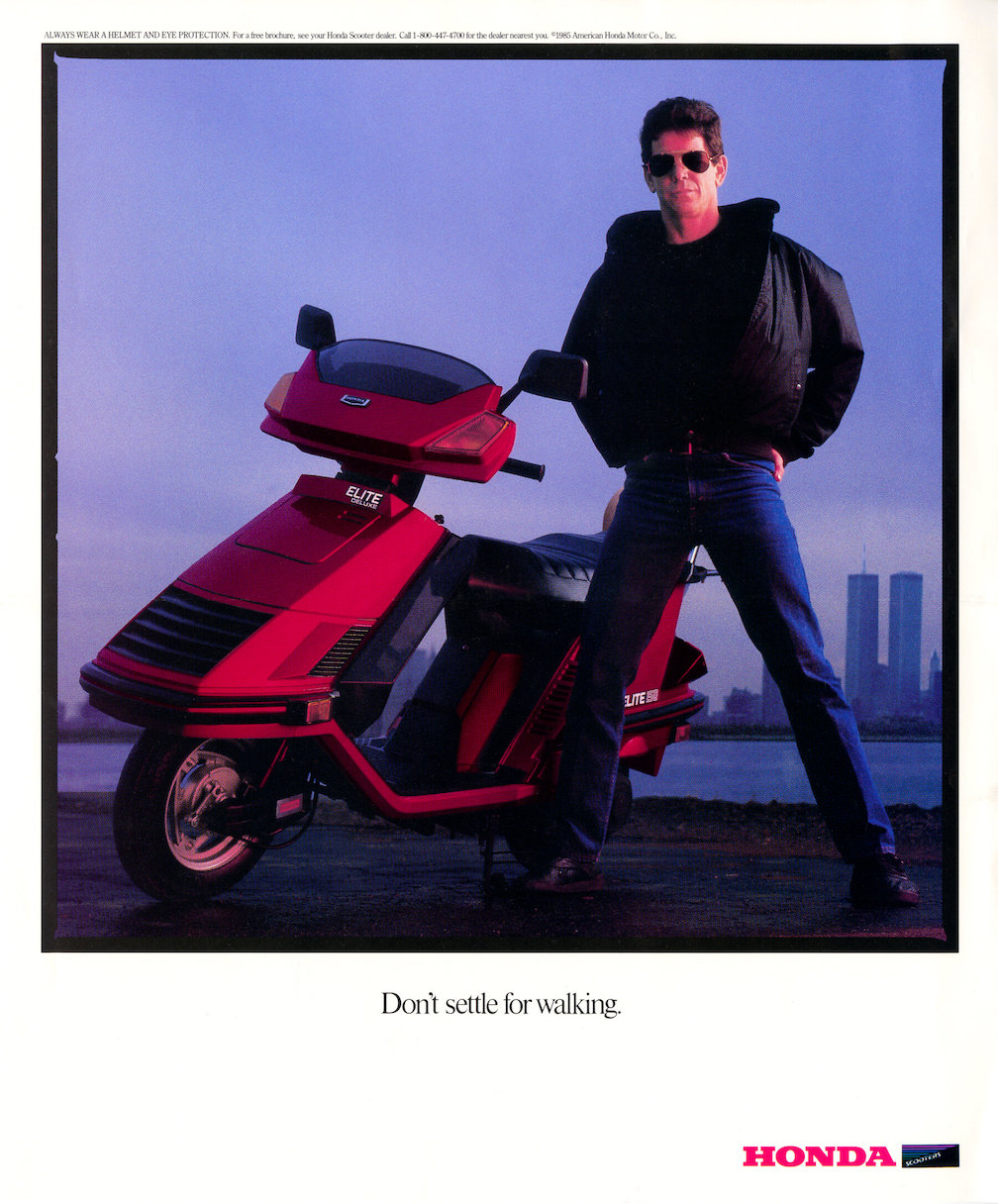
About the time Reed did the ad campaign for Honda, in 86 or so, he was asked to do something for a public service campaign for HIV prevention. He refused, saying he'd never been safe, and he was still alive.

I had dinner with Legs McNeil and a few others at some point in the mid 90s. It may have been after the premier of the film mentioned below. Or it could have been for Billy Name. Billy was there. McNeil went off on political punk. He hated it. He's a moralist.  Moralists are conservative by definition. Genet opposed prison reform because it made him who he was. I've said it before, in the same general context.  John Waters and Mike Kelley agreed, they both still loved the Catholic Church. John's a conservative. I've said that before too. And then there are the Quines 


It's still hard writing for an American audience.


The discussion of Dune and Star Wars among pseudo-leftist pundits is a corollary to Trumpist rage: varieties of childishness. And these overlap with the fanboys and fangirls of the cinematic fanboy Todd Haynes. The film critic on a website for "democratic socialists", named for anti-democratic moralists, violent political puritans, celebrates self-identified heirs of de Sade and Huysmans.

Haynes now has a tag. Haynes, Mad Men, and the nostalgia of Americans for their own childhood, or fantasies of others' youth. "They are not intellectuals, but occasionally dream that they will be. That is their secret ambition." 

Liberals and liberalism, and the whig history of the demimonde.

The Velvet Underground, like most of the self-identified avant-garde were pretentious. Pretension is defensive posturing, signaling insecurity. Lou Reed always got high on his own supply, and he was an asshole. But sometimes fuckups get something something right, describing complexity honestly, That's the basis of a large percentage of what's called "modern art". 

Picasso in 1906 is flying blind. In 1916 he's full of shit, a poseur, but still struggling. The need for easy answers, the indulgence in and struggle against kitsch, lying —to yourself and others—vs honesty,  becomes the conflict between art and pose, rebellion and its marketing.
All the albums I put out after this are going to be things I want to put out. No more bullshit, no more dyed hair, faggot junkie trip. I mimic me better than anyone else so if everybody else is making money ripping me off, I figure maybe I better get in on it. Why not? I created Lou Reed. I have nothing even faintly in common with that guy, but I can play him well, really well. 
All of this is in the context of conservatism, and an honesty that undermines intention. People who say "conservatism is the new punk rock" are right. Punk rock was always self-destructive.

I've repeated this quote from Candy Darling enough. “I’ve been up all night alone, wondering about my identity. Trying to look for an explanation for living this strange, stylized sexuality."

I'll add another, about the lover Reed dumped, from Please Kill Me: The Uncensored Oral History Of Punk.

p. 155

Eileen Polk: Everybody hung out at Max's, and then the New York Dolls played their famous show in drag at the 82 Club. I started hanging out there. The 82 Club was a famous drag-queen bar on Fourth Street, around the corner from CBGB's, which wasn't happening yet. I started going to the 82 Club real early on and made friends with all the drag queens. That's where I met Rachel, Lou Reed's girlfriend. Rachel was a drag queen who was very feminine and really nice. The drag queens liked me, but Rachel was especially nice. One night when she was really drunk she told me that she could never be a guy because she had such a small dick. Then she showed it to me, and it was really small. I said, "That's okay, Rachel. That's okay." And she said, "Well, it better be, because I make a better woman than I do a man."

Then she met Lou Reed, and he was the man of her dreams. Apparently it was love at first sight. Rachel told me, "I've met Lou Reed! I've made it! This is it! I knew this was gonna happen! Something good was gonna happen to me, and this is it and I'm in love!" She was just ecstatic.

Lou would just sit in the corner and Rachel would keep everyone away from him. She announced to everyone, "I don't want anyone near him. I don't want anyone to talk to him. He's mine." And everyone respected that at the 82 Club. All the other drag queens stayed away from him, and all the women did too. Rachel said, "He's mine," but she didn't threaten anybody. I felt like everybody wanted something good to happen for her. And when it did, everyone was happy.

p. 206 

Mary Harron: We all went off to the Locale and none of us had any money and we couldn't order food. I remember Lou Reed ordered a cheeseburger because I was so hungry. Lou was with Rachel, who was the first transvestite I'd ever met. Very beautiful, but frightening. But I mean definitely a guy: Rachel had stubble.

Legs and John were chatting with Lou so I sat next to Rachel, and I asked her what her name was—him, what his name was—and he said, "Rachel."

I thought, Right. That kind of shut me up for a bit. I think I actually sort of tried to make conversation with him, but Rachel wasn't talkative. I think that was the sum total of our conversation.

A review of Halston, on Netflix 

This is not a new lane for Murphy, and once again it seems revolutionary — how rare to make an entire five-episode series dedicated to amplifying such a sour, cynical note — until one realizes there is nowhere for this story to go. Certainly the notion that the modern history of gay life is one as colored by repression and self-loathing as much as by the power of expression is a rich vein throughout Murphy’s work. Just last year, he produced a feature film remake of “The Boys in the Band,” the 1968 play that is the ultimate theatrical howl of isolation and pain. Previously, Ben Platt in “The Politician” and Darren Criss in “The Assassination of Gianni Versace: American Crime Story” played queer men driven by ambition that looks a lot like misdirected rage.

I went to school with the director. He was a screenwriter for I shot Andy Warhol, directed by Mary Harron, quoted above. And both films have the same producer, Christine Vachon, who went to school with Haynes, and has worked him from the beginning of his career. One of my closest friends at the time was a consultant on the Warhol film; we went to the premiere. At some point after that I remember Callie saying, dryly, that it was still safe to assume every homosexual was self-hating until proven otherwise—for Boys in the Band see The Queer Art of Failure and How to be Gay, both from the second decade of this century. Vachon also worked with Cindy Sherman on her only, failed, film; Sherman's work documenting not homosexual but female self-hatred. The absurdity is the lie they tell themselves—if indeed they do—that they're liberal. Maybe it's more that earnest liberals claim them as their own. Liberalism has turned self-hatred, for some, into self-affirmation.

And this brings us back to science fiction,  the geek art of failure unacknowledged, building worlds rather than observing this one. 

Krugman in 2021

The blogger John Rogers once noted that there are two novels that can shape the lives of bookish 14-year-olds: “Atlas Shrugged” and “The Lord of the Rings.” One of these novels, he asserted, is a childish fantasy that can leave you emotionally stunted; the other involves orcs.

Well, I was a bookish 14-year-old, but my touchstones were two different novels: Isaac Asimov’s “Foundation” and Frank Herbert’s “Dune.”

Many social scientists, it turns out, are science fiction readers. For example, quite a few experts on international relations who I know are fanatics about the TV version of “The Expanse.” I think it’s because good science fiction involves building imaginary worlds that are different from the world we know, but in interesting ways that relate to the attempt to understand why society is the way it is.

 Angus Deaton, Dani Rodrik and John Quiggin, and Krugman in 1996

At the deepest level, opposition to comparative advantage -- like opposition to the theory of evolution -- reflects the aversion of many intellectuals to an essentially mathematical way of understanding the world. Both comparative advantage and natural selection are ideas grounded, at base, in mathematical models -- simple models that can be stated without actually writing down any equations, but mathematical models all the same. The hostility that both evolutionary theorists and economists encounter from humanists arises from the fact that both fields lie on the front line of the war between C.P. Snow's two cultures: territory that humanists feel is rightfully theirs, but which has been invaded by aliens armed with equations and computers.

Any systems engineer knows that efficiency in a system is in inverse proportion to stability.

Krugman indulged a fantasy; his preferences were founded in aesthetics before they were founded in ethics: he rationalized a desire, wanted to believe an absurdity, defended it as science and mocked anyone who opposed him as irrational. 

The only thing interesting is that he didn't learn from his mistakes.

How is the philosophy behind Asimov's Foundation less authoritarian than The Fountainhead? Krugman conflates art and illustration, and art and science, "truth and lies".  His link on The Expanse is to Drezner, indulging the horse-race model of political science and IR, the academic origin of the model of journalistic "objectivity" and passivity. Both Krugman and Drezner imagine statements without subtext, themselves without subtext. Their intellects are brittle, though Krugman is "intelligent". The only thing interesting about Dune is how it describes the desires and fantasies of its makers and its audience, and civilization on earth in 2021.

Tagged The Pictures Generation, the aestheticized politics of 80s art, made in the shadow of something worshipped and feared—hated—indulging reaction as radical. That's the mix that turns conservatism into fascism.  Needless to say I have more sympathy for Candy Darling and Rachel Humphreys, who's buried in Potter's Field, than Lou Reed. I have sympathy for them as people.

I want the illusion.
Do you want the illusion or do you want the illusion to be real? 
What’s the difference?
One means that you have an appreciation of the arts. The other means that you’re a fascist.
Art makes the world more interesting than it is. "We tell ourselves stories in order to live."
Living your life as art, and imposing your art on others is more than authoritarianism. Authoritarianism only demands that you behave a certain way. It doesn't demand that you believe. Coerced belief is the definition of fascism. I think Foucault was trying to construct a new conservatism. Neoliberalism ain't it.
[I've used this one before.]


I've made so many riffs on monarchists and monarchism, on liberalism, on the left, and right.
Jean-Marie Straub's film, below, was on Jonathan Rosenbaum's top 10 for 2020. In the link above [reaction as radical] he refers to Sirk and Fassbinder as "more defeatist than progressive". The man in Straub's film is reciting Georges Bernanos. It's hard to get more defeatist than Bernanos. The film is dedicated to Godard.

Saturday, August 29, 2020

Quoting Renan. Godard was always a conservative.

The younger man in the back is Louis-Do de Lencquesaing. Caroline Champetier, photographing the father of her child. I could go on with this, but it would get too cute.

Sunday, August 23, 2020

Hélas pour moi


Cinematographer: Caroline Champetier.