


Anti-Americanism might be a moral imperative for Europeans. It certainly is satisfying. But a disinterest in the US is hard to justify politically, let alone strategically expedient. As Nick Burns noted in a reflection on America, Baudrillard’s real message is that “we have to perform American experiments on ourselves”
The scab could be an immigrant, legal or illegal. His wife or one of his children could be sick, or hungry; they could all be homeless. Solidarity is a double-edged sword, or it's pointless. Dead finks don't talk.
Also Jeff Wall.
Modernity and avant-garde, to you, are two separate things?
JW: We can’t confuse them anymore.


Michael Fried, 2008, leading from the rear.
I have always liked photography, and in a low-key way I was always interested in it. I bough t a Berenice Abbott print of an Atget bedroom at the Willard Gallery in New York City more than thirty years ago, and have lived for a long time with photographs by Evans, Baldus, Frith, and O'Sullivan (a particular favorite). Over the years, too, I attended numerous exhibitions of photography, though rarely with the sense of urgency that I felt with respect to exhibitions of modern painting or sculpture. But until recently I did not have any strong intuitions about photography, and without such an intuition - some sort of epiphany, real or imagined - I have never been motivated to write on anything. Then several things happened. First, I got to know James Welling and his work because friends in Baltimore walked into his first show at Metro Pictures and bought several of the "Diary" photographs; soon they became close to him. l found that I liked his photographs enormously, and we, too, became friends . And then about ten years ago, by sheer chance, I met Jeff Wall at the Boymans Museum in Rotterdam and discovered that, to put it mildly, we were interested in many of the same pictorial issues. I had been aware of Wall's work for years and had even had an inkling of our shared concerns, but meeting him and exchanging thoughts was galvanizing for me. From that moment on I started looking seriously at recent photography, a process greatly aided by major exhibitions of work by figures such as Welling, Wall, Andreas Gursky, Thomas Struth, Bernd and Hilla Becher, Thomas Demand, Rineke Dijkstra, Candida Hofer, Hiroshi Sugimoto, and Luc Delahaye, among others. To my surprise I fairly quickly became gripped by the though that all that work, and much else besides, hung together artistically in ways that it seemed to me no one else writing about the topic had quite recognized. At that point, I began drafting what I hoped would be a short book on recent art photography that would convey the gist of my thinking. Pretty soon, though, it became clear that no such short book was in the cards. Rather, if I wanted to do justice to my subject, I would have to deal with the work of more than fifteen photographers(and, it turned out, video and filmmakers) in sufficient detail to convey a sense of what each was up to and at the same time to allow the connections I saw among their individual projects to emerge. This is what I have tried to do in Why Photography Matters as Art as Never Before.
Sauerländer is so much more interesting.
Rail: Were you aware of Modern Art at that time?
Sauerländer: Yes, in a moderate sense, but I would say that I developed a vivid interest in it only after coming to New York. I can’t deny it, it came with Pop Art. Not with Abstract Expressionism, not Barnett Newman, not Rothko. I’ve written on Rothko a couple of times, but I’m a little skeptical of his religious and mystical aura. It was in the 60s that I became interested in the works of Rauschenburg, [Claes] Oldenburg, and even Warhol (Warhol before 1970, Warhol after 1970 is a different thing) we had liberation, even if today I am skeptical of it. Suddenly the thick reality of a consumer’s world, of a media world, entered the art and that was liberating.
Rail: How did you feel about the German artists who became very visible in the decade of the 1980s, for example, Joseph Beuys and Anselm Kiefer?
Sauerländer: Beuys was an enormous event and we all were fascinated because he transformed cold reality, real things of the everyday world, into symbols of misery, death, extinction. It fascinated us though I admit that I always mistrusted the man a little. There was something tricky about it. The man was not very agreeable if you met him. Kiefer, on the other hand, is a man who lives from the darkest of the German meeds, which I don’t care much for. I remember the 1988 Kiefer exhibition [opening] at the MoMA full of drunken American ladies, if possible also Jewish. They looked as if they were in a Wagner opera, staring at all these symbols of German fire, blockhaus, the Reich Chancellor. I know Kiefer personally and there I would make a great distinction. There is something intelligent and even enlightened in Beuys whereas in Kiefer it’s a sort of fundamentalism that doesn’t interest me. Due to my health, I couldn’t go to see the 2007 Kiefer exhibition in the Grand Palais in Paris, which must have been gigantic. People were very impressed, but I have a suspicion that Kiefer is exactly what the French think Germany should be—Wagner and mysticism and so on.
Rail: Now getting back to where we had left off before: What was your impression of the U.S. when you came to Princeton in 1961?
Sauerländer: We had a totally idealistic image of America, it was the perfect democracy, the Bill of Rights, we believed in all of that. It was the moment of President Kennedy who everyone saw as young, progressive, and enlightened. Whether that was true, well that’s another question.
So we arrived in September just in time for the International Congress [of Art History]. Upon arriving at the Columbia dormitory where we were housed, my wife asked: “Goodness, who is that?” There was man who looked like an Old Testament prophet! It was Meyer Schapiro and he was the first person we saw. Apart from participating in the Congress, it was a great experience to come from truncated Germany and suddenly encounter all these émigrés. It was Panofsky, his wife, and Walter Friedländer; suddenly we discovered a Germany that no longer existed in Germany. We couldn’t help but just listen to them because they had very much remained German. With that said they, especially Panofksy naturally, regarded themselves as American. Suddenly a pre-Nazi German past came back on us and it was astonishing. During this first phase in the United States, between ’61 and ’62, we became close friends with Panofsky, Friedländer and Krautheimer. Later I invited Freidländer to Freiburg where he taught before ’33 and Panofsky took an honorary position there; [seeing these scholars return to Germany, if only temporarily] was a very important part of my American experience....
I must say that I remained in unbroken admiration of the U.S., even in ’64-’65, I found it all wonderful. Then I came back to teach in 1970 during the centenary of the Metropolitan Museum and there were all these parties with rich ladies—Panofsky, Friedländer, all were dead, the emigrés, in part, had disappeared. I suddenly saw all the poor people on the streets and I discovered the dark side of America. It was actually the moment when Panofsky’s great illumination was at its end—everyone imitated him. Panofsky himself said, “Well if I am punished for what I did to art history, I will come into the seventh stage of Hell.” In ’65 he gave those Titian lectures, which with all respect for Panofsky were a disaster. I mean, reducing Titian to iconography naturally doesn’t work....
Rail: Was your enthusiasm for America and Pop Art something shared by Germans at the time?
Sauerländer: I don’t think there were many people in Germany who were aware of it. There was Evelyn Weiss in Cologne who wrote on Pop Art and I’m not absolutely sure at what moment Peter Ludwig, a collector of art in Cologne who bought an enormous number of Pop Art pieces, began acquiring it. It was relatively early even in New York as well. [Barnett] Newman, [Mark] Rothko, [Meyer] Schapiro were shocked by Pop, they thought it was the end. It was a break that others have to write about. I couldn’t have done it in 1970, which I regret it to this day. This break coincides with all the social and mental changes of the 60s—before and after 1968.
Rail: Even in America, it has taken time for Pop to enter scholarly discourse.
Sauerländer: The disturbing question is what remains? I was very fascinated by [Edward] Kienholz, [Robert] Rauschenberg, and [Claes] Oldenburg, but where are they today? Warhol remains an icon—Warhol until 1970. Later the factory goes wrong. At this moment I find photography seems to be more interesting than other fields, especially, there are very good photographers in Germany, for example [Thomas] Struth, [Andreas] Gursky.
Rail: How about Bernd and Hilla Becher, Candida Höffer?
Sauerländer: Höffer, yes, too many libraries, a little bit sterile. I have great problems with the Bechers. There is a great human message with Walker Evans, but never were with the Bechers or Höffer. [Bernd] told me that he photographed at 5 a.m. and made scaffolding above the human level, on an abstract level. The [Robert] Bergman catalogue that you gave me is something different altogether. [August] Sander is one of the greatest artists of the twentieth century. [Thomas] Struth and [Thomas] Demand are interesting.
Panofsky's book on Titian begins with an editor's acknowledgment, quoting Panofsky, that he never intended to do an overview of Titian's career and the focus on iconography was in no way an attempt to set a limit on the work itself, and that the the images were all black and white "not in spite but because of the fact that Titian was the greatest ‘colorist’ who ever lived.” And then the passage I remember from his description of The Flaying of Marsyas, even though he was wrong in wanting to deny attribution, is key to any understanding of Titian.
When Panofsky writes that Titian, “like Henry James’ Linda Pallant, ‘knew the value of intervals’” he’s describing Titian’s focus on the space between objects and people, and implicitly between viewer and canvas. The connecting line isn’t a formal cue, an arrow or the edge of a table or the stripes on a piece of fabric; space is crossed often only by a line of sight. As in the theater, actors’ success or failure isn’t measured in inches or millimeters to match the perfect ratio of the sides of a triangle, but in faces and gestures directed at each other. And Titian makes sure the space isn’t so cluttered that things get in the way. The sense of time as the our eyes move observing others’ eyes, the fleeting sense of intimacy is beyond anything in Florence. It’s an an art that doesn’t even try to give us an illusion of perfection, except perhaps as a ‘perfect’ description of its lack.
I'm not going to quibble with other criticisms of the book. I take things that strike me and ignore others. As a scholar I'm an amateur. As for the interview I'd be surprised if Germans didn't know Warhol by the early 70s. According to a timeline I found at the Met, in 1968 he had a retrospective that went from the Moderna Museet to the Stedelijk and he had work in Documenta. But his interest in Warhol, until 1970—it's be too much to wish he'd added Rauschenberg until 64—after his scepticism about Newman and Rothko as religious theater, and then Kiefer... we all try to distinguish between observing and imposing, reading and reading in, but the 20th century was a century of enthusiasts. "Newman, Rothko, Schapiro were shocked by Pop, they thought it was the end." I'm sure Panofsky laughed.
Fried spends a good deal of time on Douglas Gordon, and his documentary with Philippe Parreno—in the form of "video art"— on Zidane, but says nothing about its predecessor. I din't know about it either until I found on the Wikipedia page about their film, but they knew about it of course, and never bothered to tell Fried. Gordon and Parreno's film has a theatrical intimacy, and with the music, an aestheticized, poeticized, melancholy; it's a film about the past in the sense that Hellmuth Costard's film is about its present. And the new film fits with the culture of music videos and advertising that grew out of video art.
Fried is the sort of critic who has a better idea of what good art should be than why anyone would want to make art to begin with. He's easily seduced by the impression of seriousness. Sauerländer saw seriousness in Warhol's work and knew the rest was secondary. Fried was right to see immaturity in the work of the late 60s and he's right to see maturity now, but he doesn't understand history, time, and change.
A Man United fan account has put Costard's film on Youtube. We'll see how long it lasts.
There are countless debates among sociologists and economists concerning the terms ‘human capital’ and ‘cultural capital’. The general view is that the former implies a rational instrumental attitude to the attainment of skills, whereas the latter suggests an investment in what Bourdieusians call illusio: the denial that the game of culture is in fact a game. Iván Szelényi once characterized the distinction slightly differently, writing that human capital denoted skills that are rewarded because of their contribution to productivity, while cultural capital was fundamentally a claim to rent. It seems to me, however, that we ought to be raising a different set of questions. In particular, it is important to ask: under what historical conditions does culture take the form of an ‘asset’ or ‘quasi-asset’?
John-Baptiste Oduor, editor at Hamasmag, in NLR, "Role Play", (filed under culture)
Untitled (Woman Standing Alone) from Kitchen Table Series, 1990, © Carrie Mae Weems. Courtesy of the artist, Jack Shainman Gallery, New York / Galerie Barbara Thumm, Berlin.
Oduor previously, on Charles Mills, and Lynette Yiadom-Boakye. Weems belongs with Hammons.
repeat. It's absurd how much is lost when the goal of disinterest devolves into a fiction of objectivity.
Stanley Hoffman reviews Distinction
But if “using rare words and tropes in place of common words and phrases” is a strategy of “deliberate transgression” of the norms of clear prose characteristic of the dominant classes and is opposed to “the hyper-correction strategies of pretentious outsiders,” then Bourdieu is a master strategist. Words such as lexis, allodoxia, chiastic, askesis, espace hodologique, hysteresis, and of course habitus (and, indeed, hysteresis of habitus) are scattered throughout the text. That a work of social science should—”unlike the sometimes illuminating intuitions of the essay”—require an effort on the part of the reader is fair enough. Here, however, reality disappears into the hypertrophied rhetoric of the Ecole Normale.
Simply as a critic, never mind the pretension to politics, Oduor doesn't know enough. A first person essay about why he likes the work, what it means to him as a writer, would be the only honest choice, but he'd never make it.
"There's no point in having sharp images if you've got fuzzy ideas. Leacock's lack of subjectivity leads him ultimately to a lack of objectivity. He doesn't even know he's a metteur-en-scene, that pure reportage doesn't exist."
“Documentaries are thought to have the same relation to social change as penicillin to syphilis.”
Jeff Wall: [Referring to Delacroix] Violence is only a theme in this kind of art; the art itself isn’t violent. That makes it very different from, even opposed to, the art of the avant-garde, which expresses aggression against the idea of art itself. This aggression is no longer viable. I don’t think its necessary or possible to go beyond the idea of bourgeois art -that is of autonomous art- towards a fusion of art and its context. Or if its possible it isn’t very desirable. We have learned how the aggression against autonomous art was consistent with aspects of totalitarianism, from the Stalinist period for example, and how state violence could benefit from that kind of aesthetic. The concept of art as autonomous, and therefore less amenable to that kind of instrumentalization, is a central concern of the modern, and I’m most sympathetic to that.
A-MB/RM: Modernity and avant-garde, to you, are two separate things?JW: We can’t confuse them anymore.
"A Democratic, a Bourgeois Tradition of Art: a Conversation with Jeff Wall"Jeff Wall: Selected Essays and Interviews
Chevrier, cited by Odour, is in the same volume. I have a lot of respect for Wall, and I've watched him work a room. See previously on Hammons. Fine art is conservative, or it's reactionary. And Fried is a fucking idiot. Always a moralist, I should have guessed that when when he adapted to change he'd become a fan of Greuze.
Leiter links to Adolph Reed again.
Reed can't help but moralize; he still has fantasies of leading change. And he publishes on a webpage named after Robert Smithson that has Michael Fried on the editorial board. Smithson would be amused. I'm not.
I had an exchange with Fried a year or so ago, with no direct connection to this. But I sent him another one last night. I think he understands me now. Reed might as well.
This essay is a sketch, an attempt to study the ways that photography occupied Conceptual artists, the ways that photography decisively realized itself as a modernist art in the experiments of the 1960s and 1970s. Conceptual art played an important role in the transformation of the terms and conditions within which established photog raphy defined itself and its relationships with other arts, a transformation which established photography as an institutionalized modernist form evolving explicitly through the dynamics of its auto-critique.
Photography's implication with modernist painting and sculpture was not, of course, developed in the 1960s; it was central to the work and discourse of the art of the 1920s. But, for the sixties generation, art photography remained too comfortably rooted in the pictorial traditions of modern art; it had an irritatingly serene, marginal existence, a way of holding itself at a distance from the intellectual drama of avant-gardism while claiming a prominent, even definitive place within it. The younger artists wanted to disturb that, to uproot and radicalize the medium, and they did so with the most sophisticated means they had in hand at the time, the auto-critique of art identified with the tradition of the avant-garde. Their approach implied that photography had not yet become "avant-garde" in 1960 or 1965, despite the epithets being casually applied to it. It had not yet accomplished the preliminary autodethronement, or deconstruction, which the other arts had established as fundamental to their development and their amour-propre.
Through that auto-critique, painting and sculpture had moved away from the practice of depiction, which had historically been the foundation of their social and aesthetic value. Although we may no longer accept the claim that abstract art had gone "beyond" representation or depiction, it is certain that such developments added something new to the corpus of possible artistic forms in Western culture. In the first half of the 1 960s, Minimalism was decisive in bringing back into sharp focus, for the first time since the 1930s, the general problem of how a work of art could validate itself as an object among all other objects in the world. Under the regime of depiction, that is, in the history of Western art before 1910, a work of art was an object whose validity as art was constituted by its being, or bearing, a depiction. In the process of developing alternative proposals for art "beyond" depiction, art had to reply to the suspicion that, without their depictive, or representational function, art objects were art in name only, not in body, form, or function. I Art projected itself forward bearing only its glamorous traditional name, thereby enter ing a troubled phase of restless searching for an alternative ground of validity. This phase continues, and must continue.
Photography cannot find alternatives to depiction, as could the other fine arts. It is in the physical nature of the medium to depict things. In order to participate in the kind of reflexivity made mandatory for modernist art, photography can put into play only its own necessary condition of being a depiction-which-constitutes an-object.
In its attempts to make visible this condition, Conceptual art hoped to reconnect the medium to the world in a new, fresh way, beyond the worn-out criteria for photography as sheer picture-making. Several important directions emerged in this process. In this essay I will examine only two. The first involves the rethinking and "refunctioning" of reportage, the dominant type of art-photography as it existed at the beginning of the 1960s. The second is related to the first, and to a certain extent emerges from it. This is the issue of the de skilling and re-skilling of the artist in a con text defined by the culture industry, and made controversial by aspects of Pop art.
Wall
Through that auto-critique, painting and sculpture had moved away from the practice of depiction, which had historically been the foundation of their social and aesthetic value.
Clement Greenberg
The essence of Modernism lies, as I see it, in the use of characteristic methods of a discipline to criticize the discipline itself, not in order to subvert it but in order to entrench it more firmly in its area of competence.
Bullshit in both cases. The question is why that bullshit came to be.
repeats: T.J. Clark on Pollock and Flaubert. I'm adding highlights this time.
Farai un vers de dreit nien:
non er de mi ni d'autra gen,
non er d'amor ni de joven,
ni de ren au,
qu'enans fo trobatz en durmen,
sus un chivau.
(I shall make a poem out of [about] nothing at all:/it will not speak of me or others,/of love or youth, or of anything else,/for it was composed while I was asleep/riding on horseback.)
William IX of Aquitaine
Once Upon a Time. When I first came across the lines by the duke of Aquitaine some years ago, naturally I imagined them in Jackson Pollock’s mouth. They put me in mind of modernism; or of one moment of modernism which I realized I had been trying (and failing) to get in focus ever since I had read Harmonium or looked at Le Bonheur de vivre. Two things were clarified. Not just that modern artists often turned away from the detail of the world in order to revel in the work of art's "essential gaudiness," but that the turning away was very often associated with a class attitude or style not unlike Duke William's, or, at least, an attempt to mimic that style - its coldness, brightness. lordliness, and nonchalance. Its "balance, largeness, precision, enlightenment, contempt for nature in all its particularity."' Its pessimism of strength.
You might expect such an effort at aristocratic world-weariness on the part of bourgeois and even petty-bourgeois artists, operating in the nineteenth and twentieth centuries not the eleventh and twelfth, to bear some strange fruit.
Largeness and lordliness, after all, were not likely to be these artists' forte. Take the novelist Gustave Flaubert, for (central) example, at the beginning of work on Madame Bovary in 1852: already chafing at the he bit of reference that seemed to come with the form he had chosen and dreaming of "a book a about nothing, a book dependent on nothing external, which would he held together by the internal strength of its style ... a book which would have almost no subject or at least where the subject would be almost invisible, if such a thing is possible.” What strikes me as truly strange in Flaubert's case is not so much the project he outlined for himself - though as an ambition for a novel rather than a sestina or a set of haiku it has its own pathos – as the distance between the book he imagined and the one he actually wrote. No book has ever been fuller than Madame Bovary of the everything external which is the bourgeois world. Fuller in its heart of hearts, I mean; fuller in its substance; in the weight it gives to words themselves. It is as if the more intense a bourgeois artist's wish to dispense with externals and visibilities, the stronger will be their hold an the work's pace, structure, and sense of its own objectivity. Or maybe we could say that what brings on the word "bourgeois" at all as a proper description of Madame Bovary is exactly the deadlock within it between a language so fine and cold that it hopes to annihilate the emotions it describes as it describes them, and an absolute subjugation to those emotions and the world of longing they conjure up. A deep sentimentality, not relieved but exacerbated by a further (ultimate) sentimentality about language – call it belief in the arbitrariness of the sign.
Clicking through the links you'll find the quotes below
Greenberg
One and the same civilization produces simultaneously two such different things as a poem by T. S. Eliot and a Tin Pan Alley song, or a painting by Braque and a Saturday Evening Post cover. All four are on the order of culture, and ostensibly, parts of the same culture and products of the same society.
T.S. Eliot:
Marie Lloyd was the greatest music-hall artist in England: she was also the most popular. And popularity in her case was not merely evidence of her accomplishment; it was something more than success. It is evidence of the extent to which she represented and expressed that part of the English nation which has perhaps the greatest vitality and interest.
Wall is, or was, tempted by the delusions Flaubert claimed for his art, and that Greenberg and Bourdieu valued, and that Fried still does. But watch him here.
On my way home. On the train from Boston to Penn Station. Looking out the window thinking about Pissarro and Anarchism. Passing through a suburban industrial landscape Jeff Wall’s images of Vancouver come to mind, and I have a thought that I regret that now we are able to blame ourselves for everything. Our mistakes are now more deadly than God’s. We are becoming used to the bureaucratization of disaster. But those problems which fall into the category ‘what is to be done’ are the preoccupation of only a few, and if most people are no closer to controlling their own destiny, they are also no more interested in it than they ever were. It makes no difference to them if a few men put themselves in God’s place. Their passivity is their freedom. And that freedom will never be taken away.
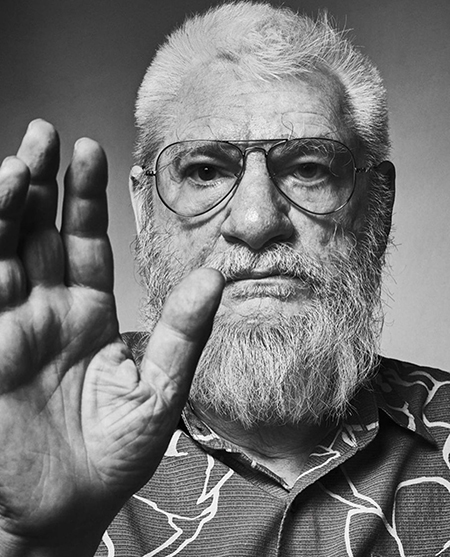
Dan the Lawgiver. It made me laugh. Requiescat in Pacem.
Dan: here, and here, and here,
So the new baroque Modernism, on its own terms, without defense or rationalization (the language of “baroque specialization”) manifests an ethic not of utopian idealism but of description: of the realities of how we live, of capital and commerce, and of our perceptions of ourselves as actors within the world both define. Glass is everywhere again but now reflection is as important as transparency and the distinction between object and reflection becomes difficult to judge. Solids become light. Talking to younger architects a few years ago about who first began using glass as it’s being used now, I was told that in architecture proper, it was probably the Dutch firm Coop Himmelblau, and before that, Dan Graham. Before that however, and no one mentioned it, it was Jaques Tati, in Playtime.
Architecture is obliged to give simple pleasures before complex ones (even more so than the fine arts are obliged to flatter the wealthy). We may enjoy reading about infernos or even having pictures of them on our walls but it’s still perverse to have a cocktail party in the boiler room. Graham’s use of reflectivity was intended originally to be emotionally disturbing, the sense of disembodiment linked to one of isolation and even terror, and Tati’s response was cooler but no less critical. Life has acclimated us so much to the splintering if not the obliteration of self in the endless reflectivity of mirrors and markets that it’s now an aspect of the popular sense of architectural pleasure. And the architects I talked to remember discovering Graham’s pavilions, and responding to them instantly, in their late teens or early 20s; recognizing what they already understood.
Have to say this worked out.
 |
| "Heads of a Man and a Woman (Homme et femme, en buste)". c. 1877–80. Monotype on paper, plate: 2 13/16 x 3 3/16” (7.2 x 8.1 cm) . British Museum, London. |
 |
| Three Studies of Ludovic Halévy Standing, c. 1876-1877, Charcoal on paper, 12 5/8 x 18 7/8" (32 x 48 cm), National Gallery of Art, Washington D.C. |
 |
| Three Studies of Ludovic Halévy Standing, c. 1876-1877, Charcoal on paper, counterproof, 14 1/8 x 19 1/4" (35.9 x 48.9 cm), National Gallery of Art, Washington D.C. |
 |
| "Forest in the Mountains (Forêt dans la montagne)” (c. 1890),monotype in oil on paper, plate: 11 13/16 x 15 3/4 inches, MoMA, New York. |
Jeff Wall: [Referring to Delacroix] Violence is only a theme in this kind of art; the art itself isn’t violent. That makes it very different from, even opposed to, the art of the avant-garde, which expresses aggression against the idea of art itself. This aggression is no longer viable. I don’t think it's necessary or possible to go beyond the idea of bourgeois art—that is of autonomous art—towards a fusion of art and its context. Or if its possible it isn’t very desirable. We have learned how the aggression against autonomous art was consistent with aspects of totalitarianism, from the Stalinist period for example, and how state violence could benefit from that kind of aesthetic. The concept of art as autonomous, and therefore less amenable to that kind of instrumentalization, is a central concern of the modern, and I’m most sympathetic to that.For art as for politics.
A-MB/RM: Modernity and avant-garde, to you, are two separate things?
JW: We can’t confuse them anymore. Essays and Interviews
Modernism was the fantasy of writing with the assumption that from then on there would be only reading with and no reading against. To read tale against teller or to read against the grain would be gross error. Rebellion against this has always taken the form of the rebellion of youth against their parents, with the more sympathetic elders caught in the middle, trying to justify the revolt while trying to make it fit with what they know and what they are. So we get the obscurantist poeticizing of Derrida -the philosopher magistrate as wise old fool- and the blandness of Rorty and Nussbaum, struggling to find a way beyond technocracy while being mocked for the attempt by professional technocrats and lionized by amateur enthusiasts. The model of the Continental philosopher was as Pope and Antipope combined, a philosophical self that could contain an other, in a sense obviating the need for actual democracy. And now that Continental and Anglo-American philosophy are joining out of necessity and the need for survival, we see parallels in Bruno Latour's Collective and David Chalmers' Extended Mind.The modernism of revolution vs the modernism of technocracy; the fascism of romance vs the fascism of reality. Wall is referring to the avant-garde of early Dada and Surrealism, not of Soviet economic policy and the Bauhaus.
Mr. Wall said he had come simply to make art, and because he had been invited. Regarding the conversation about Israel, he said, “I’m not here to help anyone to resolve these matters.”Contrary to art world mythology Jeff Wall has always been a conservative, in the best, most serious meaning of the word. The same is true for Struth.
This post takes us back to the relation of philosophy, the language of concepts, to narrative, and to and art itself, the language of description. To philosophers narrative is parasitic, in a sense even that the theory of narrative is not. This blog is mostly an attempt to theorize the opposition into subservience, like the biographer tries to conquer his subject. Between Chaplin and Deleuze et al., Chaplin wins. Deleuze is the parasite. "For Deleuze Orson Welles’s Citizen Kane is, as he puts it, 'the first great film of a cinema of time' ” All cinema is the cinema of time. Film is the greatest argument against modernism (as distinct from the modernity it describes so well).TwoJW: [Referring to Delacroix] Violence is only a theme in this kind of art; the art itself isn’t violent. That makes it very different from, even opposed to, the art of the avant-garde, which expresses aggression against the idea of art itself. This aggression is no longer viable. I don’t think its necessary or possible to go beyond the idea of bourgeois art -that is of autonomous art- towards a fusion of art and its context. Or if its possible it isn’t very desirable. We have learned how the aggression against autonomous art was consistent with aspects of totalitarianism, from the Stalinist period for example, and how state violence could benefit from that kind of aesthetic. The concept of art as autonomous, and therefore less amenable to that kind of instrumentalization, is a central concern of the modern, and I’m most sympathetic to that. A-MB/RM: Modernity and avant-garde, to you, are two separate things? JW: We can’t confuse them anymore. "A Democratic, a Bourgeois Tradition of Art: a Conversation with Jeff Wall", in Selected Essays and InterviewsMannerism describes the aristocratic sensibility in an age of incipient democracy. The baroque is the same model of (describes) conservatism in the age of a fully ascendant democracy: the age of theater. History shows that In art as in democracy (as in all culture whether wise men approve or not) practice precedes theory. --- I wish I'd done a better job in the comment above, but I doubt anyone here would get it even if I had. You're engaged in the attempted reform of the language of concepts, an attempt made in response to larger cultural/historical shifts. The best term to describe your work and of Deleuze etc. in relation to "classical" Modernism is "Mannerism". As Wall reminds us, the arts begin in practice. Attempts to work from theory were catastrophic, for the arts as for society, yet you continue to argue from the primacy of concepts, even the concept of something other than modernism. As much as you might like to pretend, concepts are not discoveries. Rationalism is not empiricism. Conceptualism is no more than reactionary late modernism. The politics of rationalism have proved monstrous. "Modernity and avant-garde, to you, are two separate things?" "We can’t confuse them anymore." Your arguments continue in the manner of the conceptualizing, prescriptive, and failed, avant-garde. That's a little more clear at least. --- "The point, in other words, is precisely to criticize the classical understanding of concepts, which seems to be the understanding of concepts you presuppose." And according to this, what replaces concepts? What forms of action and reflection and description are we left with? "Philosophy is neither film making nor art, nor is it science." I read all the time here and elsewhere that it's closer to science than to anything else. Concepts are objects almost in a material sense and the goal of philosophy is the development and direct use of objective knowledge. philosophy "invents concepts" and "makes futures possible." That's like saying that our greatest literature predicts the future. it hasn't, not even dystopia (yet). Philosophy is a branch of literature that posits itself as superior to all other forms of art. The modernist model of philosophy as logic and of logicians as philosophers is the most extreme version of that superiority but that's gone nowhere. It clings to power with the same tenacity as neoclassical economics as a description of the world. It clings on in the arguments of Eric Schliesser, Alex Rosenberg and others. And if clings on in more general ways other ways. I'll give examples I've used before. "Rationalism and empiricism are not the abstract categories that neatly house philosophers to the exclusion of one another." Empiricism involves observation of the world, of materials and history. If feminism were a branch of objective knowledge, than male and female feminists would be interchangeable. They aren't. Every major change in the moral culture over the past century has been marked first not by concepts but people and actions. American blacks not intellectuals led the civil rights movement. Women not college professors led the feminist movement. Anti-colonialism was powered by the anger of the colonized, not the understanding of the enlightened. In packaging these things after the fact, in conceptualizing them, intellectuals pretend still to have mastered the process of change. They haven't The Palestinians right now are in the position other outsiders have been in the past: they are making themselves heard. Without their own voices there would be no change. The politics of "objective understanding" is void or worse. Intellectuals intellectualize after the fact, not before. The difference between philosophy and art as practice (including Deleuze and Chaplin) is the difference between players in the the inquisitorial and adversarial systems of justice. A philosopher is like an investigating magistrate. The model is of intellectual superman, these days of the sort to claim to be able to "find the other in myself." The attempt to expand or rewrite the notion of concepts ends up in a fantasy of a sort of hypertrophied self. That's why I make fun of the language of the extended mind hypothesis as fitting for neoliberalism and neocolonialism. As an aside I'll add that if you google the "extended self" you'll get mostly discussions of marketing theory and branding. Schliesser's model is different in the sense that his model is reduce philosophy to a something like a "linguistic chemistry", when even mediocre minds can push the great process along in small ways. The tensions between these two models, of superman and petty bureaucrat, make for interesting subtext but they don't resolve any of the problems of philosophy as a practice about or in the world. Art as a model is open ended and descriptive. It's parasitic on language no more or less than the language of a trial lawyer paid to defend a client whether he believes in him or not (lawyers are like actors in that). Literature qua literature is a reflective description of the sensibility of the author in the form of a language shared by writer and audience. It is explicitly a document of its time, in a form that others in a different time and place may be able to recognize things in the form that they may not in the representation itself. To adapt a quote Wilson uses elsewhere the practice of art is to look at the spectacles we're wearing by aid of the spectacles themselves. The model is of intellectual as trial lawyer not as judge. That's a huge difference. Art functions is the explicit and honest description of and from bias. It's either anti-instrumentalist or ironically instrumentalist, as again the irony of the instrumentalism of a lawyer or an actor. Anglo-American philosophers seem to prize sincerity, when its meaningless. The Other is other and the others judge you. No amount of self-aggrandizing can change that. Calling yourself a nice guy is meaningless. That's for others to decide. Descriptive literature as opposed to the conceptual subgenre acknowledges that separation between writer and reader. It's the same separation liberal legal scholars defend in regards to the Constitution. Conservatives collapse that separation, claiming that there's only one text. There have been many, and there will be more, just as there have been many Hegels. That's the nature of language. And as I say again and again, liberal philosophers track conservative legal scholars. The other is other and others judge you. How do you engage others? That's a question for philosophy. It's interesting to learn that mathematicians cannot yet model all the actions of water, but I'm not clear why that should have mattered for philosophy, unless philosophers were under the delusion that philosophical language is capable of modeling the world outside of experience. People can't even agree on the meanings of words, so no, language is not like numbers in it's relation to the world."Doing these cases I began to find myself in a dangerous situation as an advocate. I came to believe in the truth of what I was saying. I was no longer entirely what my professional duties demanded, the old taxi on the rank waiting for the client to open the door and give his instruction, prepared to drive off in any direction, with the disbelief suspended."Those sentences describe the core of our justice system. They're philosophically as profound as it gets. And yet philosophers seem unable to understand or accept their importance.
Naturalism presupposes only that "the world" is structured in logically consistent mechanisms (though few people are willing to follow that to the logical conclusions.) It says nothing about how we go about modeling those mechanisms. "but doesn’t the Church-Turing thesis affirm successful characterization of rigor in mathematical reasoning?" What is the relation of mathematical reasoning to lived experience? Can your description of the Arab Spring match that of an Egyptian? Can Steven Weinberg's description of Zionism [chapter 15] match that of a Palestinian? Weinberg claims to defend the scientific "spirit", but power corrupts. "Curiosity, honesty, precision, and rigor" But who watches the watchmen? Naturalism must therefore model the world first as political and the model must be one of consultation at every level. That's problematic but less so than "scientific" authoritarianism. --- "and this was actually the subject of Catarina's post from earlier today on system imprisonment. The problem in this case is that formalist systems may generate problems that are only significant relative to the formal system itself and not to the real systems being described and modeled." The central error of Modernism was an assumed (utopian) relation of formalism to representation. The necessity of interpretation implies the plural: interpretations and the multiplicity of "perspectives". The logical consequence of accepting the indeterminacy of translation would seem to be an opening out to a worldly curiosity and an increasing democratization of discourse: a reciprocal, civil, social, "political" world. You're pulling yourselves towards an understanding of this. --- "A better approach for naturalists might be to engage with the arguments of scientifically spirited theists,"“But the Solar System!” I protested. “What the deuce is it to me?” he interrupted impatiently: “you say that we go round the sun. If we went round the moon it would not make a pennyworth of difference to me or my work.”Dr. Watson and Sherlock Holmes quoted by Lewontin in the NYRB, Billions and Billions of DemonsSagan and I drew different conclusions from our experience. For me the confrontation between creationism and the science of evolution was an example of historical, regional, and class differences in culture that could only be understood in the context of American social history. For Carl it was a struggle between ignorance and knowledge, although it is not clear to me what he made of the unimpeachable scientific credentials of our opponent, except perhaps to see him as an example of the Devil quoting scripture.Lewontin is a naturalist.We take the side of science in spite of the patent absurdity of some of its constructs, in spite of its failure to fulfill many of its extravagant promises of health and life, in spite of the tolerance of the scientific community for unsubstantiated just-so stories, because we have a prior commitment, a commitment to materialism. It is not that the methods and institutions of science somehow compel us to accept a material explanation of the phenomenal world, but, on the contrary, that we are forced by our a priori adherence to material causes to create an apparatus of investigation and a set of concepts that produce material explanations, no matter how counter-intuitive, no matter how mystifying to the uninitiated. Moreover, that materialism is an absolute, for we cannot allow a Divine Foot in the door.


Jeff Wall: [Referring to Delacroix] Violence is only a theme in this kind of art; the art itself isn’t violent. That makes it very different from, even opposed to, the art of the avant-garde, which expresses aggression against the idea of art itself. This aggression is no longer viable. I don’t think its necessary or possible to go beyond the idea of bourgeois art -that is of autonomous art- towards a fusion of art and its context. Or if its possible it isn’t very desirable. We have learned how the aggression against autonomous art was consistent with aspects of totalitarianism, from the Stalinist period for example, and how state violence could benefit from that kind of aesthetic. The concept of art as autonomous, and therefore less amenable to that kind of instrumentalization, is a central concern of the modern, and I’m most sympathetic to that.
A-MB/RM: Modernity and avant-garde, to you, are two separate things?
JW: We can’t confuse them anymore.
"A Democratic, a Bourgeois Tradition of Art: a Conversation with Jeff Wall"
Jeff Wall: Selected Essays and Interviews
Violence is only a theme in this kind of art [Delacroix]; the art itself isn't violent. That makes it very different from, even opposed to, the art of the avant-garde, which expresses aggression against the idea of art itself. This aggression is no longer very viable. I don't think it's necessary or possible to go beyond the idea of bourgeois art- that is of autonomous art- towards a fusion of art and its context. Or if it's possible, it isn't very desirable. We have learned how the aggression against autonomous art was consistent with aspects of totalitarianism, from the Stalinist period for example, and how state violence could benefit from that kind of esthetic. The concept of art as autonomous, and therefore less amenable to this kind of instrumentalism, is a central idea of the modern and I'm most sympathetic to that idea.The Bruces relate their education inside the contemporary art ghetto to what they know outside it, describing the world in the language they've been taught. But in doing so they're working their way out of a trap, and producing a representational (descriptive) rather than a formalist art. They're on a first name basis with everyone on the Whitney's board, and were before the Biennial took place -a friend says they remind him of the Strokes- but whether they're from money or are just comfortable around it they show independence, though the independence required to describe the world honestly as you perceive it is less threatening to the powerful than to their servants. And one way or another the Bruces seem to have bypassed them.
Essays and Interviews [p.246]
 |
| Untangling, 1994, cibachrome transparency and light box, 81.5" x 95" |
 |
| Restoration, 1993 Ilfachrome transparency and light box, 46 7/8" x 16 ft. 7" [click on the image] |


