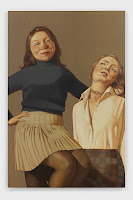
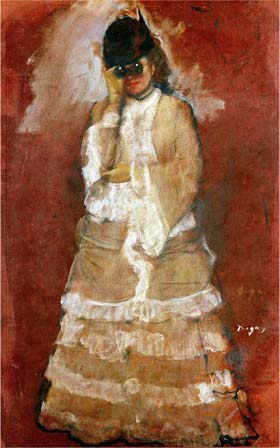
Showing posts with label Degas. Show all posts

Wednesday, May 25, 2022

unrealized projects. In these last few hours

Still having fun with this one
---

Thinking about Fantin-Latour again, because of Lorentzen and Indiana, again. Lorentzen's foreword to Indiana's new collection at Jacobin.  Jacobin is to the Jacobins what Brooklyn Industries is to... (and that's an old one too).

Lorentzen's blurb is awful.
Indiana is often associated in the popular mind or the minds of magazine editors with the “Downtown” Manhattan of the 1980s, and while this is not wrong—he was living as he does still, some of the time, in the East Village, was present at the Mudd Club, and so on—it is not enough. The vision of his novels, especially his true crime trilogy (Resentment, Three Month Fever, Depraved Indifference) spans the whole of America, and his literary sensibility is rooted in Europe.
For most of the 20th century New York was the place Americans went to escape their country without using a passport. It was last stop before leaving. You'd think a former editor of the LRB should know that, but it was clear a long time ago he didn't. As a gallery director from Vienna told me almost 20 years ago,  NY is provincial now.  
Indiana belongs with Leo Bersani and Dale Peck, and Daniel Harris, and Jayne County: "white faggots" of a certain age and place, sitting around talking, and now facing death threats from their erstwhile epigones. Remember "The Antisocial Thesis in Queer Theory": trash-talking reactionaries, honest, now beatified, cleansed, in academia.

Lorentzen 
Most of the writers, artists, and filmmakers Indiana scrutinizes in these pages are geniuses, and his criticism meets them at their level. From the fictions of Paul Scheerbart to the paintings of the young artist Sam McKinniss,...
I had to use google, and laugh.
McKinniss’s work arouses thoughts about the Leibnizian fuzziness between fiction and documentary reality, about concealment and revelation, about forms of masquerade, the mutability of memory. His paintings evoke a waking dream where figures of fiction, on furlough from their narratives, have real metaphorical force. Celebrities are fictional, whatever else they are; McKinniss’s pictures of them are layered in artifice, approximations of “perfect moments” in the careers of certain images.

McKinniss
Henri Fantin-Latour (1836–1904), whose flower paintings McKinniss frequently copies, has been called “a traditional painter with avant-garde sympathies,” which could apply to contemporary artists like Dike Blair, Maureen Gallace, Billy Sullivan, and McKinniss, who are realist painters of no discernible school, very different in style, innovators in subject matter and formal design. Alex Katz might fit in here, too. However traditional their techniques, their works are recognizably of our time, informed by the convulsive history of modernism and the wider movement of current events. Even McKinniss’s atmospheric copies of Fantin-Latour have a Pierre Menard kind of postmodernity; we see them through the filter of the past hundred years. (I like the knife on the table that features in Still Life with Primroses, Pears and Pomegranates (after Fantin-Latour), 2018—how criminal!)

What Fantin-Latour represents for McKinniss is something close to perfection in paint, the apogee of particular skills and sensitivities that McKinniss also has in abundance. I could be mistaken, but I think McKinniss’s embrace of Fantin-Latour is also his way of telling us he isn’t running for flavor of the month. Both artists are intoxicated by music.

McKinness in the New Yorker, by Jia Tolentino, another young sophisticate who isn't.

Last year, the twenty-year-old New Zealand singer-songwriter Lorde contacted the Brooklyn-based painter Sam McKinniss through mutual friends. She came to visit his studio in Bushwick, and then went to see his exhibition “Egyptian Violet,” which featured, among other works, a life-size oil painting, rendered with Symbolist intensity and high-classical technique, of Prince on a motorcycle. Soon after, she asked McKinniss if he would paint a portrait of her for the cover of her forthcoming album, “Melodrama.”  
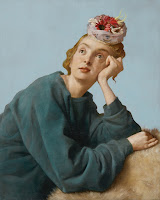
Currin
Weyant
Leibnizian fuzziness, flavor of the month. Like Hickey, Indiana sees what the wants to for whatever reason. He uses McInniss as material to talk about his own interests. Obviously there's nothing new in having a feeling for and understanding, or a fantasy, of Fantin-Latour—or  Leibniz and Joan Didion.  Peter Saville saw it in 1983. It's what others recognized in Seurat, a better artist so harder to steal from, a mechanical blankness, a passivity that Seurat could describe but that Fantin-Latour could only manifest. Fantin-Latour is why we have Richter, as Seurat is why we have Warhol. Think also of Degas, like Seurat: painters who responded to photography without being defeated by it. It took years for Maureen Gallace to accept the fact that she's a landscape painter. She started out thinking of her work as formal and conceptual. She needed to lie to herself to do what she wanted to do. Embracing kitsch, or lack of affect, is a defense mechanism, steeling yourself for mockery. Fear made her early work simple, almost Platonic anti-landscapes, complex and interesting. Now that she's out of the closet and painting at the beach, the work is maybe better but also more simply small.

I don't remember the first time I wrote that the irony of pop art came out of a need to find a way to make figurative work and get away with it. Like Robert Wilson—"I  didn't mean anything by it."—or T.S. Eliot. McKinnis is repeating work from 25 years ago, but most don't know, and those who do don't care.  Gagosian now represents both John Currin and a fan, though his female follower is even more a follower of the sexually aggressive Balthus while Currin is voyeur as cuck. But he's also a committed academician. Look at the sleeve on the female figure, The Penitent, from 2004.  I'm 
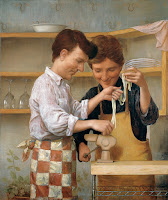
Currin
sure he can talk for hours about both Titian's paint handling and the chemistry of his paints. It's been interesting to watch his skills mature; he's fully committed now and it shows. But as I said to the girls at the desk a couple of years ago, all the show needed was a portrait of a naked black man with a 10 inch cock. That got a laugh. 

A few years ago at Christie's a young thing in the sales department saw me looking at a Gauguin monotype, one image repeated on a page, saying not too pertly, "It's a nice Warhol". I looked at her, surprised. She smiled. We both smiled. Her bosses may have told her what to to say; it may have been her idea. She may have had an intuitive understanding of what it meant to find the human behind the mechanical as opposed to the mechanical behind the human. Or maybe she was being paid to respond equally to both. At the moment I gave her the benefit of the doubt; that's why the young and attractive are out front. I wished I'd had the money for dinner if not the Gauguin. I would have asked. But at this point Indiana and others who also should know better are just scraping the barrel, or trying to get laid. 

I've said a few times that over the last 25 years I've had more interesting conversations with art dealers than artists, and even more so with gallerists and employees of auction houses who dealt with a broader range of art: 19th century to contemporary, or even older. If I didn't love the good shit I wouldn't be talking about the bad. And what annoys me almost as much as the ignorance that now rules the "artworld" is the "leftist intellectuals" and academics who refer to art—and film—as if it didn't mark them as absolutely bourgeois, and conservative.

Of course I'm a conservative. All leftists are conservatives. Anarchists are liberal idealists.

Untitled, (PCL), 2008, Transparency on lightbox, 96"x 96"

Untitled, (Bat), 2010, Transparency on lightbox, 90"x120"


Sunday, May 01, 2016

Looking over the responses to the show at MoMA,  people miss the most obvious points. Degas and Turner were trained and successful academic painters who later moved into near abstraction, but Degas was a painter for the age of mechanization. Turner may have ridden trains and painted pictures of them, but his process was anti-mechanical.

 "Heads of a Man and a Woman (Homme et femme, en buste)". c. 1877–80. Monotype on paper, plate: 2 13/16 x 3 3/16” (7.2 x 8.1 cm) . British Museum, London.

Degas was a painter after photography. His blurring is the blurring of motion in a photographic image. His technics is touched by the mechanization of Seurat.

Three Studies of Ludovic Halévy Standing, c. 1876-1877, Charcoal on paper, 12 5/8 x 18 7/8" (32 x 48 cm),
National Gallery of Art, Washington D.C. 
Three Studies of Ludovic Halévy Standing, c. 1876-1877, Charcoal on paper, counterproof,
14 1/8 x 19 1/4" (35.9 x 48.9 cm), National Gallery of Art, Washington D.C. 
He escapes the overdetermined by means of the underdetermined. He undercuts staid academicism not with relaxation but randomness. His work is never casual; it's observational and formalist. He's a conservative, and idealism can't be read into the work after the fact. He's not a painter against 19th century narrative tradition; he's not a Modernist; he's modern, with a connection to the present even greater than Manet, to the age of mechanical representation by way of Renoir (father and son), Jean Vigo, and Mizoguchi, to contemporary academic figuration, Jeff Wall and Thomas Struth, and Richter, and to abstraction by way of Seurat, to Gursky and to Richter again. Needless to say the big contemporary names stand in for the wide number of people with similar preoccupations, for whatever reason.

As I've said, Modernism is dead, modernity isn't.
"Forest in the Mountains (Forêt dans la montagne)” (c. 1890),monotype
in oil on paper, plate: 11 13/16 x 15 3/4 inches, MoMA, New York.
New and overdue tag for Degas

Monday, January 05, 2015

repeats, expanded, joined.


Exhibitions at the Morgan
Degas, Miss La La, and the Cirque Fernando
Marcel Proust and Swann's Way: 100th Anniversary
and the Metropolitan:
Impressionism, Fashion, and Modernity

They made me think that the 19th century marked the final change from an art first of making to an art of the record of observing, the biggest difference between the artists we now call, "old masters" and those we call "Modern".  Modernity, in this sense, is the end of a brief moment. The crisis of "Modern-ism" the hypertrophy of the material, is less a new beginning than the death throws of an ideal, an ideal and thus unstable hybrid.

Literature is observational; it compliments photography. Both fit well alongside the classical material arts of Asia and European antiquity where art objects are the product of cultures based more profoundly in language than in things. The Renaissance and the high material arts of Europe over a 300 odd year period are anomalous.

From 2009

Raphael, Study of Soldiers in The Conversion of Saul, ca. 1515–16
At the Met
An amazing drawing, though it's amazing also how the low resolution almost makes that hard to see. An object lesson, quite literally, in the principles and poetics of the High Renaissance: simultaneously static and full of motion, a perfect but lightly held balance of action and reflection, observation, representation, and free craft. Rigor seemingly without tension, or tension seemingly without its affect. Imagine a performer on a tightrope or balancing on a sphere, and walking with the casual gait of someone on flat solid ground. 
The figures fly off the page, yet they're anchored as solidly in place as they would be seated and face forward in a Byzantine mosaic. And they demonstrate this incongruity, this absolute, categorical, conflict while responding to our anxious questions with courtesy and concern: as if to ask us what is wrong. A Stendhal moment occurs when a work pulls you so strongly at once in both of its directions that your mind is overwhelmed. I went back to this drawing three times over the course of an afternoon and felt dizziness and chills each time.
But what to say about this?  The anomaly is here. The hybrid naturalism and formal order.
These paintings haunted my childhood before anything in Florence.


Monday, May 13, 2013

Degas
Young Woman with Field Glasses, 1866-68 (circa), British Museum

Woman with Binoculars, 1875,  Galerie Neue Meister, Dresden

Deux jockeys - Femme à la lorgnette, 1868-70 (circa) Private Collection

Manet at the Races, 1870, Metropolitan Museum

Sunday, March 31, 2013


Exhibitions at the Morgan
Degas, Miss La La, and the Cirque Fernando
Marcel Proust and Swann's Way: 100th Anniversary
and the Metropolitan:
Impressionism, Fashion, and Modernity

They made me think that the 19th century marked the final change from an art first of making to an art of the record of observing, the biggest difference between the artists we now call, "old masters" and those we call "Modern".  Modernity, in this sense, is the end of a brief moment. The crisis of "Modern-ism" the hypertrophy of the material, is less a new beginning than the death throws of an ideal, an ideal and thus unstable hybrid.

Literature is observational; it compliments photography. Both fit well alongside the classical material arts of Asia and European antiquity where art objects are the product of cultures based more profoundly in language than in things. The Renaissance and the high material arts of Europe over a 300 odd year period are anomalous.

From 2009

Raphael, Study of Soldiers in The Conversion of Saul, ca. 1515–16
At the MetAn amazing drawing, though it's amazing also how the low resolution almost makes that hard to see. An object lesson, quite literally, in the principles and poetics of the High Renaissance: simultaneously static and full of motion, a perfect but lightly held balance of action and reflection, observation, representation, and free craft. Rigor seemingly without tension, or tension seemingly without its affect. Imagine a performer on a tightrope or balancing on a sphere, and walking with the casual gait of someone on flat solid ground. 
The figures fly off the page, yet they're anchored as solidly in place as they would be seated and face forward in a Byzantine mosaic. And they demonstrate this incongruity, this absolute, categorical, conflict while responding to our anxious questions with courtesy and concern: as if to ask us what is wrong. A Stendhal moment occurs when a work pulls you so strongly at once in both of its directions that your mind is overwhelmed. I went back to this drawing three times over the course of an afternoon and felt dizziness and chills each time.
But what to say about this?  The anomaly is here. The hybrid naturalism and formal order.
These paintings haunted my childhood before anything in Florence.


Tuesday, June 01, 2010


Fantin-Latour, Portrait of a Woman, 1885


Degas, Portrait of a Woman in Gray, 1865

Fantin-Latour gives us a more interesting woman, but Degas gives us the more interesting painting. Characterization is secondary, that would follow the logic of modernism. Or did Degas give both a richer material experience (and a richer depiction of material experience) and a richer characterization of a duller person?
Both paintings are in the collection of the Met. They hang side by side.

Friday, July 23, 2004


Renoir and Mallarmé, with Degas—the photographer—reflected in the mirror.