Showing posts with label Brecht. Show all posts

Wednesday, June 28, 2023

Zuckerberg knows the history. There's nothing to be puzzled about.

Leusder again, quoting the New Yorker's music critic on Ernst Jünger
We like to think that novelists possess a special ethical strength, yet the morally compromised writer can project a strange kind of honesty—especially when his society is compromised to the same degree.

"We like to think..." No, we don't. 

Fintan O'Toole: Writers are the last people we should look to for moral clarity

For the uncomfortable truth about literature is that morally virtuous people are less likely than morally slippery people to be great writers. Having a clear set of values and sticking to it through trials and tribulations makes for a splendid human being, but seldom for a splendid novel.

My response at the time

No. The ability to face the complexities of the world begins with the acceptance of the possibility of failure. The way to understanding the frailties of others begins with an ability to recognize your own. Most people who consider themselves virtuous haven't been tested, or they're less virtuous than they imagine 

right-thinking, bien pensant, 

Leusder, Jäger et al. are fans of of all variety of fascist adjacent culture but moralize about those who cross a line, unless of course it's the one about which earnest Europeans hold their tongue.

Memories of Taruskin. Moralists' ideas of art. 

And again, both linking back to the same history:

Thug life is barbarism. It needs no written philosophy. It needs no defense. It's not opposed to art. As I've said more than once, maybe not here, if art were about morality, killers wouldn't know how to dance.
A comment that labeled me a "nihilist":

12 years ago on the subway, I watched a man playing the accordion. My first thought was that he knew how to handle a knife. His playing was hard, cold and precise, but it was turned in an instant from jagged to fluid, from points to curves, swooping and stabbing. The music described the violent moral universe that made him. He was trailed by a stoop-shouldered woman with a cup. The expression on her face was heartbreaking. 

Also from Jäger, Habermas replies:

Please allow me a final intellectual historical observation. Professor Parsons has claimed that Max Weber's teaching is a development towards bringing about the end of ideology. Weber is said to have broken the trilemma of historicism. utilitarianism and  Marxism, and to have led the way into the free field of discussion  beyond the European fronts of civil war. I envy our American  colleagues their political traditions which permit such a generous  and (in the best sense of the word) liberal interpretation of Max Weber. We here in Germany, who are still seeking for alibis,  would only too gladly follow them. But Weber's political sociology  has had a different history here. At the time of the First World War  he outlined a sketch of Caesar-like leader-democracy on the  contemporary basis of a national-state imperialism. This militant  latter-day liberalism had consequences in the Weimar period  which we, and not Weber, must answer for. If we are to judge  Weber here and now, we cannot overlook the fact that Carl Schmitt! was a ‘legitimate pupil’ of Weber’s. Viewed in the light  of the history of influences, the decisionist element in Weber's  sociology did not break the spell of ideology, but strengthened it. 

No fucking shit. 

O'Toole again, on Pinter. All I do is repeats

He goes on to quote, as if from memory, lines from The Duchess of Malfi and The White Devil like "What would it pleasure me to have my throat cut/ With diamonds?"; "There's a plumber laying pipes in my guts"; "My soul, like to a ship in a black storm/Is driven I know not whither"; "I have caught/ An everlasting cold. I have lost my voice/Most irrecoverably." And, of course, "Cover her face; mine eyes dazzle; she died young." He adds, "That language made me dizzy." 

These assholes read Brecht as a radical, when he needs to be read as Jünger is, as I read Brecht even as a child.

Reinhard Heydrich on his deathbed reciting the lyrics of his father. 

The world is just a barrel-organ which the Lord God turns Himself.
We all have to dance to the tune which is already on the drum
.

Sunday, January 29, 2023

---

In Rienzi or Lohengrin or Tannhäuser, Hitler, the rejected Academy candidate sitting over his water colors in the reading room of the home for men, recognized magnified aspects of his own confrontation with the world. Both Wagner and Hitler, moreover, possessed a furious will to power, a basically despotic tendency. All of Richard Wagner's art has never been able to conceal to what extent its underlying urge was the boundless need to dominate. From this impulse sprang the taste for massive effects, for pomposity, for overwhelming hugeness. Wagner's first major composition after Rienzi was a choral work for 1,200 male voices and an orchestra of one hundred. This blatant reliance on mass effects, employed to cover up basic weaknesses, this medley of pagan, ritual and music-hall elements anticipated the era of mass hyp. nosis. The style of public ceremonies in the Third Reich is inconceivable without this operatic tradition, without the essentially demagogical art of Richard Wagner.

Another point in common was a kind of cunning knowledge of the popular mind along with a remarkable insensitivity to banality. This combination resulted in an air of plebeian pretentiousness in which again they were remarkably similar. Gottfried Keller once called the composer a "barber and charlatan"; similarly, a contemporary observer described Hitler, with the acuteness born of hatred, as having "the aura of a head-waiter"; another spoke of him as a speechmaking sex murderer. The element of vulgarity and unsavoriness that phrases of this sort tried to catch was present in both Hitler and Wagner. They were masters of the art of brilliant fraudulence, of inspired swindling. And just as Richard Wagner could call himself a revolutionary yet pride himself on his friendship with a king ("Wagner, the government bandleader," Karl Marx said scornfully), so Hitler, in his vague dreams of mounting the social ladder, reconciled his hatred of society with his opportunistic instincts. Wagner dismissed the patent contradictions in his views by declaring that art was the goal of life and that the artist made the ultimate decisions. It was the artist who would intervene to save the situation wherever "the statesman despairs, the politician gives up, the socialist vexes himself with fruitless systems, and even the philosopher can only interpret but cannot prophesy." His doctrine then was that of the aesthetician who would subordinate life entirely to the dictates of the artist. The state was to be raised to the heights of a work of art; politics would be renewed and perfected by the spirit inherent in art. Elements of this program are clearly visible in the theatricalization of public life in the Third Reich, the regime's passion for histrionics, the staginess of its practical politics—a staginess that often appeared to be the sole end of the politics.

---

Since the German word Bildungsbürger, let alone Bildungsbürgertum, is probably untranslatable, Martin Chalmers wisely leaves it in the original and explains the meaning in a footnote. Briefly, a Bildungsbürger was a member of the pre-war bourgeois German elite whose status was marked less by birth than by a solid classical education. Some of the proudest Bildungsbürger were Jews. If sportsmanship, good manners, and fine tailoring were the vaunted signs of the English gentleman, the minimum requirement for a Bildungsbürger was a sound knowledge of Latin and Greek, the classics of European literature, and of course German classical music. The gentleman was shaped by the English public (meaning private) school, the German bourgeois by the Gymnasium.

All of which is to say that Joachim Fest, the acclaimed biographer of Hitler and Albert Speer, cultural editor of the Frankfurter Allgemeine Zeitung from 1973 to 1993, and conservative scourge of the postwar German left, was a paragon of Bildungsbürgertum. His politics were not of the far right; there was no hint of revanchism. Fest was a liberal in the classical European sense, a believer in free-market economics with the habitus of a cultivated banker and a taste for Mozart operas and Italian Renaissance art.

His childhood education during the Third Reich is the subject of Fest’s extraordinary memoir, written in a polished style full of irony and wit, not all of which survives in translation. It is also a trifle self-regarding. Ich Nicht, the German title, conveys this a little more clearly than Not I. Perhaps it should have been Not Me, as it is in the British edition. The point made is that Fest was not one of the vulgar mob that cheered for Hitler. Fest’s nemesis, Günter Grass, whose memoir Peeling the Onion appeared in the same year (2006), may have volunteered for the Waffen SS—“not I.”

Fest points out early in his book that the values of the educated German bourgeoisie were already old-fashioned before the war and discredited after 1945. Leftists who saw fascism as the logical culmination of bourgeois capitalism partly blamed this upper-middle class for the rise of Hitler. Fest responded that “this accusation merely reflects the resentment of spoiled children intent on being morally superior to their parents.” He meant the student rebels of 1968 and their literary mentors, such as Grass. Fest didn’t think much of them, nor they of him.

In fact, the rise of Hitler’s Reich was also the end of Bildungsbürgertum. But the left-wing criticism of that class started much earlier. A prime example was Heinrich Mann’s novel Professor Unrat, better known in its cinematic version, The Blue Angel, directed by Josef von Sternberg, the film that made Marlene Dietrich’s name. The downfall of Professor Raat, ruined by his liaison with a nightclub dancer, is a satire that sticks the knife into the moral pretentions of a typical bourgeois pedagogue. The novel was written in 1905, in the Empire of Wilhelm II, when the prestige of a classical German education was at its height. A devastating world war, a chaotic and weak republic, and the ensuing Nazi catastrophe left the world of Professor Raat in ashes. 

Joachim Fest’s father, Johannes, the hero of his son’s memoir, was in many respects the perfect example of a Bildungsbürger. He taught at a good school in Berlin. He took pride in his complete works of Goethe, Shakespeare, Heine, and Lessing. A bronze bust of Dante stood in his study. From a solid Prussian family of minor officials, Johannes Fest was also a devout Catholic, whose idea of decent Prussian values included a lack of sentimentality and a sense of irony, which may not be everyone’s idea of Prussianness, but to the old man was “the entry ticket to humanity.”

And yet, as Fest points out, his father’s various qualities did not always fit together easily. For example, he could never forgive Thomas Mann, whose literary talent he acknowledged, for writing Reflections of an Unpolitical Man (1918). Mann’s notion of the Bildungsbürger was that he should stay away from politics, which was a sordid business, unworthy of a civilized humanist. Kultur is what mattered, not politics. Most members of his class would have agreed. Johannes Fest did not. Mann’s prejudice, he maintained, had done more to alienate the bourgeoisie from the Weimar Republic than Hitler. 

---

Yet it is here if anywhere that a valid criterion may be found for distinguishing the elite from the mob in the pretotalitarian atmosphere. What the mob wanted, and what Goebbels expressed with great precision, was access to history even at the price of destruction. Goebbels' sincere conviction that "the greatest happiness that a contemporary can experience today" is either to be a genius or to serve one,[57] was typical of the mob but neither of the masses nor the sympathizing elite. The latter, on the contrary, took anonymity seriously to the point of seriously denying the existence of genius; all the art theories of the twenties tried desperately to prove that the excellent is the product of skill, craftsmanship, logic, and the realization of the potentialities of the material.[58] The mob, and not the elite, was charmed by the "radiant power of fame" (Stefan Zweig) and accepted enthusiastically the genius idolatry of the late bourgeois world. In this the mob of the twentieth century followed faithfully the pattern of earlier parvenus who also had discovered the fact that bourgeois society would rather open its doors to the fascinating "abnormal," the genius, the homosexual, or the Jew, than to simple merit. The elite's contempt for the genius and its yearning for anonymity was still witness of a spirit which neither the masses nor the mob were in a position to understand, and which, in the words of Robespierre, strove to assert the grandeur of man against the pettiness of the great.

in re: "The fascism debate" 

Goebbels' sincere conviction that "the greatest happiness that a contemporary can experience today" is either to be a genius or to serve one,...

The world is just a barrel-organ which the Lord God turns Himself.
We all have to dance to the tune which is already on the drum.

Sunday, January 08, 2023

Example 1.1 (The Miners Problem)

Ten miners are trapped in a shaft and threatened by rising water. You don’t know whether the miners are in shaft 𝐴 or in shaft 𝐵. You have enough sandbags to block one shaft, but not both. If you block the right shaft, all miners will survive. If you block the wrong shaft, all of them will die. If you do nothing, both shafts will fill halfway with water and one miner (the shortest of the ten) will die.

Act II

The chorus explains that the teacher, the boy, and three older students are on the way back, and the boy is exhausted ("Die Leute haben die Reise in die Berge"). As they approach their shelter, the boy confesses that he is not well ("Wir sind schnell hinangestiegen"). The teacher tells him it is forbidden to say such things on the journey, but the three students have overheard and demand to speak to the teacher. He admits that the boy is ill, and the students remind him of the strict old custom that whoever falls ill during the journey over the mountains must be hurled into the valley ("Wir wollen es dem Lehrer sagen"). The teacher reminds them that the sick person may also demand that the entire party turn back. Then he goes to the boy and offers him the choice ("Höre gut zu"). The boy decides that he knew the risks and should not impede the expedition. He asks only that the three students fill his jar with medicine and take it to his mother, and they agree. Then the three students bear him gently to the cliff and throw him over. The chorus reiterates the theme ("Wichtig zu lernen" reprise).

FRATERNIZATION

Key references: Article 134, UCMJ; U.S. NAVY REGULATIONS 1165 (applies to both Navy and Marine Corps); OPNAVINST 5370.2C (applies only to Navy); Marine Corps Manual 1100.4 (applies only to MC).

Background: The U.S. Navy has historically relied upon custom and tradition to define the bounds of acceptable personal relationships among its members and unduly familiar relationships between officers and enlisted members have traditionally been contrary to Naval custom, because they undermine the respect for authority. Acceptable conduct varies between the services based on differences in custom and tradition.

Definition: Generally, fraternization is an unduly familiar personal relationship between an officer member and an enlisted member that does not respect the difference in rank or grade. Relationships between officer members and between enlisted members that are prejudicial to good order and discipline or of a nature to bring discredit on the Naval service are unduly familiar and also constitute fraternization.

So fucking bored with philosophy.
---

Using Brecht as a model of tradition and community doesn't work. I need to distinguish the libretto from its source,  decadence from classicism, formalism from formality. Brecht's theater is mannerist: simultaneously moralizing and corrupt.

Martin Puchner, Stage Fright: Modernism, Anti-Theatricality, and Drama

What is neglected in these accounts of Brecht’s lasting success in the theater is that his work is not so much a modernist reform of the theater as one directed against it. Indeed, the most central features of Brecht’s theater arise from a vehement and at times fundamental polemic against actors and the audience. And so we must recognize that Brecht counts as one of modernism’s most successful theater reformers because he was most successful in making his resistance to the theater productive for a reform of the theater. This resistance to the theater is visible in Brecht’s attacks on expressionist plays, on the theater industry, and on Max Reinhardt’s seductive spectacles. His most categorical and fundamental condemnation of the theater emerges, however, when he, like many turn-of-the-century and early-twentieth-century reformers, speaks against the figure whose exploitation of theatricality never ceased to haunt modern theater, namely, Richard Wagner. 
Neither Wagner nor Brecht are useful as models. It looks like an interesting book, but he's still more partisan than observer. I loved Brecht's operas because they set my skin on fire, and then I had to ask why. Brecht vs Eisenstein.
---

I'm getting old. I forget everything!

In for a penny... and an overdue tag for Eisenstein

"Dickens, Griffith, and the Film Today" (1944)

People talked as if there had been no dra­matic or descriptive music before Wagner; no impressionist painting before Whistler; whilst as to myself, I was finding that the surest way to produce an effect of daring innovation and originality was to revive the ancient attraction of long rhetorical speeches; to stick closely to the methods of Moliere; and to lift characters bodily out of the pages of Charles Dickens.
George Bernard Shaw

...When Griffith proposed to his employers the novelty of a parallel "cut-back" for his first version of Enoch Arden (After Many Years, 1908), this is the discussion that took place, as recorded by Linda Arvidson Griffith in her reminiscences of Biograph days:
When Mr. Griffith suggested a scene showing Annie Lee wait­ ing for her husband's return to be followed by a scene of Enoch cast away on a desert island, it was altogether too distracting. "How can you tell a story jumping about like that? The people
won't know what it's about."
"Well," said Mr. Griffith, "doesn't Dickens write that way?" "Yes, but that's Dickens; that's novel writing; that's different." "Oh, not so much, these are picture stories; not so different." 
But, to speak quite frankly, all astonishment on this subject and the apparent unexpectedness of such statements can be ascribed only to our—ignorance of Dickens. 
All of us read him in childhood, gulped him down greedily, without realizing that much of his irresistibility lay not only in his capture of detail in the childhoods of his heroes, but also in that spontaneous, childlike skill for story-telling, equally typical for Dickens and for the American cinema, which so surely and delicately plays upon the infantile traits in its audi­ ence. We were even less concerned with the technique of Dickens's composition: for us this was non-existent—but cap­tivated by the effects of this technique, we feverishly followed his characters from page to page, watching his characters now being rubbed from view at the most critical moment, then see­ ing them return afresh between the separate links of the parallel secondary plot.

As children, we paid no attention to the mechanics of this. As adults, we rarely re-read his novels. And becoming film­ workers, we never found time to glance beneath the covers of these novels in order to figure out what exactly had captivated us in these novels and with what means these incredibly many­ paged volumes had chained our attention so irresistibly. 
Apparently Griffith was more perceptive...

But before disclosing what the steady gaze of the American film-maker may have caught sight of on Dickens's pages, I wish to recall what David Wark Griffith himself represented to us, the young Soviet film-makers of the 'twenties.

To say it simply and without equivocation: a revelation. 
Try to remember our early days, in those first years of the October socialist revolution. The fires At the Hearthsides of our native film-producers had burnt out, the Nava's Charms of their productions had lost their power over us and, whis­ pering through pale lips, "Forget the hearth," Khudoleyev and Runich, Polonsky and Maximov had departed to oblivion; Vera Kholodnaya to the grave; Mozhukhin and Lisenko to expatri­ation.

The young Soviet cinema was gathering the experience of revolutionary reality, of first experiments (Vertov), of first systematic ventures (Kuleshov), in preparation for that un­ precedented explosion in the second half of the 'twenties, when it was to become an independent, mature, original art, immediately gaining world recognition.

In those early days a tangle of the widest variety of films was projected on our screens. From out of this weird hash of old Russian films and new ones that attempted to maintain "tradi­tions," and new films that could not yet be called Soviet, and foreign films that had been imported promiscuously, or brought down off dusty shelves-two main streams began to emerge.

On the one side there was the cinema of our neighbor, post­ war Germany. Mysticism, decadence, dismal fantasy followed in the wake of the unsuccessful revolution of 1923, and the screen was quick to reflect this mood. Nosferatu the Vampire, The Street, the mysterious Warning Shadows, the mystic crim­inal Dr. Mabuse the Gambler,· reaching out towards us from our screens, achieved the limits of horror, showing us a future as an unrelieved night crowded with sinister shadows and crimes. . . .

The chaos of multiple exposures, of over-fluid dissolves, of split screens, was more characteristic of the later 'twenties (as in Looping the Loop or Secrets of a Soul ), but earlier Germman films contained more than a hint of this tendency. In the over-use of these devices was also reflected the confusion and chaos of post-war Germany.

All these tendencies of mood and method had been fore­ shadowed in one of the earliest and most famous of these films, The Cabinet of Dr. Caligari (1920), this barbaric carnival of the destruction of the healthy human infancy of our art, this common grave for normal cinema origins, this combination of silent hysteria, particolored canvases, daubed flats, painted faces, and the unnatural broken gestures and actions of mon­strous chimaeras.

Expressionism left barely a trace on our cinema. This painted, hypnotic "St. Sebastian of Cinema" was too alien to the young, robust spirit and body of the rising class.

It is interesting that during those years inadequacies in the field of film technique played a positive role. They helped to restrain from a false step those whose enthusiasm might have pulled them in this dubious direction. Neither the dimensions of our studios, nor our lighting equipment, nor the materials available to us for make-up, costumes, or setting, gave us the possibility to heap onto the screen similar phantasmagoria. But it was chiefly another thing that held us back: our spirit urged us towards life—amidst the people, into the surging actuality of a regenerating country. Expressionism passed into the formative history of our cinema as a powerful factor—of re­pulsion.

There was the role of another film-factor that appeared, dashing along in such films as The Gray Shadow, The House of Hate, The Mark of Zorro. There was in these films a \vorld, stirring and incomprehensible, but neither repulsive nor alien. On the contrary—it was captivating and attractive, in its own way engaging the attention of young and future film-makers, exactly as the young and future engineers of the time were attracted by the specimens of engineering techniques unknown to US, sent from that same unknown, distant land across the ocean.

What enthralled us was not only these films, it was also their possibilities. Just as it was the possibilities in a tractor to make collective cultivation of the fields a reality, it was the boundless temperament and tempo of these amazing (and amazingly useless!) works from an unknown country that led us to muse on the possibilities of a profound, intelligent, class­ directed use of this wonderful tool.

The most thrilling figure against this background was Grif­fiths, for it was in his works that the cinema made itself felt as more than an entertainment or pastime. The brilliant new methods of the American cinema were united in him with a profound emotion of story, with human acting, with laughter and tears, and all this was done with an astonishing ability to preserve all that gleam of a filmically dynamic holiday, which had been captured in The Gray Shadow and The Mark of Zorro and The House of Hate. That the cinema could be incomparably greater, and that this was to be the basic task of the budding Soviet cinema-these were sketched for us in Griffith's creative work, and found ever new confirmation in his films.

Our heightened curiosity of those years in construction tmd method swiftly discerned wherein lay the most powerful affec­tive factors in this great American's films. This was in a hith­erto unfamiliar province, bearing a name that was familiar to us, not in the field of art, but in that of engineering and elec­trical apparatus, first touching art in its most advanced sec­tion—in cinematography. This province, this method, this prin­ciple of building and construction was montage.

Tuesday, December 28, 2021

Self-described leftists mocking the unenlightened and unwashed for science denial, mocking economic pseudoscience, and mocking technocratic scientist/political managers for massaging science in the service of messaging, all in turn, without batting an eye.

"Leftist" academic "intellectuals",  expressing adoration for the political and the intellectual life of prewar and interwar Europe, celebrating Vienna and Weimar without admitting to themselves what it means to love those things.

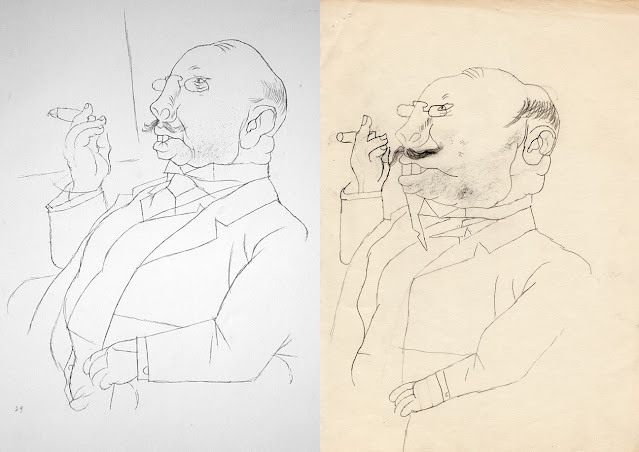
When I was a 9 year old—I'd said 12—copying George Grosz and listening or Brecht and Weil, I wanted a homburg with the brim turned down on one side. I didn't want to be a socialist or a fascist. I wanted to be immune. I understood what these idiots don't understand at 25 or 40. We're all part of the fucking disease.

Monday, November 25, 2019

"The Temporary Alliance Between the Elite and the Mob"

The first time I heard the phrase immanent critique I knew it was just a way of turning decadence and emotional honesty into positivism. I was mocked for 20 years as a conservative by people who called themselves radicals whose sensibility was more or less fascist. And now it's almost forgotten and I'm still the only one who gets the joke.

Repeat from 2007. Klaus Nomi sings Purcell


What power art thou, who from below
Hast made me rise unwillingly and slow
From beds of everlasting snow?
See'st thou not how stiff and wondrous old,
Far unfit to bear the bitter cold,
I can scarcely move or draw my breath?
Let me, let me freeze again to death.
---

Repeat from 2004

Fintan O'Toole. Our Own Jacobean NYRB, October 7, 1999
Harold Pinter's imagination was shaped to a large extent by Shakespeare, Beckett, Joyce, and Kafka. But in a speech delivered in 1995 and published now in Various Voices, a collection of his essays, interviews, short stories, and poems, he recalls the schoolteacher with whom he went for long walks in the 1940s and 1950s:

Shakespeare dominated our lives at that time (I mean the lives of my friends and me) but the revelation which Joe Brearley brought with him was John Webster. On our walks, we would declare into the wind, at the passing trolley-buses or indeed to the passers-by, nuggets of Webster....

He goes on to quote, as if from memory, lines from The Duchess of Malfi and The White Devil like "What would it pleasure me to have my throat cut/ With diamonds?"; "There's a plumber laying pipes in my guts"; "My soul, like to a ship in a black storm/Is driven I know not whither"; "I have caught/ An everlasting cold. I have lost my voice/Most irrecoverably." And, of course, "Cover her face; mine eyes dazzle; she died young." He adds, "That language made me dizzy." 
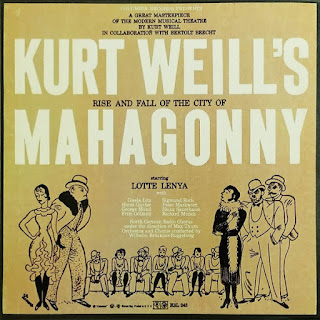
I've said this before without quoting the article. My God, how that reminds me of my childhood ecstasy, listening to the 1958 recording of Mahagonny. I felt as if I were being torn apart, and smiling. Second to this was my parents' recording of Der Jasager, the only opera that has ever made me cry, and which I've thought for years should be staged with the cast in the uniforms of the Hitlerjugend. I've always associated Brecht with just the sort of decadence, of formal rigor and conflict, that Pinter responded to and O'Toole describes.

I have caught/ An everlasting cold. I have lost my voice/Most irrecoverably.
I just laugh and laugh.
Perfect
----

I'd forgotten that the last time I posted this, I introduced a new tag.


And here

---

Years later, because I write too often as if people understand what I take for granted. Nomi's alien freak act was a defense. He knew people would laugh at him and he played to it, to harden himself against abuse and for acceptance: "a shell as hard as steel, inured to pain." 

Purcell's "What Power Art Thou", from King Arthur, was written for a bass. Nomi's transposition, as "The Cold Song" has led to others, trained countertenors and sopranos, singing it "straight". And that's possible only because they understand that under the facade, Nomi too was singing it "straight", as a man, and a homosexual, describing honestly in his art what it means to have to play the faggot and the clown. Ideological vanguardists, promoters of "immanent critique", and saints and supermen, want to preserve self-hatred as a model. That model is fascist.

Monday, January 21, 2019

Edward Mendelson in 1981, reviewing After the Wake: An Essay on the Contemporary Avant-Garde, by Christopher Butler. 
‘My plan,’ he writes, ‘has been to argue that in the 1950s radically new conventions for the language of art were developed by writers, musicians and painters who wished to break away from modernism.’ This argument faces difficulties at the start, since the avant-garde has been proclaiming its radical newness longer than anyone can remember. The most time-honoured convention of the manifesto-writers is innovation: the formula for newness is handed down unchanged from generation to generation. Butler quotes an artist who wants nothing to do with ‘all the structures, values, feelings, of the whole European tradition. It suits me fine if that’s all down the drain.’ This happens to be Frank [Donald] Judd speaking in the late 1960s, but all that distinguishes it from Futurist manifestos of fifty years before is its tone of lumpen disgruntlement. Allen Ginsberg, quoted in one of Butler’s epigraphs, says: ‘there is nothing to be learned from history any more. We’re in science fiction now.’ This remark, differing only in vocabulary from claims made early in this century for the new machine age, is proof in itself that Ginsberg’s ignorance of history does not exempt him from repeating it. 

Allen Ginsberg, quoted in one of Butler’s epigraphs, says: ‘there is nothing to be learned from history any more. We’re in science fiction now.’ This remark, differing only in vocabulary from claims made early in this century for the new machine age, is proof in itself that Ginsberg’s ignorance of history does not exempt him from repeating it.
A more vivid proof, not mentioned by Butler, may be found in Ginsberg’s recent echoes of the totalitarian apologetics offered by some of the Modernists of the 1920s and 1930s. Ginsberg has placed his spiritual life in the care of a Tibetan guru (one consciously avoided by the Dalai Lama), the autocrat of a spiritual retreat and poetry workshop near Boulder, Colorado. Among the guru’s activities are punching recalcitrant visiting faculty in the face and having them stripped naked by his goon squad. Ginsberg defends the guru’s methods as an “experiment in monarchy”, and insists that he must not be judged by the standards of lesser mortals.[i]
The public, the demimonde, and the curators in 1990. 

There were times when the Mapplethorpe trial in Cincinnati produced testimony worthy of the title attached to the museum exhibit: "The Perfect Moment."
Perfect Moment No. 1: Prosecutor Frank Prouty holds up two photographs, one of a man with a bullwhip in his rectum. He asks the art director who chose these images for the show: "Would you call these sexual acts?"
She answers: "I would call them figure studies."
Perfect Moment No. 2: Prouty questions museum director Dennis Barrie: "This photograph of a man with his finger inserted in his penis, what is the artistic content of that?"
He responds: "It's a striking photograph in terms of light and composition."[ii]

The defense is that art doesn’t really matter, because its only aesthetics. And if that’s the case nothing matters short of crime, actual law-breaking, laws written by others to be applied by others, by the state and not by us. This is the result of a belief in freedom of speech linked more to freedom of property than freedom of debate. In an atomized society of voyeurs with no political responsibility art is reduced to exhibits of masturbation followed by applause, “self-expression”, described without judgment, because judging is moralizing, and that’s left for the law-makers. 

Grace Gluick does better at least than the museum director in a review of the posthumous authorized biography. After referring the “brouhaha” of the obscenity trial, she turns to the book and the author   

Like these would-be censors, Patricia Morrisroe, a magazine journalist, does not engage in an informed discussion of her subject's work… instead she focuses on his progressively degenerate life style. Her book is long on gossipy detail (nearly a quarter of it is devoted to a ghoulishly clinical rundown of Mapplethorpe's final days) but short on real engagement with the work. The photographs were the life and vice versa, she implies, but that's about all she offers in the way of elucidation.
Early in his restless adulthood, she tells us, Mapplethorpe formed a symbiotic bond with Patti Smith, who eventually became a punk-rock star; after that he had a long relationship with Samuel Wagstaff, a wealthy older curator and collector who helped orchestrate Mapplethorpe's career. But his rapacious sexual appetite led him to other, less stable and sometimes downright dangerous liaisons. According to Ms. Morrisroe, he had a penchant for sadomasochistic, coprophiliac encounters with well-muscled black men he picked up in bars. A racist (who also seemed to dislike Jews), he called them "nigger" in love play and exacted from them servitude as photographic models. "His photographs would serve as a diary of his sexual adventures," Ms. Morrisroe writes. He was convinced that he had acquired AIDS from a black man, although he boasted of having had sex with at least a thousand male partners.
"Mapplethorpe's loft had become a port of call for men with every conceivable sexual perversion," Ms. Morrisroe writes, "and they arrived with suitcases, and sometimes doctor's bags, filled with catheters, scalpels, syringes, needles, laxatives, hot water bottles, rope, handcuffs and pills. They dressed up as women, SS troopers and pigs."[iii]
The final paragraphs of Glueck and Ellen Goodman, quoted above on the trial.

My own feeling is that those "bizarre aspects" -- the sadomasochistic images documenting a tribal culture that, like it or not, is part of the real world -- are Mapplethorpe's most original contribution.… Lightweight though he was, even Mapplethorpe deserves a better biography.

Goodman

I agree with the decision and with those who defended the museum's right to show these photographs. To leave the dark side out of a Mapplethorpe show would be like leaving the tortured black paintings out of a retrospective of Goya's work. It wouldn't be legitimate to pick and choose the sunny side of the work -- the Calla lilies and celebrities -- and show it as the whole….
But even in the moment of victory, there is still a warning here. This trial, and the funding woes of the NEA, are not just the fault of Jesse Helms on the rampage. They are the fault as well of an art community whose members prefer to live in a rarefied climate, talking to each other, subject only to "peer review" and scornful of those who translate the word "art" into "smut."
In many cities, there is still the knock of the policeman at the door. Having failed to make its case in public, the art community ends up making it in court. In the history of art, this is not a perfect moment.

Discussions of Mapplethorpe still largely miss the point. If the work is good, it’s because he’s described everything that’s damaged in our relation to homosexuality. One of his childhood neighbors remembers Mapplethorpe telling him  “There's this clock in Hell that chimes every hour, You will never get out . . . you will never get out . . . you will never get out." [iv]  His work is tragic or it’s nothing. The cold beauty is defensive armoring, the dream of a shell as hard as steel, inured to pain. To take his work seriously is to admit that all obscenity trials are absurd. He saw himself as obscene, and seeing no choice but to accept it dove in head first. The question is whether he described his sense of his own obscenity, his self-hatred, his need for self-annihilation well enough that an audience claiming at least to be without his fears and the desires that come from them, can feel their pull. 

“My wife is a saint. She’s a much better person than I am. Honestly. She’s, like, Episcopalian, Church of England. She prays, she believes in God, she knows Jesus, she believes in that stuff. And it’s just not fair if she doesn’t make it, she’s better than I am. But that is a pronouncement from the chair. I go with it.”[v]

Mel Gibson is a good filmmaker.  His conflicts, intelligence and technical skill make him one.  Art is a craft. It’s a lie; it’s seduction. If you’re not tempted to go with it, it doesn’t work. Double Indemnity doesn’t work if you’ve never wanted to kill. 

Nietzsche or Baudelaire: Is there a pernicious form of art? Is there a sick philosophy?  Philosophy faces the bigger question: to see Nietzsche’ as a tragic figure, a moralist anti-moralist, an archetypical Christian apostate, caught in the false dichotomy of rationalism and irrationalism, to read him in context and for subtext, renders his philosophy into  mere literature.  

The arts are Burkean. Artists are revolutionary only by trying to make sense of a present that others haven’t had the courage or honesty to face. You can’t describe anything in detail without having intimate knowledge of it, and intimate knowledge is attachment, and describing your perceptions of the world is more compelling than declaiming your fantasies. Milton as Blake says, was "of the Devil's party without knowing it." 

Craft, again, is common form; the most radical craftsmen always see themselves as traditionalists, even if they see their relation to craft as to reinventing it. But the grand dialecticians of Modernism always wanted to pretend the dialectic ends with them. The reification of contradiction as ‘immanent critique’, by the bureaucrats of the Frankfurt School was as decadent in its origins as the formalism of the Vienna Circle. The art celebrated in its name as radical is in fact always the most honestly reactionary, the most ‘pernicious’, because the most attached to the present, the world that made it. 

The problem for programmatic liberalism as for radicalism is that both are fantasies sprung out of individualist imagination; both deny the fact of what Arendt called human “plurality”.  The truths of liberalism and radicalism are singular because they’re generalizations; the truths of art are plural because specific. Brecht’s decadence is  far less problematic than Walter Benjamin’s for the same reason Borges’ decadence is more problematic than Billy Wilder’s. But Modernism takes what  it can use. Self-hatred is as appropriate a topic in discussing Borges and Philip Roth as Mapplethorpe, Fassbinder, Celine, Mishima, or Houellebecq. “Céline is my Proust!”[vi] as Roth said. But the only people to refer openly to Roth’s self-hatred use it to attack his work.  And he’s defended from the charge with the same loyalty as defenders of Borges, for reasons that have nothing to do with the work itself, but only with the role they’re made to play, even though Borges deals in generalizations, and Roth in specifics. 

Two Quotes, from Kant and de Maistre.

Thus we observe here as elsewhere in human affairs, in which almost everything is paradoxical, a surprising and unexpected course of events: a large degree of civic freedom appears to be of advantage to the intellectual freedom of the people, yet at the same time it establishes insurmountable barriers. A lesser degree of civic freedom, however, creates room to let that free spirit expand to the limits of its capacity.[vii]

Everything that constrains a man strengthens him[viii]

The converse of the innate conservatism of the arts is that the arts describe society at its most complex, and this complexity is a threat to idealism of any form. Moments of stress, when societies are opening up or closing down produce a flowering of culture, pushing against assumptions or demands. So Kant and de Maistre could be describing Athens and the Renaissance or fin de Siècle Vienna or Weimer, or the founding of the United States.

The word “innovate”—to make new—used to have chiefly negative connotations: it signified excessive novelty, without purpose or end. Edmund Burke called the French Revolution a “revolt of innovation”; Federalists declared themselves to be “enemies to innovation.” George Washington, on his deathbed, was said to have uttered these words: “Beware of innovation in politics.” Noah Webster warned in his dictionary, in 1828, “It is often dangerous to innovate on the customs of a nation.”[ix]

It’s safe to assume  that American liberal critics of the jargon of business school and Madison Ave  will make no reference to its history, or use today in the language of  the alt-leftand Occupy,or Ranciere’s “Disruptive Dissensus”[x]. The same critics of will lump Edmund Burke with Sarah Palin.[xi]And none of them will have much to say about art, except those things that confirm their own idealisms, or that they twist to shape it.


[i]  Edward Mendelson. “Post-Modern Vanguard”, London Review of Books,  September 3 1981
https://www.lrb.co.uk/v03/n16/edward-mendelson/post-modern-vanguard
[ii]   Ellen Goodman,  “A Warning From The Mapplethorpe Trial”, Washington Post, October 9, 1990
https://www.washingtonpost.com/archive/opinions/1990/10/09/a-warning-from-the-mapplethorpe-trial/ed531ed0-e7c4-44fe-ac8a-cbd488b89e01
[iii]  Grace Glueck, “Fallen Angel”, New York Times, June 25 1995, https://www.nytimes.com/1995/06/25/books/fallen-angel.html
[iv]  Kunio Francis Tanabe, “The Darkroom Of The Soul”, Washington Post, May 28, 1995 https://www.washingtonpost.com/archive/entertainment/books/1995/05/28/in-the-darkroom-of-the-soul/68209f7f-0504-4df6-a110-6d1ff20b4ff4
[v]  Jeannette Walls with Ashley Pearson, “Mel Gibson says his wife may be going to hell” Today, Aug. 5, 2010
https://www.today.com/popculture/mel-gibson-says-his-wife-could-be-going-hell-wbna4224452
[vi]  Norman Manea, “Nearby and Together: Norman Manea on His Friend Philip Roth”, LA Review of Books, June 23rd2018
https://lareviewofbooks.org/article/nearby-and-together-norman-manea-on-his-friend-philip-roth/
[vii]Kant, What is Enlightenment,  trans: Mary C Smith,  http://www.columbia.edu/acis/ets/CCREAD/etscc/kant.html
[viii]Quoted in John Morley, Critical Miscellanies (Vol. 2 of 3) Essay 4: Joseph de Maistre
Macmillan And Co., Limited
New York: the Macmillan Company 1905,  p. 312
[ix]Jill Lepore, “The Disruption Machine: What the gospel of innovation gets wrong”, The New Yorker,  June 24th2014 https://www.newyorker.com/magazine/2014/06/23/the-disruption-machine
[x]Jacques Rancière, Dissensus: On Politics and Aesthetics, Steven Corcoran (ed., tr.), Continuum, 2010, 
[xi]Corey Robin, The Reactionary Mind: Conservatism from Edmund Burke to Sarah Palin, Oxford University Press , 2011

Full text here or here. 

Wednesday, December 26, 2018

The last few posts are updated a bit. I'm back at the megillah 
---
Baroque art is the art of perception, the space between what is,in an ideal sense, and what we experience. Velázquez is a the first painter to paint the world and as it appears to the eye; the other way to put it is to say he was the first painter of illusions.  Jonathan Brown on the portrait of the bufón, jester and actor,  Pablo de Valladolid 
The figure, clad in a black velvet suit an wrapped in a cloak, stands with both feet planted firmly on the ground, his right arm dramatically thrust into space. The marvelous economy of the pose is intensified by the handling of the surrounding space. Pablo is set against a light-colored ground, which is almost completely undefined except in the upper right corner, where the color turns darker, and the shadow at his feet, trails inconsequentially off to the right. The juncture between floor and wall, the key to imparting a sense of space, has simply been omitted. And the figure does not float or appear to be unduly flat. Indeed, the absence distracting elements of any kind brings the jester to life with startling directness. Implicit in this painting is a remarkable challenge to the rules and procedures of Renaissance painting. Through the exercise of his powerful creative mind, Velázquez appears to arrived at a conclusion which, to us, seems obvious – conventional rules of painting produce conventional pictures of the world. Put another way, Velázquez had come to understand that paintings executed by following the classical produced a view different from what the eye sees.  Works of art governed by rules were almost by definition a mental fiction, and Velázquez was interested in perceptible fact. Pablo de Valladolidis based on a simple optical phenomenon—it is impossible for the eye to focus simultaneously on different planes of depth. Thus, the background of a portrait can be treated almost as a blur without any loss of verisimilitude, if one or two cognitive accents are given the viewer. In fact, the illusion of reality gains immeasurably from but far-reaching change of approach. In Pablo de Valladolid, as in the Portrait of Philip IV in Brown and Silver, Velazquez begins to experiment with a novel approach to the art of representation which would eventually redefine the relationship between art and nature.[i]
What’s ignored is that Velázquez is a loyal and committed servant of the most reactionary, absolutist monarchy in Europe,  and has given his king a life sized image (the painting itself is 209 x123 cm) of another, lower, servant represented in a fully realized psychologically astute portrait of another human being, a picture that at the same time has a hieratic classicism, almost the distancing of a still life. Manet called to it “possibly the most extraordinary piece of painting that has ever been done.”[ii] To us it’s almost Brechtian. 
There’s no inherent contradiction between political absolutism and the materiality in Titian’s paintings, in the literary classicism of Poussin and Claude or the physical grace of Baroque sculpture. Tensions are resolved one way or another, or awkward subjects are avoided. Velázquez’ paintings are defined by paradox. To sense this fully you need to look at -and ideally of course to stand in front of- the portraits of the people he served, his superiors, not his equals or below. Here's  Brown's description of  Philip IV in Brown and Silver.
[I]t is here the first time that see the remarkable and original technique which sets Velazquez apart from almost every other artist of his day. In this portrait, Philip wears a costume comprised of a tunic and breeches decorated with silver brocade, under which is an ornate blouse of silvery white and black. On his shoulders there is a black cape also embroidered with silver thread. The challenge of depicting an ornate costume of this kind lies in reproducing the dazzling play of light on the surface without sacrificing the intricacy of the design. The artist who concentrates on the pattern is inevitably forced to imitate the dull geometry of needlework, as dozens of late sixteenth- and early seventeenth-century court portraits show. But Velazquez’ approach, which aims at capturing the fleeting effects of light as it glances off the silver threads, is not only difficult, but runs the risk of minimizing the intricate workmanship of the garment and thus displeasing the wearer [a note shows that a portrait had been rejected for this reason]. His solution to the dilemma is a brushstroke of genius. Realizing that a high degree of finish was fatal to rendering  spontaneous effects, he resorted to using a sketch-like technique in a formal, official work of art. 
From our perspective, this seems like a logical and not especially innovative idea. But in the context of the seventeenth century, it was virtually unprecedented. A sketchy technique is of course not unknown in the work of other great seventeenth-century painters, but there is a difference of degree which is crucial. In the Portrait of Philip in Brown and Silver, Velazquez abandons the fluid technique of sketching in oil used, for example, by Rubens, and instead utilizes short, succinct, impastoed strokes of infinite shape and size which are applied so that they appear to hover above the brown ground. Seen at close range*this busy tangle of brushwork appears almost random and formless, But at a distance, it reproduces the glittering surface of a richly brocaded costume with remarkable fidelity.[iii]
The passage is confused. There’s no reason to think that Velazquez, once the issue became clear, was ever not interested in the duality that’s visible in the painting here. After all he had begun with solidity, not the reverse. The question more likely is how much practice it took get the result he wanted: light implying structure. And Brown is confused again writing about Las Meninas, or rather he refuses to accept the contradictions that lay behind in.
Las Meninas is the culmination of  a lifelong examination of the relationship between art and  nature. Velázquez seems to have tried to create art without apparent artifice and thus to reduce the gap between what the eye sees in nature and what the eye sees in art. The desire to attain greater naturalism in painting was widely felt in the seventeenth century,  but no one went further in achieving it than Velázquez. The proof of his success is Las Meninas, a painting in which his new type of artistry is used to produce an intense encounter with reality. 
In planning the calculated approximation of art to nature, Velazquez had to redefine the traditional relationship between painting and reality. 64 Renaissance theory placed the intellect at the center of artistic activity; the painter's mind was required to mediate between the haphazard world of appearances and the ordered, harmonious world of art. If the idea of beauty changed according to time and circumstances, the value of an accepted canon of beauty was never challenged. Works of painting which merely recorded natural appearances, such as still life and portraiture, were assigned a lower place in the hierarchy of art than were those which aspired to express universal truths about man, nature, and the divine in an ideal style. In Las Meninas, however, the illusion, not the improvement, of everyday reality is given primacy. For whatever the picture may be, it is a brilliant tour de force of illusionistic painting.
“…to create art without apparent artifice” . “…the illusion, not the improvement, of everyday reality is given primacy. “…a brilliant tour de force of illusionistic painting”  But the artifice is apparent; illusion has replaced the ideal, and all this is in an art made to celebrate Catholic absolutism. You can see why Brown’s head is spinning.
Velazquez’ job was to project to the world the authority of the Spanish throne, to proclaim the divine right of kings, but as he matured he became a master of  tricks and illusion. Physical solidity gives way to flickers of light and the mere perception of solidity.  He painted people of every rank with emotional directness and honesty, so we see weak and melancholy kings and proud dwarfs. He was a loyal both to the king and to his own perceptions, and for the first time in Christian art we’re presented not with an embodiment of ideal truth but images suffused with the need to believe.  Velazquez was the first artist to depict the monarchy, and maybe even god, as a noble lie. 
In the inventory of his fine library one finds very few books of devotion in comparison to what was usual among people of good breeding and social position. There were, however, numerous books on mathematics, architecture, history, and Spanish and Italian poetry. If one excepts the years of Velázquez's youth in Seville, when as merely one more of the artists of his generation, he had to work for ecclesiastical patrons, religious themes occupy an insignificant position in his works and are always the response (Christ on the Cross, The Coronation o the Virgin, Saint Anthony Abbot and Saint Paul the Hermit) to specific royal assignments. Of course we cannot think of Velázquez as a religious skeptic (an attitude inconceivable and obviously unconfessable in the Spain of the time). In contrast to his contemporaries, however, he distanced himself from conventional religiosity; this absence of the religious is nevertheless accompanied by a dignified and serious tone of mercy toward all creatures, by a "modern" and lay humanism, that makes him unique. [iv]
Panofsky dismisses the story of The Holy Roman Emperor picking Titian's paintbrush off the floor, but the same story is told about Philip IV. Velazquez’ royal portraits are tragic; they show the weaknesses of an insecure man, yet they show him great respect.  Stripped of the obligatory pomp, it’s the same respect Velazquez showed Pablo de Valladolid.  Brown ends his book writing that  Velazquez “…discovered a new way to transmute images of kings and queens and princes and princesses into a new form of art which continues to grow in power long after the memory of his protectors has faded nearly into oblivion.”  Brown, the defender of progress and art for art’s sake, stripped of its full depth of meaning, can’t see the obvious. Velazquez’s “new way” and “new form of art” describe the end of monarchy. The maturation of his technique, the curiosity that drove it, and the obligations of his calling diverged, but the form of his obligation changed as well. The glorification of a master became the sympathy for a friend, in ways that neither king nor servant could ever admit. We’re back to Baudelaire, and Renoir, von Rauffenstein, and de Boeldieu, the originating tragedy, later played as kitsch, (as farce).

[i]  Brown, p.101
[ii]  Svetlana Alpers The Vexations of Art: Velázquez and Others,Yale 2007 p. 232
[iii] Brown, p.85
[iv]Perez Sanchez, p.22

Monday, November 06, 2017

Gustav Grundgens in Fritz Lang's M, (1931)
Arendt contra Brecht, Baudelaire, and Zero Dark 30

The Origins of Totalitarianism, Part 3, Ch. 1, Sec. 2: The Temporary Alliance Between the Elite and the Mob
If we compare this generation with the nineteenth-century ideologists, with whose theories they sometimes seem to have so much in common, their chief distinction is their greater authenticity and passion. They had been more deeply touched by misery, they were more concerned with the perplexities and more deadly hurt by hypocrisy than all the apostles of good will and brotherhood had been. And they could no longer escape into exotic lands, could no longer afford to be dragon-slayers among strange and exciting people. There was no escape from the daily routine of misery, meekness, frustration, and resentment embellished by a fake culture of educated talk; no conformity to the customs of fairy-tale lands could possibly save them from the rising nausea that this combination continuously inspired.

This inability to escape into the wide world, this feeling of being caught again and again in the trappings of society—so different from the conditions which had formed the imperialist character—added a constant strain and the yearning for violence to the older passion for anonymity and losing oneself. Without the possibility of a radical change of role and character, such as the identification with the Arab national movement or the rites of an Indian village, the self-willed immersion in the suprahuman forces of destruction seemed to be a salvation from the automatic identification with pre-established functions in society and their utter banality, and at the same time to help destroy the functioning itself. These people felt attracted to the pronounced activism of totalitarian movements, to their curious and only seemingly contradictory insistence on both the primacy of sheer action and the overwhelming force of sheer necessity. This mixture corresponded precisely to the war experience of the "front generation," to the experience of constant activity within the framework of overwhelming fatality.

Activism, moreover, seemed to provide new answers to the old and troublesome question, "Who am I?" which always appears with redoubled persistence in times of crisis. If society insisted, "You are what you appear to be," postwar activism replied: "You are what you have done"—for instance, the man who for the first time had crossed the Atlantic in an air-plane (as in Brecht's Der Flug der Lindberghs)—an answer which after the second World War was repeated and slightly varied by Sartre's "You are your life" (in Huis Clos). The pertinence of these answers lies less in their validity as redefinitions of personal identity than in their usefulness for an eventual escape from social identification, from the multiplicity of inter-changeable roles and functions which society had imposed. The point was to do something, heroic or criminal, which was unpredictable and undetermined by anybody else.

The pronounced activism of the totalitarian movements, their preference for terrorism over all other forms of political activity, attracted the intellectual elite and the mob alike, precisely because this terrorism was so utterly different from that of the earlier revolutionary societies. It was no longer a matter of calculated policy which saw in terrorist acts the only means to eliminate certain outstanding personalities who, because of their policies or position, had become the symbol of oppression. What proved so attractive was that terrorism had become a kind of philosophy through which to express frustration, resentment, and blind hatred, a kind of political expressionism which used bombs to express oneself, which watched delightedly the publicity given to resounding deeds and was absolutely willing to pay the price of life for having succeeded in forcing the recognition of one's existence on the normal strata of society. It was still the same spirit and the same game which made Goebbels, long before the eventual defeat of Nazi Germany, announce with obvious delight that the Nazis, in case of defeat, would know how to slam the door behind them and not to be forgotten for centuries.

Yet it is here if anywhere that a valid criterion may be found for distinguishing the elite from the mob in the pretotalitarian atmosphere. What the mob wanted, and what Goebbels expressed with great precision, was access to history even at the price of destruction. Goebbels' sincere conviction that "the greatest happiness that a contemporary can experience today" is either to be a genius or to serve one,[57] was typical of the mob but neither of the masses nor the sympathizing elite. The latter, on the contrary, took anonymity seriously to the point of seriously denying the existence of genius; all the art theories of the twenties tried desperately to prove that the excellent is the product of skill, craftsmanship, logic, and the realization of the potentialities of the material.[58] The mob, and not the elite, was charmed by the "radiant power of fame" (Stefan Zweig) and accepted enthusiastically the genius idolatry of the late bourgeois world. In this the mob of the twentieth century followed faithfully the pattern of earlier parvenus who also had discovered the fact that bourgeois society would rather open its doors to the fascinating "abnormal," the genius, the homosexual, or the Jew, than to simple merit. The elite's contempt for the genius and its yearning for anonymity was still witness of a spirit which neither the masses nor the mob were in a position to understand, and which, in the words of Robespierre, strove to assert the grandeur of man against the pettiness of the great.

This difference between the elite and the mob notwithstanding, there is no doubt that the elite was pleased whenever the underworld frightened respectable society into accepting it on an equal footing. The members of the elite did not object at all to paying a price, the destruction of civilization, for the fun of seeing how those who had been excluded unjustly in the past forced their way into it. They were not particularly outraged at the monstrous forgeries in historiography of which all totalitarian regimes are guilty and which announce themselves clearly enough in totalitarian propaganda. They had convinced themselves that traditional historiography was a forgery in any case, since it had excluded the underprivileged and oppressed from the memory of mankind. Those who were rejected by their own time were usually forgotten by history, and insult added to injury had troubled all sensitive consciences ever since faith in a hereafter where the last would be the first had disappeared. Injustices in the past as well as the present became intolerable when there was no longer any hope that the scales of justice eventually would be set right. Marx's great attempt to rewrite world history in terms of class struggles fascinated even those who did not believe in the correctness of his thesis, because of his original intention to find a device by which to force the destinies of those excluded from official history into the memory of posterity.

The temporary alliance between the elite and the mob rested largely on this genuine delight with which the former watched the latter destroy respectability. This could be achieved when the German steel barons were forced to deal with and to receive socially Hitler the housepainter and self-admitted former derelict, as it could be with the crude and vulgar forgeries perpetrated by the totalitarian movements in all fields of intellectual life, insofar as they gathered all the subterranean, nonrespectable elements of European history into one consistent picture. From this viewpoint it was rather gratifying to see that Bolshevism and Nazism began even to eliminate those sources of their own ideologies which had already won some recognition in academic or other official quarters. Not Marx's dialectical materialism, but the conspiracy of 300 families; not the pompous scientificality of Gobineau and Chamberlain, but the "Protocols of the Elders of Zion"; not the traceable influence of the Catholic Church and the role played by anti-clericalism in Latin countries, but the backstairs literature about the Jesuits and the Freemasons became the inspiration for the rewriters of history. The object of the most varied and variable constructions was always to reveal official history as a joke, to demonstrate a sphere of secret influences of which the visible, traceable, and known historical reality was only the out-ward facade erected explicitly to fool the people.

To this aversion of the intellectual elite for official historiography, to its conviction that history, which was a forgery anyway, might as well be the playground of crackpots, must be added the terrible, demoralizing fascination in the possibility that gigantic lies and monstrous falsehoods can eventually be established as unquestioned facts, that man may be free to change his own past at will, and that the difference between truth and falsehood may cease to be objective and become a mere matter of power and clever-ness, of pressure and infinite repetition. Not Stalin's and Hitler's skill in the art of lying but the fact that they were able to organize the masses into a collective unit to back up their lies with impressive magnificence, exerted the fascination. Simple forgeries from the viewpoint of scholarship appeared to receive the sanction of history itself when the whole marching reality of the movements stood behind them and pretended to draw from them the necessary inspiration for action.

The attraction which the totalitarian movements exert on the elite, so long as and wherever they have not seized power, has been perplexing because the patently vulgar and arbitrary, positive doctrines of totalitarianism are more conspicuous to the outsider and mere observer than the general mood which pervades the pretotalitarian atmosphere. These doctrines were so much at variance with generally accepted intellectual, cultural, and moral standards that one could conclude that only an inherent fundamental short-coming of character in the intellectual, "la trahison des clercs" (J. Benda), or a perverse self-hatred of the spirit, accounted for the delight with which the elite accepted the "ideas" of the mob. What the spokesmen of humanism and liberalism usually overlook, in their bitter disappointment and their unfamiliarity with the more general experiences of the time, is that an atmosphere in which all traditional values and propositions had evaporated (after the nineteenth-century ideologies had refuted each other and exhausted their vital appeal) in a sense made it easier to accept patently absurd propositions than the old truths which had become pious banalities, precisely because nobody could be expected to take the absurdities seriously. Vulgarity with its cynical dismissal of respected standards and accepted theories carried with it a frank admission of the worst and a disregard for all pretenses which were easily mistaken for courage and a new style of life. In the growing prevalence of mob attitudes and convictions—which were actually the attitudes and convictions of the bourgeoisie cleansed of hypocrisy—those who traditionally hated the bourgeoisie and had voluntarily left respectable society saw only the lack of hypocrisy and respectability, not the content itself. [59]

Since the bourgeoisie claimed to be the guardian of Western traditions and confounded all moral issues by parading publicly virtues which it not only did not possess in private and business life, but actually held in contempt, it seemed revolutionary to admit cruelty, disregard of human values, and general amorality, because this at least destroyed the duplicity upon which the existing society seemed to rest. What a temptation to flaunt extreme attitudes in the hypocritical twilight of double moral standards, to wear publicly the mask of cruelty if everybody was patently inconsiderate and pretended to be gentle, to parade wickedness in a world, not of wickedness, but of meanness! The intellectual elite of the twenties who knew little of the earlier connections between mob and bourgeoisie was certain that the old game of epater le bourgeois could be played to perfection if one started to shock society with an ironically exaggerated picture of its own behavior.

At that time, nobody anticipated that the true victims of this irony would be the elite rather than the bourgeoisie. The avant-garde did not know they were running their heads not against walls but against open doors, that a unanimous success would belie their claim to being a revolutionary minority, and would prove that they were about to express a new mass spirit or the spirit of the time. Particularly significant in this respect was the reception given Brecht's Dreigroschenoper in pre-Hitler Germany. The play presented gangsters as respectable businessmen and respectable businessmen as gangsters. The irony was somewhat lost when respectable businessmen in the audience considered this a deep insight into the ways of the world and when the mob welcomed it as an artistic sanction of gangsterism. The theme song in the play, "Erst kommt das Fressen, dann kommt die Moral," was greeted with frantic applause by exactly everybody, though for different reasons. The mob applauded because it took the statement literally; the bourgeoisie applauded because it had been fooled by its own hypocrisy for so long that it had grown tired of the tension and found deep wisdom in the expression of the banality by which it lived; the elite applauded because the unveiling of hypocrisy was such superior and wonderful fun. The effect of the work was exactly the opposite of what Brecht had sought by it. The bourgeoisie could no longer be shocked; it welcomed the exposure of its hidden philosophy, whose popularity proved they had been right all along, so that the only political result of Brecht's "revolution" was to encourage everyone to discard the uncomfortable mask of hypocrisy and to accept openly the standards of the mob. A reaction similar in its ambiguity was aroused some ten years later in France by Celine's Bagatelles pour un Massacre, in which he proposed to massacre all the Jews. Andre Gide was publicly delighted in the pages of the Nouvelle Revue Francaise, not of course because he wanted to kill the Jews of France, but because he rejoiced in the blunt admission of such a desire and in the fascinating contradiction between Celine's bluntness and the hypocritical politeness which surrounded the Jewish question in all respectable quarters. How irresistible the desire for the unmasking of hypocrisy was among the elite can be gauged by the fact that such delight could not even be spoiled by Hitler's very real persecution of the Jews, which at the time of Celine's writing was already in full swing. Yet aversion against the philosemitism of the liberals had much more to do with this reaction than hatred of Jews. A similar frame of mind explains the remarkable fact that Hitler's and Stalin's widely publicized opinions about art and their persecution of modern artists have never been able to destroy the attraction which the totalitarian movements had for avant-garde artists; this shows the elite's lack of a sense of reality, together with its perverted selflessness, both of which resemble only too closely the fictitious world and the absence of self-interest among the masses. It was the great opportunity of the totalitarian movements, and the reason why a temporary alliance between the intellectual elite and the mob could come about, that in an elementary and undifferentiated way their problems had become the same and foreshadowed the problems and mentality of the masses.
--- 
[57]Goebbels, op. sit, p 139.

[58] The art theories of the Bauhaus were characteristic in this respect. See also Bertolt Brecht's remarks on the theater, Gesammelte Werke, London. 1938.

[59] The following passage by Rohm is typical of the feeling of almost the whole younger generation and not only of an elite "Hypocrisy and Pharisaism rule They are the most conspicuous characteristics of society today.... Nothing could be more lying than the so-called morals of society" These boys "don't find their way in the philistine world of bourgeois double morals and don't know any longer how to distinguish between truth and error" (Die Gewhichte einei Hochverratels, pp. 267 and 269) The homosexuality of these circles was also at- least partially an expression of their protest against society.

Sunday, November 20, 2016

Another from the first years of the 60s.

Alfred Kazin, Contemporaries,
The Village Today: or The Music the Money Makes
Saloon Society, by Bill Manville; photographs by David Attie, design by
Alexey Brodovitch. New York: Duell, Sloan and Pearce.

Bill Manville, who writes a column for the Village Voice, is an acute if perhaps too glibly rueful observer whose subject is New or Upper Bohemia. Whatever Greenwich Village may once have been or may now be supposed to have been, anyone who has recently strayed down MacDougal Street on a Saturday night knows that now it is a playground. What Coney Island was once to the honest workingman, Greenwich Village is now to the unmarried or ex-married young professional. The Village streets, pads, coffee houses, and bars are jammed with people who look a million times more sensitive, artistic, and "interesting" than William Faulkner or Igor Stravinsky, but who live by teaching economics, analyzing public opinion, writing advertising copy, practicing psychoanalysis, or "doing research" for political candidates. They are not intellectuals, but occasionally dream that they will be. That is their secret ambition. Meanwhile, being young and frisky, they are not yet the "managers" in our highly organized technical society. But they have the skills someday to become managers. Just now they don't want power any more than they want marriage. They want a good time, and a good time is what they go to the Village for, and a good time in the Village is what they get. The LeRoy Street Saloon, Chumley's, the San Remo, the White Horse Tavern, the Kettle, Minetta, O. Henry's, Louis's, the Riviera, Julius's, the Casa Allegra, El Faro. . . .

What I like most about Bill Manville's reports of conversations in these places is his honesty. He is aware of himself and his friends as the genuinely new fact the young always are, and he has the intelligence to notice what they want and what they miss. Maybe "honesty" in a writer is only a form that intelligence takes — perhaps this is why supposed rebels like the "beats" write so badly. But the vital difference is that the beat writers tend, on their own testimony, to be victims of mother and yearners after sex, and so write about sex as if it were the revolution. Manville's people are far more worldly than that. What the traveling salesman was once vis-a-vis the rural areas, these charming lechers and morning drinkers are now to all the humdrum and respectable marrieds in the suburbs.

The lines are carefully drawn: "Married and unmarried people should never mix. You can't be sentimental about these things; when your friends marry, you have to drop them, and they have to drop you." The same character says honestly, "God, I hate rent-payers, taxpayers, husbands, fathers, citizens, voters. I hate the New York Times, the Bronx, apple pie, motherhood, the forty-hour week, the Beat Generation, and Shirley Temple!" These are people who need just to support themselves and to pay the analyst, people (as Manville doesn't say) whose technical skills are automatic enough to leave them mentally free. They haven't moved to the Village because it's cheaper. But the blunt and concentrated pursuit of pleasure is still a vaguely subversive way of life in America. It is this that gives Manville's people their gallantry, charm, sauciness — and that touch of tristesse which Manville exploits like a musician sneaking in a few bars of Brahms.

2

But first things first. Manville has caught the delicious, the delirious, the whirligig music that money makes for so many people in New York just now. Here, at last, is a paean to good living by Greenwich Village as she is, not as she was when Edna St. Vincent Millay and Joe Gould burned their manuscripts to keep warm. "The cocktails came, so cold the gin smoked off the ice. Salad and steak, asparagus tender as love itself. Two kinds of wine cooled beside the table in silver ice buckets." On the wings of such food, sex follows swiftly. A young man named Phil confesses, "Wherever I go, I see magnificent women hurrying into saloons, stores, hotels, theaters, women so wonderful, so beautiful, so radiant and distant in their brilliance, they make me want to yell: 'Stop, stop, I don't
want to lose you!' "

That is downtown today, and even when it laughs at uptown in the person of a brazenly cynical millionaire out of a play by Bert Brecht or a movie by René Clair, it's hard to see what the difference is. Maybe it's that downtown always has uptown to laugh at. Here is a Villager describing the millionaire who arrives "a. little late, more than a little loaded. He has the standard uptown animal with him — taller than him, blonde of course, a certain dead-head serenity, a mink tent, and a Southern accent. Vanner himself is wearing an apricot-colored shirt and a tie that instantly lowers real-estate values for two blocks around. He glitters and winks with sharp metallic lights, and in fact he's encrusted all over with little bits of metal; gold cuff links, gold ring on the finger, a gold pin at the collar, another on the tie. . . , He's the kind of man who laughs a lot, you hip?"

Manville has a sure sense of style in his own writing. Sometimes, to be sure, he introduces names that remind you of Damon Runyon —George Gam, Lou the Ladies' Man, Perlman Pace, Maggie Singleton, and Big Mary; occasionally his interjected meditations on the world at large have the sentimental bitterness that reminds you of the pompous Broadway columnist. The very showiness and anxious cleverness of his obiter dicta tell you just how bourgeois and unintellectual the world of modern professionals really is. And this, I sadly discovered, is not a book to be read twice; it is journalism, not literature. But it has the great virtue of journalism — it brings news, it really informs us. And what makes these clever yet sometimes merely wistful conversations come alive is the fanaticism of people today trying to make a world entirely out of pleasure.

The "normal" world, the armed, busy, and political world, impinges so heavily that one has to blot it out to get a little privacy. But privacy is not enjoyable any more if it's experienced alone; hence the party in our age of the party — the party that starts Saturday morning ("Don't tell me about early in the morning, we'll pull the shades. We'll wear dark glasses") and that ends, really, never. Everything builds up and builds up all the time. The only question is the one Lou Manx discovered in his own mind when he fell ecstatically in love, and was ecstatically happy. "Then I thought: 'Is
this all I will ever feel in my life? Is there nothing left now but the long, slow, peaceful walk, hand in hand, to the grave?' So I broke up with her. Love is not enough."

[1960]
I'm resisting the urge to highlight what I think should be obvious.

A new tag for criticism. There's lots of overlap. As always I did word searches to find old posts that fit, but I'm sure I missed a few. And since technocrats and academics qua academics, as "experts" now see themselves as critics, and as intellectuals, and since times are changing, there's a lot of overlap with the tag for The Discovery of Experience.

Kazin's is the sort of imagination I grew up with, a faded version of something much older.
Even reading earlier into the century, Dwight Macdonald, Alfred Kazin, and Edmund Wilson, something bothers me about the American reportorial style; an artlessness that leaves me suspect even when I want to agree with its arguments. “The triumph of the fact,” as Macdonald called it, came early. C. Wright Mills, writing in the mid 1950s, was a man in the grey flannel suit, rebelling against himself. Read The Power Elite for its language and you’ll sense it’s more symptom than critique. The description itself is flat: a jeremiad written as an end of year report. Without the historical awareness of what he was or what he came from, he was unable to describe his surroundings or himself as anything more than another example of the American pendulum, swinging from rationalism to irrationalism, from Puritan to drunk, and back again. The true genius of American art is only evident in the art of drunkenness, when the artist knows intuitively that the poetry of drunkenness needs to be the description of drunkenness: the rational description of irrational action. This is where critics would have an equal role: in the reciprocal relation of artist and critic, participant and observer, actor and historian. But they would only have this role if they threw away any pretense at a universal knowledge of value, and saw only its description in the relations among people. In democracy philosophy is parasitic.
Pankaj Mishra on Edmund Wilson.