Showing posts with label Jan van Eyck. Show all posts

Tuesday, March 03, 2015

Indeed, the most intense feeling we know of, intense to the point of blotting out all other experiences, namely, the experience of great bodily pain, is at the same time the most private and least communicable of all. Not only is it perhaps the only experience which we are unable to transform into a shape fit for public appearance, it actually deprives us of our feeling for reality to such an extent that we can forget it more quickly and easily than anything else. There seems to be no bridge from the most radical subjectivity, in which I am no longer "recognizable," to the outer world of life.42 Pain, in other words, truly a borderline experience between life as "being among men" (inter homines esse) and death, is so subjective and removed from the world of things and men that it cannot assume an appearance at all.43

Since our feeling for reality depends utterly upon appearance and therefore upon the existence of a public realm into which things can appear out of the darkness of sheltered existence, even the twilight which illuminates our private and intimate lives is ultimately derived from the much harsher light of the public realm. Yet there are a great many things which cannot withstand the implacable, bright light of the constant presence of others on the public scene; there, only what is considered to be relevant, worthy of being seen or heard, can be tolerated, so that the irrelevant becomes automatically a private matter. This, to be sure, does not mean that private concerns are generally irrelevant; on the contrary, we shall see that there are very relevant matters which can survive only in the realm of the private. For instance, love, in distinction from friendship, is killed, or rather extinguished, the moment it is displayed in public. ("Never seek to tell thy love / Love that never told can be.") Because of Its inherent worldlessness, love can only become false and perverted when it is used for political purposes such as the change or salvation of the world.

42. I use here a little-known poem on pain from Rilke's deathbed: The first lines of the untitled poem are: "Komm du, du letzter, den ich anerkenne, / heil- loser Schmerz im leiblichen Geweb"; and it concludes as follows: "Bin ich es noch, der da unkenntlich brennt? / Erinnerungen reiss ich nicht herein. / O Leben, Leben: Draussensein. / Und ich in Lohe, Niemand, der mich kennt."

43. On the subjectivity of pain and its relevance for all variations of hedonism and sensualism, see §§15 and 43. For the living, death is primarily dis-appearance. But unlike pain, there is one aspect of death in which it is as though death appeared among the living, and that is in old age. Goethe once remarked that growing old is "gradually receding from appearance" (stufeniveises Zuriicktreten aus der Erscheinung); the truth of this remark as well as the actual appearance of this process of disappearing becomes quite tangible in the old-age self-portraits of the great masters—Rembrandt, Leonardo, etc.—in which the intensity of the eyes seems to illuminate and preside over the receding flesh.
Arendt again. It's been on my mind. For now, in reference to this, and the previous post and ones before.

The blankness of technocrats; the inability to read the details of behavior: to sense the casual arrogance of the wealthy, the humility, insecurity and anger of "the lower classes". The retreat to books and ideas. Kenworthy can't or refuses to read lies or elision, snobbery, sadness, regret. He can't or refuses to read subtext, because subtext is ambiguous. Empiricism is only generalization and numbers.

"Is Income Inequality Harmful?" The odds are he and his wife pay someone to pick up after them and their kids. endless repeats.

"Never seek to tell thy love / Love that never told can be." Arendt's quoting Blake, without naming him. Those days are gone.
James’s critical genius comes out most tellingly in his mastery over, his baffling escape from, Ideas; a mastery and an escape which are perhaps the last test of a superior intelligence. He had a mind so fine that no idea could violate it…. In England, ideas run wild and pasture on the emotions; instead of thinking with our feelings (a very different thing) we corrupt our feelings with ideas; we produce the public, the political, the emotional idea, evading sensation and thought…. Mr. Chesterton’s brain swarms with ideas; I see no evidence that it thinks. James in his novels is like the best French critics in maintaining a point of view, a view-point untouched by the parasite idea. He is the most intelligent man of his generation.
Arendt
What the public realm considers irrelevant can have such an extraordinary and infectious charm that a whole people may adopt it as their way of life, without for that reason changing its essentially private character. Modern enchantment with "small things," though preached by early twentieth-century poetry in almost all European tongues, has found its classical presentation in the petit bonheur of the French people. Since the decay of their once great and glorious public realm, the French have become masters in the art of being happy among "small things," within the space of their own four walls, between chest and bed, table and chair, dog and cat and flowerpot, extending to these things a care and tenderness which, in a world where rapid industrialization constantly kills off the things of yesterday to produce today's objects, may even appear to be the world's last, purely humane corner. This enlargement of the private, the enchantment, as it were, of a whole people, does not make it public, does not constitute a public realm, but, on the contrary, means only that the public realm has almost completely receded, so that greatness has given way to charm everywhere; for while the public realm may be great, it cannot be charming precisely because it is unable to harbor the irrelevant.
"..within the space of their own four walls, between chest and bed, table and chair, dog and cat and flowerpot"  Vuillard, Cezanne, and Proust, T.J Clark's Picasso and The Blue Room

It would be interesting to see if Eliot read Arendt.  He would have learned a lot from her, without having to give ground. And as far as anti-Semites go, she had Heidegger, and Eliot had Groucho Marx.

"the subjectivity of pain and its relevance for all variations of hedonism and sensualism" The Body in Ecstasy: The Making and Unmaking of the World

Again and again and again: Elaine Scarry is a fucking idiot. Her stupidity haunts me. The book was published in 1986, when Foucault was a hero, and made no references to sex. The foundation to technocratic liberalism: the ambiguities of life lived mean nothing next to the light of pure and puritan reason. But the word "puritan" gives it a subtext that reason itself does not allow. And the only art acceptable to reason is children's fantasy, because fantasy doesn't undermine the law of non-contradiction, which "literary" fiction breaks constantly, as we do in our own lives.

House of Cards: In the original you sympathize deeply both with the victims and the glorious bastard of a villain. The US version reduces that conflict to a moralizing prurience; we have contempt for all the characters and we're left with nothing but the unexamined moral superiority of voyeurs. The original, among other things, was a comedy.

We've been here before
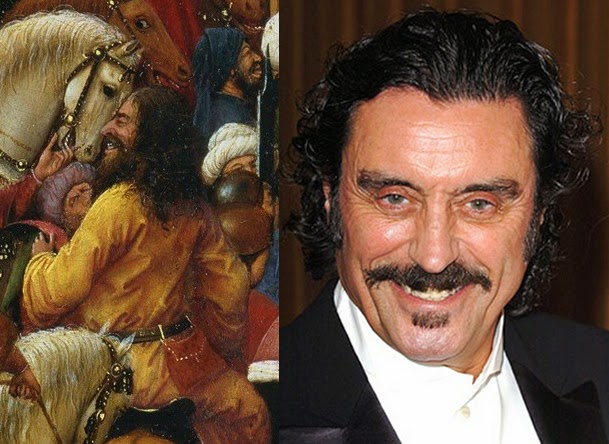
Monday, March 17, 2014

New tag: Jan van Eyck.

Five posts, with this one, all referring to the same painting and four of them making the same argument: that earnest liberals including or especially those who call themselves leftists can't distinguish conservatives from fascists and fascists from barbarians, and don't know a goddamn thing about what art is, and why.

"Look at the smile. That's the face of a great bastard. You can't help but like him."

Saturday, August 20, 2011

Another link from NewAPPS : a review by Graham Harman.
Just as the arts advance more through a punctuated series of epoch-making figures than through the collective piecework of progress-in-detail (à la Kuhnian "normal science"),...
I could barely get beyond that point. There's never been any evidence for "progress" in the arts; claims otherwise are based in fantasy and science fiction. Again: the desire for progress is not progress.

Art and the natural sciences are opposed because the natural sciences reduce experience to physics and chemistry. Humanist empiricism on the other hand is the description of the specifics of -always subjective and perspectival- experience and its coloring of our use of reason. It's not worth talking to someone who says he knows what his values are. If he claims confidence in good intentions the odds are he's lying, to you or both of you, and if he's not lying he's a simpleton. If he claims bad intentions he may be telling to truth, but honest barbarians are rare.

repeats. start there.


Jan van Eyck (and Assistant), The Crucifixion; The Last Judgment, (detail) ca. 1430 Oil on canvas,
transferred from wood, The Metropolitan Museum, NY

Those who claim to know politics because they know physics and chemistry will tend to side with authority if only their own, against the majority, and authority is habit-forming which is why our society is based on the rule of law and not the rule of 'best intentioned' rulers. Those people most worth talking to will tell you that they know what they think their values should be, not what they are. Art, both as a chosen field and as something ubiquitous in life, concerns the distance between desires, ideals and action. Liberal idealists, now as neo-liberals, try to will away that distance. They fail.

The moral logic behind the doctrine of the rule of law is conservative and pessimistic, and the arts manifest the same conservatism. Artworks do not express they describe expression. "Expressionist" art succeeds when it does, only when the audience responds to artists' tricks. Those tricks may be deployed to communicate the private emotions of an artist, but we never see the emotions; we see only the description.

An audience responds to stimuli crafted to match its language and its tastes, but in a culture of rapid change artists are often the first to articulate the language of the present. The history of the "avant-garde" is one of honest observation, not discovery. Honesty is hard. The later self-styled avant-garde of art and philosophy as science, is based on fantasy. Art describes the most intimate details of present experience, and any art that does not do that, fails. Art that claims to say something about the future speaks only to the hopes of the present, sometimes complexly. Futurism however always ages badly, but since futurists don't care about the past they never notice.

Tuesday, November 02, 2010

Jan van Eyck (and Assistant), The Crucifixion; The Last Judgment, ca. 1430 Oil on canvas,
transferred from wood, The Metropolitan Museum, NY

Monday, November 01, 2010

Oligarchs and Absinthe Shots
Mr. Prokhorov, standing a head above everyone else in the room, surveyed the crowd. Rumors circulated that this was Nicole Kidman’s apartment, adding a bit of sex appeal that grew stronger as it was translated from Russian to English and back again. Someone claimed that Mick Jagger lived downstairs. People smiled and stopped the waiter with the caviar for one more bite.

Vladimir Yakovlev, the co-founder and editor of the magazine, briefly thanked the crowd before handing the microphone to his deputy, Masha Gessen, who read her speech from her iPad. Copies of the magazine were fanned across coffee tables — the cover carried an unflattering photo of Mikhail Gorbachev — but people paid more attention to the waiters carrying trays of absinthe shots.

...As plates of scallops and beef stroganoff floated around the room, a woman with a microphone climbed the staircase and tried to silence the “the snobs and ultra-snobs,” as she described the crowd. Moments later, Cassandra Wilson, the Grammy-winning chanteuse, emerged and, eyes closed, began to sing. The Russian conversations carried on, and the party livened up as a brass band took over and the dance floor filled with rowdy moves that included a couple that broke out in push-ups. For dessert, a waiter offered a fancy wine push-up pop. “It’s like a jello shot,” he said.

Snob Magazine Coming to New York 

Because people are already totally in love with the Russian gazillionaire who is going to help ruin Downtown Brooklyn, Nets owner Mikhail Prokhorov’s magazine, Snob, is establishing a new home on New York newsstands this Wednesday, according to The Observer. "Russians living abroad have been rediscovering Russia," deputy editor in chief of Snob, Masha Gessen, told the Wall Street Journal. The lifestyle magazine hopes to promote this rediscovery and cater to the country’s elite class.
Jan van Eyck

I'm less bothered by the new barbarism than by the self-conscious intellectual culture that's unable to come to terms with it, that's unable to reconcile claims to liberalism, earnest idealism, and good intention, with a taste for high-living in service to the powerful. It's easier to have respect for honest bastards than their passive apologists. The people responsible for The Social Network may be more interesting than the people responsible for Facebook, but where does that leave Masha Gessen or her brother and the other editors of N+1?

Look at the smile. That's the face of a great bastard. You can't help but like him.

Wednesday, March 31, 2010

Duncan Black
"I think a major consequence of the lack of reading non-fiction other than textbooks is that when in late high school or college teachers want research paper type things, the students have a lot of trouble largely because they've never read any."
linking to Yglesias
"Like a lot of people I know, I read a lot and what I read is mostly nonfiction. But as Dana Goldstein points out in a great piece lots of Americans read very poorly and schools teach reading almost exclusively through fiction"
Andrew Koppelman at Balkinization on a paper:“We Don’t Want to Hear It: Psychology, Literature and the Narrative Model of Judging.” The first paragraph below is the abstract.
"The 'narrative' model of legal judging argues that legal decision makers both do and should render judgments by assembling sensible stories out of evidence (as opposed to using Bayesian-type, linear models). This model is usually understood to demand that before one may judge a situation, one must give the parties the opportunity to tell their story in a manner that invites, or at least allows, empathy from the judger. This Article refers to this as the “inclusionary approach” to the narrative model of judging. Using psychological research in emotions and perspective taking and the more intuitive techniques of literary criticism, this Article challenges the inclusionary narrative approach, arguing that, in practice, the law gives equal weight to an “exclusionary approach.” That is, in order to render sound, legitimate legal judgments, the law deliberately limits the sort of stories parties are allowed to tell—and does so on moral grounds, not, or at least not only, to improve the “accuracy” of the legal judgment. That is, as both a descriptive and normative matter, impoverished narratives can be better than enriched ones in leading decision makers to morally acceptable legal judgments."

[Koppelman] One of Bilz’s most interesting claims is about literature: she argues that it isn’t possible for a good work of literature to make us sympathetically identify with an evil character. I think that the point needs important qualifications, in the face of some obvious counterexamples, but I am reluctantly convinced. Sometimes it’s morally appropriate to be stupid and insensitive."
Jon Mandle on another paper
"But of course the scientists are not adjusting morality with a magnet, they’re affecting people’s moral judgments. I don’t think anyone ever doubted that manipulating the brain in various ways can lead people to alter their judgments – moral and otherwise. This is obvious to anyone who has observed the results of alcohol, for example, or – much more indirectly – framing effects."
Really, really, fucking stupid.

My comment at Yglesias' page: "Most of what you read is lies and most nonfiction reinforces enthusiasm without question. Fiction questions enthusiasms and assumption; as a heuristic it's the most well suited to the training of functioning adults. No one should be teaching Twilight or Harry Potter, the kids understand them better than the adults. The adults should teach Shakespeare and Euripides... What kids shouldn’t be reading, beyond 7th grade, is textbooks." Teach Tocqueville not academic essays based on him. Teach the past, live the present, and leave the purely academic stuff for later. And even academics admit most academic writing is shit.

From what I can tell, I'll look more closely when I have time, Kenworthey Bilz doesn't understand fiction, morality, or law. None of these idiots can imagine they have ever or will ever lie to themselves. Law is a function of society regulating itself, maintaining order and stability. It has little relation to imagined Platonic truths.

"One of Bilz’s most interesting claims is about literature: she argues that it isn’t possible for a good work of literature to make us sympathetically identify with an evil character." There are very few if any evil characters in good fiction, what there are are evil acts. A good work separates one from the other. If that's not possible the work fails.

Kieran Healy: "Amazingly, you can also change people’s mathematical judgements in much the same way (including with alcohol), which may be disconcerting to people who view physical laws as some kind of immutable, lofty feature of Nature. But such people will just have to get used to this radical new world." What's amazing is that Healy views morality as some kind of immutable lofty feature of Nature. As I've said more than once, philosophy professors, now called 'philosophers", are theologians in drag. Popular storytellers are the first atheists.

See the previous post... and again

I get the impression that high school literature is taught now at the level of what was once called "Art Appreciation," and that these assholes are the product of that and worry now that too much time is spent on it.
---

6/22/11 This post is getting a lot of hits today so along with fixing a couple of typos I'll add two more links.

Joe Jamail
John Mortimer

And why not… Jan Van Eyck
Twice!

Look at the smile. That's the face of a great bastard. You can't help but like him


3/14 I used the Pacino images first and never got around to replacing them.

3/30/2020 It didn't register at the time but the discussion at CT misses obvious points. That I missed them too doesn't mean they weren't obvious: the relation to autism (now part of the literature) and the seeming irrelevance of utilitarianism, trolley problems etc. But the descriptions including the authors' are muddled.  From the abstract: "When we judge an action as morally right or wrong, we rely on our capacity to infer the actor’s mental states (e.g., beliefs, intentions)." Mandle: ...they have identified a part of the brain that is important in attributing mental states to others."
But the actors' intentions were stated flat out in the experiment. There's no room for inference. The result of the experiment is to render intention less relevant as a category.
The discussion of law is just as simplistic. People who are deemed "liable" are judged guilty.
Everything above is storytelling.