“Primitives" and “barbarians” are not “reactionary”, a word describing the rebellion of individualism against itself.
Sunday, July 03, 2022
you can't get there from here


more cracks in the facade
Poland’s foreign ministry has intervened after Ukraine’s ambassador to Germany denied that Ukrainian national leader Stepan Bandera was responsible for the mass murder of ethnic Poles and Jews, and also sought to justify his collaboration with Nazi Germany.
The episode has renewed tensions over what has long been a sensitive issue in Polish-Ukrainian relations. In response, Ukraine’s foreign ministry has distanced itself from the words of the ambassador, Andrii Melnyk, saying that they were just his “own opinion”.
The remarks came in an interview on the Jung & Naiv show in Germany. The ambassador was asked by host Tilo Jung about Stepan Bandera, leader of the Organisation of Ukrainian Nationalists (OUN), which carried out massacres and ethnic cleansing of Poles and Jews.
Jung asked Melnyk how a figure resposible for mass murder could be treated as a hero today in Ukraine. The ambassador answered by claiming that “Bandera was not a mass murderer of Jews and Poles”. He said that such claims are part of a “Russian narrative”.
Jung then quoted a propaganda leaflet signed by Bandera calling for Russians, Poles, Hungarian and Jews to be “wiped out”. Melnyk responded that he “will not distance myself from it. That’s my decision [even if] you may not understand it”.
I used to drink with a Croatian ex-Nazi and and an Israeli fascist. The Croat introduced us. "I don't like Jews much, but I love Israelis" I asked the Israeli if Jews should have equal rights in Germany. He said "No".
WARSAW, Poland (AP) — Poland’s most powerful politician has acknowledged that the country bought advanced spyware from the Israeli surveillance software maker NSO Group, but denied that it was being used to target his political opponents.
WARSAW, July 6 (Reuters) - Poland's ruling party leader on Tuesday condemned comments from Israel regarding a new law that could have an impact on the restitution of Jewish property after World War Two and said the country did not owe anything to anyone.
Netanyahu's Son Becomes Star of German Nationalist Party After Calling EU 'Evil'
AfD lawmaker tweets poster quoting Yair Netanyahu after the prime minister's son appealed for a return to a 'free, democratic and Christian' Europe

Benjamin Netanyahu faced media criticism this week for hosting the right-wing prime ministers of the Czech Republic, Slovakia and Hungary who have been accused of being anti-immigrant and anti-Semitic. But in response, Likud MK Anat Berko epitomized Netanyahu’s politics in a single sentence: "They might be anti-Semites, but they’re on our side."
Human rights activists petition the court to cease Israeli arms exports to Ukraine since some of these weapons reach neo-Nazi elements in Ukraine’s security force.
Ex-Mossad Agent Who Helped Capture Eichmann Backs Far-right German Party With Nazi Past as 'Great Hope'
Don't Fixate on the Freedom Party. In Austria Today, the Real anti-Semitic Threat Is From Muslims, Not Nazis.
As the first active Jewish post-war Austrian MP, I support Sebastian Kurz’s coalition with the Freedom Party which, despite its Nazi roots, has long become an anti-immigration, populist movement. These days, the protestors shouting anti-Jewish slogans in Vienna are Muslims, not the far right
When U.S. President Donald Trump arrived in Pittsburgh last week following the single deadliest attack on Jews in American history, Pittsburgh’s mayor and elected officials refused to meet him. The only public official to greet him was the Israeli ambassador to the United States, Ron Dermer—an American and former Republican Party operative who became an Israeli citizen and close confidant of Prime Minister Benjamin Netanyahu.
Deborah Lipstadt: Is Donald Trump’s Inadvertent Anti-Semitism Worse Than the Real Thing?
Ex-defense minister says IS ‘apologized’ to Israel for November clashMoshe Ya’alon’s office refuses to elaborate after alluding to contact with terror group
"As always, amazing and absurd to think that Israel just did the local branch of Al-Qaeda a favor by carrying out an airstrike."
"why? Hezbollah+Iran are a much bigger threat to Israel than Al-Qaida have ever been."
Over the following 3 years, hundreds of Palestinian and Lebanese civilians were killed, and many more wounded, by explosive devices hidden in baskets, on bicycles or mules, in cars or trucks. After each attack, calls to the media were placed claiming responsibility in the name of the FLLF. Palestinian and Lebanese officials repeatedly insisted that the FLLF was merely a fiction intended to hide the hand of Israel and its Christian rightist allies. Israeli officials rejected such accusations, insisting rather that the bombings were part of an internecine war amongst rival Arab factions.
..In February 2018 Ronen Bergman, at the time the senior correspondent for military and intelligence affairs for Yedioth Ahronoth, published Rise and Kill First: The Secret History of Israel’s Targeted Assassination....As Rise and Kill First documents in detail, the FLLF bombings were an integral part of this Israeli strategy of provocation.
...“By mid-September 1981,” he explains, “car bombs were exploding regularly in Palestinian neighborhoods of Beirut and other Lebanese cities.”
"Hamas, to my great regret, is Israel's creation," says Mr. Cohen, a Tunisian-born Jew who worked in Gaza for more than two decades. Responsible for religious affairs in the region until 1994, Mr. Cohen watched the Islamist movement take shape,...
Instead of trying to curb Gaza's Islamists from the outset, says Mr. Cohen, Israel for years tolerated and, in some cases, encouraged them as a counterweight to the secular nationalists...
The Israeli government is so concerned that America's adversaries may miscalculate U.S. intentions that it is privately urging Washington to make it clear that the U.S. would intervene in Saudi Arabia should the survival of that government be threatened.
Friday, July 01, 2022
forthcoming in Oxford Studies in Experimental Philosophy, Volume 5
John BronsteenLoyola University Chicago School of Law
Brian LeiterUniversity of ChicagoJonathan S. MasurUniversity of Chicago - Law SchoolKevin TobiaGeorgetown University Law Center; Georgetown University - Department of Philosophy
Abstract
What constitutes a “good” life—not necessarily a morally good life, but a life that is good for the person who lived it? In response to this question of “well-being," philosophers have offered three significant answers: A good life is one in which a person can satisfy their desires (“Desire-Satisfaction” or “Preferentism”), one that includes certain good features (“Objectivism”), or one in which pleasurable states dominate or outweigh painful ones (“Hedonism”). To adjudicate among these competing theories, moral philosophers traditionally gather data from thought experiments and intuition. In this chapter, we supplement that traditional approach with a pair of experimental studies that examine whether the three theories reflect laypeople’s intuitions about well-being. The empirical studies yield two primary findings. First, they provide evidence for lay "well-being pluralism": laypeople treat desire satisfaction, positive objective conditions, and happiness as all constitutive of well-being. Second, the studies provide evidence of "hedonic dominance": laypeople evaluate an individual’s happiness as more important to an individual’s overall well-being than desire satisfaction or objective conditions.
Introduction...
We thus set out here to make the first test of whether laypeople view well-being the way that many scholars in economics and philosophy seem to have assumed they do....
III. Experimental Studies...
B. Study 2...
Jenny teaches ballet in a small studio in a small town. She usually spends her weekends going bowling with her friends.
Jenny is happy. She really enjoys teaching her ballet students, and she also has a lot of fun going bowling with her friends. She feels good when she wakes up in the morning and maintains that happy mood throughout the day until she goes to sleep at night. She often smiles and rarely frowns. She experiences positive emotions like joy and contentment most of the time; and she only rarely experiences negative emotions like sadness, anger, and irritability.
But Jenny doesn’t have what she wants. She always wanted to be a famous ballerina who lives in Paris and spends her weekends going to exclusive parties with other celebrities. That is still the life she would choose if she could choose anything.
Jenny is a famous ballerina who lives in Paris. She usually spends her weekends going to exclusive parties with other celebrities.
Jenny isn’t happy. She feels a lot of pressure to do her job well, and she doesn’t actually enjoy the work. She also feels pressure to impress her celebrity acquaintances so that she keeps getting invited to their parties. This prevents her from really ever enjoying her professional or her personal life. She feels bad when she wakes up in the morning and maintains that unhappy mood throughout the day until she goes to sleep at night. She rarely smiles and often frowns. She experiences negative emotions like sadness, anger, and irritability most of the time; and she only rarely experiences positive emotions like joy and contentment.
Incapable of reading even dime-store novels, let alone "great works of art", the recorded history of the opinions and beliefs of "laypeople" and "folk". But why would they?—since art is about aesthetics and philosophy is about truth. Knobe is credited by "scholars in economics and philosophy" with discovering what the folk and the vast majority of the educated elite would call a truism.
"My students were all obsessed with sex. Not the idea of sex, or the meaning of sex, but sex!"
"I find this reduction of sexual orientation to genitalia – what’s more, genitalia from birth – puzzling."
"William Blake, I suggest, both embodies that antithesis and proclaims the imperfection of Bentham’s understanding of happiness." J.H. Burns, first General Editor of the Collected Works of Bentham.
The Smart and the Folk, and The President and Other Intellectuals, and The Triumph of the Fact
Knobe and Calllard, autism and sociopathy. The Glimmer Twins were right.
And this goes back to the questions at the beginning of the previous post.
Pedantry is anti-political. Elite liberal opposition to politics ceded politics to the right, and that's why we're where we are.
Monday, June 27, 2022
 |
| Angela Weiss/AFP |
From Sullivan. Click on the pic and look. Is it an image of happiness?
More on that question, here
---
I get the fucking reference.

 Sullivan:

Halperin’s teaching promotes “homosexuality as a social rather than an individual condition and as a cultural practice rather than a sexual one”. He scrutinizes artefacts that he believes are indispensable to “gay acculturation” and the development of “gay male subjectivity”: Hollywood movies, Broadway musicals, opera, diva-worship, pop and disco music, camp, and allied phenomena. This is because he believes that “gay sentiment”, the feelings of the “socially disqualified”, can only be expressed in “histrionics, rage, maudlin self-pity, hyperbolic passion, and excess”. To this end he provides prolix, relentless analyses of scenes from Mildred Pierce (a 1945 Hollywood film starring Joan Crawford) and Mommie Dearest (a 1981 film about Joan Crawford’s despotism towards her adopted daughter). His interpretations seem all the more lumbering and verbose for being written in academic jargon overlain with insinuating archness. Halperin, who preens himself for his courage in comparing these films to the Iliad, makes high claims for them in sections that are ulcerated with bombast and self-reference. “The entire history of gay liberation . . . may owe a direct debt to Mildred Pierce . . . or, if not exactly to Mildred Pierce, at least to . . . a definitive mass-cultural . . . drama of enraged female powerlessness suddenly and dazzlingly transformed into momentary, headlong, careless, furious, restless power.” Both films teach “the supreme wisdom” of “living one’s love life knowingly as melodrama – understanding full well . . . that melodrama signifies . . . a despised, feminized, laughable, trivial style of expressing one’s feelings”.

But the idea that a drag queen — rather than, say, a firefighter or a pilot or a tennis player — is somehow an ideal role model for young gay children is, in its misguided progressivism, actually regressive. A hefty majority of gay kids have absolutely no interest in being a drag queen. Presenting it as a model for gayness is part of a misguided bid to impose the postmodern concept of “queerness” on all gay people. It’s right back to my own childhood, when I could see no role models for being gay except drag queens or flamboyantly effeminate men. Drag queens actually made me think I wasn’t gay, because I had no desire to be one. In the gay rights movement, we spent many years getting past these stereotypes — only to have the woke reimpose them with as much zeal as the religious right used to.
Sullivan's a racist. Nwanevu is a Zionist. Bernie Sanders opposes democracy in Israel. Mea Culpa, mea culpa, mea maxima culpa.
James L. Moses, "William O. Douglas and the Vietnam War: Civil Liberties, Presidential Authority, and the "Political Question" Presidential Studies Quarterly , Fall, 1996, Vol. 26, No. 4, Intricacies of U.S. Foreign Policy (Fall, 1996), pp. 1019-1033
Douglas and Conscientious Objection
...In addition to those who sought status as conscientious objectors because of their religious or moral objection to war in any form, there were many who saw the Vietnam War as a particularly immoral and unjust conflict. In 1970 Douglas tackled the prickly problem of "selective conscientious objection," or the refusal on religious or moral grounds of people to participate in certain wars or conflicts. Did there exist a right to refuse induction into "unjust" conflicts as opposed to "just" wars? In Gillette v. United States, the Court answered strongly in the negative, stating that "persons who object solely to participation in a particular war are not within the purview of the exempting section" of the draft statutes, even though the objection be "'religious' in character." Thurgood Marshall, for the eight to one majority, wrote that Congress intended to exempt from service only those who objected to "war in any form."
William O. Douglas, strongly disagreed as the lone dissenter. He saw the forced induction of "selective" objectors as violative of First Amendment free exercise guarantees. Though he conceded the question involved "freedom of conscience" more than religion, he argued "conscience and belief are the main ingredients of First Amendment rights." Douglas believed the religion clauses in the First Amendment were broader than "religion" in the conventional sense, and any narrower reading represented an "invidious discrimination in favor of religious persons and against others with like scruples." For Douglas, Marshall's majority opinion in Gillette struck a blow against the "right of conscience" implicit in the First Amendment and therefore represented an unconstitutional violation of Vietnam opponents' rights.
Justice Douglas himself had foreshadowed the arrival of the "selective conscientious objection" cases. The Supreme Court refused to hear arguments in the 1969 case Jones v. Lemond concerning an enlistee who, after five months in the service, claimed to have "acquired" CO status. As in hundreds of other instances, Douglas insisted that his dissent from the Court's denial o?certiorari be printed in the official record so that the public would be aware of his stance on the issues raised. He argued that a substantial issue had been raised in the case; that is, the First Amendment dimensions of conscientious objection "whether based on religion, philosophy, or one's view of a particular 'war' or armed conflict." It was precisely this "selective" component championed by Douglas in this earlier dissenting opinion that the Court as a whole again rejected in the 1970 cases....
Douglas and Cambodian "Incursion"
In 1973, New York Representative Elizabeth Holtzman and several U.S. Air Force officers sought to halt the bombing of Cambodia, instituted by Richard Nixon in a effort to "clean out major enemy sanctuaries on the Cambodian-Vietnam border," on the grounds that the United States had not declared war against that country. They approached Justice Thurgood Marshall, who denied their petition to vacate the lower court stay on the bombing halt injunction. Marshall refused to act unilaterally, instead stating that this action "must follow the regular appellate procedures." Nonetheless, two days later, Holtzman asked Justice Douglas to vacate the lower court stay. Dressed in blue jeans and boots, Douglas met on the steps of his Goose Prairie, Washington, retreat with the ACLU attorneys seeking the order. Not at all hesitant to act unilaterally, Justice Douglas told them he would indeed hear them at the Yakima courthouse, some fifty miles south of Goose Prairie, the following morning. He said that he would issue a ruling, but "wanted to hear the other side of the case."
Dean Smith of the U.S. Attorney's Office and Burt Neuborne of the ACLU made their arguments to Douglas on August 4, 1973, at Yakima. Smith told Douglas that this was not a judicial but a political question, and that the August 15 bombing cutoff date already mandated by Congress represented a political compromise previously made on the issue. This avoided what he called a "constitutional confrontation." Douglas replied, "we live in a world of confrontations. That's what the whole system is about." Neuborne told Douglas that "the effect of the stay is to get judicial authority to continue to do something the judiciary said in the first place the President has no right to do." After hearing arguments, Justice Douglas stated that he would not let the question become moot, August 15 cutoff date or not. "I will make a ruling."
In perhaps his most extraordinary exertion of judicial activism, Douglas vacated the lower court's stay against a bombing halt, in effect personally ordering the United States government to cease its bombing of Cambodia. By approaching Douglas to vacate the stay, Holtzman had given the Justice a legal means finally to do what he had been unable thus far to accomplish: meaningfully intervene in American Vietnam policy and put an end to at least a portion of the war. Douglas's decision is also a classic example of Jerome Frank's definition, under the tenets of legal realism, of the judicial function as the expression of judgments "worked out backward from conclusions tentatively formulated." There could be little doubt, given Douglas's history on the Vietnam issue and his judicial temperament, that he would grant the petitioners' request.
Sunday, June 26, 2022
repeat
I grew up around lawyers; they're my favorite bureaucrats. As far as legal philosophy is concerned, as a NY Biglaw partner put it, "Lawyers don't read that stuff. Lawyers are tradespeople!" Her tone was contemptuous. I laughed.
In Griswold, the justices wholesale *made up a constitutional right* to achieve a political outcome. I am opposed to judges making law. It’s the job of the legislative branch to create laws, not the courts. This is separation of powers 101.
— Blake Masters (@bgmasters) May 7, 2022
the court has nothing to do with laws, it is a council of clerics that rules by decree and is discussed as such https://t.co/94xU4wwH4I
— ryan cooper (@ryanlcooper) May 3, 2022
this was pretty good.
'This thing that has happened in my country done by people from my country who have been saying they will do this thing for decades feels like a strange thing that happens in a foreign country' - Americans
— Karl Sharro (@KarlreMarks) May 3, 2022
---
The justices of Supreme Court are political appointees, almost always mediocre minds.
If we get hacks it's a failure of politics.
"It is the common fate of the indolent to see their rights become a prey to the active. The condition upon which God hath given liberty to man is eternal vigilance; which condition if he break, servitude is at once the consequence of his crime and the punishment of his guilt."
Friday, June 24, 2022
Bessner
At the present moment, however, a majority of Americans side with the liberal internationalists: in a Pew poll taken in early 2020, 91 percent of American adults thought that “the U.S. as the world’s leading power would be better for the world,” up from 88 percent in 2018.
Nonetheless, there’s a growing generational divide over the future of U.S. foreign policy. A 2017 survey by the Chicago Council on Global Affairs, for instance, discovered that only 44 percent of millennials believe that it’s “very important” for the United States to maintain “superior military power worldwide,” compared with 64 percent of boomers. In a poll from 2019, zoomers and millennials were more likely than boomers to agree that “it would be acceptable if another country became as militarily powerful as the U.S.”
The fact that younger Americans are waking up to the manifold and manifest failures of liberal internationalism presents the United States with an enormous opportunity: it can abandon an irresponsible and hubristic liberal internationalism for restraint. This will, admittedly, be a difficult task. Americans have ruled the world for so long that they see it as their right and duty to do so (especially since most don’t have to fight their nation’s wars). Members of Congress, meanwhile, get quite a bit of money, and their districts even get a few jobs, from defense contractors. Both retired generals and pointy-headed intellectuals rely on the defense industry for employment. And restraint is still a minority position in the major political parties.
It’s an open question whether U.S. foreign policy can transform in a way that fully reflects an understanding of the drawbacks of empire and the benefits of a less violent approach to the world. But policymakers must plan for a future beyond the American Century, and reckon with the fact that attempts to relive the glories of an inglorious past will not only be met with frustration, but could even lead to war.
The American Century did not achieve the lofty goals that oligarchs such as Henry Luce set out for it. But it did demonstrate that attempts to rule the world through force will fail. The task for the next hundred years will be to create not an American Century, but a Global Century, in which U.S. power is not only restrained but reduced, and in which every nation is dedicated to solving the problems that threaten us all. As the title of a best-selling book from 1946 declared, before the Cold War precluded any attempts at genuine international cooperation, we will either have “one world or none.”
Bessner reviewed, 2020
By charging scholars of international and transnational history with “downplaying” American actors and American power in their analyses, Bessner and Logevall overlook the myriad and compelling ways in which those scholars are integrating the United States and its formidable power into the study of post-1945 foreign relations. It is precisely because these scholars are adopting global and other border-crossing perspectives that they are able to pursue this integrative agenda. But Bessner and Logevall seem to prefer an older approach, one in which non-American people, places, cultures, and societies remain in the outer reaches of their imagined U.S.-centric solar system. In their view, the study of American foreign relations needs to return to the orbit in which it has traditionally travelled: a path that circles tightly around the “sun” of American power.
"...in a Pew poll taken in early 2020, 91 percent of American adults thought that “the U.S. as the world’s leading power would be better for the world,” up from 88 percent in 2018."
Everything good about this country is good about every other democracy; everything great is inseparable from criminality and empire. That's the definition of greatness, and it's something Americans have never understood. It's impossible to have a conversation with people who don't know what they are.
Thursday, June 23, 2022
Leiter links to Robert Paul Wolf, on Geuss, and again.
Geuss, adapted from his memoir, in the New Statesman.
When I met Axel, what struck me most was the particular way in which his moral world was structured around his conscience. Even 40 years later, he could not forgive himself, but not so much for having failed to kill Hitler – his failure had not been his fault at all. Rather what obsessed him was that he had sworn an oath to the Führer, and yet had then plotted to kill him. The Führer was a monster, but this didn’t seem to matter to him as much as the fact that he had broken an oath he had freely sworn; the guilt for that pursued him to the end of his life. I was flabbergasted by this and had the sense that I had encountered a man from Mars, but I think I had just met a proper Protestant. Fear and shame played no role in this: in fact, Axel was universally feted after the war for what he had tried to do. His view still was, though, that Hitler’s crimes were Hitler’s guilt, but Axel’s violation of his oath was his own unending guilt. I still find this way of looking at the world extraordinary.
At least he's open about calling it a memoir, unlike his fellow Catholic, Adolph Reed, who's just a snob. But they're both idiots. Catholics and Protestants. Protestants and Catholics, and Jews.
I want to examine that mixture of the good and the bad, the light and the shadows, by focusing on the idea of a ”research imperative.” Though unfamiliar to most scientists and the general public, the term expresses a cultural problem that caught my eye. It occurs in an article written by the late Protestant moral theologian Paul Ramsey in 1976 as part of a debate with a Jesuit theologian, Richard McCormick. McCormick argued that it ought to be morally acceptable to use children for nontherapeutic research, that is, for research with no direct benefit to the children themselves and in the absence of any informed consent. Referring to claims about the “necessity” of such research, Ramsey accused McCormick of falling prey to the “research imperative”, the view that the importance of research could overcome moral values.
That was the last time I heard of the phrase for many years, but it informs important arguments about research that have surfaces with increasing force of late. It captures, for instance, the essence of what Joshua Lederberg, a Nobel laureate for his work on genetics and president emeritus of Rockefeller University once remarked to me: “The blood of those who will die if biomedical research is not pursued will be upon the hands of those who don’t do it.”
I've used that quote a lot since It's in the manuscript. On Lederberg: "It’s war communism in the war on disease, Stalinism for the betterment of the race. And isn't that what Stalinism always was?"
repeats: Two essays on violence, by Wolff, and Arendt. Fans of John Ganz should read it.
And Geuss on Arendt, and "Ghandi".
Wednesday, June 22, 2022
Working on a house in Brooklyn, in a neighborhood that was once mostly black, working- and middle-class. Walking away from the subway I passed an old black man who said "Good morning sir". His eyes looked down. I replied without thinking, repeating his words. He'd spent a life saying "sir" to white men, and now he was doing it in his own neighborhood.
I didn't grow up in a white neighborhood. Experience changes you.
Tuesday, June 21, 2022
Michelle Goldberg, the NYT, "The Future isn't Female Anymore"
The Drift, a buzzy literary journal founded by Kiara Barrow and Rebecca Panovka, left-leaning women in their late 20s, published a series of short essays earlier this year under the rubric, “What to Do About Feminism.” “For a long time now, we’ve had the sense that feminism is in trouble,” Barrow and Panovka wrote in the introduction. They described an ambient feeling that feminism has been sapped of cultural vitality, even as an anti-feminist backlash is gathering momentum, and that young people especially were turning against the movement.
Of the eight essays they commissioned to try to make sense of this moment of “profound malaise” in feminism, four used the word “cringe.”...
“Much of contemporary feminism, like my adolescent self, relies on a defensive posture, its energy driven toward negation. (Save Roe!),” wrote Elisa Gonzalez....
Barrow and Panovka both consider themselves feminists; neither of them takes any pleasure in dissecting what they see as the movement’s stasis. “We’re quite alarmed to see that the people around us, who are our age, are by and large quite disaffected and maybe considered themselves feminists five years ago, but now don’t want to anymore,” said Panovka.
You can extrapolate only so much about broader trends from the mores of up-and-coming intellectuals, though they can be a leading indicator. (Brooklyn literary circles nurtured a millennial socialism years before the Bernie Sanders presidential campaign.)...
Recently the Southern Poverty Law Center and Tulchin Research commissioned a poll of 1,500 Americans to measure belief in various reactionary sentiments, including the “great replacement” conspiracy theory and the idea that trans people are a threat to children. Because misogyny is so ubiquitous in far-right spaces, Cassie Miller, a senior research analyst at the S.P.L.C., decided to add a question about feminism.
Predictably, most young Republicans agree with the statement, “Feminism has done more harm than good.” What was astonishing was how many young Democrats agreed as well. While only 4 percent of Democratic men over 50 thought feminism was harmful, 46 percent of Democratic men under 50 did. Nearly a quarter of Democratic women under 50 agreed, compared with only 10 percent of those 50 and older....
“I don’t know that I’ve seen a new influx of energy,” said Samhita Mukhopadhyay, co-editor of “Nasty Women: Feminism, Resistance, and Revolution in Trump’s America” and the former executive editor of Teen Vogue....
Beyoncé would sample that talk in her song “Flawless,” and in 2014 she performed at the Video Music Awards in front of a giant screen emblazoned “Feminist.” A feminism that valorized the quest for power and prestige suddenly had cultural currency. Taylor Swift, who’d distanced herself from feminism in 2012, embraced it in 2014, with the help of the then it-girl Lena Dunham.
Teen Vogue’s transformation into an explicitly feminist publication was an indication of the movement’s glamour....
Recently I emailed Faludi to ask how this moment of backlash compares to the one she chronicled more than three decades ago. In part, she replied, there’s more raw misogyny now.
The whole thing's hilarious, in a tragic sort of way. "Brooklyn literary circles... millennial socialism... Bernie Sanders", the link's to Goldberg's own piece in Tablet, where Jewish identitarians and their friends complain about identity politics.
More links: Vogue, and Beyoncé Knowles, Taylor Swift and Lena Dunham, and "glamour", and again, and again... "Glamour is the performativity of the sexually intimidating woman—intimidating according to conservative gender roles: the woman not as passive but as judge."
See also fiascos: Comaroff vs/and Ronell and "Cat Person", Jian Ghomeshi and his lawyer, Marie Henein. The last of the "agains" for glamour is about Iran. The difference between the strength in/of performative but reserved feminine sexuality in conservative but modernizing cultures vs the weakness of sexualized femininity in post-feminist cultures. For Beyoncé there's also this, for a laugh, on the purblind reality of Oxbridge idealism.
The Drift, "Steered by the Reactionary"/ What to Do about Feminism
Of the 8 pieces two of them are by transwomen: men who've responded to and mimic the performance of sexualized femininity. Candy Darling, as always.
"I've been up all night alone, wondering about my identity. Trying to look for an explanation for living this strange, stylized sexuality. Realization cuts feeling off. I try to explain my identity as being a male who has assumed the attitudes and somewhat the emotions of a female. I don't know what role to play."
Warhol said Candy Darling and Holly Woodlawn weren't women because "they don't bleed." In the late 90s, a 40 year old woman, a well known artist, told me me everything she'd learned about being a woman she'd learned from drag queens. The switch is important: from the artifice of femininity built out of biology and culture, out of necessity, to an art built out of fantasy—from representation to mannerism—and then returned to the source. I've described the process dozens of times. That's why Streeck made me laugh, or maybe as I said just left me "banging my fucking head against the wall."
In the order that seems to be emerging, social bonds are construed as a matter of taste and choice rather than of obligation, making communities appear as voluntary associations from which one can resign if they require excessive self-denial, rather than as ‘communities of fate’ with which one either rises or goes under.
A definition of woman, not based on the experience of women, but on a male fantasy of women. And of course what does all of this say to women and girls who have no interest in or ability to trade in glamour, to play off others' desire, who are neither beautiful nor fabulous, but simply female? And on the streets the plain have a disadvantage. The streets are Darwinian.
One of the pieces was written by Andrea Long Chu, and another by Becca Rothfeld, a biological woman, on Srinivasan. That makes comments easy. On Long Chu, and then the two of them, Chu and Srinivasan, and Katha Pollitt, whom Rothfeld doesn't mention. Chu thinks political lesbianism is a "failed project." Derrick Bell argued that the decision in Brown v Board was a mistake. Our new liberals who call themselves leftists are beginning to understand his point. But again: "As I said years ago, all that's clear is that blacks as a group get the benefit of a knee-jerk sympathy from liberals that women as a group do not."
The Drift, appears in a link here. Steered by the reactionary, indeed.

I though about "I Wanna Be Black" again (a third time), but this song came on at work today and I heard myself singing every word.
updated. I wanted to add these. The quotes are verifiable. Men are the new women; the asshole is the new vagina. Self-hatred and anti-feminism is the new feminism.


Saturday, June 18, 2022
Not coming to your elementary school anytime soon

IN OCTOBER 2018, signs began to appear in the dressing rooms of California strip clubs owned by the company Déjà Vu. They told dancers that “the club is now FORCED to make all entertainers become EMPLOYEES” in response to “lawsuits filed by certain entertainers and their attorneys.” At clubs owned by Spearmint Rhino, signs attributed the same change to a California Supreme Court decision. Regardless of the reason, dancers were given the unwelcome news that instead of taking home cash from private dance sales every night, the club would be collecting that money and issuing them a paycheck—after deducting the club’s cut and payroll withholding.
Drag queens are rated G and trannies are kosher, but abortion is not. Lesbians are racist, and Israelis are Palestinians. What a world. I blame John Rawls.
The below reminded me that the distinction between cognitive and noncognitive makes no sense.
The Economic Policy Institute (EPI) on "noncognitive skills"
Autism is described as a cognitive "deficiency" or a cognitive "style". Do Aspies have a cognitive deficit in noncognitive abilities?
---
Since even intelligent people are arguing about this again.
Follow the links. You'll get there. Or just go directly. I wrote Searle in the late 90s. It seemed obvious to me then. Back in the day, Leiter told me Searle didn't respond to him either.
"Build a machine with two separate and competing algorithms, for conditioned response and calculation, and a root level imperative for continued operation: survival. The result will be a neurotic machine, "haunted" by past actions."
Jäger retweets and seconds the executive opinion editor of the FT: "Sentience is not sapience"
And earlierSurely the frightening thing about Google’s sentient AI programme is not that machines are starting to think like humans, but that there are more and more humans, particularly among Google’s employee base, who are slowly starting to think like machines.
— Anton Jäger (@AntonJaegermm) June 14, 2022
“What I mean by reified consciousness, I can illustrate — without elaborate philosophical contemplation — most simply with an American experience. Among the frequently changing colleagues which the Princeton Project provided me with, was a young lady. After a few days, she had gained confidence in me, and asked most kindly: “Dr Adorno, would you mind a personal question? I said, “It depends on the question, but just go ahead and she went on: “Please tell me: are you an extrovert or an introvert? It was as if she, as a living being, already thought according to the model of multi-choice questions inquestionnaires. ”
"People say that Andy said he was a machine. But he didn't. He said he wanted to be a machine and that's not the same thing at all."
"The fantasy of objectivity is the fantasy of the universal through the elision of the particular, beginning with the elision of the particular self." I'm tired of quoting myself but no one else says it. It's all so obvious. These people are all children.
Thinking and doubting may be epiphenomenal, but they exist as events.
Thursday, June 16, 2022


Dembroff, and Sophie Lewis
I've always thought drag queens were useless creatures who need something to ground them in the world. Child care would be a good start: get them off the street, teach them responsibility, etc. Better a drag queen than a priest, or "theorist". Most survivors don't want others to go through the hell they lived through. They respect the innocence of childhood.
At some point in the mid 70s, when I was in my early teens, the Philadelphia ACLU moved their office. I asked my mother where to. "Down by the chicken run." "What?" "Where they go for boys!" A few years later I remember my parents fuming about a man who'd been arrested as a pedophile. They were disgusted. He was HIV positive, and he'd been sentenced to live out what was left of his life in solitary. He was harmless. All he did was suck off boys who were already working on the street. They boys took pity on him, and so did my parents. But the state had none.
Sophie Lewis is a fascist. The pathetic little man should never have been left to die alone.
1
What Cavell added to this feast of ordinary language philosophy was something he called ‘scepticism’. This begins, crudely put, from the insight that however much we can see from a conventional set of behaviours that someone is experiencing embarrassment or pain or guilt we can’t ever know what those experiences are like from inside. ‘I feel your pain in my finger’ is not something I can say outside the realm of science fiction or philosophical thought experiments, and in this case the norms of verbal usage reveal something about what human beings in general can and cannot do. Cavell regarded this scepticism as internal to Wittgenstein, and it is why he didn’t follow the Roger Scrutons of the world in regarding a ‘form of life’ as a set of codes embedded in a culture which enable human understanding through being both shared and more or less unalterable, and which might therefore justify the conservation of even apparently barbaric cultural practices such as dressing up in scarlet and encouraging dogs to tear foxes apart. Instead Cavell’s Wittgenstein is principally about the big dark things we don’t actually know about ourselves or one another, and which philosophers spend their time seeking.
The next step in Cavell’s scepticism was to argue that although we don’t have ‘knowledge’ of another’s pain we can ‘acknowledge’ or ‘recognise’ it. Making claims to be acknowledged and to have emotions, claims recognised by the other, and in return to acknowledge the claims of the other, is fundamental to living in language, which is a realm (as it is for Austin) of interpersonal ethical demands and needs. The world of art, in particular, is ethically charged: ‘The creation of art, being human conduct which affects others, has the commitments any conduct has.’
2
He liked to quote Erich Auerbach’s assertion that in reading literature we need an ‘empirical confidence in our spontaneous faculty for understanding others on the basis of our own experience’.
All this effort to rediscover the obvious.
History and historians now frequently perform the role to which sociology and sociologists once aspired: to narrate and contextualise the conflicts of the present.
The beginning of the article is a bit absurd. Davies is a bit of an idiot, but I'll take it.
Cavell belongs with Derrida. The same desperation, the need to feel superior, as a philosopher, to those who merely play. Reversing the claims of philosophers that fiction is parasitic, philosophy becomes parasitic in relation to art. I've said it all before.
Sunday, June 12, 2022
The politics of cosplay
The genius of D&D wasn’t just the way it let players wield halberds, turn into wolves or cast fireball spells, though players (especially young ones) can use it to do only those things if they want. It turned out to serve as a perfect bridge from statistics-oriented, win-or-lose simulations of complex combat (like many video games, or fantasy football) to character creation and story-oriented play (like acting, or novel writing). You set out to find the caves and slay the Balrog, and ten sessions later you’ve fallen in love with Samwise, but Pippin’s fallen in love with you. (D&D’s revival piggybacked on the film-based Tolkien revival too, though the Tolkien estate may not have loved it: the first D&D sets had characters called hobbits, but the makers changed the name to ‘halflings’ after a trademark challenge.) The first role-playing games (RPGs) and the first popular video games appeared at nearly the same time: symptoms, if you like, of an emerging nerd culture, pastimes and ways of life made by, for and about people who preferred graph paper, basements and imagined monsters to what we have been instructed to call the real world.
A lot of those people turned out to be trans.
The writing of cosplay is speculative fiction, like John Rawls and Isaac Asimov. The writing of "literary fiction", detective fiction and romance novels, is formal and descriptive. Jane Austen described the experience of 19th century women of a specific nationality, class, and race. Romance novels serve a function as a fantasy that readers build on. The "art" the "thick description" is after-the-fact, in the minds of the readers. Fantasy is thin by definition.
I googled the author on a hunch before I finished the paragraph above. I won the bet.
The politics of D&D is reactionary. I've said it enough, as I've linked to the stories of women threatened with assault by bitter fantasists, and the long record of liberal optimism and authoritarian technocracy. Wanting to be something you're not is as human as sadness. Playing along is a courtesy. Demanding that others accept your lies as their own is something else entirely. But rationalists rationalize.
---
The pathetic man above isn't a threat to anyone; not every fantasist is a fascist. But the first link above links to this, and to a few pathetic fantasists who are.
Now tell me why this smiling little man reminds me of Borges.
---
We are simultaneously being told that gender differences do not exist and that genders are so profoundly different that irreversible surgery is the only option.
— Elon Musk (@elonmusk) June 11, 2022
Perhaps someone wiser than me can explain this dichotomy.
Musk is right of course. For anyone who sees himself, or herself or itself as happily non-binary, pronouns are irrelevant. But that's not what this is about.
Unlike Forrest Gump, who jogged through the same period blissfully ignorant and unseduced by any particular line, Brand fervently believed in almost everything—at least for a little while. Born into an ownership-class family in Rockford, Ill., he was the youngest of four children. His father was a partner at an advertising agency, but the family money traced to the Midwestern timber boom. Stewart attended prep schools, boarding at Exeter Academy in New Hampshire, where despite his intellectual disposition, he was an unexceptional student, especially compared with a standout older brother. It was here, Markoff writes, that Brand developed a “coping mechanism” that became an “operating manual” for him throughout his life: “Brand figured out that the best way to compete was not to follow the crowd but to instead chart his own iconoclastic path.” For an underachieving elitist, better to be incomparably strange than second-rate.
The author is Malcom Harris, another fantasist.
"For an underachieving elitist, better to be incomparably strange than second-rate." Not always underachieving. Narcissism takes many forms. Harris got his start at OWS, with Justine Tunney. Follow the bouncing ball from The Grateful Dead to techno fascism. Aaron Swartz and Scott Aaronson (and here) and David Graeber, and Stewart Brand, have a lot in common. My parents knew Brand in the 60s. They knew what he was.
Wednesday, June 08, 2022
I made a comment a few days ago and again tonight and I've realized it's the best definition of fascism I know.
Individualism and authoritarianism are in conflict, but each taken to the extreme they unite in an unstable antinomy, like a knot pulled tighter and tighter. Individualists become willing servants, and servitude becomes the end of individuality: the worship of the master they can never be, and the hatred of those maintaining their own individuality, who refuse to serve. I've said similar things dozens of times, but not I think the simple description of the simultaneous imperatives of freedom and its opposite. It doesn't matter if Trump's a fascist. His followers are. In proclaiming their loyalty they declare their own impotence. Political and industrial leaders along for the ride are just that.
I worked on a job in the mid 90s with a man I only knew as Nitro.
"Why do they call you Nitro?"
"because sometimes I go off." His voice was flat, descriptive.
I'd worked with him for a few days before I asked, and it was obvious he'd done some serious time, so the answer should have been obvious too, but I still laughed.
He was the sort of man who could side with fascists or republicans, but he wasn't either. He was the sort of man Borges worshipped, but who held Borges in contempt.
It was a mixed crew, artists and straight tradesmen. A day later at lunch one of the artists made a comment and I chimed in, revealing myself. From that point he hated me.
---
I'd forgotten this: "It might be worth defining fascism as the rebellion of individualism against itself, since fascists are incapable of functioning within a community."
---
and this, in the manuscript
“Primitives" and “barbarians” are not “reactionary”, a word describing the rebellion of individualism against itself. p 107.
I added it a couple of years ago.
Friday, June 03, 2022
Branko discovers the night.
update because I'm afraid I have to explain every fucking reference.
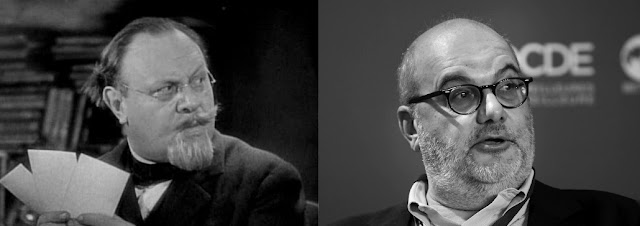

The author’s (Lakicevic) path to graduate education was somewhat less flamboyant, but it is his story that I find most interesting. Both Djindjic and Lakicevic were almost totally penniless, living on irregular and minute stipends, and surviving by doing odd jobs (from construction to night clubs and smuggling), mixing up with Yugoslav and Turkish gastarbeiters, and being treated by them or accidental women they seduced to dinners and drinks.It is the contrast between the day life composed of philosophy lectures at a prestigious and orderly university, where professors appear exactly on time, give appointments one month in advance, deliver lectures on social contract, alienation, ontology, epistemology….where libraries are immense and quiet, books arrive quickly, carried by the silent helpers, and the world of the night–when our heroes return to their lair—that is striking....When the night is over, Lakicevic goes back to the world of learning where the discussion is about the best ways to organize a community, citizens’ rights and duties, working class and bourgeoisie, l’etre et le néant. But the world of the day and the world of the night have nothing in common. It is not solely that the people of the day and the people of the night have different interests and backgrounds. The two cannot be said, in any meaningful way, to belong to the same community. They are two worlds.
Naipaul saw the same duality between the whites and the enslaved and miserable African populations. In a beautiful passage he writes:
“There was the world of the day; that was the white world. There was the world of the night; that was the African world, of spirits and magic and the true gods. And in that world, ragged men, humiliated by day, were transformed--in their own eyes, and in the eyes of their fellows--into kings, sorcerers, herbalists, men in touch with the true forces of the earth and possessed of complete power... "
The quote continues but that's enough. As to whether he ignores Naipaul's racism or just doesn't get it, my bet is it's the latter.
"But the world of the day and the world of the night have nothing in common." They have nothing in common in the world of philosophical liberalism, or in the earnest Catholicism of Reed and Geuss, but in the world of history, facts and events, in the world of politics—real politics—they're as inseparable as youth and sex. "Not the idea of sex, or the meaning of sex, but sex!"
The life of the world or the life of the library.
"mixing up with Yugoslav and Turkish gastarbeiters, and being treated by them or accidental women they seduced to dinners and drinks." A classic tale of student bohemia. The tale of Djindjic climbing through the window and scaring the famous professor fits almost too perfectly.
Serendipity again. Compare that scene to this one.
Thursday, June 02, 2022
Leiter links to Solveig Gold again—see previously—ignoring that the exchange he links to continues from a defense not of the classics as such, but "Western Civilization", and that she's defending Trump from accusations of racism in his use of obviously coded speech. This time she reminds me of Lipstadt.
Leiter knows the context. He's not lying; he's behaving like a lawyer, an advocate, not a seeker of truth. What would John Tasioulas say?
When academics veer towards activism, perhaps in quest of bureaucratically mandated 'impact', there's often a rise in hyperbole and a corresponding decline in credibility. One of the reasons I find John Curtice so admirable, I have no clue which way he votes.— John Tasioulas (@JTasioulas) August 29, 2019
The rule of law - too easily confused with the rule of lawyers.
— John Tasioulas (@JTasioulas) September 9, 2019
In the same post he links again to Adolf Reed, from 2013
Race is a taxonomy of ascriptive difference, that is, an ideology that constructs populations as groups and sorts them into hierarchies of capacity, civic worth, and desert based on “natural” or essential characteristics attributed to them.
Shelby Steele, "The Inauthenticity Behind Black Lives Matter" 2020
Insisting on the prevalence of ‘systemic racism’ is a way of defending a victim-focused racial identity.
Reed in 1997
Beware the proliferation of a peculiar political species-the black conservative crusader against "race-based" policies.
"The Descent of Black Conservatism", The Progressive, Oct 1997
Times change
I listened to Reed on a podcast and at some point he paused: "Mea Culpa, mea culpa, mea maxima culpa." He was talking to himself. The interviewer said nothing.
Like Geuss: raised a Catholic and opposed to politics, believing only in "truth".
Tuesday, May 31, 2022
The New Statesman, "New York’s hipster wars"
Why the city’s clash of cultures between progressive Brooklyn and transgressive Manhattan marks a new era in American politics.
In American cultural and intellectual life, New York City sets the tone. As the main hub for the country’s media and frequent originator of trends that percolate through US society, what’s “in” with the New York scene today is often central to American culture tomorrow. And politics, too – as US conservatives never tire of noting – is often downstream of culture.
But New York City’s intellectual landscape is increasingly split between two warring scenes, divided by geography, aesthetics and politics. Which of these prevails could affect whether America shifts right or remains where it is.
In Brooklyn, the borough associated with the “hipster” revolution from the late 2000s, writers energised by the Bernie Sanders campaigns in 2016 and 2020 retain their faith in left-wing politics through new “small” magazines. But on the island of Manhattan, a self-consciously transgressive artistic and literary scene is brewing downtown. In podcasts, plays and literary journals, a different sensibility is being elaborated. Scornful of the “woke” sanctimony of Brooklyn-based media, some flirt with alternative ideologies, while others claim not to be interested in politics at all.
[see also: A farewell to Enid’s, Greenpoint’s iconic “hipster” hangout]
Who wins in New York’s clash of cultures is high-stakes for the future of American political culture....
The first time I walked in Enid's all I thought was that it felt like the midwest: slackers from suburban Illinois and their junkie ex-cheerleader girlfriends.
"And politics, too – as US conservatives never tire of noting – is often downstream of culture."
Serendipity/timing...
That culture might be powerless to affect the movement of history was a perception Viennese society held in abeyance for half a century, by endorsing every avant-garde that appeared in its arts and literature.
The author is an American, a nationalist hipster conservative.
Even the pointless endless squabbling of the American culture war—which I have called an engine of unfreedom—is also a machine that originates new doctrines quickly copied from Brazil to Bessarabia, that generates entirely new lifestyles, physical-medical-cultural modes of life hitherto unknown.
To be present at the creation is why one lives in America and in New York specifically, why one bears the thousand tiny indignities of life here, why one consents to being broiled in summer and frozen in winter, ripped off for everything in all seasons, why one submits to the terrible restlessness and the deleterious effect on the body of the climate, the cuisine, the lifestyle—why it’s necessary to endure the vulgarity that pervades the city at every level, up to the highest levels of supposed refinement and intellectualism....
A postscript: I recently published a piece for the New Statesman gathering some observations on the political-cultural landscape in New York City. Just a fun little piece for the Brits, something to give them a very rough sense of developments here, because they love that sort of thing. I figured it would probably get lukewarm pick-up this side of the Atlantic because I didn’t come out swinging against any of the people I mentioned.
Wrong! People outside New York City were irritated by what they perceived as an exaggeration on my part of the influence of a handful of figures in New York City, none of whom are household names. And after another essay was published earlier in the week, people in New York City were fed up with articles about cultural developments in lower Manhattan
He links to Lorentzen's response. They're part of the same stupid scene.
"In American cultural and intellectual life, New York City sets the tone....Who wins in New York’s clash of cultures is high-stakes for the future of American political culture."
"To be present at the creation is why one lives in America and in New York specifically."
I fucking had to laugh. A Californian fantasy of the center of the universe, 30[?] years too late.
"—which I have called..." From the link:
Michel Foucault, ever more out of favour on the left, would have been right to see the American culture war itself as an engine of unfreedom, a means of disciplining thought and action on both sides.
Foucault, after Tocqueville, and all the conservatives, and historians who read them, who've made the distinction between aristocracy and wealth, and Puritans and drunks. Lawrence, as always: "The deliberate consciousness of Americans so fair and smooth-spoken, and the under-consciousness so devilish. Destroy! destroy! destroy!..."
American liberals are optimists about themselves; American conservatives are pessimists about everyone else. The first principle for both is their own self-image.
Leiter links to the wife of a recently fired Princeton professor, Joshua Katz.
I decided to apply for early admission to Princeton after sitting in on Professor Joshua Katz’s seminar in April of 2012.
...In November 2018, Joshua bought my father a martini and asked for permission to marry me. In March 2019, we found our dream home in Princeton. That December, Joshua proposed.

I'm not a moralist. Is all that is just pious?
Solveig Gold, First Things, "Princeton and the Erosion of Expertise"
Plato argued that we should, in all areas of life, defer to experts. If you wish to raise good horses, employ an expert horse-trainer. If you wish to cure a sick man, take him to an expert doctor. And if you wish to live in a harmonious city, enthrone an expert statesman.One would be hard-pressed to find a group of people today who take greater pride or place more stock in expertise than the faculty members at my alma mater, Princeton University. “Trust the experts”: a constant refrain, plastered across their yard signs and social media accounts. In theory, it’s easy to imagine the little town of Princeton, New Jersey, as a modified, modern-day Kallipolis.
A second generation writer for First Things; a defender of free speech and the Federalist Society; published in The New Criterion, defending western civilization against attacks by Peter Beinart.
Peter Beinart’s assertion last week, in “The Racial and Religious Paranoia of Trump’s Warsaw Speech,” that “the West is a racial and religious term” has raised more than a few eyebrows, primarily for its implication that to champion Western Civilization is to participate in bigotry. Jonah Goldberg’s article in National Review took Beinart to task on this point, offering a rousing defense of Western Civilization. But not yet fully debunked is Beinart’s initial premise: that is, that “the West” is code for white, Christian culture—a culture that belongs to white Christians, and to them alone.

The Federalist Society is no more conservative than the Club for Growth. The fight is over the definition of freedom, the American religion. American conservatives are fakers and vulgarians, like Ralph Lauren as a WASP. On the hipster's page I compared him to Whit Stillman and Andrew Exum. Stillman is a fantasist, and Exum sees himself as a cold war liberal in his own Vietnam. The Alden Pyle schtick was old in 1955. But American liberals now call themselves leftists—they're now social democrats—and American conservatives agree. Facts are boring to the faithful. And we also have a new crew of fascists; academic fascist kitsch, and suburban club kid college graduates. I've mentioned Anna Khachiyan once and that's enough. I've never written about Whit Stillman, but I've told a story about Tina Barney, from before Stillman made his first film. Barney and Gold, a couple of Jewish Shiksa goddesses in an anti-Semitic world. It's amusing rereading it that I obviously worked on the tone, as I have here, maybe too much. I indulge myself responding to this shit, calling their snobbery and raising it. It's an affectation.
I never posted this pic and you can't find it anymore, but it takes me back.

Subscribe to:
Posts (Atom)