Monday, July 25, 2022

Tell me a story

Leiter

Narratives that engage the emotions, not arguments, are more effective at producing charitable behavior

Interesting study, confirming what all Humeans and Nietzscheans already suspected. As Nietzsche quips (in Twilight of the Idols), "Nothing is easier to erase than a dialectical effect."

History is written by the winners. What does that tell you?

Leiter, Joseph Raz, and David Enoch, Chomsky, and Bernie Sanders, all rationalize the ethnic cleansing of Palestine in defense of a narrative. To that end, facts are forgotten. Leiter says academic freedom is more important than freedom of speech for the rest of us. 

Leiter opposes "diversity blather" because other people's storytelling undermines his own.

Eric Schwitzgebel et al: "Engaging charitable giving: The motivational force of narrative versus philosophical argument"

ABSTRACT

Are philosophical arguments as effective as narratives in influencing charitable giving and attitudes toward it? In four experiments, we exposed online research participants to either philosophical arguments in favor of charitable giving, a narrative about a child whose life was improved by charitable donations, both the narrative and the argument, or a control text (a passage from a middle school physics text or a description of charitable organizations). Participants then expressed their attitudes toward charitable giving and were either asked how much they would hypothetically donate if given $10 (Experiment 1) or told they had a 10% chance of winning $10 and given the opportunity to donate from their potential winnings (Experiments 2–4). Across the four experiments, participants in all of the narrative conditions and in some of the argument conditions tended to express more positive attitudes toward charitable giving and donated about $1 more on average than did participants in the control conditions. These effects appear to have been mediated by the “narrative transportation” scale, which suggests that appeals to donate can be effective if they engage participants’ emotions, imagery, and interest.

Rationalists discover empiricism and claim it as their own. And they reinvent the wheel.

Schwitzgebel, earlier this year. Still hilarious.

philosophers vs lawyers and historians, every fucking day.

Sunday, July 24, 2022

Paragraphs from "Militant Nudes", Elizabeth Hardwick, in the NYRB in 1971

Troubling Images: 1.) Professor Theodor W. Adorno, at the University of Frankfurt, was, not long before his death, the audience for—or the object of—a striking bit of symbolic action. Adorno, a distinguished philosopher and the teacher of many leftist students, had come to be worried about student zeal for immediate action, about spontaneity, random rebellion, and, of course, the possibility of repressive actions by the government. And how was the sacred old father rebuked? A girl got up in the classroom and took off all her clothes.

A bit of The Blue Angel here? No, perhaps the key is found in the famous scene in Swann’s Way. Mlle. Vinteuil, making love to her girl friend, puts the photograph of her doting, gifted father on the table next to the sofa so that the girl can spit on it. Proust says about the scene: “When we find in real life a desire for melodramatic effect, it is generally the ‘sadic’ instinct that is responsible for it.”

“Sexuality”—the word has become a sort of unfleshed abstraction as it trails along with liberty, fraternity, and equality in the youth revolution—is suddenly political. The body, the young one at least, is a class moving into the forefront of history.

In Gimme Shelter, a brilliant documentary film about the Rolling Stones and their concert outside San Francisco that ended in murder, several accidental deaths, and an outburst of desolation, anger, and danger that is thought to have signaled the end of something in the rock and roll scene—in this film a number of people, mostly girls, take off their clothes. Each has an expression both blank and yet sure that something is being done, accomplished, signified. They stand there in the crowd, enclosed in their sad flesh, as lonely as scarecrows among the angry, milling thousands. The gestures did not cause a head to turn and all one could feel was that the body, the feet, the breasts were foolishly vulnerable, not because of any attractions they might have for the crowd, but merely due to the lack of protecting clothing. The nude bodies were no match in dramatic interest to the fabulously dressed performers, whose tight pants, scarves, snakeskin boots, spangled boleros, red silk ruffled shirts, represented what is meant in the entertainment world by a “personal statement.”

2.) Huey Newton in New Haven, visiting Bobby Seale in jail. “If Ericka and Bobby are not set free, if the people can’t set them free, then we’ll hold back the night, there won’t be day—there’ll be no light.” The eschatological mode has in modern times wearied the Christian world, but it served them well enough for centuries and so perhaps militant leaders sensibly feel there is some life left in this style. At the Black Panther convention recently—a small and dispirited gathering according to journalists—Huey Newton outlined the program: “First, focus on closing down Howard University, second on liberating Washington, and third the seizure of the White House.” Liberating Washington. The seizure of the White House. For a little group of the faithful these words perfectly represent the “schizophrenic bind” R. D. Laing writes about. If the words are not genuinely taken seriously and only a pretense about them is kept up, this creates an impossible and corrupting cynicism very difficult for all except leaders to live with; if the commands are treated as genuine their insane and sadistic nature will unhinge all who try to act them out. This is perhaps what is truly meant by the phrase, revolutionary suicide—the killing in oneself of the uses of reality by submitting to “the program.”

The film, Ice, and the novel, Dance the Eagle to Sleep, are both imaginary projections of revolutions and civil wars to come, and there is a coercive and mystical inevitability claimed, not directly but aesthetically, that links them with the program Huey Newton gives to his followers. And the concentration upon revolutionary “balling” in the novel goes back in my mind to the poor professor in his classroom, to the mysteriousness of the girl’s answer to the professor’s worries. 

...The activism in Ice and Dance the Eagle to Sleep is not a replacement of deadening alienation but simply an addition to it. Even though Ice was filmed in the basements and bookstores and streets of New York City, one often feels in it a memory of the suffocating boredom and darkly sexual crowdings of an old army post, the kind of waiting and frustration that made soldiers before Vietnam long for some action. So, after a few years of threats and promise of revolution, rebellion, change, militant encounter, Ice and Dance the Eagle to Sleep are tours of active duty at last.

...Trash is a homosexual film produced by Andy Warhol and directed by Paul Morrissey. The Groupies has to do with deranged, obscene girls who follow rock stars around, hoping to sleep with them, if one may use such a drowsy, untimely phrase for these wandering, never-sleeping hunters. The Groupies is a documentary, although there is considerable staginess in it; Trash is a concoction that is also a real life thing part of the time.

The nature of sexuality is repetition. Phallic compulsiveness is an exaltation of repetition and yet a reduction to routine of the most drastic kind. Still novelty and challenge never lose their hold on the imagination and in the phallic hell, the center of interest will be reserved for the refusing, even for the impotent. The hero of Trash is an impotent junkie. He wanders through the long hours of the film, quiet, handsome, mysterious, stoned, but arousing almost insane desire in everyone he meets. In a world of compulsive sex, dramatic interest can only be achieved by complications, particularly since every frontier of practice has been crossed.

...In Gimme Shelter, Mick Jagger, Grace Slick, Tina Turner—the rock stars—are a disturbing contrast to the dull, sullen, angry hundreds of thousands who have come to hear them. For one thing the performers are working and even if the pay is outrageous, the acts somewhat tarnished by time, there is still discipline, energy, travel, planning, and talent. Each one is a presence, unique, competitive, formed by uncommon experiences. The crowd, however, is just a huge clot of dazed swayings, fatuous smilings, empty nightmares, threatening hallucinations, and just plain meanness. 

There is death everywhere, and of every sort, in the dead, drugged eyes and in the jostling, nervous kicks and shoves. Everyone is a danger to himself and to others. One could be stabbed by a “mystic” who thought he was God or Satan; or choked by the lowering, alcoholic violence of the Hell’s Angels just for brushing against one of their sweating arms. Someone is having a baby—another corny freakout, you find yourself thinking. The owner of the Altamont Speedway, where the concert took place, wants the birth mentioned in the media as a “first.” “Easy, easy,” Grace Slick pleads from the stage. “Why are you people fighting?” Mick Jagger wants to know. After the concert, two young boys were killed when a car left the highway and crashed into their campfire. Another young man, drugged, fell into a canal and was drowned. 

Thinking about the predatory girls who call themselves “the groupies,” remembering their obscene reveries and their moronic self-exploitation, one wants to hold back from description. One of the young men connected with the film said, in a press interview, that he was horrified by the girls and that they were stoned out of their minds all of the time. The girls are hoarse and coarse and not one arouses pity of the kind we feel for the pimply, snaggletooth synthetic girl. Holly Woodlawn, in Trash. All are despised by everyone, by the cameramen, the producers, the rock stars, just as Holly is despised by Andy Warhol and Paul Morrissey.

The main life of Trash comes from the perverse, proletarian vitality of Holly Woodlawn, who comes across to us as rotting skin and bones, kept alive by the blood of mascara and the breath of discarded clothing from the city’s trash barrels. Still, the people in charge of the film show their hatred by a long, boring, hideous scene in which Holly buggers herself to some sort of satisfactory exhaustion with a beer bottle. This scene is pure sadistic contempt and is also gratuitous, since it is unreal, even strangely unconvincing. Or not strangely.

The groupies take plaster casts of the parts of rock stars—or they claim the stars as the origin of their “collection.” The idea came to one of them, she says into the waiting microphones, when an art teacher said one could make a plaster cast of “anything hard.” “Wow,” grunts the groupie. She later describes herself in the more delicate moments of the casting as being “very gingerly.”

Certainly these girls are in extremity, pushing out beyond the horizon. Yet they are not much more freakish nor are they more obscene than the teen radicals in Dance the Eagle to Sleep. In the novel, Joanna, the girl most admired and desired by the boys, is serenaded with a little song that goes:

Joanna has a hairy cunt.
It’s the kind of cunt I want.
I get on my knees and grunt 
For a touch of Jo-Jo’s hairy cunt!

Still the groupies contain in every swagger and delusion genetic reminders of their parents, longing for the kiss of celebrity; aging Stalinists seem to haunt the memories in Ice; Holly Woodlawn says in the film she was born on welfare and while that is probably a fiction there is no reason why she might not have been. Hell’s Angels and the vaguely disoriented crowds are both caught up in mindless anarchy. What can one make of these deaths, since death is the feeling most clearly projected by radical and freak, girl and boy: death by drugs, by the misery and dreariness of the commune; death by political enemies, death to political enemies, death in “regional actions,” by helicopters raining destruction on teen tribes, death at the free rock festival, in the eyes of Miss Harlow, the little groupie with frizzy hair.

At his trial, perhaps feeling the sorrow of his complicity in the death of Che Guevara, Regis Debray said: “The tragedy is that we do not kill objects, numbers, abstract or interchangeable instruments, but, precisely, on both sides, irreplaceable individuals, essentially innocent, unique….”

Something pitiless and pathological has seeped into youth’s love of itself, its body, its politics. Self-love is an idolatry. Self-hatred is a tragedy. But the life around us is not a pageant of coldness and folly to which we have paid admission and from which we can withdraw as it becomes boring. You feel a transcendental joke links us all together; some sordid over-soul hangs out there in the heavy air. No explanation—the nuclear bomb, the Vietnam war, the paralyzing waste of problems and vices that our lives and even the virtues of our best efforts have led to—explains. Yet it would be dishonorable to try to separate ourselves from our deforming history and from the depressing dreams being acted out in its name.

After the squalor of Trash, The Groupies, and Dance the Eagle to Sleep, one comes back to the girl in Professor Adorno’s class. What did she think her bare breasts meant? What philosophy and message could this breathing nude embody? In one of his last essays Adorno wrote, “Sanctioned delusions allow a dispensation from comparison with reality….” And he also said, “Of the world as it exists, one cannot be enough afraid.” The students may have known all about the second idea, but perhaps they could not forgive him the first.

“Sanctioned delusions..." including his own.

Saturday, July 23, 2022

The mediocrity of John Ganz—again—the failed painter in Bushwick. His highlighting

Peter Thiel is a fascist. There’s really no better word for what he is. For some reason, people have a lot of trouble grasping this or just coming out and saying it. 

In his biography of Thiel, The Contrarian: Peter Thiel and Silicon Valley’s Pursuit of Power, Max Chafkin writes, “The Thiel ideology is complicated and, in parts, self-contradictory, and will take many of the pages that follow to explore, but it combines an obsession with technological progress with nationalist politics—a politics that at times has seemingly flirted with white supremacy.” Let’s see, we’ve go some futurism, nationalism, maybe a little bit of racism here and there…hmm, what does that all add up to? What a mystery this guy is!

...But being anti-democratic is one thing, but how could the libertarian, the defender of individual freedom, the believer in the market ever really be a fascist, an ideology that celebrates the collective masses and the state? I think part of the problem is that there is still a very cartoonish notion of what actually-existing fascism looked like.

Back to Bacharach: "I was a Gay Jewish Teenage Nazi"; also Milo Yiannopoulos, and Jörg Haider,
Michael Kühnen et al.

"For Kuhnen, there was something supermacho about being a Nazi, as well as being a homosexual, both of which enforced his sense of living on the edge, of belonging to an elite that was destined to make an impact. He told a West German journalist that homosexuals were 'especially well-suited for our task, because they do not want ties to wife, children and family.'" 

"Should a homosexual be a good citizen?" Leo Bersani asked in Homos in 1995, expressing a gay skepticism that has dogged every upsurge of gay politics. Bersani's doubt results from his diagnosis of "the rage for respectability ... in gay life today." He locates that rage in postmodern dissolutions of gay identity, in clamors for gay marriage and gay parenting, in queer antisepticizings of gay sex. "Useful thought," Homos suggests, might result from "questioning the compatibility of homosexuality with civic service." And from questioning more: Bersani makes a claim about social being itself. He hypothesizes "that homo-ness ... necessitates a massive redefining of relationality," that it instances "a potentially revolutionary inaptitude perhaps inherent in gay desire for sociality as it is known." If there is anything "politically indispensable" in homosexuality, it is its "politically unacceptable" opposition to community. Thus Homos paradoxically formulates what might be called "the antisocial thesis" in contemporary queer theory.

The contradictions are the point. Conservatism is anti-individualist but not destructive of the individual as such. Fascism is the cult of individualism and the destruction of individuality. The destruction of the self. 

"Self-hated is the foundation of fascism. Self-hatred directed outward: the Catholic Integralists and faggots disgusted by the fact that most people don't know enough to hate themselves." 

Bersani: "No one wants to be called a homosexual."
Yiannopoulos:  "If I could choose, I wouldn't be a homosexual."  
On the other side of Brooklyn, a hipster lesbian discovers the pleasures of pleasure.
Initially, Fishman’s narrator is herself an aspiring ascetic. A young barista adrift in Brooklyn, Eve is concerned by the various evils of modern life – capitalism, sexism, environmental degradation – but remains unsure what, if anything, she can do about them. “My friends and I were raised without real religion and without a comparable ethics of living through which to filter our beliefs and ambitions,” she reports. “We were encouraged to care deeply about the state of our world but our ability to affect it personally was very much in doubt.” What Eve can control is her own wayward desire, or so she is committed to believing. She belongs to a set “to whom queerness meant a specific type of ethical awareness”, and lesbianism arises in her life “like a faith”. Her girlfriend, Romi, represents her ideal. A doctor of withering virtuousness, Romi is “so preoccupied with her vocation that she [is] immune to beauty. The concept [hasn’t] occurred to her outside an introductory art-history course.”

Review by Becca Rothfeld.  It's all so silly, or just sad. 

I'm not sure why people are surprised and even upset that some teenagers don't know who the hell bin Laden is.
...The kids are fine. It's our elite overlords that are all screwed up.

The kids are idiots, and so are their overlords. 

Friday, July 22, 2022

continuing.

repeat from 2003

Earlier tonight my neighbor told me he's gotten a break; he's not going to do any time. He was arrested a few months ago for pistol-whipping someone on the subway in a drunken rage, and he's going to be able to keep his job. I told him I was happy for him, which I am. He showed me the head of Jesus that he's having tattooed on the left side of his chest and stomach. He said the one his mother won't be so happy about, also of Jesus, will be on the other side; the face will have horns and will be screaming in pain. I said Jesus had had a hard life. He said it was probably closer to the expression Jesus had on his face before he died. We talked for a few minutes. He said it doesn't matter what side you worship, you'll will be taken care of, but that now he's worshiping "the better angel." I said life is complex. He said no, it's simple. It's just hard.

I just wasted an hour at a bar listening to a couple of slackers doing an open mike tribute to Johnny Cash. At one point I watched a shaggy ex-suburbanite, who could probably pass as Matthew Yglesias' kid brother, singing along—"I shot a man in Reno, just to watch him die"—pointing a cocked finger at the head of a friend next to him, laughing with an expression that betrayed no knowledge of violence. The 12 years olds on my block have a better understanding of the world.

He was my landlady's son. He was a court officer. A year earlier he'd talked to me about a judge he'd been assigned to who he thought didn't like him. "A little Jewish lady." Later he said he'd changed his mind, that maybe she'd changed hers, because of the way he handled the people who appeared before her. It was criminal court, and he saw himself as someone who could easily be in their situation, so he told them simply that they had to get through this, and that the fastest way was the best. He respected them, and he told me he thought she'd understood how he was helping her. He kept his job and his assignment, but without the gun.  

Around the same time, the same few years, a couple of Latino kids kids walking down the street, 12 or 13, a boy and a girl, the girl angry that someone had brought coke to a party—"I don't want to see that shit!"—passing two white suburban 20-somethings, dressed like children at a church picnic, sitting outside a laundromat, now wearing expressions of near panic. 

2004

Ann
Born in Greenpoint.
Father, born Austria-Hungary.
Father worked in the mills in Homestead PA before moving to New York. She says he never wanted to talk about it. I told her my grandfather was a Pinkerton.
—My grandfather was born in the Bronx. My grandmother was born on South 6th Street
in Williamsburg—
25 years on the floor at Leviton.
11 years as the manager of a small store on Manhattan Ave.
Wanted to be a doctor.
Languages: English, Polish, Slovak, Russian, French.
Maintains a correspondence since 1947, in French, with a woman who knew and now tends the grave of her brother, killed and buried just before the end of the war, in 1945.

2014 

A few nights ago I sat in cafe owned by a half-German Cypriot from London, listening to a discussion of Arabic diacriticals between a Bulgarian raised in Morocco and an Iranian-Bangladeshi fashion stylist who's just broken up, again, with her Afro-Scottish boyfriend. The Bulgarian studied kickboxing in Thailand and has an MBA from France. Between them they speak 12 languages. 
The next night I sat in a Bosnian wine bar drinking with an Israeli fascist and a Croatian ex-Nazi. Next to them were an Indian pharmacologist, a former dancer for Dolly Parton, his Moroccan roommate, and a gay ex-priest.  The bartender was from Macedonia; the Afro-Swedish waitress has the number one blues album in France, and the uncle of another led Serbian battalions in Kosovo. She's studying international law. The father of a Serbian waitress at the Cypriot cafe was indicted at the Hague. She does stand up. She started a gig at an AIDS benefit by wishing her ex-boyfriend was HIV positive and dying. About the new one she says "My boyfriend is black, and I'm from Serbia.  Once you go black, you can't go back." The Croatian Nazi has great stories about the war. "Cover me! I'm going for a beer."

Monica opened her cafe in 1995. She's been back in Cyprus since 2016 and closed the place in 2020. The wine bar's been gone for years. In 2005 a Bulgarian/Irish bartender from the Bronx, working at a small lounge on Broadway asked me if I thought the Manhattanites would take over, adding: "I hope not. I like the diversity." The same year a European gallery owner in Manhattan told me she'd stopped coming out to Astoria. "The Americans are moving in". Astoria had been a place to go for Europeans in Manhattan. But it was the Mediterranean from Spain to Beirut, and north and south, and then the Caribbean and South America. The French were among the first to move out, not forced by gentrification but by choice. I have more stories than I can count. At 2 AM one night an Egyptian restaurant owner ran into to a Croatian bar yelling "Bourdain came in!" A few months later he did a show there.  A trio of Mexican kids, early 20s, young and loud walk in and look at the bar menu—it was the wine list—and say something to the German owner. She comes back with a bottle of wine and three glasses, pours a little in the glass in front of the kid who placed the order, who while still talking to his friends, puts two fingers on the base of the glass and moves it on a tight circle. He took a sip and nodded. She poured wine in the three glasses. He wasn't being an asshole; he was a restaurant worker in a good restaurant and someone had taken the time to teach him. And the owner wasn't annoyed. It was all polite, professional, but it took place on grounds most of the Americans moving into the neighborhood can't recognize. I dated a Croatian women I met at that bar—opened by a Croatian and a woman born in East Berlin—she was  artist and lived in Paris, and made extra money every year as a translator at Cannes. Her father had built large projects in Yugoslavia. At the Cypriot bar I met a Bosnian from Sarajevo whose grandfather had been recruited into Tito's partisans, by Tito. She was reading his autobiography, which is unpublishable now. There's too much dirt on too many people.

I used to see Maseratis on 30th Avenue on Saturday nights. One of my neighbors owns a BMW i8. In winter of 2003 or 4 a Greek tile man on a job told everyone his summer plan: home to get his motorcycle then ride from Athens to the Spanish Riviera. He talked about riding in the US, in the south, the midwest, going to small towns. "In any country you go somewhere, you ask, what do you drink here? What do you eat? I want to know!" He had an audience of 10, carpenters, plasterers, laborers, people from 5 countries, all nodding."And here they don't want you! What a stupid country!" 

The German moved back to Berlin with her Dominican husband. His mother was Dominican Japanese and he could never speak to his grandmother growing up because she didn't speak Spanish. At 20 he got on a freighter and went to Japan. He spent a year working in a restaurant working for a man who treated him like shit. At the end his boss told him he'd done it because you have to be tough to survive. It was never personal. And he learned what he needed to learn. After seven years he owned a diving company and he could go back to the Dominican Republic and talk to his grandmother. In NY he worked for a Japanese software company. He didn't speak German when they moved to Berlin, but I'm sure it took less that a year; I know a Bulgarian woman who learned English after six months in Rancho Cucamonga. 

I walked into another bar, underdressed in an old hoodie, and the man walking in behind me, grey-haired, in jeans, a crisp white shirt and suit jacket looked at me with annoyed contempt. The only empty seat was next to mine. I frowned and tugged at my cuffs, and he laughed. Five minutes later he launched into a speech: "They killed babies!! Both of them! Murderers!" Milosevic and Tudjman. He wanted to unburden himself to an outsider. "Tito put my father in jail... My father loved Tito!" Some dogs need a leash.

I got drunk with a former finance minister of Bangladesh at at Irish bar owned by a cop. He had the hots for the Polish bartender, the daughter of former high ranking officers in the secret police in communist Poland who had the hots for me. He was introduced by a neighbor who remembers the famine in 1974 looking out the window of father's Mercedes. My neighbor has land on three continents, but the crash in Florida hurt him. His five children, all top of their classes, will be going to the Ivy League or Trinity Dublin. His wife's sister is still a bit confused. "She was the conservative one". His parents were relieved. Hard drinking Muslim men and Irish Catholic wives. I've seen it more than once. It seems to work. 

I have plenty of stories where I don't come off well but these are different from the stories where I'm the butt of jokes. "You think you're any better than any of those other gringo motherfuckers!" The grill man at a Mexican coffee shop is yelling at me." I yell back: You're saying that to my face!" He tilts his head to one side and laughs. His nephew went to Russia for the World Cup, and then to Germany and the Netherlands. "You said Europe was different! But they all want to be America!" The crowd went wild at Octoberfest singing along with Four Non Blondes. Later his descriptions became more specific and softer. He'd been to Canada years before he went to Europe and felt the difference. He's going to Spain in November. About the changes here he says "We make Taco Bell tacos now." 

I've been ridiculed by people from 20 countries, many of whom are used to being treated like shit by people who look and sound like me. "You're not a real New Yorker. You're from Queens", says an NYU student with high school French, to a woman who speaks 6 languages and is married to a Frenchman. The man behind the counter at a Yemeni deli who now puts up with white suburban brats has family in Algiers, Istanbul and Milan, and went on vacation with his wife and kid to Amsterdam. He shrugs it all off. But the nice Americans behave like social workers, wanting to help the weak.

That's just a short list, a few stories stripped of details about people I've met, some of whom don't like me, and the comparison, of these descriptions and those lives, with the flatness of the American political imagination, or the serious and earnest political imagination, mocked by Tocqueville and others. Immigrants think Americans are idiots. And when I say they came here so that their children will be idiots they agree, and laugh. 

On the subway a couple of days ago after work and after the end of of Roe v Wade I passed a couple of earnest young activists, the man with a placard, "Ban Guns" and a frown. I kept walking, and sat down across from two black women, well dressed, with expensive braids. They were fuming. I was a white guy in work clothes covered in dust, and I engaged them, as I do. Fifteen minutes later they got off the train; one of them looked back and we said goodbye to each other. I'd argued class over race, but without denying it's a racist country. The second woman focused on race. She attacked the democrats and I said—not asking a question— "including Obama", and she said "Yes!" She said she didn't see a reason for voting for them anymore. I didn't ask her what her other options were, but I'll take her anger, defending her interests, over the earnest young activists defending their ideals. You can argue with anger but you can't argue with faith.

Thursday, July 21, 2022

I've said it before and I'l say it again: cosmopolitanism doesn't follow the tenets of philosophical liberalism. It's the common ground shared by conservatives of varying beliefs. And that connects to the irony of art against the pedantry of philosophy. 

Somewhere in the archives of this page there's a mention of a famous European political scientist's concern about religion and assimilation, and his missing the point because his data comes from mosques and not restaurants. 
I've remembered the name. Ulrich Beck is an idiot. See also Shadi Hamid.
Hamid's ideal of secularism comes out of Protestant theology. It's a transition within the elite. But Protestant secularism also comes against theology: the secularism of the demos. The division between the church and street becomes the division between the academy and the theater.

Catholic, Jewish, and Islamic secularism all come from the street. Unlike Protestantism there's no possible smooth transition. Religious scholars continue their role only as readers of secular books. 

"Hey Kabir. Its Ramadan!"
"Began today." He raises his glass.
"I'm watching you! Yeah. I'm the Irish mullah. Muslims. Just like everyone else. Full of shit!"
Kabir, getting out of his chair: "See you tomorrow."
"What else you gonna do?"

A friend tells a story about an old woman, wealthy and devout, and her dinnerware: one for meat, one for dairy. And for special occasions: one for meat, one for dairy. And for high holidays: one for meat, one for dairy. And for high holidays with guests: one for meat, one for dairy. And one for shellfish, because she loved oysters. The owner of a Brazilian restaurant had breakfast every morning at a Cuban one. One day he told us—I was there, as I was at the bar—about a man who came in for lunch and complimented him on the Feijoada, a pork stew. The owner thanked him, then the customer took off his hat, revealing a yarmulke, showing his seriousness as a critic. They both laughed. 

Emmanuel Todd says the end of the Rassemblement National will be sex, because fucking is the drug that destroys ideologies.

I was raised to refer to anyone much older than myself as Mr, Mrs, Miss, Ms. Any old man or woman was the equivalent of a grandparent. They may have been someone else's grandmother or grandfather, but I owed them the same courtesy. It was never hammered into me; I followed my parents' example. I had a sense of a world divided between people who lived their lives as members of a specific community and those who, distancing themselves from any one tribe, served a larger one. Individualism as such was disdained. When we moved into the neighborhood I grew up in we were viewed as blockbusters: Jews buying from a Jewish realtor who were going to fix up and sell, or otherwise change the neighborhood. But the neighborhood didn't change. My sister became friends of our neighbor's daughters—our neighbors whose arrival had been the cause of white flight 25 years before—and my bother made friends of his own. They'd grown up in public school; for them it was nothing new.  But the neighborhood changed me. I remember being in rooms with mothers who were bemused to see a polite 7 year old white boy who was now friends with their son. And the woman was a Mrs and I owed her the obeisance due an elder. I bowed my head. The fathers were more incredulous. But I'm left to say that the first community I ever knew, as a community, who accepted me, even tangentially as an outsider, was black and working class. 

What this means is that when I was living with Graeber in Chicago, running looking for work and losing patience, the only person I talked to for pleasure, to relax, to calm my nerves, to blow off steam was the super, who'd moved north in the Great Migration. His parents had named him for FDR. He'd been a long-haul truck driver and a lot of other things. I remember sitting on the stoop with him watching a driver back an 18 wheeler around a tight corner and into the loading dock of a supermarket across the street, He describing how hard that was to do, and get it right the first time. And the driver made it look easy. One of my many regrets is not taking him up on his invitation to go to social clubs on the South Side on a Friday night. "You'll be safe. You'll be with me!" I trusted him but I didn't trust his judgment and I should have.  I copped out. But he invited me to a family barbecue. We were sitting in his basement apartment, and I remember the Ebony and Jet magazine on his coffee table. I said I thought I'd be out of place. He said "You're out of place now aren't you!" I went with my girlfriend, the former shop steward for the UAW, who was now in grad school at IU. And learned the secret to great ribs. 

Roosevelt read Graeber like a book. He'd witnessed things, and knew what they implied. David didn't like him either. 

David took me to Harold's Fried Chicken and Valois. But David didn't write Slim's Table. He studied with Bourdieu, but he didn't write Body and Soul, and he's not Alice Goffman. This is the shit David didn't want to deal with. And this is where it gets messy. David's parents were working class, but David never worked a real job for a day in his life. His politics was an idea not an experience. Mitchell Duneier and  Loïc Wacquant have both gone Hollywood in a sense, but that's part of the same ambiguity. Wacquant  and Duneier are feuding, and I don't have to pick a side. But there's a sense that what got Goffman into trouble was her loyalty, and that, as evidence of friendship trumps proclamations of it.

And this again is why The Wire, Breaking Bad, The Sopranos, are more important, more intellectually serious than David's Dungeons and Dragons.

I played Dungeons and Dragons once in my life, in 1978, sitting on the floor with a teenage grad student in computer science, dialed into the mainframe at U. Penn, reading the printouts from a large format printer. 

I should have a tag for The Politics of Fantasy, but Futurism and Data Culture, and Utopia and Intentional Communities cover it. David was a geek from my generation. He was still analog.

Tuesday, July 19, 2022

2. The AFA letter, however, neglects the fact that some of the allegations concern not extramural speech, but speech and actions in the classroom; and some concern concern extramural speech on matters that impact the functioning of the school. In the former category is the fact that Professor Wax invited an infamous (and unabashed) racist, Jared Taylor, to speak in her class and have lunch with her students. It is dubious that the decision to host Mr. Taylor in her classroom can be defended on academic freedom grounds, as a professionally sound choice given academic standards in law teaching. It also has the potential to implicate violation of anti-discrimination norms, to which the law school is bound (although one would need more details to say for sure). In the latter category is Professor Wax's public disparagement of the academic competence of her Black students, which I have addressed before. Disciplinary action for both of these incidents would not violate principles of academic freedom (indeed, Wax has already been disciplined for the latter incident).

Jared Taylor is beyond the pale, but Charles Murray is in bounds.

It would be a good idea if some CRT, CLS, badass invited Murray or Taylor to speak and face a response. They'd decline of course. But law professors aren't really lawyers. If they were they'd get the fucking point.

The solution, protecting both academic freedom and schools from lawsuits is putting some people out to pasture.

A Federal judge has ruled that City College of New York may not punish a professor for writing that "on average, blacks are significantly less intelligent than whites."

The professor, Dr. Michael Levin, who is tenured in the philosophy department, had sued the college president and dean, charging violations of his civil and constitutional rights.

I don't give a shit about "safety".

A smart and sophisticated piece of academic leftish Eurotrash retweeted someone mocking this idiot. She has 7 times the followers he does, and deserves the ridicule, but if he called her a lesbian he'd be thrown off twitter. 

A year ago I sent a note detailing attacks on women to a writer who used to call herself a feminist and now calls herself a man. She'd have none of it.
Snide superiority and passivity go well with each other but not with politics as a vocation. That's a reference and a joke, but it's not one Weber ever got. Or if he did, the "big children in university chairs" do not. Politics is vulgar. A culture of management dumbs down the managers and the managed.

Walking out to pick up dinner on a summer night, I passed conversations in Bangla and Croatian, Spanish and Arabic. The first English was my own voice asking for a Reuben. A couple of years ago the man behind the counter—Turkish and Algerian, with family in Milan—gave me a list of the Jewish delis in Brooklyn that made a good one.  For a few minutes tonight it was like nothing had changed.

In 2005 a Bulgarian/Irish bartender asked me "Do you think the Manhattanites will take over? I hope not. I like the diversity." The same year a European gallery owner in Manhattan told me she'd stopped coming out. "Astoria is over. The Americans are moving in". The fact that the daughters of working class immigrants and old European money could happily share a common space, or that Yugoslav ballers could play in the projects, is not something American liberalism, or American propriety in any form, can comprehend. Astoria was the most organically cosmopolitan neighborhood in NY. The first to leave without being forced were the French. 

"Americans aren't social!" Still the best description.

I have lots of stories. I prefer the impersonal. If you're a hard drinking Muslim man and your parents are worried about your future, marry an Irish Catholic.
---
A follow-up because I wanted to tell stories.

Sunday, July 17, 2022

Forgive us men, for we have sinned. Some of us more than others, few of us as prodigiously and joyfully as Isaac Fitzgerald, whose new memoir, “Dirtbag, Massachusetts,” chronicles his upbringing as the accidental byproduct of sin between two divinity students; his turbulent and violent childhood; his years of drugging, day drinking, scrapping, bartending and acting in porn; along with a sideline of missionary work in two Southeast Asian war zones.

 Puritans and drunks, provincialism and self-absorption. Nothing changes in this fucking country.

 missionary work in two Southeast Asian war zones. That just sealed it.

Friday, July 15, 2022

Art is the product of culture. Really. 
The thought that Mozart would have preferred to write for a small audience goes against everything we know about the music itself. Mozart wasn't a snob, but both Adorno and Schönberg were. And they became the model for the art and politics of university chairs. Jäger is blind to his own decadence. Jäger, Slobodian. and the rest. 

It's all in the manuscript.

The decadence of Weber
After Nietzsche's devastating criticism of those 'last men' who 'invented happiness,' I may leave aside altogether the naive optimism in which science–that is, the technique of mastering life which rests upon science–has been celebrated as the way to happiness. Who believes in this? –aside from a few big children in university chairs or editorial offices.

So much for disenchantment. Who needs gods when you have ghosts?

Adorno

After all, I have to look out for the interests of the Institute—our old Institute, Herbert—and these interests would be directly endangered by such a circus, believe me: the prevailing tendency to block any subsidies coming to us would grow acutely. 
Panofsky
The late Scholastic logicians devised amusing helps to memory by which the many forms or figures of syllogism (conclusions from a major and minor premise) could be remembered. These mnemonic devices consisted of words of three syllables partly real and partly made up for the purpose. Each syllable stood for one of the three propositions, and the vowels therein signified the character of these propositions. The vowel a, for instance, denoted a general and positive statement; the vowel o, a partial and negative one. Thus the nice name Barbara, with its three as, designates a syllogism that consists of three general and positive propositions (for instance: 'All men are mortal all mortal beings need food consequently all men need food"). And for a syllogism consisting of one general and positive proposition and two partial and negative ones (for instance: "All cats have whiskers some animals have no whiskers consequently some animals are not cats"), there was coined the word Baroco, containing one a and two os. Either the word, or the peculiarly roundabout fashion of the main of thought denoted by it, or both, must have struck later generations as particularly funny and characteristic of the pedantic formalism to which they objected in medieval thought , and when humanistic writers, including Montaigne, wished to ridicule an unworldly and sterile pedant, they reproached him with having his head full of "Barbara and Baroco," etc. Thus it came about that the word Baroco (French and English Baroque) came to signify everything wildly abstruse, obscure, fanciful, and useless (much as the word intellectual in many circles today). (The other derivation of the term from Latin veruca and Spanish barueca, meaning, originally, a wart and by extension a pearl of irregular shape, is most improbable both for logical and purely linguistic reasons.)

Milton Babbitt 

This article might have been entitled "The Composer as Specialist" or, alternatively, and perhaps less contentiously, "The Composer as Anachronism." For I am concerned with stating an attitude towards the indisputable facts of the status and condition of the composer of what we will, for the moment, designate as "serious," "advanced," contemporary music. his composer expends an enormous amount of time and energy- and, usually, considerable money- on the creation of a commodity which has little, no, or negative commodity value. e is, in essence, a "vanity" composer. he general public is largely unaware of and uninterested in his music. he majority of performers shun it and resent it. Consequently, the music is little performed, and then primarily at poorly attended concerts before an audience consisting in the main of fellow 'professionals'. At best, the music would appear to be for, of, and by specialists.

Joseph Kerman on Babbitt 

His writing of the 1950s had developed into a strange amalgam. Conjoined with a fanatical scientism, a search for quasi-logical precision of reference which tortured his syntax into increasingly Jamesian spirals for very un-Jamesian ends, there was an undertone of distress, even rage, erupting into repeated assaults and innuendos directed against various predictable targets. This scarcely contained emotion issued obviously (and openly enough) from the same sense of modernist alienation as was expressed very differently by Schoenberg or, to take an even more extravagant case, Adorno. But while Adorno was telling anyone who would listen at Darmstadt and Donaueschingen that modern music was decisively cut off from decadent bourgeois culture, Babbitt at Princeton was pointing out that avant-garde music could find its niche after all – though only by retreating from one bastion of middle class culture, the concert hall, to another, the university. Like pure science, he argued, musical composition has a claim on the university as a protector of abstract thought. (The complicity of composition and theory, it will be seen, was crucial to this argument, the complicity of theory and mathematics extremely helpful.) Instead of lamenting the no-doubt irreparable breach between avant-garde music and the public, composers like mathematicians should turn their backs on the public and demand their rightful place in the academy. Otherwise ‘music will cease to evolve, and in that important sense, will cease to live'. 

SE, continuing

“Jamesian spirals for very un-Jamesian ends.” Kerman restates my arguments, marking the same line from the subjective but impersonal to the ‘objective’, formality to formalism, elision to denial, from bourgeois culture to technocratic anti-culture. But he ignores that Babbitt’s and Adorno’s prescriptions are variations of the same institutionalism, with the same positivist, Weberian, contempt for art. If Babbitt’s art succeeds it succeeds in spite of this. The undertones in his essays,  "of distress, even rage, erupting into repeated assaults” is matched in his music. The parallel is not science or mathematics but the other art music of its time: free Jazz. Formal logic is a cover. 

Expressionism in the atomic age is the product of technocracy and the bomb, the emotion escaping the denial of emotion; it's the melodrama behind positivism, from Vienna to Weimar to New York, the relation of Strangelove to von Neumann. This is what Brendel and Rosen, and Kerman, as exegetes, interpreters not pedants, who are neither positivists nor emotionalists, rationalists nor irrationalists, are describing and debating. If music is formal, how can a gesture that breaks with the form, function within it? Rosen says Brendel defends farting in Church; he misses the logic behind the change. If Beethoven puts an explosion at the end of the metrical line, then formal art has become mimetic. One of my teachers, Abe Ajay, an arch modernist, a friend of Ad Reinhardt who worked with him at The New Masses, used to complain that Beethoven ruined his music with images. "All those wonderful notes and then... Birds!!" Abe wasn’t joking, but I laughed. This is what Schoenberg and Babbitt rebelled against, not Beethoven but the only option for those following him into the 20th century: the vulgar romance of Korngold and the program music of Hollywood, music of the classical western tradition no longer independent, now subservient to another form, the art of images.  

Jäger's vanguardism is reactionary scholasticism.

Meanwhile John Ganz, who deleted his twitter account briefly after being mocked for asking why NATO could be considered colonialist, on the NY hipster wars (repeats: Nick Burns, Lorentzen, et al.)  
Cooper calls it "splendid" 

They pride themselves in being retrograde or blithely unaware along a number of axes, from declaring, as a last ditch Bohemian provocation, their fealty to conventional bourgeois values; their preoccupation with adolescence; appropriation of lower-brow or conservative religious themes; their affectation of not being the product of arts education but rather the native denizens of the dark underbelly of internet message boards; their deliberate cultivation of a sense of mental debility or confusion with results that less like Dadaist or Futurist experimentation and more just senseless chatter and maudlin ecstasy.
Also Ganz

They're all so confused. And they all defend technocracy: the rule of experts talking amongst themselves. 

Jäger can write about Houellebecq; all Cooper can talk about is video games and argue that It's a Wonderful Life is "the greatest American film of all time." But none of them are able to describe their own politics with any honesty. 
---

jumping ahead: Ganz explains fascism. 

Tuesday, July 12, 2022

Cars, like everything else. 

The understanding man scrutinizes the car serenely and comprehends ‘what is for what’: why it has so many cylinders and why it has big wheels, where its transmission is situated, and why its rear is cut in an acute angle and its radiator unpolished. This is the way one should read.

Viktor Shklovsky

These, then, are what I have facetiously called the ideological antecedents of the Rolls-Royce radiator. The composition of this radiator sums up, as it were, twelve centuries of Anglo-Saxon preoccupations and aptitudes: it conceals an admirable piece of engineering behind a majestic Palladian temple front; but this Palladian temple front is surmounted by the wind-blown “Silver Lady” in whom art nouveau appears infused with the spirit of unmitigated “romanticism.” The radiator and the radiator cap have not been changed since the first Rolls-Royce car was delivered at the beginning of 1905; the “Silver Lady,” modeled by Charles Sykes, R. A., was added as early as 1911. 

Erwin Panofsky 

So I finally just stopped the car and made him get out. I just flat left him there by the road, man, and just drove off. Said, 'See you later, Max.' 

Robert Irwin 

Friday, July 08, 2022

Done fucking with this
---
repeats of repeats: The distinction between collaborative reason in the academy its proud imitators and adversarial reason in the world at large.

Continuing from the previous post, and building on it in light of news.

I've quoted this scene for years, and used it as part of a montage without sound, but I've never posted the scene straight. As I said 20 years ago, "When it is so easy to share, people will do it. And whether or not that sharing should be bound in some sense by other forms of obligation is largely irrelevant."  "Downloading is theft, but if the opportunity is ubiquitous then theft will be too, and you will need to change your model."  Capitalists realized that takedown notices are bad for business and they adapted, so I'm blocked from making money off the video. It's not that "data wants to be free"; it's realism. I didn't expect to be bringing in Aaron Swartz, but there you go. Economic reason is adversarial within the model of markets, but not all social relations are economic. Adversarialism is formal. It's a game, and games have rules. But libertarians don't believe in games. They believe in "truth".
"For the aesthetic in general as an expression of the supreme ultimate value of a system can influence the result of ethical action only secondarily, just as “wealth” is not the main goal but the side effect of individual commercial activity. And “wealth” itself is an irrational concept. It is an almost mystical process, the setting of ethical values: Arising from the irrational, transforming the irrational to the rational, yet nonetheless it is the irrational that radiates from within the resulting form."
Hermann Broch

Jack Balkin debates fascists. 

The republican tradition certainly hopes that citizens and officials alike will possess civic virtue and be devoted to the common good. At the same time, it does not assume that government officials will in fact have civic virtue and be adequately devoted to the public good. Republican theory focuses instead on the fact that republics are difficult to maintain and easily corrupted; that government officials—and especially executive officials—are likely to engage in self-aggrandizement, self-dealing and a desire to maintain power; that representative government can easily slide into oligarchy; and that public officials will undermine the public good in the process. Anyone who has lived through recent American history can understand the contemporary relevance of these ideas.

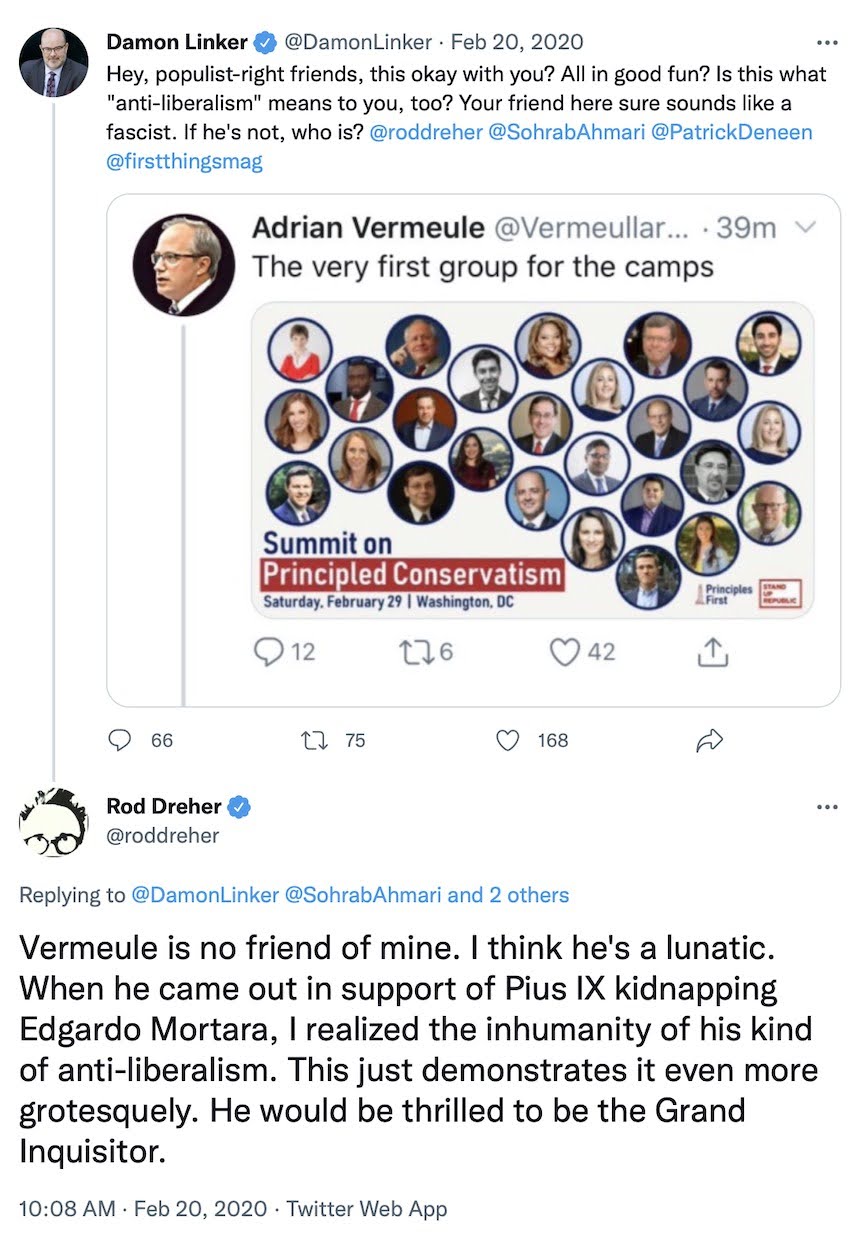
Vermeule, by contrast, is comparatively complacent about these questions. Along with Eric Posner, he coined the phrase "tyrannophobia" to describe an excessive concern with government overreaching, self-aggrandizement and illegitimate attempts by rulers to entrench themselves in power.

But what Vermeule regards as a pathology of thought is actually a central idea in the republican tradition—and the liberal tradition as well. It is precisely because of a deep concern that public officials will become corrupt, misbehave, or try to entrench themselves in power that the republican tradition has focused on questions of separation of powers, checks and balances, rule of law limitations, and rights.

Balkin's contribution as part of a symposium that includes more than one: Vermeule and an earnest defender. There's a time for choosing honey over vinegar, and those are Balkin's words, but this ain't it.  

repeats: Leiter's model of academic discourse, paraphrased  

Universities would deserve criticism for rejecting a presentation by the authors of the Nuremberg Laws, but would be right in rejecting a speech by a rabble-rousing journalist who promotes them.

John Quiggin, 2008: "Sunstein argues that the echo chamber effect tends to reinforce existing views and produce a poisonous partisan divide. It seems to me that exactly the opposite is true. "

repeats

I always thought Sunstein's point was obvious, especially for any culture founded on individualist liberalism. It's that culture that's given us Facebook and surveillance capitalism and personalized marketing, the virtual store where the displays are changed and items moved to the front to fit your last purchases. Newsfeeds work the same way, reinforcing biases, from narrowcasting to microcasting to the narcissism where the world is reduced to a mirror.

Twitter changed its algorithm years ago, forcing you to choose between replying to a tweet and quoting it, limiting the exposure of either your followers or those of the person you're replying to. Up to that point a reply appeared on both timelines.

Ryan Cooper 

Have you ever argued with a conservative? They won't learn anything no matter what I say or where I say it. Whatever I say is wrong by definition.

The same is "true"—the same facts hold—for liberals, and for most people. They hold for Cooper. 

The web was made by techs and in the Anglosphere self-selected for technocratic culture—I haven't used that link in a while. It's was made for talking to your friends, not for argument. I was told that 20 years ago. It's the model of civility, contempt and passive aggression basic to academia under the pretense that academia, educated liberals, the elite, the licensed vanguard are just that.  It was always bullshit.  Balkin, practicing "high politics" treats Vermeule as a friend. He's from the same tradition as Panofsky, but he's weaker. He called Vermeule and Posner "fine young scholars", when they defended legalized torture. I had more patience in 2004.

Balkin has a tag. Vermeule has one.  I emailed Balkin as I do sometimes, to ask him why he's done it again, ceding ground to opponents of democracy.  

I've gotten drunk with honest reactionaries. They're better company than hypocrites. I cede them nothing. But I have more contempt for liberals like Cooper who are blind to what they are. 

If everything is political, then high politics and low politics both have their place.  There's a time for debate and a time to stand on principle and walk away. If you don't understand both you don't understand either.

The Mortara Case "Why Some Catholics Defend the Kidnapping of a Jewish Boy"


Dreher, 16 days earlier:
The invention of the "Judeo-Christian" tradition, etc.

 repeating the link above.

Most arguments against mass surveillance don't respond fully substantively to claims that you shouldn't worry if you "have nothing to hide".  Defense of personal freedom isn't enough.  What's needed is an argument in defense of the need for citizens in a democratic state to be able to be all kinds of wrong, all kinds of confused, creepy, conflicted, desirous, weepy or hate-filled, so that they may be able to learn to understand and outgrow their childishness. The choice is between a community of adults with a minority of the inveterately childish and criminal or a community of children ruled by moralists and crime lords.

Freedom of speech is the right to argue for freedom of property. Those who defend freedom of property are among the first to oppose freedom of speech. I support Vermeule's right to be a fascist, but an earnest engagement with his ideas is to take fascism seriously as an intellectual position. Allowing the argument to exist does not mean treating it with respect. It means destroying it, again, and again.

"It is the common fate of the indolent to see their rights become a prey to the active. The condition upon which God hath given liberty to man is eternal vigilance; which condition if he break, servitude is at once the consequence of his crime and the punishment of his guilt."

I like Balkin, but he's a law professor, not a lawyer. He's passive. He's not a legal philosopher—they all suck—but he doesn't understand the importance of vulgarity. 

I forgot I'd used this with Vermeule already. All I do is repeat myself.

…in a hospital tent at the clearing station I came across a man with a French flag wrapped around his waist; the medics discovered it when they cut his shirt away. He was a hard-looking, blondish chap with a mouthful of gold teeth and a face adorned by a cross-shaped knife scar—the croix de vache with which procurers sometimes mark business rivals. An interesting collection of obscene tattooing showed on the parts of him that the flag did not cover. Outwardly he was not a sentimental type.
"Where are you from?" I asked him.
"Belleville," he said. Belleville is a part of Paris not distinguished for its elegance.
"What did you do in civilian life?" I inquired.
That made him grin. "I lived on my income," he said.
"Why did you choose the Corps Franc?"
"Because I understood," he said. 

And again: thugs against fascists

"He was always a loser, a jest/he barely got 50% on his high-school test/with a bribe the rich kid's a fool no more/got 100 diplomas hanging on his door/You crows nesting in our house/why are you ruining all our fun?

We won't do as you tell us/Spare us your face/Cook up your case/That's what the Interior does/I'm arrested and charged as a terrorist/Just for holding a flare and singing Ahly"

All philosophy is perverse.

Wednesday, July 06, 2022

We learn about the world by living in it

I misread something and went off in the wrong direction. Now I've gone off in a more appropriate one.
I still might need to tweak it.
---

Leiter links to this

Drawing and Thinking  We learn about a face by drawing it. What can that tell us about how we learn the truth by thinking?

How can one learn the truth by thinking? As one learns to see a face better if one draws it.
Ludwig Wittgenstein, Zettel §255

This remark, like many of Wittgenstein’s, seems to arise from self-examination. The answer he gives suggests that he is concerned with learning just by thinking, and indeed with the particular kind of learning just by thinking that happens in philosophy (as opposed to, say, mathematics). He seems to be asking how such learning is even possible. What are we to make of his answer?...

Learning the truth just by thinking, as one does in philosophy, is analogous to learning to see a face better by drawing it, in at least the sense that they require analogous attitudes of humility.

Rationalism and empiricism are opposed. The rationalist defense of empiricism is not empirical.   

Truth is theological, metaphysical garbage, or it's poetry: the record of a full moral commitment to a view of the world described in granular specificity. Facts are for arguing and argument is social; the result is a product of that social activity. Truth is asocial and anti-political.  Leiter will never accept that his defense of truth is just another form of moralism, and I'm as sick of moralism as he pretends to be. 

I've used one quote from John Mortimer for years, as part of my jihad of lawyers and orators, poets and side-show barkers, against pedants and philosophers—poets are all priests of their own sect, and every one's a sincere ironist. But my source was Mortimer's obit in the NY Times, and I've finally gotten around to finding the original. I'll add it to the sourcing in the manuscript. And the timing is perfect. 

From Clinging to the Wreckage, 1984  

The trial of Last Exit took place eight years after the acquittal of Lady Chatterley. It was the only obscenity case in which witnesses were produced who said that they had been depraved and corrupted, or in which we were given an opportunity of seeing what a depraved and corrupted person looked like. Sir Basil Blackwell, the Oxford bookseller, said that he had certainly been depraved by the book, but as he was in his eighties at the time the matter didn’t seem to be of great practical significance. The Reverend David Sheppard, who had been Captain of the English Cricket Team, also gave evidence to the effect that he had not, metaphorically speaking, held his bat so straight after reading Last Exit to Brooklyn, but as he went on to become Bishop of Liverpool the damage, whatever it was, doesn’t seem to have been serious. In spite of the industry of a number of literary and clerical witnesses, the book was found to be obscene in its trial at the Old Bailey and the publishers were fined £100. So it came about that John Calder asked me to argue the Last Exit case in the Court of Appeal.

We were lucky in our Court. It was presided over by Cyril Salmon, whose casual way with a gold watch and leisurely stroll up to a cross-examination had led me to envious imitation when I was starting at the bar. I found myself standing up at a point where the two great concerns of my life, writing and the law, met and almost failed to recognize each other. Indeed I was trying to explain to three courteous and distinguished Judges the fundamental difference between writers and lawyers, which produces the basic fallacy of all censorship laws. The writer is bound to explore all areas of human experience. The whole of life must be open to his voyage of discovery, he must sail as far as he can and his only duty is to come back with the truth as he sees it. There can’t be ‘no go’ areas in the world of art, and the writer who cuts short a line of work for fear of shocking some people or ‘giving offence’ is untrue to his calling. But lawyers are trained on ‘no go’ areas. They are accustomed to find truth concealed behind barriers marked ‘inadmissible evidence’. They cannot accept that it’s a writer’s duty to reveal all truths however unpalatable. I tried my best to explain this to the Court of Appeal in the Last Exit case and the Judges listened with great care and attention. The proposition which must be elementary to all students of literature came to their Lordships as an apparent surprise. They looked like three poets who had just been told that you may not call expert evidence on the point the Jury has to decide. 

An easier argument in the case was that the descriptions of homosexual prostitution and drug-taking in the book were so revolting that, far from turning anyone on to such practices, they would cause a sharp upswing in the marriage rate and the consumption of unadulterated ‘Old Holborn’ tobacco. The Judges were impressed by this argument which became known as the ‘Aversion Theory’ and withstood the test of a good many obscenity cases. The Court also ruled out the more usual meanings of the word ‘obscene’ which the trial Judge had given them. Publishing a book that was merely disgusting, or immoral, or erotic, or rude was clearly not a crime: it had to be blessed with the mysterious ‘tendency to deprave and corrupt’. In the end the Court allowed John Calder’s and Marion Boyars’ appeal and set aside the conviction. Last Exit became a best-seller for a “short while and I was led into a new department of law which I, in my more elevated moments, called arguments about free speech, but most of the friendly hacks in the robing-room call ‘dirty-book cases’.

I became more and more aware of the gulf that is fixed between the law and any sort of literature. One of the most difficult things to explain to Courts is that writers don’t necessarily approve of their characters’ behaviour. Because Shakespeare wrote Othello and Macbeth it doesn’t mean that he approved of wife murder and the stabbing of house guests. The putting-out of Gloucester’s eyes in King Lear is a deeply disturbing, shocking and horrific scene; but it tells a terrible truth about man’s inhumanity to man. The purpose of a play, Shakespeare said, is to hold a mirror up to nature: censorship laws would ensure that the mirror is a rose-coloured distortion.

Courts are very unclear about the effect of books on readers. Reading is done in a world of the imagination which has, it would appear, little direct result on the reader’s behaviour. I suppose the worst crime is murder and murder is nowhere written about more freely than in the works of Agatha Christie. If books had the effect claimed for them by the censors, every English country house would have a bloodstained butler in the library, dead with a knife between his shoulder blades. James Bond, licensed to kill, is read about and enjoyed by millions of inoffensive people who catch the train to the office every day and have never killed anyone with a karate chop or slept with a Chinese air hostess. It has been said that it is a strange anomaly of the censoring attitude that murder is against the law, but it is no crime to write about it. Sex is not against the law, but to write about it has often been held a criminal offence.

Doing these cases I began to find myself in a dangerous situation as an advocate. I came to believe in the truth of what I was saying. I was no longer entirely what my professional duties demanded, the old taxi on the rank waiting for the client to open the door and give his instruction, prepared to drive off in any direction, with the disbelief suspended. The attempts of the law to control the written word seemed to me dangerous and likely to put our Courts of Justice in a somewhat ridiculous light. I suppose that writers should, in a way, feel flattered by the censorship laws. They show a primitive fear and dread at the fearful magic of print. 

One of the difficulties of laws which tried to control books and habits of reading was that they assumed that our society was as one, as it no doubt was in 1868 when Lord Cockburn made his resonant pronouncement, and not a loose federation of groups with their own languages, customs, taboos, freedoms, courting habits and senses of morality. In England the moral values of a group of retired army officers and their wives frequenting a golf course in Worthing are not the same as those of a crowd of art students in a Kings Cross squat. What appears permissible in the Surrey commuter belt, among bright young advertising men and their wives, would be looked on with horror by the Puritan Pakistanis of Bradford. Of course all these groups must be subject to a basic strongly enforced criminal law; they must not be allowed to assault or pillage or rape or rob one another. But in such a society, tolerance demands that no one group may be allowed to impose its own moral views, however strongly held, upon another; still less should they be able to use the severe sanctions of the criminal law to do so. The law, it has always seemed to me, is at its best when it is enforcing practical remedies for specific crimes; it is at its worst when it tries to enforce the morality of one group in society upon another which may, for quite sincere and logical reasons, refuse to accept it. 

And it is significant that the attempted use of force is all one way. I did not wish to compel any member of the Festival of Light to sit through Oh, Calcutta! or read Gay News, although they do appear, no doubt from the highest motives and in the spirit of martyrdom, quite prepared to submit themselves to such works in the call of duty. No one, in the whole chequered history of censorship, has ever questioned anyone’s right not to read a book, to stay away from a play or not to visit a cinema. No one has ever suggested the compulsory sale of television sets without the button necessary to switch them off if you don’t like the picture.

"We were lucky in our Court. It was presided over by Cyril Salmon, whose casual way with a gold watch and leisurely stroll up to a cross-examination had led me to envious imitation when I was starting at the bar. I found myself standing up at a point where the two great concerns of my life, writing and the law, met and almost failed to recognize each other." 

Cyril Barnet Salmon, Baron Salmon 
by Walter Bird, 
bromide print, 1 December 1964, 8 1/8 in. x 6 1/8 in. (205 mm x 155 mm) image size.
Commissioned, 1964


Please find, attached, a copy of the image, which I am happy to supply to you with permission to use solely according to your licence, detailed at http://creativecommons.org/licenses/by-nc-nd/3.0/

It is essential that you ensure images are captioned and credited as they are on the Gallery's own website (search/find each item by NPG number at http://www.npg.org.uk/collections/search/advanced-search.php).

This has been supplied to you free of charge. I would be grateful if you would please consider making a donation at https://my.npg.org.uk/dev/contribute2.aspx? in support of our work and the service we provide.

Regards 
Rights and Images Department

National Portrait Gallery St Martin's Place London WC2H OHE

more fun with Horace Rumpole. 

Tuesday, July 05, 2022

Twitter Allowed Israel's Deadname To Trend In Violation Of Its Own Hateful Conduct Policy.
The country's deadname was listed under the site's trending tab for at least 45 minutes.

"Efforts by German authorities to clamp down on the Boycott, Divestment and Sanctions (BDS) campaign took a sinister turn recently after a Jewish-German singer and daughter of a Holocaust survivor was warned that a concert in which she is scheduled to perform would be cancelled if she made any remarks in support of BDS." 

"In the order that seems to be emerging, social bonds are construed as a matter of taste and choice rather than of obligation, making communities appear as voluntary associations from which one can resign if they require excessive self-denial, rather than as ‘communities of fate’ with which one either rises or goes under."  

To be born and raised in a community is not to have a choice: the world is what it is. We can go on to try to change the order of that world (which in fact is changing always), but "intentional" communities do more than that; they're founded in self-description, denying not only outside interference but outside interpretation, demanding acknowledgement for a world of their own making. At the lowest level it's simple fascism. "Israeli" is more of an invention than "Palestinian",  if less so than "Aryan", but the opinions of outsiders in both cases are claimed to mean nothing.

Click through the links and maybe you'll learn something.

I have sympathy for Page's self-hatred; as an adult you have the right to do to your own body what you feel you need to do. But double mastectomies for healthy 13 year olds is not something to be glib about. And contra Glamour's Woman of The Year for 2015, the hardest part about being a woman is putting up with men who demand sex, and then want to control the result

“I am for a woman’s right to choose,” Jenner responded before trying to have it both ways. “I am also for a state having the ability to make their own laws. So I support Texas in that decision, that’s their decision. 

Freedom of speech means the ability to mock. And more importantly, it means the acknowledgement of historical fact. Elliot was born Ellen, and Palestine was conquered by Europeans.

I now have a copy of Herzl's diaries. I won't have to rely on others' quotes.

I'm not cynical enough. I admit I was surprised by the number of liberals and self-described leftists praising twitter for banning people for stating facts. 
Joseph Raz was Joseph Zaltsman. David Ben-Gurion was David Grün; Ariel Sharon was the son of Shmuel Scheinerman; Amiri Baraka was LeRoi Jones; Uri Avnery was Helmut Ostermann; Louis Farrakhan was Louis Eugene Wolcott; Malcolm X was Malcolm Little; Netanyahu was Mileikowsky; Muhammad Ali was Cassius Clay; Martin David (Meir) Kahane passed, as "Michael King"; Mark Regev was Mark Freiberg. 

And, again, I was banned from twitter for throwing Ben Shapiro's bigotry back in his face.

Monday, July 04, 2022

Leiter repeats, and so do I. 

I propose to defend and explore three claims in this Essay. First, there is very little actual “law” in federal constitutional law in the United States, especially with respect to cases that end up at the Supreme Court. There, the Court operates as a kind of super-legislature, albeit one with limited jurisdiction. The jurisdiction is limited in two important ways: first, the Court can only pass on issues that are brought before it; and second, the Court is constrained, to some extent, by its past decisions and by constitutional and legislative texts. The problem, however, is that those constraints underdetermine the Court’s decisions in most cases, so the Court essentially makes its final choice among the legally viable options based on the moral and political values of the Justices, and not simply on the basis of legally binding standards. The latter claim is, in part, a jurisprudential thesis about what constitutes “legally binding standards.” I shall defend the first claim by reference to the most plausible account of the nature of law—the legal positivist theory developed by H.L.A. Hart and Joseph Raz.

Second, the absence of law in so many parts of federal constitutional law means that the quality of moral and political judgment exercised by judges is of decisive importance in how they fulfill their role. Thus, it should be the overriding factor in the appointment of federal appellate judges, especially Supreme Court Justices. That brings me to my third claim, namely, that all political actors know that the Supreme Court often operates as a super-legislature, and thus that the moral and political views of the Justices are decisive criteria for their appointment. This almost banal truth is, however, rarely discussed in the public confirmation process, but is common knowledge among political and legal insiders. To be sure, there is always media speculation about the political predilections of the nominees, but their actual moral and political views are treated as off limits in the real confirmation process. This antidemocratic secrecy is, in my view, deeply wrong and must be replaced with a realistic acknowledgment of the role of the Supreme Court as a political actor of limited jurisdiction. I will illustrate these claims by discussing a number of important public law cases, recent and not-so-recent.

What does it mean to say there is very little “law” in American constitutional law?  

Right wing vulgarians say the SCOTUS shouldn't make law. Right wing sophisticates—Leiter's an elitist who defends academic freedom but not freedom of speech for the rest of us—argue that it doesn't make true Law.

"Former friends have recounted that Loughner had a fixation for grammar and words, saying that he challenged Giffords at a previous public meeting with the impenetrable question: 'What is government if words have no meaning?'"

Words have no meaning. Meanings are plural.


Follow the links. You'll get the joke, or you may get the joke. Raz never did, and Leiter never will.