I'm tired I'll keep it simple, but no links.
From the Times today: Firemen on 9-11: I know someone who was there. Rolex's half way up the arm of a corpse. [I don't know where I got that line. What the person saw was firemen putting on Brooks Brothers suits and hiding them under their coats. The witness was a cop]
Susan Sontag on "images." She sleeps with Annie Leibovitz forfuckssake. And I'll never forget the description I friend of mine gave of her in Sarajevo clasping a bag of food that she'd brought in, and surrounded by people who hadn't eaten in a week. "But it's all we have." She whined.
Mark Kleiman has a link to some idiot who wanted to be a human shield until he wised up. The kid comes off as an absolute idiot. But what the fuck does that have to do with the logic behind the war? Does Kleiman think we're all illiterate teenagers? Idiot.
The Agonist is useful but he's getting off on all the attention, seemingly without an ounce of irony about his obvious pleasure: "I beat CNN by ten minutes on the two British soldiers [reported missing!] and the two missiles. Maybe they are reading me!."
The fact remains that of all the shitheads following the war in this country, I know not one I would have anything to say to outside of politics. The war becomes something to fill a void in the American life. The purpose is to keep busy. 'Reflection' becomes a job or it has no purpose. It becomes impossible to cast that now quasi-reflective gaze upon oneself.
Every Pakistani cabdriver I've ever met can tell me more about what it feels to be alive than any of these idiots.
My apologies to Sam Heldman- whom I like and respect as a blogger and a person- but the question is not whether or not Scalia has a logic vis-a-vis the text of the constitution. His logic is entirely a priori. The choice to him is for order over chaos. As an anti-democratic Catholic. He defines order narrowly and chaos broadly. His is not a legal philosophy but a moral one, and that is why he feels free to bend the law -or break it- to his own ends. Textual interpretation as such is useless but textual analysis extending outside the law itself it absolutely necessary.
SWM 40. Tall, dark, etc. Any country but this one. Looking. Preferably female and tall. Ass+mind. Shia a plus. Will follow. Get me the fuck out of here.
Monday, March 24, 2003
Sunday, March 23, 2003
It's one of those work days where I'm near to a computer.
Reading the reports and commentary reminds me of something I thought of a few months ago that now seems obvious. If there are any parallels between what's been happening and past events the nearest, with the frightening exception of 1918, is undoubtedly Vietnam. But as far as this country is concerned that means at the very least, 1972. The contempt that is pouring out of normally mainstream commentators is shocking. How quickly we've moved to this point makes clear how radical, and I still think how absurdly miscalculated, was the Bush administation's tear to the right.
Reading the reports and commentary reminds me of something I thought of a few months ago that now seems obvious. If there are any parallels between what's been happening and past events the nearest, with the frightening exception of 1918, is undoubtedly Vietnam. But as far as this country is concerned that means at the very least, 1972. The contempt that is pouring out of normally mainstream commentators is shocking. How quickly we've moved to this point makes clear how radical, and I still think how absurdly miscalculated, was the Bush administation's tear to the right.
"At a news conference, Cindy and her husband, Craig, displayed photos they described as 286 children who have died in Israel and the disputed occupied territory in the past two years. They deserve as much notice as Corrie on the morning news, she said."
We have become acculturated to Empire. Stephen Brill thinks he's being fair and generous by acknowledging that the ground has shifted beneath our feet, but he is not. He is describing a shift from covert and de facto to overt empire. The former can coexist after a fashion with a democracy. The latter can not. He is lying first to himself and then to us.
It's not Failed Diplomacy if your ultimatum is rejected. It's not diplomacy at all.
That should be clear by now, shouldn't it?
I'm tired of pundits referring to the opinions of the leaders of countries as representative when it suits their purposes and to the opinions of citizens when it does not.
And of course this goes on regardless of whether those governments are democracies or dictatorial monarchies.
And What the fuck is Richard Bernstein talking about?
It would be interesting to do a study of precisely when and under what circumstances American interests have actually tried to 'replicate our system of government' and when we have expended all effort to create and retain vassal states and eunuch economies.
I would have more respect for Bernstein if he had said that we have respect for great powers even in defeat and that we leave alone or try to help small powers that offer no obstruction to our goals.
That should be clear by now, shouldn't it?
I'm tired of pundits referring to the opinions of the leaders of countries as representative when it suits their purposes and to the opinions of citizens when it does not.
And of course this goes on regardless of whether those governments are democracies or dictatorial monarchies.
And What the fuck is Richard Bernstein talking about?
It would be interesting to do a study of precisely when and under what circumstances American interests have actually tried to 'replicate our system of government' and when we have expended all effort to create and retain vassal states and eunuch economies.
I would have more respect for Bernstein if he had said that we have respect for great powers even in defeat and that we leave alone or try to help small powers that offer no obstruction to our goals.
Saturday, March 22, 2003
I'm beginning to think that all the anti war activity in this country serves only one purpose: to show the world, specifically the Arab world, that the country is not unified. The rest is up to them as it should be.
American peaceniks are a pain in the ass. They're as self-indulgent as they're accused of being. They remain unaware of their power as Americans and that becomes fodder for their cynical opposition. It's why the working class in this country has contempt for liberals and reformers, who only condescend to care.
How many times can I say this: We have no real left in this country because the workers are the subject of discussion and not the participants. We're bonded together only by desire. Alterman's hard-on for Springsteen only proves the point. His contempt for the unwieldy and profane is obvious, but you need to appreciate vulgarity if you want to understand politics, or even enjoy the complexities of culture.
But the Arab street is speaking for itself. It can do that because its revolution will be a bourgeois revolution, which history teaches us is the only inevitable one. I envy them.
The real fight now is not between Old and New Europe, or America and Islam, it's between old and new capital. Al Jazeera is new. It represents the aspirations of an insurgent middle class. And old Europe is embracing new capital, including Russia, China and Islam. Trying to maintain control by force, we'll lose. Our bourgeoisie is crap. Maybe our flaw is that we don't even have one.
American peaceniks are a pain in the ass. They're as self-indulgent as they're accused of being. They remain unaware of their power as Americans and that becomes fodder for their cynical opposition. It's why the working class in this country has contempt for liberals and reformers, who only condescend to care.
How many times can I say this: We have no real left in this country because the workers are the subject of discussion and not the participants. We're bonded together only by desire. Alterman's hard-on for Springsteen only proves the point. His contempt for the unwieldy and profane is obvious, but you need to appreciate vulgarity if you want to understand politics, or even enjoy the complexities of culture.
But the Arab street is speaking for itself. It can do that because its revolution will be a bourgeois revolution, which history teaches us is the only inevitable one. I envy them.
The real fight now is not between Old and New Europe, or America and Islam, it's between old and new capital. Al Jazeera is new. It represents the aspirations of an insurgent middle class. And old Europe is embracing new capital, including Russia, China and Islam. Trying to maintain control by force, we'll lose. Our bourgeoisie is crap. Maybe our flaw is that we don't even have one.
As I said, it's not what Bush has in mind. Even if civilian casualties are kept to a minimum, the damage will be done. We're being left behind. They're tired of waiting.
It feels good.
It feels good.
The question that needs to be asked, that will be asked, since our victory was assured from the moment we decided to go, is whether the extreme nature of the assault was necessary. Since Harlan Ullman's design was meant to be comparable to Hiroshima, the same questions need to be asked as have been asked since then. And given the nature of our impoverished enemy, and the expense, the justifications ring hollow. How many American lives will be saved as a result of this plan? If we have the option to run a war by remote control, can it
ever be called just?
Shock and Awe is the wholesale destruction of a country as an act of propaganda and as such is directed not at Iraq alone but at the citizens of every country other than the US, and to a lesser extent—though not by much—at our own. My disgust at our leadership, and at the majority of our population who neither know nor understand, nor even want to understand the implications of all this, is tempered by my awareness that in the long run this campaign will be seen if not as a turning point—since it isn't one—then as the most memorable and tragic event of our devolution as a world power.
As it has been argued that The Revolution cemented the power of the bourgeoisie in France, and spread out from there, this war will mark a similar break with the past in the Arab world. Bin Laden and all the other reactionaries will fail but will have done their job merely by giving the giant a little rock to stumble over. A bee sting has driven him mad. Capitalism and modernity will spread more quickly than ever as a result of this war, not because we say so and not under our terms, but on its own. The combination of our exhaustion after decades of effort, and our desire by means of any cheap trick and sleight-of-hand to maintain control, is destroying us. But you cannot control desire and greed, you can only manage it and try not to be controlled by it. It takes a lot work to ride a bull or to be a professional gambler, and we are not up to it anymore. It's that simple: We're a country of salesmen, of drug dealers, and we use too much product. The sentimental glamour, the confusion of illusion and reality, our insistent equation of John Wayne with a cowboy, has brought about the confusion in many of us of our politics with those of a small independent republic, and of George Bush with a statesman. What can be said about those people who imagine themselves the virtuous citizens of such a state? Only this: that illusions are important. And that is why this adventure, if it is pushed to its logical extreme will fail. Americans are following their president because, and only because, in their ignorance they think his actions are just. Cheney and Rumsfeld may be commissioning studies of Julius Caesar and Attila, but that is as delusional, as divorced from reality, as any pro-war argument made by a housewife in Iowa. This is not ancient Rome. It is the illusion of fairness that has kept America going. If Bush goes much farther he will shatter his support. He's right to think he has a lot of it. But it's so shallow, and he seems so unaware.
"There is something anarchic about all human beings, about their reaction to violence. The Iraqis around me stood and watched, as I did, at huge tongues of flame bursting from the upper stories of Saddam's palace, reaching high into the sky. Strangely, the electricity grid continued to operate and around us the traffic lights continued to move between red and green. Billboards moved in the breeze of the shock waves and floodlights continued to blaze on public buildings. Above us we could see the massive curtains of smoke beginning to move over Baghdad, white from the explosions, black from the burning targets.
How could one resist it? How could the Iraqis ever believe with their broken technology, their debilitating 12 years of sanctions, that they could defeat the computers of these missiles and of these aircraft? It was the same old story: irresistible, unquestionable power.
Well yes, one could say, could one attack a more appropriate regime? But that is not quite the point. For the message of last night's raid was the same as that of Thursday's raid, that of all the raids in the hours to come: that the United States must be obeyed. That the EU, UN, Nato nothing must stand in its way. Indeed can stand in its way."
Robert Fisk in The Independent
How could one resist it? How could the Iraqis ever believe with their broken technology, their debilitating 12 years of sanctions, that they could defeat the computers of these missiles and of these aircraft? It was the same old story: irresistible, unquestionable power.
Well yes, one could say, could one attack a more appropriate regime? But that is not quite the point. For the message of last night's raid was the same as that of Thursday's raid, that of all the raids in the hours to come: that the United States must be obeyed. That the EU, UN, Nato nothing must stand in its way. Indeed can stand in its way."
Robert Fisk in The Independent
Friday, March 21, 2003
and more.
When the assholes are reduced to listing the per capita income and GDP of each state in the coalition of the 'billing', they must understand by now they've given us permission to laugh.
Fleischer looked embarrassed for once.
When the assholes are reduced to listing the per capita income and GDP of each state in the coalition of the 'billing', they must understand by now they've given us permission to laugh.
Fleischer looked embarrassed for once.
Thursday, March 20, 2003
Support the troops, redux
"It is fashionable to present our forces as composed of peace-loving people who have been reluctantly coerced into risking their lives for us – "They'd give anything to be doing such mundane things as walking to work in the spring sunshine or meeting their friends for a pint," said one commentator yesterday – but when ex-soldiers speak out about their experiences, they do not usually see themselves in quite such a gentle fashion.
A telling account of the first Gulf War, Jarhead, by Anthony Swofford, has just been published. It gives us the experiences of a young marine 13 years ago, and he is horribly honest about what drew him into the army. "I wanted to be a killer, to kill my country's enemies," he says. He gives you a sense of his fellow soldiers' desire for the actual physical experience of killing, and he vividly describes how, when he and his colleagues were cheated – as they saw it – of that experience, some of them carried out acts of desecration on corpses as if in a spirit of revenge."
"It is fashionable to present our forces as composed of peace-loving people who have been reluctantly coerced into risking their lives for us – "They'd give anything to be doing such mundane things as walking to work in the spring sunshine or meeting their friends for a pint," said one commentator yesterday – but when ex-soldiers speak out about their experiences, they do not usually see themselves in quite such a gentle fashion.
A telling account of the first Gulf War, Jarhead, by Anthony Swofford, has just been published. It gives us the experiences of a young marine 13 years ago, and he is horribly honest about what drew him into the army. "I wanted to be a killer, to kill my country's enemies," he says. He gives you a sense of his fellow soldiers' desire for the actual physical experience of killing, and he vividly describes how, when he and his colleagues were cheated – as they saw it – of that experience, some of them carried out acts of desecration on corpses as if in a spirit of revenge."
"The 'direct action' visions circulating out there now are not about building the largest possible coalition of opposition to the Bush Administration, not about building a political consensus, not about laying the groundwork for 2004. If you really care about opposing the war, you need to put your own selfish needs to proclaim your virtuousness aside and keep your eyes on the prize. Large public gatherings that are respectful, quiet and rhetorically modest would be a good thing, sure, but for the moment, little more than that."
Timothy Burke, quoted at
Electrolite.
If some people are willing to risk their asses, then let them. Is it practical? I can't say; it depends on how many people are involved. But for someone to moralize about the self indulgence of such actions is absurd. It's so wonderfully American to argue that everyone should run to the middle no matter what. For some people, principles are all they have. For others it comes down to green hair and safety pins. Can you always tell one from the other? Not always. But I'm not going to make sweeping and stupid generalizations.

I'm not like Rachel Corrie. All I'm going to do is wait.
Our government has invaded a small and corrupt dictatorship just as they did in Afghanistan and Panama. And they'll win pretty easily. But they won't win so easily in Iran or Korea, and they don't seem to understand why.
--------------
Anyone who opposed the war before is now in an awkward position, and I wish someone rather than repeating the idiotic mantra that's now popping up would come out and face the reality of the situation. If the war goes easily it will become more popular, and this will make things difficult. it will not change the situation on the ground, will not eliminate new Al Qaeda recruitment or stabilize Pakistan. It will do nothing but delay the problems that will haunt us down the road. And, as I mentioned above, with a quick success, our arrogant leadership will look at other 'trouble' states to engage. The American populace is uninformed and intellectually lazy.
It's an uncomfortable thought, and we are all aware of it, so I'm sick of all the antiwar pundits proclaiming their SUPPORT FOR THE TROOPS in caps as if to prove to themselves the cleanness of their souls.
I do not support the troops. I support those poor dupes who needed money for college, or who wanted to get out of the small town they were going to be stuck in for the rest of their lives. I support the poor kids with no other choice. But nationalism is stupid. And this is not a fucking football game. I support the living and those who are guilty of no crime.
Timothy Burke, quoted at
Electrolite.
If some people are willing to risk their asses, then let them. Is it practical? I can't say; it depends on how many people are involved. But for someone to moralize about the self indulgence of such actions is absurd. It's so wonderfully American to argue that everyone should run to the middle no matter what. For some people, principles are all they have. For others it comes down to green hair and safety pins. Can you always tell one from the other? Not always. But I'm not going to make sweeping and stupid generalizations.
I'm not like Rachel Corrie. All I'm going to do is wait.
Our government has invaded a small and corrupt dictatorship just as they did in Afghanistan and Panama. And they'll win pretty easily. But they won't win so easily in Iran or Korea, and they don't seem to understand why.
--------------
Anyone who opposed the war before is now in an awkward position, and I wish someone rather than repeating the idiotic mantra that's now popping up would come out and face the reality of the situation. If the war goes easily it will become more popular, and this will make things difficult. it will not change the situation on the ground, will not eliminate new Al Qaeda recruitment or stabilize Pakistan. It will do nothing but delay the problems that will haunt us down the road. And, as I mentioned above, with a quick success, our arrogant leadership will look at other 'trouble' states to engage. The American populace is uninformed and intellectually lazy.
It's an uncomfortable thought, and we are all aware of it, so I'm sick of all the antiwar pundits proclaiming their SUPPORT FOR THE TROOPS in caps as if to prove to themselves the cleanness of their souls.
I do not support the troops. I support those poor dupes who needed money for college, or who wanted to get out of the small town they were going to be stuck in for the rest of their lives. I support the poor kids with no other choice. But nationalism is stupid. And this is not a fucking football game. I support the living and those who are guilty of no crime.
Wednesday, March 19, 2003

Before I go to work:
"Electronic bugging devices have been found at offices used by French and German delegations at a European Union building in Brussels, officials have confirmed"
"Electronic bugging devices have been found at offices used by French and German delegations at a European Union building in Brussels, officials have confirmed"
Tuesday, March 18, 2003
"If the US attacks Iraq without support of the UN Security Council, will the
world be powerless to stop it? The answer is no. Under a procedure called
"Uniting for Peace," the UN General Assembly can demand an immediate
ceasefire and withdrawal. The global peace movement should consider
demanding such an action.
When Egypt nationalized the Suez Canal in 1956, Britain, France, and Israel
invaded Egypt and began advancing on the Suez Canal. U.S. President Dwight
D. Eisenhower demanded that the invasion stop. Resolutions in the UN
Security Council called for a cease-fire - but Britain and France vetoed
them. Then the United States appealed to the General Assembly and proposed a
resolution calling for a cease-fire and a withdrawal of forces. The General
Assembly held an emergency session and passed the resolution. Britain and
France withdrew from Egypt within a week.
The appeal to the General Assembly was made under a procedure called
"Uniting for Peace." This procedure was adopted by the Security Council so
that the UN can act even if the Security Council is stalemated by vetoes.
Resolution 377 provides that, if there is a "threat to peace, breach of the
peace, or act of aggression" and the permanent members of the Security
Council do not agree on action, the General Assembly can meet immediately
and recommend collective measures to U.N. members to "maintain or restore
international peace and security." The "Uniting for Peace" mechanism has
been used ten times, most frequently on the initiative of the United States.
The Bush Administration is currently promoting a Security Council resolution
that it claims will authorize it to attack Iraq. However, huge opposition
from global public opinion and most of the world's governments make such a
resolution's passage unlikely.
What will happen if the US withdraws its resolution or the resolution is
defeated? The US is currently indicating that it will attack Iraq even
without Security Council approval. The US would undoubtedly use its veto
should the Security Council attempt to condemn and halt its aggression. But
the US has no veto in the General Assembly.
Lawyers at the Center for Constitutional Rights
(www.ccr-ny.org) have drafted a proposed "Uniting for Peace"
resolution that governments can submit to the
General Assembly. It declares that military action without a Security
Council resolution authorizing such action is contrary to the UN Charter and
international law.
...Countries opposed to such a war can be asked to state now that, if there is
a Security Council deadlock and a US attack on Iraq is imminent or under
way, they will convene the General Assembly on an emergency basis to condemn
the attack and order the US to cease fire and withdraw."
Link
Prepared by Jeremy Brecher (jbrecher@igc.org).
Information on Uniting for Peace based on "A U.N. Alternative to War:
'Uniting for Peace'" by Michael Ratner, Center for Constitutional Rights and
Jules Lobel, University of Pittsburgh Law School
CCR
A Sample Letter:
Dear Ambassadors,
Please consider invoking UN resolution 377! Many Iraqi lives and American
soldiers depend on it. The world needs your care and guidance through this
catastrophe. Please consider sending peacekeepers to the demilitarized zone
between Kuwait and Iraq. Please protect peace and stop this attack of
aggression.
"When Egypt nationalized the Suez Canal in 1956, Britain, France, and Israel
invaded Egypt and began advancing on the Suez Canal. U.S. President Dwight
D. Eisenhower demanded that the invasion stop. Resolutions in the UN
Security Council called for a cease-fire - but Britain and France vetoed
them. Then the United States appealed to the General Assembly and proposed a
resolution calling for a cease-fire and a withdrawal of forces. The General
Assembly held an emergency session and passed the resolution. Britain and
France withdrew from Egypt within a week."
The world protests have reflected an outcry that must not be ignored."
And some addresses from the Security Council:
Pakistan
Germany
Chile
Mexico
France
Guinea
Cameroon
Syria
Bulgaria
Angola
China
world be powerless to stop it? The answer is no. Under a procedure called
"Uniting for Peace," the UN General Assembly can demand an immediate
ceasefire and withdrawal. The global peace movement should consider
demanding such an action.
When Egypt nationalized the Suez Canal in 1956, Britain, France, and Israel
invaded Egypt and began advancing on the Suez Canal. U.S. President Dwight
D. Eisenhower demanded that the invasion stop. Resolutions in the UN
Security Council called for a cease-fire - but Britain and France vetoed
them. Then the United States appealed to the General Assembly and proposed a
resolution calling for a cease-fire and a withdrawal of forces. The General
Assembly held an emergency session and passed the resolution. Britain and
France withdrew from Egypt within a week.
The appeal to the General Assembly was made under a procedure called
"Uniting for Peace." This procedure was adopted by the Security Council so
that the UN can act even if the Security Council is stalemated by vetoes.
Resolution 377 provides that, if there is a "threat to peace, breach of the
peace, or act of aggression" and the permanent members of the Security
Council do not agree on action, the General Assembly can meet immediately
and recommend collective measures to U.N. members to "maintain or restore
international peace and security." The "Uniting for Peace" mechanism has
been used ten times, most frequently on the initiative of the United States.
The Bush Administration is currently promoting a Security Council resolution
that it claims will authorize it to attack Iraq. However, huge opposition
from global public opinion and most of the world's governments make such a
resolution's passage unlikely.
What will happen if the US withdraws its resolution or the resolution is
defeated? The US is currently indicating that it will attack Iraq even
without Security Council approval. The US would undoubtedly use its veto
should the Security Council attempt to condemn and halt its aggression. But
the US has no veto in the General Assembly.
Lawyers at the Center for Constitutional Rights
(www.ccr-ny.org) have drafted a proposed "Uniting for Peace"
resolution that governments can submit to the
General Assembly. It declares that military action without a Security
Council resolution authorizing such action is contrary to the UN Charter and
international law.
...Countries opposed to such a war can be asked to state now that, if there is
a Security Council deadlock and a US attack on Iraq is imminent or under
way, they will convene the General Assembly on an emergency basis to condemn
the attack and order the US to cease fire and withdraw."
Link
Prepared by Jeremy Brecher (jbrecher@igc.org).
Information on Uniting for Peace based on "A U.N. Alternative to War:
'Uniting for Peace'" by Michael Ratner, Center for Constitutional Rights and
Jules Lobel, University of Pittsburgh Law School
CCR
A Sample Letter:
Dear Ambassadors,
Please consider invoking UN resolution 377! Many Iraqi lives and American
soldiers depend on it. The world needs your care and guidance through this
catastrophe. Please consider sending peacekeepers to the demilitarized zone
between Kuwait and Iraq. Please protect peace and stop this attack of
aggression.
"When Egypt nationalized the Suez Canal in 1956, Britain, France, and Israel
invaded Egypt and began advancing on the Suez Canal. U.S. President Dwight
D. Eisenhower demanded that the invasion stop. Resolutions in the UN
Security Council called for a cease-fire - but Britain and France vetoed
them. Then the United States appealed to the General Assembly and proposed a
resolution calling for a cease-fire and a withdrawal of forces. The General
Assembly held an emergency session and passed the resolution. Britain and
France withdrew from Egypt within a week."
The world protests have reflected an outcry that must not be ignored."
And some addresses from the Security Council:
Pakistan
Germany
Chile
Mexico
France
Guinea
Cameroon
Syria
Bulgaria
Angola
China
Sunday, March 16, 2003
The Guardian
"Zalmay Khlalilzad, Mr Bush's envoy to the 'free Iraqis', said: 'We oppose unilateral force. Such an action would have a negative effect on US-Turkish relations and Turkey's relations with other countries.' "
no comment
"Zalmay Khlalilzad, Mr Bush's envoy to the 'free Iraqis', said: 'We oppose unilateral force. Such an action would have a negative effect on US-Turkish relations and Turkey's relations with other countries.' "
no comment

I'm not going to go into the obvious today. It's pointless. Of course I'll end up there by the end of it, but lets see if I can keep my mind clear enough to venture something more complex than expressing a wish to kick someone in the teeth.
A short treatise on certainty.
The physicist Alan Lightman had a piece in The Times yesterday, concerning the relationship, such as it is, between art and science. Lightman earnestly tried to give 'art' what he considered it's due. He did not mean to be condescending, but in defending the 'illogic' of artistic creativity, he neutered it, and destroyed any 'logical' and therefore ethical reason for valuing it. I'm tired of saying this but I'll say it again: It is not only unnecessary but counterproductive to attempt to defend art solely by means of metaphysics.
"Science and art have different ways of thinking, and those differences, when explored and portrayed, can enlarge both activities.
For example, scientists struggle mightily to name things. To name a thing, you've distilled it and purified it, you've quantified it; you've put a box around the thing and said, "What's in the box is the thing, and what's not is not." Consider the word 'electron'...
"By contrast, artists tend to avoid naming things. A novelist can use a word like "love," but that word doesn't convey much in itself because each reader will experience love in a different way. To name a thing too precisely can destroy that delicate, participatory creative experience that happens when a good reader reads a good book. Every electron is the same, but every love is different. "
Replace the word 'novelist' with 'lawyer' and the word 'love' with justice, and you will, I hope understand the problem. Science is capable of certainty but as a moral barometer it is a worthless failure. I appreciate the value of science and of certainty as I appreciate the military, only if they are kept in their place. The debate is not between the logical sciences and the metaphysical arts, but between the desire to name and the desire to ask; both have metaphysical implications.
The article Antonin Scalia published in First Things should be considered loathsome to anyone who believes in democracy as a system, precisely because he argues not that justice, as it is defined in our constitution and our history, is order, but that order in any absolute sense- meaning certainty- is justice. His is the Hobbesian argument for the state. And though it is an argument made through his arch and reactionary Catholicism it is abetted by the common assumption among the intellectual elite that the metaphysical certainty ensconced so irrefutably in science is a value higher than the doubt that is basic not only to the arts and humanities but to the rule of law itself.
PICKY, PICKY, PICKY!
On a related note Mark Kleiman has written a post of such blitheringly stupid condescension and bitter cruelty, about a subject of such painful importance, that his friends, let alone Salam Pax deserve an immediate apology.
His logic is nonexistent and his arrogance grotesque.
A short treatise on certainty.
The physicist Alan Lightman had a piece in The Times yesterday, concerning the relationship, such as it is, between art and science. Lightman earnestly tried to give 'art' what he considered it's due. He did not mean to be condescending, but in defending the 'illogic' of artistic creativity, he neutered it, and destroyed any 'logical' and therefore ethical reason for valuing it. I'm tired of saying this but I'll say it again: It is not only unnecessary but counterproductive to attempt to defend art solely by means of metaphysics.
"Science and art have different ways of thinking, and those differences, when explored and portrayed, can enlarge both activities.
For example, scientists struggle mightily to name things. To name a thing, you've distilled it and purified it, you've quantified it; you've put a box around the thing and said, "What's in the box is the thing, and what's not is not." Consider the word 'electron'...
"By contrast, artists tend to avoid naming things. A novelist can use a word like "love," but that word doesn't convey much in itself because each reader will experience love in a different way. To name a thing too precisely can destroy that delicate, participatory creative experience that happens when a good reader reads a good book. Every electron is the same, but every love is different. "
Replace the word 'novelist' with 'lawyer' and the word 'love' with justice, and you will, I hope understand the problem. Science is capable of certainty but as a moral barometer it is a worthless failure. I appreciate the value of science and of certainty as I appreciate the military, only if they are kept in their place. The debate is not between the logical sciences and the metaphysical arts, but between the desire to name and the desire to ask; both have metaphysical implications.
The article Antonin Scalia published in First Things should be considered loathsome to anyone who believes in democracy as a system, precisely because he argues not that justice, as it is defined in our constitution and our history, is order, but that order in any absolute sense- meaning certainty- is justice. His is the Hobbesian argument for the state. And though it is an argument made through his arch and reactionary Catholicism it is abetted by the common assumption among the intellectual elite that the metaphysical certainty ensconced so irrefutably in science is a value higher than the doubt that is basic not only to the arts and humanities but to the rule of law itself.
PICKY, PICKY, PICKY!
On a related note Mark Kleiman has written a post of such blitheringly stupid condescension and bitter cruelty, about a subject of such painful importance, that his friends, let alone Salam Pax deserve an immediate apology.
His logic is nonexistent and his arrogance grotesque.
Saturday, March 15, 2003
I got an email from a woman in Britain, British most of her life but Arab by birth, asking me among other things about my opinions on the Israeli conflict. I've written on it often enough, but my response surprised her. She says she's never heard anyone say something similar outside of the region:
"Zionism is Racism. Considering the current situation, and including the fact that I'm a left-wing secularist, Hamas and Hezbollah are impressive. As far as I can tell the bombings are not acts of nihilism, are not fascist like Al Qaeda, but are seen as part of a concrete military strategy. [similar to Giap's in Vietnam?] The leadership seems to be in control and to be able—and willing (which is important)—to stop the bombings when they think it's appropriate. It's a terrible, painful, strategy, but it is a strategy nonetheless, and it is working. Israel is slowly falling apart.
I really don't think at this point there is such a thing as an Israeli 'civilian.'
I oppose the bombings, but at the same time, I don't know what else could replace them."
There are plenty of people who would agree with this, including many Jews.
It's important to understand the dynamic here: Jews—and Arabs—are the only people for whom I have an implicit trust on the issue of the Middle East. Anti-Semitism, in the bastard sense of anti-Jewish sentiment, is real in this country and Europe, and all minorities are defensive—and need to be—in the face of a history of bias.
Black anger toward Jews in this country I understand and 'as-a-rule' put aside without disrespect. A black man, or woman, and I can talk about the need for self-protection and understand one another. I've never attacked Farrakhan. I've argued against him but not as it were, behind his back, and not until my interlocutors have looked into my eyes and given their permission. That is the courtesy a member of one minority pays to another. But to a black man I'm white, just as I'm still black to many other—white—Americans. So when a white man says the that Jews have too much power in this country I watch his eyes as well.
It's empiricism and not rationalism that's needed in these cases, and it's something else that programmatic liberals, and conservatives, who have never been on the street, don't understand.
"Zionism is Racism. Considering the current situation, and including the fact that I'm a left-wing secularist, Hamas and Hezbollah are impressive. As far as I can tell the bombings are not acts of nihilism, are not fascist like Al Qaeda, but are seen as part of a concrete military strategy. [similar to Giap's in Vietnam?] The leadership seems to be in control and to be able—and willing (which is important)—to stop the bombings when they think it's appropriate. It's a terrible, painful, strategy, but it is a strategy nonetheless, and it is working. Israel is slowly falling apart.
I really don't think at this point there is such a thing as an Israeli 'civilian.'
I oppose the bombings, but at the same time, I don't know what else could replace them."
There are plenty of people who would agree with this, including many Jews.
It's important to understand the dynamic here: Jews—and Arabs—are the only people for whom I have an implicit trust on the issue of the Middle East. Anti-Semitism, in the bastard sense of anti-Jewish sentiment, is real in this country and Europe, and all minorities are defensive—and need to be—in the face of a history of bias.
Black anger toward Jews in this country I understand and 'as-a-rule' put aside without disrespect. A black man, or woman, and I can talk about the need for self-protection and understand one another. I've never attacked Farrakhan. I've argued against him but not as it were, behind his back, and not until my interlocutors have looked into my eyes and given their permission. That is the courtesy a member of one minority pays to another. But to a black man I'm white, just as I'm still black to many other—white—Americans. So when a white man says the that Jews have too much power in this country I watch his eyes as well.
It's empiricism and not rationalism that's needed in these cases, and it's something else that programmatic liberals, and conservatives, who have never been on the street, don't understand.
Friday, March 14, 2003
Major Barbara
Paul Krugman
I don't like Krugman that much but at least his arrogance is not the spineless arrogance of most of the press. A person who calls himself a moderate should be willing to criticize immoderation, but Krugman was for a long time the only one around who asked any questions at all.
I can't think of a precedent. Our government has built itself a house of cards and I no one I think now believes otherwise, even in the White House. This adventure will be remembered as an amalgam of The Vietnam War and Watergate, in effect the Vietnam War AS Watergate- as a criminal conspiracy- having the worst of both and doing more damage than either. The romance behind it all is something that I still can't fathom.
Paul Krugman
I don't like Krugman that much but at least his arrogance is not the spineless arrogance of most of the press. A person who calls himself a moderate should be willing to criticize immoderation, but Krugman was for a long time the only one around who asked any questions at all.
I can't think of a precedent. Our government has built itself a house of cards and I no one I think now believes otherwise, even in the White House. This adventure will be remembered as an amalgam of The Vietnam War and Watergate, in effect the Vietnam War AS Watergate- as a criminal conspiracy- having the worst of both and doing more damage than either. The romance behind it all is something that I still can't fathom.
Thursday, March 13, 2003
War only can be used as entertainment in two ways by two groups of people: those who treat it as a game played by choice—a deadly game but one that can be left and rejoined—and those who know only war. The most important difference is that the former have never been the victims of a war, only the warriors. They didn't learn to kill by feeling pain. As I said, that's why I found Swofford so offensive.
There is, of course, a third kind of group: an audience who don't understand the stakes and are watching the whole thing as a sort of grand parade. The show on ABC tonight is a performance by a mixture of all three groups for an audience made up entirely of the third. By it's nature it's both barbaric and purposefully uncomprehending; fascism is the true esthetic of the proudly mediocre.
Profiles [archive.org]
There is, of course, a third kind of group: an audience who don't understand the stakes and are watching the whole thing as a sort of grand parade. The show on ABC tonight is a performance by a mixture of all three groups for an audience made up entirely of the third. By it's nature it's both barbaric and purposefully uncomprehending; fascism is the true esthetic of the proudly mediocre.
Profiles [archive.org]
"The Pentagon and Department of Defense lent their full support and cooperation to this unique production by Jerry Bruckheimer and Bertram van Munster, which will feature compelling personal stories of America's military men and women and the elite U.S. Special Operations Forces."To paraphrase D.H Lawrence, writing on another illusion of this country: you can't idealize brute violence, without being undone as an idealist.
"As America prepares for a possible war with Iraq, the country continues to wage a perilous war on terrorism. ABC will transport viewers to actual battlefields in central Asia with a six-episode series that will feature actual footage of the elite U.S. Special Operations forces apprehending possible terrorists, as well as compelling, personal stories of the U.S. military men and women who bear the burden and risks of this fighting. This new, one-hour primetime reality series will bring home the danger faced every day by America's bravest in the war on terrorism."
Wednesday, March 12, 2003
Tim Judah in The New York Review.
"Taher Masri is a former prime minister of Jordan, a former foreign minister, and former parliamentary speaker. Like 60 percent of Jordan's 5.32 million people, he is of Palestinian origin. I told him that I had seen the anti-war demonstration in London two days earlier in which, depending on whom you believed, anywhere between 750,000 and two million people took part. He said he had been delighted to observe this, and the other demonstrations, because it meant that there were now "two Wests. Europe is now a different West from America and luckily Europe is taking this position because it is preventing, or delaying, the clash of civilizations, so anti-Western feeling is directed toward the US and its policies." He added that he had been surprised by the tone of the demonstrations in Europe because "we thought it was just us, but we saw in Europe that they were not pro-Iraq but anti-American, so it seems this is spreading all over." (He did not mention the large demonstrations in the US.)"
As I've been saying, it is the US that is being weakened by the activity of our government, not the UN and not the 'West'.
"Taher Masri is a former prime minister of Jordan, a former foreign minister, and former parliamentary speaker. Like 60 percent of Jordan's 5.32 million people, he is of Palestinian origin. I told him that I had seen the anti-war demonstration in London two days earlier in which, depending on whom you believed, anywhere between 750,000 and two million people took part. He said he had been delighted to observe this, and the other demonstrations, because it meant that there were now "two Wests. Europe is now a different West from America and luckily Europe is taking this position because it is preventing, or delaying, the clash of civilizations, so anti-Western feeling is directed toward the US and its policies." He added that he had been surprised by the tone of the demonstrations in Europe because "we thought it was just us, but we saw in Europe that they were not pro-Iraq but anti-American, so it seems this is spreading all over." (He did not mention the large demonstrations in the US.)"
As I've been saying, it is the US that is being weakened by the activity of our government, not the UN and not the 'West'.
Since everybody else is ganging up on our president and his various sidekicks/handlers, that leaves me to attack self important liberals on my own:
Pardon me Josh, but what the fuck are "The United States' fundamental needs in Iraq" and why should they be any different than those of the rest of the world?
Tuesday, March 11, 2003
Halliburton is up for contracts in post war Iraq, and Cheney is still on the payroll. The indifference to even the appearance of a conflict, is staggering. This, and Perle (see yesterday): It's fascinating how moral absolutism and corruption are always so intertwined. Does it begin with hypocrisy or just end that way?
Ecce Homo
Ecce Homo
A good piece in The Times on the American tendency towards 'providencial' thinking. For an example of its influence I'll link again to Tom Friedman's absurd piece from last week:
The intellectual defense of the Sure Thing. Irrational exuberance indeed.
Other then that there's not much to add from me tonight. There's a lot of news. Linking to it all would only be a waste of time. We are almost undoubtedly going in, but the hawks are scared. There are too many intelligent, well educated, and conservative people telling them how stupid they are. I feel sorry for Bill Kristol. He's about to get his wish and he's beginning to realize that he will regret it for the rest of his life.
I mentioned this last night and then took it down for being too glib. A friend has connections at Prudential Securities, and yes, the jokes are about velocity and impact of a body falling from their floor. Everybody is thinking of getting out and Bush is being blamed for everything. It's absurd to think- since I'm recapping last night's post- that Dean would not see clear to link unemployment with the war. But then again it's absurd that some people are being praised, as Jackson Lears, and even Tom Friedman are, for saying that they, and we, are stuck on somebody else's ride. When helpless passivity is considered a brave critique, we're fucked.
The intellectual defense of the Sure Thing. Irrational exuberance indeed.
Other then that there's not much to add from me tonight. There's a lot of news. Linking to it all would only be a waste of time. We are almost undoubtedly going in, but the hawks are scared. There are too many intelligent, well educated, and conservative people telling them how stupid they are. I feel sorry for Bill Kristol. He's about to get his wish and he's beginning to realize that he will regret it for the rest of his life.
I mentioned this last night and then took it down for being too glib. A friend has connections at Prudential Securities, and yes, the jokes are about velocity and impact of a body falling from their floor. Everybody is thinking of getting out and Bush is being blamed for everything. It's absurd to think- since I'm recapping last night's post- that Dean would not see clear to link unemployment with the war. But then again it's absurd that some people are being praised, as Jackson Lears, and even Tom Friedman are, for saying that they, and we, are stuck on somebody else's ride. When helpless passivity is considered a brave critique, we're fucked.
Monday, March 10, 2003
In Iowa, according to The Times, Democratic hopefuls found a 'minefield' of anti war sentiment. Apparently Dean felt frustrated(?) and was forced into asking if anyone wanted to talk about something else. The audience was throwing an issue at him and he was trying to ignore it.
At some level this has to do with money. The Republican base and financial backers share ideologies, as much as the two sides of a coin share the coin. Working class Republicans vote against their own interests for reasons of romance. Rich Republicans vote for what they want. Wealthy Democrats on the other hand vote against their interests for reasons of what they consider decency or, at least, noblesse oblige. It's the Democratic middle class and below that vote their interests outright; and as a result while rich Republicans are hard Republicans, rich Democrats are soft Democrats. Their ideals are a luxury, not a necessity. They don't need health insurance or a fair minimum wage, they merely believe in them on principle, which is not the same thing. But Luxury Democrats have to be placated, while the base loses out.
Very few people live their principles by choice.
Dean and the others are not merely cowards, though they are, they are also almost always trapped. [And then again, they are wealthy themselves, aren't they?] And when they're not trapped, they're so used to being hemmed in that they remain frozen even when there is room to move.
At some level this has to do with money. The Republican base and financial backers share ideologies, as much as the two sides of a coin share the coin. Working class Republicans vote against their own interests for reasons of romance. Rich Republicans vote for what they want. Wealthy Democrats on the other hand vote against their interests for reasons of what they consider decency or, at least, noblesse oblige. It's the Democratic middle class and below that vote their interests outright; and as a result while rich Republicans are hard Republicans, rich Democrats are soft Democrats. Their ideals are a luxury, not a necessity. They don't need health insurance or a fair minimum wage, they merely believe in them on principle, which is not the same thing. But Luxury Democrats have to be placated, while the base loses out.
Very few people live their principles by choice.
Dean and the others are not merely cowards, though they are, they are also almost always trapped. [And then again, they are wealthy themselves, aren't they?] And when they're not trapped, they're so used to being hemmed in that they remain frozen even when there is room to move.
Here's Hersh's article on Perle.
Here's Tapped on Perle's history and questions of divided loyalty. And they end with an interesting question.
Ed Vulliamy, talking to Eric Alterman about the leaked NSA email, and the arrest of the suspected leaker:
"If charges are made, they will be serious — Britain is far more severe in these matters than the US (so far!). They could result in a major trial and a long prison sentence for the alleged mole. It is also a criminal offence to receive such information in Britain (some of you may recall the ‘ABC’ trial of the 1970s), and this may also become an issue of press freedom. The authors of the piece will defy any attempt by the government to discuss our sources.
It is important that maximum international — as well as domestic British — pressure be brought to bear on the Blair government over this impending case, the prosecution of which will inevitably have a political agenda, and to protect this prospective defendant all we can. Pleading motive will be impossible because there is no defence of justification in Britain. It would be a great help if you would very kindly put your minds to the issue during a spare moment, and think of appropriate people — individuals, concerned organisations, politicians, academics and student or grass roots groups — who might consider making representations to the British government in a letter to the Prime Minister at 10 Downing Street, London, SW1.”
Here's Tapped on Perle's history and questions of divided loyalty. And they end with an interesting question.
Ed Vulliamy, talking to Eric Alterman about the leaked NSA email, and the arrest of the suspected leaker:
"If charges are made, they will be serious — Britain is far more severe in these matters than the US (so far!). They could result in a major trial and a long prison sentence for the alleged mole. It is also a criminal offence to receive such information in Britain (some of you may recall the ‘ABC’ trial of the 1970s), and this may also become an issue of press freedom. The authors of the piece will defy any attempt by the government to discuss our sources.
It is important that maximum international — as well as domestic British — pressure be brought to bear on the Blair government over this impending case, the prosecution of which will inevitably have a political agenda, and to protect this prospective defendant all we can. Pleading motive will be impossible because there is no defence of justification in Britain. It would be a great help if you would very kindly put your minds to the issue during a spare moment, and think of appropriate people — individuals, concerned organisations, politicians, academics and student or grass roots groups — who might consider making representations to the British government in a letter to the Prime Minister at 10 Downing Street, London, SW1.”
Sunday, March 09, 2003
I can barely listen to Politicians in this country. Dean is talking to Russert as I write and his arguments are so middling; its an embarrassment to anyone who has an opinion, about anything at all.
I'm going to the Velazquez-Manet show today, but I'll tie up some loose ends before I go:
First I want to clarify my post on T.S. Eliot. Eliot's politics are repugnant, but I don't defend his poems because they're politically neutral—they aren't. They're as reactionary as he is. But they are an honest description of the mind of a reactionary. They are the poetry of reaction. There is no better antidote to the ideological defense of monarchy than the rambling monologues of an impotent and asexual nihilist desperate to maintain a sense of even the shadow of absolute moral order. It is heartbreaking to watch him cobble his arguments together. But brilliant obfuscation is still brilliant, and he is forced by circumstance and by his respect for order that his form has be so modern to be true. After all, modernity is all he knows. He can't allow himself to fall for cheap nostalgia. I read Eliot and still get a chill up my spine.
Arthur Schlesinger, that ass-kissing creep, has a piece on Henry Adams' 'Democracy' in the New York Review this week. Schlesinger talks about Adams' conflicted sympathies concerning the various characters as if somehow Adams should have made up his mind. The request is laughable. In the same issue Aileen Kelly has a piece on Dostoevsky documenting the long attempt of a few to make clear, to us in the west, the importance of the relationship between Dostoevsky's intellectual and artistic lives. But why should there even be a question? The intellectual life of this country is still so immature that intellectuals still have no idea what art is.
The words in a piece of writing may describe a blue sky and happiness, and the author may even imagine that that is what the piece is about, but the sentence structure, the phrasing, the music of the sounds of the letters strung together as you speak them may spell out despair. Do you think Milton wanted the Devil to get all the good lines?
That's why it's called "art". The artist creates a structure that he/she decides is right. If he's lucky he nails it, according to some principle or other. And that principle has as much to do with rhyme or paint as a drawing room comedy has to do with furniture -they are all props- and everything to do with family, god, rationalism, nihilism, democracy athiesm, sex, or any other subject you can name. Those subjects in whatever form they appear to the maker, are then not illustrated -if the thing is good enough- but made manifest in the product itself. Of course the result is contradictory. If it weren't contradictory it wouldn't be very interesting. Even Fra Angelico is contradictory, he's just so gracious it seems too violent a word to use.
It seems to me that since we now look at religious art with athiest eyes we forget that subject matter exists for all art. Add this to our moralizing protestant streak, and it makes sense that we in this country make our art in secret and then deny it. The Blues. Jazz. Hollywood.
It may seem odd to use this as an illustration but it fits. I ran into John Waters on the street last night, and we chatted for a bit. I've know him as a friendly stranger for a few years, through CDL. And he has a show up now at the gallery. John is in the Eliot mold in a sense: innately conservative, but aware of the emptiness of it; he wants to take himself seriously but can't (but does in secret), caught between high, low, and now middle. There's a lot of sadness to him, but it's manic.
What a country.
I'm going to the Velazquez-Manet show today, but I'll tie up some loose ends before I go:
First I want to clarify my post on T.S. Eliot. Eliot's politics are repugnant, but I don't defend his poems because they're politically neutral—they aren't. They're as reactionary as he is. But they are an honest description of the mind of a reactionary. They are the poetry of reaction. There is no better antidote to the ideological defense of monarchy than the rambling monologues of an impotent and asexual nihilist desperate to maintain a sense of even the shadow of absolute moral order. It is heartbreaking to watch him cobble his arguments together. But brilliant obfuscation is still brilliant, and he is forced by circumstance and by his respect for order that his form has be so modern to be true. After all, modernity is all he knows. He can't allow himself to fall for cheap nostalgia. I read Eliot and still get a chill up my spine.
Arthur Schlesinger, that ass-kissing creep, has a piece on Henry Adams' 'Democracy' in the New York Review this week. Schlesinger talks about Adams' conflicted sympathies concerning the various characters as if somehow Adams should have made up his mind. The request is laughable. In the same issue Aileen Kelly has a piece on Dostoevsky documenting the long attempt of a few to make clear, to us in the west, the importance of the relationship between Dostoevsky's intellectual and artistic lives. But why should there even be a question? The intellectual life of this country is still so immature that intellectuals still have no idea what art is.
The words in a piece of writing may describe a blue sky and happiness, and the author may even imagine that that is what the piece is about, but the sentence structure, the phrasing, the music of the sounds of the letters strung together as you speak them may spell out despair. Do you think Milton wanted the Devil to get all the good lines?
That's why it's called "art". The artist creates a structure that he/she decides is right. If he's lucky he nails it, according to some principle or other. And that principle has as much to do with rhyme or paint as a drawing room comedy has to do with furniture -they are all props- and everything to do with family, god, rationalism, nihilism, democracy athiesm, sex, or any other subject you can name. Those subjects in whatever form they appear to the maker, are then not illustrated -if the thing is good enough- but made manifest in the product itself. Of course the result is contradictory. If it weren't contradictory it wouldn't be very interesting. Even Fra Angelico is contradictory, he's just so gracious it seems too violent a word to use.
It seems to me that since we now look at religious art with athiest eyes we forget that subject matter exists for all art. Add this to our moralizing protestant streak, and it makes sense that we in this country make our art in secret and then deny it. The Blues. Jazz. Hollywood.
It may seem odd to use this as an illustration but it fits. I ran into John Waters on the street last night, and we chatted for a bit. I've know him as a friendly stranger for a few years, through CDL. And he has a show up now at the gallery. John is in the Eliot mold in a sense: innately conservative, but aware of the emptiness of it; he wants to take himself seriously but can't (but does in secret), caught between high, low, and now middle. There's a lot of sadness to him, but it's manic.
What a country.
Friday, March 07, 2003
The obituary is truthful but condescending. Roberta Smith in The Times.
Of the many refugees from the moralizing hypocrisy of the middle classes, more than a few have found employment and comfort over the centuries as the playthings of the rich. From its beginnings there have been two critiques of capitalist democracy, from the left and right, but recently we've tended to fade one into the other. Earnest naiveté is still prized over self-awareness, and it's certainly less bruising to the ego, at least until you're pulled up short. Americans remain a people of faith, if only in themselves.
Colin De Land was almost pathologically honest, which is not to say he always paid his debts. No man I've ever met was more convinced of the emptiness of desire, or greed of any sort, while being so capable of indulging (or wanting to). If Europe recently could still give us the self-destructive artist as painter instead of pop star, only the United States, which has no end of pop stars, could give him to us as a gallery owner.
I wrote this a few weeks ago. It will have to do for now:
Of the many refugees from the moralizing hypocrisy of the middle classes, more than a few have found employment and comfort over the centuries as the playthings of the rich. From its beginnings there have been two critiques of capitalist democracy, from the left and right, but recently we've tended to fade one into the other. Earnest naiveté is still prized over self-awareness, and it's certainly less bruising to the ego, at least until you're pulled up short. Americans remain a people of faith, if only in themselves.
Colin De Land was almost pathologically honest, which is not to say he always paid his debts. No man I've ever met was more convinced of the emptiness of desire, or greed of any sort, while being so capable of indulging (or wanting to). If Europe recently could still give us the self-destructive artist as painter instead of pop star, only the United States, which has no end of pop stars, could give him to us as a gallery owner.
I wrote this a few weeks ago. It will have to do for now:
The guy running the job didn't show up this morning and nobody else had keys, so after waiting in the cold for almost an hour we went to a coffee shop to wait some more and read the papers. Between phone calls to the turned off cell phone of our employer we had a lot of time to waste. The East German is so disgusted by what's going on with Iraq that he's thinking of becoming a Communist. Larry from Barbados told us that if you're deep sea fishing in the Islands and catch a marlin you have to cut off the spike before you get ashore or you risk 9 months on a weapons charge. Mike said that his parents had been hippies and that they had taken him to Woodstock as an infant and had lost him in the crowd. They were reunited after someone asked Country Joe McDonald to make an announcement from the stage: "Hey, Anybody lose a baby!?" It's in the movie.
We split up. Mike went to Bed Bath and Beyond to buy a toaster. Larry, The German and I went to the Apple store. After an hour or so we walked back to the job and met up with Mike again. No one was at the site so we went back to the coffee shop and had lunch. Then we went back to the job again, with no luck, and called it. Mike and I walked north to the subway where we said goodbye and I continued up to Chelsea to see a few galleries and get up the nerve to visit a friend of mine who is dying of cancer. They sent him home from the hospital last week. He'll be dead in a few days.
I went to Colin's gallery and phoned his house to see if it was a good time and if I should bring anything for anybody who was there. Jack picked up the phone and said they didn't need anything, and that I should just come by. I walked the two blocks to the apartment building, took the elevator to the 10th floor, walked down the hallway and knocked lightly on the door. There was a sticker on the door jamb, it said: "Stop the War Machine." Jack was there with a caregiver, Taka, and Spencer. I spent a few minutes with Colin by his bedside. It was hard. It was the first time I've ever been on a death watch. I stroked his hair and held his hand, then went to talk to Jack in the living room. The caregiver was watching TV. I said it wasn't easy for me, but I knew Jack had been through this before. He laughed. The phone rang and he went to pick it up.
I went back into the bedroom and saw a blond girl in a beret sitting on the bed next to Colin. I didn't recognize her but I figured she was a friend of Kembra. She looked a bit like a stripper. Her name was Amanda but (she said) Colin called her Peaches. Amanda and I talked for a while, each holding one of Colin's hands, trying to give him something to be aware of other than pain. He spends most of his time doubled up. He's lost a lot of weight and his skin is yellow green; his liver is finally giving out. Amanda got some ice cream and I spooned small amounts into his mouth. Amanda said, with mock disdain: "I guess... vanilla is your favorite flavor."
Taka was sitting on the floor with a laptop and a digital camera collecting images for the gallery archive. Jack came back in the room and asked Spencer about pain medication; he was curious about some suppositories he'd found. Taka looked up from the computer: "Oh.. those are great" We looked at Taka. " No... really" Jack smiled and offered to administer them to whomever might be interested.
Before I left there were a few more visitors. Amanda thought Colin might like to watch a movie. I thought he could at least listen to one. "What do we have?" she asked. Spencer picked up a video box with a photograph on the cover of a woman being taken from behind. It was Jane Birkin, and Serge Gainsbourg, based on his most famous song. "We have the sex film." Amanda was curled up, smiling and looking somewhat kittenish, next to Colin on the bed.


Tuesday, March 04, 2003
Israeli minister to relax laws for non-Jews. Well it is supposed to be a democracy isn't it?
Force is next resort, Bush tells Pyongyang.
A long day building a booth at The Armory Show for my dead friend, Colin De Land.
He died Saturday.
Sunday, March 02, 2003
...but something in Mr. Bush's audacious shake of the dice appeals to me.
This man considers himself an intellectual. All he's interested in is poetry and dreams; and liberals are accused of being irresponsible. It's disgusting.
Meanwhile at the CIA. I'll quote Atrios: "Words fail me."
And from Max Sawicky and NWB. It's about oil after all.
This man considers himself an intellectual. All he's interested in is poetry and dreams; and liberals are accused of being irresponsible. It's disgusting.
Meanwhile at the CIA. I'll quote Atrios: "Words fail me."
And from Max Sawicky and NWB. It's about oil after all.
I don't know what my response is supposed to be; in-between the sneaker ads, half naked girls and glib ponitification on politics, I read this.
What to make of Anthony Swofford? Is there a difference between him and the negro thugs television pundits howl about on talk shows? Is it possible for a fascist to write well? Of course it is. It's hypocrites who make bad artists and not all fascists are hypocrites, though their leaders generally are.
Deep down I can only say I don't care one way or another. There have been honest soldiers before, born to explain to the well-meaning and naive what life is really about. But there's a limit to a soldier's sophistication. In the end you have to leave the armor behind if you want to get something interesting done. I can shrug off the writing not because he doesn't write well or honestly but because given the circumstances he doesn't write well enough or with enough complexity for me to overcome distaste. And the only way he could do that would be by having a more subtle understanding of his subject. What would his response be if the war were not temporary and in a foreign place, but permanent and in his homeland?
This marks the difference for example between Al Qaeda and Hezbollah, the difference between a violent and abstract ideology and a struggle for survival. The rhetoric of Islamic Jihad and Hezbollah doesn't have the fascist overtones of Al Qaeda because for them the war has never been an abstraction but a presence in their lives. They understand the sadness of war, the sadness of a violence they did not choose. Osama Bin Laden and Anthony Swofford chose violence. That's why I can have contempt for both.
What to make of Anthony Swofford? Is there a difference between him and the negro thugs television pundits howl about on talk shows? Is it possible for a fascist to write well? Of course it is. It's hypocrites who make bad artists and not all fascists are hypocrites, though their leaders generally are.
Deep down I can only say I don't care one way or another. There have been honest soldiers before, born to explain to the well-meaning and naive what life is really about. But there's a limit to a soldier's sophistication. In the end you have to leave the armor behind if you want to get something interesting done. I can shrug off the writing not because he doesn't write well or honestly but because given the circumstances he doesn't write well enough or with enough complexity for me to overcome distaste. And the only way he could do that would be by having a more subtle understanding of his subject. What would his response be if the war were not temporary and in a foreign place, but permanent and in his homeland?
This marks the difference for example between Al Qaeda and Hezbollah, the difference between a violent and abstract ideology and a struggle for survival. The rhetoric of Islamic Jihad and Hezbollah doesn't have the fascist overtones of Al Qaeda because for them the war has never been an abstraction but a presence in their lives. They understand the sadness of war, the sadness of a violence they did not choose. Osama Bin Laden and Anthony Swofford chose violence. That's why I can have contempt for both.
More comments on the New American Century, and on our governmant's Dirty Tricks campaign against members of the Security Council. Both links courtesy of the foreign press (The Observer).
"Go to your computer now, Mr. Blair. Look at the reality behind all this sanctimonious wringing of hands over the plight of the Iraqi people. Read what your American Republican friends are really intending. Please."
The war seems inevitable, and the backlash even more so. I've said it before: this isn't the beginning of the American empire, it's the end of it. The plans are utopian and fascist, but they have no popular appeal. It's an anomaly of this country that an institution with such an agenda would choose to publicise itself, but that's why the plan won't work. For every cynical and corrupt Donny Rumsfeld there are ten earnest Bill Kristols. In any other time or place it would be the other way around, but here even fascists want to be loved.
None of this mean I'm not terrified.
"Go to your computer now, Mr. Blair. Look at the reality behind all this sanctimonious wringing of hands over the plight of the Iraqi people. Read what your American Republican friends are really intending. Please."
The war seems inevitable, and the backlash even more so. I've said it before: this isn't the beginning of the American empire, it's the end of it. The plans are utopian and fascist, but they have no popular appeal. It's an anomaly of this country that an institution with such an agenda would choose to publicise itself, but that's why the plan won't work. For every cynical and corrupt Donny Rumsfeld there are ten earnest Bill Kristols. In any other time or place it would be the other way around, but here even fascists want to be loved.
None of this mean I'm not terrified.
Saturday, March 01, 2003
Some of My Best Friends are Anti-Semites.
There's another skirmish over T.S. Eliot. Only in this country could we still get in an argument over an intelligent man's lack of purity; the Germans have an easier time with the Stasi. The literary critic Dwight Macdonald was an anti-semite. How do I know? Because one of my best friends grew up around him. Macdonald was a friend of his father. Joshua laughs. They used to sit around and watch "Taxi" together. Dwight loved "Taxi."
Macdonald was an anti-Semite who used to sit around the house with a fat Jewish sculptor from Milwaukee and his teenage son and watch Judd Hirsch and Andy Kaufman. When Eliot had lunch with Groucho Marx all he wanted to talk about was "Duck Soup."
Liberal Oasis on the blueprints for Empire. As they say, it's all out in the open if anyone cares to look. This is the stuff Josh Marshall should be hitting Pollack with. If it is so obviously the case that we are not even trying to stand as a fair arbiter, why should anyone else choose to flock to our defense. Is it not in their own 'logical self interest' to oppose us? The logic seems to be that imperialism equals stability, but would the citizens of this country acccept stability under this rule if it were to be imposed by others?
What liberal pundits and their audience fail to realize is what a good percentage of the right and a few on the left have always known and even been proud of, it's what links Buchanan and Cockburn in the appreciation they both have for this country, that if it were invaded we would produce more suicide bombers per square mile than anywhere else in the western hemisphere.
And I agree with Nathan Newman on Kucinich.
What liberal pundits and their audience fail to realize is what a good percentage of the right and a few on the left have always known and even been proud of, it's what links Buchanan and Cockburn in the appreciation they both have for this country, that if it were invaded we would produce more suicide bombers per square mile than anywhere else in the western hemisphere.
And I agree with Nathan Newman on Kucinich.
Friday, February 28, 2003
A letter to Arik Sharon and, in fact, to all Israelis and their American supporters.
Also: a reminder from The Horse:
The Washington Post, June 17, 2002
UNITED NATIONS — Conservative U.S. Christian organizations have joined forces with Islamic governments to halt the expansion of sexual and political protections and rights for gays, women and children at United Nations conferences.
The new alliance, which coalesced in the past year, has received a major boost from the Bush administration, which appointed anti-abortion activists to several key positions on U.S. delegations to U.N. conferences on global economic and social policy.
The alliance of conservative Islamic states and Christian organizations has placed the Bush administration in the awkward position of siding with some of its most reviled adversaries — including Iraq and Iran — in a cultural skirmish against its closest European allies, which broadly support expanding sexual and political rights.
Also: a reminder from The Horse:
The Washington Post, June 17, 2002
UNITED NATIONS — Conservative U.S. Christian organizations have joined forces with Islamic governments to halt the expansion of sexual and political protections and rights for gays, women and children at United Nations conferences.
The new alliance, which coalesced in the past year, has received a major boost from the Bush administration, which appointed anti-abortion activists to several key positions on U.S. delegations to U.N. conferences on global economic and social policy.
The alliance of conservative Islamic states and Christian organizations has placed the Bush administration in the awkward position of siding with some of its most reviled adversaries — including Iraq and Iran — in a cultural skirmish against its closest European allies, which broadly support expanding sexual and political rights.
"Hussein Kamel, the highest-ranking Iraqi official ever to defect from Saddam Hussein’s inner circle, told CIA and British intelligence officers and U.N. inspectors in the summer of 1995 that after the gulf war, Iraq destroyed all its chemical and biological weapons stocks and the missiles to deliver them."
Newsweek
Analysis by Glen Rangwala the Cambridge analyst who outed Blair's plagiarized "intelligence dossier."
Newsweek
Analysis by Glen Rangwala the Cambridge analyst who outed Blair's plagiarized "intelligence dossier."
Thursday, February 27, 2003
I feel awkward using my own work as an example but rhetoric is a theme of mine so if you haven't seen it before here is my own brief primer on staged emotion.
There's a good parallel to my comments on theater, Donmar Warehouse and Fiona Shaw, in an article in today's Times.
Bill Viola has been around for years. Recently he's begun to move away from the abstract ideas of body and landscape that he's known for and focus more on characterization, but he seems unaware of the logic behind the art he's trying to mimic and his actors seem equally unaware of their responsibilities.
The new works function less as images of theatrical emotion than false sincerity. The actors below, from a video shot with a high speed camera -15 seconds of real time spread out to 15 minutes- appear to be trying to express emotions rather than exhibit them, or to try to cause them in us. The extreme slowness of the action doesn't strengthen the illusion of emotion it destroys it, turning an image of pathos into something absurd. William Wegman's early work, mentioned in the review, is a perfect answer. [I was too general. It's not film or theater it's the acting. If they wore masks or were able to turn their faces into moving masks it would have worked. It's actually the physical rhetoric that fails.]
Another obvious answer is Jeff Wall, whose works succeed in adopting the classical pictorial sensibility these works undermine against their will. Both document the product of the same transition, a return via film to openly bourgeois forms of representation. Viola's work fails. Wegman's early work was post-Warhol, late Duchampian joke.

Bill Viola has been around for years. Recently he's begun to move away from the abstract ideas of body and landscape that he's known for and focus more on characterization, but he seems unaware of the logic behind the art he's trying to mimic and his actors seem equally unaware of their responsibilities.
The new works function less as images of theatrical emotion than false sincerity. The actors below, from a video shot with a high speed camera -15 seconds of real time spread out to 15 minutes- appear to be trying to express emotions rather than exhibit them, or to try to cause them in us. The extreme slowness of the action doesn't strengthen the illusion of emotion it destroys it, turning an image of pathos into something absurd. William Wegman's early work, mentioned in the review, is a perfect answer. [I was too general. It's not film or theater it's the acting. If they wore masks or were able to turn their faces into moving masks it would have worked. It's actually the physical rhetoric that fails.]
Another obvious answer is Jeff Wall, whose works succeed in adopting the classical pictorial sensibility these works undermine against their will. Both document the product of the same transition, a return via film to openly bourgeois forms of representation. Viola's work fails. Wegman's early work was post-Warhol, late Duchampian joke.
 |
| The Quintet of the Astonished, from The Passions. HD Video |
The Labour Party just gave me a birthday present. I wonder how they knew. I'm starting the second half of my life off on a good note after all.
Wednesday, February 26, 2003
The Guardian says I'm not alone. (see previous)
I'd never seen Chekhov, except as rearranged by The Wooster Group a few years ago, but I've read him, and I understood the context. The Donmar Vanya was a disaster, and Twelfth Night was deeply off balance. The Guardian says it has something to do with the scale of the theater, and that makes sense. The Donmar Warehouse itself apparently is much smaller and what seemed overwrought at BAM would have come off differently in a more intimate space. Simon Russell Beale's characters, Malvolio and Vanya might have been the terrifying messes they were supposed to be if he was slobbering all over rather than beneath you.
All that said, I think the problem was more involved. As I was watching the plays I wanted to blame film and television for what I was seeing. Actors now are often very good at inhabiting their characters, are very skillful at 'being' them, but not as good at describing them as works of art. Art means artifice; it's an artificial construction, but it is an artificial construction as poetry. Chekhov's play is about a group of mediocre people; if you like Chekhov you'd call it a brilliant description of their mediocrity. But the actors had more respect for their characters than they had for the play, and they brought it down to their level. If Mendes had done a better job, had circumscribed their roles, controlled their gestures as a film editor cuts and pastes a scene, then the naturalism would have had more direction, and the artificiality would have been more precise. I got the impression that acting has become a memetic skill and not an art. The recreation of human character you see in almost every TV ad is amazing, but there's no art involved, just a brilliant imitation of the banality of life, and that's not what the theater is about. That kind of acting however is perfect for film; an actor's performance is cut apart and put back together ruthlessly after the fact. In the theater the actor must do it himself, and this skill is being lost. Young actors do not understand the art of theatrical acting.
I've heard there have been complaints about Russell Beale's weight. That has nothing to do with it, except as an adjunct to another aspect of the actors love for their characters, 'as they are'. I've always liked British actors for being blank slates and even empty suits off stage. I imagine Olivier as boring. Kenneth Branagh or Ralph Fiennes seem almost non persons outside their characters. Jeremy Irons, who ended up accidently holding the door for me while he was trying to sneak in unnoticed after the play, has always struck me as a perverse sort of Zelig. American actors on the other hand are generally one character, their own, or at least what the one character they imagine themselves to be, think Stallone or John Wayne. Charles Laughton professed an awe of the 'naturalness' of Gary Cooper. Why not? He wasn't an actor; he played himself. Maybe it's not film so much as the influence of the Actors Studio and method acting that's the problem: that American democratic ideal that whatever anybody is, is fine, that it all comes down to the individual and the self. It's interesting that people have said Beale is less the next Olivier than the first Simon Russell Beale, interesting that the actors in both plays were playing versions of themselves, playing to type in a way that I didn't expect.
But Russell Beale was impressive, physically and intellectually a stage actor; he presented his characters, not merely putting them forth for public view. His naturalism is an artist's naturalism, but in Twelfth Night his Malvolio was so overpoweringly tragic that it threw everything else out of whack. And again this goes back to Mendes. The orchestra had a soloist in an ensemble and no conductor.
Eveything I've said here also applies in varying degrees to Medea. Fiona Shaw is as much of a theater actor as artist as Russell Beale. Her performance was something to revisit and dissect. I can't say I liked or agreed with all of her decisions, but they were all made seriously, especially the moments of cruel humor, with a thought to the results as theater. The lack of such awareness in the actors and the direction around Simon Russell Beale holds true as well in the production surrounding Fiona Shaw.
I'd never seen Chekhov, except as rearranged by The Wooster Group a few years ago, but I've read him, and I understood the context. The Donmar Vanya was a disaster, and Twelfth Night was deeply off balance. The Guardian says it has something to do with the scale of the theater, and that makes sense. The Donmar Warehouse itself apparently is much smaller and what seemed overwrought at BAM would have come off differently in a more intimate space. Simon Russell Beale's characters, Malvolio and Vanya might have been the terrifying messes they were supposed to be if he was slobbering all over rather than beneath you.
All that said, I think the problem was more involved. As I was watching the plays I wanted to blame film and television for what I was seeing. Actors now are often very good at inhabiting their characters, are very skillful at 'being' them, but not as good at describing them as works of art. Art means artifice; it's an artificial construction, but it is an artificial construction as poetry. Chekhov's play is about a group of mediocre people; if you like Chekhov you'd call it a brilliant description of their mediocrity. But the actors had more respect for their characters than they had for the play, and they brought it down to their level. If Mendes had done a better job, had circumscribed their roles, controlled their gestures as a film editor cuts and pastes a scene, then the naturalism would have had more direction, and the artificiality would have been more precise. I got the impression that acting has become a memetic skill and not an art. The recreation of human character you see in almost every TV ad is amazing, but there's no art involved, just a brilliant imitation of the banality of life, and that's not what the theater is about. That kind of acting however is perfect for film; an actor's performance is cut apart and put back together ruthlessly after the fact. In the theater the actor must do it himself, and this skill is being lost. Young actors do not understand the art of theatrical acting.
I've heard there have been complaints about Russell Beale's weight. That has nothing to do with it, except as an adjunct to another aspect of the actors love for their characters, 'as they are'. I've always liked British actors for being blank slates and even empty suits off stage. I imagine Olivier as boring. Kenneth Branagh or Ralph Fiennes seem almost non persons outside their characters. Jeremy Irons, who ended up accidently holding the door for me while he was trying to sneak in unnoticed after the play, has always struck me as a perverse sort of Zelig. American actors on the other hand are generally one character, their own, or at least what the one character they imagine themselves to be, think Stallone or John Wayne. Charles Laughton professed an awe of the 'naturalness' of Gary Cooper. Why not? He wasn't an actor; he played himself. Maybe it's not film so much as the influence of the Actors Studio and method acting that's the problem: that American democratic ideal that whatever anybody is, is fine, that it all comes down to the individual and the self. It's interesting that people have said Beale is less the next Olivier than the first Simon Russell Beale, interesting that the actors in both plays were playing versions of themselves, playing to type in a way that I didn't expect.
But Russell Beale was impressive, physically and intellectually a stage actor; he presented his characters, not merely putting them forth for public view. His naturalism is an artist's naturalism, but in Twelfth Night his Malvolio was so overpoweringly tragic that it threw everything else out of whack. And again this goes back to Mendes. The orchestra had a soloist in an ensemble and no conductor.
Eveything I've said here also applies in varying degrees to Medea. Fiona Shaw is as much of a theater actor as artist as Russell Beale. Her performance was something to revisit and dissect. I can't say I liked or agreed with all of her decisions, but they were all made seriously, especially the moments of cruel humor, with a thought to the results as theater. The lack of such awareness in the actors and the direction around Simon Russell Beale holds true as well in the production surrounding Fiona Shaw.
When Thomas Friedman deigns to give a lesson in intellectual generosity he does so by condescending equally to all of us. And if he does not choose do so by recourse to realism, he does so by means of high morality, and we strike out either way. Politics is a cynical business, but there are both practical and a moral differences- differences that affect our ability to respond - between the behavior of a state authority in its treatment of its own citizens and it's treatment of vanquished and in the relevant case here, stateless, victims.
You quote William Reese-Mogg on the recent protests:
"There was, I thought, one slogan which was missing. There were quite a number which called for `Freedom for Palestine' [but] I looked in vain for one which called for `Freedom for Iraq.' . . . None of the speakers expressed any wish to free Iraq. . . ."
I was talking to my mother a few years ago and somehow the subject of Henry James came up. He was a favorite author of my father's. I said that from what little I had read I found him hard to take, and preferred Jane Austen. She agreed. I described it as the difference between condescending to members of another class, and thinking it proper only to condescend to members of one's own. This problem is something you and Rees-Mogg choose to ignore, since it suits your interests, though I am sure you would both lecture us on it's importance in some other circumstance, when you again find Realism a useful defense for your opinions.
The only way that you succeed in condescending to the Palestinians is that for reasons that have everything to do with politics and nothing at all to do with morality they have little weight in the American political marketplace. Under normal circumstances, for example, it is fine for the British and for the French to make fun of themselves, but not of each other. It is considered appropriate for anyone to laugh -freely and often- at their own foibles, but laughing at someone else's is a more complex matter. This is referred to by analytic philosphers as 'self other asymmetry' and is considered common sense. But such asymmetry nonetheless assumes the presence of two equal terms. And while the Israelis recieve the deference due a state, the Palestinians, who have none, do not.
Politics is also more bloody than a faculty lunch. Before Iraq invaded Kuwait the issue of any abuse of the domestic Iraqi population was the concern of only a few people. After the invasion, it became politically important. What Hitler was doing in Germany was not so much the issue either, at first. Is it simply the limit of political will? Cowardice? The residue of otherwise perfectly reasonable deference? You know as well as anyone that it's all of the above. When is it presumptuous to help someone without being asked? When is it presumptuous to help the people of a state before being asked by their leader? The answer depends on many things, some of which are moral and some not. But you know all this.
You are smart enough to know your shelf life as an intellectual will last about two years longer than your career as a pundit. What bothers me more than the prospect of 30 more years- if we all live that long- is that there will be someone else with an intellect as shallow and self serving as yours to take your place. It's unending. I should give up being angry about and just respond as if it were my job. But it isn't and it shouldn't be. I'm at a loss.
You quote William Reese-Mogg on the recent protests:
"There was, I thought, one slogan which was missing. There were quite a number which called for `Freedom for Palestine' [but] I looked in vain for one which called for `Freedom for Iraq.' . . . None of the speakers expressed any wish to free Iraq. . . ."
I was talking to my mother a few years ago and somehow the subject of Henry James came up. He was a favorite author of my father's. I said that from what little I had read I found him hard to take, and preferred Jane Austen. She agreed. I described it as the difference between condescending to members of another class, and thinking it proper only to condescend to members of one's own. This problem is something you and Rees-Mogg choose to ignore, since it suits your interests, though I am sure you would both lecture us on it's importance in some other circumstance, when you again find Realism a useful defense for your opinions.
The only way that you succeed in condescending to the Palestinians is that for reasons that have everything to do with politics and nothing at all to do with morality they have little weight in the American political marketplace. Under normal circumstances, for example, it is fine for the British and for the French to make fun of themselves, but not of each other. It is considered appropriate for anyone to laugh -freely and often- at their own foibles, but laughing at someone else's is a more complex matter. This is referred to by analytic philosphers as 'self other asymmetry' and is considered common sense. But such asymmetry nonetheless assumes the presence of two equal terms. And while the Israelis recieve the deference due a state, the Palestinians, who have none, do not.
Politics is also more bloody than a faculty lunch. Before Iraq invaded Kuwait the issue of any abuse of the domestic Iraqi population was the concern of only a few people. After the invasion, it became politically important. What Hitler was doing in Germany was not so much the issue either, at first. Is it simply the limit of political will? Cowardice? The residue of otherwise perfectly reasonable deference? You know as well as anyone that it's all of the above. When is it presumptuous to help someone without being asked? When is it presumptuous to help the people of a state before being asked by their leader? The answer depends on many things, some of which are moral and some not. But you know all this.
You are smart enough to know your shelf life as an intellectual will last about two years longer than your career as a pundit. What bothers me more than the prospect of 30 more years- if we all live that long- is that there will be someone else with an intellect as shallow and self serving as yours to take your place. It's unending. I should give up being angry about and just respond as if it were my job. But it isn't and it shouldn't be. I'm at a loss.
Tuesday, February 25, 2003
Hail Caesar.
It would be interesting to see research on the relationships between those in Hitler's entourage who saw themselves as great criminals, such as Goering, and those who considered their actions morally justified and noble. Fascism is always made from both groups, in alliance, sometimes within the same characters. A study of the details would be interesting.
It would be interesting to see research on the relationships between those in Hitler's entourage who saw themselves as great criminals, such as Goering, and those who considered their actions morally justified and noble. Fascism is always made from both groups, in alliance, sometimes within the same characters. A study of the details would be interesting.
One additional comment on Israel, since I'm imagining the response to my impatience coming this way from the weak and well meaning: If the Israeli right did not receive so much support from this country there would be no need for the left to compromise morality to practical politics. The Israeli moral economy is a bubble that will soon either collapse or burst, and which way it goes depends on Israelis having a courage they seem to lack.
Our support of their illusions only increases the odds of catastrophe.
I'm all in favor of support for the anti-war effort from liberal imperialists, but Nicholas Kristof's attempt to argue against war by using Eisenhower's response to Nasser, including reference to the contemporary comparison of Nasser to Hitler, still annoys me.
Our support of their illusions only increases the odds of catastrophe.
I'm all in favor of support for the anti-war effort from liberal imperialists, but Nicholas Kristof's attempt to argue against war by using Eisenhower's response to Nasser, including reference to the contemporary comparison of Nasser to Hitler, still annoys me.
Monday, February 24, 2003
"That's how the gun and the knife is"
I've posted a couple of comments to Nathan Newman's second post on the implications of current Israeli policy.
Matthew Yglesias annoys me. Arrogant thoughtfulness is not the same as thoughtful arrogance, and unlike the latter, whatever the indulgences associated with it, has no moral or philosophical validity anywhere outside the beltway. Even there it will only get you as far as an advisory position. Real politicians know the value of their own hypocrisy. It's their assistants who end up believing their own lies.
I've posted a couple of comments to Nathan Newman's second post on the implications of current Israeli policy.
Matthew Yglesias annoys me. Arrogant thoughtfulness is not the same as thoughtful arrogance, and unlike the latter, whatever the indulgences associated with it, has no moral or philosophical validity anywhere outside the beltway. Even there it will only get you as far as an advisory position. Real politicians know the value of their own hypocrisy. It's their assistants who end up believing their own lies.
Sunday, February 23, 2003
I saw the Donmar Warehouse production of Twelfth Night on thursday, and Medea yesterday. There were things seriously wrong with both and I'm surprised that the response hasn't been more mixed, though Medea did get a harsh response from Daniel Mendelsohn in the NYRB. I'm not a theater lover as much as someone who thinks about it as an art among others, so perhaps I don't let things slip by as easily as some. I'm not being cheap or glib but I was still surprised. I'm seeing Uncle Vanya on tuesday.
Calpundit seems to have gotten in trouble with Atrios over the Bell Curve. The post made me cringe. There's not much worse than a well meaning liberal who out of ignorance and arrogance feels both moral superiority and pity.
The number of adventures Bush seems to be planning around the world has to seen as a weak point in his armor, and needs to become one.
Islamic Jihad said this week it would not target Americans in response to the arrests in Florida.
Brilliant.
Calpundit seems to have gotten in trouble with Atrios over the Bell Curve. The post made me cringe. There's not much worse than a well meaning liberal who out of ignorance and arrogance feels both moral superiority and pity.
The number of adventures Bush seems to be planning around the world has to seen as a weak point in his armor, and needs to become one.
Islamic Jihad said this week it would not target Americans in response to the arrests in Florida.
Brilliant.
Friday, February 21, 2003
"Washington is also insisting that the loans be linked to a stringent program of economic reform that is backed by the International Monetary Fund."The Guardian.
Krugman is good today, and his ability to speak from a general awareness of issues at large, including specifically the possible wider impact of our planned invasion - THE FACT THAT HE IS NOT FORCED TO LIMIT HIS FRAME OF REFERENCE TO IRAQ ITSELF- reads as good antidote to
Kenneth Pollack, who once again refuses to ask, or even seemingly acknowledge the relevance of any questions outside his chosen sphere of expertise.
Pollack's "Last Chance" is predicated on the assumption that each time we avoid a fight we encourage Hussein.
"Most ominous today, we have heard from many intelligence sources — including some of the highest-level defectors now in America and abroad — that Saddam Hussein believes that once he has acquired nuclear weapons it is the United States that will be deterred. He apparently believes that America will be so terrified of getting into a nuclear confrontation that it would not dare to stop him should he decide to invade, threaten or blackmail his neighbors."
Leaving aside the possibility, given where we are at this point, that he will be allowed to get that far (we are already, after all, on a war footing with others as well as Iraq and are not going to be standing down any time soon -and Israel already has nukes) Pollack acts, and apparently thinks , only as an analyst. He does not attempt even as an amateur, to construct a scenario for any outcome other than the one he desires. Coming from someone in his position, this is frankly bizarre. The instability of Pakistan and Saudi Arabia; The Palestinian situation; Israeli settlements; the occupation; Iran; our history as a self interested and deeply partial arbiter in the region and indeed the world; and the impact of our past behavior on the present. None of these come into play in his argument. We are already in the process of abandoning Afghanistan. We pressured the most popular figure, the former king, to step down from consideration so that we could have more control, and what have we done with Karzai? The list of relevant issues Pollack ignores is mind boggling. And still he returns to his worries about our future 'weakness.' Right now I'm worried about much more than that.
In light of the increasing rate of specialization in intellectual life, let's hear it for the generalists.
Tapped follows Salon in dissing the volunteer "human shields" in Iraq. Their take on it is stupid.
The fact is it depends on how many there are who are willing to go. If 200 get killed it was their decision. If thousands die than it will have become ours.
Krugman is good today, and his ability to speak from a general awareness of issues at large, including specifically the possible wider impact of our planned invasion - THE FACT THAT HE IS NOT FORCED TO LIMIT HIS FRAME OF REFERENCE TO IRAQ ITSELF- reads as good antidote to
Kenneth Pollack, who once again refuses to ask, or even seemingly acknowledge the relevance of any questions outside his chosen sphere of expertise.
Pollack's "Last Chance" is predicated on the assumption that each time we avoid a fight we encourage Hussein.
"Most ominous today, we have heard from many intelligence sources — including some of the highest-level defectors now in America and abroad — that Saddam Hussein believes that once he has acquired nuclear weapons it is the United States that will be deterred. He apparently believes that America will be so terrified of getting into a nuclear confrontation that it would not dare to stop him should he decide to invade, threaten or blackmail his neighbors."
Leaving aside the possibility, given where we are at this point, that he will be allowed to get that far (we are already, after all, on a war footing with others as well as Iraq and are not going to be standing down any time soon -and Israel already has nukes) Pollack acts, and apparently thinks , only as an analyst. He does not attempt even as an amateur, to construct a scenario for any outcome other than the one he desires. Coming from someone in his position, this is frankly bizarre. The instability of Pakistan and Saudi Arabia; The Palestinian situation; Israeli settlements; the occupation; Iran; our history as a self interested and deeply partial arbiter in the region and indeed the world; and the impact of our past behavior on the present. None of these come into play in his argument. We are already in the process of abandoning Afghanistan. We pressured the most popular figure, the former king, to step down from consideration so that we could have more control, and what have we done with Karzai? The list of relevant issues Pollack ignores is mind boggling. And still he returns to his worries about our future 'weakness.' Right now I'm worried about much more than that.
In light of the increasing rate of specialization in intellectual life, let's hear it for the generalists.
Tapped follows Salon in dissing the volunteer "human shields" in Iraq. Their take on it is stupid.
The fact is it depends on how many there are who are willing to go. If 200 get killed it was their decision. If thousands die than it will have become ours.
Tuesday, February 18, 2003
However much I'm grateful for the French on Iraq, Chirac's comments were stupid. Why should Western Europeans have the right to treat the East with the same condescension that Bush and Rummy use it on 'Old Europe'? There was a better way to handle it than to sound like Giscard d'Estaing.
As far as politics goes, Nathan Newman has covered all bases recently: Blair, Bush, the Kurds and Dennis Kucinich's switch on abortion. And, while we're waiting for the Senate to get back to work, read Sam Heldman on Estrada.
It's a good month for art in New York. The da Vinci show at the Metropolitan, the Matisse-Picasso show at MoMA and now Manet-Velazquez also at The Met. I didn't know about this last one until I read about it in The Times on Sunday, but this show may be the one I'm most interested in, though depending on how it is curated, I might end up more frustrated by it as well. Velazquez is one of my favorite artists and Manet, and in fact the whole French 19th century, has become a minor preoccupation for me in the past couple of years. I may put up something soon on Matisse-Picasso (I'm seeing it on Monday) but I want to say something first about Manet-Velazquez, since everything about these two artists is so fitting to our present 'unenviable situation.'
Some art can have at it's center a sort of involuntary honesty. I wrote about this in relation to Velazquez in the first few weeks of this blog. Philip IV was a weak King, and from the looks of Velazquez' portraits of him, a nebbish. But the painter was a sincere believer in the King and what he represented. He had been raised in a country where painting was seen as more a craft than a high art and yet he had helped to transform it, in his lifetime, into a symbol of educated sophistication. Velazquez was trained as a humanist in a country without a long humanist tradition, and he was a willing servant of a king who ruled, Velazquez believed, as we know, by divine right. But he not only painted the servants and the bit players as well as his employer and family, he showed the servants, including handmaidens, buffoons and dwarfs, a courtesy and respect few other artists, and no one else in his position, would ever attempt. As I wrote, he did not depict nobility itself "but an image of the nobility of the need to believe." The weight of that desire, what is in fact the weight of a pretense, is excruciating, but he has chosen it himself. The most amazing backward glance in the history of art.
Manet was in a similar position in some ways, but his honesty caused more professional problems. And he also lacked something as a technnician. Manet did not have a great hand, but he had an intelligent eye. And he was not a hypocrite. In a nation of hypocrites that's a lonely position to be in. When he painted naked women he found ways to acknowledge in painting, in the material, in the expressions on the faces, that he was paying them to sit there. If a woman was bored he painted her looking bored. When he painted prostitutes, they looked like prostitutes. And he was condemned by men who had sex with prostitutes for being vulgar. But he wasn't being vulgar for vulgarity's sake, he was trying to describe things that art was almost incapable of describing by [in] the time he was doing it. [Q4 later: Does it also have something to do with France being a Catholic country? unlike the Netherlands? Catholic idealism etc]
Baudelaire nails it in a letter that T.J. Clark, in The Painting of Modern Life, calls a "kind and annihilating reply" to a letter from Manet whining about being rejected by the critics: (After referring to greater men who had suffered ridicule) "They did not die of it. And... I shall add that these men were exemplary, each in his own genre, and in a world which was very rich, while you, you are only the first in the decrepitude of your art."
Manet was trying to describe what he saw, and give it weight and substance -a financial transaction between a man and woman can have substance, but what kind? [again Q: Catholic v. Protestant? Weber etc.?] - while others, in many cases of greater technical skill but much less intelligence, were making a killing posing prostitutes as wood nymphs, and producing art of no substance at all.
Art has to have substance and weight to be worth remembering. And in times of crisis, that weight comes from fear. All art is to a large degree conservative -it is after all trying to conserve or husband something, some desire or event in memory- and the visual arts are the most conservative, producing commodities in small amounts (if you're only interested in the words, one 'copy' of a book is as good as another).
---
It's a good month for art in New York. The da Vinci show at the Metropolitan, the Matisse-Picasso show at MoMA and now Manet-Velazquez also at The Met. I didn't know about this last one until I read about it in The Times on Sunday, but this show may be the one I'm most interested in, though depending on how it is curated, I might end up more frustrated by it as well. Velazquez is one of my favorite artists and Manet, and in fact the whole French 19th century, has become a minor preoccupation for me in the past couple of years. I may put up something soon on Matisse-Picasso (I'm seeing it on Monday) but I want to say something first about Manet-Velazquez, since everything about these two artists is so fitting to our present 'unenviable situation.'
Some art can have at it's center a sort of involuntary honesty. I wrote about this in relation to Velazquez in the first few weeks of this blog. Philip IV was a weak King, and from the looks of Velazquez' portraits of him, a nebbish. But the painter was a sincere believer in the King and what he represented. He had been raised in a country where painting was seen as more a craft than a high art and yet he had helped to transform it, in his lifetime, into a symbol of educated sophistication. Velazquez was trained as a humanist in a country without a long humanist tradition, and he was a willing servant of a king who ruled, Velazquez believed, as we know, by divine right. But he not only painted the servants and the bit players as well as his employer and family, he showed the servants, including handmaidens, buffoons and dwarfs, a courtesy and respect few other artists, and no one else in his position, would ever attempt. As I wrote, he did not depict nobility itself "but an image of the nobility of the need to believe." The weight of that desire, what is in fact the weight of a pretense, is excruciating, but he has chosen it himself. The most amazing backward glance in the history of art.
Manet was in a similar position in some ways, but his honesty caused more professional problems. And he also lacked something as a technnician. Manet did not have a great hand, but he had an intelligent eye. And he was not a hypocrite. In a nation of hypocrites that's a lonely position to be in. When he painted naked women he found ways to acknowledge in painting, in the material, in the expressions on the faces, that he was paying them to sit there. If a woman was bored he painted her looking bored. When he painted prostitutes, they looked like prostitutes. And he was condemned by men who had sex with prostitutes for being vulgar. But he wasn't being vulgar for vulgarity's sake, he was trying to describe things that art was almost incapable of describing by [in] the time he was doing it. [Q4 later: Does it also have something to do with France being a Catholic country? unlike the Netherlands? Catholic idealism etc]
Baudelaire nails it in a letter that T.J. Clark, in The Painting of Modern Life, calls a "kind and annihilating reply" to a letter from Manet whining about being rejected by the critics: (After referring to greater men who had suffered ridicule) "They did not die of it. And... I shall add that these men were exemplary, each in his own genre, and in a world which was very rich, while you, you are only the first in the decrepitude of your art."
Manet was trying to describe what he saw, and give it weight and substance -a financial transaction between a man and woman can have substance, but what kind? [again Q: Catholic v. Protestant? Weber etc.?] - while others, in many cases of greater technical skill but much less intelligence, were making a killing posing prostitutes as wood nymphs, and producing art of no substance at all.
Art has to have substance and weight to be worth remembering. And in times of crisis, that weight comes from fear. All art is to a large degree conservative -it is after all trying to conserve or husband something, some desire or event in memory- and the visual arts are the most conservative, producing commodities in small amounts (if you're only interested in the words, one 'copy' of a book is as good as another).
---
Sunday, February 16, 2003
From Independent Media Center
• Rome: 2.5 million
• London: 1.5 million
• Barcelona: 1 million
• Madrid: 1 million
• Paris: 800,000
• New York City: 500,000
• Berlin: 500,000
• Seville: 250,000
• Melbourne: 200,000
• Athens: 200,000
• Oviedo, Spain: 200,000
• Montreal: 150,000
• Dublin: 100,000+
• Brussels: 100,000
• Lisbon: 100,000
• Las Palmas, Spain: 100,000
• Cadiz, Spain: 100,000
• Amsterdam: 80,000
• Toronto: 80,000
• Stockholm: 80,000
• Los Angeles: 75-100,000
• Glasgow: 60,000+
• Oslo: 60,000
• Seattle: 55,000
• Montevideo: 50,000
• Stuttgart, Germany: 50,000
• Thessaloniki, Greece: 40,000
• Copenhagen: 35-40,000
• Berne, Switzerland: 40,000
• Sao Paulo: 30,000
• Girona, Spain: 30,000
• Vancouver: 30,000
• Goteborg, Sweden: 30,000
• Tokyo: 25,000
• Budapest: 20,000
• Newcastle, Australia: 20,000
• Vienna: 20,000
• Lyon: 20,000
• Perth, Australia: 20,000
• Irunea, Basque Country: 20,000
• Montpeilier, France: 15-20,000
• Luxemburg: 15-20,000
• Buenos Aires: 15,000
• Rio de Janeiro: 15,000
• Helsinki: 15,000
• Mexico City: 10-15,000
• Canberra, Australia: 10-15,000
• Trondheim, Norway: 11,000
• Kolkata, India: 10,000
• Johannesburg: 10,000
• Minneapolis: 10,000
• Zagreb, Croatia: 10,000
• San Diego: 10,000
• Philadelphia: 10,000
• Edmonton, Canada: 10,000
• Auckland: 8-10,000
And other cities: Tel Aviv: 1500, Adelaide, Bellingen, Bregenz: 1500, Bratislava, Cape Town: 5000, Christchurch, Dunedin, Durban: 3000, Iraklio: 4000, Maine, Patras: 3500, Prague: 1000, Quito: 250, Rethimno: 2000, Rhodes: 2000, Santiago: 3000, Taipei, Tampere: 2000, Tudela: 5000, Turku: 5000, Volos: 3000, Warsaw, Wellington...
• Global Count of Protestors Hits Eleven Million
• Rome: 2.5 million
• London: 1.5 million
• Barcelona: 1 million
• Madrid: 1 million
• Paris: 800,000
• New York City: 500,000
• Berlin: 500,000
• Seville: 250,000
• Melbourne: 200,000
• Athens: 200,000
• Oviedo, Spain: 200,000
• Montreal: 150,000
• Dublin: 100,000+
• Brussels: 100,000
• Lisbon: 100,000
• Las Palmas, Spain: 100,000
• Cadiz, Spain: 100,000
• Amsterdam: 80,000
• Toronto: 80,000
• Stockholm: 80,000
• Los Angeles: 75-100,000
• Glasgow: 60,000+
• Oslo: 60,000
• Seattle: 55,000
• Montevideo: 50,000
• Stuttgart, Germany: 50,000
• Thessaloniki, Greece: 40,000
• Copenhagen: 35-40,000
• Berne, Switzerland: 40,000
• Sao Paulo: 30,000
• Girona, Spain: 30,000
• Vancouver: 30,000
• Goteborg, Sweden: 30,000
• Tokyo: 25,000
• Budapest: 20,000
• Newcastle, Australia: 20,000
• Vienna: 20,000
• Lyon: 20,000
• Perth, Australia: 20,000
• Irunea, Basque Country: 20,000
• Montpeilier, France: 15-20,000
• Luxemburg: 15-20,000
• Buenos Aires: 15,000
• Rio de Janeiro: 15,000
• Helsinki: 15,000
• Mexico City: 10-15,000
• Canberra, Australia: 10-15,000
• Trondheim, Norway: 11,000
• Kolkata, India: 10,000
• Johannesburg: 10,000
• Minneapolis: 10,000
• Zagreb, Croatia: 10,000
• San Diego: 10,000
• Philadelphia: 10,000
• Edmonton, Canada: 10,000
• Auckland: 8-10,000
And other cities: Tel Aviv: 1500, Adelaide, Bellingen, Bregenz: 1500, Bratislava, Cape Town: 5000, Christchurch, Dunedin, Durban: 3000, Iraklio: 4000, Maine, Patras: 3500, Prague: 1000, Quito: 250, Rethimno: 2000, Rhodes: 2000, Santiago: 3000, Taipei, Tampere: 2000, Tudela: 5000, Turku: 5000, Volos: 3000, Warsaw, Wellington...
• Global Count of Protestors Hits Eleven Million
Google has bought Blogger.
Google-Watch.org.
Perhaps I should temper my anger over the behavior of the police yesterday with at least a little skepticism about their supposed strategy. Nathan Newman says calls it more incompetence, though incompetence based on a false and undemocratic premise. He also calls it ' Without question, a glorious day.' For my part, without meaning to sound more anti-American than I am - and by and large these days my opinions have become those of a foreigner- I found the audience either youthfully naive, unaware and insecure, or stupidly dogmatic.
I have not had or been witness to a fully satisfying conversation on issues of politics and culture involving a native of this country -who is not already an old friend- in years. Yesterday did not change that.
Google-Watch.org.
Perhaps I should temper my anger over the behavior of the police yesterday with at least a little skepticism about their supposed strategy. Nathan Newman says calls it more incompetence, though incompetence based on a false and undemocratic premise. He also calls it ' Without question, a glorious day.' For my part, without meaning to sound more anti-American than I am - and by and large these days my opinions have become those of a foreigner- I found the audience either youthfully naive, unaware and insecure, or stupidly dogmatic.
I have not had or been witness to a fully satisfying conversation on issues of politics and culture involving a native of this country -who is not already an old friend- in years. Yesterday did not change that.
Saturday, February 15, 2003
Here's more on the Makiya story. Another White House fuck up? It's silly to think that the opposition is in any position to form a government. What did they expect, that Bush would shake everyone's hand and give them the keys?
Back to the marches: Since the largest turnout for the demonstrations was in Rome, and Spain had more than half a million in Madrid alone (apparently less than 10% of Spaniards support an assault) what are the numbers for the populations of the rest of our 'Coalition of the Willing'?
I did a search and found out someone's put together a list.
"The plan- discussed by Pentagon officials and military chiefs last week on the orders of Defence Secretary Donald Rumsfeld - is designed 'to harm' the German economy to make an example of the country for what US hawks see as Chancellor Gerhard Schröder's 'treachery'."
Back to the marches: Since the largest turnout for the demonstrations was in Rome, and Spain had more than half a million in Madrid alone (apparently less than 10% of Spaniards support an assault) what are the numbers for the populations of the rest of our 'Coalition of the Willing'?
I did a search and found out someone's put together a list.
"The plan- discussed by Pentagon officials and military chiefs last week on the orders of Defence Secretary Donald Rumsfeld - is designed 'to harm' the German economy to make an example of the country for what US hawks see as Chancellor Gerhard Schröder's 'treachery'."
Regardless of what you think of Kanan Makiya or his history as an apologist for American foreign policy, In this article in The Observer he says now that the administration plan for a US military government in Iraq is a betrayal.
"Every word that I have committed to paper in the last quarter of a century is, in one way or another, an application of the universal values that I have absorbed from many years of living and working in the West to the very particular conditions of Iraq.The government of the United States is about to betray, as it has done so many times in the past, those core human values of self-determination and individual liberty."
How he could imagine they would have any other plan, or that any other plan even would be feasible following an invasion, I don't know.
"Every word that I have committed to paper in the last quarter of a century is, in one way or another, an application of the universal values that I have absorbed from many years of living and working in the West to the very particular conditions of Iraq.The government of the United States is about to betray, as it has done so many times in the past, those core human values of self-determination and individual liberty."
How he could imagine they would have any other plan, or that any other plan even would be feasible following an invasion, I don't know.
Whoever came up with the plan for crowd control today, it was brilliant but disgusting. The cops created bottlenecks where there were none strictly for the purpose of keeping us frustrated, though we weren't allowed to stand still. They could have opened and closed the cross streets to let traffic through and give free access to each block, but the city's crowd control designers chose not to. Apparently they were afraid that we would end up in mini-rallies on every corner, which happened anyway since they couldn't move everyone. The cops themselves were assholes. I would have expected better, considering the makeup of the crowd. The first few times I dealt with them I was friendly, but after a while I stopped giving them the benefit of the doubt. The best that could be said was that the vast majority, regardless of race or gender, and most of them of course were white men, just didn't give a shit.
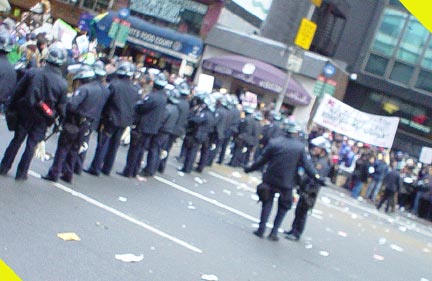
You really have the sense that the state in this country, however one defines it, has a systemic incomprehension of democracy. As much as an invasion will lead to more terrorism -and from new sources- the shutting down of debate leads to it being taken over by fringe elements. I heard the word 'revolution' coming out of the loudspeakers today more times than I could count. Political immaturity breeds political immaturity.
Thursday, February 13, 2003
It's difficult trying to make entertainment out of tragedy, your own or someone else's, but that is what you need to do if your're interested in communicating emotions rather than merely feeling them yourself. The more painful the situation the greater the need for restraint and discretion. It's the difference between a scream of pain and the song that describes it. But the risk is that the sensations, instead of being strengthened are made opaque and distant, that the form becomes the subject and emotional awareness devolves into a sense of taste.
I'm not on my computer and I don't have the code memorized, so I can't insert links, but if you don't know the sites already, you can look to the side of the page.
Nathan Newman has a good post up on Sharpton and the DNC, the latter being the real threat to the Democrats though Sharpton is getting the heat. Of course he's good on Estrada as well.
back to work.
Nathan Newman has a good post up on Sharpton and the DNC, the latter being the real threat to the Democrats though Sharpton is getting the heat. Of course he's good on Estrada as well.
back to work.
Tuesday, February 11, 2003
I don't have much to say on the days events. I'm reading the same stories everyone else is, and waiting to see if the French et al. hold out. I live in New York so I'll be at the demo.
As I've always said, the real pressure has to come from conservatives, and it seems now as if there is some grumbling on all sides. If the war were two month's away I would say both that things were going in the right direction and that there was still time. As it stands now things are going well. The White House is getting hit from every direction. The Belgians are being more forceful in their opposition than either France or Germany - partly, perhaps, as a result of their recent forthright admission of their own crimes. Max Sawicky had a great post a few days ago on the economies of the various countries that are backing us (Denmark has a smaller economy than Dallas.) The al Jazeera tape fiasco would be funny if it weren't about a war. All of this is good news, but we don't have two months.
Apparently Answer won't let Michael Lerner speak at the rally. I can't stand Lerner but banning him is indefensible, if only for reasons of politics. It's causing problems we don't need. It's stupid.
As I've always said, the real pressure has to come from conservatives, and it seems now as if there is some grumbling on all sides. If the war were two month's away I would say both that things were going in the right direction and that there was still time. As it stands now things are going well. The White House is getting hit from every direction. The Belgians are being more forceful in their opposition than either France or Germany - partly, perhaps, as a result of their recent forthright admission of their own crimes. Max Sawicky had a great post a few days ago on the economies of the various countries that are backing us (Denmark has a smaller economy than Dallas.) The al Jazeera tape fiasco would be funny if it weren't about a war. All of this is good news, but we don't have two months.
Apparently Answer won't let Michael Lerner speak at the rally. I can't stand Lerner but banning him is indefensible, if only for reasons of politics. It's causing problems we don't need. It's stupid.
It's late and, again, I'm tired.
Contrary to the opinions of many this is not the beginning of the American Empire, it is probably the end. If we are lucky our president's policies may yet bring about an independent Europe, with strong ties to the east and to China, and a newly sped-up process of democratization in the middle east. And all because the man's a loudmouth with so many weapons that everybody else is terrified. I admit it's risky, but it's brilliant. He's probably a mole working for Kofi Annan.
If there's no war I'm nominating him for a Nobel Peace Prize.
I've read enough crap recently to last my lifetime as to why art is or should be moral. Art is not moral, it's honest, and that's not the same thing. Or rather I'd say that, of course, it is about someone's morality, but not necessarily yours or mine. On Sunday I saw the show of da Vinci drawings that just opened at the Met. His work practically defines the rebuttal to such an argument. If he were alive today he would be designing missile systems.
I do not have the interest in da Vinci I once had. It's not the result so much of my adult, and middle aged(?) comprehension of the meaning of war machines and machiavellianism, as it is of my dislike of the thing from which they both derive: a cold academicism. He is the first and greatest painter of the French Academy. For all his skill and technical curiosity he lacked something, seemingly without realizing that it was missing. His arrogance precludes such an awareness.
Contrary to the opinions of many this is not the beginning of the American Empire, it is probably the end. If we are lucky our president's policies may yet bring about an independent Europe, with strong ties to the east and to China, and a newly sped-up process of democratization in the middle east. And all because the man's a loudmouth with so many weapons that everybody else is terrified. I admit it's risky, but it's brilliant. He's probably a mole working for Kofi Annan.
If there's no war I'm nominating him for a Nobel Peace Prize.
I've read enough crap recently to last my lifetime as to why art is or should be moral. Art is not moral, it's honest, and that's not the same thing. Or rather I'd say that, of course, it is about someone's morality, but not necessarily yours or mine. On Sunday I saw the show of da Vinci drawings that just opened at the Met. His work practically defines the rebuttal to such an argument. If he were alive today he would be designing missile systems.
I do not have the interest in da Vinci I once had. It's not the result so much of my adult, and middle aged(?) comprehension of the meaning of war machines and machiavellianism, as it is of my dislike of the thing from which they both derive: a cold academicism. He is the first and greatest painter of the French Academy. For all his skill and technical curiosity he lacked something, seemingly without realizing that it was missing. His arrogance precludes such an awareness.
Saturday, February 08, 2003
Iraq Opens Suspicious Sites to Eyes of Media.
From the LA Times, courtesy of Thomas Spencer at Stand Down. If you are not registered, use 'untoward' 'klingel' to read the article.
From the LA Times, courtesy of Thomas Spencer at Stand Down. If you are not registered, use 'untoward' 'klingel' to read the article.
The authors whose works were plagiarized by Blair's interns oppose the war.
And veteran intelligence officers take on Powell.
And veteran intelligence officers take on Powell.
It was an exhausting week. I sometimes think my life is being played out as a variation on The Blithedale Romance in which I play all the characters. I'm not having much fun.
The point in my Stand Down post this week was not, as one idiot commented, about conspiracy but something simpler and obvious.
I have a habit of showing up for work 5 to 10 minutes late. I also rarely leave the job quickly at the end of the day. I deduct the time I miss but rarely add the time I stay (unless it's over 30 minutes). I'm responsible, and am one of the most versatile members of any crew I work on. I think and plan ahead. I take on more responsibility than I need to, and when I do a job I try to do it better, more quickly and cleanly, this time than the last. I try to get better at everything I do. All of this keeps me from getting sick of the whole thing, or from just being bored. Economically, if my employer wants good work- and that's a big 'if'- I'm a good investment, but I come in 10 minutes late.
I've been fired a few times for this. I once showed up 5 minutes late for a job that was only going to last a few weeks, but which would have been a good connection for the future. A cabinetmaker who usually worked alone, a friend of a friend, needed an assistant for one job. I showed up at 9:05; my employer was not pleased. It's only 5 minutes, I said. And I'll work till 5:05. "That's not the point" he said. I said I didn't know what difference it would make. He said if I work for him I should show up on time. I shrugged. My indifference made him more annoyed, and the rest of the morning was a contest between the two of us: him waiting for me to make a mistake -I made none- and me being as fast and precise as I could and finishing each assignment well before he expected it, and then waiting for him to figure out the next project. By lunchtime it had become ridiculous. I called up a cabinetmaker I knew who had offered me a few weeks work, she came by on her motorcycle, and I left.
"That's not the point" I heard that phrase again this week from the guy I've been working with for the past few months. Though in every other way I'm practically the only man he can rely on my lateness annoys him more than others' mistakes. That is precisely the point. There are people who need to be bosses more than they need money. It's their revenge.
I wasn't always as responsible as I am now; that was my laziness.
George Bush is not interested in defeating Saddam Hussein; he's interested in making Hussein admit it. It doesn't matter to Bush whether or not Iraq has been rendered incapable of military aggression. As long as Hussein is capable of putting on a show, Bush will want to go in. Handcuffed and on the ground, as long as Hussein can still mouth the words "Fuck You" George Bush will still call him a dangerous criminal. He needs not only to win but to humiliate the beaten foe for the crime of cursing him. This is about the shadows our president sees with anyone who disses him. And he's willing to kill hundreds of thousands of people, and risk the lives of millions more, solely for the purpose of beating back those shadows. Conspiracy has nothing to do with it. It's nothing but insipid mediocrity.
The banality of evil.
The point in my Stand Down post this week was not, as one idiot commented, about conspiracy but something simpler and obvious.
I have a habit of showing up for work 5 to 10 minutes late. I also rarely leave the job quickly at the end of the day. I deduct the time I miss but rarely add the time I stay (unless it's over 30 minutes). I'm responsible, and am one of the most versatile members of any crew I work on. I think and plan ahead. I take on more responsibility than I need to, and when I do a job I try to do it better, more quickly and cleanly, this time than the last. I try to get better at everything I do. All of this keeps me from getting sick of the whole thing, or from just being bored. Economically, if my employer wants good work- and that's a big 'if'- I'm a good investment, but I come in 10 minutes late.
I've been fired a few times for this. I once showed up 5 minutes late for a job that was only going to last a few weeks, but which would have been a good connection for the future. A cabinetmaker who usually worked alone, a friend of a friend, needed an assistant for one job. I showed up at 9:05; my employer was not pleased. It's only 5 minutes, I said. And I'll work till 5:05. "That's not the point" he said. I said I didn't know what difference it would make. He said if I work for him I should show up on time. I shrugged. My indifference made him more annoyed, and the rest of the morning was a contest between the two of us: him waiting for me to make a mistake -I made none- and me being as fast and precise as I could and finishing each assignment well before he expected it, and then waiting for him to figure out the next project. By lunchtime it had become ridiculous. I called up a cabinetmaker I knew who had offered me a few weeks work, she came by on her motorcycle, and I left.
"That's not the point" I heard that phrase again this week from the guy I've been working with for the past few months. Though in every other way I'm practically the only man he can rely on my lateness annoys him more than others' mistakes. That is precisely the point. There are people who need to be bosses more than they need money. It's their revenge.
I wasn't always as responsible as I am now; that was my laziness.
George Bush is not interested in defeating Saddam Hussein; he's interested in making Hussein admit it. It doesn't matter to Bush whether or not Iraq has been rendered incapable of military aggression. As long as Hussein is capable of putting on a show, Bush will want to go in. Handcuffed and on the ground, as long as Hussein can still mouth the words "Fuck You" George Bush will still call him a dangerous criminal. He needs not only to win but to humiliate the beaten foe for the crime of cursing him. This is about the shadows our president sees with anyone who disses him. And he's willing to kill hundreds of thousands of people, and risk the lives of millions more, solely for the purpose of beating back those shadows. Conspiracy has nothing to do with it. It's nothing but insipid mediocrity.
The banality of evil.
Friday, February 07, 2003
"My colleagues, every statement I make today is backed up by sources, solid sources. These are not assertions. What we are giving you are facts and conclusions based on solid intelligence....
"I would call my colleagues' attention to the fine paper that the United Kingdom distributed yesterday which describes in exquisite detail Iraqi deception activities."
"I would call my colleagues' attention to the fine paper that the United Kingdom distributed yesterday which describes in exquisite detail Iraqi deception activities."
Wednesday, February 05, 2003
This question has been asked previously, but has not been pushed nearly enough: Why has the US not given any and all new information to the inspectors immediately after it was received? Intercepts and over flights are not sources that need to be protected. I can think of no other reason for the behavior of the Bush White House than that the goal of their policy is not to disarm but to punish Saddam Hussein for not bowing to our authority. If the goal were disarmament, it seems more obvious than ever that this is can be achieved without war, if the US were to cooperate.
The war is a test case. It is not about oil but power, of which control of oil is only one aspect. One does not have to be a pacifist to understand the implications -to understand how valueless to such people are the lives of those who stand in their path, even by an accident of fate.
The war is a test case. It is not about oil but power, of which control of oil is only one aspect. One does not have to be a pacifist to understand the implications -to understand how valueless to such people are the lives of those who stand in their path, even by an accident of fate.
Monday, February 03, 2003
According to a few sources Dini is a Christian and according to The NY Times, a devout Catholic. The debate should be over. But Mark Kleiman still chooses politics over science.
The question over whether creationism limits one's ability to conduct science is tricky. It would have to be taken on a case by case basis, and would require an examintion in itself. A comment on Electrolite says drug-resistant bacteria do not challenge a creationist viewpoint. Is this true? I don't know. What I do know is that many people, and even some lawyers including Eugene Volokh, do not even understand the point of the question. Kleiman himself says "Medicine is not a science' preferring to see it, in it's need for social interaction, as a 'Profession.' Actually, for a good doctor, it is both.
Perhaps this confusion comes about because lawyers may make use of a casuistic logic- indeed are required to- while biologists do not have that luxury. Dini therefore limits such indulgences to his private life and asks his students to do likewise.
The issue seems pretty clear, but I will admit to a Kleiman-like appreciation of fact that Dini takes his religion seriously. It takes some of the pressure off. But then again, I never said there wasn't any, only that it shouldn't come from 'us'; or more sensibly, that we should judge it all carefully before deciding.
That's it for now. It's Monday and again, I'm tired and dusty. The job is coming along well. Next up I think we're ripping up the kitchen floor and pouring a slab with a 'radiant heat' system. One of the guys on the job know is a graduate of an East German trade school. Some interesting conversations.
tschüs!
The question over whether creationism limits one's ability to conduct science is tricky. It would have to be taken on a case by case basis, and would require an examintion in itself. A comment on Electrolite says drug-resistant bacteria do not challenge a creationist viewpoint. Is this true? I don't know. What I do know is that many people, and even some lawyers including Eugene Volokh, do not even understand the point of the question. Kleiman himself says "Medicine is not a science' preferring to see it, in it's need for social interaction, as a 'Profession.' Actually, for a good doctor, it is both.
Perhaps this confusion comes about because lawyers may make use of a casuistic logic- indeed are required to- while biologists do not have that luxury. Dini therefore limits such indulgences to his private life and asks his students to do likewise.
The issue seems pretty clear, but I will admit to a Kleiman-like appreciation of fact that Dini takes his religion seriously. It takes some of the pressure off. But then again, I never said there wasn't any, only that it shouldn't come from 'us'; or more sensibly, that we should judge it all carefully before deciding.
That's it for now. It's Monday and again, I'm tired and dusty. The job is coming along well. Next up I think we're ripping up the kitchen floor and pouring a slab with a 'radiant heat' system. One of the guys on the job know is a graduate of an East German trade school. Some interesting conversations.
tschüs!
Sunday, February 02, 2003
Since I made my comments on religion yesterday, here and at Maxspeak, I remembered that I do, after all have a link to Alt.Muslem on my site, if not to Aziz Poonawalla. Links to islamic sites make up the only links I 've made to anything remotely religious.
Islam is the only faith that is both central to a political debate and relevant to my interests. Since I am a secularist this may be condescenscion on my part, but that judgement applies much less to Islam than it does to any debates within Christianity or Judaism. We are witnessing the growth of a secular humanist culture of an Islamic heritage. Once that is fully out in the open Islam will lose interest for me, as the others have. But as long as meaningful debate continues, even within a religious context, over the questions of what constitute the rights and obligations of individuals and those of the state, I'm there.
Islam is the only faith that is both central to a political debate and relevant to my interests. Since I am a secularist this may be condescenscion on my part, but that judgement applies much less to Islam than it does to any debates within Christianity or Judaism. We are witnessing the growth of a secular humanist culture of an Islamic heritage. Once that is fully out in the open Islam will lose interest for me, as the others have. But as long as meaningful debate continues, even within a religious context, over the questions of what constitute the rights and obligations of individuals and those of the state, I'm there.
File under Intellectually simple but emotionally and politically complex.
Here are Dini's instructions to recommendation seekers. Here is Mark Kleiman's first post. Go there and scroll up and you'll find a link to Calpundit and Electrolite where I posted the response I've amended below.
Kleiman begins by calling Dini a 'fool' and says it's "perfectly possible to understand a theory without accepting it.
The issue is not understanding, but acceptance. If one does not accept that diseases can become drug resistant through evolution one should have have no right to a license to prescribe drugs. Dini is a hardass, but is well within his rights. I think it would have been smarter if he had asked at what point religious beliefs intersect with the student's daily life. If the student said evolution applied to to the history of disease, and to animals, but not to humans, or that evolution applies now but not at the beginning of time, that might arguably give the student wiggle room. The student may lie, but there's nothing to say he or she wouldn't lie anyway. But most creationists are not believers in 'Sunday Truths." and I'm willing to bet the kid bringing the suit is not either.
To argue that evolution did not occur is to argue that at some point in time, or in some situations, 1+1 does not equal 2. Evolution is, after all, a fact as we define the term. There are 'theories' about its effects. If someone is willing to state that from his understanding, the point at which this division between empirical fact and mysticism occurs does not in any way intersect what occurs in the present- that evolution applies to everything after "creation"- then maybe that student deserves a pass, regardless of his faith. Dini does not agree, but there should be no means to force him to.
Klieman writes as a Jew in a world of Gentiles, and avers he's :"delighted that the teacher in question wasn't an atheist named Rabinowitz." He speaks as one condescendingly aware of the dangers 'we' face but which others ignore. He exhibits the glib cynicism of the ghetto realist. He should not generalize from his own insecurities, but only do so while acknowledging them. Then we can begin to discuss the politics of the situation.
Here are Dini's instructions to recommendation seekers. Here is Mark Kleiman's first post. Go there and scroll up and you'll find a link to Calpundit and Electrolite where I posted the response I've amended below.
Kleiman begins by calling Dini a 'fool' and says it's "perfectly possible to understand a theory without accepting it.
The issue is not understanding, but acceptance. If one does not accept that diseases can become drug resistant through evolution one should have have no right to a license to prescribe drugs. Dini is a hardass, but is well within his rights. I think it would have been smarter if he had asked at what point religious beliefs intersect with the student's daily life. If the student said evolution applied to to the history of disease, and to animals, but not to humans, or that evolution applies now but not at the beginning of time, that might arguably give the student wiggle room. The student may lie, but there's nothing to say he or she wouldn't lie anyway. But most creationists are not believers in 'Sunday Truths." and I'm willing to bet the kid bringing the suit is not either.
To argue that evolution did not occur is to argue that at some point in time, or in some situations, 1+1 does not equal 2. Evolution is, after all, a fact as we define the term. There are 'theories' about its effects. If someone is willing to state that from his understanding, the point at which this division between empirical fact and mysticism occurs does not in any way intersect what occurs in the present- that evolution applies to everything after "creation"- then maybe that student deserves a pass, regardless of his faith. Dini does not agree, but there should be no means to force him to.
Klieman writes as a Jew in a world of Gentiles, and avers he's :"delighted that the teacher in question wasn't an atheist named Rabinowitz." He speaks as one condescendingly aware of the dangers 'we' face but which others ignore. He exhibits the glib cynicism of the ghetto realist. He should not generalize from his own insecurities, but only do so while acknowledging them. Then we can begin to discuss the politics of the situation.
Saturday, February 01, 2003
The brains behind the war.
I don't know how to respond to this stupidity. Can I say Shock and Awe?
I quoted Pollack a couple of months ago, when I heard him asked, on NPR, about the possible effect on Pakistan of an invasion of Iraq: "I can't respond to that. I don't know the first thing about Pakistan" What business does he have making arguments about international policy if he denies knowing anything outside his specialty?
And Kristol adds: "The Europeans sometimes make it seem as if we're about to invade Madagascar"
Say what!?
These idiots don't understand a goddamn thing. Since when does arrogance and wishful thinking pass for political wisdom? This makes Vietnam seem like an honest mistake.
I wonder how the American people will feel when they see Baghdad in ashes. Will they sound like the Germans after Auschwitz? We didn't know. What could we do?
"Harlan Ullman, the military strategist who apparently developed the plan, last week characterized the Baghdad assault thusly: 'You have this simultaneous effect, rather like the nuclear weapons of Hiroshima, not taking days or weeks but minutes.' "
Max is making nice to god, in the form of Allah. [No, Max is not Allah, that would be interesting but problematic. Max is just being nice] I disagree on principle, not as regards Allah, but the gods in general.
Faith rarely leads to clarity of thought, on issues of morality or anything else. Poetry yes, but not clarity. It's like booze. Just because it's fun, and made on occasion by men, and women, of great skill, doesn't mean you should drink and drive.
Faith rarely leads to clarity of thought, on issues of morality or anything else. Poetry yes, but not clarity. It's like booze. Just because it's fun, and made on occasion by men, and women, of great skill, doesn't mean you should drink and drive.
Subscribe to:
Posts (Atom)