
Wednesday, July 05, 2023


NYT Federal Judge Limits Biden Officials’ Contacts With Social Media Sites
The Republican attorneys general of Texas and Florida are defending first-of-their-kind state laws that bar internet platforms from taking down certain political content, and legal experts believe those cases may eventually reach the Supreme Court. The high court this year declined to limit a law that allows the platforms to escape legal liability for content that users post to the sites.
The ruling on Tuesday, in a lawsuit brought by the attorneys general of Louisiana and Missouri, is likely to be appealed by the Biden administration, but its impact could force government officials, including law enforcement agencies, to refrain from notifying the platforms of troublesome content.
Government officials have argued they do not have the authority to order posts or entire accounts removed, but federal agencies and the tech giants have long worked together to take action against illegal or harmful material, especially in cases involving child sexual abuse, human trafficking and other criminal activity. That has also included regular meetings to share information on the Islamic State and other terrorist groups.
The White House said the Justice Department was reviewing the ruling and evaluating its next steps.
“Our consistent view remains that social media platforms have a critical responsibility to take account of the effects their platforms are having on the American people, but make independent choices about the information they present,” the White House said in a statement.
Meta, which owns Facebook and Instagram, declined to comment. Twitter did not have a comment, and Google did not respond to a request for comment.
Democracy Now June 9th: DOJ vs. African People’s Socialist Party: Omali Yeshitela Blasts Charges of Being Russian Agent
Yeshitela's an ass. It's irrelevant. I shouldn't have to say it.
Tampa Bay Times, May 10, St. Petersburg Uhuru members speak for first time since indictment
It’s a matter of free speech, says Omali Yeshitela, the longtime leader of the St. Petersburg-based Uhuru Movement and founder of the African People’s Socialist Party.
Yeshitela was indicted by a federal grand jury in Tampa last month and accused of working with Russian nationals to sow discord in the United States, spread pro-Russian propaganda and influence elections, along with two other members of the Uhuru Movement, Penny Joanne Hess and Jesse Nevel.
On Wednesday, the three Uhuru members spoke to the press for the first time since their indictment.
“I believe in free speech,” Yeshitela said at the news conference. “If I didn’t believe in free speech, I would never have said anything because they kill Black people for talking in this country.”
Twitter said 100 accounts with Russian ties were removed for amplifying narratives that undermined faith in NATO and targeted the United States and the European Union.
"For those of you who have been with us so far, you'll know that we've been thinking and talking a lot about how the First Amendment should adjust to the new challenges of the platform era."
"And that's an important story because tech platforms are perhaps the most important speech regulators in the world."
Republicans want to ban books; Democrats want to ban "disinformation"; it's one syllable or five. But Democrats want corporations to do the dirty work, so Facebook is free to incite in the quest for engagement, and the speech of its captive audience is policed.
All this misinformation being spread these days is getting in the way of disseminating official government propaganda
— Karl Sharro (@KarlreMarks) December 1, 2022
There are far worse sins than snobbery (which can mean just having standards in the democratic age), and you can learn a lot about how to write about ideas, art, etc for a non-academic audience by studying her work. She was flawed, interesting, a now vanished type
— Matthew Sitman (@MatthewSitman) June 27, 2023
And for the record (don't post this), Yglesias as an individual has a great, self-aware sense of humor and is much more starkly honest (if also unapologetic) about his own elitism than most liberals. Take him out for a beer and I think you'd find that.
Tuesday, July 04, 2023
A famous philosopher Francis Fukuyama @FukuyamaFrancis joined us in Stanford. Mr. Fukuyama expressed gratitude to Azov @azov_media Sergeant Arseniy Fedosyuk for his service and heroism during Mariupol campaign and uttered support to Ukraine on our sure way to victory. pic.twitter.com/dpqGjI27v8
— Kateryna Prokopenko (@KatProkopenkoUa) June 30, 2023


The Forward, "Why did Stanford students host a group of neo-Nazis?"
Conversations about white supremacy in America today typically center on right-wing media and incendiary politicians who blast out racist dog whistles.But hate doesn’t need demagogues to get mainstreamed; it has also found an outlet at elite universities.On June 29, Stanford University hosted a delegation from the Azov Brigade, a neo-Nazi formation in the Ukrainian National Guard. The panel, during which Azov’s neo-Nazi insignia was projected onto the wall, was attended by noted political scientist Francis Fukuyama, who posed for a photograph with the delegation.This event — and the disturbing lack of reaction from Jewish organizations — showcases the limits of America’s commitment to combating white supremacy.Call it the Ukraine exception.
Moss Robeson, a thread with links:
Yulia Fedosiuk, famous Azov Regiment wife currently touring the US for a 2nd time, makes reference to alt-right / neo-Nazi meme on her way back to Stanford
more:
Denys Redis Prokopenko - 32!
— Hooligans.cz Official (@hooliganscz1999) June 27, 2023
Legend of Ukraine, the Army and Dynamo.
For us it’s a great honor that Denis has come from our movement. The guy with whom we had fights in the city, away matches and concerts with. Today he represents real hope for Ukraine. His leadership in the… pic.twitter.com/8VtEMrdwpL

—Denys Redis Prokopenko - 32!
Legend of Ukraine, the Army and Dynamo.
For us it’s a great honor that Denis has come from our movement. The guy with whom we had fights in the city, away matches and concerts with. Today he represents real hope for Ukraine. His leadership in the defence of Mariupol will go down in military history. The officer with a flame of Idea in his heart and cares deeply about the fate of Europe.
We are very thankful to our comrades from Zagreb, Berlin and Madrid for your congratulations. We will always appreciate who have been with us in than hard time.
Redis will see it personally and he will be shy because he doesn’t like “birthday parties” like many other warriors. Especially when our country is spilling blood. His biggest wish is to return to battle.
“Ukraine belongs to us
Brave, real and loyal
Who have chosen honour and courage”.
We wait for you at home, comman𝕯er!—

Sunday, July 02, 2023
Role Play indeed.
Dylan Riley, Director, Interdisciplinary Studies Field, dept. of Sociology, UC Berkeley,
in NLR, "Decapitalizing Culture", (filed under society)
There are countless debates among sociologists and economists concerning the terms ‘human capital’ and ‘cultural capital’. The general view is that the former implies a rational instrumental attitude to the attainment of skills, whereas the latter suggests an investment in what Bourdieusians call illusio: the denial that the game of culture is in fact a game. Iván Szelényi once characterized the distinction slightly differently, writing that human capital denoted skills that are rewarded because of their contribution to productivity, while cultural capital was fundamentally a claim to rent. It seems to me, however, that we ought to be raising a different set of questions. In particular, it is important to ask: under what historical conditions does culture take the form of an ‘asset’ or ‘quasi-asset’?
John-Baptiste Oduor, editor at Hamasmag, in NLR, "Role Play", (filed under culture)
Untitled (Woman Standing Alone) from Kitchen Table Series, 1990, © Carrie Mae Weems. Courtesy of the artist, Jack Shainman Gallery, New York / Galerie Barbara Thumm, Berlin.
Oduor previously, on Charles Mills, and Lynette Yiadom-Boakye. Weems belongs with Hammons.
repeat. It's absurd how much is lost when the goal of disinterest devolves into a fiction of objectivity.
Stanley Hoffman reviews Distinction
But if “using rare words and tropes in place of common words and phrases” is a strategy of “deliberate transgression” of the norms of clear prose characteristic of the dominant classes and is opposed to “the hyper-correction strategies of pretentious outsiders,” then Bourdieu is a master strategist. Words such as lexis, allodoxia, chiastic, askesis, espace hodologique, hysteresis, and of course habitus (and, indeed, hysteresis of habitus) are scattered throughout the text. That a work of social science should—”unlike the sometimes illuminating intuitions of the essay”—require an effort on the part of the reader is fair enough. Here, however, reality disappears into the hypertrophied rhetoric of the Ecole Normale.
Simply as a critic, never mind the pretension to politics, Oduor doesn't know enough. A first person essay about why he likes the work, what it means to him as a writer, would be the only honest choice, but he'd never make it.
"There's no point in having sharp images if you've got fuzzy ideas. Leacock's lack of subjectivity leads him ultimately to a lack of objectivity. He doesn't even know he's a metteur-en-scene, that pure reportage doesn't exist."
“Documentaries are thought to have the same relation to social change as penicillin to syphilis.”
Jeff Wall: [Referring to Delacroix] Violence is only a theme in this kind of art; the art itself isn’t violent. That makes it very different from, even opposed to, the art of the avant-garde, which expresses aggression against the idea of art itself. This aggression is no longer viable. I don’t think its necessary or possible to go beyond the idea of bourgeois art -that is of autonomous art- towards a fusion of art and its context. Or if its possible it isn’t very desirable. We have learned how the aggression against autonomous art was consistent with aspects of totalitarianism, from the Stalinist period for example, and how state violence could benefit from that kind of aesthetic. The concept of art as autonomous, and therefore less amenable to that kind of instrumentalization, is a central concern of the modern, and I’m most sympathetic to that.
A-MB/RM: Modernity and avant-garde, to you, are two separate things?JW: We can’t confuse them anymore.
"A Democratic, a Bourgeois Tradition of Art: a Conversation with Jeff Wall"Jeff Wall: Selected Essays and Interviews
Chevrier, cited by Odour, is in the same volume. I have a lot of respect for Wall, and I've watched him work a room. See previously on Hammons. Fine art is conservative, or it's reactionary. And Fried is a fucking idiot. Always a moralist, I should have guessed that when when he adapted to change he'd become a fan of Greuze.
Proletarian dictatorship is an oxymoron.
back to the top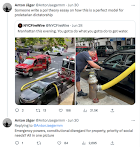
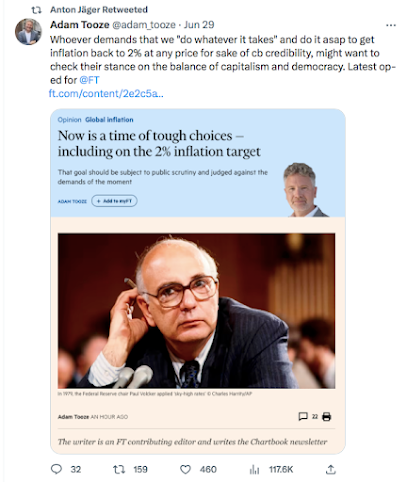
Someone write a pol theory essay on how this is a perfect model for proletarian dictatorship https://t.co/AJrUExJsbV
— Anton Jäger (@AntonJaegermm) June 30, 2023

Dictatorship or democracy: pick one. And that Science fiction fantasy is called Star Trek. Jameson is an idiot.
repeats: "Liberals love benign authoritarianism. The argument is circular: it's benign when they love it."
The argument for freedom or speech is that every one off these assholes defends the Nakba and the Jewish ethnostate in Palestine. Israel is the state of exception liberals and European social democrats accept. The presumption and arrogance is unchanged
"Neither Marx nor Engels lived to see the imperialist epoch of world capitalism, which began not earlier than 1898–1900" Lenin 1916
— Adam Tooze (@adam_tooze) July 1, 2023
The chronological specificity of this is striking. Imperialism =/= Empire or settler colonialism.
Herzl to Rhodes:"How, then, do I happen to turn to you, since this is an out-of-the-way matter for you? How indeed? Because it is something colonial, and because it presupposes understanding of a development which will take twenty or thirty years."
All knowledge is dispersed and perspectival, and the market is vulgar. Googling "Hayek was a utilitarian" doesn't get you much, but it gets you more than "utopianism is fascist"
Danielle Guizzo is at the University of Bristol. On twitter, she follows and is followed by Weber, Gabor, et al. Her reference is to Skidelsky from 2006. Call it progress.
And "wealth" itself is an irrational concept. It is an almost mystical process, the setting of ethical values: Arising from the irrational, transforming the irrational to the rational, yet nonetheless it is the irrational that radiates from within the resulting form." Broch, as always.
If the PRC is the Moses we need against global warming, it should go the same way when the crisis is done. Exception as fact not as theory. It's almost refreshing that the next hegemon won't have the baggage of Christian hypocrisy. Monotheism is disaster.
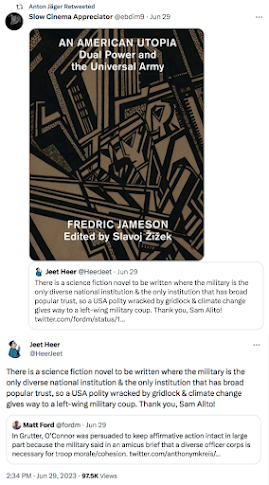
Tooze isn't actually interested in democracy; he wants government to help the people. Any question of informed consent is secondary.


One minute Western elite was worrying earnestly about balance of democracy and capitalism and announcing a new social contract, next we are assigning both fiscal & monetary policy to hammer inflation & maintain financial stability cos .. TINA. C'mon ...! https://t.co/8jtuOkaHRe pic.twitter.com/0ooUMGcXuJ
— Adam Tooze (@adam_tooze) June 29, 2023
Derek Brower, FT, An energy editor’s farewell reflections
Capitalism won’t deliver the energy transition fast enough . . .
There’s too much to do, and given the urgency and the need to get the solution right, this isn’t a task for your favourite ESG-focused portfolio manager or the tech bros. The sheer scale of the physical infrastructure that must be revamped, demolished or replaced is almost beyond comprehension. Governments, not BlackRock, will have to lead this new Marshall Plan. And keep doing it. The western nations that did so much of the damage will have to finance the transition in the developing world — it is astonishing that this idea is still debated. Massive deficit spending will be necessary, not a new ETF. For all the cleantech advances and renewable deployment in recent decades, fossil fuels’ share of total global energy use was 86 per cent in 2000 and 82 per cent last year.
. . . and nor will Big Oil
Remington was good at typewriters, but not the personal computer. Why expect ExxonMobil or Saudi Aramco to lead — or even survive — a shift from their core business of digging up fossil fuels and selling them? And do you really want them to? In the US, the Joe Biden administration has implored drillers to pump more oil, not less; liquefy more shale gas for export, not less. Shell’s and BP’s share prices have risen since they said they would slow down their retreat from oil.
If we want oil companies to stop selling fossil fuels we should consume less of them and we should vote for governments that make them more expensive, not less. Yes, our physical infrastructure has been built over decades around petroleum use. Yes, oil companies have lobbied forever to preserve this arrangement and slow down alternatives. But no one is compelling those of us in the rich world to fly so much, drive Escalades, devour so much meat, or buy so much stuff.
Oil demand will hit a new record high this year, with almost half of it still burnt in the rich 38 countries of the OECD. Don’t fly across Europe for your skiing holiday or business meeting and then complain that the poor world isn’t doing enough on climate and that BP is still making jet fuel.
Is Russia’s war good for the energy transition?
Optimists think Russia’s weaponisation of gas supplies and brutal violence in Ukraine will speed up the transition from fossil fuels that sustain Vladimir Putin’s regime. Maybe. The IRA and REPowerEU suggest so. Europe certainly isn’t going to be rushing to buy more hydrocarbons from Russia.
But India and China have used western sanctions on Russia as an opportunity to deepen their dependence on its (cheaper) crude. Germany has become a newly minted LNG buyer in less than a year, while Europe’s rush to hoover up cargoes has priced out countries such as Pakistan, forcing them back to coal. The White House was so scared about rising gasoline prices after the invasion that it drained its emergency oil reserves and begged Texas frackers and Saudi Arabia to boost supplies. The G7’s entire goal in the price cap was to keep Russian oil flowing, not stop it. A lesson of the war: western leaders talk a lot, but stomaching fossil fuel supply disruptions is hard.
The next few years will be messy
Either we ignore the consensus of the world’s best scientists and accept an ever-deteriorating climate, or we upend a multitrillion-dollar fossil fuel-based energy system created over decades. For obvious reasons it would be better to decarbonise and clean the energy system, avoiding the trauma of a ever-heating world, while trying to manage the political fallout. But powerful petrostates such as Saudi Arabia and the UAE — in charge of this year’s COP climate conference — won’t go quietly. The transition could put weak petrostates like Iraq in peril. Big Oil lobbyists will fight tooth and nail to stop change and influence elections. Saying the geopolitics of the energy transition will be volatile seems like an understatement.
The beginning made me laugh
Energy professionals are more interesting than others
Mercenaries and inner-city schoolteachers run them close. But there isn’t another sector that combines worldly experience, mechanical knowhow, practical economics and politics. My colleagues covering banks speak to people wearing suits. I got to interview rig-hands in Siberia, warlords, climate activists, solarpanel installers in Texas, ‘wildcatting’ billionaires, and Baghdadi politicians. Objectively, these are more interesting people.
Saturday, July 01, 2023
608. No supposition seems to me more natural than that there is no process in the brain correlated with associating or with thinking; so that it would be impossible to read off thought-processes from brain-processes. I mean this: if I talk or write there is, I assume, a system of impulses going out from my brain and correlated with my spoken or written thoughts. But why should the system continue further in the direction of the centre? Why should this order not proceed, so to speak, out of chaos? The case would be like the following—certain kinds of plants multiply by seed, so that a seed always produces a plant of the same kind as that from which it was produced—but nothing in the seed corresponds to the plant which comes from it; so that it is impossible to infer the properties or structure of the plant from those of the seed that comes out of it—this can only be done from the history of the seed. So an organism might come into being even out of something quite amorphous, as it were causelessly; and there is no reason why this should not really hold for our thoughts, and hence for our talking and writing.
609. It is thus perfectly possible that certain psychological phenomena cannot be investigated physiologically, because physiologically nothing corresponds to them.
And John King, another former student, testifies to Wittgenstein's distaste for British (as opposed to American) movies precisely on the ground of their theatricality. "The Mill Road cinema . . . was the one he most favoured," King recalls, "and here he sat as far to the front as he could get, leant forward in his seat and was utterly absorbed by the film. He never would go to any British film; and if we passed a cinema advertising one he pointed out how the actors looked dressed-up, unnatural, unconvincing, obviously play-acting, while, in comparison, in the American films the actors were the part, with no pretence" ("Recollections of Wittgenstein," in Rhees, ed., Recollections of Wittgenstein, p. 71).
Cooper's ability to project his personality onto his characters played an important part in his appearing natural and authentic on screen. Actor John Barrymore said of Cooper, "This fellow is the world's greatest actor. He does without effort what the rest of us spend our lives trying to learn – namely, to be natural."[88] Charles Laughton, who played opposite Cooper in Devil and the Deep agreed, "In truth, that boy hasn't the least idea how well he acts ... He gets at it from the inside, from his own clear way of looking at life."[88] William Wyler, who directed Cooper in two films, called him a "superb actor, a master of movie acting".[399]
In his review of Cooper's performance in The Real Glory, Graham Greene wrote, "Sometimes his lean photogenic face seems to leave everything to the lens, but there is no question here of his not acting. Watch him inoculate the girl against cholera – the casual jab of the needle, and the dressing slapped on while he talks, as though a thousand arms had taught him where to stab and he doesn't have to think anymore."[88]
Cooper's style of underplaying before the camera surprised many of his directors and fellow actors. Even in his earliest feature films, he recognized the camera's ability to pick up slight gestures and facial movements.[400] Commenting on Cooper's performance in Sergeant York, director Howard Hawks observed, "He worked very hard and yet he didn't seem to be working. He was a strange actor because you'd look at him during a scene and you'd think ... this isn't going to be any good. But when you saw the rushes in the projection room the next day you could read in his face all the things he'd been thinking."[174] Sam Wood, who directed Cooper in four films, had similar observations about Cooper's performance in Pride of the Yankees, noting, "What I thought was underplaying turned out to be just the right approach. On the screen he's perfect, yet on the set you'd swear it's the worst job of acting in the history of motion pictures."[401]
A novel is a thing crafted out of a plot, and judged as that. It's less an essay than a house. Language, as event and communication is an aspect of life. Philosophy and theology are parasitic on that. Literature, art, is both descriptive and formal. History, describing both art and the world, is observational and secular.
Thursday, June 29, 2023
as expected, the court has inverted the 14th. an amendment written explicitly to directly ameliorate the conditions of race hierarchy becomes in conservative hands an amendment that says it’s illegal to try to directly ameliorate the conditions of race hierarchy https://t.co/CeklyHtyBr
— b-boy bouiebaisse (@jbouie) June 29, 2023

NYT: Supreme Court Strikes Down Race-Based Admissions at Harvard and U.N.C.
In disavowing race as a factor in achieving educational diversity, the court all but ensured that the student population at the campuses of elite institutions will become whiter and more Asian and less Black and Latino.
Again and again.
[I]n 1867 Congress passed a law providing relief for “freedmen or destitute colored people in the District of Columbia,” to be distributed under the auspices of the Freedmen’s Bureau. Of particular importance in the late 1860s was the Bureau’s operation of schools for blacks, to the point that black children in the South were often better educated than their white counterparts.
The great critical race scholar Derrick Bell, for example, argued that African Americans can advance on issues of race only when whites also benefit. One way to secure this “interest convergence,” he observed, is to ally with lower-class whites "who, except for the disadvantages imposed on blacks because of color, are in the same economic and political boat."
NYT today:
College admissions experts anticipate there will be increased pressure on elite schools to end preferential treatment for children of alumni, who are more frequently white and affluent, as a result of the Supreme Court’s decision.
And in his concurring opinion, Justice Neil M. Gorsuch criticized Harvard for resisting proposals to eliminate legacy admissions, saying the university’s “preferences for the children of donors alumni, and faculty are no help to applicants who cannot boast of their parents’ good fortune or trip to the alumni tent all their lives,” he wrote.
Another tweet that shows how prioritising blue tick replies in the new Twitter world just degrades the Twitter experience. https://t.co/xpWqr4GUq6
— James Ball (@jamesrbuk) June 29, 2023

"And that's an important story because tech platforms are perhaps the most important speech regulators in the world."
Unwilling or unable to recognize recognize the difference between Disney World as a place to visit or the place you live: a company town.


Wednesday, June 28, 2023
AJ rts his co-author
In 1927, Piero Sraffa left Italy for good out of fear of the fascists and became a lecturer in Cambridge. That same year, he was invited by Keynes to give a lecture on the corporative state.His concluding remarks are devastating on liberal's fantasies about a return to normalcy.
Sraffa
The really important question to which the future will give an answer is whether fascism is an abnormal product of the post war psychosis: only suited to the local conditions of Italy or whether it represents a logical and unavoidable outcome of the conditions of modern industrial communities.
The Italian democratic opposition has, at least in the first period of fascism, taken the former view: and it has been confidently expecting the downfall of fascism, which should have occurred so soon as people came back to their senses. Then, fascism would have passed without leaving any permanent trace, everything would have reverted to the liberal system, and the natural order of things would have been restored exactly where it stood in the good old days.
But if experience proves that fascism, apart from its superficial and more picturesque aspects has been originated by more permanent and less futile causes, the case is profoundly different. If it really has represented the last line of resistance from which the present social order must fall bade in order to defend itself against the attacks of organized labour, if in fact it is the only method of consolidating the basis of capitalism when it has reached a stage in which it is no longer possible to preserve it without breaking the forms of political democracy—then the developments of fascism will have a much greater interest in so Far as they will perhaps represent an anticipation of the results to which capitalism may ultimately lead in other countries.
DL rts Alice Evans
Tremendous book on cultural change in 1950s/60s Italy!
By @niamhanncullen

Evans blocked me on her Substack page for a comment I'd already deleted because I'd felt guilty about it. She wants to imagine the best.
Jäger and Leusder, aka minimaldamage, Cooper, Bruenig and Gilman: Individualism and community, the family, Europe and the US, Germany and Greece.
Jäger
This album is such a tragedy for electronic dance music in that every single song on it set the bar so high in 1987 that no one’s surpassed it ever since

Neurodivergent disco is a guaranteed succes[sic]
"Joy Division" "New Order" and autism. Henry Farrell, fan of "My Bloody Valentine" and defender of Truth. The absolute lack of self-awareness. A culture of nostalgia, in an era of engineering and blank violence.
"Atomization, isolation and the illusion of absolute community. The low buzz and hum—the violence and warmth—of neurological overload."
Seth Edenbaum
"Behind the chiliasm of modern man, is the megalomania of self-infinitization."
Daniel Bell
I've given up submitting anything, anywhere.
The Court on Tuesday in Moore v. Harper emphatically rejected the independent state legislature theory. Chief Justice Roberts wrote for the Court in a 6-3 decision, and held that state courts have the power to enforce state law, including with regard to elections. He invoked Marbury v. Madison, the 1803 decision that famously recognized the power of courts to review the constitutionality of executive and legislative actions. The Court declared: “We are asked to decide whether the Elections Clause carves out an exception to this basic principle. We hold that it does not. The Elections Clause does not insulate state legislatures from the ordinary exercise of state judicial review.”
Win for judicial review. I wonder if Ryan Cooper was forced to work on the piece.
Stop what you're doing and read the extraordinary amici curiae brief Akhil Amar, Vik Amar and Steve Calabresi have just filed in Moore v. Harper. That's the case involving a claim by North Carolina legislators that under the Constitution only the legislature of a state has the power to regulate federal elections--without any interference from state courts or any constraints from state constitutions. The brief from Akhil, Vik and Steve is an intellectual battering ram that demolishes the independent state legislature theory. It is also the punchiest brief filed in a very long time. In its substance and by its candor, the brief sets a new standard for friend of the court. The brief is available at this link.
The adulation for Augustus puzzles me. During the civil war, he, Octavian, would have sons and fathers fight each other to death for entertainment. Just one example. Even for the time this was considered real sicko stuff. Historical distance plays strange tricks on our minds. https://t.co/vMfDVKve8V
— New Left EViews (@NewLeftEViews) June 27, 2023
Leusder again, quoting the New Yorker's music critic on Ernst Jünger
We like to think that novelists possess a special ethical strength, yet the morally compromised writer can project a strange kind of honesty—especially when his society is compromised to the same degree.
"We like to think..." No, we don't.
Fintan O'Toole: Writers are the last people we should look to for moral clarity
For the uncomfortable truth about literature is that morally virtuous people are less likely than morally slippery people to be great writers. Having a clear set of values and sticking to it through trials and tribulations makes for a splendid human being, but seldom for a splendid novel.
My response at the time
No. The ability to face the complexities of the world begins with the acceptance of the possibility of failure. The way to understanding the frailties of others begins with an ability to recognize your own. Most people who consider themselves virtuous haven't been tested, or they're less virtuous than they imagine
right-thinking, bien pensant,
Leusder, Jäger et al. are fans of of all variety of fascist adjacent culture but moralize about those who cross a line, unless of course it's the one about which earnest Europeans hold their tongue.
Memories of Taruskin. Moralists' ideas of art.
And again, both linking back to the same history:
Thug life is barbarism. It needs no written philosophy. It needs no defense. It's not opposed to art. As I've said more than once, maybe not here, if art were about morality, killers wouldn't know how to dance.
A comment that labeled me a "nihilist":12 years ago on the subway, I watched a man playing the accordion. My first thought was that he knew how to handle a knife. His playing was hard, cold and precise, but it was turned in an instant from jagged to fluid, from points to curves, swooping and stabbing. The music described the violent moral universe that made him. He was trailed by a stoop-shouldered woman with a cup. The expression on her face was heartbreaking.
Also from Jäger, Habermas replies:
Please allow me a final intellectual historical observation. Professor Parsons has claimed that Max Weber's teaching is a development towards bringing about the end of ideology. Weber is said to have broken the trilemma of historicism. utilitarianism and Marxism, and to have led the way into the free field of discussion beyond the European fronts of civil war. I envy our American colleagues their political traditions which permit such a generous and (in the best sense of the word) liberal interpretation of Max Weber. We here in Germany, who are still seeking for alibis, would only too gladly follow them. But Weber's political sociology has had a different history here. At the time of the First World War he outlined a sketch of Caesar-like leader-democracy on the contemporary basis of a national-state imperialism. This militant latter-day liberalism had consequences in the Weimar period which we, and not Weber, must answer for. If we are to judge Weber here and now, we cannot overlook the fact that Carl Schmitt! was a ‘legitimate pupil’ of Weber’s. Viewed in the light of the history of influences, the decisionist element in Weber's sociology did not break the spell of ideology, but strengthened it.
No fucking shit.
O'Toole again, on Pinter. All I do is repeats
He goes on to quote, as if from memory, lines from The Duchess of Malfi and The White Devil like "What would it pleasure me to have my throat cut/ With diamonds?"; "There's a plumber laying pipes in my guts"; "My soul, like to a ship in a black storm/Is driven I know not whither"; "I have caught/ An everlasting cold. I have lost my voice/Most irrecoverably." And, of course, "Cover her face; mine eyes dazzle; she died young." He adds, "That language made me dizzy."
These assholes read Brecht as a radical, when he needs to be read as Jünger is, as I read Brecht even as a child.
Reinhard Heydrich on his deathbed reciting the lyrics of his father.
The world is just a barrel-organ which the Lord God turns Himself.
We all have to dance to the tune which is already on the drum.
Sunday, June 25, 2023
Riley at about 29:40
This is a quite striking graph this is from very conservative man Andrew Smithers from a journal, it's a very strange Journal, called American Affairs, which I would say it basically a kind of intellectual justification of Trumpism but because it is it it it sometimes attracts very heterodox and independent-minded thinkers, Smithers being one of them.
"Investment, Productivity, and the Bonus Culture", by Andrew Smithers in American Affairs


Riley is a little annoying. The "intellectual left" have a problem. The mannerism of Verso. The elite pretending to represent the majority and wondering why the majority don't get off their asses; inventing various solutions; the end justifying the elite.
Julius Krein, aka "Publius Decius Mus" at the Claremont Review, interviewed, anonymously and later under his own name in the New Yorker. He changed his mind about Trump. Oops.
Someone other than me needs to write something about the over-attention to design in the new kids magazines. Nostalgia is a form of utopianism, a fantasy of the past as opposed to the future..
Saturday, June 24, 2023
Grozev
Last December, @juliaioffe asked me what I thought Prigozhin would do. I said he'd try a coup within six months. (Julia even asked me if I was okay to commit to a timeline on the record). Anyhoo..
I spent most of last night on Twitter and Telegram. A friend tells me Prigozhin's language in this diatribes is untranslatable, rich. A great orator. J's parents lived through the Holodomor, Russian speakers in Kiev.
Seddon
Kremlin spox Dmitry Peskov:– charges dropped against Prigozhin, who will leave Russia for Belarus– Wagner fighters who didn't take part in the uprising will sign contracts with the MOD– Wagner fighters who did take part not charged– No word on potential MOD leadership changesDespite declaring Prigozhin a "traitor" and vowing to "liquidate" Wagner on Saturday morning, Peskov said Putin had asked Lukashenko to mediate in the hope of avoiding any further bloodshed because the Belarusian leader has known Prigozhin for 20 years.
Peskov described the uprising – in which Wagner shot down helicopters, captured a major command post, and marched most of the way to Moscow – as "fairly difficult" and "full of tragic events," but said "there were higher goals of escaping bloodshed and internal confrontation."
Putin will not make any further comment on the issue. The invasion of Ukraine will continue as normal.
No word from Peskov on whether Prigozhin managed to secure Shoigu's resignation – he said only Putin has that authority so Prigozhin and Lukashenko couldn't discuss it.
Closer and closer to a failed state. Even Gazprom has it's own militia. And the videos from Moscow last night were teenagers celebrating the end of high school. It's terrifying.
repeats
There are three distinct groups in Russia: 1/25
1) radicals – a sizeable but extremely loud minority that actively supports war, is engaged, follows the news and in rare cases even goes to the frontlines (15-25%). This is the audience of the milbloggers, Telegram channels and vampires like Solovyov or Skabeeva 2/25
2) dissenters – a sizeable minority that categorically opposes the war. It is banned from Russian-based media and generally depressed (20-25%) 3/25
3) laymen – a passive majority that is completely depoliticized and doesn’t want to have anything in common with politics & war (50-65%) 4/25
"a passive majority that is completely depoliticized and doesn’t want to have anything in common with politics & war"
Woke from a dream in which Keith McNally was leading a coup against President Biden backed by 25,000 Balthazar waiters.
— CHRISTIAN LORENTZEN (@xlorentzen) June 24, 2023
Balthazar. related in more ways than one.
A thread by Mateev.
Fact: Wagner troops did have their own command structure and were ready to follow Prigozhin.1/Fact: in multiple videos from Rostov-on-Don, people were cheering and greeting Prigozhin's troops.2/Fact: the army reacted to Prigozhin's coup... by starting negotiations. Prigozhin was caught on camera talking rather arrogantly to Yunus-bek Yevkurov, deputy minister of defense (!!), along with a high-level MoD officer responsible for the interaction with PMCs.3/Fact: some skirmishes between Prigozhinists and the army did happen. Several helicopters were downed. One helicopter crew died.4/Fact: instead of court-martialing Prigozhin and the rest of the mutineers, Putin - through Lukashenko, of all people! - offered them amnesty and an escape route.5/
What to make of this?The contours of the possible civil war are suddenly brought into sharp relief.6/
What do the Russian troops consist of at the moment?1) Akhmat/Kadyrovites, 2) LDNR militias, 3) multiple PMCs other than Wagner (!), 4) local regiments created in each Russian region and financed locally, at least in part (!!)7/Furthermore: FSB and other agencies apparently do not have military counterintelligence capable of preventing something like this.8/In effect, a free-for-all across the country is totally possible.Putin said many times that Russia's very existence hangs in the balance - apparently it's true, thanks to his own actions and the system he has built in the last 23 years.9/Incredible result for the self-proclaimed "gosudarstennik" [state-minded person] - the state he built is brittle like a porcelain cup.10/
repeats, October 2022. Grozev and Ragozin, Prigozhin and Arestovych.
Looking forward to nuclear blackmail by the competing warlords of the failed Russian state.
1
Unlike most realists, Marx does not see art as precious because it reflects reality. On the contrary, it is most relevant to humanity when it is an end in itself. Art is a critique of instrumental reason. John Milton sold Paradise Lost to a publisher for five pounds, but he produced it ‘for the same reason that a silkworm produces silk. It was an activity wholly natural to him.’ In its free, harmonious expression of human powers, art is a prototype of what it is to live well. It is radical not so much because of what it says as because of what it is. It is an image of non-alienated labour in a world in which men and women fail to recognise themselves in what they create.
The aesthete, then, possesses more of the truth than the political left generally imagines. The point is not to substitute art for life, but to convert life into art. Living like a work of art means fully realising one’s capacities – this is Marx’s ethics. It is also the basis of his politics: socialism is whatever set of institutional arrangements would allow this to happen to the greatest extent. If artistic work is a scandal to the status quo, it is not because it champions the proletariat but because to live abundantly in this way isn’t possible under capitalism. Art prefigures a future in which human energies can exist simply for their own delight. Where art was, there shall humanity be.
Self-realisation, however, must be more than individual, which is the reason Marx adds a crucial rider to this humanist case. You must realise your powers reciprocally, through the equal self-expression of others. Or, as The Communist Manifesto puts it, the free development of each is the condition for the free development of all. This is the way he converts an essentially aristocratic ethic into communism. Oscar Wilde would do much the same in his essay ‘The Soul of Man under Socialism’, in which layabouts like himself who don’t have to work anticipate a socialist order in which this will be true of everybody. In his belief that the political goal is to get rid of labour rather than make it creative, Wilde is closer to Marx than William Morris is, though Morris was a Marxist and Wilde was not.
There are difficulties with the self-realisation thesis, as there are with any form of ethics. It seems to assume that human powers are positive in themselves, and the only problem is that some of them are being blocked. But the urge to shoot down schoolchildren should be restrained whatever the harm to your creativity. The idea also implies that our various capabilities are in harmony with one another, which is far from true. Like postmodern culture, it errs in seeing diversity as inherently valuable. But why should a life rich in a variety of impulses be more worthwhile than one devoted to a single activity? Emma Raducanu may have led a fuller life if she had played less tennis, but people have good reason to envy her all the same.
2
As cash transfers became increasingly popular as a fix to the American welfare state, UBI’s status diminished in the United States, while in Western Europe it gained adherents. The cause for this, the authors argue, was a growing European “left-wing anti-statism and a new post-work sensibility.” Across the continent, large swathes of the Left had come to accept the postindustrial fate of the West, brought about by the increase in free-trade-facilitated international competition, as an unchangeable fact of life. Fordism was apparently bleeding steam, and intellectuals on the order of André Gorz were saying adieu to the working class. The proliferation of European post-work organizations in the late 1970s and early 1980s — the Dutch Council Against the Work Ethic, TUNIX in Germany, as well as French and Italian groups — testified to the Left’s move away from a vision of revolution centered on the industrial working class. In the philosopher George Caffentzis’s words, the excitement surrounding the possibility of a basic income revealed “a failed politics” whose platform presumed that “behind everyone’s back, capitalism [had] ended.”
Of course, UBI’s appeal was premised not on capitalism’s end, but the supremacy of markets. Nowhere was this clearer than in UBI’s surprising discursive turn to the Global South. Jäger and Zamora’s decision to focus on the developing world is both unconventional and welcome. Far from ushering in a postindustrial, post-work, postcapitalist society, in India, Mexico, and Brazil UBI proved itself a useful method for intensifying market relations without actually investing in development. While Julius Nyerere had argued that poor nations could not escape poverty “without industrialization,” the UN, the IMF, and the World Bank pushed poorer nations to adopt transfer payments in lieu of heavy capital investment. In place of an industrial policy to create national independence, transfer payments became the go-to policy in a development scheme that would, ultimately, maintain and reinforce preexisting structures of market exchange.
Eagleton goes up and down, and ends with an absurd note and a bad joke. He needs to see art as teleology: the avant-garde must be a high point rather than a product of immaturity and desperation, honest without being articulate.
For the second, the Brahmin left, Oxbridge bankers and Oxbridge philosophers, and the servants in the first class carriage.
Here, Bruges is a good example of the European garden. Yes, Europe is a garden. We have built a garden. Everything works. It is the best combination of political freedom, economic prosperity and social cohesion that the humankind has been able to build - the three things together. And here, Bruges is maybe a good representation of beautiful things, intellectual life, wellbeing.
The rest of the world – and you know this very well, Federica – is not exactly a garden. Most of the rest of the world is a jungle, and the jungle could invade the garden. The gardeners should take care of it, but they will not protect the garden by building walls. A nice small garden surrounded by high walls in order to prevent the jungle from coming in is not going to be a solution. Because the jungle has a strong growth capacity, and the wall will never be high enough in order to protect the garden.
The gardeners have to go to the jungle. Europeans have to be much more engaged with the rest of the world. Otherwise, the rest of the world will invade us, by different ways and means.
[Josep Borrell apologises for controversial 'garden vs jungle' metaphor but defends speech.]
The myth that Look Back in Anger marked an absolute breach with all that went before has been dispelled over the years. But Soden points out that Coward didn’t merely manage to carry on, he found himself in tune to a surprising degree with the Angry Young Men, the satire boom and the sexually liberated 1960s. He didn’t like postwar England any more than John Osborne did, and he quite liked Look Back in Anger. For his part, Osborne wanted to put on a production of Design for Living, which, like his own play, dramatises a love-hate triangle. Edward Albee got Coward’s work back into print in America and Coward enjoyed Who’s Afraid of Virginia Woolf?, in which the amount of screaming and hurling of household objects is no greater than at the end of Private Lives. Soden also sees parallels with Orton: the dark sexual undertow and the delight in playing with the conventions of farce.
[Osborne] died just after his 65th birthday, on Christmas Eve 1994, and was buried in his Turnbull & Asser smoking jacket with his old copy of “Hamlet” stuffed in a pocket. (It had every part crossed out except Hamlet’s.) He died a club man, an Anglican, a country gentleman, a collector of teddy bears. Not the world he was born into, or that which his early work seemed to inveigh against, but a vanishing world that Osborne identified as England. Only those who had missed the nostalgia in “Look Back in Anger” saw him as a sellout. As Jimmy Porter says of the remnants of Edwardian England in 1956, “if you’ve no world of your own, it’s rather pleasant to regret the passing of someone else’s.”
2
Far from ushering in a postindustrial, post-work, postcapitalist society, in India, Mexico, and Brazil UBI proved itself a useful method for intensifying market relations without actually investing in development.
The book seems less about welfare for markets than welfare for the rich, and restricting the market. The "sovereign consumer" is in the "global north". Like Rodrik's defense of military dictatorship, opposing the creation of a new bourgeoisie in Turkey. It was left to Milanovic to describe the spread of capitalism to the world.
1
The aesthete, then, possesses more of the truth than the political left generally imagines. The point is not to substitute art for life, but to convert life into art.
John Milton was not an "aesthete", and neither were most of the names Eagleton lists that Marx loved and quoted and riffed on. Eagleton's inability to consider the relation of posing to thinking, and his need simply to celebrate adults who never wanted to grow up, Tzara or Benjamin, and we can add Picasso, Duchamp, Wilde, Coward, Osborne, on down the list, all they way to Elvis and Warhol, is just stupid.
Turning life into art is fascism. The desire to turn life into art is born of desperation, and art made out desperation can be very good. Aesthetes are fans who make art out of fandom, and then become fans of themselves.
Before the passages quoted above
Marx is one of the sources of what we now call cultural studies: the single work of fiction to which he devoted most space was the bestselling sensationalist novel The Mysteries of Paris by Eugène Sue. He was also one of the first exponents of the historical study of literature. He championed what he called ‘the present splendid brotherhood of fiction writers in England’, among them Dickens, Thackeray, Gaskell and the Brontë sisters, claiming that they revealed more social and political truths than all the moralists and politicians put together; but like his collaborator and financial backer Friedrich Engels he was wary of literary works that had political designs on the reader. He used the term ‘literature’ to cover all writing of high quality, yet he scorned those who confused the kind of truth appropriate to poetry and fiction with other modes of knowledge. To demand a philosophical system from poets and novelists struck him as absurd. Truth for a writer was not abstract and invariable but unique and specific.
Art is a fine-tuned empiricism, "containing at once the object and the subject, the world external to the artist and the artist himself." Marx was a classicist with no interest in fantasy. He would have hated Benjamin, and all the crap that followed.
on Jäger and Zamora, previously
Thursday, June 22, 2023
Tooze at Substack "recommends" Jeremy Ney's American Inequality: Harvard, MIT and "privacy @google". And "Brooklyn" of course
Privacy at google is an oxymoron, and so is equality.
But Pageboy doesn’t read defiant, strong or joyful. It reads sad: the story of a vulnerable girl thrown into the entertainment business at the age of 10; unprotected by her family; struggling with food; closeted, and reminded by the casual homophobia of Hollywood to stay that way; and subjected to sexual assault and harassment by people who should have been trusted colleagues.
In the memoir, Page says: “At certain points I’ve referred to myself using my previous name and pronouns. This is a choice that felt right to me, occasionally, when talking about my past self, but it’s not an invitation for anyone to do the same.” But talking about Page’s past as though it happened to a boy is nonsensical: Ellen’s experiences are tied to her femaleness, and more than that, her lesbianism.
Not that Page refers to his pre-transition sexuality as “lesbian”: “queer” is preferred, and when the word “lesbian” comes up, it’s marked as something held in contempt, by others if not by Page. At one point, Page calls lesbianism a “repugnant” feature that directors cannot allow on-screen.
Any resistance to compulsory femininity — high heels, tight dresses — is cast by the industry as Page being “difficult”. Roles for women are so sexualised that at one point Page describes Juno as representing “a space beyond the boundary”. This is, remember, a film in which Page’s character is pregnant: you could hardly get a more female role. But because Juno is not “hyperfeminised” — because Page wears tees and jeans for the part — the pressure of gender is lifted, somewhat.
But 2007 was also the year that trans writer Julia Serano published Whipping Girl, which is probably the most influential text in terms of solidifying gender identity theory. In it, Serano argued that “feminine verbal and aesthetic expression” are “driven by intrinsic and deep-seated inclinations that are likely to be the result of biology”. In other words, regardless of your actual sex, if you don’t act or dress “girly”, you might not be a girl at all.
As this idea gained intellectual purchase, femininity standards in popular culture were growing ever more exacting. This pressure was even dramatised in Juno screenwriter Diablo Cody’s follow-up movie, Jennifer’s Body, which starred ultimate hottie Megan Fox as a cheerleader succubus, and Amanda Seyfried as her hoodie-wearing, jealousy-gnarled best friend. The space for the kind of girl-character Page played — girls who were not limited to being objects of desire — was shrinking.
But Hollywood was only amplifying messages Page had heard from her family. Page’s mother informs her daughter that she can “do anything a boy can do”, but from Page’s perspective, this is never sincere. There is continual maternal pressure for Page to be more girly, as well as an absolute rejection of the possibility of homosexuality. One of the few vignettes in which Page recalls his mother being happy is when Page requests a shopping trip to buy “girl clothes” as a teenager. (Page enjoys the way the new wardrobe alters her social standing, but not the way the clothes make her feel about herself.) When Page initially comes out as gay, her mother’s reaction is to yell: “That doesn’t exist!”
Becoming a “transgender guy” doesn’t spare Page from judgement and disgust. (Page still seems wounded by a Jordan Peterson tweet that referred to the surgeon who performed Page’s mastectomy as a “criminal”.) But it does resolve the problem of being a lesbian: Page’s mother, at least, seems better able to accept a trans child than a gay one. “She loves her son endlessly,” writes Page. Transition also makes Page’s body safer — a body that has been repeatedly violated and threatened. Page mentions an “acquaintance” who told her, after she came out for the first time, “I’m going to fuck you to make you realise you aren’t gay.” There’s also a male director who “grooms” her, a male crew member on an early film who forces oral sex on her, and a female crew member on another film who sexually assaults her while presenting it to Page as a consensual relationship. Over and over, Page is informed with violence that her body is not hers.
Again, Hollywood reinforces what began in Page’s childhood. Her adversarial relationship with her body can be seen in her reaction to her stepmother’s cooking. Page hears an “internal voice” saying “no, that can’t go inside you” when she’s confronted with food that scares her: a terror of adulteration, of losing control. Puberty inevitably heightens this. Page describes the age of 11 as “the age I sensed a shift from boy to girl without my consent”. This is, I think, a common sensation for girls: puberty ends an era of uncomplicated, happy embodiment, and launches you into a world where your body appears to invite dangerous attention against your will. Not a shift from boy to girl, but a shift from “person” to “thing”. As Hilary Mantel wrote, some girls want out. They starve themselves, or punish their bodies, and now they have the option to disown their sex entirely.
"It’s time for some game theory" "Public reason" has become "private reason"

In order to maintain free speech, liberalism proposes a norm of reciprocity: it’s in everyone’s interest to defend free speech for their enemies so that their enemies will defend free speech for them.
"Carl Beijer" doesn't know the history of what he's attacking any more than of what he's defending. He thinks politics is about talking to your friends, not about convincing strangers that they should agree with you. He defends the dictatorship of the pure like a moralizing high school student from the American suburbs.

again, and again
John Quiggin, 2008: "Sunstein argues that the echo chamber effect tends to reinforce existing views and produce a poisonous partisan divide. It seems to me that exactly the opposite is true. "repeats
I always thought Sunstein's point was obvious, especially for any culture founded on individualist liberalism. It's that culture that's given us Facebook and surveillance capitalism and personalized marketing, the virtual store where the displays are changed and items moved to the front to fit your last purchases. Newsfeeds work the same way, reinforcing biases, from narrowcasting to microcasting to the narcissism where the world is reduced to a mirror.Twitter changed its algorithm years ago, forcing you to choose between replying to a tweet and quoting it, limiting the exposure of either your followers or those of the person you're replying to. Up to that point a reply appeared on both timelines.
Ryan Cooper
Have you ever argued with a conservative? They won't learn anything no matter what I say or where I say it. Whatever I say is wrong by definition.

Amia Srinivasan gives the game away
A graduate student once complained to me and my co-convenor that we had not put a content warning on Catharine MacKinnon’s ‘Feminism, Marxism, Method and the State’, even though we had at the start of the course issued a blanket policy that permitted students to skip any class meeting, without explanation – which we had done in recognition that the reading for the seminar was emotionally demanding. Another student, an undergraduate, told me she didn’t want to read MacKinnon’s work because she had heard (from her brother) that MacKinnon was a ‘TERF’ (she is not). A student asked me why I thought it was worthwhile to discuss in a lecture what sort of metaphysics of gender was required to vindicate the identities of trans women as women and trans men as men, given that he (a trans man) already knew that he was a man.
"a blanket policy that permitted students to skip any class meeting, without explanation – which we had done in recognition that the reading for the seminar was emotionally demanding", like a medical student exempted from class because she can't stand the sight of blood.
"...given that he (a trans man) already knew that he was a man", just like Beijer and Cooper and the rest know that they're a leftists. And no one and nothing should ever be allowed to challenge that.
Srinivasan has a tag.
When it rains in pours. Fraser McDonald, in the same issue of the LRB
It’s not uncommon for a student to come to my office to tell me they’re not happy with their exam mark. ‘Perhaps you just made a mistake?’ one suggested to me last year.
"Get the fuck out of my office."
The academy is conservative and authoritarian. That's its strength and weakness. It should be hard to get a governmentally recognized license, and it should be easy to say it's not worth it. These idiots dumb down everything.
At the University of Edinburgh, where I teach, changes pushed through the Senate will allow students to get degrees ‘on aggregate’ (based on work marked to date) but with a greater number of missing course credits than would previously have been permitted. The same is true across the sector. It’s not unusual for students to graduate with missing coursework – the affordance is called ‘special circumstances’. But universities have now turned this occasional act of compassion into a handy workaround to benefit employers. ‘Special circumstances’ are being redefined, it seems, to apply to the university’s crisis rather than the student’s.
"It is the common fate of the indolent to see their rights become a prey to the active."
Leaders and followers. Hustlers and customers. Who do you blame, the con man or the rube?
Wednesday, June 21, 2023

Monday, June 19, 2023
“For a “big green state” to be conceivable, we have to imagine not just different instruments of policy and a greater degree of state involvement, we have to imagine a shift in the balance of class power.” https://t.co/91cC3oLn8S
— Anton Jäger (@AntonJaegermm) June 17, 2023
Finally, if it is abstract and ahistorical to ignore this wider agenda behind the IRA that makes it more than merely the continuation of derisking in another guise, it is abstract and ahistorical also to ignore the remarkable fusion within the Biden administration between economic policy and the national security state. As Grey Anderson points out in a brilliant contribution in Sidecar, it is a sign of the times that the programmatic statement on economic policy of the Biden administration should be made by the National Security Advisor. Meanwhile, the Treasury Secretary gives speeches on economic relations with China, framed by the question of whether the two countries can avoid war. And the connection runs all the way down the hierarchy. Last week Jigar Shah, of the Department of Energy, tweeted out an image of Rosie the Riveter framed by wind turbines, with an appeal for Americans of today to emulate the greatest generation, who in a matter of a few short years turned American from a military non-valeur into the greatest superpower the world has ever seen.
Shah was tweeting the cover article in The New Republic by Bill McKibben, from September 2016
"A World at War: We’re under attack from climate change—and our only hope is to mobilize like we did in WWII."
Rosie is drawn like a character out of PRC propaganda, and her face is Asian. It's hard to say if the illustrator was editorializing, or if he's just more familiar with Asian graphics. And Tooze doesn't mention or link to McKibben's piece.

Streeck's reply to Tooze in the LRB
Adam Tooze’s outpouring is material for a future anatomy of the class rhetoric of faux cosmopolitanism as it flourishes among a soul-searching urban-academic middle class in the post-Brexit moment (LRB, 5 January). Those of us who do not meet the demanding standards of universalist utopianism can find solace in the fact that when it comes to earthly matters, even the inhabitants of the moral high ground have in the past shown a sense of healthy pragmatism, for example by abstaining from calling for Britain to join the European Monetary Union or the Dublin or Schengen agreements, making one suspect that they, too, distinguish between different institutional constructions of Europeanism or globalism, and between different national needs and interests in relation to them.
My comment on Tooze's post
"we have to imagine a shift in the balance of class power". Yes, a massive increase in the power of technocratic leadership. That has nothing to do with democracy, which is why China leads the green transition.
The EU was designed by an elite playing lip service to democracy while feeding itself, liberals believing their own lies while the poor and the periphery suffer. The leaders of the PRC have no interest in democracy but they like stability, and they worry about the people they rule. Honest realism carries a moral weight; idealism and hypocrisy not so much.
Subscribe to:
Posts (Atom)