Wednesday, March 31, 2010

Duncan Black
"I think a major consequence of the lack of reading non-fiction other than textbooks is that when in late high school or college teachers want research paper type things, the students have a lot of trouble largely because they've never read any."
linking to Yglesias
"Like a lot of people I know, I read a lot and what I read is mostly nonfiction. But as Dana Goldstein points out in a great piece lots of Americans read very poorly and schools teach reading almost exclusively through fiction"
Andrew Koppelman at Balkinization on a paper:“We Don’t Want to Hear It: Psychology, Literature and the Narrative Model of Judging.” The first paragraph below is the abstract.
"The 'narrative' model of legal judging argues that legal decision makers both do and should render judgments by assembling sensible stories out of evidence (as opposed to using Bayesian-type, linear models). This model is usually understood to demand that before one may judge a situation, one must give the parties the opportunity to tell their story in a manner that invites, or at least allows, empathy from the judger. This Article refers to this as the “inclusionary approach” to the narrative model of judging. Using psychological research in emotions and perspective taking and the more intuitive techniques of literary criticism, this Article challenges the inclusionary narrative approach, arguing that, in practice, the law gives equal weight to an “exclusionary approach.” That is, in order to render sound, legitimate legal judgments, the law deliberately limits the sort of stories parties are allowed to tell—and does so on moral grounds, not, or at least not only, to improve the “accuracy” of the legal judgment. That is, as both a descriptive and normative matter, impoverished narratives can be better than enriched ones in leading decision makers to morally acceptable legal judgments."

[Koppelman] One of Bilz’s most interesting claims is about literature: she argues that it isn’t possible for a good work of literature to make us sympathetically identify with an evil character. I think that the point needs important qualifications, in the face of some obvious counterexamples, but I am reluctantly convinced. Sometimes it’s morally appropriate to be stupid and insensitive."
Jon Mandle on another paper
"But of course the scientists are not adjusting morality with a magnet, they’re affecting people’s moral judgments. I don’t think anyone ever doubted that manipulating the brain in various ways can lead people to alter their judgments – moral and otherwise. This is obvious to anyone who has observed the results of alcohol, for example, or – much more indirectly – framing effects."
Really, really, fucking stupid.

My comment at Yglesias' page: "Most of what you read is lies and most nonfiction reinforces enthusiasm without question. Fiction questions enthusiasms and assumption; as a heuristic it's the most well suited to the training of functioning adults. No one should be teaching Twilight or Harry Potter, the kids understand them better than the adults. The adults should teach Shakespeare and Euripides... What kids shouldn’t be reading, beyond 7th grade, is textbooks." Teach Tocqueville not academic essays based on him. Teach the past, live the present, and leave the purely academic stuff for later. And even academics admit most academic writing is shit.

From what I can tell, I'll look more closely when I have time, Kenworthey Bilz doesn't understand fiction, morality, or law. None of these idiots can imagine they have ever or will ever lie to themselves. Law is a function of society regulating itself, maintaining order and stability. It has little relation to imagined Platonic truths.

"One of Bilz’s most interesting claims is about literature: she argues that it isn’t possible for a good work of literature to make us sympathetically identify with an evil character." There are very few if any evil characters in good fiction, what there are are evil acts. A good work separates one from the other. If that's not possible the work fails.

Kieran Healy: "Amazingly, you can also change people’s mathematical judgements in much the same way (including with alcohol), which may be disconcerting to people who view physical laws as some kind of immutable, lofty feature of Nature. But such people will just have to get used to this radical new world." What's amazing is that Healy views morality as some kind of immutable lofty feature of Nature. As I've said more than once, philosophy professors, now called 'philosophers", are theologians in drag. Popular storytellers are the first atheists.

See the previous post... and again

I get the impression that high school literature is taught now at the level of what was once called "Art Appreciation," and that these assholes are the product of that and worry now that too much time is spent on it.
---

6/22/11 This post is getting a lot of hits today so along with fixing a couple of typos I'll add two more links.

Joe Jamail
John Mortimer

And why not… Jan Van Eyck
Twice!

Look at the smile. That's the face of a great bastard. You can't help but like him
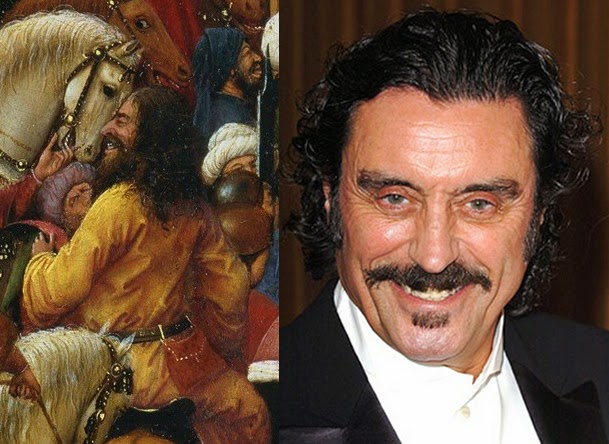

3/14 I used the Pacino images first and never got around to replacing them.

3/30/2020 It didn't register at the time but the discussion at CT misses obvious points. That I missed them too doesn't mean they weren't obvious: the relation to autism (now part of the literature) and the seeming irrelevance of utilitarianism, trolley problems etc. But the descriptions including the authors' are muddled.  From the abstract: "When we judge an action as morally right or wrong, we rely on our capacity to infer the actor’s mental states (e.g., beliefs, intentions)." Mandle: ...they have identified a part of the brain that is important in attributing mental states to others."
But the actors' intentions were stated flat out in the experiment. There's no room for inference. The result of the experiment is to render intention less relevant as a category.
The discussion of law is just as simplistic. People who are deemed "liable" are judged guilty.
Everything above is storytelling.

Tuesday, March 30, 2010

note taking [my comments] same post as before
"The problem in UK universities is that the government are putting them under pressure to demonstrate their 'social and economic impact', and this includes the Humanities as well as the Sciences,"

But the humanities have played into that. "Theory" attitudinizes itself as science as much as economics does. Even the fine arts are taught in terms of "theory" and "practice." Follow the language of contemporary design and it's all modeled on the terminology of "research." And recently it's infected the language of foodies. Cooks now conduct research. Outside of popular -and thankfully still vulgar- culture every aspect of taste is now treated in the manner of objective knowledge. And manner is all it is.

The humanities are founded in this: that every 29 years or so someone will write another book on Abraham Lincoln, George III, or Plato. And each book will be different from the last. There was a "Lincoln for the first half of the 20th century" and there will be a Lincoln for the second of of the 22nd, if anyone is alive to write it. People will be writing histories of the important figures of their culture long after the last facts about those people are known, because in each and every case, those histories describe the periods in which they're written. For the humanities the description of things is the description of our relation to them, not the "things themselves" whatever they're supposed to be. The humanities oppose the sciences. That's their job and moral responsibility.

We test ourselves against the world in order to gauge what we are. The most important thing history and literature and the arts give us is a more objective understanding of ourselves. The world is a MacGuffin. We fill it with desire, And we can do it knowingly or not.

There are two kinds of narcissist, the one who spends his life staring in the mirror and the other who's never looked at his reflection even once, and can't even imagine being looked at. For him what he is is normal, even universal. That others might think otherwise is unthinkable or irrational. The telos of science is as absurd as any other but its internal logic makes it seem superior to its enthusiasts. But technological progress is just that, no more. The culture of progress in the humanities gives us this

The culture of moral exceptionalism in the sciences gives us this. See chapter 15. It's unreconstructed racism, straight out of the 19th century.
The only reason it's in the book is the irrationalism of its author and the obeisance of his editors.

The proper study of mankind is man. Perhaps if Weinberg had been better trained he wouldn't have made such basic errors of logic and morality.
I've linked to Weinberg's book enough, but most people don't even know it.

Saturday, March 27, 2010

M. de Palancy, who with his huge carp’s head and goggling eyes moved slowly up and down the stream of festive gatherings, unlocking his great mandibles at every moment as though in search of his orientation, had the air of carrying about upon his person only an accidental and perhaps purely symbolical fragment of the glass wall of his aquarium, a part intended to suggest the whole which recalled to Swann, a fervent admirer of Giotto’s Vices and Virtues at Padua, that Injustice by whose side a leafy bough evokes the idea of the forests that enshroud his secret lair.
the "symbolical fragment" is a monocle.

Thursday, March 25, 2010

Untangling, 1994, cibachrome transparency and light box, 81.5" x 95"

Restoration, 1993 Ilfachrome transparency and light box, 46 7/8" x 16 ft. 7"
[click on the image]
And here. [updated] It's worth zooming around the images in Flash. [the new page includes a link to the archived page]
One of the few living artists whose work has once or twice given me a Stendhal moment. At its best the work is supremely academic, and still alive.

The bottom image: three women, the crossed arms of the two on the right, facing opposite directions and mirroring each other; the contrapposto of the figure on the left; three art restorers, an image of the aftermath of war; three nurses, three graces; cinemascope and The Bourbaki Panorama.


Wednesday, March 24, 2010

Note taking
“genial incompetence.”
And what form of incompetence is Tyler Cowen and the rest of the GM economic department supposed to represent?
No matter what, I think I prefer the Italian variety.

And why do at least two of the academics in the small circle posting their choice of 10 important books put the Bell Curve as a positive influence?

Get off your high horse.

Umberto Echo-Echo
---

I think people should acknowledge that one of the reasons for what you would consider “positive” change is the fading of the old aristocracy and the rise of the aspirant petit bourgeois. In England that meant Thatcher, and in France Sarko. Since the subject of the miners’ strike comes up now and again on this site, it’s worth noting that the old aristocracy had at least a sense of noblesse oblige. Thatcherites had none. But now London is full of millionaire stockbrokers with accents straight from the pub or the coal mine.

Enzensberger argued once that Italy should be something of a model: nothing gets done, nobody starves.
I’m not entirely unsympathetic to that argument.

Clod Levi-Strauss
---

“the rise of the aspirant petit bourgeois.”
I guess I should have written “victory.”

Pierre Bourdieu wrote a silly book called “Distinction,” with arguments that could never be applied to the US and apply less and less to western Europe. The words of old “oiks” describing their childhood relations to the “toffs” in another post and the words of the miners linked to a couple of weeks ago here made the same point. “We are what we are and it’s ok,” but a little more respect would be appreciated.
Those days are done.

I wish people wouldn’t confuse the old conservatism of land and the new conservatism of capital. It gets tiring to hear “economic liberals” refer to Tocqueville as one of their own. As tiring has hearing neoliberals refer to themselves as socialists

Clod Levi-Strauss

Tuesday, March 23, 2010

This begins here
Think of the second graph as built upon the model of historical observation (across time) becoming a model of contemporaneous communication across space: we observe each other acting, communicating only by way of mediating form. The sciences efface both the mediation and the self, imagining a collective consciousness of universal knowledge.

Monday, March 22, 2010

The absurd American dislike of partisanship is mirrored by the equally absurd desire for absolutes. Witness the popularity of the slogan: "Health care is a right." Health care is a good, but not every good is a right.

Liberals like to think their goals are justified by logic and "objective" reason before preference. Universal truths are timeless: they don't evolve. So whatever liberals are defending at any given time, whether health care or welfare reform, Zionism or the rights of Palestinians, tax cuts or the Great Society, anyone who opposes them is assumed to be acting on impulse or making arguments founded on irrationalism. 20 years ago it was Reagan and the Palestinians, and even today the assumption regarding the latter holds for many. Facts be damned. But all agree that the Republicans are nuts.

Conservatives opposed to health care mythologize work as pain and relief from pain only as earned. This is conservative principle and it's ridiculous to argue that opposition to various proposals and to abortion for example is based on anything else. There's a question whether or not this principle is something conservatives are or have ever been capable of upholding, and the answer by and large but not entirely is no. But conservatives see life as lived according to principles only alongside the inevitability of failure, with punishment and a concomitant shame. There's plenty of room for hypocrisy in that but there's hypocrisy as well in Duncan Black's downplaying the problems of urban gentrification while not acknowledging that the masters of the "hellhole" -as he affectionately calls the city I was born in- made room for him and those like him by forcing out the previous residents of the place he calls "his" neighborhood. Atrios got his home the old fashioned way: slum clearance.

If liberals have principles so do conservatives, ditto for the failure to live up to them. But liberals have enlightened reason on their side so there's no need for punishment. They have their idealism and the best intentions.
What a stupid fucking country.
---
A year ago passage of some sort of health care reform seemed inevitable, and not a tremendous challenge. Only a year of dithering and bipartisaning and gangs of wankers and pre-compromising and, frankly, failure to put forward something simple and popular jeopardized it.
Duncan Black is an asshole, but assholes can be right. The Democrats won the election and have played defense ever since. Another example of conditioned response winning out over rational action. Josh Marshall is right to call it the "bitch slap" theory of politics.
The past isn't dead. It isn't even past.

Saturday, March 20, 2010

Mash-ups again.
I made another comment after I the realized the obvious: mash-up culture as a culture of reference is pastiche culture, with all that word implies. [and then I discover the Yglesias actually uses the term] Pastiche is to collage as illustration is to art: dependent on its references for strength; like bragging about who your parents are rather than boasting about who you are as their son, or daughter. The distinction is subtle but important.
Rationalists/Conceptualists do not understand performance.

"No idea's original/ There's nothin' new under the sun/ It's never what you do/ But how it's done."

In a passage from one of the Five Lectures on Psychoanalysis Freud says that as the result of a successful treatment repression is replaced by 'a condemning judgment'. He doesn't explain the difference between the two. What's the difference between "I don't want to kill my father and sleep with my mother" and "I don't want to kill my father and sleep with my mother."
That's a decision for the audience to make.

Friday, March 19, 2010

Thursday, March 18, 2010


I posted both years ago. They bring back memories.
note taking/posted elsewhere. Teaching the Young
A previous commenter had linked and quoted Le Guin
“But art is not essentially content. Art is essentially form. Art is object, not subject.”

So Ursula Le Guin, [archive.org] a fantasy author, of all people, is the first to say the obvious: that culture is form production, not content production. Form embodies meanings; it does not merely carry them, and it rarely embodies what you want it to.

But of course the reason geek and technocrat intellectuals read SF, and the reason they read Rawls, is that it’s all about ideas, so therefore about their own wish fulfillment; like earnest cafe revolutionaries whose fantasies have no relation to a reality other than their own.

Mash-ups are collage and collage is form. But don’t pretend a mash-up has much to do with the originals. The history of collage is the history of art made from crap. The new history of mash-ups in most cases is the history of crap made from art: crap made by idiots piggybacking on someone else’s work.

Picasso wasn’t the most articulate schmuck but he said one thing that was on the mark: “Bad artists borrow, good artists steal.” If you do a mash-up like you own it, then everything in it is raw material. If you make it just as reference, it’s like saying “Hey everybody I just wrote a paper about Nietzsche! Cool huh!?”

Works of art are made to be read against the grain. Subtext is the point because the maker’s focus is on form. Even a Holocaust novelist is a novelist first, not a “Holocaust person.” That’s why badly written Holocaust novels like badly written love letters rarely get the point across. Mash-ups are the culture of citation as a claim to authority. Why does it remind me of academia?
I'll add that mash-ups are popular with "intellectuals" who prefer an art of intention [illustration] and for whom an art of form is considered light entertainment rather than the most intimate record of ourselves that we will leave behind.

Who Sampled.
Arthur Baker and Afrika Bambaataa took what they found and made it theirs. It wasn't footnotes for prestige.
---

Adding more from Le Guin. She gets sloppy later in the piece but what's below is good, and obvious to writers and readers of fiction as a whole.  Turn some of the words around and you can reconcile her arguments with mine. What she calls theft, I call borrowing, but they mean the same thing in this case.

Readers of fantasy and speculative fiction may be fans of illustration, but good illustrators still know something about art. It's sad that you can't even trust anthropologists to understand this anymore.
Information is essentally content. Content does not, or should not, belong to anybody. It may take Einstein to think it up in the first place, this little equation, this bit of information, but once he’s published it, once you’ve learned it, it’s yours. And you can do whatever you like with it. No question about that.

This lack of ownership is of course anathema to capitalism. The corporations would like to keep all their scientific and techological information secret forever. An individual’s right to profit from discovery of information is more defensible; a chemical formula for making a useful or salable substance, for instance, is information of immediate money value, and it doesn’t seem unfair for it to be kept secret for a while so the originator can profit from it. Inventors can patent an invention (on the same principle as copyright). But information in the sense of knowledge rightly belongs to anyone who will learn it. You cannot patent the knowledge of how to perform a mastectomy. You cannot copyright a mathematical equation.

If you suppress information so that only you can profit from it, it’s very likely to get away from you. And it’s extremely difficult to keep information secret. As all governments know, the more you classify, the greater the leakage. As a general rule, the best thing to do with information is release it, set it free. It is in this sense that information really does want to be free.

Content flourishes when it is allowed to be common knowledge, or at least available knowledge.

But art is not essentially content. Art is essentially form. Art is object, not subject.

You learn a subject. Surgery, or math. History, or philosophy.

You don’t learn an object.

You can study it, sure. You can observe an object, you can look at it, listen to it, read it. You can learn how it was made. You can buy it, or ask permission to borrow it or use it or copy it. You can steal it.

And these days, if the art object is an object made of words — a poem, a novel — and you want to steal it, you refer to it as “information.”

And that’s supposed to legitimise the thievery. To glamorise it, even. To postmodernise it. To make it authentic…

Monday, March 15, 2010

Interesting

From Lobelog
---

Helena Cobban: More on Patreus
"Salaries soar for heads of British universities More than 80 university heads, generally known as vice-chancellors, now earn more than the prime minister"

From the past: comments removed
A history of the modern academy would show that the fixation on money began in the 70’s first with the astronomical rise in salaries of administrators and the concomitant shrinking of the salaries of faculty. It became a scandal decades ago. [link*] Then the faculty caught on. The contemporary culture of academia, of professional intellectuals, is one of a neoliberal individualism (as others have said: traceable to the 60's). That some are paid $150,000 or more to preach against neoliberalism is irrelevant.
A response to Anthony Grafton [published then removed by the administrator]
Grafton refers twice in the first paragraphs to "humanists", opposing them to "bureaucrats, and 'managers'" as if the latter were not members of the professorate, but over the past 40 years the bureaucratic ethos has come to dominate the academy in the classroom as well. The academic study of bureaucracy in economics and political science has become in the age of Sputnik and mass man, the celebration of it - outside the academy there's a more appropriately ironic take. The humanities now are thought of wishfully as demi-sciences, and literature and history as forms of interpersonal communication have become instead the study of stories as inanimate objects.

The arts and humanities are thriving in the outside world as they're dying in the academy because the academy has ceased to defend them on their own terms. Humanism is said by philosophy professors to have its beginnings in Descartes and the Age of Reason, and that's simply not true, as any scholar should know. It's Descartes who said "History is like foreign travel. It broadens the mind, but it does not deepen it." That's not the beginning of humanism, that's the end of it.

The humanities out of delusion or desperation have tried to piggyback on the sciences and failed. Universities have become technical schools and a lot of what is taught is the "techincal" mastery of hot air, packaged like collateralized debt. Economics is not science. "Technical" philosophy like "technical" Marxism are creatures of a bureaucratic age, "Naturalized" epistemology is founded on analogy. The humanist academy has become a bubble economy and the true technical academies shrug.

No, scholars do not "innovate" they observe the history and effects of technical innovation and remind us, even when almost no one wants to listen, that not much has changed.
That last line sounds too much like an argument from passivity. I live my life in the unending hope that someday everyone will grow the fuck up.

*During his tenure Liacouras became the highest paid university administrator in the US.

Sunday, March 14, 2010

Mark Perry in Foreign Policy
"The Petraeus briefing: Biden’s embarrassment is not the whole story"
On Jan. 16, two days after a killer earthquake hit Haiti, a team of senior military officers from the U.S. Central Command (responsible for overseeing American security interests in the Middle East), arrived at the Pentagon to brief Joint Chiefs of Staff Chairman Adm. Michael Mullen on the Israeli-Palestinian conflict. The team had been dispatched by CENTCOM commander Gen. David Petraeus to underline his growing worries at the lack of progress in resolving the issue. The 33-slide, 45-minute PowerPoint briefing stunned Mullen. The briefers reported that there was a growing perception among Arab leaders that the U.S. was incapable of standing up to Israel, that CENTCOM's mostly Arab constituency was losing faith in American promises, that Israeli intransigence on the Israeli-Palestinian conflict was jeopardizing U.S. standing in the region, and that Mitchell himself was (as a senior Pentagon officer later bluntly described it) "too old, too slow ... and too late."
Read the rest. It's gets interesting.
To whom it may concern etc.
"Countering the prosecution in court at Saint-Étienne, Crozet, a.k.a. Aramis, presumed prolific thief, met all questions with silence"

Saturday, March 13, 2010

"They Fucked The Whole Thing Up"
Atrios (Ph.D, Brown University, 1999) links to Chris Hayes, (BA, Brown, 2001): "The Twilight of the Elites"

Atrios' new neighborhood:
"Despite the positive results of the initiative’s efforts, it ultimately led to significant community displacement. The former residents of the MLK towers were dispersed during the construction. In addition, the amount of residential space was reduced after the redevelopment, and the vast majority of former residents could not afford to move into and sustain a living in the new MLK complex. This has ultimately changed the demographic of the neighborhood; prior to the government intervention and development provided by Hope VI, the neighborhood was predominantly African American, however, since federal intervention the community is 67% White, 12% Black, 15% Asian, and 6% Latino."
It's true elite culture is becoming more democratic: it's becoming more vulgar while the popular is becoming more sophisticated (Atrios and Hayes are exemplars of both). But if leadership is becoming more diffuse the higher levels are also becoming much more secretive.

Jack Balkin on The National Surveillance State [and here]
Most people know the names Microsoft, Bill Gates, and Google but far fewer have ever heard of Sergey Brin. That diffuseness of representation is I think one of the reasons for Google's popularity as an institution even among those who should know better. It's true that unlike Microsoft they're good at what they do but it's not just that. In the long run Google will have to be nationalized [literally: internationalized] but that won't happen for awhile. Siva Vaidhyanathan

This country's academic and political elite are probably unique in their lack of intellectualism. Or rather unique in their having replaced intellectualism with a love of "ideas."

Friday, March 12, 2010

A movie about a man who faces questions of moral responsibility.
A movie about a man who doesn't.

Thursday, March 11, 2010

George Monbiot has been good if too theatrical (as usual) on "Climategate".
Considering his arguments you might think the various writers at Scienceblogs would say more; but since he agrees with them on questions of science they ignore his questions regarding the behavior of scientists.