Friday, June 07, 2013

PRISM
by KIERAN HEALY on JUNE 6, 2013
Bureaucratic administration means fundamentally domination through knowledge. … This consists on the one hand of technical knowledge, which, by itself, is sufficient to ensure it a position of extraordinary power. But in addition to this, bureaucratic organizations, or the holders of power who make use of them, have the tendency to increase their power still further by the knowledge growing out of experience in the service. For they acquire through the conduct of office a special knowledge of facts and have available a store of documentary material peculiar to themselves. While not particular to bureaucratic organizations, the concept of “official secrets” is certainly typical of them. It stands in relation to technical knowledge in somewhat the same position as commercial secrets do to technological training. It is the product of the striving for power.
Dan Nexon 06.07.13 at 2:45 am
Weber. 
seth edenbaum 06.07.13 at 4:00 am
Your comment is awaiting moderation. 
Dan Nexon: “Weber.”
"They then chuckle together in a self-congratulatory academic manner"

Take it away, commenter “Marfrks”
http://crookedtimber.org/2010/04/01/greenwald-v-kerr/comment-page-6/#comment-309996

“I have been a lawyer for many years, and then got a chance to teach at a non-lawyerly academic institution. I loved it; I loved playing in the garden of the mind. Eventually, however, it became clear to me that academics and non-academics have very different approaches to ideas. Academics, though it sounds odd to say it, don’t take ideas seriously. For academics, ideas are games,”

All the above without a single mention of US foreign policy, no more anti-democratic now than before. You can’t support freedom at home while opposing it abroad, especially not in the age on electronic communication.
Healy responds to events with in-jokes and glib affectations of superiority; Nexon seconds, closing the circle. "They then chuckle..": Farrell's sardonic take on McGinn. The creepiness is the same. The only difference is the sex.

repeats: Healy, Nexon, McGinn. Rationalists rationalize; superiority to politics is anti-politics, laziness, decadence.  Marfrks like Greenwald is an advocate. If you're paid to be biased you understand what it is and how it creeps in. Objectivity does not exist; self-awareness cannot be naturalized.
Old discussion of Farrell, Greenwald, and Kerr, here and here.
---

McGinn contra Judt.
And I'd forgotten about Bertram
QS 06.03.12 at 9:58 am
You’ve turned sexual harassment into an intellectual game, that is where the “creepiness” originates. How do you moderate that? You don’t. You realize that your ability to treat the issue so dispassionately, playing the game of Find the Universal, probably has something to do with your maleness and position outside this particular terrain.

Sexual harassment was banned not because we found the Universal Principle Against Harassment but because women and men who believed it to be wrong fought successfully for prohibition. These people were likely motivated by a variety of ideas and experiences. The way we keep the libertarians marginalized is not by abstract philosophical games but by appealing to this concrete history.

Chris Bertram 06.03.12 at 10:06 am
QS: your latest tells me that you see political philosophy as it is usually practised as involving a profound mistake. You are entitled to that opinion. It is not one that I share.
It's all there. Idiots.

Thursday, June 06, 2013

Any state has to allow for the distinction between insiders and outsiders, which is why arguments that "no one is illegal" are more romance than viable policy.  But democracies and republics are built on laws that descend from principles of universal civil and political rights, and if the divide between citizen and foreigner becomes too broad, if foreign and domestic policy are not just separate but contradictory, there's no way for one not to affect the other. You cannot support freedom at home while opposing it abroad; the inconsistency itself is a recipe for disaster.  The right and the left both understand this. Liberals don't.

The sudden howls of indignation are pathetic.

Wednesday, June 05, 2013


Niamh Hardiman at CT
Who will bring about political reform, and what are the political incentives for doing it? The question comes from an earlier post. Is there a road-map for exiting from a sub-optimal equilibrium in the way political institutions function? I don’t know the answer. 
In Ireland, parties in opposition seem to agree that the lack of accountability of the executive to parliament is a problem. But why would they voluntarily cede the advantages of executive autonomy when in power themselves?
If you build your logic around the lowest common denominator it becomes hard to imagine anything higher. To say that politicians "should" value something more than their own short term interests is to no longer make arguments that can be defined as "value free". Republicans see their duty to the party now as more important than their duty to the state. Yet it's difficult for liberals to criticism them specifically for that because demanding more is accepted tacitly if not openly as unreasonable.

I've read the same arguments for years about presidential power. It's seen as illogical to think that Obama should choose to cede power back to congress. Naturalism of this sort leads to moral passivity.

obvious. repeats. etc.
A couple of days old
The military is an extremely important actor in Turkish politics. Traditionally, there has been a faustian pact between Turkish society and its armed forces to ensure the government could not endanger Turkey’s sacrosanct secularism. But over the past decade, the military has been unprecedentedly co-opted into supporting the AKP party. A series of high-profile sackings of generals set the stage for a neutered military leadership, despite the fact that many below top level may feel differently.

Over the course of the past day though, they have been quietly supporting the protesters. They have refused to cooperate with Police requests to use military zones for transportation. At a military hospital in Istanbul they refused to treat police officers, instead handing out gas masks to dissidents. As this exchange between a policeman and soldier attests, relations between the two armed groups are indeed frosty at present. Part of the dialogue translates as:  
Policeman: “Next time we should also throw gas bombs here [a military zone].”
Soldier: “If you do it, we will find something to throw to you as well, rest assured.”
From Arabist

Erdogan's won every election.

Tuesday, June 04, 2013

Atrios
Repetition
What Daniel Hallin (via Jay Rosen) called the Sphere of Legitimate Controversy seems to be changing. Since Serious People don't acknowledge dirty hippies, it's hard to know whether we've had anything to do with that.
yes, repetition.

Atrios again
Merit  
Ezra picks some highlights of a speech by Helicopter Ben to Princeton graduates. 
The concept of success leads me to consider so-called meritocracies and their implications. We have been taught that meritocratic institutions and societies are fair. Putting aside the reality that no system, including our own, is really entirely meritocratic, meritocracies may be fairer and more efficient than some alternatives. But fair in an absolute sense? Think about it. A meritocracy is a system in which the people who are the luckiest in their health and genetic endowment; luckiest in terms of family support, encouragement, and, probably, income; luckiest in their educational and career opportunities; and luckiest in so many other ways difficult to enumerate–these are the folks who reap the largest rewards.
As if Duncan Black or Ezra Klein would have defended that argument 12 years ago.

And Bertram likes Robert Hughes.
"So what Brasilia became in less than 20 years wasn't the city of tomorrow at all. It was yesterday's science fiction. Nothing dates faster than people's fantasies about the future.
This is what you get when perfectly decent, intelligent and talented men start thinking in terms of space, rather than place, and about single, rather than multiple meanings."
Always the anger of the committed, even as the commitment changes.
Consistently unaware of what and where they were in the past; unable to understand themselves, or change.

Sunday, June 02, 2013

An article in the Times on changing museum policies and downloading.
The Rijksmuseum
“We’re a public institution, and so the art and objects we have are, in a way, everyone’s property,” Mr. Dibbits said in an interview. “With the Internet, it’s so difficult to control your copyright or use of images that we decided we’d rather people use a very good high-resolution image of the ‘Milkmaid’ from the Rijksmuseum rather than using a very bad reproduction,” he said, referring to that Vermeer painting from around 1660.
It's not mentioned in the article, but the Met now allows downloads, not high quality but enough for the web. The original file of the Hals I posted recently is 3.1mb.
When you go to the page for a painting, click on "full screen" and a download link appears on the lower right.
Aaron Swartz was too good for this world
"Aaron wasn't built for a world of red lines and strict rules," Wikler says. "He moved in and out of institutions, he didn't fit into boxes and that was OK be cause he was also obsessed with never hurting anyone. He was monk-like. And the prosecution, all the way through, showed no hint of remorse or recognition of what might have been wrong, even in his death. There's just something wrong with a system where people have power to do that to someone like Aaron."

There is a particular tragedy, too, in realising that Aaron Swartz was one of the few people equipped with the skills and idealism to want to change that system for the better. In the end, says Stinebrickner-Kauffman, there is no explanation that could possibly make sense of his suicide. "He just… " she breaks off, searching for the right words. "It was just too hard." She crosses her arms loosely on the table. The sentence floats between us. It seems like the only thing there is left to say.
"I took the children with me, for they are too good for the life that would follow, and a merciful God will understand me when I will give them the salvation ... The children are wonderful ... there never is a word of complaint nor crying. The impacts are shaking the bunker. The elder kids cover the younger ones, their presence is a blessing and they are making the Führer smile once in a while. May God help that I have the strength to perform the last and hardest. We only have one goal left: loyalty to the Führer even in death. Harald, my dear son — I want to give you what I learned in life: be loyal! Loyal to yourself, loyal to the people and loyal to your country ... Be proud of us and try to keep us in dear memory …"
Since his death, his family and closest friends have tried to hone his story into a message, in order to direct the public sadness and anger aroused by his suicide to political purposes. They have done this because it is what he would have wanted, and because it is a way to extract some good from the event. They tell people that the experience of being prosecuted is annihilatingly brutal, and that prosecutors can pursue with terrible weapons defendants who have caused little harm. One of the corollaries of this message is that Swartz did not kill himself; he was murdered by the government. But this claim is for public consumption, and the people closest to him do not really believe it. They believe that he would not have killed himself without the prosecutors, but they feel that there is something missing from this account—some further fact, a key, that will make sense of what he did.

Despite his public presence, he was small and frail and shy and often sick, and people wanted to protect him. He was loved intensely, as a child is loved.
An indulged and indulgent narcissist.

"Aaron Swartz was one of the few people equipped with the skills and idealism to want to change that system for the better." Bullshit.

Rick Perlstein on Aaron Swartz:
I remember a creature who seemed at first almost to be made up of pure data, disembodied—a millionaire, I had to have guessed, given his early success building a company sold to Condé Nast, but one who seemed to live on other people’s couches. (Am I misremembering that someone told me he crashed in his apartment for a while, curling up to sleep under a sink?)
Only slowly, it seems, did he come to learn that he possessed a body.
earlier here

Wednesday, May 29, 2013

posted (by me) in comments elsewhere. mostly repeats.
Old conservatives went from "is" to an acceptance of a world of indulgence laced with shame. Modern liberals, following science, go from "is" to passive acceptance, laced with guilt (you're right about that).

Neoliberals, as modern liberals, lose the guilt.
Brad DeLong: "For those humans who live in the city and are not really rich, rubber tomatoes provide a welcome and tasty and affordable simulacrum of the tomato-eating experience."
After hurricane Katrina Tyler Cowen proposed letting swaths of New Orleans rebuilt as shantytowns, to foster a cultural rebirth, on the model of the corrupt and violent but vibrant New Orleans of 100 years ago. As another example he cited Kingston Jamaica, and the birth of Reggae. Interestingly enough he didn't mention the South Bronx and Hip Hop.  There's no accounting for taste.

Robert Reich goes from "is" to "ought".
Tony Judt argues against nature.

The woman who talked down killer last week in London was asked why she approached him. Her response was immediate and regarding the question itself, incredulous. "Better me than a child".
The woman has a strong and ingrained sense of moral responsibility. If she'd been more objective and less knee-jerk she might have realized that over the course of her career she would be able to instill that sense of responsibility in perhaps as much as 20% of her students, but that the odds of any children in the vicinity of the killer growing up to become like her meant that it would be better for society in the long run if she did not get involved.  But science lost out to morality. Reflex trumped reason.

"Scientific" and "disinterested" reason has shown that disinterested reason is in fact impossible in any engagements with the world.  That's your point, right?  We search for laws to govern our inevitably shallow self-interested behavior. And in our passivity we become even shallower. Delong attacks Alex Cockburn and William Safire in extremes of high dudgeon, but eulogizes Jeanne Kirkpatrick, closer to a war criminal than either of the others, as an old family friend.  Power corrupts. He can't even conceive of himself as a jackass.

"To the pure, all things are pure." From science to Saint Paul, from arrogance to stupidity. Technocracy expands and democracy fades.
"Reflex trumped reason" even if reason would defend the actions themselves as ideal.
"Tony Judt argues against nature." I shouldn't have to telegraph the irony.
Liberal idealism ends in perversity.

Sunday, May 26, 2013

Bring on the Thirty Years War

AA
There is no mystery at all about the triggers to the clashes of Tripoli.  You can even tell by two factors: 1) the clashes ALWAYS occur when the Salafites of Tripoli are upset over one reason or another (and this week they were upset upon the news of the offensive against Qusayr).  2) `Alawites in Tripoli are a mere 5% of the population and they are surrounded from all sides, and it is just impossible that they would instigate a fight, especially that they have been evicted from Tripoli and their businesses all stolen and set on fire.  But Anne Barnard does not note any of that:
"Maj. Gen. Ashraf Rifi, a retired senior security official from Tripoli, said Hezbollah, through Mr. Eid, started the fight to keep Sunnis from flocking to Qusayr after it realized its hope of taking the city in 24 hours was “delusional.
She did not say the rest of the talk of Mr. Rifi, and did not say that he is a functionary of Hariri who started his career as a bodyguard for Rafiq Hariri, and who sits on the board of the Prince Nayif University for Security Studies.  She made him sound like a neutral observer.  She said that both sides in Tripoli blame the other, but only offered one side's account, without even mentioning that he represents one side.  Of course, the dominant view in Lebanon is that when the news of the offensive reached Tripoli, the Salafite thugs there started doing what they always do when they are angry: they started shelling Jabal Muhsin.  Even the official Hariri mouthpiece website reported that Tripoli was shelling Jabal Muhsin (see citation below). And the theory of Rifi is dumb: as if Tripoli is the only place that supplies Salafite fighters for Syrian armed movement.
"استمرار الاشتباكات والقذائف الصاروخية من باب التبانة باتجاه جبل محسن"
The US is backing Saudi Arabia and Al Qaeda against Syria, Iran, and Hezbollah, Sunni against Shia, supporting a reactionary monarchy where minorities face harsh discrimination and Christians and Jews are not allowed to live, and once again backing fundamentalist militias, and terrorists, who view all non-adherents to their beliefs with disgust. We're supporting both against a secular dictatorship, and one we've worked with in the past, which is centered in a minority community but broadens its support by guaranteeing the safety of other minorities. This dictatorship is allied to a country governed as a Shia "guided democracy" where minorities, including Christians and Jews, are discriminated against but safe in their homes, a government that was formed following the overthrow of a ruler installed by the US, which had overthrown in turn a secular democracy.  Both these states are allied to a Shia militia and political party from a third country with long-standing allegiances across sectarian lines.  Our actions are made in defense of "US interests" and those of our closest ally in the region, a Jewish sectarian state founded 65 years ago by immigrant refugees, scarred survivors of a European holocaust, on land captured after the expulsion of three quarters of a million people from their homes, an act which created a new group of refugees whose descendants live in nearby countries, including those listed above, many still in refugee camps, while almost 6 million more are under either direct or indirect rule of the new state built on their land.

We're backing the Spanish monarchy and the Inquisition against Calvinism and Lutheranism, on the belief that it's good for America and good for the Jews. A multi-ethnic democracy is defending its greatest enemies in defense of the prerogatives it claims for itself.

An old post from Syria Comment on the Jews of Syria.

The extra effort above because someone, somewhere, mentioned Harry fucking Frankfurt.

Saturday, May 25, 2013

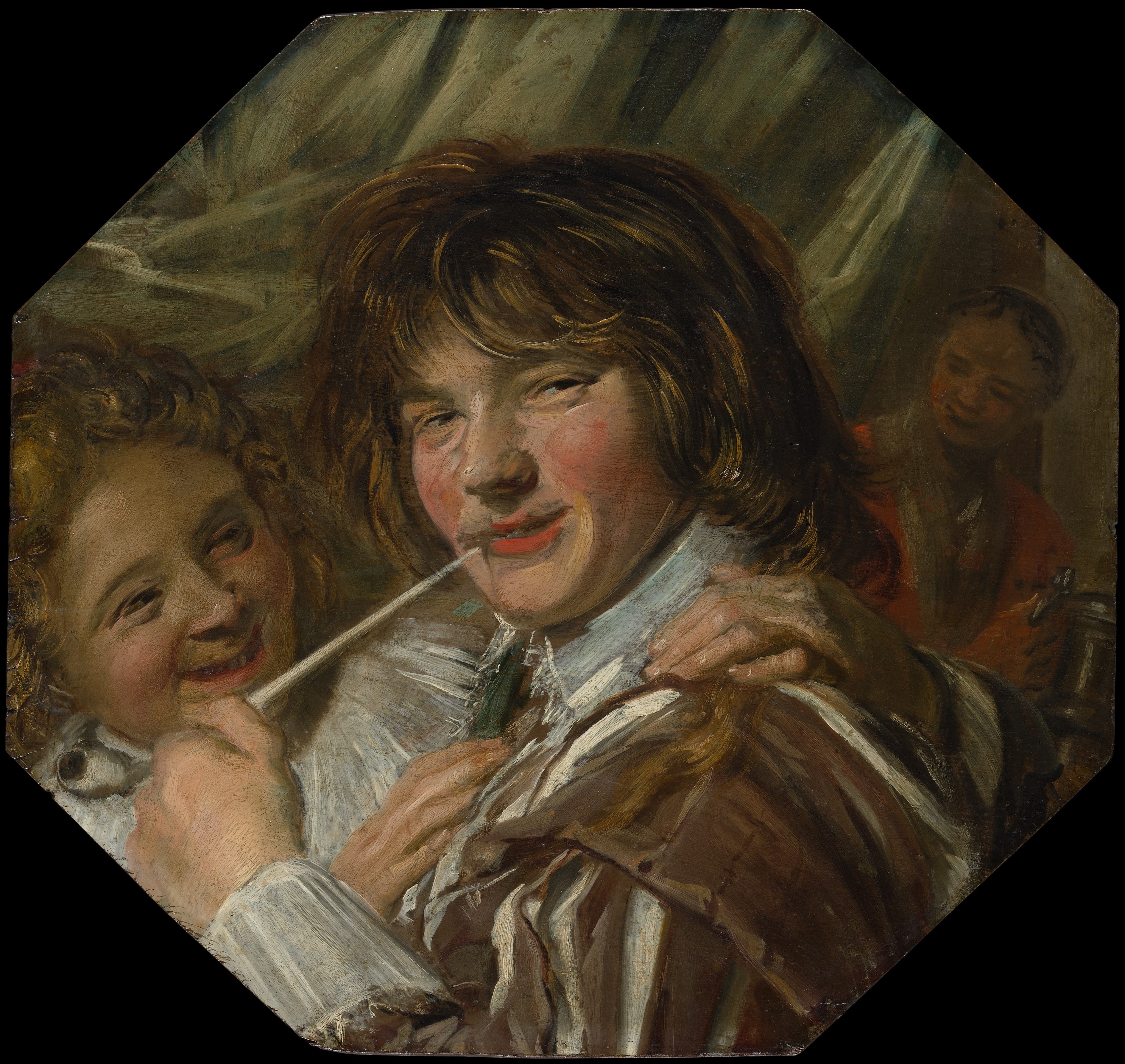
Frans Hals, No Worries, ca.1623-25, Metropolitan Museum,  NY
see previous
Started from the bottom now we here


Jews III
II, and  I

Friday, May 24, 2013


What is the role of science in a democracy? Leaving aside arguments over the fact/value distinction, the choice between cancer research and astronomy is a choice based on preference, and preference is value. But the research imperative ends in Stalinism; so what's to do?

The woman interviewed in the first video responded reflexively, unthinkingly, to a situation. It's safe to assume the values behind her choice were instilled in childhood.  The two men in the second video are, respectively, an empiricist, comedian, trickster, con-man, and a rationalist, rube and fool.

Greenwald is good.

Tuesday, May 21, 2013

note taking my comments elsewhere.
"a class of people who are better than the rest of us, on whom we depend for our salvation and prosperity"

That sentence is a hoot. We're left to choose between the elitism of the rich or of economists and technocrats. Philosophy professors refer to "the folk". Somehow I doubt James Kwak and Mark Thoma would consider themselves folk. And DeLong?

It drives me nuts that our technocratic elite, with their fixation on ideas are so willfully ignorant of their own complexities, simply as people.

Logicians and moralists divide the world in twos, but the law of non-contradiction doesn't apply to books any more than people.  Nietzsche connects to fascism; a lot of people did and do. The problem he faced as we do is how to come to terms with the modern desires for "equality" and "liberty".  Hayek and Rand are secondary and minor figures facing the same questions.

The old aristocracy and the intellectuals around it were both anti-bourgeois and anti-capitalist, and in their contempt for mediocrity in bourgeois culture they had a point, which is why so much of the cultural left over the past 200 years has been intellectually aristocratic.  Foucault learned from the Surrealists and Symbolists, Baudelaire, Stendhal and Tocqueville.  The flaneur is aristocratic observer. Technocracy qua technocracy, in service to itself, gets us this:
"Italian rules allowing candy makers to label their products as “pure chocolate” breach European Union law, the region’s highest court said.
Permitting chocolate made from pure cocoa butter to be called “cioccolato puro,” or “pure chocolate,” clashes with EU-wide measures which allow chocolate laced with vegetable fats to be marketed as chocolate, the tribunal in Luxembourg said."
That's not an important example but it's part for whole.
A focus on the mean puts downward pressure on the mean.

Robin mocks [links below]: “The ancients sought virtue, a life of excellence lived in and through the polis; the moderns (Machiavelli, Descartes, Bacon, Hobbes, and Locke) perpetrate ‘a lowering of aims.’ ”

If everyone is equal then its just a small shift to say we can refer only to averages: the average man becomes the benchmark for analysis by the new elite. And there is a new elite. What do you think it means every time Krugman says "it's a bit technical". Equality? No.  And of course experts can make stupid mistakes, and who's the first to get hurt? Any engineer can lecture you on efficiency, redundancy and stability, but somehow efficiency makes economics take on the character of a morality play. If I were less of a determinist I'd be shocked.

An exchange with Chris Bertram:
SE: "Arguments for the nobility of greed are a recent development."Bertram: "If, by “recent” you mean 1705, you may be right."
I wasn't raised to think of greed as noble. Yet somehow in the minds of technocratic liberals, facts became ideals, and actions became secondary, so we get elitists preaching equality, meaning the equivalence of everyone in the majority to each other, while taking their own superiority for granted. Technocracy is not democracy.

Democracy is founded on obligations before freedoms.  Libertarians are finally open in their dislike for democracy; maybe it's time defenders of democracy should develop a healthy skepticism regarding freedom defined as individualism. Freedom of speech serves the health of the polis.  And maybe compulsory education should extend over the course of a life.

If you pay attention to the culture that produced you, you'll understand your contradictions. If you think you're not contradictory, you're wrong. Too many liberals think saying "I'm a nice guy" makes it so. And of course, if I am what I say I am, others are what I say they are too.  According to Cory Robin, Nietzsche and Burke are bad guys.  Robin's arguments are based in simplistic assumptions about history, historical figures, and himself. His writing is shallow and obvious.  His primary politics is self-promotion.

US mythology includes puritans and drunks, Carry Nation and John Wayne; individualized self-righteousness is the only universal. Scandinavian mythology includes Janteloven. Social democracy wasn't the product of an idea; the ideas were the product of a culture.  If you want to debate social democracy, as I've it would make sense to read Henning Mankell before John Rawls, and read for contradictions and questions not ideas.
---

Responding to two comments:

1-"The wealthy are not better than the rest of us. The 1% have taken the opportunity of the past 40 years and managed all the gains in production…"

The US has 4.5% of the population of the planet. Think, just for a minute.

2-"I'm not particularly a Hayek fan, but bald statements like this are pitiful.
'Hayek cared about liberty for ultimately elitist reasons: liberty is not an end in itself, but a condition that enables the select few to make the world a better place'
How about a citation that doesn't require starting with an assumption of corrupt motives?"

Technocrats left and right refer to the need to foster "progress" and "innovation". What percentage of the population does that directly refer to? The majority are supposed to benefit from these policies only because as employees they've been given jobs. Pundits demand increased funding for education in science and technology for a new generation of leaders not for teaching all 5th graders, brilliant or not, the foundations of the Bill of Rights. A popular econ blogger (or at least one with a PhD in economics) says: 
"I'm not sure why people are surprised and even upset that some teenagers don't know who the hell bin Laden is." 
I won't even ask if they know anything about the Vietnam war, or any one before it.
But I'm sure his friends kids know something. They're the educated elite.

Another blogger, an academic whom I doubt any of you would read says:
"Yesterday, I asked 130 students in my American Government class: who has never ever heard of a country called Lebanon? Some 40 students raised their hands."
Leave it to someone born in another country to make the point a native born American would not. It's safe to say I won't be able to talk to most of you about economics for the same reason I won't be able to talk to you about foreign policy. One is no more or less based on science than the other.

The American Dream has done more damage to the world than born again Christianity, but American liberals defend one while being horrified by the other, as if they had no relation.

"They have the power. Look around and see what they have done with it."
Yes we do. And power corrupts.
---

Read the Krugman link above. It's not just wrong it's stupid. Krugman is fond of saying the economics is not a morality play, but the his defense of free trade is founded on cheap moralism.

Dean Baker complains that proposals to eliminate SS income for billionaires would be unfair. That's an argument from normative American morality, not logic.

The debate on blogs like this one is part of a debate among the elite in and out of power.
DeLong:
"R.I.P. JEANE J. KIRKPATRICK
Let me express my condolences to her two surviving sons John Evron and Stuart Alan Kirkpatrick, whom she loved beyond all measure.
She was a good friend to my grandfather Earl. She was an American and a world patriot: her counsel--even at its most boneheaded--was always devoted to advancing the security of the United States and the cause of liberty and prosperity around the world."
"Efrain Rios Montt." The three words you need to know this week.

Dani Rodrik's defense of his father in law, a Turkish General.
"The military has long set the ground rules of Turkish politics. Its hard line defending secularism has resulted in frequent clashes with political movements it views as "soft" on Islam, such as the Justice and Development Party (AKP), which has governed the country since November 2002. Periodically, the military has intervened, bringing down governments and, on occasion, establishing periods of military rule, most recently from 1980 to 1983."
Kwak: "Corey Robin's fascinating article on nineteenth-century European culture".
That sentence is bizarre. It's written from the logic of an elite happily unaware of its place as an elite. "Oh, I don't know anything about power, I only deal in numbers and logic".

The logical foundation to any argument by American liberals is that other people are the problem. Just as American individualist liberalism is the product of American culture, "the Scandinavian anomaly" in economics is the product of Scandinavian culture. There is nothing new in Robin's article. What he adds is moralism.

"We hold these truths to be self-evident, that all men are created equal". DeLong doesn't believe that; Krugman doesn't believe that; Rodrik doesn't believe that; I don't believe that; and neither do you. Robin wants to pretend he does, so he needs to describe a Manichean world. He writes for a journal published by graduates of Phillips Exeter and Harvard and named for 18th century revolutionary terrorists. In 200 years another crew will name their journal "Hamas". It's safe to say I won't be able to talk to most of you about economics for the same reason I won't be able to talk to you about foreign policy, because that obvious point, a cheap observation about cheap politics, is lost on you.
"I like to walk about among the beautiful things that adorn the world; but private wealth I should decline, or any sort of personal possessions, because they would take away my liberty." George Santayana
Santayana was not a liberal. I am. But I learn from him as I learn from Burke. I learn from Nietzsche. I learn as much from Robin as I learn from Ayn Rand, or Hayek, or Likudniks and Salafists. I learn about fear and pathology.
---

Libertarianism isn't an idea it's an ideology, extended from ideas most of you share; that why you go over it as much as you do. Hayek is debated in American academia the way Islamic scholars in other countries argue over Sayyid Qutb. The myopia is the same.
In the end, all simply product of the times.

Sunday, May 19, 2013

and forward, and back

For Joseph Massad
a repeat:

Haaretz
Meanwhile on Sunday, Israeli daily Maariv published an interview with Interior Minister Eli Yishai, in which he stated that most of the "Muslims that arrive here do not even believe that this country belongs to us, to the white man."

"I will continue the struggle until the end of my term, with no compramises [sic]," Yishai continued, stating that he would use "all the tools to expel the foreigners, until not one infiltrator remains."
"...the white man." Words of a self-hating Jew.

Massad's piece, now here

Saturday, May 18, 2013

NYT "Rights Group Says It Finds Proof of Torture in Syria"

Monday, May 13, 2013

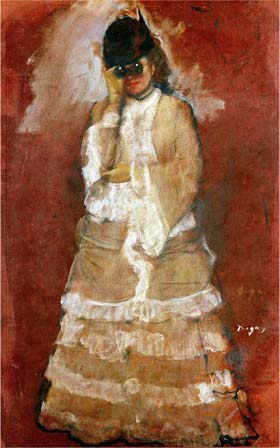
Degas
Young Woman with Field Glasses, 1866-68 (circa), British Museum

Woman with Binoculars, 1875,  Galerie Neue Meister, Dresden

Deux jockeys - Femme à la lorgnette, 1868-70 (circa) Private Collection

Manet at the Races, 1870, Metropolitan Museum

Friday, May 10, 2013

New York Could Be America's First City To Let Non-Citizens Vote

Please. Yes.

Josh Marshall
What New York is proposing isn’t unprecedented. And to the extent that large numbers of people who’ve basically become Americans and are making their life here cannot participate in our politics, I understand some of the motivation. Indeed, this is why keeping the doors open to citizenship is so important. But I don’t really want anything that blurs the lines of the political community we all (those of us who are American citizens) participate in. And to me, this does that.
 "I'm not asking Israel to be Utopian"

International cities should be international, and immigrants to understand America more than Americans do.  But immigrants in NY socialize with each other, across ethnicities, while avoiding Americans.

Wednesday, May 08, 2013

"Hamas" takes on the Palestine question.

"Why now?"
Because almost without anyone noticing, the movement in solidarity with Palestinian rights — with all its solipsisms and ultra-leftist foibles, its quarrels and magnetic attraction for eccentrics, opportunists, and, yes, the occasional antisemite — has grown to become one of the most important, inspiring, and fast-growing social movements in the country.
"Why now?" Because enough people have become involved that now it's safe for the best and brightest young American intellectuals to follow along.  Long live the academic avant-garde, always ready to play catch-up.

More credit to Hawking; he doesn't pretend to lead.
Are all telephone calls recorded and accessible to the US government?
A former FBI counterterrorism agent claims on CNN that this is the case
3D-printable guns are just the start, says Cody Wilson
A self-described child of the internet age, Wilson is an admirer of Julian Assange and Kim Dotcom. "I number myself among them, at least in spirit," he says. "I think the future is openness to the point of the eradication of government. The state shouldn't have a monopoly on violence; governments should live in fear of their citizenry."
There are two options for human society: government of the people and of law, or the rule of the strong. "The eradication of government" guarantees the latter.

Technocracy is not democracy, and the knee-jerk, mirror-image, rebellion against technocracy is not a democratic movement. The decay of technocracy is something else; it produces another social order.


The bow-tied college professor, Jerry Herron, like Borges and his gauchos, idealizes a culture built from necessity. For the whites, including white DJs, in from the suburbs, the music was a discovery, but the men who invented the music have a richer more complex understanding. They were trying to preserve the humane in an inhumane world, using a language they as products of that world understood. There's a connection that runs through Herron to both Borges and Lawrence Lessig, and also Graeber and to Cody Wilson: a fundamental misunderstanding of culture. The knowing irony on all sides that connected Detroit techno and hip-hop to Kraftwerk and hip-hop to the gay clubs in the 70's is lost on followers of simple, otherworldly individualist, liberalism. Culture is conservative: it conserves.

Ideological liberals don't understand culture, seeing it as a choice rather than something constitutive of what they are. But libertarian culture like fascist and Stalinist culture could be called almost an oxymoron.

Tuesday, May 07, 2013

Leiter:

Bayesian epistemology...

...in The Guardian.
It doesn't begin well...
The late Margaret "Tina" Thatcher claimed that "there is no alternative" to economic liberalism, and our own iron Frau Angela Merkel has defended her controversial fiscal policies for Europe with the very same slogan. It is not surprising that politicians use such thought-terminating cliches to push through their agenda, but remarkably the "there is no alternative" argument also plays a vital role in science. 
so it can't end well.
It fails, however, if we are certain that the number of alternative theories is infinite.
The number of alternative policies in England and Germany were/are finite.

Wednesday, May 01, 2013

Spot the disconnect:

Stupid Plan B Rule
Basically anything having to do with teenage girls and sex freaks people out.Whether or not 13-year-old girls should be having sex, plenty of them are. If the drug is safe then it's safe.

What Could Go Wrong
I'm not a parent, but I do know that young children only have a vague understanding of the potential consequences of their actions. Teenagers only have a vague understanding of the potential consequences of their actions. So, you know, don't give them guns.
"I'm not sure why people are surprised and even upset that some teenagers don't know who the hell bin Laden is."

"The kids are alright"
---
more:
Paternalism
It all just boils down to "I must know what my teenage girl is doing." Which I get, and if you have a healthy open relationship with your teenage daughter (good luck!), good for you. But uncle or daddy might also be raping her, or planning to beat the shit out of her for daring to make Jesus cry.
WP: "Obama considers direct aid to Al Qaeda in Syria"
NYT: "Nasrallah annoyed"
Tens of thousands of low-paid workers took to the streets on May Day to demand higher wages, better benefits and improved working conditions a week after a building collapse in Bangladesh became a grim reminder of the dangers of lax safety regulations in poor countries...

Thousands of garment factory workers in Bangladesh also paraded through the streets calling for safeguards to be put in place and for the owner of the collapsed building to be sentenced to death.

In Indonesia, the world's fourth-most populous country, tens of thousands of workers rallied... 
In the Philippines, an estimated 8,000 workers marched in Manila to also demand better pay and regular jobs instead of contractual work...

Some workers rallied outside the U.S. Embassy, torching a wooden painting stamped with the words "low wages" and "union busting" that depicted Philippine President Benigno Aquino III as a lackey of President Barack Obama...

Several thousand people in Hong Kong protested, including dockworkers who have been on strike for a month. They want better working conditions and a pay raise to make up for cuts in previous years.

And an estimated 3,000 people demonstrated in Singapore, where any form of public protest is rare,...

Violent clashes erupted in Turkey when May Day demonstrators tried to break through police barriers to reach Istanbul's main hub, Taksim Square...

More than 10,000 Taiwanese protested a government plan to cut pension payouts...

In Cambodia, more than 5,000 garment workers marched in Phnom Penh,...

The garment industry globally has come under fire since an illegally built eight-story building collapsed last week in Bangladesh, bringing down five garment factories inside it and killing more than 400 people. The collapse followed a garment factory fire there in November when 112 people died. 
A loud procession of workers wound through central Dhaka, waving the national flag and chanting "direct action!" and "death penalty!" while one participant vowed the workers' deaths would not be in vain.

"My brother has died. My sister has died. Their blood will not be valueless."

Monday, April 29, 2013

NEW YORK (AP) — After Officer Pedro Serrano decided to testify in federal court about what he sees as wrongdoing within the New York Police Department, a rat sticker appeared on his locker.
That was the least of his problems.
Serrano claims he’s been harassed, micromanaged and eventually transferred to a different precinct and put on the overnight shift.
“It hasn’t been a picnic,” he said in an interview this week. “They have their methods of dealing with someone like me.”

..."Nothing's changed," the 76-year-old Serpico said in a recent phone interview when asked about the current crop of whistle-blowers. "It's the same old crap — kill the messenger."
Just for fun
But something odd happens when you quit policing. In the following hears you assume nothing has changed.
I really agree with you about Serpico living in the police world of the past.
Nothing's changed. "Cops hate Serpico, because he was a rat"


With Bags of Cash, C.I.A. Seeks Influence in Afghanistan

Sunday, April 28, 2013

"kicking the poors" site: eschatonblog.com
"gentrification" site: etc. ...
"67% white"

American conservatives think of themselves as hardened realists; American liberals think of themselves as nice people.
"I hate explaining this shit"

Friday, April 26, 2013

I've used these two a few times, separately and together.

A couple of years ago I had a drink with a junior architect in the office of Robert A.M. Stern. He said Stern was loading the Bush Library with architectural in-jokes and secret commentary, to be read by future generations. Stern thinks of himself as an intellectual.  His employee thinks he's a pretentious cynic and a hack.
Academic intellectuals and the social model of policing.

NewApps

Religious education, child abuse and responsible parental stewardship

[this is cross-posted at Prosblogion] Richard Dawkins has argued several times (e.g., here) that bringing up your child religiously is a form of child abuse. I think his argument that religious upbringing in general is child abuse has little merit (after all, Dawkins himself is the product of a traditional Anglican upbringing and calls himself - rather proudly - a cultural Anglican, hardly the victim of child abuse). However, his claim in the linked article is that parents who attempt to instill things like Young Earth Creationism (henceforth YEC) in their children are doing something wrong, or are somehow overstepping their role as parents. This question, I believe, is worthy of further attention. 
...But where can we draw the line? Under what circumstances does the transmission of religious beliefs count as a form of child mistreatment, to put it strongly? For clarity of discussion, I do not mean those aspects of religious education that involve, say, denying your child a vaccine or blood transfusion, but I want to focus on the transmission of beliefs alone. An interesting model to consider the moral dimension of parenting is the stewardship model.

Kevin McdonoughHelen (if I may), these issues are discussed fairly extensively in the philosophy of education -- the work of folks like Eamonn Callan, Harry Brighouse, Meira Levinson (and others), is exemplary in this respect.
You might find of interest Bryan Warnick's discussion of the parental right to 'invite' their children to participate in a particular (religious or other) way of life- see his new book "Understanding Student Rights in Schools". I think Warnick's arguments are interesting and also sympatico with what you are proposing above.

Rebecca KuklaI've never actually understood why people don't think it is morally problematic to lie to their kids about things like Santa. First of all it's lying, and we typically think that's wrong ceteris paribus, and second of all it sets them out at the start with a super confused and scientifically impossible ontology (not to mention a deeply creepy ethics in the Santa case but never mind that for now), which might well make it harder to reason well later, who knows?  

Two comments of mine, and no response: 
"But where can we draw the line? Under what circumstances does the transmission of… beliefs count as a form of child mistreatment...? " 
"Belief": that all men/women/people are created equal; that theirs is "the necessary country"; in the American dream; in vegetarianism; in dualism; in materialism; in marxism; in democracy; in capitalism; in pacifism; in unaided reason; in empiricism; in "love". The logical ordering of a desire begins with the desire. Dawkins is as Anglican as Colin McGinn is Catholic.
Lewontin : Billions and Billions of Demons 
Dawkins' arguments are best defined as moralizing anti-politics; they're based on an a notion of textual inerrancy that begins in religion and noted (publicly) in the US most often in arguments over the meaning of the Constitution. Once you allow for interpretation you allow for subjectivity, and subjectivity is assumption and assumption is faith. 
I know plenty of people who would never, ever, raise a child in the United States. 
Rumsfeld and Rove are both atheists, and Dawkins is somewhere between Nino Scalia and Carrie Nation.
'When I use a word,' Humpty Dumpty said, in rather a scornful tone, 'it means just what I choose it to mean — neither more nor less.'
'The question is,' said Humpty Dumpty, 'which is to be master — that's all.'
'The question is,' said Alice, 'whether you can make words mean so many different things.'
There's no master, only politics, in the best sense or the worst depending on the people involved.
--- 
With all the discussion of autonomy I wish I could say I was amazed by the constant sense of coercion in the language above. It's everything Foucault et al spent their lives describing in their attacks on liberalism: the inner and outer coercion of Protestant moralism. Brighouse is on record worrying about the anti-egalitarian forces at work in the love of one's own children. He's deeply concerned. He wrote an entire paper on "legitimate parental partiality". [I'd written "permissible"]
He's also on record wishing there were "mechanisms" to keep our trouble-making desires in check. Read him on G.A. Cohen. 
[The image on the left appears twice on this page. Both apply]
Since I linked to Lewontin I'll quote him, from a different piece. [PDF] It's a quote I'm fond of. [repeat, recent]
"Bill Wimsatt's "Lewontin's Evidence (that There Isn't Any)" made me think about a lot of questions in my paper. I would like to point out that the rhetoric of this conference has undergone a sudden change. Up until Bill's presentation and mine, everyone read his or her paper. In the tradition to which I belong that would be considered very bad form. That rhetorical difference is a mirror of the differences that I want to talk about. The words that all of the rest of you use are conceived of as being the matter, and so you must choose them carefully, and, therefore, you have to compose your papers and read them. I, on the other hand and perhaps Bill as well, but especialy I, as a natural scientist, am nothing but the oracle of Delphi, sitting here on my stool with eyeballs rolled upwards, and through me Nature speaks. That explains, in my view, the difference in rhetorical tradition between a meeting like this and the ones at which I spend my time. No one in my tradition believes that the words are very important. After all, if I misspeak someone else will say the right thing because we are both talking about the same things and ultimately the gods will speak through us. So words are not the matter. It is extremely important to understand the origin of that difference in rhetorical tradition because it represents a very great difference in what scientists believe to be the nature of evidence in natural science. A conference on the questions of evidence is really a conference on the questions of theory and metatheory. We cannot begin to talk about the evidence until we talk about what it is we are trying to produce evidence of. And the very method which we use is itself a form of evidence."
"The words that all of the rest of you use are conceived of as being the matter" Words or ideas as opposed to events and actions. 
My parents were atheists, as I am. But they were modernists. They held to ideas of morality and the world, but first and foremost, of themselves. After my mother died, my sister told me the story of how our mother came into her room one christmas morning when my sister was 5, at 3 AM, in tears, begging her daughter to forgive her for lying: the truth is there is no Santa Claus.  My sister was more disturbed by her mother's behavior.  She remembers it now with bemusement, but my mother's actions were less driven by a sense of responsibility for others than by her own narcissism, which manifest in any number of ways. The same held for my father. By their own logic there could be no subtexts to their words or actions. Their consciousness and conscientiousness was a given, the sine qua non of mature intellectual adulthood. This was made clear to us in no uncertain terms. In fact they were wrong, disastrously.
I'm happy to assume most of you are better parents than mine were. That's not the point. Outside of home and social life I'm proud of the record of their actions. In the world at large they understood that words are not the matter.
repeats of repeats of repeats
Modernism was the fantasy of writing with the assumption that from then on there would be only reading with and no reading against. To read tale against teller or to read against the grain would be gross error. Rebellion against this has always taken the form of the rebellion of youth against their parents, with the more sympathetic elders caught in the middle, trying to justify the revolt while trying to make it fit with what they know and what they are. So we get the obscurantist poeticizing of Derrida-the philosopher magistrate as wise old fool- and the blandness of Rorty and Nussbaum, struggling to find a way beyond technocracy, while being mocked for the attempt by professional technocrats and lionized by amateur enthusiasts. The model of the Continental philosopher was as Pope and Anti-Pope combined, a philosophical self that could contain an other, in a sense obviating the need for actual democracy. And now that Continental and Anglo-American philosophy are joining out of necessity and the need for survival, we see parallels in Bruno Latour's Collective and David Chalmers' Extended Mind. 
The tension in the older tradition of classical humanism, now mostly forgotten, between the worldliness of antiquity and the otherworldliness of Christianity and its relation to modern science, or what science is taken to be. Why I paired the Lewontin quote above with Arendt, who like Panofsky, and Manfred Stanley, is from that older tradition.
The true heirs of the classical tradition are jobbing lawyers.

Brighouse needs there to be objective moral truths because he needs a foundation to authority, but whose authority will that become?

"You might find of interest Bryan Warnick's discussion of the parental right to 'invite' their children to participate…"  
Pretensions of equality/equivalence between parents and children, self and other (the extended mind), man and nature (Latour); willing power relations away.  

Monday, April 22, 2013

Quoting myself in comments elsewhere.
Hard determinism: Conservative societies desperate to modernize produce techno-fantasists, utopians and engineers of terror, fed by the dreck-poetry of modernism. Rational action is a myth. People aren't rational; they're predictable.
"But both Paul Krugman and Newt Gingrich grew up dreaming of being Hari Seldon, the intellectual hero of Isaac Asimov's 1950's intellectual trash fiction Foundation novels. Celebrations of academic rationalism, dreams of technocratic utopia…"

A fixation on reason leads to a perverse fascination with its opposite.
And as always, there's Shalizi.

Farrell continues his too slow drift away from political fantasy.  If you want to understand his interest in libertarianism all you have to know where he was born, and that his sister still prays daily for the health of the Pope. He wants to think he's free of the past. He isn't.


The Guardian:
Bill for compulsory science fiction in West Virginia schools 
"Republican state delegate Ray Canterbury says move would inspire pupils to use practical knowledge and imagination in the real world"
"I'm not interested in fantasy novels about dragons," Canterbury told Blastr in a recent interview. "I'm primarily interested in things where advanced technology is a key component of the storyline, both in terms of the problems that it presents and the solutions that it offers."

A fan of Isaac Asimov and Jules Verne, Canterbury believes that "one of the things about science fiction is that it gives you this perspective that as long as you have an imagination and it's grounded in some sort of practical knowledge, you can do anything you wanted to".

"In Southern West Virginia, there's a bit of a Calvinistic attitude toward life – this is how things are and they'll never be any different," he said. "[Science fiction] serves as a kind of antidote to that fatalistic kind of thinking."

Scientist and award-winning science fiction author David Brin, who has long fought for the educational value of the genre to be recognised, said it was "wonderful to live in a country where politicians can raise this possibility".

James Gunn, author, critic and a "grand master" of science fiction, agreed that "classrooms should expose more students to science fiction", and said that Canterbury's plan "sounds like an enlightened idea".

"As long ago as Future Shock, Alvin Toffler was calling for exposing young people to science fiction as 'a sovereign prophylactic' against 'the premature arrival of the future'. Today in an even more rapidly changing world, it is even more important for Toffler's purpose but also for making the kinds of informed decisions about present issues that will lead to better futures," said Gunn, who is founder of the Centre for the Study of Science Fiction at Kansas University.

"Because science fiction incorporates the one thing that is undeniably true in today's fiction – that the world is changing – it has the capability of shaping that change as well as adjusting to it. As I say in my signature motto, 'Let's save the world through science fiction.'

"Science fiction has the capability, at its best, of exercising the rational portions of the brain. You have to think to read it. And what the world needs now is people who can think better and more clearly and make good choices."
People aren't rational; they're predictable.

Sunday, April 21, 2013

Theory vs Practice. Arendt and Lewontin vs. ...

Arendt, from The Human Condition
The chief difference between the Aristotelian and the later medieval use of the term is that the bios politikos denoted explicitly only the realm of human affairs, stressing the action, praxis, needed to establish and sustain it. Neither labor nor work was considered to possess sufficient dignity to constitute a bios at all, an autonomous and authentically human way of life; since they served and produced what was necessary and useful, they could not be free, in- dependent of human needs and wants. That the political way of life escaped this verdict is due to the Greek understanding of polis life, which to them denoted a very special and freely chosen form of political organization and by no means just any form of action necessary to keep men together in an orderly fashion. Not that the Greeks or Aristotle were ignorant of the fact that human life always demands some form of political organization and that rul ing over subjects might constitute a distinct way of life; but the despot's way of life, because it was "merely" a necessity, could not be considered free and had no relationship with the bios politikos

With the disappearance of the ancient city-state—Augustine seems to have been the last to know at least what it once meant to be a citizen—the term vita activa lost its specifically political meaning and denoted all kinds of active engagement in the things of this world. To be sure, it does not follow that work and labor had risen in the hierarchy of human activities and were now equal in dignity with a life devoted to politics.8 It was, rather, the other way round: action was now also reckoned among the necessities of earthly life, so that contemplation (the bios theoutikos, translated into the vita contemplativa) was left as the only truly free way of life.

However, the enormous superiority of contemplation over activity of any kind, action not excluded, is not Christian in origin. We find it in Plato's political philosophy, where the whole Utopian reorganization of polis life is not only directed by the superior insight of the philosopher but has no aim other than to make possible the philosopher's way of life. Aristotle's very articulation of the different ways of life, in whose order the life of pleasure plays a minor role, is clearly guided by the ideal of contemplation (theoria). To the ancient freedom from the necessities of life and from compulsion by others, the philosophers added freedom and surcease from political activity (skhole),10 so that the later Christian claim to be free from entanglement in worldly affairs, from all the business of this world, was preceded by and originated in the philosophic apolitia of late antiquity. What had been demanded only by the few was now considered to be a right of all.

...Traditionally, therefore, the term vita activa receives its meaning from the vita contemplativa; its very restricted dignity is bestowed upon it because it serves the needs and wants of contemplation in a living body. Christianity, with its belief in a hereafter whose joys announce themselves in the delights of contemplation, conferred a religious sanction upon the abasement of the vita activa to its derivative, secondary position; but the determination of the order itself coincided with the very discovery of contemplation (theorid) as a human faculty, distinctly different from thought and reasoning, which occurred in the Socratic school and from then on has ruled metaphysical and political thought throughout our tradition. ...

Eternity versus Immortality

...The task and potential greatness of mortals lie in their ability to produce things—works and deeds and words— which would deserve to be and, at least to a degree, are at home in everlastingness, so that through them mortals could find their place in a cosmos where everything is immortal except themselves. By their capacity for the immortal deed, by their ability to leave non-perishable traces behind, men, their individual mortality notwithstanding, attain an immortality of their own and prove themselves to be of a "divine" nature. The distinction between man and animal runs right through the human species itself: only the best (aristoi), who constantly prove themselves to be the best (aristeuein, a verb for which there is no equivalent in any other language) and who "prefer immortal fame to mortal things," are really human; the others, content with whatever pleasures nature will yield them, live and die like animals. This was still the opinion of Heraclitus, an opinion whose equivalent one will find in hardly any philosopher after Socrates.

In our context it is of no great importance whether Socrates himself or Plato discovered the eternal as the true center of strictly metaphysical thought. It weighs heavily in favor of Socrates that he alone among the great thinkers—unique in this as in many other respects—never cared to write down his thoughts; for it is obvious that, no matter how concerned a thinker may be with eternity, the moment he sits down to write his thoughts he ceases to be concerned primarily with eternity and shifts his attention to leaving some trace of them. He has entered the vita activa and chosen its way of permanence and potential immortality. One thing is certain: it is only in Plato that concern with the eternal and the life of the philosopher are seen as inherently contradictory and in conflict with the striving for immortality, the way of life of the citizen, the bios politikos.

The philosopher's experience of the eternal, which to Plato was arrheton ("unspeakable"), and to Aristotle aneu logon ("without word"), and which later was conceptualized in the paradoxical nunc stans ("the standing now"), can occur only outside the realm of human affairs and outside the plurality of men, as we know from the Cave parable in Plato's Republic, where the philosopher, having liberated himself from the fetters that bound him to his fellow men, leaves the cave in perfect "singularity," as it were, neither accompanied nor followed by others. Politically speaking, if to die is the same as "to cease to be among men," experience of the eternal is a kind of death, and the only thing that separates it from real death is that it is not final because no living creature can endure it for any length of time. And this is precisely what separates the vita contemplativa from the vita activa in medieval thought.21 Yet it is decisive that the experience of the eternal, in contradistinction to that of the immortal, has no correspondence with and cannot be transformed into any activity whatsoever, since even the activity of thought, which goes on within one's self by means of words, is obviously not only inadequate to render it but would interrupt and ruin the experience itself.

Theoria, or "contemplation," is the word given to the experience of the eternal, as distinguished from all other attitudes, which at most may pertain to immortality. It may be that the philosophers' discovery of the eternal was helped by their very justified doubt of the chances of the polis for immortality or even permanence, and it may be that the shock of this discovery was so overwhelming that they could not but look down upon all striving for immortality as vanity and vainglory, certainly placing themselves thereby into open opposition to the ancient city-state and the religion which inspired it. However, the eventual victory of the concern with eternity over all kinds of aspirations toward immortality is not due to philosophic thought. The fall of the Roman Empire plainly demonstrated that no work of mortal hands can be immortal, and it was accompanied by the rise of the Christian gospel of an ever- lasting individual life to its position as the exclusive religion of Western mankind. Both together made any striving for an earthly immortality futile and unnecessary. And they succeeded so well in making the vita activa and the bios politikos the handmaidens of contemplation that not even the rise of the secular in the modern age and the concomitant reversal of the traditional hierarchy be- tween action and contemplation sufficed to save from oblivion the striving for immortality which originally had been the spring and center of the vita activa.


Lewontin
Bill Wimsatt's "Lewontin's Evidence (that There Isn't Any)" made me think about a lot of questions in my paper. I would like to point out that the rhetoric of this conference has undergone a sudden change. Up until Bill's presentation and mine, everyone read his or her paper. In the tradition to which I belong that would be considered very bad form. That rhetorical difference is a mirror of the differences that I want to talk about. The words that all of the rest of you use are conceived of as being the matter, and so you must choose them carefully, and, therefore, you have to compose your papers and read them. I, on the other hand and perhaps Bill as well, but especialy I, as a natural scientist, am nothing but the oracle of Delphi, sitting here on my stool with eyeballs rolled upwards, and through me Nature speaks. That explains, in my view, the difference in rhetorical tradition between a meeting like this and the ones at which I spend my time. No one in my tradition believes that the words are very important. After all, if I misspeak someone else will say the right thing because we are both talking about the same things and ultimately the gods will speak through us. So words are not the matter. It is extremely important to understand the origin of that difference in rhetorical tradition because it represents a very great difference in what scientists believe to be the nature of evidence in natural science. A conference on the questions of evidence is really a conference on the questions of theory and metatheory. We cannot begin to talk about the evidence until we talk about what it is we are trying to produce evidence of. And the very method which we use is itself a form of evidence.
more later 

Saturday, April 20, 2013

Outsourcing to AA
As usual, a few of them are overblown or silly; the rest are obvious or should be.

Friday, April 19, 2013

A repeat from 2008
Venus and the Lute Player c. 1565-70
Venus with an Organist and a Little Dog  c. 1550
They're both in the same building, for a little while, but not in the same room. Titian's Lute Player is in the collection and the Organist is on loan from the Prado for Art and Love in Renaissance Italy. I called to see if the curators had thought of putting them together even for a week in public view, knowing that they'd done that for themselves. The last comment drew a laugh and a quick if slightly abashed confirmation of the obvious. I assume a few well-connected scholars and patrons flew into town just for that -it won't happen again in my lifetime- and expressed some gently-worded frustration that the rest of us won't be able to share it. In truth there really is no excuse for not placing the two works together. The show is moving to the Kimball after NY and if there were no thematic relation then given budgetary and time constraints I could see why I'd have no claims beyond simple jealousy of the access of experts. But they're a lovely pair of pairs. And if the Lute Player is all adolescent desire and youthful vanity (his Venus is manipulative and coy) the Organist and his partner are engaged in the erotic and touching conversation of adults.

One could argue that the pairing might have thrown the exhibition off balance, but that could have been resolved by moving them off to the side; they would have been the highlight of the show not its doom.

As it is they're only a two minute walk from one another, until February 16th.